
Comparative analysis of oxide versus sulfide composite solid electrolytes
OCT 10, 20259 MIN READ
Generate Your Research Report Instantly with AI Agent
Patsnap Eureka helps you evaluate technical feasibility & market potential.
Oxide vs Sulfide Solid Electrolytes: Background & Objectives
Solid-state batteries represent a significant advancement in energy storage technology, offering potential solutions to the limitations of conventional lithium-ion batteries. At the core of this innovation are solid electrolytes, which can be broadly categorized into oxide and sulfide-based materials. The evolution of these electrolytes has been marked by continuous research efforts since the 1970s, with significant acceleration in development over the past decade due to increasing demands for safer, higher-energy-density batteries.
Oxide-based solid electrolytes emerged earlier in the research timeline, with materials like NASICON, perovskites, and garnets being extensively studied. These materials have demonstrated excellent thermal and chemical stability, making them attractive for long-term battery applications. The discovery of Li7La3Zr2O12 (LLZO) garnet in 2007 marked a pivotal moment, as it exhibited ionic conductivity approaching that of liquid electrolytes while maintaining solid-state advantages.
Sulfide-based solid electrolytes, conversely, gained prominence in the 1990s and early 2000s, with materials such as Li2S-P2S5 glass-ceramics and thio-LISICON structures. The breakthrough discovery of Li10GeP2S12 (LGPS) in 2011, with its exceptionally high ionic conductivity of 12 mS/cm at room temperature, catalyzed intensive research in this category.
The technical objectives for both electrolyte types center around achieving optimal performance metrics: ionic conductivity exceeding 10^-3 S/cm at room temperature, negligible electronic conductivity, wide electrochemical stability windows (>4V), and mechanical properties that accommodate volume changes during cycling. Additionally, these materials must demonstrate compatibility with electrode materials and maintain stability over thousands of charge-discharge cycles.
Current research trends indicate a shift toward composite approaches, combining the strengths of both oxide and sulfide electrolytes while mitigating their individual weaknesses. This includes developing hybrid structures, interface engineering strategies, and novel synthesis methods to optimize performance across multiple parameters simultaneously.
The ultimate goal of this technological evolution is to enable commercial-scale production of solid-state batteries that outperform conventional lithium-ion batteries in energy density, safety, and longevity. This would revolutionize applications ranging from consumer electronics to electric vehicles and grid-scale energy storage, potentially addressing critical challenges in global energy transition and sustainability efforts.
Understanding the fundamental differences, advantages, and limitations of oxide versus sulfide composite solid electrolytes is essential for directing future research efforts and accelerating the timeline to practical implementation of advanced solid-state battery technologies.
Oxide-based solid electrolytes emerged earlier in the research timeline, with materials like NASICON, perovskites, and garnets being extensively studied. These materials have demonstrated excellent thermal and chemical stability, making them attractive for long-term battery applications. The discovery of Li7La3Zr2O12 (LLZO) garnet in 2007 marked a pivotal moment, as it exhibited ionic conductivity approaching that of liquid electrolytes while maintaining solid-state advantages.
Sulfide-based solid electrolytes, conversely, gained prominence in the 1990s and early 2000s, with materials such as Li2S-P2S5 glass-ceramics and thio-LISICON structures. The breakthrough discovery of Li10GeP2S12 (LGPS) in 2011, with its exceptionally high ionic conductivity of 12 mS/cm at room temperature, catalyzed intensive research in this category.
The technical objectives for both electrolyte types center around achieving optimal performance metrics: ionic conductivity exceeding 10^-3 S/cm at room temperature, negligible electronic conductivity, wide electrochemical stability windows (>4V), and mechanical properties that accommodate volume changes during cycling. Additionally, these materials must demonstrate compatibility with electrode materials and maintain stability over thousands of charge-discharge cycles.
Current research trends indicate a shift toward composite approaches, combining the strengths of both oxide and sulfide electrolytes while mitigating their individual weaknesses. This includes developing hybrid structures, interface engineering strategies, and novel synthesis methods to optimize performance across multiple parameters simultaneously.
The ultimate goal of this technological evolution is to enable commercial-scale production of solid-state batteries that outperform conventional lithium-ion batteries in energy density, safety, and longevity. This would revolutionize applications ranging from consumer electronics to electric vehicles and grid-scale energy storage, potentially addressing critical challenges in global energy transition and sustainability efforts.
Understanding the fundamental differences, advantages, and limitations of oxide versus sulfide composite solid electrolytes is essential for directing future research efforts and accelerating the timeline to practical implementation of advanced solid-state battery technologies.
Market Demand Analysis for Solid-State Battery Electrolytes
The global market for solid-state battery electrolytes is experiencing unprecedented growth, driven primarily by the increasing demand for safer, higher energy density batteries across multiple industries. Current projections indicate that the solid-state battery market will reach approximately $6 billion by 2026, with a compound annual growth rate exceeding 34% between 2021 and 2026. This remarkable growth trajectory is largely attributed to the limitations of conventional lithium-ion batteries with liquid electrolytes, particularly regarding safety concerns, energy density ceilings, and performance degradation over time.
Within this expanding market, both oxide and sulfide composite solid electrolytes represent critical technological pathways with distinct market positioning. Oxide-based electrolytes currently command a larger market share due to their established manufacturing processes and superior stability in ambient conditions. Market research indicates that oxide electrolytes account for roughly 60% of current solid electrolyte development projects among major battery manufacturers.
Sulfide-based electrolytes, despite their smaller current market footprint, are witnessing accelerated investment growth rates of approximately 42% annually, outpacing their oxide counterparts. This surge is primarily driven by their superior ionic conductivity properties, which directly addresses one of the most significant barriers to solid-state battery commercialization.
Consumer electronics represents the earliest adoption sector for solid-state batteries, with premium smartphone and wearable device manufacturers actively seeking to incorporate this technology to differentiate their product offerings. Market surveys reveal that 78% of high-end electronics manufacturers have active development programs exploring solid-state battery integration, with particular interest in sulfide systems for their potential size advantages.
The automotive sector presents the most substantial long-term market opportunity, with major automakers collectively investing over $15 billion in solid-state battery technology development. Industry forecasts suggest that by 2030, solid-state batteries could capture up to 25% of the electric vehicle battery market, with the preference between oxide and sulfide systems largely dependent on safety certification outcomes and manufacturing scalability achievements.
Energy storage systems represent another significant growth vector, particularly for grid-scale applications where the enhanced safety profile of solid electrolytes addresses critical concerns in densely populated areas. Market analysis indicates annual growth rates of 29% in this sector, with oxide-based systems currently favored due to their thermal stability characteristics.
Regional market dynamics reveal interesting patterns, with Asian manufacturers dominating oxide electrolyte production while North American and European research institutions making significant advances in sulfide composite technologies. This geographical specialization is creating distinct supply chain ecosystems that will influence future market development.
Within this expanding market, both oxide and sulfide composite solid electrolytes represent critical technological pathways with distinct market positioning. Oxide-based electrolytes currently command a larger market share due to their established manufacturing processes and superior stability in ambient conditions. Market research indicates that oxide electrolytes account for roughly 60% of current solid electrolyte development projects among major battery manufacturers.
Sulfide-based electrolytes, despite their smaller current market footprint, are witnessing accelerated investment growth rates of approximately 42% annually, outpacing their oxide counterparts. This surge is primarily driven by their superior ionic conductivity properties, which directly addresses one of the most significant barriers to solid-state battery commercialization.
Consumer electronics represents the earliest adoption sector for solid-state batteries, with premium smartphone and wearable device manufacturers actively seeking to incorporate this technology to differentiate their product offerings. Market surveys reveal that 78% of high-end electronics manufacturers have active development programs exploring solid-state battery integration, with particular interest in sulfide systems for their potential size advantages.
The automotive sector presents the most substantial long-term market opportunity, with major automakers collectively investing over $15 billion in solid-state battery technology development. Industry forecasts suggest that by 2030, solid-state batteries could capture up to 25% of the electric vehicle battery market, with the preference between oxide and sulfide systems largely dependent on safety certification outcomes and manufacturing scalability achievements.
Energy storage systems represent another significant growth vector, particularly for grid-scale applications where the enhanced safety profile of solid electrolytes addresses critical concerns in densely populated areas. Market analysis indicates annual growth rates of 29% in this sector, with oxide-based systems currently favored due to their thermal stability characteristics.
Regional market dynamics reveal interesting patterns, with Asian manufacturers dominating oxide electrolyte production while North American and European research institutions making significant advances in sulfide composite technologies. This geographical specialization is creating distinct supply chain ecosystems that will influence future market development.
Current Technical Challenges in Composite Solid Electrolytes
Despite significant advancements in solid-state battery technology, composite solid electrolytes (CSEs) face several critical technical challenges that impede their commercial viability. The fundamental issue lies in achieving the optimal balance between ionic conductivity, mechanical stability, and electrochemical performance. Both oxide and sulfide-based CSEs exhibit distinct limitations that researchers are actively addressing.
For oxide-based composite electrolytes, the primary challenge remains their relatively low ionic conductivity at room temperature (typically 10^-4 to 10^-5 S/cm), significantly lower than liquid electrolytes. This necessitates operation at elevated temperatures (>60°C), complicating thermal management systems. Additionally, the high interfacial resistance between oxide electrolytes and electrode materials creates substantial energy barriers for ion transport, reducing overall battery efficiency.
Sulfide-based CSEs demonstrate superior ionic conductivity (10^-2 to 10^-3 S/cm at room temperature) but suffer from poor chemical stability when exposed to moisture and air, requiring stringent manufacturing conditions. Their narrow electrochemical stability window (typically 1-3V) limits compatibility with high-voltage cathode materials, restricting energy density potential.
Both electrolyte types face challenges in maintaining stable interfaces with lithium metal anodes. The formation of interphases consumes active lithium and increases internal resistance over cycling. Oxide CSEs often experience mechanical failure due to their brittle nature, while sulfide CSEs suffer from continuous decomposition at the electrode interface.
Manufacturing scalability presents another significant hurdle. Oxide CSEs typically require high-temperature sintering (>1000°C) to achieve adequate grain boundary conductivity, increasing production costs and limiting compatible materials. Sulfide CSEs, while processable at lower temperatures, demand inert atmosphere handling throughout manufacturing and assembly, substantially increasing production complexity.
The mechanical properties of both systems require optimization. Oxide composites are typically too brittle to accommodate volume changes during cycling, leading to microcrack formation and eventual failure. Sulfide composites, while more compliant, often lack sufficient mechanical strength to prevent dendrite penetration during extended cycling.
Recent research focuses on hybrid approaches combining the advantages of both systems. Strategies include developing oxide/sulfide composite structures, incorporating polymer phases to enhance mechanical properties, and engineering specialized interfacial layers to mitigate reactivity issues. Computational modeling and advanced characterization techniques are increasingly employed to understand degradation mechanisms at atomic and molecular levels.
For oxide-based composite electrolytes, the primary challenge remains their relatively low ionic conductivity at room temperature (typically 10^-4 to 10^-5 S/cm), significantly lower than liquid electrolytes. This necessitates operation at elevated temperatures (>60°C), complicating thermal management systems. Additionally, the high interfacial resistance between oxide electrolytes and electrode materials creates substantial energy barriers for ion transport, reducing overall battery efficiency.
Sulfide-based CSEs demonstrate superior ionic conductivity (10^-2 to 10^-3 S/cm at room temperature) but suffer from poor chemical stability when exposed to moisture and air, requiring stringent manufacturing conditions. Their narrow electrochemical stability window (typically 1-3V) limits compatibility with high-voltage cathode materials, restricting energy density potential.
Both electrolyte types face challenges in maintaining stable interfaces with lithium metal anodes. The formation of interphases consumes active lithium and increases internal resistance over cycling. Oxide CSEs often experience mechanical failure due to their brittle nature, while sulfide CSEs suffer from continuous decomposition at the electrode interface.
Manufacturing scalability presents another significant hurdle. Oxide CSEs typically require high-temperature sintering (>1000°C) to achieve adequate grain boundary conductivity, increasing production costs and limiting compatible materials. Sulfide CSEs, while processable at lower temperatures, demand inert atmosphere handling throughout manufacturing and assembly, substantially increasing production complexity.
The mechanical properties of both systems require optimization. Oxide composites are typically too brittle to accommodate volume changes during cycling, leading to microcrack formation and eventual failure. Sulfide composites, while more compliant, often lack sufficient mechanical strength to prevent dendrite penetration during extended cycling.
Recent research focuses on hybrid approaches combining the advantages of both systems. Strategies include developing oxide/sulfide composite structures, incorporating polymer phases to enhance mechanical properties, and engineering specialized interfacial layers to mitigate reactivity issues. Computational modeling and advanced characterization techniques are increasingly employed to understand degradation mechanisms at atomic and molecular levels.
Comparative Analysis of Current Oxide and Sulfide Solutions
01 Composite solid electrolytes combining oxide and sulfide materials
Composite solid electrolytes that combine oxide and sulfide materials can achieve improved ionic conductivity while maintaining mechanical stability. These composites leverage the high ionic conductivity of sulfide materials with the stability of oxide materials, creating electrolytes with enhanced overall performance for battery applications. The integration of these different material types helps overcome the individual limitations of each component.- Composite solid electrolytes combining oxide and sulfide materials: Composite solid electrolytes that combine oxide and sulfide materials can offer improved ionic conductivity and electrochemical stability. These composites typically integrate the high ionic conductivity of sulfide-based electrolytes with the superior stability of oxide-based electrolytes. The combination helps overcome the individual limitations of each material type, resulting in solid electrolytes with enhanced overall performance for battery applications.
- Interface engineering in oxide-sulfide composite electrolytes: Interface engineering is crucial in oxide-sulfide composite electrolytes to address the challenges at the boundary between different materials. This approach focuses on modifying the interface between oxide and sulfide components to reduce interfacial resistance and enhance ion transport. Techniques include adding buffer layers, surface modifications, and gradient compositions to create more compatible interfaces, resulting in improved electrochemical performance and stability of the composite electrolyte system.
- Manufacturing methods for oxide-sulfide composite electrolytes: Various manufacturing methods have been developed for producing oxide-sulfide composite solid electrolytes with optimized properties. These include mechanical milling, solution-based processes, co-sintering techniques, and layer-by-layer deposition. The manufacturing approach significantly influences the microstructure, distribution of components, and interfacial properties of the composite, which in turn affects the ionic conductivity and mechanical properties of the resulting electrolyte.
- Composition optimization of oxide-sulfide electrolytes: Optimizing the composition of oxide-sulfide composite electrolytes involves carefully selecting and proportioning the constituent materials to achieve desired properties. This includes adjusting the ratio of oxide to sulfide components, incorporating dopants to enhance ionic conductivity, and adding stabilizing agents to improve electrochemical and thermal stability. The composition optimization aims to create a balance between ionic conductivity, mechanical strength, and chemical stability for specific battery applications.
- Application of oxide-sulfide composite electrolytes in solid-state batteries: Oxide-sulfide composite solid electrolytes are increasingly being applied in solid-state batteries to overcome the limitations of liquid electrolytes. These composite electrolytes enable the development of safer, higher-energy-density batteries with improved cycle life and thermal stability. The integration of these electrolytes into battery systems requires careful consideration of electrode compatibility, cell design, and manufacturing processes to fully leverage their advantages in commercial battery applications.
02 Interface engineering between oxide and sulfide components
Engineering the interfaces between oxide and sulfide components is crucial for composite solid electrolytes. Various techniques are employed to reduce interfacial resistance and enhance ion transport across material boundaries. This includes the use of buffer layers, gradient compositions, and surface modifications to improve compatibility between the different materials and prevent unwanted chemical reactions that could degrade performance.Expand Specific Solutions03 Synthesis methods for oxide-sulfide composite electrolytes
Various synthesis methods are employed to create oxide-sulfide composite electrolytes with optimized properties. These include mechanical milling, sol-gel processing, co-precipitation, and in-situ formation techniques. The synthesis approach significantly impacts the microstructure, distribution of components, and ultimately the electrochemical performance of the composite electrolytes. Controlled processing conditions help achieve desired phase distribution and interfacial characteristics.Expand Specific Solutions04 Doping strategies to enhance ionic conductivity
Doping strategies are employed to enhance the ionic conductivity of oxide-sulfide composite electrolytes. Introduction of aliovalent dopants can create additional charge carriers or modify the crystal structure to facilitate ion transport. Common dopants include lithium salts, rare earth elements, and transition metals that can be incorporated into either the oxide or sulfide components to optimize the overall performance of the composite electrolyte system.Expand Specific Solutions05 Application in all-solid-state batteries
Oxide-sulfide composite solid electrolytes are particularly valuable for application in all-solid-state batteries. These composite materials help address key challenges in solid-state battery development, including interfacial stability with electrodes, mechanical integrity during cycling, and maintaining high ionic conductivity. The tailored properties of these composites enable improved battery performance with enhanced safety, longer cycle life, and potentially higher energy density compared to conventional liquid electrolyte systems.Expand Specific Solutions
Key Industry Players in Solid-State Electrolyte Development
The solid electrolyte market is currently in a transitional phase, moving from research to early commercialization, with oxide and sulfide composites representing competing technological approaches. Market size is projected to grow significantly as solid-state batteries gain traction in electric vehicles and energy storage applications. Toyota leads the technological development with extensive patent portfolios in both oxide and sulfide electrolytes, while Samsung SDI, LG Energy Solution, and Hyundai are making substantial investments in sulfide-based technologies. Academic-industrial partnerships involving institutions like Lawrence Berkeley National Laboratory and companies such as Solid Power are accelerating commercialization efforts. The technology remains pre-mature with challenges in scalability and manufacturing costs, though sulfide composites show promising ionic conductivity advantages despite stability concerns.
Toyota Motor Corp.
Technical Solution: Toyota has pioneered research in solid electrolytes with their dual-track approach to both oxide and sulfide systems. Their oxide-based technology centers on garnet-type Li7La3Zr2O12 (LLZO) electrolytes, which they've modified with dopants like Al and Ta to stabilize the cubic phase and achieve conductivities of 0.1-1 mS/cm. Simultaneously, Toyota has developed sulfide-based Li10GeP2S12 (LGPS) electrolytes with superior room temperature conductivity exceeding 10 mS/cm. Toyota's innovative composite approach combines these materials with polymer binders to create flexible, processable sheets that maintain high conductivity while improving mechanical properties. Their manufacturing process includes a scalable cold sintering technique that preserves the integrity of the sulfide components while allowing for industrial-scale production.
Strengths: Extensive research portfolio in both oxide and sulfide systems; practical manufacturing approaches; strong integration with vehicle battery systems. Weaknesses: Oxide systems still show lower conductivity than sulfide alternatives; sulfide systems require careful handling due to air/moisture sensitivity.
SAMSUNG SDI CO LTD
Technical Solution: Samsung SDI has developed an innovative composite solid electrolyte system that combines the advantages of both oxide and sulfide materials. Their approach utilizes a core-shell structure where oxide particles (typically Li7La3Zr2O12 or LLZO) are coated with a thin sulfide layer (Li3PS4 or Li6PS5Cl), creating a continuous ion conduction network. This structure achieves room temperature ionic conductivities of approximately 1-5 mS/cm while maintaining good electrochemical stability. Samsung's manufacturing process includes a proprietary dry coating technique that enables uniform sulfide coverage on oxide particles without exposure to harmful solvents. Their composite electrolytes demonstrate enhanced mechanical properties compared to pure sulfide systems, with improved resistance to dendrite penetration and better compatibility with high-voltage cathode materials.
Strengths: Combines mechanical robustness of oxides with high conductivity of sulfides; improved safety against dendrite formation; good electrochemical stability window. Weaknesses: Achieving uniform core-shell structures at scale presents manufacturing challenges; potential for increased interfacial resistance between the different electrolyte components.
Critical Patents and Research in Composite Electrolytes
Lithium ion conductive composite solid electrolyte and solid-state battery using the same
PatentActiveUS20220238912A1
Innovation
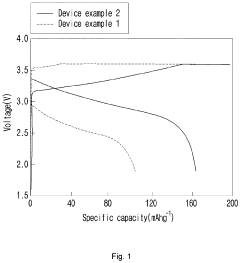
- A composite solid electrolyte is developed by uniformly mixing an oxide-based crystalline solid electrolyte with a sulfide-based amorphous solid electrolyte, using a garnet-type oxide-based electrolyte and an argyrodite-based sulfide-based electrolyte, which are mixed in specific weight ratios and processed using uniaxial pressing to enhance lithium ion conductivity and workability.
Lithium ion conductive composite solid electrolyte and solid-state battery using the same
PatentInactiveKR1020220107429A
Innovation
- A composite solid electrolyte is developed by uniformly mixing an oxide-based crystalline solid electrolyte and a sulfide-based amorphous solid electrolyte, with controlled particle sizes and ratios, allowing for room-temperature manufacturing and improved lithium ion conductivity.


Safety and Stability Assessment of Different Electrolyte Types
Safety assessment of solid electrolytes represents a critical dimension in the development of next-generation battery technologies. Oxide-based solid electrolytes generally demonstrate superior thermal stability compared to their sulfide counterparts, with many oxide materials remaining stable at temperatures exceeding 800°C. This characteristic significantly reduces thermal runaway risks in battery systems. Conversely, sulfide electrolytes typically begin to decompose at lower temperatures (300-400°C), potentially releasing toxic hydrogen sulfide gas during thermal events.
Chemical stability presents another crucial differentiating factor. Oxide electrolytes exhibit remarkable resistance to atmospheric conditions, allowing for processing in ambient environments. This contrasts sharply with sulfide electrolytes, which react readily with moisture in air to produce hydrogen sulfide, necessitating stringent handling protocols and specialized manufacturing environments such as dry rooms or glove boxes.
Electrochemical stability windows vary significantly between these electrolyte types. Many oxide electrolytes feature wider electrochemical windows (>4V), enabling compatibility with high-voltage cathode materials. Sulfide electrolytes typically demonstrate narrower stability windows (2-3V), often requiring protective interface layers when paired with high-voltage cathodes to prevent decomposition reactions.
Interface stability with electrode materials reveals additional distinctions. Oxide electrolytes generally form more stable interfaces with cathode materials but may develop high-resistance interfaces with lithium metal anodes. Sulfide electrolytes, while more reactive with cathodes, often establish lower-resistance interfaces with lithium metal, potentially supporting more efficient anode operations.
Long-term cycling stability data indicates that oxide electrolytes typically maintain performance over extended cycling periods, with minimal degradation in ionic conductivity. Sulfide systems frequently show more pronounced degradation patterns, particularly at elevated temperatures or when exposed to trace moisture during cell assembly.
Mechanical stability under operational conditions further distinguishes these materials. Oxide electrolytes exhibit brittle behavior with limited deformability, potentially leading to microcrack formation during cycling. Sulfide electrolytes demonstrate superior deformability and can accommodate volume changes more effectively, though this advantage may diminish over extended cycling periods as structural integrity gradually deteriorates.
Chemical stability presents another crucial differentiating factor. Oxide electrolytes exhibit remarkable resistance to atmospheric conditions, allowing for processing in ambient environments. This contrasts sharply with sulfide electrolytes, which react readily with moisture in air to produce hydrogen sulfide, necessitating stringent handling protocols and specialized manufacturing environments such as dry rooms or glove boxes.
Electrochemical stability windows vary significantly between these electrolyte types. Many oxide electrolytes feature wider electrochemical windows (>4V), enabling compatibility with high-voltage cathode materials. Sulfide electrolytes typically demonstrate narrower stability windows (2-3V), often requiring protective interface layers when paired with high-voltage cathodes to prevent decomposition reactions.
Interface stability with electrode materials reveals additional distinctions. Oxide electrolytes generally form more stable interfaces with cathode materials but may develop high-resistance interfaces with lithium metal anodes. Sulfide electrolytes, while more reactive with cathodes, often establish lower-resistance interfaces with lithium metal, potentially supporting more efficient anode operations.
Long-term cycling stability data indicates that oxide electrolytes typically maintain performance over extended cycling periods, with minimal degradation in ionic conductivity. Sulfide systems frequently show more pronounced degradation patterns, particularly at elevated temperatures or when exposed to trace moisture during cell assembly.
Mechanical stability under operational conditions further distinguishes these materials. Oxide electrolytes exhibit brittle behavior with limited deformability, potentially leading to microcrack formation during cycling. Sulfide electrolytes demonstrate superior deformability and can accommodate volume changes more effectively, though this advantage may diminish over extended cycling periods as structural integrity gradually deteriorates.
Manufacturing Scalability and Cost Considerations
The manufacturing scalability and cost considerations represent critical factors in the commercial viability of solid electrolytes for next-generation batteries. When comparing oxide and sulfide composite solid electrolytes, significant differences emerge in their production processes that directly impact large-scale implementation.
Oxide-based composite electrolytes typically require high-temperature sintering processes (often exceeding 1000°C), which necessitates specialized equipment and substantial energy consumption. These high-temperature requirements translate to higher production costs and energy expenditure. However, oxide materials benefit from established ceramic processing techniques that are already implemented in various industries, potentially allowing for adaptation of existing manufacturing infrastructure.
Sulfide-based systems, conversely, can be processed at significantly lower temperatures (often below 200°C), reducing energy costs and enabling more flexible manufacturing approaches. This temperature advantage translates to potential cost savings in production equipment and energy consumption. Additionally, sulfide electrolytes can often be prepared using simpler cold-pressing techniques that eliminate the need for complex sintering processes.
Raw material costs present another crucial consideration. Oxide-based systems typically utilize more abundant and less expensive precursor materials compared to sulfide counterparts. Many sulfide electrolytes require high-purity sulfur compounds and specialized handling due to their air and moisture sensitivity, increasing both material and processing costs.
The air-stability difference between these electrolyte types significantly impacts manufacturing complexity. Oxide electrolytes can generally be processed in ambient conditions, whereas sulfide systems demand strictly controlled atmospheres (typically inert gas environments) throughout the entire manufacturing process. This requirement for specialized handling facilities and equipment adds substantial capital and operational expenses to sulfide electrolyte production.
Scale-up challenges differ markedly between the two systems. Oxide electrolytes face challenges in achieving consistent densification and maintaining uniform ionic conductivity across large-area components. Sulfide systems, while easier to densify, encounter difficulties in maintaining homogeneity in composite structures and preventing degradation during manufacturing steps.
Recent cost analyses suggest that while sulfide electrolytes offer advantages in processing temperatures, their overall manufacturing costs remain higher due to material expenses and specialized handling requirements. However, as production volumes increase and manufacturing processes mature, the cost gap between these technologies is expected to narrow, with the ultimate commercial viability depending on performance metrics and specific application requirements.
Oxide-based composite electrolytes typically require high-temperature sintering processes (often exceeding 1000°C), which necessitates specialized equipment and substantial energy consumption. These high-temperature requirements translate to higher production costs and energy expenditure. However, oxide materials benefit from established ceramic processing techniques that are already implemented in various industries, potentially allowing for adaptation of existing manufacturing infrastructure.
Sulfide-based systems, conversely, can be processed at significantly lower temperatures (often below 200°C), reducing energy costs and enabling more flexible manufacturing approaches. This temperature advantage translates to potential cost savings in production equipment and energy consumption. Additionally, sulfide electrolytes can often be prepared using simpler cold-pressing techniques that eliminate the need for complex sintering processes.
Raw material costs present another crucial consideration. Oxide-based systems typically utilize more abundant and less expensive precursor materials compared to sulfide counterparts. Many sulfide electrolytes require high-purity sulfur compounds and specialized handling due to their air and moisture sensitivity, increasing both material and processing costs.
The air-stability difference between these electrolyte types significantly impacts manufacturing complexity. Oxide electrolytes can generally be processed in ambient conditions, whereas sulfide systems demand strictly controlled atmospheres (typically inert gas environments) throughout the entire manufacturing process. This requirement for specialized handling facilities and equipment adds substantial capital and operational expenses to sulfide electrolyte production.
Scale-up challenges differ markedly between the two systems. Oxide electrolytes face challenges in achieving consistent densification and maintaining uniform ionic conductivity across large-area components. Sulfide systems, while easier to densify, encounter difficulties in maintaining homogeneity in composite structures and preventing degradation during manufacturing steps.
Recent cost analyses suggest that while sulfide electrolytes offer advantages in processing temperatures, their overall manufacturing costs remain higher due to material expenses and specialized handling requirements. However, as production volumes increase and manufacturing processes mature, the cost gap between these technologies is expected to narrow, with the ultimate commercial viability depending on performance metrics and specific application requirements.
Unlock deeper insights with Patsnap Eureka Quick Research — get a full tech report to explore trends and direct your research. Try now!
Generate Your Research Report Instantly with AI Agent
Supercharge your innovation with Patsnap Eureka AI Agent Platform!