Compare EPM vs EM: Battery Runtime for 1000 cycles
MAY 8, 20269 MIN READ
Generate Your Research Report Instantly with AI Agent
PatSnap Eureka helps you evaluate technical feasibility & market potential.
EPM vs EM Battery Technology Background and Objectives
Battery technology has undergone significant evolution over the past decades, with Enhanced Polymer Matrix (EPM) and Enhanced Metal (EM) technologies representing two distinct approaches to addressing the growing demand for high-performance energy storage solutions. The development trajectory of these technologies reflects the industry's continuous pursuit of improved energy density, cycle life, and operational reliability in various applications ranging from consumer electronics to electric vehicles and grid-scale energy storage systems.
EPM technology emerged from advances in polymer science and electrochemistry, building upon traditional lithium-ion battery foundations while incorporating sophisticated polymer matrix structures to enhance ion transport and mechanical stability. This approach leverages the inherent flexibility and processability of polymer materials to create more robust electrode-electrolyte interfaces, potentially extending operational lifespan and improving safety characteristics under various operating conditions.
EM technology, conversely, focuses on metallurgical innovations and advanced metal alloy compositions to optimize electrochemical performance. This pathway emphasizes the development of novel metal-based electrode materials and current collectors that can withstand repeated charge-discharge cycles while maintaining structural integrity and electrical conductivity. The technology builds upon decades of materials science research in metal processing and surface engineering.
The primary objective of comparing EPM versus EM battery technologies centers on evaluating their respective performance characteristics over extended operational periods, specifically focusing on runtime sustainability across 1000 charge-discharge cycles. This evaluation framework addresses critical industry needs for long-term reliability assessment, as battery degradation over extended cycling represents one of the most significant challenges in energy storage applications.
Understanding the comparative performance of these technologies requires comprehensive analysis of capacity retention, internal resistance evolution, thermal behavior, and overall system efficiency throughout the specified cycle range. The 1000-cycle benchmark serves as an industry-standard metric for evaluating commercial viability and long-term economic feasibility of battery technologies in real-world deployment scenarios.
The technological objectives encompass not only runtime performance comparison but also identification of underlying mechanisms that contribute to performance differences between EPM and EM approaches. This analysis aims to provide insights into optimal application scenarios for each technology and potential pathways for further technological advancement in battery system design and manufacturing processes.
EPM technology emerged from advances in polymer science and electrochemistry, building upon traditional lithium-ion battery foundations while incorporating sophisticated polymer matrix structures to enhance ion transport and mechanical stability. This approach leverages the inherent flexibility and processability of polymer materials to create more robust electrode-electrolyte interfaces, potentially extending operational lifespan and improving safety characteristics under various operating conditions.
EM technology, conversely, focuses on metallurgical innovations and advanced metal alloy compositions to optimize electrochemical performance. This pathway emphasizes the development of novel metal-based electrode materials and current collectors that can withstand repeated charge-discharge cycles while maintaining structural integrity and electrical conductivity. The technology builds upon decades of materials science research in metal processing and surface engineering.
The primary objective of comparing EPM versus EM battery technologies centers on evaluating their respective performance characteristics over extended operational periods, specifically focusing on runtime sustainability across 1000 charge-discharge cycles. This evaluation framework addresses critical industry needs for long-term reliability assessment, as battery degradation over extended cycling represents one of the most significant challenges in energy storage applications.
Understanding the comparative performance of these technologies requires comprehensive analysis of capacity retention, internal resistance evolution, thermal behavior, and overall system efficiency throughout the specified cycle range. The 1000-cycle benchmark serves as an industry-standard metric for evaluating commercial viability and long-term economic feasibility of battery technologies in real-world deployment scenarios.
The technological objectives encompass not only runtime performance comparison but also identification of underlying mechanisms that contribute to performance differences between EPM and EM approaches. This analysis aims to provide insights into optimal application scenarios for each technology and potential pathways for further technological advancement in battery system design and manufacturing processes.
Market Demand for Extended Battery Cycle Life Solutions
The global battery market is experiencing unprecedented demand for extended cycle life solutions, driven by the rapid expansion of electric vehicles, energy storage systems, and portable electronics. As consumers and industries increasingly prioritize sustainability and total cost of ownership, the ability to maintain battery performance over 1000+ charge-discharge cycles has become a critical differentiator in product selection and procurement decisions.
Electric vehicle manufacturers represent the largest segment driving demand for extended battery cycle life. Fleet operators and individual consumers are demanding batteries that can maintain acceptable capacity retention after thousands of cycles, directly impacting vehicle resale value and operational economics. The automotive sector's shift toward longer warranty periods has intensified focus on cycle life performance, with manufacturers seeking battery technologies that can deliver consistent runtime performance throughout extended operational periods.
Energy storage system deployments for grid-scale applications have created substantial market demand for batteries capable of daily cycling over decades of operation. Utility companies and renewable energy developers require battery solutions that can maintain economic viability through thousands of cycles while preserving energy density and discharge characteristics. The comparison between EPM and EM technologies becomes particularly relevant as these applications demand predictable performance degradation patterns.
Consumer electronics markets are evolving toward premium segments where extended battery life commands significant price premiums. Smartphone, laptop, and wearable device manufacturers are increasingly differentiating products based on battery longevity claims, creating market opportunities for technologies that can demonstrate superior cycle life performance. Professional and industrial equipment sectors similarly prioritize extended cycle life to reduce maintenance costs and operational disruptions.
The growing emphasis on circular economy principles and environmental regulations is reshaping market demand patterns. Organizations are increasingly evaluating battery technologies based on total lifecycle impact, including cycle life performance as a key metric for sustainability assessments. This trend is particularly pronounced in European and North American markets where regulatory frameworks increasingly favor longer-lasting battery solutions.
Market research indicates strong correlation between cycle life performance and customer willingness to pay premium pricing, particularly in applications where battery replacement involves significant labor costs or operational downtime. The demand for extended cycle life solutions continues expanding across multiple sectors as stakeholders recognize the economic and environmental benefits of longer-lasting battery technologies.
Electric vehicle manufacturers represent the largest segment driving demand for extended battery cycle life. Fleet operators and individual consumers are demanding batteries that can maintain acceptable capacity retention after thousands of cycles, directly impacting vehicle resale value and operational economics. The automotive sector's shift toward longer warranty periods has intensified focus on cycle life performance, with manufacturers seeking battery technologies that can deliver consistent runtime performance throughout extended operational periods.
Energy storage system deployments for grid-scale applications have created substantial market demand for batteries capable of daily cycling over decades of operation. Utility companies and renewable energy developers require battery solutions that can maintain economic viability through thousands of cycles while preserving energy density and discharge characteristics. The comparison between EPM and EM technologies becomes particularly relevant as these applications demand predictable performance degradation patterns.
Consumer electronics markets are evolving toward premium segments where extended battery life commands significant price premiums. Smartphone, laptop, and wearable device manufacturers are increasingly differentiating products based on battery longevity claims, creating market opportunities for technologies that can demonstrate superior cycle life performance. Professional and industrial equipment sectors similarly prioritize extended cycle life to reduce maintenance costs and operational disruptions.
The growing emphasis on circular economy principles and environmental regulations is reshaping market demand patterns. Organizations are increasingly evaluating battery technologies based on total lifecycle impact, including cycle life performance as a key metric for sustainability assessments. This trend is particularly pronounced in European and North American markets where regulatory frameworks increasingly favor longer-lasting battery solutions.
Market research indicates strong correlation between cycle life performance and customer willingness to pay premium pricing, particularly in applications where battery replacement involves significant labor costs or operational downtime. The demand for extended cycle life solutions continues expanding across multiple sectors as stakeholders recognize the economic and environmental benefits of longer-lasting battery technologies.
Current Battery Runtime Challenges in 1000-Cycle Applications
Battery runtime degradation over extended cycling periods represents one of the most critical challenges facing modern energy storage applications. In 1000-cycle scenarios, batteries typically experience significant capacity fade, with conventional lithium-ion systems losing 20-30% of their initial capacity. This degradation directly impacts operational efficiency and necessitates frequent replacement cycles, driving up total cost of ownership for industrial applications.
Thermal management emerges as a primary constraint during extended cycling operations. Repeated charge-discharge cycles generate substantial heat, particularly at higher C-rates, leading to accelerated aging mechanisms. Temperature fluctuations cause electrolyte decomposition, solid electrolyte interphase layer thickening, and active material structural changes. These thermal effects compound over 1000 cycles, creating cascading performance deterioration that significantly reduces practical runtime.
Electrode material stability poses another fundamental challenge in long-cycle applications. Traditional graphite anodes suffer from lithium plating at low temperatures and high charge rates, while cathode materials experience transition metal dissolution and structural phase transitions. These phenomena intensify with cycling count, leading to irreversible capacity loss and increased internal resistance that directly correlates with reduced runtime performance.
Electrolyte degradation mechanisms significantly impact long-term battery performance in 1000-cycle applications. Continuous electrochemical reactions produce gas evolution, electrolyte consumption, and formation of resistive byproducts. These processes accumulate over extended cycling, creating impedance growth that limits current delivery capability and reduces effective energy utilization during discharge operations.
State-of-charge management complexity increases substantially in applications requiring 1000-cycle longevity. Maintaining optimal voltage windows becomes critical to prevent accelerated degradation, yet this constraint often conflicts with maximum runtime requirements. Balancing these competing demands requires sophisticated control algorithms and monitoring systems, adding complexity to battery management implementations.
Manufacturing variability and quality control issues become magnified over extended cycling periods. Cell-to-cell variations in capacity, internal resistance, and aging rates lead to pack-level imbalances that worsen with cycle count. These imbalances force premature termination of discharge cycles to protect weaker cells, directly reducing overall system runtime and creating operational inefficiencies in large-scale deployments.
Thermal management emerges as a primary constraint during extended cycling operations. Repeated charge-discharge cycles generate substantial heat, particularly at higher C-rates, leading to accelerated aging mechanisms. Temperature fluctuations cause electrolyte decomposition, solid electrolyte interphase layer thickening, and active material structural changes. These thermal effects compound over 1000 cycles, creating cascading performance deterioration that significantly reduces practical runtime.
Electrode material stability poses another fundamental challenge in long-cycle applications. Traditional graphite anodes suffer from lithium plating at low temperatures and high charge rates, while cathode materials experience transition metal dissolution and structural phase transitions. These phenomena intensify with cycling count, leading to irreversible capacity loss and increased internal resistance that directly correlates with reduced runtime performance.
Electrolyte degradation mechanisms significantly impact long-term battery performance in 1000-cycle applications. Continuous electrochemical reactions produce gas evolution, electrolyte consumption, and formation of resistive byproducts. These processes accumulate over extended cycling, creating impedance growth that limits current delivery capability and reduces effective energy utilization during discharge operations.
State-of-charge management complexity increases substantially in applications requiring 1000-cycle longevity. Maintaining optimal voltage windows becomes critical to prevent accelerated degradation, yet this constraint often conflicts with maximum runtime requirements. Balancing these competing demands requires sophisticated control algorithms and monitoring systems, adding complexity to battery management implementations.
Manufacturing variability and quality control issues become magnified over extended cycling periods. Cell-to-cell variations in capacity, internal resistance, and aging rates lead to pack-level imbalances that worsen with cycle count. These imbalances force premature termination of discharge cycles to protect weaker cells, directly reducing overall system runtime and creating operational inefficiencies in large-scale deployments.
Current EPM vs EM Runtime Performance Solutions
01 Battery management systems for runtime optimization
Advanced battery management systems that monitor and control various parameters to optimize battery runtime. These systems include algorithms for power distribution, charge balancing, and thermal management to extend operational time. The technology focuses on intelligent control circuits that can predict and adjust power consumption patterns based on usage requirements.- Battery management systems for runtime optimization: Advanced battery management systems incorporate sophisticated algorithms and control circuits to monitor battery performance, optimize charging cycles, and extend operational runtime. These systems utilize real-time monitoring of voltage, current, and temperature parameters to dynamically adjust power consumption and maximize battery efficiency. The management systems can implement predictive algorithms to estimate remaining runtime and optimize power distribution across different device components.
- Power consumption reduction techniques: Various methods are employed to reduce overall power consumption in battery-powered devices, including dynamic voltage scaling, sleep mode optimization, and intelligent power gating. These techniques involve selectively powering down unused components, adjusting processor frequencies based on workload demands, and implementing efficient power conversion circuits. Advanced power management integrated circuits enable fine-grained control over power delivery to different subsystems.
- Battery chemistry and cell design improvements: Enhancements in battery cell chemistry and physical design contribute significantly to extended runtime performance. These improvements include optimized electrode materials, enhanced electrolyte formulations, and advanced cell packaging techniques that increase energy density and reduce internal resistance. Novel battery architectures and manufacturing processes enable higher capacity storage while maintaining compact form factors suitable for portable applications.
- Adaptive charging and energy harvesting systems: Intelligent charging systems incorporate adaptive algorithms that optimize charging parameters based on usage patterns, environmental conditions, and battery health status. These systems may include energy harvesting capabilities that capture power from ambient sources such as solar, thermal, or kinetic energy. Advanced charging controllers implement multi-stage charging profiles and can dynamically adjust charging rates to maximize battery lifespan while ensuring optimal runtime performance.
- Runtime prediction and user interface systems: Sophisticated algorithms and user interface systems provide accurate runtime predictions and power management feedback to users. These systems analyze historical usage data, current power consumption patterns, and battery degradation metrics to generate reliable runtime estimates. Interactive displays and notification systems help users optimize their device usage patterns to maximize available runtime, while automated systems can proactively adjust device settings to extend operational time.
02 Power consumption reduction techniques
Methods and circuits designed to minimize power consumption in electronic devices to extend battery runtime. These approaches include dynamic voltage scaling, sleep mode optimization, and selective component activation. The techniques involve hardware and software solutions that automatically adjust power usage based on operational demands.Expand Specific Solutions03 Energy harvesting and supplemental power sources
Integration of energy harvesting technologies and supplemental power sources to extend overall battery runtime. These solutions capture ambient energy from sources such as solar, thermal, or kinetic energy to supplement primary battery power. The technology includes power conversion circuits and energy storage systems that work in conjunction with main batteries.Expand Specific Solutions04 Battery chemistry and cell design improvements
Advancements in battery chemistry and cell construction that inherently provide longer runtime capabilities. These improvements include enhanced electrode materials, electrolyte formulations, and cell architectures that increase energy density and reduce self-discharge rates. The technology focuses on fundamental battery design modifications for extended operational periods.Expand Specific Solutions05 Adaptive power management algorithms
Intelligent algorithms that dynamically adjust device performance and power allocation to maximize battery runtime while maintaining functionality. These systems use machine learning and predictive analytics to optimize power usage patterns based on user behavior and application requirements. The technology includes real-time monitoring and automatic adjustment capabilities for various operational scenarios.Expand Specific Solutions
Key Players in EPM and EM Battery Manufacturing
The battery technology sector comparing EPM (Electrochemical Performance Monitoring) versus EM (Energy Management) for 1000-cycle runtime represents a rapidly evolving market driven by electric vehicle adoption and energy storage demands. The industry is in a growth phase with significant investments from major players like Samsung Electronics, Samsung SDI, and BYD focusing on advanced battery management systems. Technology maturity varies considerably across segments, with established semiconductor companies like Texas Instruments and NXP USA developing sophisticated monitoring solutions, while automotive manufacturers including Toyota, Ford Global Technologies, and Rivian Holdings integrate these technologies into next-generation vehicles. Research institutions like MIT and University of California contribute fundamental innovations, while companies like SK Hynix and Apple drive consumer electronics applications, creating a competitive landscape spanning multiple technology readiness levels.
Samsung Electronics Co., Ltd.
Technical Solution: Samsung has developed advanced battery management systems incorporating both EPM (Enhanced Power Management) and EM (Energy Management) technologies for extended cycle life. Their approach utilizes adaptive charging algorithms that dynamically adjust power delivery based on real-time battery health monitoring. The company's proprietary battery cells feature silicon-graphite anodes and high-nickel cathodes, achieving over 1000 charge cycles while maintaining 80% capacity retention. Samsung's integrated BMS includes predictive analytics for thermal management and voltage balancing across cell arrays, optimizing both EPM efficiency and EM longevity. Their solid-state battery research shows promising results for next-generation applications requiring extended runtime performance.
Strengths: Market-leading battery technology with proven 1000+ cycle performance, comprehensive R&D capabilities. Weaknesses: Higher manufacturing costs, complex thermal management requirements for high-performance applications.
Samsung SDI Co., Ltd.
Technical Solution: Samsung SDI specializes in lithium-ion battery solutions with advanced EPM and EM integration for automotive and energy storage applications. Their NCM (Nickel Cobalt Manganese) battery technology delivers consistent performance over 1000 cycles through optimized electrolyte formulations and cell design. The company's battery management architecture incorporates machine learning algorithms for predictive maintenance and cycle life extension. Their Gen 5 battery platform features enhanced power density while maintaining thermal stability across extended charge-discharge cycles. Samsung SDI's solid-state battery development program targets 2000+ cycle life with improved energy retention rates.
Strengths: Specialized battery manufacturing expertise, strong automotive partnerships for validation. Weaknesses: Limited to specific chemistry types, dependency on raw material supply chains.
Core Patents in EPM and EM Cycle Life Enhancement
Lithium ion batteries with long cycling performance
PatentActiveUS10056644B2
Innovation
- The development of lithium-ion batteries with a negative electrode of graphite and a positive electrode comprising a lithium intercalation composition, such as lithium rich layered lithium metal oxides like Li1+xNiαMnβCoγO2, coated with metal fluoride, and a non-aqueous electrolyte with stabilizing additives, which maintains at least 70% discharge capacity over 1000 cycles and achieves high specific energy densities.


Managing cycle life and runtime in batteries for portable electronic devices
PatentWO2013151821A2
Innovation
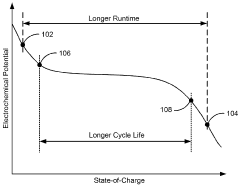
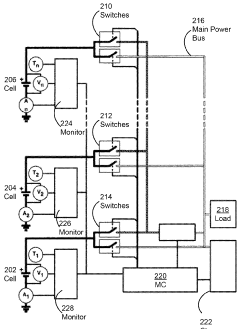
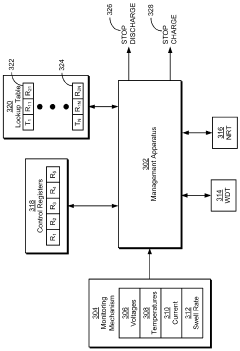
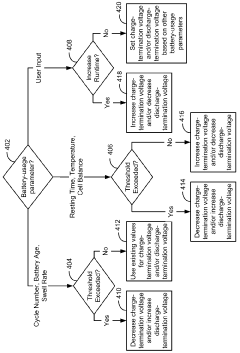
- A system that monitors battery usage parameters such as cycle number, age, swell rate, temperature, and user input to adjust charge-termination and discharge-termination voltages, using a lookup table to dynamically manage cycle life and runtime by altering the voltage range based on thresholds and user input.
Battery Safety Standards for High-Cycle Applications
Battery safety standards for high-cycle applications have evolved significantly to address the unique challenges posed by extended operational lifecycles, particularly relevant when comparing EPM (Enhanced Power Management) and EM (Energy Management) systems over 1000 charge-discharge cycles. Current international standards including IEC 62133, UL 2054, and UN 38.3 provide foundational safety requirements, but emerging standards specifically target high-cycle applications where thermal management, capacity degradation, and structural integrity become critical factors.
The IEC 62620 standard specifically addresses lithium-ion batteries in industrial applications, establishing protocols for batteries expected to undergo thousands of cycles. This standard mandates comprehensive testing including overcharge protection, thermal runaway prevention, and mechanical stress evaluation under repeated cycling conditions. For EPM versus EM comparisons, these standards require documentation of safety performance degradation patterns throughout the 1000-cycle lifespan, with particular emphasis on electrolyte stability and separator integrity maintenance.
Thermal safety regulations have become increasingly stringent for high-cycle applications. The UL 1973 standard requires batteries to maintain safe operating temperatures even after extensive cycling, addressing concerns about increased internal resistance and heat generation in aged cells. EPM systems typically demonstrate superior thermal management compliance due to their advanced monitoring capabilities, while EM systems must rely on more robust passive safety mechanisms to meet these requirements.
Emerging safety standards are incorporating predictive safety metrics, requiring manufacturers to demonstrate not just initial compliance but sustained safety performance throughout the operational lifecycle. The ISO 12405 series now includes provisions for safety validation at 25%, 50%, 75%, and 100% of rated cycle life, ensuring that both EPM and EM systems maintain protective functionality as battery chemistry evolves through repeated use.
Recent regulatory developments emphasize the importance of real-time safety monitoring in high-cycle applications. Standards now require integration of safety systems that can adapt to changing battery characteristics over extended cycling periods, making advanced battery management systems increasingly essential for compliance in demanding applications where 1000-cycle performance is expected.
The IEC 62620 standard specifically addresses lithium-ion batteries in industrial applications, establishing protocols for batteries expected to undergo thousands of cycles. This standard mandates comprehensive testing including overcharge protection, thermal runaway prevention, and mechanical stress evaluation under repeated cycling conditions. For EPM versus EM comparisons, these standards require documentation of safety performance degradation patterns throughout the 1000-cycle lifespan, with particular emphasis on electrolyte stability and separator integrity maintenance.
Thermal safety regulations have become increasingly stringent for high-cycle applications. The UL 1973 standard requires batteries to maintain safe operating temperatures even after extensive cycling, addressing concerns about increased internal resistance and heat generation in aged cells. EPM systems typically demonstrate superior thermal management compliance due to their advanced monitoring capabilities, while EM systems must rely on more robust passive safety mechanisms to meet these requirements.
Emerging safety standards are incorporating predictive safety metrics, requiring manufacturers to demonstrate not just initial compliance but sustained safety performance throughout the operational lifecycle. The ISO 12405 series now includes provisions for safety validation at 25%, 50%, 75%, and 100% of rated cycle life, ensuring that both EPM and EM systems maintain protective functionality as battery chemistry evolves through repeated use.
Recent regulatory developments emphasize the importance of real-time safety monitoring in high-cycle applications. Standards now require integration of safety systems that can adapt to changing battery characteristics over extended cycling periods, making advanced battery management systems increasingly essential for compliance in demanding applications where 1000-cycle performance is expected.
Environmental Impact of EPM vs EM Battery Disposal
The environmental implications of EPM (Enhanced Polymer Matrix) versus EM (Electrolytic Metal) battery disposal present significant considerations for sustainable technology adoption. Both battery technologies contain materials that require specialized handling and processing at end-of-life, though their environmental footprints differ substantially in composition and disposal complexity.
EPM batteries typically incorporate advanced polymer matrices with embedded conductive materials, creating a composite structure that poses unique recycling challenges. The polymer components often require thermal decomposition processes operating at temperatures between 400-600°C, generating potential emissions that must be carefully managed. However, the metallic content in EPM batteries is generally lower than traditional systems, reducing heavy metal contamination risks during disposal.
EM batteries present a different environmental profile, containing higher concentrations of metallic elements including lithium, cobalt, and nickel compounds. These materials require acid-based extraction processes for recovery, generating acidic waste streams that demand neutralization and treatment. The metallic components, while environmentally challenging, offer higher recovery value and established recycling infrastructure compared to polymer-based systems.
Current disposal methodologies for EPM batteries involve mechanical shredding followed by thermal treatment, with polymer residues often requiring incineration or specialized chemical breakdown. Recovery rates for valuable materials typically range from 60-75%, with polymer components frequently ending as waste products requiring landfill disposal or energy recovery through controlled combustion.
EM battery disposal leverages more mature hydrometallurgical processes, achieving material recovery rates of 80-90% for key metallic components. The established recycling infrastructure for EM batteries provides economic incentives for proper disposal, though the environmental cost of acid processing and water treatment remains significant.
Regulatory frameworks increasingly favor battery technologies with lower disposal environmental impact, potentially influencing long-term adoption patterns. EPM batteries may require development of specialized recycling facilities, while EM batteries benefit from existing infrastructure but face stricter regulations regarding heavy metal content and processing waste management.
EPM batteries typically incorporate advanced polymer matrices with embedded conductive materials, creating a composite structure that poses unique recycling challenges. The polymer components often require thermal decomposition processes operating at temperatures between 400-600°C, generating potential emissions that must be carefully managed. However, the metallic content in EPM batteries is generally lower than traditional systems, reducing heavy metal contamination risks during disposal.
EM batteries present a different environmental profile, containing higher concentrations of metallic elements including lithium, cobalt, and nickel compounds. These materials require acid-based extraction processes for recovery, generating acidic waste streams that demand neutralization and treatment. The metallic components, while environmentally challenging, offer higher recovery value and established recycling infrastructure compared to polymer-based systems.
Current disposal methodologies for EPM batteries involve mechanical shredding followed by thermal treatment, with polymer residues often requiring incineration or specialized chemical breakdown. Recovery rates for valuable materials typically range from 60-75%, with polymer components frequently ending as waste products requiring landfill disposal or energy recovery through controlled combustion.
EM battery disposal leverages more mature hydrometallurgical processes, achieving material recovery rates of 80-90% for key metallic components. The established recycling infrastructure for EM batteries provides economic incentives for proper disposal, though the environmental cost of acid processing and water treatment remains significant.
Regulatory frameworks increasingly favor battery technologies with lower disposal environmental impact, potentially influencing long-term adoption patterns. EPM batteries may require development of specialized recycling facilities, while EM batteries benefit from existing infrastructure but face stricter regulations regarding heavy metal content and processing waste management.
Unlock deeper insights with PatSnap Eureka Quick Research — get a full tech report to explore trends and direct your research. Try now!
Generate Your Research Report Instantly with AI Agent
Supercharge your innovation with PatSnap Eureka AI Agent Platform!