

Comparing PCIe vs CXL in Disaggregated Memory Applications
MAY 12, 20269 MIN READ
Generate Your Research Report Instantly with AI Agent
PatSnap Eureka helps you evaluate technical feasibility & market potential.
PCIe vs CXL Memory Disaggregation Background and Objectives
The evolution of data center architectures has been fundamentally driven by the exponential growth in computational demands and the need for more efficient resource utilization. Traditional server designs, where memory, storage, and compute resources are tightly coupled within individual nodes, have increasingly shown limitations in terms of scalability, cost-effectiveness, and resource optimization. This has led to the emergence of disaggregated memory architectures as a transformative approach to data center design.
Memory disaggregation represents a paradigm shift from conventional server architectures by decoupling memory resources from compute nodes, enabling them to be pooled, shared, and dynamically allocated across multiple processors. This architectural approach addresses critical challenges including memory stranding, where unused memory in one server cannot be utilized by memory-constrained applications running on other servers, and the inefficient scaling of resources that occurs when memory and compute requirements grow at different rates.
The interconnect technology serving as the foundation for memory disaggregation has become a critical determinant of system performance, latency characteristics, and overall feasibility. PCIe has long been the dominant standard for high-speed peripheral connections in server environments, providing reliable connectivity for storage devices, network adapters, and accelerators. However, the emergence of CXL represents a significant technological advancement specifically designed to address the unique requirements of memory-centric workloads and cache-coherent communications.
The primary objective of comparing PCIe and CXL in disaggregated memory applications centers on evaluating their respective capabilities in enabling efficient, low-latency access to remote memory resources. Key performance metrics include memory access latency, bandwidth utilization, cache coherency mechanisms, and the ability to maintain transparent memory semantics across distributed memory pools. Additionally, the comparison aims to assess the scalability potential of each technology in supporting large-scale memory disaggregation deployments.
Understanding the technical trade-offs between these interconnect technologies is essential for determining optimal deployment strategies in next-generation data center architectures. The evaluation encompasses not only raw performance characteristics but also considerations of ecosystem maturity, hardware compatibility, software stack requirements, and long-term technological roadmaps that will influence the adoption and success of disaggregated memory solutions.
Memory disaggregation represents a paradigm shift from conventional server architectures by decoupling memory resources from compute nodes, enabling them to be pooled, shared, and dynamically allocated across multiple processors. This architectural approach addresses critical challenges including memory stranding, where unused memory in one server cannot be utilized by memory-constrained applications running on other servers, and the inefficient scaling of resources that occurs when memory and compute requirements grow at different rates.
The interconnect technology serving as the foundation for memory disaggregation has become a critical determinant of system performance, latency characteristics, and overall feasibility. PCIe has long been the dominant standard for high-speed peripheral connections in server environments, providing reliable connectivity for storage devices, network adapters, and accelerators. However, the emergence of CXL represents a significant technological advancement specifically designed to address the unique requirements of memory-centric workloads and cache-coherent communications.
The primary objective of comparing PCIe and CXL in disaggregated memory applications centers on evaluating their respective capabilities in enabling efficient, low-latency access to remote memory resources. Key performance metrics include memory access latency, bandwidth utilization, cache coherency mechanisms, and the ability to maintain transparent memory semantics across distributed memory pools. Additionally, the comparison aims to assess the scalability potential of each technology in supporting large-scale memory disaggregation deployments.
Understanding the technical trade-offs between these interconnect technologies is essential for determining optimal deployment strategies in next-generation data center architectures. The evaluation encompasses not only raw performance characteristics but also considerations of ecosystem maturity, hardware compatibility, software stack requirements, and long-term technological roadmaps that will influence the adoption and success of disaggregated memory solutions.
Market Demand for Disaggregated Memory Solutions
The global data center infrastructure market is experiencing unprecedented growth driven by the exponential increase in data generation, cloud computing adoption, and artificial intelligence workloads. Traditional server architectures are reaching their limits in terms of resource utilization efficiency, creating a compelling market opportunity for disaggregated memory solutions. Organizations are increasingly seeking ways to optimize memory allocation across distributed computing environments while reducing total cost of ownership.
Enterprise data centers face significant challenges with memory stranding, where compute resources become idle due to memory constraints or vice versa. This inefficiency drives substantial capital expenditure waste, as organizations must over-provision resources to handle peak workloads. Disaggregated memory architectures address this fundamental problem by decoupling memory resources from compute nodes, enabling dynamic allocation based on real-time demand patterns.
Cloud service providers represent the primary market segment driving demand for disaggregated memory solutions. These organizations operate at massive scale and require flexible resource allocation to serve diverse customer workloads efficiently. The ability to pool memory resources across multiple compute nodes directly translates to improved resource utilization rates and reduced infrastructure costs. Major cloud providers are actively investing in disaggregated architectures to maintain competitive advantages in pricing and service delivery.
High-performance computing applications, particularly in artificial intelligence and machine learning domains, generate substantial demand for memory-intensive workloads. These applications often require large memory footprints that exceed the capacity of traditional server configurations. Disaggregated memory solutions enable organizations to scale memory resources independently of compute capacity, supporting larger datasets and more complex analytical workloads without requiring complete system replacements.
The telecommunications industry presents another significant market opportunity as network functions virtualization and edge computing deployments require flexible resource allocation. Telecom operators need to optimize infrastructure utilization across geographically distributed locations while maintaining low latency requirements. Disaggregated memory architectures provide the flexibility to allocate resources dynamically based on network traffic patterns and service demands.
Financial services organizations increasingly recognize the value proposition of disaggregated memory for real-time analytics and risk management applications. These workloads require rapid access to large datasets and benefit from the improved memory bandwidth and reduced latency that modern disaggregated architectures can provide. The ability to scale memory resources independently supports growing data volumes without proportional increases in compute infrastructure.
Enterprise data centers face significant challenges with memory stranding, where compute resources become idle due to memory constraints or vice versa. This inefficiency drives substantial capital expenditure waste, as organizations must over-provision resources to handle peak workloads. Disaggregated memory architectures address this fundamental problem by decoupling memory resources from compute nodes, enabling dynamic allocation based on real-time demand patterns.
Cloud service providers represent the primary market segment driving demand for disaggregated memory solutions. These organizations operate at massive scale and require flexible resource allocation to serve diverse customer workloads efficiently. The ability to pool memory resources across multiple compute nodes directly translates to improved resource utilization rates and reduced infrastructure costs. Major cloud providers are actively investing in disaggregated architectures to maintain competitive advantages in pricing and service delivery.
High-performance computing applications, particularly in artificial intelligence and machine learning domains, generate substantial demand for memory-intensive workloads. These applications often require large memory footprints that exceed the capacity of traditional server configurations. Disaggregated memory solutions enable organizations to scale memory resources independently of compute capacity, supporting larger datasets and more complex analytical workloads without requiring complete system replacements.
The telecommunications industry presents another significant market opportunity as network functions virtualization and edge computing deployments require flexible resource allocation. Telecom operators need to optimize infrastructure utilization across geographically distributed locations while maintaining low latency requirements. Disaggregated memory architectures provide the flexibility to allocate resources dynamically based on network traffic patterns and service demands.
Financial services organizations increasingly recognize the value proposition of disaggregated memory for real-time analytics and risk management applications. These workloads require rapid access to large datasets and benefit from the improved memory bandwidth and reduced latency that modern disaggregated architectures can provide. The ability to scale memory resources independently supports growing data volumes without proportional increases in compute infrastructure.
Current State and Challenges of Memory Disaggregation
Memory disaggregation represents a paradigm shift in data center architecture, where memory resources are decoupled from compute nodes and managed as a shared pool accessible across the network. This approach addresses the growing mismatch between compute and memory requirements in modern workloads, enabling more efficient resource utilization and dynamic allocation based on application demands.
Current implementations of disaggregated memory primarily rely on two interconnect technologies: PCIe and CXL (Compute Express Link). PCIe-based solutions leverage existing infrastructure and mature ecosystems, utilizing technologies like NVMe-oF (NVMe over Fabrics) to access remote memory pools. These implementations typically achieve memory access latencies in the range of 5-15 microseconds, which is significantly higher than local DRAM access but acceptable for certain workloads.
CXL has emerged as a more promising solution for memory disaggregation, offering cache-coherent memory semantics and lower latency compared to PCIe-based approaches. CXL.mem protocol enables direct memory mapping and maintains coherency across the fabric, achieving sub-microsecond latencies in optimal configurations. However, CXL adoption faces challenges related to ecosystem maturity and limited vendor support.
The primary technical challenge in memory disaggregation lies in managing the latency penalty associated with remote memory access. While local DRAM access typically occurs within 100-200 nanoseconds, disaggregated memory introduces additional network traversal and protocol overhead. This latency increase can significantly impact performance-sensitive applications, particularly those with irregular memory access patterns.
Another significant challenge involves maintaining memory coherency and consistency across distributed nodes. Traditional cache coherency protocols designed for single-node systems become complex when extended to disaggregated environments. Both PCIe and CXL approaches must address coherency management, though CXL provides native support for cache-coherent operations.
Scalability represents a critical concern as current disaggregated memory solutions face bandwidth limitations and increased complexity with growing cluster sizes. The fabric infrastructure must support high aggregate bandwidth while maintaining low latency characteristics. Additionally, fault tolerance and reliability mechanisms become more complex when memory resources are distributed across multiple physical nodes.
Software stack integration poses another substantial challenge, as existing operating systems and memory management subsystems require modifications to effectively utilize disaggregated memory pools. Applications must be redesigned or adapted to account for non-uniform memory access patterns and varying latency characteristics across different memory tiers.
Current implementations of disaggregated memory primarily rely on two interconnect technologies: PCIe and CXL (Compute Express Link). PCIe-based solutions leverage existing infrastructure and mature ecosystems, utilizing technologies like NVMe-oF (NVMe over Fabrics) to access remote memory pools. These implementations typically achieve memory access latencies in the range of 5-15 microseconds, which is significantly higher than local DRAM access but acceptable for certain workloads.
CXL has emerged as a more promising solution for memory disaggregation, offering cache-coherent memory semantics and lower latency compared to PCIe-based approaches. CXL.mem protocol enables direct memory mapping and maintains coherency across the fabric, achieving sub-microsecond latencies in optimal configurations. However, CXL adoption faces challenges related to ecosystem maturity and limited vendor support.
The primary technical challenge in memory disaggregation lies in managing the latency penalty associated with remote memory access. While local DRAM access typically occurs within 100-200 nanoseconds, disaggregated memory introduces additional network traversal and protocol overhead. This latency increase can significantly impact performance-sensitive applications, particularly those with irregular memory access patterns.
Another significant challenge involves maintaining memory coherency and consistency across distributed nodes. Traditional cache coherency protocols designed for single-node systems become complex when extended to disaggregated environments. Both PCIe and CXL approaches must address coherency management, though CXL provides native support for cache-coherent operations.
Scalability represents a critical concern as current disaggregated memory solutions face bandwidth limitations and increased complexity with growing cluster sizes. The fabric infrastructure must support high aggregate bandwidth while maintaining low latency characteristics. Additionally, fault tolerance and reliability mechanisms become more complex when memory resources are distributed across multiple physical nodes.
Software stack integration poses another substantial challenge, as existing operating systems and memory management subsystems require modifications to effectively utilize disaggregated memory pools. Applications must be redesigned or adapted to account for non-uniform memory access patterns and varying latency characteristics across different memory tiers.
Existing PCIe and CXL Memory Disaggregation Solutions
01 PCIe and CXL interface integration and compatibility
Technologies for integrating PCIe and CXL interfaces to ensure compatibility and seamless communication between different protocol standards. This includes methods for protocol conversion, interface bridging, and maintaining backward compatibility while enabling advanced features of both standards.- PCIe and CXL interface integration and compatibility: Technologies for integrating PCIe and CXL interfaces to ensure compatibility and seamless communication between different protocol standards. This includes methods for protocol conversion, interface bridging, and maintaining backward compatibility while enabling advanced features of both standards.
- Memory expansion and management using CXL over PCIe infrastructure: Systems and methods for expanding memory capacity and improving memory management by utilizing CXL protocol over existing PCIe infrastructure. This enables dynamic memory allocation, memory pooling, and enhanced memory bandwidth while leveraging the established PCIe ecosystem.
- Data processing and acceleration with PCIe-CXL hybrid architectures: Architectures that combine PCIe and CXL capabilities for enhanced data processing and hardware acceleration. These solutions optimize data flow, reduce latency, and improve overall system performance by leveraging the strengths of both protocols in computing environments.
- Switch and controller designs for PCIe-CXL interconnects: Hardware designs for switches, controllers, and interconnect devices that support both PCIe and CXL protocols. These designs include routing mechanisms, traffic management, and protocol handling to enable efficient communication in multi-protocol environments.
- Power management and thermal optimization in PCIe-CXL systems: Power management techniques and thermal optimization strategies specifically designed for systems utilizing both PCIe and CXL technologies. These approaches focus on energy efficiency, heat dissipation, and performance scaling while maintaining system reliability and stability.
02 Memory expansion and management using CXL over PCIe infrastructure
Systems and methods for expanding memory capacity and improving memory management by utilizing CXL protocol over existing PCIe infrastructure. This enables dynamic memory allocation, memory pooling, and enhanced memory bandwidth while leveraging the established PCIe ecosystem.Expand Specific Solutions03 Data center and server architecture optimization
Architectural improvements for data centers and server systems that leverage both PCIe and CXL technologies to optimize performance, scalability, and resource utilization. This includes rack-scale architectures, disaggregated computing models, and enhanced interconnect topologies.Expand Specific Solutions04 Cache coherency and memory coherence protocols
Advanced cache coherency mechanisms and memory coherence protocols that enable efficient data sharing and consistency across PCIe and CXL connected devices. This includes coherent memory access, cache line management, and maintaining data integrity in distributed memory systems.Expand Specific Solutions05 High-speed interconnect switching and routing
Switching and routing technologies for high-speed interconnects that support both PCIe and CXL protocols. This encompasses intelligent packet routing, bandwidth management, quality of service mechanisms, and multi-protocol switching capabilities for complex system topologies.Expand Specific Solutions
Key Players in CXL and PCIe Memory Ecosystem
The disaggregated memory market comparing PCIe versus CXL technologies is in a transitional phase, with the industry moving from PCIe-dominated architectures toward CXL-enabled solutions. The market shows significant growth potential driven by AI and cloud computing demands, with established memory giants like Intel, Samsung Electronics, Micron Technology, and SK hynix leading traditional approaches. Technology maturity varies considerably - while PCIe represents mature, widely-deployed infrastructure, CXL adoption is accelerating through specialized companies like Unifabrix and Enfabrica developing advanced memory fabric solutions. Chinese players including Inspur, xFusion, and research institutions like Peking University are actively developing competitive technologies. The ecosystem spans from semiconductor manufacturers to system integrators, indicating a dynamic competitive landscape where CXL's superior memory pooling and bandwidth capabilities are gradually displacing PCIe limitations in high-performance computing environments.
Intel Corp.
Technical Solution: Intel has been a pioneer in CXL technology development, offering comprehensive solutions that include CXL-enabled processors and memory controllers. Their approach focuses on cache-coherent memory expansion using CXL.mem protocol, enabling seamless integration of disaggregated memory pools with existing CPU architectures. Intel's CXL implementation provides superior memory coherency and lower latency compared to traditional PCIe-based solutions, with CXL 2.0 supporting up to 32GT/s bandwidth. Their technology enables dynamic memory pooling and sharing across multiple compute nodes, significantly improving resource utilization in data center environments. Intel also provides software stack optimizations and memory management tools specifically designed for CXL-based disaggregated memory systems.
Strengths: Industry leadership in CXL standardization, comprehensive ecosystem support, excellent cache coherency. Weaknesses: Higher implementation complexity, limited backward compatibility with legacy systems.
Micron Technology, Inc.
Technical Solution: Micron has developed comprehensive memory solutions for disaggregated architectures, focusing on CXL-enabled memory modules and controllers. Their technology stack includes both DRAM and emerging memory technologies optimized for CXL.mem protocol implementation. Micron's approach emphasizes memory pooling efficiency and dynamic allocation capabilities, enabling multiple compute nodes to share large memory pools transparently. They offer advanced memory management features including quality of service controls, bandwidth allocation, and fault tolerance mechanisms. Micron's CXL solutions provide superior memory access patterns optimization compared to PCIe-based alternatives, with intelligent prefetching and data placement algorithms. Their technology supports both near-memory and far-memory configurations, enabling flexible memory hierarchy designs in modern data center environments.
Strengths: Strong memory technology foundation, excellent reliability and endurance, competitive pricing. Weaknesses: Limited processor integration compared to Intel, smaller ecosystem presence.
Core Technical Innovations in CXL Memory Protocols
Memory encryption engine interface in compute express link (CXL) attached memory controllers
PatentActiveUS20210311643A1
Innovation
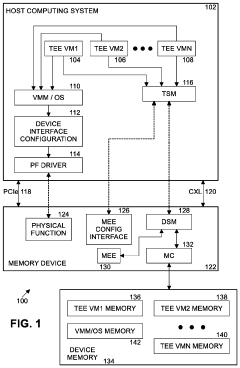
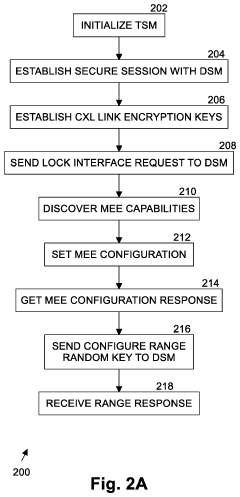
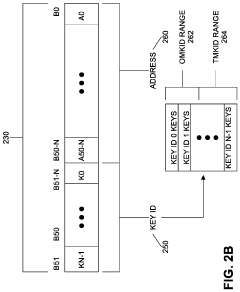
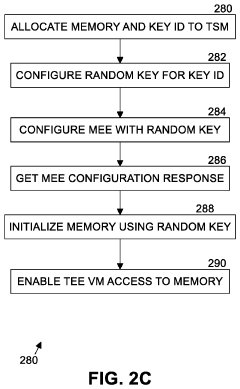
- The implementation of a memory encryption engine (MEE) with a memory mapped I/O-based configuration and capability enumeration interface supports memory encryption and integrity for CXL devices, using cryptographic ciphers like AES-XTS and message authentication codes to ensure confidentiality and integrity, and a device security manager to lock down memory device configurations and verify their security.
Memory disaggregation method,and computing system implementing the method
PatentPendingKR1020240007533A
Innovation
- Utilizes CXL (Compute Express Link) network for memory disaggregation, enabling direct memory access between host server and remote memory devices with lower latency compared to traditional PCIe-based solutions.
- Enables transparent memory resource pooling where computing devices can access disaggregated memory resources through standardized CXL packets without requiring application-level modifications.
- Provides scalable memory expansion capability by allowing host servers to dynamically access memory resources from multiple memory devices through the CXL network infrastructure.


Industry Standards and Compatibility Requirements
The standardization landscape for disaggregated memory applications presents distinct pathways for PCIe and CXL technologies, each governed by different industry bodies and compatibility frameworks. PCIe operates under the PCI-SIG consortium, which has established a mature standardization process spanning over two decades. The current PCIe 6.0 specification provides comprehensive guidelines for implementation, ensuring broad vendor compatibility and interoperability across diverse hardware platforms.
CXL represents a newer standardization effort led by the CXL Consortium, founded by Intel and supported by major industry players including AMD, ARM, Google, and Microsoft. The consortium has rapidly evolved the specification from CXL 1.0 to CXL 3.0, demonstrating accelerated development cycles compared to traditional PCIe evolution. This rapid progression reflects the urgent industry need for coherent memory access protocols in modern computing architectures.
Compatibility requirements differ significantly between the two technologies. PCIe maintains backward compatibility across generations, allowing PCIe 5.0 devices to operate in PCIe 4.0 slots with reduced performance. This compatibility model ensures smooth technology transitions and protects existing infrastructure investments. However, this approach may limit the adoption of advanced features specific to newer generations.
CXL compatibility follows a more complex model due to its multi-protocol nature. CXL.io maintains PCIe compatibility for basic I/O operations, while CXL.cache and CXL.mem protocols require specific host processor support and memory controller integration. This creates a tiered compatibility structure where basic functionality remains accessible, but advanced coherent memory features require comprehensive ecosystem support.
Industry adoption patterns reveal different standardization challenges. PCIe benefits from established ecosystem maturity, with extensive validation tools, compliance testing procedures, and certified component availability. Major server manufacturers have integrated PCIe-based memory expansion solutions with proven reliability and performance characteristics.
CXL standardization faces the challenge of coordinating across multiple technology domains, including processor architectures, memory controllers, and system firmware. The consortium has established rigorous compliance testing programs and reference implementations to accelerate ecosystem development. However, the technology requires closer coordination between CPU vendors, memory manufacturers, and system integrators to achieve full compatibility.
The regulatory and certification landscape also differs between technologies. PCIe compliance testing follows established procedures with multiple certified testing laboratories worldwide. CXL compliance requires new testing methodologies that address coherency protocols and memory semantics, necessitating specialized testing equipment and expertise that is still developing across the industry ecosystem.
CXL represents a newer standardization effort led by the CXL Consortium, founded by Intel and supported by major industry players including AMD, ARM, Google, and Microsoft. The consortium has rapidly evolved the specification from CXL 1.0 to CXL 3.0, demonstrating accelerated development cycles compared to traditional PCIe evolution. This rapid progression reflects the urgent industry need for coherent memory access protocols in modern computing architectures.
Compatibility requirements differ significantly between the two technologies. PCIe maintains backward compatibility across generations, allowing PCIe 5.0 devices to operate in PCIe 4.0 slots with reduced performance. This compatibility model ensures smooth technology transitions and protects existing infrastructure investments. However, this approach may limit the adoption of advanced features specific to newer generations.
CXL compatibility follows a more complex model due to its multi-protocol nature. CXL.io maintains PCIe compatibility for basic I/O operations, while CXL.cache and CXL.mem protocols require specific host processor support and memory controller integration. This creates a tiered compatibility structure where basic functionality remains accessible, but advanced coherent memory features require comprehensive ecosystem support.
Industry adoption patterns reveal different standardization challenges. PCIe benefits from established ecosystem maturity, with extensive validation tools, compliance testing procedures, and certified component availability. Major server manufacturers have integrated PCIe-based memory expansion solutions with proven reliability and performance characteristics.
CXL standardization faces the challenge of coordinating across multiple technology domains, including processor architectures, memory controllers, and system firmware. The consortium has established rigorous compliance testing programs and reference implementations to accelerate ecosystem development. However, the technology requires closer coordination between CPU vendors, memory manufacturers, and system integrators to achieve full compatibility.
The regulatory and certification landscape also differs between technologies. PCIe compliance testing follows established procedures with multiple certified testing laboratories worldwide. CXL compliance requires new testing methodologies that address coherency protocols and memory semantics, necessitating specialized testing equipment and expertise that is still developing across the industry ecosystem.
Performance Benchmarking and Optimization Strategies
Performance benchmarking of PCIe and CXL in disaggregated memory applications requires comprehensive evaluation across multiple dimensions to establish meaningful comparisons. Standard benchmarking suites such as STREAM, SPEC CPU, and custom memory-intensive workloads provide baseline measurements for bandwidth, latency, and throughput characteristics. These benchmarks must be adapted to account for the unique properties of each interconnect technology, particularly CXL's cache coherency capabilities and PCIe's mature ecosystem optimization.
Latency optimization strategies differ significantly between the two technologies. PCIe-based solutions benefit from established techniques including interrupt coalescing, direct memory access optimization, and buffer management refinements. Advanced PCIe implementations leverage features like Address Translation Services and Single Root I/O Virtualization to reduce overhead. CXL optimization focuses on exploiting cache coherency protocols, implementing efficient memory pooling algorithms, and minimizing protocol translation overhead between different CXL device types.
Bandwidth maximization approaches vary based on workload characteristics and system architecture. PCIe optimization typically involves queue depth tuning, multi-path configurations, and careful attention to Non-Uniform Memory Access topology. CXL systems require different strategies, including intelligent memory tiering, coherency domain optimization, and dynamic memory allocation policies that leverage the protocol's native memory semantics.
System-level optimization encompasses both hardware and software considerations. Hardware optimizations include proper lane allocation, power management tuning, and thermal design considerations that affect sustained performance. Software optimizations involve driver-level enhancements, operating system kernel modifications for improved memory management, and application-level adaptations to exploit each technology's strengths.
Workload-specific tuning strategies must account for access patterns, data locality requirements, and concurrency characteristics. Memory-bound applications may benefit more from CXL's coherent memory access, while I/O-intensive workloads might perform better with optimized PCIe implementations. Hybrid approaches combining both technologies require sophisticated orchestration mechanisms to dynamically route memory requests based on performance requirements and system state.
Latency optimization strategies differ significantly between the two technologies. PCIe-based solutions benefit from established techniques including interrupt coalescing, direct memory access optimization, and buffer management refinements. Advanced PCIe implementations leverage features like Address Translation Services and Single Root I/O Virtualization to reduce overhead. CXL optimization focuses on exploiting cache coherency protocols, implementing efficient memory pooling algorithms, and minimizing protocol translation overhead between different CXL device types.
Bandwidth maximization approaches vary based on workload characteristics and system architecture. PCIe optimization typically involves queue depth tuning, multi-path configurations, and careful attention to Non-Uniform Memory Access topology. CXL systems require different strategies, including intelligent memory tiering, coherency domain optimization, and dynamic memory allocation policies that leverage the protocol's native memory semantics.
System-level optimization encompasses both hardware and software considerations. Hardware optimizations include proper lane allocation, power management tuning, and thermal design considerations that affect sustained performance. Software optimizations involve driver-level enhancements, operating system kernel modifications for improved memory management, and application-level adaptations to exploit each technology's strengths.
Workload-specific tuning strategies must account for access patterns, data locality requirements, and concurrency characteristics. Memory-bound applications may benefit more from CXL's coherent memory access, while I/O-intensive workloads might perform better with optimized PCIe implementations. Hybrid approaches combining both technologies require sophisticated orchestration mechanisms to dynamically route memory requests based on performance requirements and system state.
Unlock deeper insights with PatSnap Eureka Quick Research — get a full tech report to explore trends and direct your research. Try now!
Generate Your Research Report Instantly with AI Agent
Supercharge your innovation with PatSnap Eureka AI Agent Platform!