
Composite solid electrolytes in sodium-ion battery applications
OCT 10, 20259 MIN READ
Generate Your Research Report Instantly with AI Agent
Patsnap Eureka helps you evaluate technical feasibility & market potential.
Sodium-ion Battery Electrolyte Evolution and Objectives
The evolution of sodium-ion battery electrolytes has undergone significant transformation since the initial research in the 1980s. Early sodium-ion battery systems primarily utilized liquid electrolytes, specifically sodium salts dissolved in organic solvents. These conventional liquid electrolytes, while offering high ionic conductivity, presented substantial challenges including safety concerns related to flammability, limited electrochemical stability windows, and sodium dendrite formation issues.
The mid-2000s marked a pivotal shift toward solid-state electrolytes for sodium-ion batteries, driven by increasing demands for safer and more energy-dense energy storage solutions. This transition was catalyzed by advancements in materials science and growing environmental concerns regarding traditional lithium-ion technologies. Solid electrolytes emerged as promising alternatives due to their enhanced safety profiles and potential for enabling higher energy density configurations.
Composite solid electrolytes represent the latest evolutionary stage, combining multiple materials to overcome the limitations of single-component systems. These hybrid structures typically integrate inorganic components (providing mechanical stability and high ionic conductivity) with organic or polymer elements (offering flexibility and improved interfacial contact). This synergistic approach addresses the critical challenges of brittleness in ceramic electrolytes and insufficient ionic conductivity in polymer systems.
The primary objectives in developing composite solid electrolytes for sodium-ion batteries include achieving room-temperature ionic conductivity exceeding 10^-4 S/cm, which is considered the minimum threshold for practical applications. Additionally, researchers aim to establish electrochemical stability windows wider than 4V to accommodate high-voltage cathode materials, thereby maximizing energy density potential.
Mechanical stability represents another crucial objective, as solid electrolytes must withstand volume changes during cycling while maintaining intimate electrode contact. Interface engineering has emerged as a central focus, with researchers working to minimize interfacial resistance between electrolyte and electrode materials—often the limiting factor in solid-state battery performance.
Long-term cycling stability constitutes a fundamental goal, with targets exceeding 1000 cycles while maintaining capacity retention above 80%. This requirement necessitates addressing issues of chemical compatibility between electrolyte components and electrode materials. Simultaneously, scalable manufacturing processes must be developed to transition these materials from laboratory demonstrations to commercial viability.
The ultimate objective remains creating sodium-ion batteries with composite solid electrolytes that can compete with or exceed the performance metrics of current lithium-ion technologies while offering advantages in cost, safety, and environmental impact. This ambitious goal drives ongoing research across academic institutions and industrial laboratories worldwide.
The mid-2000s marked a pivotal shift toward solid-state electrolytes for sodium-ion batteries, driven by increasing demands for safer and more energy-dense energy storage solutions. This transition was catalyzed by advancements in materials science and growing environmental concerns regarding traditional lithium-ion technologies. Solid electrolytes emerged as promising alternatives due to their enhanced safety profiles and potential for enabling higher energy density configurations.
Composite solid electrolytes represent the latest evolutionary stage, combining multiple materials to overcome the limitations of single-component systems. These hybrid structures typically integrate inorganic components (providing mechanical stability and high ionic conductivity) with organic or polymer elements (offering flexibility and improved interfacial contact). This synergistic approach addresses the critical challenges of brittleness in ceramic electrolytes and insufficient ionic conductivity in polymer systems.
The primary objectives in developing composite solid electrolytes for sodium-ion batteries include achieving room-temperature ionic conductivity exceeding 10^-4 S/cm, which is considered the minimum threshold for practical applications. Additionally, researchers aim to establish electrochemical stability windows wider than 4V to accommodate high-voltage cathode materials, thereby maximizing energy density potential.
Mechanical stability represents another crucial objective, as solid electrolytes must withstand volume changes during cycling while maintaining intimate electrode contact. Interface engineering has emerged as a central focus, with researchers working to minimize interfacial resistance between electrolyte and electrode materials—often the limiting factor in solid-state battery performance.
Long-term cycling stability constitutes a fundamental goal, with targets exceeding 1000 cycles while maintaining capacity retention above 80%. This requirement necessitates addressing issues of chemical compatibility between electrolyte components and electrode materials. Simultaneously, scalable manufacturing processes must be developed to transition these materials from laboratory demonstrations to commercial viability.
The ultimate objective remains creating sodium-ion batteries with composite solid electrolytes that can compete with or exceed the performance metrics of current lithium-ion technologies while offering advantages in cost, safety, and environmental impact. This ambitious goal drives ongoing research across academic institutions and industrial laboratories worldwide.
Market Analysis for Na-ion Battery Technologies
The sodium-ion battery market is experiencing significant growth as a promising alternative to lithium-ion batteries, driven by several key factors. The global push for sustainable energy solutions has created a favorable environment for Na-ion technology, particularly due to sodium's abundance and wide geographical distribution compared to lithium. Current market projections indicate the Na-ion battery market could reach $1.2 billion by 2025, with a compound annual growth rate exceeding 25% between 2023-2030.
The demand for Na-ion batteries is primarily fueled by grid energy storage applications, where cost considerations often outweigh energy density requirements. This segment currently represents approximately 40% of the potential market for Na-ion technologies. The electric vehicle sector, particularly in the two-wheeler and low-cost vehicle segments in emerging markets, constitutes another significant demand driver, accounting for roughly 30% of market potential.
Consumer electronics manufacturers are also showing increasing interest in Na-ion solutions for applications where cost efficiency is prioritized over maximum energy density. This segment represents about 20% of the potential market. The remaining 10% encompasses specialized applications including backup power systems and remote monitoring devices.
Regionally, China is leading Na-ion battery development and commercialization, with companies like CATL and HiNa Battery Technology making substantial investments. The European market is growing rapidly due to strategic initiatives to reduce dependency on imported battery materials, with several research consortia and startups focusing on Na-ion technology development.
Composite solid electrolytes for Na-ion batteries represent a particularly promising segment within this market. The enhanced safety profile of solid electrolytes addresses a critical market need, especially for applications in extreme environments or where safety concerns are paramount. Market analysis indicates that solid-state Na-ion batteries could capture up to 15% of the total Na-ion market by 2028.
Price sensitivity analysis reveals that Na-ion batteries need to maintain at least a 20-30% cost advantage over lithium-ion alternatives to drive widespread adoption. Current production costs for Na-ion cells with composite solid electrolytes remain approximately 40% higher than liquid electrolyte versions, presenting a significant commercialization challenge that requires further technological advancement and scale economies.
The demand for Na-ion batteries is primarily fueled by grid energy storage applications, where cost considerations often outweigh energy density requirements. This segment currently represents approximately 40% of the potential market for Na-ion technologies. The electric vehicle sector, particularly in the two-wheeler and low-cost vehicle segments in emerging markets, constitutes another significant demand driver, accounting for roughly 30% of market potential.
Consumer electronics manufacturers are also showing increasing interest in Na-ion solutions for applications where cost efficiency is prioritized over maximum energy density. This segment represents about 20% of the potential market. The remaining 10% encompasses specialized applications including backup power systems and remote monitoring devices.
Regionally, China is leading Na-ion battery development and commercialization, with companies like CATL and HiNa Battery Technology making substantial investments. The European market is growing rapidly due to strategic initiatives to reduce dependency on imported battery materials, with several research consortia and startups focusing on Na-ion technology development.
Composite solid electrolytes for Na-ion batteries represent a particularly promising segment within this market. The enhanced safety profile of solid electrolytes addresses a critical market need, especially for applications in extreme environments or where safety concerns are paramount. Market analysis indicates that solid-state Na-ion batteries could capture up to 15% of the total Na-ion market by 2028.
Price sensitivity analysis reveals that Na-ion batteries need to maintain at least a 20-30% cost advantage over lithium-ion alternatives to drive widespread adoption. Current production costs for Na-ion cells with composite solid electrolytes remain approximately 40% higher than liquid electrolyte versions, presenting a significant commercialization challenge that requires further technological advancement and scale economies.
Composite Solid Electrolytes: Current Status and Barriers
Composite solid electrolytes (CSEs) represent a promising solution for sodium-ion batteries, combining the advantages of different materials to overcome limitations of single-component electrolytes. Currently, CSEs for sodium-ion batteries primarily fall into three categories: polymer-ceramic composites, ceramic-ceramic composites, and polymer-ceramic-salt composites, each with distinct characteristics and performance profiles.
Polymer-ceramic composites typically incorporate ceramic fillers like Na-β-alumina or NASICON-type materials into polymer matrices such as PEO or PVDF. These composites achieve ionic conductivities of 10^-4 to 10^-3 S/cm at room temperature, representing a significant improvement over pure polymer electrolytes but still below the target threshold of 10^-2 S/cm needed for practical applications.
Ceramic-ceramic composites combine different ceramic materials to leverage complementary properties. For example, integrating Na3Zr2Si2PO12 with Na-β-alumina has shown enhanced mechanical properties and reduced grain boundary resistance. However, these systems still struggle with processing challenges and interfacial resistance issues.
A major barrier for CSEs in sodium-ion batteries is the interfacial compatibility with electrodes. Many composites exhibit high interfacial resistance, particularly with sodium metal anodes, leading to unstable cycling performance and potential safety hazards. Chemical and electrochemical stability remains problematic, with degradation occurring at high voltages (>4V) or during extended cycling.
Manufacturing scalability presents another significant challenge. Current laboratory-scale production methods for CSEs are difficult to translate to industrial scales while maintaining uniform distribution of components and consistent performance. The complex processing requirements, including precise control of particle size distribution and homogeneous mixing, increase production costs substantially.
Mechanical properties also limit widespread adoption. Many CSEs suffer from poor flexibility and inadequate mechanical strength, making them unsuitable for flexible or large-format battery designs. The ceramic components, while enhancing conductivity, often introduce brittleness that compromises the overall structural integrity of the electrolyte.
Temperature sensitivity remains a critical issue, with most current CSEs showing dramatic performance variations across operating temperature ranges. This thermal instability limits their application in environments with fluctuating temperatures, such as electric vehicles or outdoor energy storage systems.
Recent research has focused on novel interface engineering approaches and three-dimensional architectures to address these limitations. Strategies including surface functionalization of ceramic particles and development of gradient-structured composites show promise but require further optimization before commercial viability can be achieved.
Polymer-ceramic composites typically incorporate ceramic fillers like Na-β-alumina or NASICON-type materials into polymer matrices such as PEO or PVDF. These composites achieve ionic conductivities of 10^-4 to 10^-3 S/cm at room temperature, representing a significant improvement over pure polymer electrolytes but still below the target threshold of 10^-2 S/cm needed for practical applications.
Ceramic-ceramic composites combine different ceramic materials to leverage complementary properties. For example, integrating Na3Zr2Si2PO12 with Na-β-alumina has shown enhanced mechanical properties and reduced grain boundary resistance. However, these systems still struggle with processing challenges and interfacial resistance issues.
A major barrier for CSEs in sodium-ion batteries is the interfacial compatibility with electrodes. Many composites exhibit high interfacial resistance, particularly with sodium metal anodes, leading to unstable cycling performance and potential safety hazards. Chemical and electrochemical stability remains problematic, with degradation occurring at high voltages (>4V) or during extended cycling.
Manufacturing scalability presents another significant challenge. Current laboratory-scale production methods for CSEs are difficult to translate to industrial scales while maintaining uniform distribution of components and consistent performance. The complex processing requirements, including precise control of particle size distribution and homogeneous mixing, increase production costs substantially.
Mechanical properties also limit widespread adoption. Many CSEs suffer from poor flexibility and inadequate mechanical strength, making them unsuitable for flexible or large-format battery designs. The ceramic components, while enhancing conductivity, often introduce brittleness that compromises the overall structural integrity of the electrolyte.
Temperature sensitivity remains a critical issue, with most current CSEs showing dramatic performance variations across operating temperature ranges. This thermal instability limits their application in environments with fluctuating temperatures, such as electric vehicles or outdoor energy storage systems.
Recent research has focused on novel interface engineering approaches and three-dimensional architectures to address these limitations. Strategies including surface functionalization of ceramic particles and development of gradient-structured composites show promise but require further optimization before commercial viability can be achieved.
Contemporary Composite Solid Electrolyte Solutions
01 Polymer-based composite solid electrolytes
Polymer-based composite solid electrolytes combine polymer matrices with inorganic fillers to enhance ionic conductivity and mechanical properties. These electrolytes typically use polymers like polyethylene oxide (PEO) or polyvinylidene fluoride (PVDF) as the base material, with various additives to improve performance. The polymer matrix provides flexibility while the inorganic components enhance ionic transport and stability, making these composites suitable for next-generation batteries with improved safety profiles.- Polymer-based composite solid electrolytes: Polymer-based composite solid electrolytes combine polymer matrices with inorganic fillers to enhance ionic conductivity and mechanical properties. These electrolytes typically use polymers like polyethylene oxide (PEO) or polyvinylidene fluoride (PVDF) as the base material, with ceramic particles dispersed throughout. The polymer provides flexibility and processability while the inorganic components improve the ionic transport and stability. These composites offer advantages such as reduced interfacial resistance and improved electrochemical performance in lithium-ion batteries.
- Ceramic-based composite solid electrolytes: Ceramic-based composite solid electrolytes incorporate multiple ceramic materials to achieve enhanced ionic conductivity while maintaining mechanical strength. These electrolytes typically consist of a primary ceramic conductor such as LLZO (lithium lanthanum zirconate) or LATP (lithium aluminum titanium phosphate) combined with secondary phases that improve grain boundary conductivity or mechanical properties. The composite structure helps overcome the brittleness of pure ceramic electrolytes while maintaining their high thermal stability and wide electrochemical window, making them suitable for high-performance solid-state batteries.
- Glass-ceramic composite electrolytes: Glass-ceramic composite electrolytes combine the advantages of both glassy and crystalline materials to achieve improved ionic conductivity and mechanical properties. These electrolytes are typically formed through controlled crystallization of glass precursors, resulting in a microstructure with crystalline domains embedded in a glassy matrix. The crystalline phase provides pathways for fast ion transport while the glassy phase offers flexibility and improved interfacial contact. These composites demonstrate enhanced thermal stability and reduced grain boundary resistance compared to conventional ceramic electrolytes.
- Interface-engineered composite electrolytes: Interface-engineered composite solid electrolytes focus on optimizing the interfaces between different components to enhance overall performance. These electrolytes incorporate specialized coatings, interlayers, or gradient structures to reduce interfacial resistance and improve ion transport across boundaries. By carefully designing the interfaces between the electrolyte and electrodes or between different phases within the electrolyte itself, these composites can achieve superior electrochemical stability and cycling performance. This approach addresses one of the key challenges in solid-state battery technology by minimizing interfacial impedance.
- Hybrid organic-inorganic composite electrolytes: Hybrid organic-inorganic composite electrolytes combine organic polymers with inorganic components at the molecular or nanoscale level to create materials with synergistic properties. These electrolytes often utilize sol-gel chemistry or other synthesis methods to create intimate mixing of the organic and inorganic phases. The organic components provide flexibility and processability while the inorganic components enhance mechanical strength and thermal stability. These hybrids can be tailored to achieve specific properties such as enhanced ionic conductivity, improved mechanical properties, or better interfacial compatibility with electrodes.
02 Ceramic-polymer hybrid electrolytes
Ceramic-polymer hybrid electrolytes combine the high ionic conductivity of ceramic materials with the flexibility and processability of polymers. These hybrids typically incorporate ceramic particles such as LLZO, LATP, or NASICON-type materials into polymer matrices. The ceramic components provide pathways for lithium-ion transport while the polymer phase improves interfacial contact with electrodes and mechanical properties. These hybrid systems aim to overcome the brittleness of pure ceramic electrolytes while maintaining high ionic conductivity.Expand Specific Solutions03 Sulfide-based solid electrolytes
Sulfide-based solid electrolytes offer exceptionally high ionic conductivity comparable to liquid electrolytes. These materials typically consist of lithium sulfide combined with other components like phosphorus sulfide or germanium sulfide. Their high conductivity stems from the large ionic radius of sulfur and the resulting weak interaction with lithium ions. Despite their excellent conductivity, these electrolytes face challenges including air/moisture sensitivity and interfacial instability with electrode materials, requiring special handling and interface engineering.Expand Specific Solutions04 Composite electrolytes with interface modifiers
Composite solid electrolytes incorporating interface modifiers address the critical challenge of high resistance at solid-solid interfaces. These systems use additives or coatings that improve the contact between electrolyte components and between the electrolyte and electrodes. Common interface modifiers include lithium salts, ionic liquids, or specialized polymers that enhance wetting and adhesion. By reducing interfacial resistance, these composites achieve higher overall ionic conductivity and better electrochemical performance in solid-state batteries.Expand Specific Solutions05 Oxide-based composite solid electrolytes
Oxide-based composite solid electrolytes utilize metal oxides as primary components, offering excellent thermal and chemical stability. These materials typically incorporate lithium-conducting oxides such as LLZO (Li7La3Zr2O12), LATP (Li1.3Al0.3Ti1.7(PO4)3), or other NASICON-type structures. To overcome their inherent brittleness and moderate conductivity at room temperature, these oxides are often combined with secondary phases or dopants. The resulting composites balance mechanical robustness with improved ionic transport properties for use in high-safety energy storage applications.Expand Specific Solutions
Industry Leaders in Na-ion Battery Electrolyte Research
The sodium-ion battery market utilizing composite solid electrolytes is currently in an early growth phase, with significant research momentum but limited commercial deployment. Market size remains modest but is projected to expand rapidly as sodium-ion technology presents a cost-effective alternative to lithium-ion batteries. Academic institutions like Kunming University of Science & Technology, Beijing Institute of Technology, and Ulsan National Institute of Science & Technology are driving fundamental research, while commercial players including LG Energy Solution, Samsung Electronics, and SK Innovation are advancing toward practical applications. The technology maturity varies across electrolyte compositions, with polymer-ceramic composites showing the most promise. Major industrial players like Toyota Motor Corp. and Toshiba Corp. are strategically positioning themselves in this emerging field through patent development and research partnerships.
LG Energy Solution Ltd.
Technical Solution: LG Energy Solution has developed advanced composite solid electrolytes (CSEs) for sodium-ion batteries that combine polymer matrices with ceramic fillers. Their proprietary technology utilizes poly(ethylene oxide) (PEO) as the polymer host and incorporates sodium superionic conductor (NASICON) ceramic particles to enhance ionic conductivity. The company has achieved room temperature ionic conductivities exceeding 10^-4 S/cm through precise control of ceramic-polymer interfaces[1]. Their CSEs feature a unique cross-linking structure that improves mechanical properties while maintaining flexibility. LG Energy Solution has also developed specialized coating techniques for the ceramic particles to enhance compatibility with the polymer matrix and reduce interfacial resistance[2]. Their latest generation of CSEs incorporates flame-retardant additives to address safety concerns while maintaining electrochemical performance.
Strengths: Superior ionic conductivity at room temperature compared to pure polymer electrolytes; excellent mechanical flexibility allowing for various cell designs; enhanced safety through non-flammable components. Weaknesses: Higher production costs compared to liquid electrolytes; challenges in scaling up manufacturing processes; potential long-term stability issues at elevated temperatures.
LG Chem Ltd.
Technical Solution: LG Chem has pioneered a dual-phase composite solid electrolyte system for sodium-ion batteries that combines an inorganic NASICON-type Na3Zr2Si2PO12 framework with a sodium-conducting polymer phase. Their approach focuses on creating a continuous ion transport network through both phases, achieving ionic conductivities of approximately 10^-3 S/cm at operating temperatures[3]. The company has developed proprietary processing techniques to create thin-film composite electrolytes with thicknesses below 50 μm, enabling higher energy density in sodium-ion cells. LG Chem's technology incorporates surface-modified ceramic particles with functional groups that improve compatibility with the polymer matrix and enhance the mechanical properties of the composite[4]. Their recent advancements include the addition of plasticizers and flame-retardant additives to optimize the balance between ionic conductivity, mechanical strength, and safety performance in practical sodium-ion battery applications.
Strengths: High ionic conductivity approaching that of liquid electrolytes; excellent mechanical properties allowing for thin-film fabrication; superior thermal stability compared to conventional electrolytes. Weaknesses: Complex manufacturing process requiring precise control of multiple components; potential challenges with long-term cycling stability; higher cost compared to conventional electrolyte systems.
Critical Patents and Breakthroughs in Na-ion Electrolytes
Composite solid electrolyte for secondary battery and manufacturing method thereof
PatentInactiveJP2021101428A
Innovation
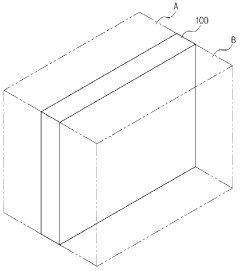
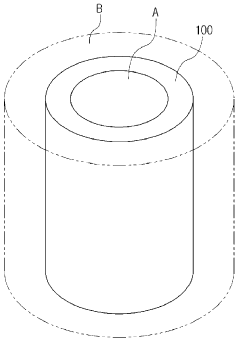
- A composite solid electrolyte is developed by combining an ion-conductive ceramic, a polymer, and a liquid electrolyte, with a solvent containing lithium or sodium ions, to enhance stability and electrochemical characteristics.


Complex Solid Electrolyte for Sodium Secondary Battery and the Fabrication Method Thereof
PatentActiveKR1020150066889A
Innovation
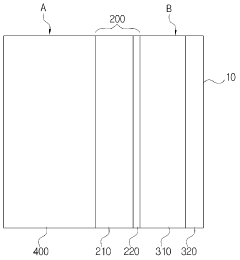
- A composite solid electrolyte is developed with a sodium ion conductive solid electrolyte coated with an anti-corrosion film that is permeable to sodium ions and impermeable to negative ions, formed by thermal decomposition of a polymer film containing carboxylic acid and glycol, ensuring uniformity and preventing direct contact with the anolyte.
Safety and Stability Considerations for Na-ion Solid Electrolytes
Safety considerations for sodium-ion solid electrolytes represent a critical aspect of their commercial viability. Unlike liquid electrolytes, solid electrolytes significantly reduce fire and explosion risks by eliminating flammable organic components. This inherent safety advantage positions composite solid electrolytes as particularly promising for large-scale energy storage applications where safety concerns are paramount.
Thermal stability remains a key performance indicator for Na-ion solid electrolytes. Most polymer-based composites demonstrate stability up to 150-200°C, while ceramic-based systems can withstand temperatures exceeding 300°C. However, thermal cycling can induce mechanical stress at interfaces between different components, potentially creating microcracks that compromise ionic conductivity and overall battery performance over time.
Chemical stability against sodium metal presents another significant challenge. Many solid electrolytes undergo undesirable redox reactions when in direct contact with sodium anodes, forming interphases that increase interfacial resistance. Composite approaches incorporating protective buffer layers have shown promise in mitigating these reactions, with NASICON-type ceramics demonstrating superior stability compared to sulfide-based alternatives.
Environmental stability, particularly moisture sensitivity, remains problematic for many Na-ion solid electrolytes. Sulfide-based materials rapidly degrade upon air exposure, releasing toxic H2S gas. Oxide-based ceramics generally exhibit better atmospheric stability but may gradually absorb moisture, affecting long-term performance. Polymer components in composites can provide some protection against environmental factors but may introduce their own degradation mechanisms over extended periods.
Mechanical stability under cycling conditions represents another critical consideration. Volume changes during sodium insertion/extraction create mechanical stresses that can fracture brittle ceramic components. Composite approaches incorporating flexible polymer matrices help accommodate these volume changes, but achieving optimal mechanical properties while maintaining high ionic conductivity remains challenging.
Long-term cycling stability data for Na-ion solid electrolytes remains limited compared to their lithium counterparts. Current research indicates that interface degradation mechanisms often accelerate after 100-200 cycles, suggesting the need for improved interface engineering. Recent advances in composite designs incorporating self-healing polymers and gradient-structured interfaces show promise for enhancing long-term stability.
Thermal stability remains a key performance indicator for Na-ion solid electrolytes. Most polymer-based composites demonstrate stability up to 150-200°C, while ceramic-based systems can withstand temperatures exceeding 300°C. However, thermal cycling can induce mechanical stress at interfaces between different components, potentially creating microcracks that compromise ionic conductivity and overall battery performance over time.
Chemical stability against sodium metal presents another significant challenge. Many solid electrolytes undergo undesirable redox reactions when in direct contact with sodium anodes, forming interphases that increase interfacial resistance. Composite approaches incorporating protective buffer layers have shown promise in mitigating these reactions, with NASICON-type ceramics demonstrating superior stability compared to sulfide-based alternatives.
Environmental stability, particularly moisture sensitivity, remains problematic for many Na-ion solid electrolytes. Sulfide-based materials rapidly degrade upon air exposure, releasing toxic H2S gas. Oxide-based ceramics generally exhibit better atmospheric stability but may gradually absorb moisture, affecting long-term performance. Polymer components in composites can provide some protection against environmental factors but may introduce their own degradation mechanisms over extended periods.
Mechanical stability under cycling conditions represents another critical consideration. Volume changes during sodium insertion/extraction create mechanical stresses that can fracture brittle ceramic components. Composite approaches incorporating flexible polymer matrices help accommodate these volume changes, but achieving optimal mechanical properties while maintaining high ionic conductivity remains challenging.
Long-term cycling stability data for Na-ion solid electrolytes remains limited compared to their lithium counterparts. Current research indicates that interface degradation mechanisms often accelerate after 100-200 cycles, suggesting the need for improved interface engineering. Recent advances in composite designs incorporating self-healing polymers and gradient-structured interfaces show promise for enhancing long-term stability.
Sustainability Impact of Na-ion Battery Technologies
The adoption of sodium-ion battery technologies represents a significant shift towards more sustainable energy storage solutions compared to conventional lithium-ion batteries. The environmental benefits begin with raw material sourcing, as sodium is approximately 1,000 times more abundant than lithium in the Earth's crust, reducing extraction impacts and resource depletion concerns. This abundance translates to lower mining footprints and decreased habitat disruption in sensitive ecosystems where lithium is traditionally extracted.
From a manufacturing perspective, Na-ion batteries utilizing composite solid electrolytes demonstrate reduced energy consumption during production. Recent life cycle assessments indicate that Na-ion battery manufacturing can generate up to 30% lower carbon emissions compared to equivalent lithium-ion technologies, primarily due to less energy-intensive material processing requirements and lower thermal management demands during cell assembly.
The operational sustainability advantages extend to safety considerations, as solid electrolyte composites in Na-ion batteries significantly reduce fire and explosion risks associated with liquid electrolytes. This enhanced safety profile minimizes the environmental hazards from potential battery failures and reduces the need for complex cooling systems, further decreasing the overall energy consumption during battery operation.
End-of-life management presents another sustainability advantage for Na-ion technologies. The materials in composite solid electrolytes for Na-ion batteries are generally less toxic than their lithium counterparts, facilitating more straightforward recycling processes. Recovery rates for sodium compounds can reach up to 90% with current recycling technologies, creating a more circular material economy and reducing waste streams.
Economic sustainability metrics also favor Na-ion battery development, with raw material costs estimated to be 40-60% lower than lithium-based alternatives. This cost advantage could accelerate renewable energy adoption in developing regions, democratizing access to clean energy storage solutions and supporting global decarbonization efforts.
Water consumption represents another critical sustainability parameter where Na-ion technologies excel. Sodium extraction typically requires 50-70% less water than lithium extraction from brine operations, addressing a significant environmental concern in water-stressed regions where battery material mining occurs.
The integration of composite solid electrolytes in Na-ion batteries further enhances these sustainability benefits through improved cycle life and reduced degradation rates, extending useful battery lifespans and decreasing replacement frequency and associated environmental impacts.
From a manufacturing perspective, Na-ion batteries utilizing composite solid electrolytes demonstrate reduced energy consumption during production. Recent life cycle assessments indicate that Na-ion battery manufacturing can generate up to 30% lower carbon emissions compared to equivalent lithium-ion technologies, primarily due to less energy-intensive material processing requirements and lower thermal management demands during cell assembly.
The operational sustainability advantages extend to safety considerations, as solid electrolyte composites in Na-ion batteries significantly reduce fire and explosion risks associated with liquid electrolytes. This enhanced safety profile minimizes the environmental hazards from potential battery failures and reduces the need for complex cooling systems, further decreasing the overall energy consumption during battery operation.
End-of-life management presents another sustainability advantage for Na-ion technologies. The materials in composite solid electrolytes for Na-ion batteries are generally less toxic than their lithium counterparts, facilitating more straightforward recycling processes. Recovery rates for sodium compounds can reach up to 90% with current recycling technologies, creating a more circular material economy and reducing waste streams.
Economic sustainability metrics also favor Na-ion battery development, with raw material costs estimated to be 40-60% lower than lithium-based alternatives. This cost advantage could accelerate renewable energy adoption in developing regions, democratizing access to clean energy storage solutions and supporting global decarbonization efforts.
Water consumption represents another critical sustainability parameter where Na-ion technologies excel. Sodium extraction typically requires 50-70% less water than lithium extraction from brine operations, addressing a significant environmental concern in water-stressed regions where battery material mining occurs.
The integration of composite solid electrolytes in Na-ion batteries further enhances these sustainability benefits through improved cycle life and reduced degradation rates, extending useful battery lifespans and decreasing replacement frequency and associated environmental impacts.
Unlock deeper insights with Patsnap Eureka Quick Research — get a full tech report to explore trends and direct your research. Try now!
Generate Your Research Report Instantly with AI Agent
Supercharge your innovation with Patsnap Eureka AI Agent Platform!