

Connecting Rod Efficiency Enhancement Through Weight Reduction
FEB 13, 20269 MIN READ
Generate Your Research Report Instantly with AI Agent
PatSnap Eureka helps you evaluate technical feasibility & market potential.
Connecting Rod Tech Background and Weight Goals
The connecting rod represents a critical component in internal combustion engines, serving as the mechanical link between the piston and crankshaft to convert reciprocating motion into rotational energy. Since the advent of the internal combustion engine in the late 19th century, connecting rods have undergone continuous evolution in materials, manufacturing processes, and design optimization. Early connecting rods were manufactured from cast iron, prioritizing durability over efficiency. As engine performance demands escalated throughout the 20th century, forged steel became the predominant material, offering superior strength-to-weight ratios and fatigue resistance.
The evolution of connecting rod technology has been fundamentally driven by the automotive industry's pursuit of enhanced fuel efficiency, reduced emissions, and improved power output. Weight reduction emerged as a paramount objective because lighter connecting rods directly decrease reciprocating mass, thereby reducing inertial forces and enabling higher engine speeds with lower mechanical losses. This translates to measurable improvements in fuel economy, reduced vibration, extended component lifespan, and enhanced overall engine responsiveness.
Contemporary connecting rod development focuses on achieving optimal balance between structural integrity and mass minimization. Advanced computational methods including finite element analysis and topology optimization have revolutionized design approaches, enabling engineers to identify and eliminate unnecessary material while maintaining critical load-bearing capacity. The integration of high-strength materials such as titanium alloys, powder metallurgy steels, and composite materials has expanded the possibilities for weight reduction without compromising mechanical performance.
Current weight reduction goals in connecting rod technology typically target 15-30% mass reduction compared to conventional forged steel designs, depending on application requirements. High-performance automotive applications pursue aggressive weight targets, while heavy-duty industrial engines prioritize durability with moderate weight optimization. The technical challenge lies in achieving these weight goals while satisfying stringent requirements for fatigue strength, buckling resistance, bearing surface durability, and manufacturing cost-effectiveness. Modern connecting rods must withstand peak cylinder pressures exceeding 200 bar and operate reliably for hundreds of thousands of cycles under extreme thermal and mechanical stress conditions.
The evolution of connecting rod technology has been fundamentally driven by the automotive industry's pursuit of enhanced fuel efficiency, reduced emissions, and improved power output. Weight reduction emerged as a paramount objective because lighter connecting rods directly decrease reciprocating mass, thereby reducing inertial forces and enabling higher engine speeds with lower mechanical losses. This translates to measurable improvements in fuel economy, reduced vibration, extended component lifespan, and enhanced overall engine responsiveness.
Contemporary connecting rod development focuses on achieving optimal balance between structural integrity and mass minimization. Advanced computational methods including finite element analysis and topology optimization have revolutionized design approaches, enabling engineers to identify and eliminate unnecessary material while maintaining critical load-bearing capacity. The integration of high-strength materials such as titanium alloys, powder metallurgy steels, and composite materials has expanded the possibilities for weight reduction without compromising mechanical performance.
Current weight reduction goals in connecting rod technology typically target 15-30% mass reduction compared to conventional forged steel designs, depending on application requirements. High-performance automotive applications pursue aggressive weight targets, while heavy-duty industrial engines prioritize durability with moderate weight optimization. The technical challenge lies in achieving these weight goals while satisfying stringent requirements for fatigue strength, buckling resistance, bearing surface durability, and manufacturing cost-effectiveness. Modern connecting rods must withstand peak cylinder pressures exceeding 200 bar and operate reliably for hundreds of thousands of cycles under extreme thermal and mechanical stress conditions.
Market Demand for Lightweight Engine Components
The automotive industry is experiencing a fundamental shift driven by stringent environmental regulations and evolving consumer expectations for fuel-efficient vehicles. Lightweight engine components, particularly connecting rods, have emerged as critical enablers in meeting these demands. Regulatory frameworks such as the Corporate Average Fuel Economy standards in North America and Euro 7 emission norms in Europe are compelling manufacturers to reduce vehicle weight systematically. This regulatory pressure translates directly into heightened demand for weight-optimized powertrain components that maintain structural integrity while contributing to overall vehicle mass reduction.
The market for lightweight connecting rods spans multiple automotive segments, with distinct demand patterns emerging across passenger vehicles, commercial transportation, and high-performance applications. Internal combustion engine manufacturers are actively seeking solutions that deliver measurable fuel economy improvements without compromising durability or increasing production costs prohibitively. The transition toward hybrid powertrains has further intensified this demand, as these systems require components that minimize reciprocating mass to optimize the synergy between electric motors and combustion engines.
Performance-oriented vehicle segments represent another significant demand driver, where reduced connecting rod weight directly enhances engine responsiveness and enables higher operational speeds. Motorsport applications and premium automotive brands are demonstrating willingness to adopt advanced materials and manufacturing processes, creating a technology adoption pathway that gradually cascades to mainstream production vehicles. This segment serves as a proving ground for innovative weight reduction techniques before broader market implementation.
The commercial vehicle sector presents unique demand characteristics, where operational cost reduction through improved fuel efficiency directly impacts fleet profitability. Long-haul transportation operators are increasingly evaluating total cost of ownership metrics that incorporate fuel consumption benefits from lightweight components. This economic calculus is driving procurement decisions toward engines featuring weight-optimized connecting rods, particularly in markets with high fuel costs or carbon taxation mechanisms.
Emerging markets are exhibiting growing awareness of lightweight component benefits, though adoption rates vary based on local regulatory environments and manufacturing capabilities. The global nature of automotive supply chains means that component specifications increasingly reflect the most stringent international requirements, effectively globalizing demand for advanced lightweight connecting rod technologies across diverse geographic markets.
The market for lightweight connecting rods spans multiple automotive segments, with distinct demand patterns emerging across passenger vehicles, commercial transportation, and high-performance applications. Internal combustion engine manufacturers are actively seeking solutions that deliver measurable fuel economy improvements without compromising durability or increasing production costs prohibitively. The transition toward hybrid powertrains has further intensified this demand, as these systems require components that minimize reciprocating mass to optimize the synergy between electric motors and combustion engines.
Performance-oriented vehicle segments represent another significant demand driver, where reduced connecting rod weight directly enhances engine responsiveness and enables higher operational speeds. Motorsport applications and premium automotive brands are demonstrating willingness to adopt advanced materials and manufacturing processes, creating a technology adoption pathway that gradually cascades to mainstream production vehicles. This segment serves as a proving ground for innovative weight reduction techniques before broader market implementation.
The commercial vehicle sector presents unique demand characteristics, where operational cost reduction through improved fuel efficiency directly impacts fleet profitability. Long-haul transportation operators are increasingly evaluating total cost of ownership metrics that incorporate fuel consumption benefits from lightweight components. This economic calculus is driving procurement decisions toward engines featuring weight-optimized connecting rods, particularly in markets with high fuel costs or carbon taxation mechanisms.
Emerging markets are exhibiting growing awareness of lightweight component benefits, though adoption rates vary based on local regulatory environments and manufacturing capabilities. The global nature of automotive supply chains means that component specifications increasingly reflect the most stringent international requirements, effectively globalizing demand for advanced lightweight connecting rod technologies across diverse geographic markets.
Current Status and Challenges in Rod Weight Reduction
The pursuit of connecting rod weight reduction has become a critical focus in modern engine development, driven by stringent emission regulations and fuel efficiency demands. Current manufacturing approaches predominantly employ forged steel and powder metallurgy techniques, which have achieved significant mass reductions compared to traditional cast iron designs. However, the industry faces a fundamental challenge in balancing weight reduction with the structural integrity required to withstand extreme cyclic loading conditions during engine operation.
Advanced materials represent a primary avenue for weight reduction, with high-strength aluminum alloys and titanium alloys gaining traction in high-performance applications. Despite their favorable strength-to-weight ratios, these materials introduce substantial cost increases and manufacturing complexities. The adoption of composite materials, particularly carbon fiber reinforced polymers, remains largely experimental due to concerns regarding fatigue resistance, thermal stability, and compatibility with existing production infrastructure.
Manufacturing process limitations constitute another significant barrier. While topology optimization and finite element analysis enable sophisticated design refinements, translating these optimized geometries into production-ready components often proves challenging. Conventional forging processes struggle to achieve the complex internal geometries that computational models suggest would yield optimal weight savings. Additive manufacturing technologies offer potential solutions but currently lack the production scalability and cost-effectiveness required for mass-market applications.
The technical challenges extend beyond material selection and manufacturing. Engineers must address the intricate relationship between reduced mass and dynamic behavior, as lighter connecting rods alter engine balance characteristics and vibration profiles. This necessitates comprehensive system-level analysis and potential redesign of complementary components such as crankshafts and bearings. Additionally, the reduction in thermal mass affects heat dissipation patterns, potentially creating localized stress concentrations that compromise durability.
Geographically, development efforts concentrate in established automotive engineering centers across Germany, Japan, and the United States, where OEMs collaborate with specialized suppliers and research institutions. Emerging markets demonstrate growing interest but face technology transfer barriers and limited access to advanced materials and precision manufacturing equipment necessary for breakthrough innovations in this domain.
Advanced materials represent a primary avenue for weight reduction, with high-strength aluminum alloys and titanium alloys gaining traction in high-performance applications. Despite their favorable strength-to-weight ratios, these materials introduce substantial cost increases and manufacturing complexities. The adoption of composite materials, particularly carbon fiber reinforced polymers, remains largely experimental due to concerns regarding fatigue resistance, thermal stability, and compatibility with existing production infrastructure.
Manufacturing process limitations constitute another significant barrier. While topology optimization and finite element analysis enable sophisticated design refinements, translating these optimized geometries into production-ready components often proves challenging. Conventional forging processes struggle to achieve the complex internal geometries that computational models suggest would yield optimal weight savings. Additive manufacturing technologies offer potential solutions but currently lack the production scalability and cost-effectiveness required for mass-market applications.
The technical challenges extend beyond material selection and manufacturing. Engineers must address the intricate relationship between reduced mass and dynamic behavior, as lighter connecting rods alter engine balance characteristics and vibration profiles. This necessitates comprehensive system-level analysis and potential redesign of complementary components such as crankshafts and bearings. Additionally, the reduction in thermal mass affects heat dissipation patterns, potentially creating localized stress concentrations that compromise durability.
Geographically, development efforts concentrate in established automotive engineering centers across Germany, Japan, and the United States, where OEMs collaborate with specialized suppliers and research institutions. Emerging markets demonstrate growing interest but face technology transfer barriers and limited access to advanced materials and precision manufacturing equipment necessary for breakthrough innovations in this domain.
Existing Weight Reduction Solutions for Connecting Rods
01 Lightweight material selection for connecting rods
Connecting rods can be manufactured using lightweight materials such as aluminum alloys, titanium alloys, or composite materials to reduce overall weight while maintaining structural integrity. The selection of appropriate materials with high strength-to-weight ratios is crucial for weight reduction. Advanced manufacturing processes enable the use of these materials in connecting rod production, resulting in improved engine efficiency and reduced inertial forces.- Lightweight material selection for connecting rods: Connecting rods can be manufactured using lightweight materials such as aluminum alloys, titanium alloys, or composite materials to reduce overall weight while maintaining structural integrity. The selection of appropriate materials with high strength-to-weight ratios is crucial for weight reduction. Advanced manufacturing processes enable the production of connecting rods with optimized material distribution to achieve weight savings without compromising performance.
- Structural optimization and topology design: The weight of connecting rods can be reduced through structural optimization techniques including topology optimization, finite element analysis, and computer-aided design. These methods allow for the removal of excess material from non-critical areas while reinforcing stress-concentrated regions. The optimized geometry maintains mechanical strength and fatigue resistance while achieving significant weight reduction.
- Hollow or cavity design in connecting rod structure: Implementing hollow sections or internal cavities within the connecting rod body is an effective approach to reduce weight. This design strategy removes material from the interior while maintaining the outer structural framework. The hollow design can be achieved through various manufacturing methods and provides substantial weight savings while preserving the required mechanical properties.
- Manufacturing process improvements for weight reduction: Advanced manufacturing processes such as powder metallurgy, precision forging, and casting techniques enable the production of lighter connecting rods with improved material efficiency. These processes allow for near-net-shape manufacturing, reducing material waste and enabling complex geometries that contribute to weight reduction. Post-processing treatments can further enhance the strength-to-weight ratio.
- Integration of weight-reducing features and components: Connecting rods can incorporate specific design features such as reduced cross-sections in low-stress areas, optimized bearing surfaces, and integrated fastening systems that eliminate additional components. The integration of multiple functions into a single component and the use of advanced joining techniques contribute to overall weight reduction while maintaining or improving functionality.
02 Structural optimization and hollow design
Weight reduction can be achieved through structural optimization techniques including hollow designs, internal cavities, and optimized cross-sectional geometries. These designs remove material from non-critical areas while preserving strength in high-stress regions. Finite element analysis and computational methods are employed to determine optimal material distribution and create lightweight structures without compromising mechanical performance.Expand Specific Solutions03 Forging and manufacturing process improvements
Advanced forging techniques and manufacturing processes contribute to weight reduction by enabling precise material placement and improved material properties. Processes such as precision forging, powder metallurgy, and advanced machining allow for the creation of near-net-shape components with minimal excess material. These manufacturing methods also enhance the mechanical properties of connecting rods, allowing for thinner sections and reduced weight.Expand Specific Solutions04 Weight balancing and mass distribution optimization
Optimizing the mass distribution and balancing of connecting rods is essential for reducing vibration and improving engine performance. Strategic placement of material and careful design of the big end and small end configurations help achieve proper weight balance. This approach considers the dynamic forces during engine operation and ensures that weight reduction does not negatively impact the rotational balance and operational smoothness.Expand Specific Solutions05 Surface treatment and coating technologies
Surface treatments and coating technologies can contribute to weight reduction by allowing the use of thinner base materials while maintaining wear resistance and durability. Advanced coatings provide protection against friction and wear, enabling designers to reduce material thickness in certain areas. These treatments also improve fatigue resistance, which is critical for lightweight connecting rod designs operating under high stress conditions.Expand Specific Solutions
Key Players in Connecting Rod and Lightweighting Industry
The connecting rod weight reduction technology is experiencing significant growth as the automotive and aerospace industries transition toward electrification and fuel efficiency optimization. The market demonstrates substantial expansion driven by stringent emission regulations and performance demands. Technology maturity varies considerably across sectors, with established automotive manufacturers like Toyota Motor Corp., Nissan Motor Co., Audi AG, and Ford Global Technologies LLC leading advanced lightweight material integration and precision manufacturing. Aerospace leaders including Airbus Operations SAS and Safran Aircraft Engines SAS are pioneering high-performance composite applications. Specialized manufacturers such as Tianrun Industry Technology Co., Ltd. and component suppliers like Safran Landing Systems SAS contribute innovative forging and material solutions. The competitive landscape shows a mix of mature production technologies from major OEMs and emerging innovations from specialized engineering firms, indicating a transitioning industry moving from traditional steel-based designs toward advanced composites and optimized geometries for enhanced efficiency.
AUDI AG
Technical Solution: Audi has pioneered the use of advanced materials and manufacturing techniques for connecting rod weight reduction in their high-performance engines. The company utilizes crack-splitting technology combined with powder metallurgy to produce connecting rods with optimized grain structure and reduced weight. Their latest designs incorporate topology optimization algorithms to identify and eliminate unnecessary material while preserving critical load paths. Audi's connecting rods feature asymmetric designs with variable cross-sections, achieving weight savings of approximately 18-25% compared to traditional forged steel components. The company has also explored the use of titanium alloys for ultra-high-performance applications, particularly in their racing and limited-production vehicles, where weight reduction directly translates to improved engine response and reduced reciprocating mass.
Strengths: Cutting-edge materials research, strong integration with motorsport development, premium manufacturing capabilities. Weaknesses: Higher production costs, limited scalability to mass-market applications, complex quality control requirements.
Toyota Motor Corp.
Technical Solution: Toyota has developed advanced lightweight connecting rod technologies utilizing high-strength forged steel alloys and precision manufacturing processes. Their approach incorporates finite element analysis (FEA) to optimize material distribution, removing excess material from non-critical stress areas while maintaining structural integrity in high-load zones. The company employs micro-alloying techniques with elements such as vanadium and niobium to achieve superior strength-to-weight ratios. Toyota's connecting rods feature optimized I-beam cross-sections and strategically placed material removal in the shank area, achieving weight reductions of 15-20% compared to conventional designs while maintaining fatigue resistance exceeding 10^7 cycles. Their manufacturing process includes controlled cooling rates and shot peening for enhanced surface properties and durability.
Strengths: Extensive R&D resources, proven reliability in high-volume production, excellent fatigue life performance. Weaknesses: Conservative approach may limit aggressive weight reduction, higher manufacturing costs for premium materials.
Core Innovations in Lightweight Rod Design Patents
Engine connecting rod for high performance applications and method of manufacture
PatentInactiveUS20080282838A1
Innovation
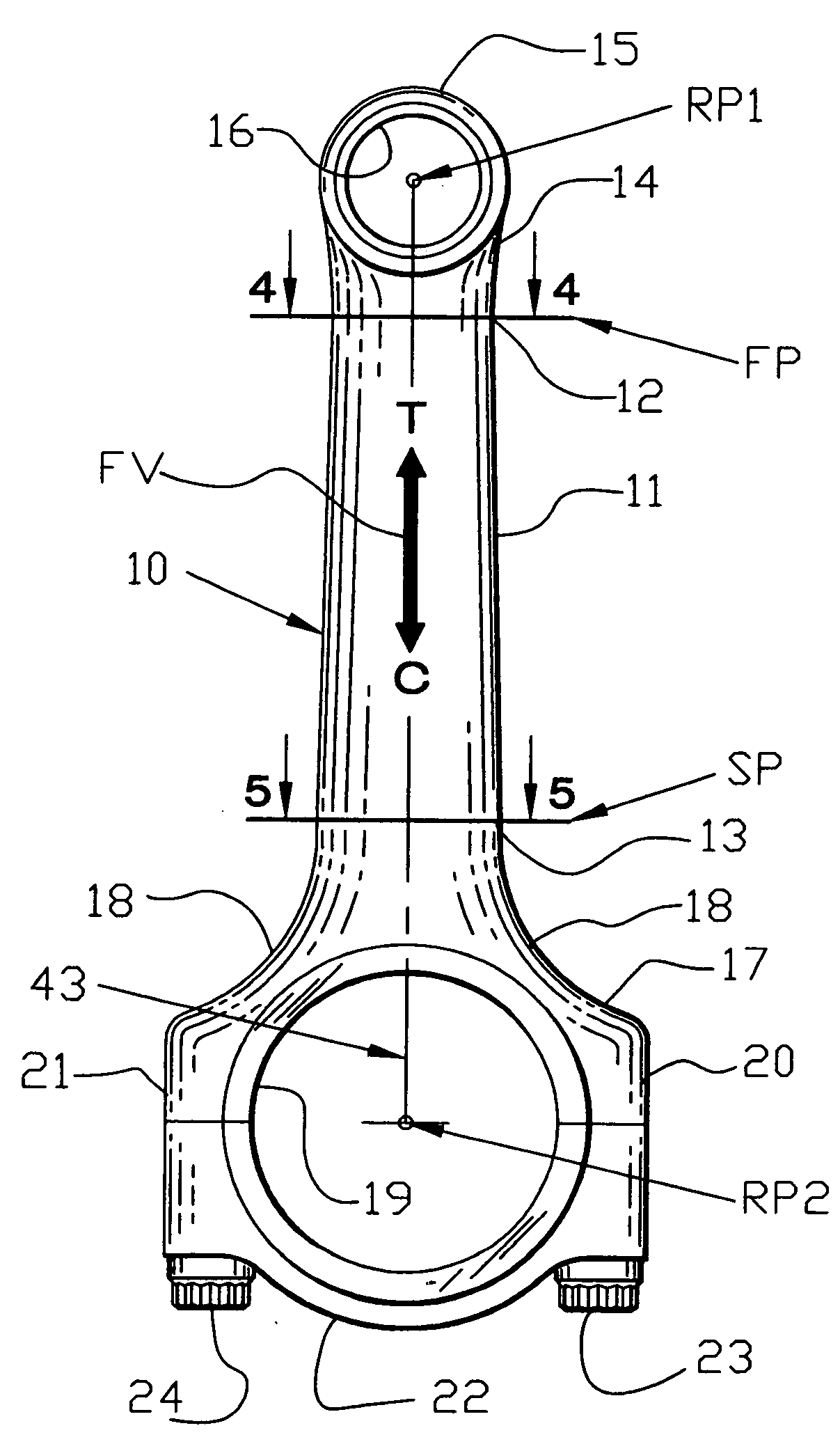
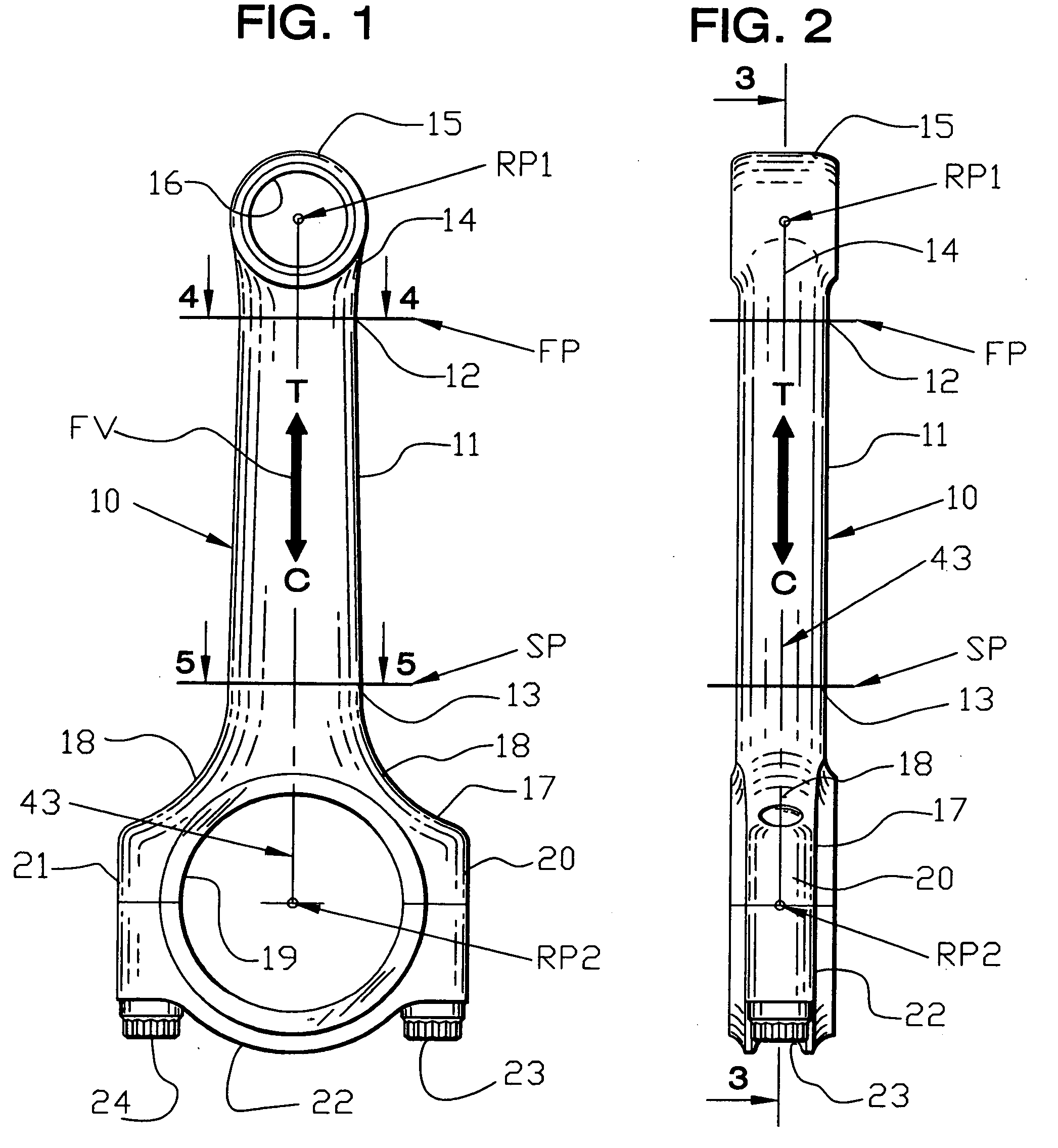
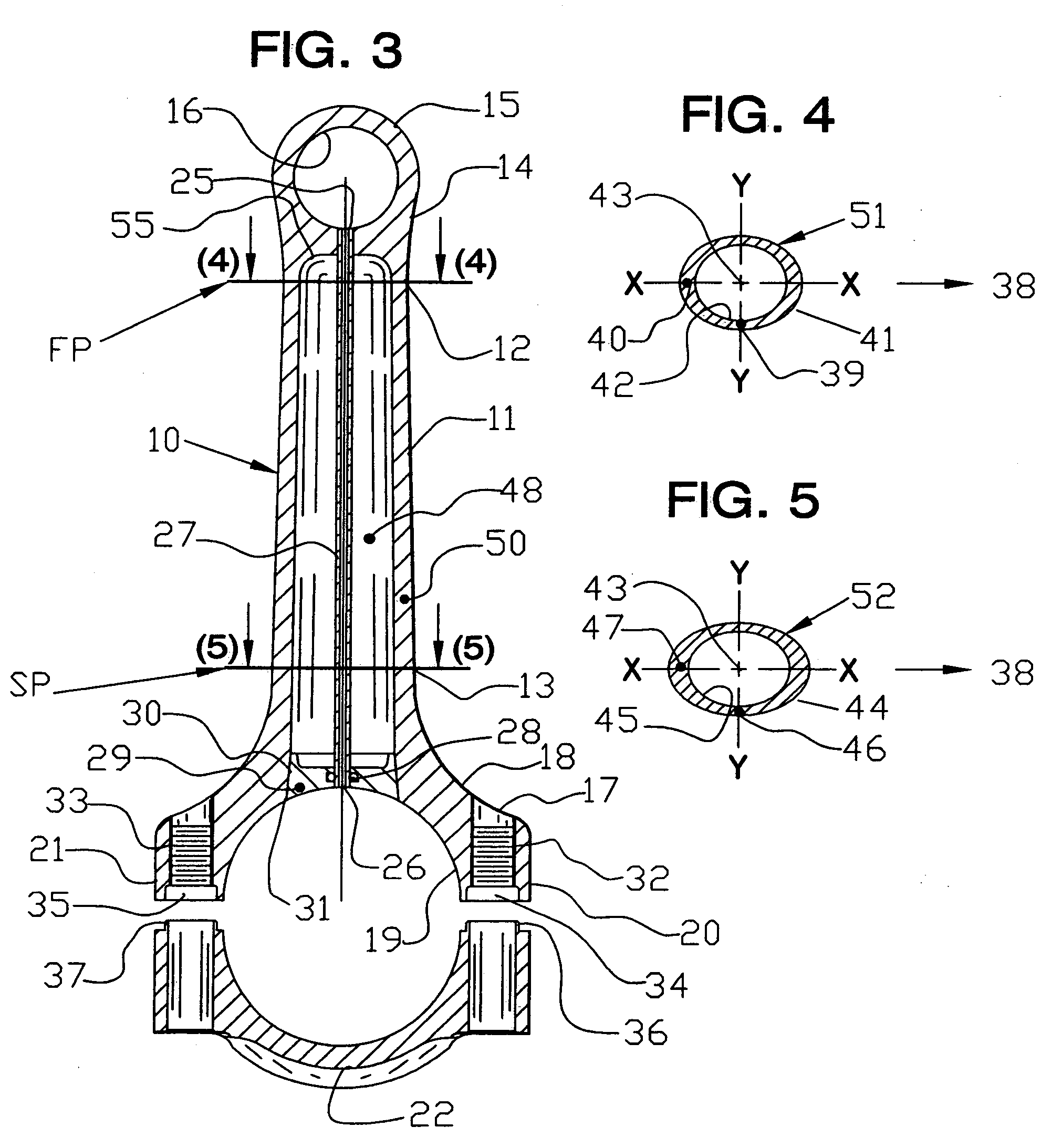
- A hollow beam connecting rod with an elliptical or convex segment cross-section profile, optimized by specific wall thickness and profile length ratios, which minimizes stress concentrations and improves force flux distribution from the wrist-pin boss to the crankshaft boss, using high-strength alloy steel and forgings to enhance structural integrity.

Lightweight, stiff in compression, connecting rod for a reciprocating piston engine
PatentInactiveUS20160265580A1
Innovation
- A connecting rod design featuring an embedded structural tube with a higher Young's modulus than the body material, made from ceramic oxides, ceramic non-oxides, or composite materials, which increases the stiffness and reduces deformation, while also serving as a lubricant pathway.


Emission Regulations Driving Lightweighting Trends
The automotive industry faces increasingly stringent emission regulations worldwide, fundamentally reshaping vehicle design philosophies and manufacturing priorities. Legislative frameworks such as the European Union's Euro 7 standards, China's National VI emission norms, and the United States' Corporate Average Fuel Economy (CAFE) regulations impose progressively tighter limits on carbon dioxide and nitrogen oxide emissions. These regulatory pressures create compelling economic and compliance incentives for manufacturers to pursue aggressive weight reduction strategies across all vehicle components, with connecting rods representing a critical target for optimization due to their mass-production volumes and direct impact on engine efficiency.
The correlation between vehicle weight and fuel consumption establishes a direct pathway between lightweighting initiatives and emission compliance. Industry research demonstrates that every 10% reduction in vehicle mass yields approximately 6-8% improvement in fuel efficiency, translating directly to proportional decreases in tailpipe emissions. Connecting rods, despite their relatively modest individual weight, contribute significantly to overall powertrain mass when considered across multi-cylinder configurations and global production volumes. This multiplicative effect positions connecting rod weight reduction as a strategic lever for meeting regulatory targets while maintaining performance standards.
Regulatory timelines are accelerating the urgency of lightweighting adoption. The phased implementation of emission standards creates defined milestones that manufacturers must achieve, with non-compliance resulting in substantial financial penalties and market access restrictions. This regulatory cadence drives continuous innovation cycles in connecting rod design and materials selection, pushing the industry toward advanced alloys, composite materials, and topology-optimized geometries that were previously considered economically unfeasible or technically premature.
Beyond direct emission reduction benefits, lightweighting initiatives align with broader regulatory trends toward electrification and hybridization. Lighter connecting rods reduce reciprocating mass and mechanical losses in internal combustion engines, extending the viability of hybrid powertrains as transitional technologies. This dual benefit—improving conventional engine efficiency while enhancing hybrid system performance—positions connecting rod weight reduction as a versatile compliance strategy adaptable to diverse regulatory scenarios and market conditions across different geographical regions.
The correlation between vehicle weight and fuel consumption establishes a direct pathway between lightweighting initiatives and emission compliance. Industry research demonstrates that every 10% reduction in vehicle mass yields approximately 6-8% improvement in fuel efficiency, translating directly to proportional decreases in tailpipe emissions. Connecting rods, despite their relatively modest individual weight, contribute significantly to overall powertrain mass when considered across multi-cylinder configurations and global production volumes. This multiplicative effect positions connecting rod weight reduction as a strategic lever for meeting regulatory targets while maintaining performance standards.
Regulatory timelines are accelerating the urgency of lightweighting adoption. The phased implementation of emission standards creates defined milestones that manufacturers must achieve, with non-compliance resulting in substantial financial penalties and market access restrictions. This regulatory cadence drives continuous innovation cycles in connecting rod design and materials selection, pushing the industry toward advanced alloys, composite materials, and topology-optimized geometries that were previously considered economically unfeasible or technically premature.
Beyond direct emission reduction benefits, lightweighting initiatives align with broader regulatory trends toward electrification and hybridization. Lighter connecting rods reduce reciprocating mass and mechanical losses in internal combustion engines, extending the viability of hybrid powertrains as transitional technologies. This dual benefit—improving conventional engine efficiency while enhancing hybrid system performance—positions connecting rod weight reduction as a versatile compliance strategy adaptable to diverse regulatory scenarios and market conditions across different geographical regions.
Durability Testing Standards for Lightweight Rods
Durability testing standards for lightweight connecting rods represent a critical framework ensuring that weight-reduced components maintain structural integrity under operational stresses. As connecting rods transition from traditional forged steel to advanced materials such as titanium alloys, powder metallurgy composites, and carbon fiber reinforced polymers, establishing rigorous validation protocols becomes paramount. These standards must address the unique failure modes associated with lightweight designs, including fatigue crack propagation, stress concentration at reduced cross-sections, and material degradation under cyclic loading conditions.
International standards organizations have developed comprehensive testing methodologies specifically tailored for lightweight connecting rod validation. ISO 3928 and SAE J1995 provide baseline frameworks for fatigue testing, requiring specimens to endure millions of load cycles simulating real-world engine operation. For lightweight rods, these protocols are augmented with accelerated life testing at elevated temperatures and corrosive environments to evaluate material stability. High-cycle fatigue testing typically involves applying alternating tensile and compressive loads ranging from 80% to 120% of design stress levels, with failure criteria defined by crack initiation exceeding 0.5mm or complete fracture.
Advanced non-destructive testing techniques have become integral to durability validation processes. Ultrasonic inspection, magnetic particle testing, and computed tomography scanning enable detection of internal defects, porosity, and microstructural anomalies that could compromise lightweight rod performance. Digital image correlation systems now provide real-time strain mapping during testing, identifying stress concentration zones that may not be apparent through traditional strain gauge measurements. These technologies allow engineers to validate finite element analysis predictions and refine design iterations before production commitment.
Specific attention must be paid to interface durability between lightweight rod bodies and bearing surfaces. Standards mandate fretting wear testing at big-end and small-end connections, simulating micro-movements under oscillating loads. Surface treatment validation, including shot peening effectiveness and coating adhesion strength, requires dedicated test protocols ensuring that weight reduction measures do not compromise contact fatigue resistance. Temperature cycling tests between -40°C and 200°C verify dimensional stability and material compatibility across operational temperature ranges, particularly critical for composite and hybrid material constructions where thermal expansion coefficients vary significantly between constituent materials.
International standards organizations have developed comprehensive testing methodologies specifically tailored for lightweight connecting rod validation. ISO 3928 and SAE J1995 provide baseline frameworks for fatigue testing, requiring specimens to endure millions of load cycles simulating real-world engine operation. For lightweight rods, these protocols are augmented with accelerated life testing at elevated temperatures and corrosive environments to evaluate material stability. High-cycle fatigue testing typically involves applying alternating tensile and compressive loads ranging from 80% to 120% of design stress levels, with failure criteria defined by crack initiation exceeding 0.5mm or complete fracture.
Advanced non-destructive testing techniques have become integral to durability validation processes. Ultrasonic inspection, magnetic particle testing, and computed tomography scanning enable detection of internal defects, porosity, and microstructural anomalies that could compromise lightweight rod performance. Digital image correlation systems now provide real-time strain mapping during testing, identifying stress concentration zones that may not be apparent through traditional strain gauge measurements. These technologies allow engineers to validate finite element analysis predictions and refine design iterations before production commitment.
Specific attention must be paid to interface durability between lightweight rod bodies and bearing surfaces. Standards mandate fretting wear testing at big-end and small-end connections, simulating micro-movements under oscillating loads. Surface treatment validation, including shot peening effectiveness and coating adhesion strength, requires dedicated test protocols ensuring that weight reduction measures do not compromise contact fatigue resistance. Temperature cycling tests between -40°C and 200°C verify dimensional stability and material compatibility across operational temperature ranges, particularly critical for composite and hybrid material constructions where thermal expansion coefficients vary significantly between constituent materials.
Unlock deeper insights with PatSnap Eureka Quick Research — get a full tech report to explore trends and direct your research. Try now!
Generate Your Research Report Instantly with AI Agent
Supercharge your innovation with PatSnap Eureka AI Agent Platform!