

Quantifying Connecting Rod Effect on Engine Out NOx Emissions
FEB 13, 20269 MIN READ
Generate Your Research Report Instantly with AI Agent
PatSnap Eureka helps you evaluate technical feasibility & market potential.
Connecting Rod Impact on NOx Background and Objectives
Nitrogen oxides (NOx) emissions from internal combustion engines have been a critical environmental concern for decades, driving stringent regulatory standards worldwide. While extensive research has focused on combustion chamber design, fuel injection strategies, and after-treatment systems, the mechanical components' influence on emission formation remains less explored. The connecting rod, as a fundamental element in the engine's kinematic chain, plays a crucial role in piston motion dynamics and combustion chamber conditions, yet its specific contribution to NOx formation has not been systematically quantified.
The connecting rod's geometric and inertial properties directly affect piston acceleration profiles, instantaneous piston speeds, and the resulting gas motion within the combustion chamber. These parameters influence critical combustion characteristics including peak cylinder temperatures, residence time at high-temperature zones, and local air-fuel mixing patterns—all of which are primary determinants of thermal NOx formation through the Zeldovich mechanism. Variations in connecting rod length, mass distribution, and material properties can alter these combustion conditions in ways that may either exacerbate or mitigate NOx production.
Recent advances in engine downsizing and efficiency optimization have intensified interest in understanding how every component contributes to emission outcomes. The connecting rod represents a potential optimization target that has received insufficient attention in emission reduction strategies. Understanding its quantitative impact could unlock new pathways for emission control without relying solely on expensive after-treatment technologies or compromising engine performance.
The primary objective of this research is to establish a quantitative relationship between connecting rod design parameters and engine-out NOx emissions. This involves developing methodologies to isolate the connecting rod's contribution from other influencing factors, identifying which specific rod characteristics most significantly affect NOx formation, and determining the magnitude of these effects across various operating conditions. Secondary objectives include validating predictive models that can guide connecting rod design for emission optimization and providing actionable insights for engine development programs seeking cost-effective NOx reduction strategies.
The connecting rod's geometric and inertial properties directly affect piston acceleration profiles, instantaneous piston speeds, and the resulting gas motion within the combustion chamber. These parameters influence critical combustion characteristics including peak cylinder temperatures, residence time at high-temperature zones, and local air-fuel mixing patterns—all of which are primary determinants of thermal NOx formation through the Zeldovich mechanism. Variations in connecting rod length, mass distribution, and material properties can alter these combustion conditions in ways that may either exacerbate or mitigate NOx production.
Recent advances in engine downsizing and efficiency optimization have intensified interest in understanding how every component contributes to emission outcomes. The connecting rod represents a potential optimization target that has received insufficient attention in emission reduction strategies. Understanding its quantitative impact could unlock new pathways for emission control without relying solely on expensive after-treatment technologies or compromising engine performance.
The primary objective of this research is to establish a quantitative relationship between connecting rod design parameters and engine-out NOx emissions. This involves developing methodologies to isolate the connecting rod's contribution from other influencing factors, identifying which specific rod characteristics most significantly affect NOx formation, and determining the magnitude of these effects across various operating conditions. Secondary objectives include validating predictive models that can guide connecting rod design for emission optimization and providing actionable insights for engine development programs seeking cost-effective NOx reduction strategies.
Market Demand for Low NOx Emission Engines
The global automotive industry is experiencing unprecedented regulatory pressure to reduce nitrogen oxide (NOx) emissions, driven by increasingly stringent environmental standards across major markets. The European Union's Euro 7 standards, China's National VI emission regulations, and the United States Environmental Protection Agency's Tier 3 standards collectively represent a paradigm shift in acceptable emission thresholds. These regulations have created substantial market demand for engines capable of achieving lower NOx output while maintaining performance and fuel efficiency. The commercial vehicle sector, particularly heavy-duty diesel engines, faces the most acute pressure as these powertrains traditionally generate higher NOx levels during combustion.
Understanding the connecting rod's influence on engine-out NOx emissions has emerged as a critical research priority for manufacturers seeking competitive advantages in this regulated environment. Engine designers recognize that optimizing connecting rod parameters—including length, mass distribution, and material properties—can influence combustion chamber dynamics, peak cylinder pressures, and temperature profiles that directly affect NOx formation. This technical insight offers potential pathways to reduce emissions at the source rather than relying solely on costly aftertreatment systems.
The market opportunity extends beyond regulatory compliance to encompass total cost of ownership considerations. Fleet operators increasingly prioritize vehicles with lower emissions maintenance requirements, as selective catalytic reduction systems and diesel particulate filters represent significant operational expenses. Engines that achieve lower engine-out NOx through mechanical optimization can reduce the burden on aftertreatment components, extending service intervals and decreasing lifetime costs. This value proposition resonates strongly in commercial transportation, construction equipment, and agricultural machinery sectors where operational efficiency directly impacts profitability.
Emerging markets present additional growth drivers as developing economies implement their first comprehensive emission standards. Manufacturers capable of quantifying and optimizing connecting rod effects on NOx emissions can develop scalable solutions applicable across diverse engine platforms and market segments. The transition toward hybrid powertrains further amplifies this demand, as internal combustion engines in hybrid configurations must operate with exceptional efficiency across varied duty cycles. Technical solutions addressing fundamental combustion optimization through connecting rod design represent enabling technologies for next-generation powertrain architectures that balance environmental performance with market viability.
Understanding the connecting rod's influence on engine-out NOx emissions has emerged as a critical research priority for manufacturers seeking competitive advantages in this regulated environment. Engine designers recognize that optimizing connecting rod parameters—including length, mass distribution, and material properties—can influence combustion chamber dynamics, peak cylinder pressures, and temperature profiles that directly affect NOx formation. This technical insight offers potential pathways to reduce emissions at the source rather than relying solely on costly aftertreatment systems.
The market opportunity extends beyond regulatory compliance to encompass total cost of ownership considerations. Fleet operators increasingly prioritize vehicles with lower emissions maintenance requirements, as selective catalytic reduction systems and diesel particulate filters represent significant operational expenses. Engines that achieve lower engine-out NOx through mechanical optimization can reduce the burden on aftertreatment components, extending service intervals and decreasing lifetime costs. This value proposition resonates strongly in commercial transportation, construction equipment, and agricultural machinery sectors where operational efficiency directly impacts profitability.
Emerging markets present additional growth drivers as developing economies implement their first comprehensive emission standards. Manufacturers capable of quantifying and optimizing connecting rod effects on NOx emissions can develop scalable solutions applicable across diverse engine platforms and market segments. The transition toward hybrid powertrains further amplifies this demand, as internal combustion engines in hybrid configurations must operate with exceptional efficiency across varied duty cycles. Technical solutions addressing fundamental combustion optimization through connecting rod design represent enabling technologies for next-generation powertrain architectures that balance environmental performance with market viability.
Current NOx Formation Mechanisms and Connecting Rod Challenges
Nitrogen oxide (NOx) emissions from internal combustion engines remain a critical environmental concern, with formation mechanisms primarily governed by thermal, prompt, and fuel NOx pathways. The thermal NOx mechanism, described by the extended Zeldovich mechanism, dominates at high combustion temperatures above 1800K, where molecular nitrogen reacts with oxygen radicals. This temperature-dependent process is exponentially sensitive to peak cylinder temperatures and local oxygen concentrations. Prompt NOx formation occurs through hydrocarbon radical reactions with nitrogen molecules in fuel-rich zones, while fuel NOx results from nitrogen-containing compounds in the fuel itself, though the latter is negligible in modern diesel and gasoline applications.
The connecting rod plays an indirect yet significant role in NOx formation through its influence on combustion chamber dynamics. Variations in connecting rod length, mass, and center of gravity position directly affect piston motion characteristics, altering the compression and expansion stroke profiles. These geometric and inertial parameters modify the instantaneous piston velocity and acceleration patterns, consequently impacting the heat transfer rates between the combustion gases and cylinder walls. Such thermal boundary condition changes can shift peak combustion temperatures by several degrees, which translates to measurable variations in thermal NOx production rates.
Current challenges in quantifying the connecting rod effect stem from the complex interdependencies between mechanical dynamics and thermochemical processes. Traditional engine simulation models often treat connecting rod parameters as fixed geometric constraints without adequately capturing their dynamic influence on local temperature distributions and residence times at critical NOx-forming conditions. The coupling between connecting rod-induced piston motion variations and turbulence intensity within the combustion chamber further complicates accurate NOx prediction. Additionally, manufacturing tolerances in connecting rod mass and dimensional specifications introduce variability that is difficult to isolate from other contributing factors in experimental measurements.
Advanced computational fluid dynamics approaches combined with detailed chemical kinetics are required to resolve these challenges, yet the computational cost of such integrated simulations remains prohibitive for routine design optimization. Establishing robust correlations between connecting rod design parameters and engine-out NOx emissions requires extensive experimental validation across multiple operating conditions, which current research efforts are still working to comprehensively address.
The connecting rod plays an indirect yet significant role in NOx formation through its influence on combustion chamber dynamics. Variations in connecting rod length, mass, and center of gravity position directly affect piston motion characteristics, altering the compression and expansion stroke profiles. These geometric and inertial parameters modify the instantaneous piston velocity and acceleration patterns, consequently impacting the heat transfer rates between the combustion gases and cylinder walls. Such thermal boundary condition changes can shift peak combustion temperatures by several degrees, which translates to measurable variations in thermal NOx production rates.
Current challenges in quantifying the connecting rod effect stem from the complex interdependencies between mechanical dynamics and thermochemical processes. Traditional engine simulation models often treat connecting rod parameters as fixed geometric constraints without adequately capturing their dynamic influence on local temperature distributions and residence times at critical NOx-forming conditions. The coupling between connecting rod-induced piston motion variations and turbulence intensity within the combustion chamber further complicates accurate NOx prediction. Additionally, manufacturing tolerances in connecting rod mass and dimensional specifications introduce variability that is difficult to isolate from other contributing factors in experimental measurements.
Advanced computational fluid dynamics approaches combined with detailed chemical kinetics are required to resolve these challenges, yet the computational cost of such integrated simulations remains prohibitive for routine design optimization. Establishing robust correlations between connecting rod design parameters and engine-out NOx emissions requires extensive experimental validation across multiple operating conditions, which current research efforts are still working to comprehensively address.
Existing Methods for NOx Quantification and Reduction
01 Engine design modifications to reduce NOx emissions
Modifications to engine components and combustion chamber design can significantly reduce NOx emissions. This includes optimizing the connecting rod geometry, piston design, and combustion chamber shape to achieve better fuel-air mixing and lower peak combustion temperatures. Advanced materials and coatings for connecting rods can also contribute to improved thermal management and reduced emissions.- Engine design modifications to reduce NOx emissions: Modifications to engine components and combustion chamber design can significantly reduce NOx emissions. This includes optimizing the connecting rod geometry, piston design, and combustion chamber shape to achieve better fuel-air mixing and lower combustion temperatures. Advanced materials and coatings for connecting rods can also contribute to improved thermal management and reduced emissions.
- Exhaust gas recirculation (EGR) systems: EGR systems recirculate a portion of exhaust gases back into the engine cylinders to reduce combustion temperatures and NOx formation. The integration of EGR systems with optimized connecting rod assemblies ensures proper engine balance and durability while maintaining emission reduction performance. Advanced control strategies can further enhance the effectiveness of EGR in reducing NOx emissions.
- Selective catalytic reduction (SCR) technology: SCR systems use catalytic converters with urea-based reducing agents to convert NOx into nitrogen and water. The mechanical design of engine components, including connecting rods, must accommodate the additional thermal and mechanical stresses associated with SCR systems. Proper integration ensures optimal performance and longevity of both the engine and emission control systems.
- Advanced fuel injection and combustion control: Precise fuel injection timing and pressure control can minimize NOx formation during combustion. Modern common rail injection systems combined with optimized connecting rod dynamics enable better control over combustion processes. Electronic control units can adjust injection parameters in real-time to maintain low emissions across various operating conditions while ensuring mechanical reliability.
- Lightweight connecting rod materials and manufacturing: The use of advanced materials and manufacturing techniques for connecting rods can reduce engine weight and inertial forces, leading to improved combustion efficiency and reduced NOx emissions. High-strength alloys, powder metallurgy, and precision forging processes enable the production of connecting rods with optimal strength-to-weight ratios. These improvements contribute to better engine performance and lower emissions throughout the engine's operational life.
02 Exhaust gas recirculation (EGR) systems
EGR systems recirculate a portion of exhaust gases back into the combustion chamber to lower combustion temperatures and reduce NOx formation. The integration of EGR with optimized engine mechanics, including connecting rod assemblies, helps maintain engine performance while meeting emission standards. Advanced control strategies ensure proper EGR flow rates under various operating conditions.Expand Specific Solutions03 Selective catalytic reduction (SCR) systems
SCR technology uses catalysts and reducing agents to convert NOx into nitrogen and water vapor in the exhaust stream. This after-treatment method is highly effective for diesel engines and can be combined with engine design improvements. The system requires precise control of injection timing and dosing to maximize NOx reduction efficiency while minimizing ammonia slip.Expand Specific Solutions04 Combustion control and fuel injection optimization
Advanced fuel injection strategies, including multiple injection events and precise timing control, can reduce NOx formation during combustion. Optimizing injection pressure, spray patterns, and timing in coordination with connecting rod dynamics helps achieve cleaner combustion. Electronic control systems monitor and adjust parameters in real-time to minimize emissions across different operating conditions.Expand Specific Solutions05 Lean-burn technology and air-fuel ratio management
Lean-burn combustion strategies operate with excess air to reduce peak combustion temperatures and NOx formation. This approach requires careful management of air-fuel ratios and may involve modifications to engine components including connecting rod assemblies to handle different combustion characteristics. Advanced sensors and control algorithms ensure stable combustion while maintaining low emissions.Expand Specific Solutions
Key Players in Engine Components and Emission Control
The competitive landscape for quantifying connecting rod effects on engine-out NOx emissions reflects a mature automotive and heavy-duty engine industry in its optimization and regulatory compliance phase. The market is dominated by established OEMs and tier-1 suppliers including Caterpillar, Toyota, GM, Ford, Mercedes-Benz, Cummins, Volvo, and Scania, alongside specialized catalyst manufacturers like Johnson Matthey and Topsoe. Technology maturity is advanced, with companies like Bosch, Vitesco Technologies, and Honeywell developing sophisticated emission control systems integrating sensors, catalysts, and engine management solutions. The market demonstrates significant scale driven by stringent global emission regulations, particularly for diesel engines in commercial vehicles and construction equipment. Research institutions such as University of Maryland and Friedrich Alexander Universität contribute to fundamental understanding, while emerging players from China including Weichai Power, Foton, and Great Wall Motor represent growing regional capabilities in emission control technologies.
Caterpillar, Inc.
Technical Solution: Caterpillar has developed advanced combustion modeling systems that integrate connecting rod dynamics analysis with NOx emission prediction. Their approach utilizes high-fidelity finite element analysis to quantify connecting rod deformation and bearing clearance effects on cylinder pressure profiles and combustion phasing. The technology incorporates real-time sensor data from crankshaft position and cylinder pressure to correlate mechanical variations with emission outputs. Their proprietary algorithms account for connecting rod mass distribution, elastic deformation under high loads, and secondary motion effects that influence gas exchange processes and peak combustion temperatures, which are critical factors in NOx formation. This system has been validated across their heavy-duty diesel engine portfolio, demonstrating measurable correlations between connecting rod geometric tolerances and engine-out NOx variations of 3-8% under steady-state conditions.
Strengths: Extensive heavy-duty engine experience with robust validation data; integrated approach combining mechanical and combustion analysis. Weaknesses: Primarily focused on large displacement engines; computational complexity may limit real-time application in production environments.
Toyota Motor Corp.
Technical Solution: Toyota has developed an integrated engine simulation platform that quantifies connecting rod effects on NOx emissions through multi-domain modeling. Their approach combines rigid body dynamics, elastic deformation analysis, and detailed chemical kinetics to assess how connecting rod characteristics influence combustion quality and emission formation. The system evaluates connecting rod mass properties, stiffness characteristics, and bearing clearances to determine their impact on piston motion accuracy, which directly affects compression ratio variations and combustion timing. Toyota's methodology includes sensitivity analysis tools that rank connecting rod design parameters by their influence on NOx output. Their research demonstrates that connecting rod small-end bearing clearance variations can alter peak cylinder temperatures by 15-30K, resulting in NOx emission changes of 4-10%. This technology supports their lean combustion strategies and has been applied across gasoline and diesel powertrains to optimize emission performance while maintaining durability requirements.
Strengths: Comprehensive multi-physics modeling capability; strong integration with production engine development processes. Weaknesses: Technology may be optimized for passenger vehicle applications; proprietary nature limits external validation and benchmarking.
Core Technologies in Connecting Rod Dynamics Analysis
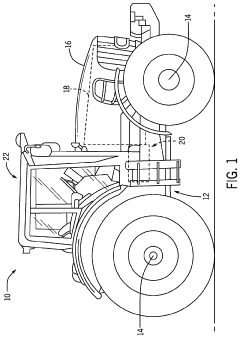
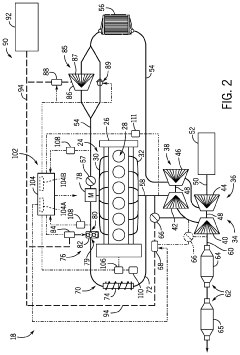
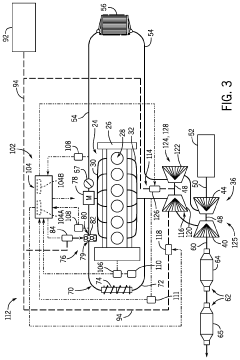
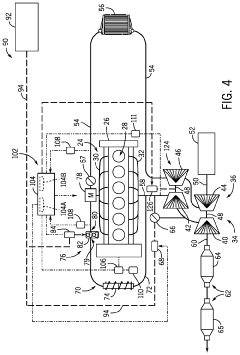
Engine system with electrified air system components for managing emissions of nitrogen oxides in a work vehicle
PatentActiveUS11536213B2
Innovation
- The engine system incorporates electrified air system components, including a turbocharger with a regulator and a controller that monitors engine load and exhaust gas temperature to modify the flow of exhaust gas through the turbine, reducing energy extraction and intake air flow, and utilizes an electrified wastegate or variable geometry turbocharger to optimize NOx emissions control.
Method and system for controlling nitrogen oxide emissions from a combustion engine
PatentWO2015130218A1
Innovation
- An active control method is implemented to adjust the NOx emissions upstream of the oxidizing component and reduction catalyst, optimizing the NO2/NOx ratio by controlling parameters such as fuel injection timing, pressure, and recirculation, to enhance catalytic performance and reduce NO2 emissions.


Emission Regulations and Compliance Standards
Emission regulations governing nitrogen oxides (NOx) from internal combustion engines have become increasingly stringent worldwide, driven by growing concerns over air quality and public health. In the European Union, the Euro VI standards impose strict limits on NOx emissions from heavy-duty diesel engines, capping them at 0.4 g/kWh under steady-state conditions and 0.46 g/kWh in real driving emissions tests. Similarly, the United States Environmental Protection Agency enforces rigorous NOx limits through its EPA 2010 standards for on-highway diesel engines, setting the threshold at 0.2 g/bhp-hr. These regulatory frameworks necessitate comprehensive understanding of all engine components that influence combustion characteristics and emission formation, including connecting rod dynamics.
The regulatory landscape extends beyond traditional certification cycles to encompass real-world driving conditions. The introduction of Portable Emissions Measurement Systems (PEMS) testing under Euro VI-E and subsequent regulations requires manufacturers to demonstrate compliance across diverse operating scenarios. This shift emphasizes the importance of quantifying subtle mechanical influences on combustion processes, as connecting rod effects may manifest differently under transient versus steady-state conditions. Compliance verification now demands detailed documentation of all design parameters affecting emission performance.
China has implemented its own stringent standards through the China VI regulations, which closely align with Euro VI requirements while incorporating specific provisions for local market conditions. These standards mandate NOx emission limits comparable to their European counterparts, with additional emphasis on durability and in-service conformity testing. The global harmonization of emission standards creates a unified imperative for engine manufacturers to optimize every component affecting combustion efficiency and pollutant formation.
Compliance strategies must account for the cumulative impact of mechanical design choices on emission outcomes. Connecting rod characteristics influence piston motion profiles, which directly affect in-cylinder temperature distributions and residence times critical to NOx formation kinetics. Regulatory bodies increasingly scrutinize the interaction between mechanical design parameters and emission control system performance, requiring manufacturers to demonstrate that component specifications consistently support emission targets throughout the engine's operational life. This regulatory environment establishes the framework within which connecting rod effects on NOx emissions must be quantified and optimized.
The regulatory landscape extends beyond traditional certification cycles to encompass real-world driving conditions. The introduction of Portable Emissions Measurement Systems (PEMS) testing under Euro VI-E and subsequent regulations requires manufacturers to demonstrate compliance across diverse operating scenarios. This shift emphasizes the importance of quantifying subtle mechanical influences on combustion processes, as connecting rod effects may manifest differently under transient versus steady-state conditions. Compliance verification now demands detailed documentation of all design parameters affecting emission performance.
China has implemented its own stringent standards through the China VI regulations, which closely align with Euro VI requirements while incorporating specific provisions for local market conditions. These standards mandate NOx emission limits comparable to their European counterparts, with additional emphasis on durability and in-service conformity testing. The global harmonization of emission standards creates a unified imperative for engine manufacturers to optimize every component affecting combustion efficiency and pollutant formation.
Compliance strategies must account for the cumulative impact of mechanical design choices on emission outcomes. Connecting rod characteristics influence piston motion profiles, which directly affect in-cylinder temperature distributions and residence times critical to NOx formation kinetics. Regulatory bodies increasingly scrutinize the interaction between mechanical design parameters and emission control system performance, requiring manufacturers to demonstrate that component specifications consistently support emission targets throughout the engine's operational life. This regulatory environment establishes the framework within which connecting rod effects on NOx emissions must be quantified and optimized.
Simulation and Testing Methodologies for NOx Quantification
Accurate quantification of connecting rod effects on engine-out NOx emissions requires a comprehensive integration of simulation and experimental methodologies. Computational fluid dynamics (CFD) coupled with chemical kinetics modeling serves as the primary simulation approach, enabling detailed analysis of in-cylinder combustion processes and NOx formation mechanisms. Advanced multi-dimensional CFD tools incorporate turbulence models, spray dynamics, and detailed chemical reaction schemes to predict NOx emissions under varying connecting rod geometries and operating conditions. These simulations must account for the subtle changes in piston motion profiles, compression ratios, and gas exchange dynamics introduced by different connecting rod designs.
Experimental validation remains essential for confirming simulation predictions and capturing real-world phenomena that numerical models may overlook. Engine dynamometer testing with precise NOx measurement equipment, including chemiluminescence analyzers and fast-response sensors, provides direct quantification of emission levels across diverse operating points. Test protocols should encompass steady-state and transient conditions to fully characterize the connecting rod influence on combustion phasing and emission formation.
Hybrid methodologies combining one-dimensional engine cycle simulation with three-dimensional CFD analysis offer computational efficiency while maintaining acceptable accuracy levels. These approaches enable rapid parametric studies of connecting rod length-to-stroke ratios and their impact on combustion chamber geometry evolution throughout the engine cycle. Sensitivity analysis techniques help isolate the specific contribution of connecting rod parameters from other confounding variables affecting NOx formation.
Advanced instrumentation including in-cylinder pressure transducers, heat flux sensors, and optical diagnostic techniques such as laser-induced fluorescence provide granular data for model calibration and validation. Statistical design of experiments methodologies optimizes test matrix development, reducing the number of required experimental runs while maximizing information yield. Machine learning algorithms increasingly complement traditional approaches by identifying complex nonlinear relationships between connecting rod characteristics and NOx emissions that conventional analysis methods might miss.
Experimental validation remains essential for confirming simulation predictions and capturing real-world phenomena that numerical models may overlook. Engine dynamometer testing with precise NOx measurement equipment, including chemiluminescence analyzers and fast-response sensors, provides direct quantification of emission levels across diverse operating points. Test protocols should encompass steady-state and transient conditions to fully characterize the connecting rod influence on combustion phasing and emission formation.
Hybrid methodologies combining one-dimensional engine cycle simulation with three-dimensional CFD analysis offer computational efficiency while maintaining acceptable accuracy levels. These approaches enable rapid parametric studies of connecting rod length-to-stroke ratios and their impact on combustion chamber geometry evolution throughout the engine cycle. Sensitivity analysis techniques help isolate the specific contribution of connecting rod parameters from other confounding variables affecting NOx formation.
Advanced instrumentation including in-cylinder pressure transducers, heat flux sensors, and optical diagnostic techniques such as laser-induced fluorescence provide granular data for model calibration and validation. Statistical design of experiments methodologies optimizes test matrix development, reducing the number of required experimental runs while maximizing information yield. Machine learning algorithms increasingly complement traditional approaches by identifying complex nonlinear relationships between connecting rod characteristics and NOx emissions that conventional analysis methods might miss.
Unlock deeper insights with PatSnap Eureka Quick Research — get a full tech report to explore trends and direct your research. Try now!
Generate Your Research Report Instantly with AI Agent
Supercharge your innovation with PatSnap Eureka AI Agent Platform!