
Control Oxidation Processes In Anode-Free Battery Compartments
JUN 16, 20269 MIN READ
Generate Your Research Report Instantly with AI Agent
Patsnap Eureka helps you evaluate technical feasibility & market potential.
Anode-Free Battery Oxidation Control Background and Objectives
Anode-free battery technology represents a paradigm shift in energy storage systems, eliminating the traditional metallic lithium anode and instead relying on in-situ lithium plating during the charging process. This innovative approach has emerged from decades of research aimed at overcoming the limitations of conventional lithium-ion batteries, particularly in terms of energy density and safety concerns. The evolution from lithium-ion to lithium-metal and subsequently to anode-free configurations reflects the industry's persistent pursuit of higher energy densities while maintaining operational safety and cycle stability.
The fundamental challenge in anode-free battery systems lies in controlling oxidation processes within the battery compartments, which significantly impacts both performance and longevity. Unlike traditional batteries where the anode provides a stable foundation for lithium intercalation, anode-free systems must manage the complex electrochemical environment where lithium metal is dynamically deposited and stripped from a current collector surface. This process creates unique oxidation challenges that can lead to electrolyte decomposition, current collector corrosion, and formation of undesirable side products.
Historical development of anode-free technology traces back to early lithium-metal battery research in the 1970s, where scientists first observed the potential for eliminating the anode host material. However, significant technical barriers, particularly related to dendrite formation and electrolyte stability, delayed practical implementation for several decades. Recent advances in electrolyte chemistry, current collector materials, and cell design have renewed interest in this technology, with major breakthroughs occurring in the past decade.
The primary objective of controlling oxidation processes in anode-free battery compartments centers on achieving stable, reversible lithium plating and stripping while minimizing parasitic reactions. This involves developing comprehensive strategies to manage the oxidative environment at both the current collector interface and within the electrolyte system. Key targets include extending cycle life beyond 500 cycles, maintaining coulombic efficiency above 99.5%, and preventing capacity fade associated with oxidative degradation.
Secondary objectives encompass optimizing the solid electrolyte interphase formation to create a protective barrier against unwanted oxidation reactions, while ensuring sufficient ionic conductivity for efficient battery operation. Additionally, the development of advanced current collector materials and surface treatments aims to provide oxidation-resistant platforms for lithium deposition, ultimately enabling the commercial viability of anode-free battery technology in high-energy applications.
The fundamental challenge in anode-free battery systems lies in controlling oxidation processes within the battery compartments, which significantly impacts both performance and longevity. Unlike traditional batteries where the anode provides a stable foundation for lithium intercalation, anode-free systems must manage the complex electrochemical environment where lithium metal is dynamically deposited and stripped from a current collector surface. This process creates unique oxidation challenges that can lead to electrolyte decomposition, current collector corrosion, and formation of undesirable side products.
Historical development of anode-free technology traces back to early lithium-metal battery research in the 1970s, where scientists first observed the potential for eliminating the anode host material. However, significant technical barriers, particularly related to dendrite formation and electrolyte stability, delayed practical implementation for several decades. Recent advances in electrolyte chemistry, current collector materials, and cell design have renewed interest in this technology, with major breakthroughs occurring in the past decade.
The primary objective of controlling oxidation processes in anode-free battery compartments centers on achieving stable, reversible lithium plating and stripping while minimizing parasitic reactions. This involves developing comprehensive strategies to manage the oxidative environment at both the current collector interface and within the electrolyte system. Key targets include extending cycle life beyond 500 cycles, maintaining coulombic efficiency above 99.5%, and preventing capacity fade associated with oxidative degradation.
Secondary objectives encompass optimizing the solid electrolyte interphase formation to create a protective barrier against unwanted oxidation reactions, while ensuring sufficient ionic conductivity for efficient battery operation. Additionally, the development of advanced current collector materials and surface treatments aims to provide oxidation-resistant platforms for lithium deposition, ultimately enabling the commercial viability of anode-free battery technology in high-energy applications.
Market Demand for Advanced Anode-Free Battery Systems
The global battery market is experiencing unprecedented growth driven by the rapid expansion of electric vehicles, renewable energy storage systems, and portable electronics. Traditional lithium-ion batteries with graphite anodes face significant limitations in energy density, charging speed, and material costs, creating substantial market pressure for next-generation battery technologies. Anode-free battery systems represent a revolutionary approach that eliminates the conventional anode material entirely, potentially increasing energy density by up to thirty percent while reducing manufacturing complexity and material costs.
Electric vehicle manufacturers are particularly driving demand for advanced anode-free battery systems as they seek to overcome range anxiety and reduce charging times. The automotive sector requires batteries with higher energy density to extend driving range without increasing vehicle weight or battery pack size. Current lithium-ion technology struggles to meet these demanding requirements, especially for long-haul transportation and commercial vehicle applications where weight and space constraints are critical factors.
Consumer electronics manufacturers face similar challenges as devices become increasingly sophisticated while consumers demand longer battery life and faster charging capabilities. Smartphones, laptops, and wearable devices require compact battery solutions that can deliver sustained performance throughout extended usage periods. Anode-free battery technology offers the potential to significantly reduce device thickness while maintaining or improving battery performance characteristics.
The renewable energy storage market presents another significant opportunity for anode-free battery systems. Grid-scale energy storage installations require cost-effective, high-capacity battery solutions that can efficiently store and discharge large amounts of energy. Traditional battery technologies often prove economically challenging for large-scale deployment due to material costs and energy density limitations. Anode-free systems could substantially reduce the cost per kilowatt-hour while improving overall system efficiency.
Emerging applications in aerospace, medical devices, and industrial equipment are creating additional market segments that demand specialized battery solutions. These applications often require batteries that can operate reliably under extreme conditions while maintaining consistent performance over extended periods. The simplified architecture of anode-free batteries potentially offers improved reliability and reduced failure modes compared to conventional battery designs.
However, controlling oxidation processes within anode-free battery compartments remains a critical technical challenge that must be addressed before widespread market adoption can occur. Successful resolution of oxidation control issues will unlock significant market opportunities across multiple industry sectors, positioning anode-free battery technology as a transformative solution for next-generation energy storage applications.
Electric vehicle manufacturers are particularly driving demand for advanced anode-free battery systems as they seek to overcome range anxiety and reduce charging times. The automotive sector requires batteries with higher energy density to extend driving range without increasing vehicle weight or battery pack size. Current lithium-ion technology struggles to meet these demanding requirements, especially for long-haul transportation and commercial vehicle applications where weight and space constraints are critical factors.
Consumer electronics manufacturers face similar challenges as devices become increasingly sophisticated while consumers demand longer battery life and faster charging capabilities. Smartphones, laptops, and wearable devices require compact battery solutions that can deliver sustained performance throughout extended usage periods. Anode-free battery technology offers the potential to significantly reduce device thickness while maintaining or improving battery performance characteristics.
The renewable energy storage market presents another significant opportunity for anode-free battery systems. Grid-scale energy storage installations require cost-effective, high-capacity battery solutions that can efficiently store and discharge large amounts of energy. Traditional battery technologies often prove economically challenging for large-scale deployment due to material costs and energy density limitations. Anode-free systems could substantially reduce the cost per kilowatt-hour while improving overall system efficiency.
Emerging applications in aerospace, medical devices, and industrial equipment are creating additional market segments that demand specialized battery solutions. These applications often require batteries that can operate reliably under extreme conditions while maintaining consistent performance over extended periods. The simplified architecture of anode-free batteries potentially offers improved reliability and reduced failure modes compared to conventional battery designs.
However, controlling oxidation processes within anode-free battery compartments remains a critical technical challenge that must be addressed before widespread market adoption can occur. Successful resolution of oxidation control issues will unlock significant market opportunities across multiple industry sectors, positioning anode-free battery technology as a transformative solution for next-generation energy storage applications.
Current Oxidation Challenges in Anode-Free Battery Compartments
Anode-free battery systems face significant oxidation challenges that fundamentally limit their commercial viability and long-term performance. The absence of a pre-formed anode creates unique electrochemical environments where oxidative reactions occur more readily, particularly at the current collector interface where lithium metal deposits directly during charging cycles.
The primary oxidation challenge stems from the highly reactive nature of freshly deposited lithium metal, which exhibits exceptional susceptibility to atmospheric oxygen, moisture, and electrolyte decomposition products. This reactivity leads to the formation of lithium oxide (Li2O) and lithium hydroxide (LiOH) layers that impede subsequent lithium plating and stripping processes, resulting in increased cell resistance and capacity fade.
Electrolyte oxidation presents another critical challenge, as the high surface area of deposited lithium accelerates parasitic reactions with carbonate-based electrolytes. These reactions consume active lithium inventory while generating gaseous byproducts that can cause cell swelling and safety concerns. The continuous consumption of electrolyte components leads to gradual performance degradation and shortened cycle life.
Current collector corrosion represents a particularly problematic oxidation pathway in anode-free configurations. Copper current collectors, while generally stable in conventional lithium-ion systems, experience enhanced oxidation in the presence of highly reactive lithium deposits and aggressive electrolyte environments. This corrosion process creates copper ions that can migrate through the electrolyte and deposit on the cathode, causing permanent capacity loss.
The formation of solid electrolyte interphase (SEI) layers in anode-free systems differs significantly from conventional batteries due to the dynamic nature of the lithium metal surface. Repeated dissolution and redeposition of lithium disrupts SEI stability, leading to continuous oxidative decomposition of electrolyte components and progressive thickening of resistive surface films.
Temperature-dependent oxidation kinetics further complicate the challenge, as elevated operating temperatures accelerate all oxidative processes while low temperatures promote non-uniform lithium deposition that increases surface area exposure to oxidizing species. This temperature sensitivity limits the operational window for anode-free battery systems and requires sophisticated thermal management strategies.
The interconnected nature of these oxidation challenges creates cascading failure mechanisms where initial oxidative reactions trigger secondary processes that accelerate overall system degradation. Understanding and mitigating these complex oxidation pathways remains the primary technical barrier preventing widespread adoption of anode-free battery technology in commercial applications.
The primary oxidation challenge stems from the highly reactive nature of freshly deposited lithium metal, which exhibits exceptional susceptibility to atmospheric oxygen, moisture, and electrolyte decomposition products. This reactivity leads to the formation of lithium oxide (Li2O) and lithium hydroxide (LiOH) layers that impede subsequent lithium plating and stripping processes, resulting in increased cell resistance and capacity fade.
Electrolyte oxidation presents another critical challenge, as the high surface area of deposited lithium accelerates parasitic reactions with carbonate-based electrolytes. These reactions consume active lithium inventory while generating gaseous byproducts that can cause cell swelling and safety concerns. The continuous consumption of electrolyte components leads to gradual performance degradation and shortened cycle life.
Current collector corrosion represents a particularly problematic oxidation pathway in anode-free configurations. Copper current collectors, while generally stable in conventional lithium-ion systems, experience enhanced oxidation in the presence of highly reactive lithium deposits and aggressive electrolyte environments. This corrosion process creates copper ions that can migrate through the electrolyte and deposit on the cathode, causing permanent capacity loss.
The formation of solid electrolyte interphase (SEI) layers in anode-free systems differs significantly from conventional batteries due to the dynamic nature of the lithium metal surface. Repeated dissolution and redeposition of lithium disrupts SEI stability, leading to continuous oxidative decomposition of electrolyte components and progressive thickening of resistive surface films.
Temperature-dependent oxidation kinetics further complicate the challenge, as elevated operating temperatures accelerate all oxidative processes while low temperatures promote non-uniform lithium deposition that increases surface area exposure to oxidizing species. This temperature sensitivity limits the operational window for anode-free battery systems and requires sophisticated thermal management strategies.
The interconnected nature of these oxidation challenges creates cascading failure mechanisms where initial oxidative reactions trigger secondary processes that accelerate overall system degradation. Understanding and mitigating these complex oxidation pathways remains the primary technical barrier preventing widespread adoption of anode-free battery technology in commercial applications.
Existing Oxidation Control Solutions in Battery Systems
01 Electrolyte composition and additives for anode-free batteries
Specialized electrolyte formulations and additives are developed to enhance the performance of anode-free battery systems. These compositions help stabilize the electrochemical environment and improve the efficiency of metal deposition processes. The electrolyte systems are designed to prevent dendrite formation and enhance the reversibility of metal plating and stripping reactions during battery operation.- Electrolyte composition and additives for anode-free batteries: Specialized electrolyte formulations and additives are developed to enhance the performance of anode-free battery systems. These compositions help stabilize the electrochemical environment and improve the oxidation resistance during battery operation. The electrolyte systems are designed to prevent unwanted side reactions and maintain battery stability throughout charge-discharge cycles.
- Cathode materials and structures for oxidation control: Advanced cathode materials and structural designs are employed to manage oxidation processes in anode-free battery configurations. These materials are engineered to provide stable electrochemical performance while minimizing oxidative degradation. The cathode structures help maintain proper voltage levels and prevent excessive oxidation that could compromise battery performance.
- Protective coatings and interface engineering: Protective coating technologies and interface engineering approaches are implemented to control oxidation at critical battery interfaces. These solutions create barriers that prevent unwanted oxidative reactions while maintaining ionic conductivity. The protective layers help extend battery life by reducing degradation caused by oxidative processes.
- Battery management and control systems: Sophisticated battery management systems are developed to monitor and control oxidation processes in anode-free batteries. These systems implement algorithms and control strategies to optimize charging protocols and prevent conditions that lead to excessive oxidation. The management systems help maintain optimal operating conditions throughout the battery lifecycle.
- Manufacturing processes and quality control: Specialized manufacturing techniques and quality control measures are established for producing anode-free batteries with controlled oxidation characteristics. These processes ensure consistent battery performance and minimize oxidation-related defects during production. The manufacturing approaches focus on creating stable battery structures that resist oxidative degradation over time.
02 Metal plating and stripping mechanisms in anode-free systems
The fundamental processes of metal deposition and dissolution in anode-free battery configurations involve complex electrochemical mechanisms. These systems rely on direct metal plating onto current collectors during charging and subsequent stripping during discharge. The optimization of these processes is crucial for achieving high coulombic efficiency and preventing capacity fade over multiple cycles.Expand Specific Solutions03 Current collector surface modifications and treatments
Surface engineering of current collectors plays a critical role in anode-free battery performance. Various surface treatments and modifications are employed to promote uniform metal nucleation and growth while preventing unwanted side reactions. These modifications help create favorable interfaces for metal deposition and improve the overall stability of the anode-free system.Expand Specific Solutions04 Protective layers and interface engineering
The development of protective layers and interface engineering strategies addresses the challenges associated with direct metal plating in anode-free batteries. These approaches involve creating stable interfaces that can accommodate volume changes and prevent electrolyte decomposition. The protective layers help maintain battery performance and extend cycle life by controlling the metal deposition morphology.Expand Specific Solutions05 Battery cell design and manufacturing processes
Specialized cell architectures and manufacturing techniques are required for anode-free battery systems. These processes involve precise control of assembly conditions and the implementation of specific design features to accommodate the unique requirements of anode-free operation. The manufacturing approaches focus on creating robust cell structures that can withstand the stresses associated with metal plating and stripping cycles.Expand Specific Solutions
Key Players in Anode-Free Battery Development
The anode-free battery oxidation control technology represents an emerging segment within the advanced battery industry, currently in its early development stage with significant growth potential driven by the increasing demand for higher energy density storage solutions. The market remains relatively nascent but shows promising expansion prospects as electric vehicle adoption accelerates globally. Technology maturity varies considerably across key players, with established automotive manufacturers like Toyota Motor Corp. and BMW AG leveraging their extensive R&D capabilities alongside traditional battery specialists such as LG Chem Ltd. and specialized research institutions including Wisconsin Alumni Research Foundation. Companies like Enevate Corp. and Our Next Energy Inc. are pioneering silicon-dominant anode technologies, while industrial giants including 3M Innovative Properties Co. and Robert Bosch GmbH contribute materials science expertise. The competitive landscape features a diverse ecosystem spanning automotive OEMs, battery manufacturers, materials companies, and research institutions, indicating the technology's cross-industry importance and collaborative development approach essential for commercialization success.
Toyota Motor Corp.
Technical Solution: Toyota has developed advanced electrolyte formulations and protective coating technologies for anode-free battery systems. Their approach focuses on solid-state electrolyte interfaces that minimize lithium dendrite formation and control oxidative degradation at high voltages. The company employs ceramic-polymer composite separators with integrated oxygen scavenging additives to prevent electrolyte decomposition. Their proprietary surface treatment methods create stable passivation layers that resist oxidation while maintaining ionic conductivity. Toyota's system incorporates real-time monitoring of oxidation potential and adaptive charging protocols to extend battery lifespan in automotive applications.
Strengths: Extensive automotive integration experience, robust solid-state electrolyte technology, proven manufacturing scalability. Weaknesses: Higher production costs, limited energy density compared to liquid electrolyte systems.
3M Innovative Properties Co.
Technical Solution: 3M has developed innovative material solutions for oxidation control using their expertise in advanced polymers and surface treatments. Their approach centers on fluoropolymer-based protective coatings applied to current collectors and separator materials, providing exceptional chemical resistance to oxidative environments. The company's technology includes specialized adhesive systems that maintain structural integrity under oxidative stress while preventing electrolyte degradation. 3M's solution incorporates micro-encapsulated antioxidant additives that release protective compounds when triggered by oxidation byproducts, creating a self-healing mechanism for long-term battery stability in demanding applications.
Strengths: Advanced materials expertise, proven chemical resistance technologies, scalable manufacturing processes. Weaknesses: Limited battery-specific experience, potential compatibility issues with existing battery chemistries.
Core Innovations in Anode-Free Battery Oxidation Management
Anode-free battery cell
PatentInactiveEP4383388A1
Innovation
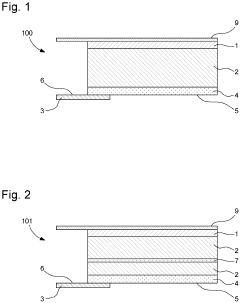
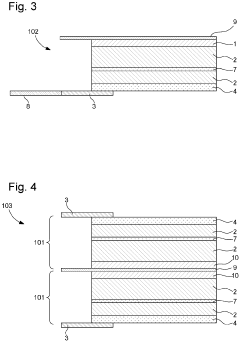
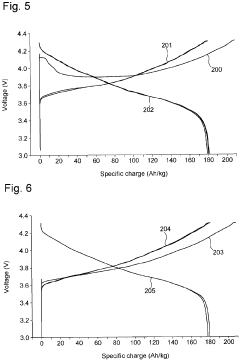
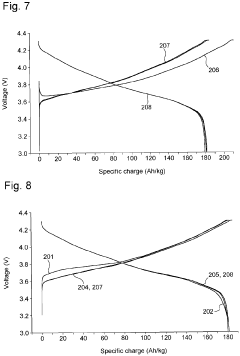
- The anode-free battery cell design includes a cathode current collector, a cathode with active materials, an electrolyte, and a high surface area substrate with an electronic conductor, which reduces dendrite formation by facilitating efficient metal deposition and improving electrical conductivity, thereby enhancing safety and longevity.
Anode-free battery cell
PatentWO2024120812A1
Innovation
- The anode-free battery cell design includes a cathode current collector, cathode with active materials, an electrolyte, and an electronic conductor, along with a high surface area substrate and separator, which reduces dendrite formation by facilitating efficient metal deposition and improving electrical conductivity.


Safety Standards for Advanced Battery Technologies
The development of safety standards for advanced battery technologies, particularly for anode-free battery systems, has become increasingly critical as these technologies advance toward commercial deployment. Current safety frameworks primarily address conventional lithium-ion batteries, leaving significant gaps in addressing the unique risks associated with anode-free architectures and their susceptibility to oxidation processes.
Existing safety standards such as IEC 62133, UL 2054, and UN 38.3 provide foundational guidelines for battery safety testing, including thermal runaway prevention, mechanical abuse tolerance, and electrical safety protocols. However, these standards were developed before the emergence of anode-free battery technologies and do not adequately address the specific failure modes associated with oxidation control in compartmentalized battery designs.
The International Electrotechnical Commission (IEC) and Underwriters Laboratories (UL) are currently developing supplementary standards specifically targeting next-generation battery chemistries. These emerging standards focus on enhanced thermal management requirements, stricter gas emission controls, and more rigorous testing protocols for batteries operating without traditional anode materials. The standards emphasize the need for real-time monitoring systems capable of detecting early oxidation indicators.
Key safety requirements being established include mandatory implementation of oxygen sensors within battery compartments, enhanced fire suppression systems designed for metal-air chemistries, and stricter containment protocols for preventing cross-contamination between cells. These standards also mandate advanced battery management systems capable of predictive failure analysis and automated shutdown procedures when oxidation thresholds are exceeded.
Regulatory bodies across major markets are aligning their approaches, with the European Union's Battery Regulation and similar frameworks in North America and Asia incorporating provisions for advanced battery technologies. These regulations require comprehensive lifecycle safety assessments, including end-of-life disposal considerations for anode-free systems where oxidation byproducts may pose environmental risks.
The evolving safety landscape demands that manufacturers implement multi-layered protection strategies, combining passive safety features with active monitoring and control systems to ensure safe operation throughout the battery's operational life.
Existing safety standards such as IEC 62133, UL 2054, and UN 38.3 provide foundational guidelines for battery safety testing, including thermal runaway prevention, mechanical abuse tolerance, and electrical safety protocols. However, these standards were developed before the emergence of anode-free battery technologies and do not adequately address the specific failure modes associated with oxidation control in compartmentalized battery designs.
The International Electrotechnical Commission (IEC) and Underwriters Laboratories (UL) are currently developing supplementary standards specifically targeting next-generation battery chemistries. These emerging standards focus on enhanced thermal management requirements, stricter gas emission controls, and more rigorous testing protocols for batteries operating without traditional anode materials. The standards emphasize the need for real-time monitoring systems capable of detecting early oxidation indicators.
Key safety requirements being established include mandatory implementation of oxygen sensors within battery compartments, enhanced fire suppression systems designed for metal-air chemistries, and stricter containment protocols for preventing cross-contamination between cells. These standards also mandate advanced battery management systems capable of predictive failure analysis and automated shutdown procedures when oxidation thresholds are exceeded.
Regulatory bodies across major markets are aligning their approaches, with the European Union's Battery Regulation and similar frameworks in North America and Asia incorporating provisions for advanced battery technologies. These regulations require comprehensive lifecycle safety assessments, including end-of-life disposal considerations for anode-free systems where oxidation byproducts may pose environmental risks.
The evolving safety landscape demands that manufacturers implement multi-layered protection strategies, combining passive safety features with active monitoring and control systems to ensure safe operation throughout the battery's operational life.
Environmental Impact of Anode-Free Battery Manufacturing
The manufacturing of anode-free batteries presents significant environmental considerations that differ substantially from conventional lithium-ion battery production. The elimination of traditional anode materials such as graphite reduces the environmental burden associated with mining and processing these materials, potentially decreasing carbon emissions by approximately 15-20% during the material extraction phase. However, the specialized manufacturing processes required for anode-free architectures introduce new environmental challenges that must be carefully evaluated.
The production of ultra-thin copper current collectors and advanced electrolyte formulations requires more energy-intensive manufacturing processes compared to standard battery components. These processes typically involve high-precision coating techniques and controlled atmosphere environments that consume 25-30% more energy per unit area of electrode material. The increased energy consumption is partially offset by the reduced material throughput, as anode-free designs eliminate the need for active anode material processing and coating operations.
Electrolyte manufacturing for anode-free batteries often requires specialized additives and stabilizers to control oxidation processes and enhance lithium plating uniformity. These additives, including fluorinated compounds and organophosphorus materials, present unique disposal challenges and require specialized waste treatment protocols. The environmental impact assessment must consider the entire lifecycle of these chemicals, from synthesis to end-of-life disposal.
The oxidation control mechanisms essential for anode-free battery performance introduce additional environmental considerations. Advanced protective coatings and interfacial layers often incorporate rare earth elements or specialized polymers that require careful sourcing and disposal management. The manufacturing processes for these protective systems typically generate chemical waste streams that require specialized treatment facilities.
Water usage in anode-free battery manufacturing differs significantly from conventional processes. The elimination of graphite processing reduces water consumption in material preparation by approximately 40%, but the increased requirements for electrolyte purification and component cleaning can offset these savings. Advanced filtration and recycling systems are essential to minimize overall water impact.
The potential for material recovery and recycling in anode-free batteries presents both opportunities and challenges. While the simplified electrode structure may facilitate certain recycling processes, the specialized electrolyte formulations and protective coatings require development of new recovery techniques to maximize material reclamation and minimize environmental impact.
The production of ultra-thin copper current collectors and advanced electrolyte formulations requires more energy-intensive manufacturing processes compared to standard battery components. These processes typically involve high-precision coating techniques and controlled atmosphere environments that consume 25-30% more energy per unit area of electrode material. The increased energy consumption is partially offset by the reduced material throughput, as anode-free designs eliminate the need for active anode material processing and coating operations.
Electrolyte manufacturing for anode-free batteries often requires specialized additives and stabilizers to control oxidation processes and enhance lithium plating uniformity. These additives, including fluorinated compounds and organophosphorus materials, present unique disposal challenges and require specialized waste treatment protocols. The environmental impact assessment must consider the entire lifecycle of these chemicals, from synthesis to end-of-life disposal.
The oxidation control mechanisms essential for anode-free battery performance introduce additional environmental considerations. Advanced protective coatings and interfacial layers often incorporate rare earth elements or specialized polymers that require careful sourcing and disposal management. The manufacturing processes for these protective systems typically generate chemical waste streams that require specialized treatment facilities.
Water usage in anode-free battery manufacturing differs significantly from conventional processes. The elimination of graphite processing reduces water consumption in material preparation by approximately 40%, but the increased requirements for electrolyte purification and component cleaning can offset these savings. Advanced filtration and recycling systems are essential to minimize overall water impact.
The potential for material recovery and recycling in anode-free batteries presents both opportunities and challenges. While the simplified electrode structure may facilitate certain recycling processes, the specialized electrolyte formulations and protective coatings require development of new recovery techniques to maximize material reclamation and minimize environmental impact.
Unlock deeper insights with Patsnap Eureka Quick Research — get a full tech report to explore trends and direct your research. Try now!
Generate Your Research Report Instantly with AI Agent
Supercharge your innovation with Patsnap Eureka AI Agent Platform!