

Designing Custom Current Interrupt Devices for Space-Grade Applications
MAY 25, 20269 MIN READ
Generate Your Research Report Instantly with AI Agent
Patsnap Eureka helps you evaluate technical feasibility & market potential.
Space-Grade Current Interrupt Device Background and Objectives
Space-grade current interrupt devices represent a critical component in spacecraft electrical protection systems, designed to safeguard sensitive electronic equipment from overcurrent conditions in the harsh environment of space. These specialized devices must operate reliably in extreme temperatures, radiation exposure, vacuum conditions, and electromagnetic interference while maintaining precise current monitoring and interruption capabilities.
The evolution of space-grade current interrupt technology has progressed through several distinct phases since the early space programs of the 1960s. Initial spacecraft relied on simple fuses and basic circuit breakers adapted from terrestrial applications, which often proved inadequate for the unique demands of space missions. The Apollo program highlighted the need for more sophisticated protection systems, leading to the development of specialized space-qualified components.
During the 1980s and 1990s, the advent of solid-state switching technologies revolutionized current interrupt device design. This period saw the introduction of semiconductor-based solutions that offered faster response times, better controllability, and enhanced reliability compared to mechanical alternatives. The development of radiation-hardened semiconductors became crucial as mission durations extended and electronic systems became more complex.
The modern era of space-grade current interrupt devices began in the 2000s with the integration of smart monitoring capabilities and digital control systems. Contemporary devices incorporate advanced features such as programmable trip curves, real-time telemetry, remote reset capabilities, and predictive maintenance algorithms. These innovations have enabled more sophisticated power management strategies essential for long-duration missions and complex spacecraft architectures.
Current technological objectives focus on achieving several key performance targets. Primary goals include developing devices capable of operating across extended temperature ranges from -180°C to +150°C while maintaining consistent performance characteristics. Radiation tolerance requirements demand survival of total ionizing doses exceeding 100 krad and single-event upset immunity for mission-critical applications.
Miniaturization represents another crucial objective, driven by the increasing demand for smaller, lighter spacecraft components. Modern designs target significant reductions in size, weight, and power consumption compared to previous generations while maintaining or improving functional capabilities. Enhanced diagnostic and prognostic features aim to provide comprehensive system health monitoring and predictive failure analysis.
Future development objectives emphasize autonomous operation capabilities, enabling devices to adapt their protection characteristics based on real-time system conditions and mission phases. Integration with spacecraft-wide power management systems seeks to optimize overall electrical system efficiency and reliability through coordinated protection strategies.
The evolution of space-grade current interrupt technology has progressed through several distinct phases since the early space programs of the 1960s. Initial spacecraft relied on simple fuses and basic circuit breakers adapted from terrestrial applications, which often proved inadequate for the unique demands of space missions. The Apollo program highlighted the need for more sophisticated protection systems, leading to the development of specialized space-qualified components.
During the 1980s and 1990s, the advent of solid-state switching technologies revolutionized current interrupt device design. This period saw the introduction of semiconductor-based solutions that offered faster response times, better controllability, and enhanced reliability compared to mechanical alternatives. The development of radiation-hardened semiconductors became crucial as mission durations extended and electronic systems became more complex.
The modern era of space-grade current interrupt devices began in the 2000s with the integration of smart monitoring capabilities and digital control systems. Contemporary devices incorporate advanced features such as programmable trip curves, real-time telemetry, remote reset capabilities, and predictive maintenance algorithms. These innovations have enabled more sophisticated power management strategies essential for long-duration missions and complex spacecraft architectures.
Current technological objectives focus on achieving several key performance targets. Primary goals include developing devices capable of operating across extended temperature ranges from -180°C to +150°C while maintaining consistent performance characteristics. Radiation tolerance requirements demand survival of total ionizing doses exceeding 100 krad and single-event upset immunity for mission-critical applications.
Miniaturization represents another crucial objective, driven by the increasing demand for smaller, lighter spacecraft components. Modern designs target significant reductions in size, weight, and power consumption compared to previous generations while maintaining or improving functional capabilities. Enhanced diagnostic and prognostic features aim to provide comprehensive system health monitoring and predictive failure analysis.
Future development objectives emphasize autonomous operation capabilities, enabling devices to adapt their protection characteristics based on real-time system conditions and mission phases. Integration with spacecraft-wide power management systems seeks to optimize overall electrical system efficiency and reliability through coordinated protection strategies.
Market Demand for Space-Grade Current Protection Systems
The space industry is experiencing unprecedented growth driven by the proliferation of satellite constellations, deep space exploration missions, and commercial space ventures. This expansion has created substantial demand for reliable electrical protection systems capable of operating in the harsh space environment. Current interrupt devices represent a critical component in spacecraft electrical architectures, where system failures can result in mission loss worth hundreds of millions of dollars.
Satellite manufacturers face increasing pressure to enhance power system reliability while reducing weight and volume constraints. Traditional terrestrial circuit protection solutions prove inadequate for space applications due to radiation exposure, extreme temperature variations, and vacuum conditions. The need for custom current interrupt devices has become particularly acute as spacecraft electrical systems grow more complex and power-hungry.
The commercial satellite sector drives significant market demand, with operators requiring protection systems that can function reliably for mission durations spanning fifteen to twenty years. Geostationary communication satellites, low Earth orbit constellations, and scientific missions each present unique protection requirements that standard commercial-off-the-shelf components cannot address effectively.
Government space agencies and defense contractors represent another substantial market segment demanding advanced current protection capabilities. Military satellites require enhanced radiation tolerance and cybersecurity features, while scientific missions to planetary bodies need devices capable of operating in extreme environmental conditions that exceed typical space qualification standards.
The emerging space tourism and commercial crew transportation markets are creating additional demand for human-rated current protection systems. These applications require enhanced safety margins and fail-safe operation modes that differ significantly from traditional unmanned spacecraft requirements.
Supply chain considerations further amplify market demand for custom solutions. Space-grade components often face long lead times and limited supplier bases, making custom designs attractive for mission-critical applications where schedule control and performance optimization are paramount. The trend toward vertical integration among major space companies has increased interest in developing proprietary current interrupt technologies tailored to specific platform architectures.
Market growth is also fueled by the miniaturization trend in spacecraft design, where traditional protection devices consume excessive space and mass budgets. CubeSats and small satellite platforms require compact, lightweight current interrupt solutions that maintain high performance while meeting stringent size constraints.
Satellite manufacturers face increasing pressure to enhance power system reliability while reducing weight and volume constraints. Traditional terrestrial circuit protection solutions prove inadequate for space applications due to radiation exposure, extreme temperature variations, and vacuum conditions. The need for custom current interrupt devices has become particularly acute as spacecraft electrical systems grow more complex and power-hungry.
The commercial satellite sector drives significant market demand, with operators requiring protection systems that can function reliably for mission durations spanning fifteen to twenty years. Geostationary communication satellites, low Earth orbit constellations, and scientific missions each present unique protection requirements that standard commercial-off-the-shelf components cannot address effectively.
Government space agencies and defense contractors represent another substantial market segment demanding advanced current protection capabilities. Military satellites require enhanced radiation tolerance and cybersecurity features, while scientific missions to planetary bodies need devices capable of operating in extreme environmental conditions that exceed typical space qualification standards.
The emerging space tourism and commercial crew transportation markets are creating additional demand for human-rated current protection systems. These applications require enhanced safety margins and fail-safe operation modes that differ significantly from traditional unmanned spacecraft requirements.
Supply chain considerations further amplify market demand for custom solutions. Space-grade components often face long lead times and limited supplier bases, making custom designs attractive for mission-critical applications where schedule control and performance optimization are paramount. The trend toward vertical integration among major space companies has increased interest in developing proprietary current interrupt technologies tailored to specific platform architectures.
Market growth is also fueled by the miniaturization trend in spacecraft design, where traditional protection devices consume excessive space and mass budgets. CubeSats and small satellite platforms require compact, lightweight current interrupt solutions that maintain high performance while meeting stringent size constraints.
Current State and Challenges of Space Current Interrupt Technology
Space-grade current interrupt devices represent a critical component in spacecraft electrical systems, yet the current technological landscape reveals significant gaps between terrestrial solutions and the extreme requirements of space environments. Contemporary current interrupt technology primarily relies on mechanical circuit breakers, solid-state switches, and hybrid solutions, each presenting distinct limitations when adapted for space applications.
Mechanical circuit breakers, while proven in terrestrial applications, face substantial challenges in space environments. The vacuum of space eliminates air as an arc-quenching medium, leading to prolonged arc duration and potential contact welding. Temperature cycling between -150°C and +120°C causes thermal stress on mechanical components, while the absence of gravity affects the operation of spring-loaded mechanisms designed for Earth-based applications.
Solid-state current interrupt devices, including MOSFETs, IGBTs, and silicon carbide switches, offer faster switching speeds and eliminate mechanical wear concerns. However, these devices encounter severe limitations in space environments, particularly regarding radiation tolerance. Total ionizing dose effects and single-event effects can cause permanent damage or temporary malfunctions, compromising system reliability. Additionally, the heat dissipation challenges in vacuum environments limit their current-carrying capacity.
The space industry currently lacks standardized current interrupt solutions specifically designed for the unique combination of high vacuum, extreme temperatures, radiation exposure, and zero gravity. Most existing space-qualified devices are modified terrestrial products, resulting in over-engineered solutions that add unnecessary weight and complexity to spacecraft systems.
Radiation hardening remains one of the most significant technical challenges. Current space-grade devices must withstand total ionizing doses exceeding 100 krad while maintaining functionality during single-event upsets. This requirement often necessitates expensive radiation-hardened semiconductors or complex redundancy schemes, substantially increasing system cost and complexity.
Thermal management presents another critical challenge, as traditional convective cooling is impossible in space. Current interrupt devices must operate reliably across extreme temperature ranges while dissipating fault currents that can generate substantial heat. The lack of atmospheric cooling requires innovative thermal design approaches and materials capable of radiative heat transfer.
Manufacturing and testing constraints further complicate the development of space-grade current interrupt devices. The limited availability of space-qualified components, extended qualification timelines, and the high cost of space-environment testing create barriers to innovation. Additionally, the low-volume nature of space applications makes it economically challenging to develop specialized solutions.
Current technology gaps include the absence of fast-acting, radiation-tolerant current limiters capable of handling high fault currents, lack of intelligent current interrupt systems with built-in diagnostics, and insufficient integration between current interrupt devices and spacecraft power management systems. These limitations highlight the urgent need for purpose-built solutions that address the unique requirements of space applications rather than adapting terrestrial technologies.
Mechanical circuit breakers, while proven in terrestrial applications, face substantial challenges in space environments. The vacuum of space eliminates air as an arc-quenching medium, leading to prolonged arc duration and potential contact welding. Temperature cycling between -150°C and +120°C causes thermal stress on mechanical components, while the absence of gravity affects the operation of spring-loaded mechanisms designed for Earth-based applications.
Solid-state current interrupt devices, including MOSFETs, IGBTs, and silicon carbide switches, offer faster switching speeds and eliminate mechanical wear concerns. However, these devices encounter severe limitations in space environments, particularly regarding radiation tolerance. Total ionizing dose effects and single-event effects can cause permanent damage or temporary malfunctions, compromising system reliability. Additionally, the heat dissipation challenges in vacuum environments limit their current-carrying capacity.
The space industry currently lacks standardized current interrupt solutions specifically designed for the unique combination of high vacuum, extreme temperatures, radiation exposure, and zero gravity. Most existing space-qualified devices are modified terrestrial products, resulting in over-engineered solutions that add unnecessary weight and complexity to spacecraft systems.
Radiation hardening remains one of the most significant technical challenges. Current space-grade devices must withstand total ionizing doses exceeding 100 krad while maintaining functionality during single-event upsets. This requirement often necessitates expensive radiation-hardened semiconductors or complex redundancy schemes, substantially increasing system cost and complexity.
Thermal management presents another critical challenge, as traditional convective cooling is impossible in space. Current interrupt devices must operate reliably across extreme temperature ranges while dissipating fault currents that can generate substantial heat. The lack of atmospheric cooling requires innovative thermal design approaches and materials capable of radiative heat transfer.
Manufacturing and testing constraints further complicate the development of space-grade current interrupt devices. The limited availability of space-qualified components, extended qualification timelines, and the high cost of space-environment testing create barriers to innovation. Additionally, the low-volume nature of space applications makes it economically challenging to develop specialized solutions.
Current technology gaps include the absence of fast-acting, radiation-tolerant current limiters capable of handling high fault currents, lack of intelligent current interrupt systems with built-in diagnostics, and insufficient integration between current interrupt devices and spacecraft power management systems. These limitations highlight the urgent need for purpose-built solutions that address the unique requirements of space applications rather than adapting terrestrial technologies.
Existing Solutions for Space Current Interrupt Devices
01 Circuit breaker mechanisms and switching devices
Current interrupt devices that utilize mechanical switching mechanisms to break electrical circuits when overcurrent conditions are detected. These devices typically employ spring-loaded contacts, arc extinguishing chambers, and trip mechanisms that physically separate conductors to interrupt current flow. The mechanisms are designed to handle various voltage and current ratings while providing reliable protection against electrical faults.- Circuit breaker mechanisms and switching devices: Current interrupt devices that utilize mechanical switching mechanisms to break electrical circuits when overcurrent conditions are detected. These devices typically employ spring-loaded contacts, arc extinguishing chambers, and trip mechanisms that physically separate conductors to interrupt current flow. The mechanisms are designed to handle various voltage and current ratings while providing reliable protection against electrical faults.
- Arc suppression and extinguishing technologies: Technologies focused on controlling and extinguishing electrical arcs that form during current interruption. These systems employ various methods including gas-filled chambers, vacuum environments, magnetic field manipulation, and specialized contact materials to quickly quench arcs and prevent re-ignition. The arc suppression mechanisms are critical for safe and effective current interruption in high-power applications.
- Electronic and solid-state current interruption: Solid-state devices that use semiconductor components to interrupt current flow without mechanical moving parts. These systems utilize power electronics such as thyristors, transistors, and integrated control circuits to provide fast and precise current interruption. Electronic interrupt devices offer advantages in terms of response time, reliability, and the ability to provide programmable protection characteristics.
- Fault detection and protection control systems: Intelligent control systems that monitor electrical parameters and automatically trigger current interruption when abnormal conditions are detected. These systems incorporate sensors, microprocessors, and communication interfaces to provide comprehensive protection against overcurrent, short circuits, ground faults, and other electrical anomalies. The control systems can be integrated with building management systems and provide diagnostic capabilities.
- High-voltage and power system applications: Specialized current interrupt devices designed for high-voltage transmission and distribution systems. These devices must handle extreme electrical stresses and provide reliable interruption of large fault currents. They incorporate advanced insulation systems, specialized contact materials, and robust mechanical designs to operate safely in demanding power system environments while maintaining grid stability and protection.
02 Arc suppression and extinguishing technologies
Technologies focused on controlling and extinguishing electrical arcs that form during current interruption. These systems employ various methods including gas-filled chambers, vacuum environments, magnetic field manipulation, and specialized contact materials to quickly quench arcs and prevent re-ignition. The arc suppression mechanisms are critical for safe and effective current interruption in high-power applications.Expand Specific Solutions03 Electronic and solid-state current interruption
Solid-state devices that use semiconductor components to interrupt current flow without mechanical moving parts. These systems utilize power electronics, thyristors, transistors, and control circuits to detect fault conditions and rapidly interrupt current. They offer faster response times and higher reliability compared to mechanical systems, with precise control over interruption timing and current levels.Expand Specific Solutions04 Fault detection and protection control systems
Intelligent control systems that monitor electrical parameters and automatically trigger current interruption when abnormal conditions are detected. These systems incorporate sensors, microprocessors, and algorithms to analyze current, voltage, and frequency patterns. They provide selective protection, coordination with other protective devices, and communication capabilities for modern power system management.Expand Specific Solutions05 High-voltage and power system applications
Specialized current interrupt devices designed for high-voltage transmission and distribution systems. These devices handle extreme electrical stresses and must interrupt very high fault currents while maintaining system stability. They incorporate advanced insulation systems, SF6 gas or vacuum technology, and sophisticated control mechanisms to ensure reliable operation in critical power infrastructure applications.Expand Specific Solutions
Key Players in Space Electronics and Current Protection Industry
The space-grade current interrupt device market represents a highly specialized niche within the broader aerospace electronics sector, characterized by stringent reliability requirements and limited market participants. The industry is in a mature development stage, driven by increasing satellite deployments and space exploration missions, with market size constrained by the specialized nature and high certification barriers. Technology maturity varies significantly among key players, with established aerospace giants like China Academy of Space Technology, Beijing Satellite Manufacturing Factory, and Thales SA leading in system integration capabilities, while semiconductor specialists including Intel Corp., STMicroelectronics, and Infineon Technologies Austria AG provide advanced component-level solutions. Chinese institutions such as Shanghai Institute of Satellite Engineering and Northwestern Polytechnical University contribute significant research capabilities, while companies like ABB Ltd. and Schneider Electric Industries bring industrial power management expertise to space applications, creating a competitive landscape where collaboration between system integrators and component manufacturers drives innovation.
China Academy of Space Technology
Technical Solution: Develops radiation-hardened current interrupt devices utilizing silicon carbide (SiC) semiconductor technology for enhanced thermal stability and radiation tolerance. Their approach incorporates triple modular redundancy (TMR) architecture with real-time fault detection algorithms, enabling operation in temperature ranges from -180°C to +125°C. The devices feature magnetic flux compression current limiting with response times under 10 microseconds and can handle fault currents up to 1000A while maintaining less than 1mV voltage drop during normal operation.
Strengths: Extensive space heritage and proven radiation hardening expertise, comprehensive testing facilities for space qualification. Weaknesses: Limited commercial availability and higher costs compared to terrestrial solutions.
Thales SA
Technical Solution: Implements hybrid solid-state current interrupt technology combining MOSFET and mechanical relay systems for space applications. Their design features gallium nitride (GaN) power devices with integrated current sensing and predictive failure analysis. The system operates with bi-directional current interruption capability up to 500A, incorporating electromagnetic interference (EMI) shielding and vacuum-compatible materials. Advanced thermal management uses phase-change materials and conductive cooling paths to maintain junction temperatures below 150°C in space environments.
Strengths: Strong aerospace heritage with proven space-qualified components and comprehensive system integration capabilities. Weaknesses: Complex hybrid architecture may introduce additional failure modes and requires sophisticated control systems.
Core Innovations in Space-Grade Current Protection Patents
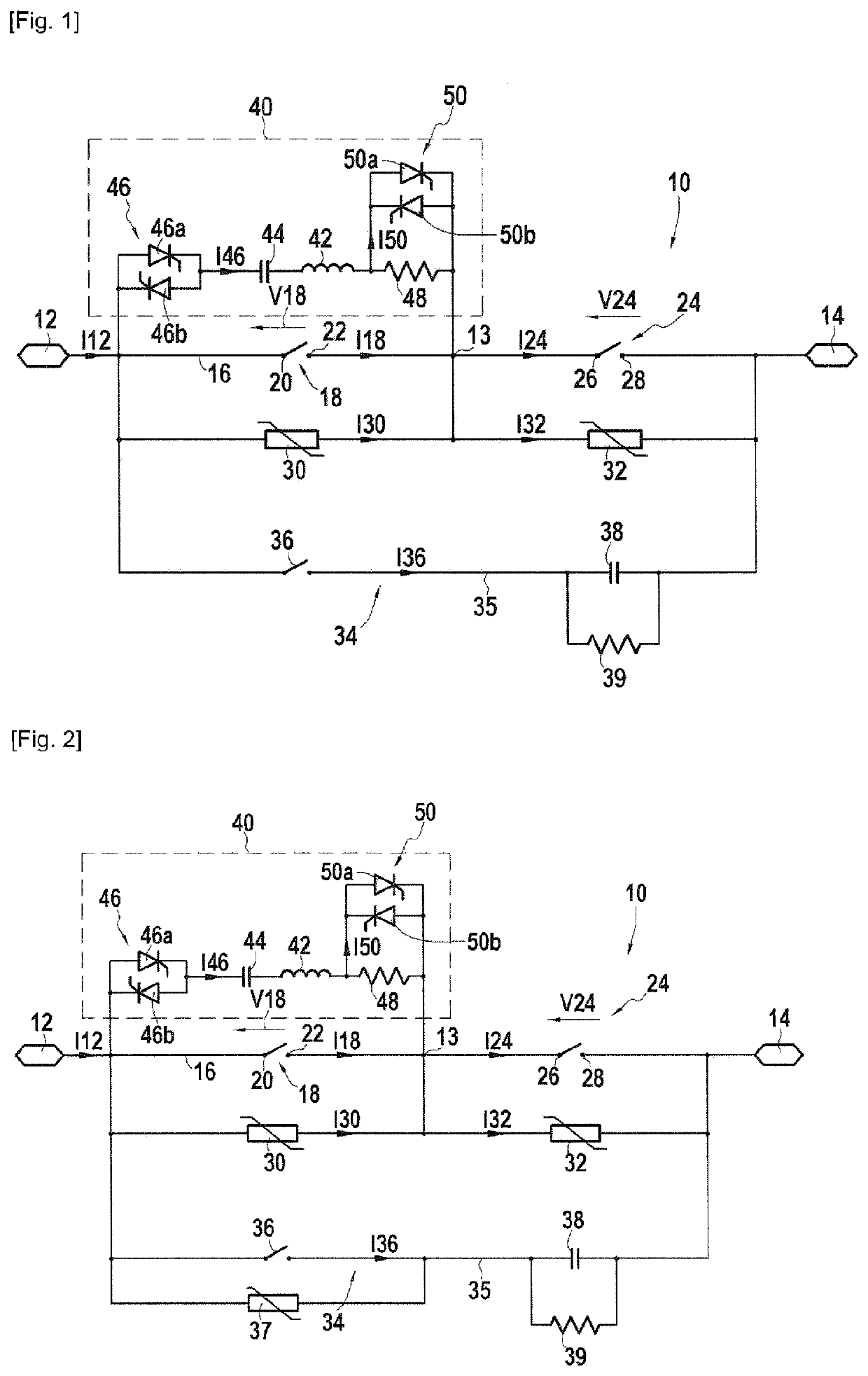
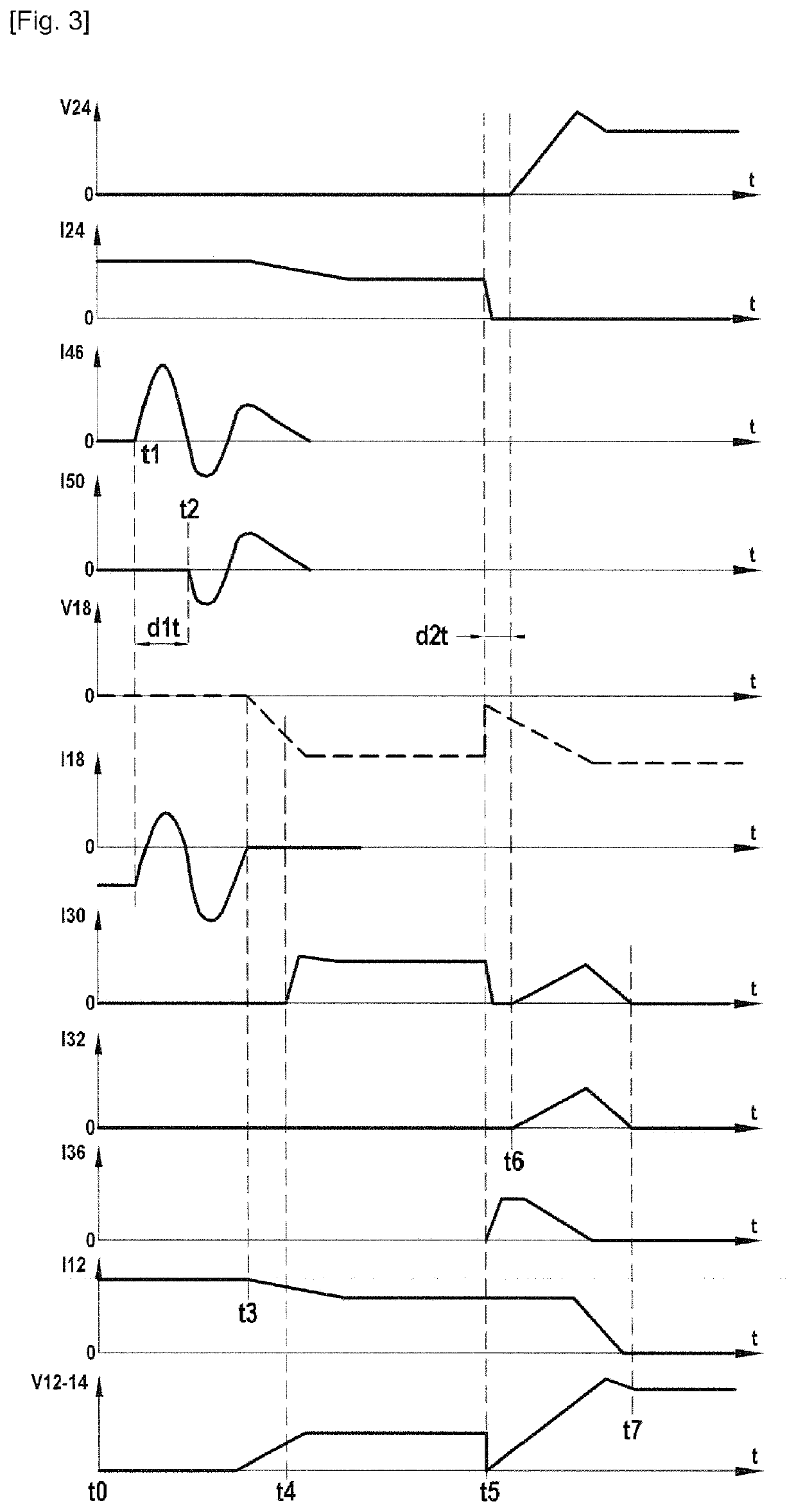
Current cut-off device for high-voltage direct current with capacitive buffer circuit, and control method
PatentActiveUS20220029408A1
Innovation
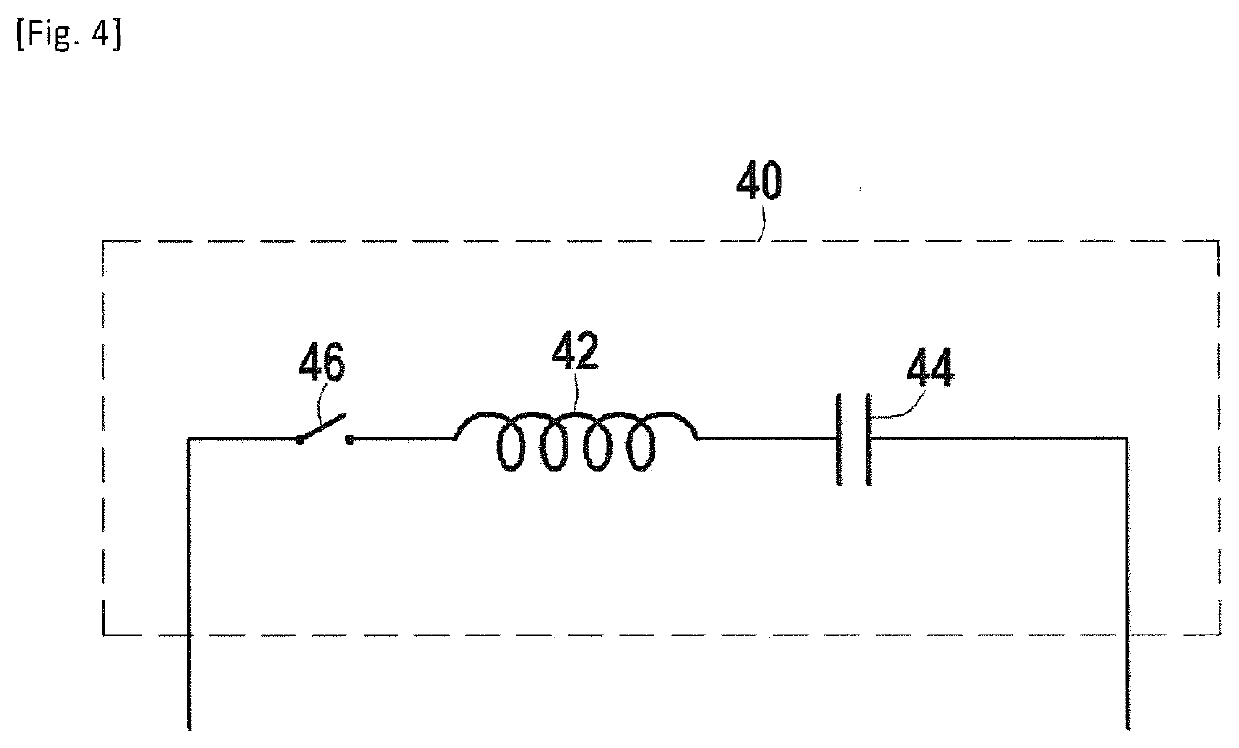
- A high-voltage DC current cut-off device featuring a capacitive buffer circuit without a dedicated inductive component, combined with an oscillation circuit and surge protectors, allows for the generation of a zero crossing and effective current interruption by charging a buffer capacitance to divert current and extinguish arcs, enabling the cut-off of currents up to 20 kA with reasonable size and cost.
Current breaking device for interrupting a high voltage direct current path
PatentPendingEP4506976A1
Innovation
- A current breaking device with a circuit topology that includes a main branch with a mechanical circuit breaker, an auxiliary branch with a capacitor bank, inductor, and commutation switch, and a surge arrester, which creates a current zero crossing by superimposing oscillating current on the main DC flow.


Space Qualification Standards and Certification Requirements
Space qualification standards for current interrupt devices represent one of the most stringent certification frameworks in the electronics industry. These standards are primarily governed by NASA-STD-8739 series, ESA-ECSS standards, and military specifications such as MIL-PRF-38534 for hybrid microcircuits and MIL-STD-883 for semiconductor devices. The qualification process ensures that components can withstand the extreme environmental conditions of space missions while maintaining reliable performance throughout their operational lifetime.
The certification requirements encompass multiple testing phases, beginning with component-level qualification testing. This includes thermal cycling tests ranging from -55°C to +125°C, vibration testing up to 2000Hz, shock testing with accelerations exceeding 1500g, and radiation exposure testing using gamma rays and heavy ions. Current interrupt devices must demonstrate consistent switching characteristics and maintain electrical isolation integrity under these extreme conditions.
Space-grade components must achieve specific reliability metrics, typically requiring Mean Time Between Failures (MTBF) exceeding 1 million hours under operational conditions. For current interrupt devices, this translates to maintaining switching accuracy within ±2% and leakage current below 1nA across temperature ranges. The qualification process also mandates extensive documentation including failure mode analysis, statistical process control data, and traceability records for all materials and manufacturing processes.
Radiation hardness assurance represents a critical certification aspect, requiring devices to withstand Total Ionizing Dose (TID) levels up to 100 krad(Si) and Single Event Effects (SEE) testing. Current interrupt devices must demonstrate immunity to latch-up conditions and maintain functional performance after neutron displacement damage equivalent to 1×10^14 neutrons/cm². These requirements necessitate specialized semiconductor processing techniques and materials selection.
The certification timeline typically spans 18-24 months, involving multiple test lots and statistical validation. Manufacturers must establish qualified manufacturing lines with documented process controls and undergo periodic surveillance audits. The final qualification certificate provides flight heritage documentation essential for mission approval, making compliance with these standards a fundamental prerequisite for space applications deployment.
The certification requirements encompass multiple testing phases, beginning with component-level qualification testing. This includes thermal cycling tests ranging from -55°C to +125°C, vibration testing up to 2000Hz, shock testing with accelerations exceeding 1500g, and radiation exposure testing using gamma rays and heavy ions. Current interrupt devices must demonstrate consistent switching characteristics and maintain electrical isolation integrity under these extreme conditions.
Space-grade components must achieve specific reliability metrics, typically requiring Mean Time Between Failures (MTBF) exceeding 1 million hours under operational conditions. For current interrupt devices, this translates to maintaining switching accuracy within ±2% and leakage current below 1nA across temperature ranges. The qualification process also mandates extensive documentation including failure mode analysis, statistical process control data, and traceability records for all materials and manufacturing processes.
Radiation hardness assurance represents a critical certification aspect, requiring devices to withstand Total Ionizing Dose (TID) levels up to 100 krad(Si) and Single Event Effects (SEE) testing. Current interrupt devices must demonstrate immunity to latch-up conditions and maintain functional performance after neutron displacement damage equivalent to 1×10^14 neutrons/cm². These requirements necessitate specialized semiconductor processing techniques and materials selection.
The certification timeline typically spans 18-24 months, involving multiple test lots and statistical validation. Manufacturers must establish qualified manufacturing lines with documented process controls and undergo periodic surveillance audits. The final qualification certificate provides flight heritage documentation essential for mission approval, making compliance with these standards a fundamental prerequisite for space applications deployment.
Radiation Hardening Considerations for Space Electronics
Space-grade current interrupt devices face unique radiation challenges that fundamentally differ from terrestrial applications. The space environment exposes electronic components to various forms of ionizing radiation, including galactic cosmic rays, solar particle events, and trapped radiation in planetary magnetospheres. These radiation sources can cause both temporary and permanent damage to semiconductor devices, making radiation hardening a critical design consideration for current interrupt devices intended for spacecraft applications.
Single Event Effects (SEE) represent one of the most significant concerns for space electronics. When high-energy particles strike semiconductor junctions, they can cause temporary malfunctions such as Single Event Upsets (SEU) or catastrophic failures like Single Event Latchup (SEL) and Single Event Burnout (SEB). Current interrupt devices are particularly vulnerable to these effects due to their power handling requirements and the presence of sensitive control circuits that must operate reliably under all conditions.
Total Ionizing Dose (TID) effects accumulate over the mission lifetime, gradually degrading device performance through charge buildup in oxide layers and interface states. For current interrupt devices, TID can affect threshold voltages, leakage currents, and switching characteristics. Design strategies must account for these gradual changes to ensure devices maintain their interrupt capabilities throughout extended mission durations, which can span decades for deep space missions.
Displacement Damage (DD) occurs when radiation displaces atoms from their lattice positions in semiconductor materials, creating defects that act as recombination centers. This phenomenon particularly affects the minority carrier lifetime and can degrade the performance of bipolar devices commonly used in current interrupt applications. The cumulative nature of displacement damage requires careful material selection and device architecture optimization.
Radiation hardening techniques for current interrupt devices include both design-level and process-level approaches. Circuit-level hardening involves implementing redundancy, error detection and correction mechanisms, and robust layout practices that minimize sensitive node areas. Process-level hardening focuses on using radiation-tolerant materials, specialized fabrication techniques, and packaging solutions that provide additional shielding while maintaining thermal management capabilities essential for high-current applications.
Single Event Effects (SEE) represent one of the most significant concerns for space electronics. When high-energy particles strike semiconductor junctions, they can cause temporary malfunctions such as Single Event Upsets (SEU) or catastrophic failures like Single Event Latchup (SEL) and Single Event Burnout (SEB). Current interrupt devices are particularly vulnerable to these effects due to their power handling requirements and the presence of sensitive control circuits that must operate reliably under all conditions.
Total Ionizing Dose (TID) effects accumulate over the mission lifetime, gradually degrading device performance through charge buildup in oxide layers and interface states. For current interrupt devices, TID can affect threshold voltages, leakage currents, and switching characteristics. Design strategies must account for these gradual changes to ensure devices maintain their interrupt capabilities throughout extended mission durations, which can span decades for deep space missions.
Displacement Damage (DD) occurs when radiation displaces atoms from their lattice positions in semiconductor materials, creating defects that act as recombination centers. This phenomenon particularly affects the minority carrier lifetime and can degrade the performance of bipolar devices commonly used in current interrupt applications. The cumulative nature of displacement damage requires careful material selection and device architecture optimization.
Radiation hardening techniques for current interrupt devices include both design-level and process-level approaches. Circuit-level hardening involves implementing redundancy, error detection and correction mechanisms, and robust layout practices that minimize sensitive node areas. Process-level hardening focuses on using radiation-tolerant materials, specialized fabrication techniques, and packaging solutions that provide additional shielding while maintaining thermal management capabilities essential for high-current applications.
Unlock deeper insights with Patsnap Eureka Quick Research — get a full tech report to explore trends and direct your research. Try now!
Generate Your Research Report Instantly with AI Agent
Supercharge your innovation with Patsnap Eureka AI Agent Platform!