

Develop Low-Frequency Magnetoelectric Sensors for Long-term Use
APR 16, 20269 MIN READ
Generate Your Research Report Instantly with AI Agent
PatSnap Eureka helps you evaluate technical feasibility & market potential.
Low-Frequency Magnetoelectric Sensor Development Background and Goals
Magnetoelectric sensors represent a revolutionary advancement in magnetic field detection technology, combining the magnetostrictive and piezoelectric effects to achieve unprecedented sensitivity in low-frequency applications. The evolution of these sensors traces back to the fundamental discovery of magnetoelectric coupling in composite materials during the 1970s, where researchers first observed the ability to convert magnetic energy directly into electrical signals through strain-mediated interactions.
The historical development of magnetoelectric sensors has been driven by the limitations of traditional magnetic sensing technologies, particularly in detecting weak, low-frequency magnetic fields below 1 Hz. Conventional sensors such as fluxgate magnetometers and superconducting quantum interference devices, while effective in specific applications, face significant challenges in terms of power consumption, operational complexity, and long-term stability in harsh environments.
The primary technological objective centers on developing magnetoelectric sensors capable of detecting magnetic field variations in the sub-millihertz to hertz frequency range with exceptional sensitivity, targeting detection limits approaching femtotesla levels. This ambitious goal requires overcoming fundamental challenges in noise reduction, thermal stability, and mechanical resonance optimization while maintaining operational reliability over extended periods exceeding five years.
Current development trends focus on advancing composite material engineering, particularly the optimization of magnetostrictive-piezoelectric bilayer and trilayer structures. Key technical targets include achieving magnetic field resolution below 1 pT/√Hz at frequencies under 10 Hz, operating temperature ranges from -40°C to 85°C, and power consumption under 1 mW for battery-powered applications.
The strategic importance of this technology extends beyond traditional magnetic sensing applications, encompassing emerging fields such as biomedical diagnostics, geophysical monitoring, and space exploration. Long-term stability requirements demand innovative approaches to material degradation mitigation, packaging technologies, and self-calibration mechanisms to ensure consistent performance throughout the sensor's operational lifetime.
The historical development of magnetoelectric sensors has been driven by the limitations of traditional magnetic sensing technologies, particularly in detecting weak, low-frequency magnetic fields below 1 Hz. Conventional sensors such as fluxgate magnetometers and superconducting quantum interference devices, while effective in specific applications, face significant challenges in terms of power consumption, operational complexity, and long-term stability in harsh environments.
The primary technological objective centers on developing magnetoelectric sensors capable of detecting magnetic field variations in the sub-millihertz to hertz frequency range with exceptional sensitivity, targeting detection limits approaching femtotesla levels. This ambitious goal requires overcoming fundamental challenges in noise reduction, thermal stability, and mechanical resonance optimization while maintaining operational reliability over extended periods exceeding five years.
Current development trends focus on advancing composite material engineering, particularly the optimization of magnetostrictive-piezoelectric bilayer and trilayer structures. Key technical targets include achieving magnetic field resolution below 1 pT/√Hz at frequencies under 10 Hz, operating temperature ranges from -40°C to 85°C, and power consumption under 1 mW for battery-powered applications.
The strategic importance of this technology extends beyond traditional magnetic sensing applications, encompassing emerging fields such as biomedical diagnostics, geophysical monitoring, and space exploration. Long-term stability requirements demand innovative approaches to material degradation mitigation, packaging technologies, and self-calibration mechanisms to ensure consistent performance throughout the sensor's operational lifetime.
Market Demand for Long-term Magnetoelectric Sensing Applications
The global market for long-term magnetoelectric sensing applications is experiencing substantial growth driven by increasing demands across multiple industrial sectors. Infrastructure monitoring represents one of the most significant market segments, where magnetoelectric sensors are deployed for continuous structural health monitoring of bridges, buildings, pipelines, and transportation networks. The aging infrastructure in developed countries and rapid urbanization in emerging markets create sustained demand for reliable, maintenance-free sensing solutions capable of operating for decades without replacement.
Geophysical monitoring applications constitute another major market driver, particularly for earthquake detection, volcanic activity monitoring, and geological survey operations. National geological agencies and research institutions worldwide require sensors that can maintain accuracy and stability over extended periods in harsh environmental conditions. The growing emphasis on natural disaster preparedness and climate change monitoring further amplifies this demand.
The automotive and transportation sector presents emerging opportunities for long-term magnetoelectric sensors, especially in electric vehicle charging infrastructure and autonomous vehicle navigation systems. As electric vehicle adoption accelerates globally, the need for durable magnetic field sensors in charging stations and vehicle detection systems creates new market segments with stringent longevity requirements.
Industrial automation and manufacturing sectors increasingly rely on magnetoelectric sensors for position sensing, current monitoring, and equipment condition assessment. The trend toward Industry 4.0 and predictive maintenance strategies drives demand for sensors that can operate continuously for years without calibration or replacement, reducing operational costs and improving system reliability.
Defense and aerospace applications represent high-value market segments where sensor longevity is critical for mission success. Military installations, naval vessels, and satellite systems require magnetoelectric sensors capable of maintaining performance over extended deployment periods in extreme environments.
The renewable energy sector, particularly wind power generation, creates substantial demand for long-term magnetoelectric sensors used in turbine monitoring and grid integration systems. As wind farms expand globally and operational lifespans extend beyond twenty years, sensor durability becomes increasingly important for maintaining system efficiency and reducing maintenance costs.
Market growth is further supported by the Internet of Things expansion, where remote sensing applications require sensors with minimal maintenance requirements and extended operational lifespans to ensure cost-effective deployment and operation.
Geophysical monitoring applications constitute another major market driver, particularly for earthquake detection, volcanic activity monitoring, and geological survey operations. National geological agencies and research institutions worldwide require sensors that can maintain accuracy and stability over extended periods in harsh environmental conditions. The growing emphasis on natural disaster preparedness and climate change monitoring further amplifies this demand.
The automotive and transportation sector presents emerging opportunities for long-term magnetoelectric sensors, especially in electric vehicle charging infrastructure and autonomous vehicle navigation systems. As electric vehicle adoption accelerates globally, the need for durable magnetic field sensors in charging stations and vehicle detection systems creates new market segments with stringent longevity requirements.
Industrial automation and manufacturing sectors increasingly rely on magnetoelectric sensors for position sensing, current monitoring, and equipment condition assessment. The trend toward Industry 4.0 and predictive maintenance strategies drives demand for sensors that can operate continuously for years without calibration or replacement, reducing operational costs and improving system reliability.
Defense and aerospace applications represent high-value market segments where sensor longevity is critical for mission success. Military installations, naval vessels, and satellite systems require magnetoelectric sensors capable of maintaining performance over extended deployment periods in extreme environments.
The renewable energy sector, particularly wind power generation, creates substantial demand for long-term magnetoelectric sensors used in turbine monitoring and grid integration systems. As wind farms expand globally and operational lifespans extend beyond twenty years, sensor durability becomes increasingly important for maintaining system efficiency and reducing maintenance costs.
Market growth is further supported by the Internet of Things expansion, where remote sensing applications require sensors with minimal maintenance requirements and extended operational lifespans to ensure cost-effective deployment and operation.
Current State and Challenges of Low-Frequency ME Sensors
Low-frequency magnetoelectric (ME) sensors represent a rapidly evolving technology that combines magnetic and electric phenomena to detect weak magnetic fields at frequencies below 1 kHz. Currently, these sensors primarily utilize composite structures consisting of magnetostrictive and piezoelectric materials, such as Terfenol-D/PZT or Metglas/PZT combinations. The magnetostrictive layer responds to external magnetic fields by changing its dimensions, which induces mechanical stress in the adjacent piezoelectric layer, subsequently generating an electrical output signal.
The global development of low-frequency ME sensors shows significant regional variations, with leading research concentrated in the United States, China, Germany, and Japan. American institutions focus on fundamental material science and novel composite architectures, while Chinese researchers emphasize manufacturing scalability and cost reduction. European efforts primarily target automotive and industrial applications, whereas Japanese development concentrates on miniaturization and integration with existing electronic systems.
Current ME sensor technology faces several critical challenges that limit widespread adoption. Noise interference represents the most significant obstacle, as low-frequency applications are particularly susceptible to environmental electromagnetic interference, thermal fluctuations, and mechanical vibrations. The signal-to-noise ratio often falls below acceptable thresholds for precision applications, requiring sophisticated filtering and signal processing techniques that increase system complexity and power consumption.
Temperature stability poses another major constraint, as both magnetostrictive and piezoelectric materials exhibit strong temperature dependencies. Coefficient variations can cause sensor drift of up to 5% per degree Celsius in some configurations, making long-term stability extremely difficult to achieve without active compensation systems. This temperature sensitivity is particularly problematic for outdoor applications or industrial environments with varying thermal conditions.
Manufacturing consistency remains a persistent challenge due to the complex multi-material interfaces required in ME composites. Achieving uniform bonding between dissimilar materials while maintaining optimal stress transfer efficiency requires precise control of adhesive properties, curing conditions, and surface preparation. Current production yields for high-performance ME sensors rarely exceed 70%, significantly impacting commercial viability.
Power consumption and size constraints further limit practical applications. Existing low-frequency ME sensors typically require active biasing circuits and amplification stages that consume substantial power, making battery-operated deployment challenging. Additionally, achieving high sensitivity often necessitates relatively large sensor dimensions, conflicting with modern miniaturization requirements for portable and embedded applications.
Long-term reliability testing reveals degradation mechanisms including interface delamination, material fatigue, and gradual depolarization of piezoelectric components. These factors collectively contribute to sensor drift and eventual failure, with typical operational lifespans ranging from 2-5 years under continuous operation, falling short of the 10-15 year requirements for many industrial and infrastructure monitoring applications.
The global development of low-frequency ME sensors shows significant regional variations, with leading research concentrated in the United States, China, Germany, and Japan. American institutions focus on fundamental material science and novel composite architectures, while Chinese researchers emphasize manufacturing scalability and cost reduction. European efforts primarily target automotive and industrial applications, whereas Japanese development concentrates on miniaturization and integration with existing electronic systems.
Current ME sensor technology faces several critical challenges that limit widespread adoption. Noise interference represents the most significant obstacle, as low-frequency applications are particularly susceptible to environmental electromagnetic interference, thermal fluctuations, and mechanical vibrations. The signal-to-noise ratio often falls below acceptable thresholds for precision applications, requiring sophisticated filtering and signal processing techniques that increase system complexity and power consumption.
Temperature stability poses another major constraint, as both magnetostrictive and piezoelectric materials exhibit strong temperature dependencies. Coefficient variations can cause sensor drift of up to 5% per degree Celsius in some configurations, making long-term stability extremely difficult to achieve without active compensation systems. This temperature sensitivity is particularly problematic for outdoor applications or industrial environments with varying thermal conditions.
Manufacturing consistency remains a persistent challenge due to the complex multi-material interfaces required in ME composites. Achieving uniform bonding between dissimilar materials while maintaining optimal stress transfer efficiency requires precise control of adhesive properties, curing conditions, and surface preparation. Current production yields for high-performance ME sensors rarely exceed 70%, significantly impacting commercial viability.
Power consumption and size constraints further limit practical applications. Existing low-frequency ME sensors typically require active biasing circuits and amplification stages that consume substantial power, making battery-operated deployment challenging. Additionally, achieving high sensitivity often necessitates relatively large sensor dimensions, conflicting with modern miniaturization requirements for portable and embedded applications.
Long-term reliability testing reveals degradation mechanisms including interface delamination, material fatigue, and gradual depolarization of piezoelectric components. These factors collectively contribute to sensor drift and eventual failure, with typical operational lifespans ranging from 2-5 years under continuous operation, falling short of the 10-15 year requirements for many industrial and infrastructure monitoring applications.
Key Players in Magnetoelectric Sensor Industry
The low-frequency magnetoelectric sensor market is in an emerging growth phase, driven by increasing demand for long-term monitoring applications across industrial, automotive, and IoT sectors. The market shows significant expansion potential as these sensors offer superior sensitivity and stability compared to traditional alternatives. Technology maturity varies considerably across players, with established semiconductor giants like TDK Corp., Murata Manufacturing, and Samsung Electro-Mechanics leading in commercialization and mass production capabilities. Research institutions including University of Kiel, Carnegie Mellon University, and Chinese universities like Jilin University are advancing fundamental magnetoelectric materials and sensing mechanisms. Specialized companies such as MultiDimension Technology and Everspin Technologies focus on magnetic sensor innovations, while government entities like Naval Research Laboratory drive defense applications. The competitive landscape reflects a transition from laboratory research to commercial viability, with academic-industry collaborations accelerating technological breakthroughs in sensor durability and performance optimization.
TDK Corp.
Technical Solution: TDK has developed advanced magnetoelectric sensor technologies utilizing multilayer composite structures combining magnetostrictive and piezoelectric materials. Their approach focuses on optimizing the magnetoelectric coupling coefficient through precise control of layer thickness and interface engineering. The company has implemented novel signal processing algorithms to enhance low-frequency detection capabilities while maintaining long-term stability through advanced packaging techniques and temperature compensation methods. Their sensors demonstrate exceptional sensitivity in the sub-Hz frequency range with minimal drift over extended operational periods.
Strengths: Strong manufacturing capabilities and proven reliability in harsh environments. Weaknesses: Higher cost compared to traditional magnetic sensors and complex calibration requirements.
Murata Manufacturing Co. Ltd.
Technical Solution: Murata has pioneered the development of compact magnetoelectric sensors using their proprietary ceramic-based composite materials. Their technology integrates ferrite-PZT heterostructures with advanced MEMS fabrication processes to achieve miniaturized sensors suitable for IoT applications. The company's approach emphasizes power efficiency and wireless connectivity, enabling battery-powered long-term monitoring systems. Their sensors feature self-calibration capabilities and adaptive filtering algorithms to maintain accuracy over years of continuous operation in various environmental conditions.
Strengths: Excellent miniaturization capabilities and low power consumption design. Weaknesses: Limited sensitivity compared to larger sensor architectures and susceptibility to electromagnetic interference.
Core Patents in Long-term Magnetoelectric Sensing
Magnetoelectric magnetic field sensor with longitudinally biased magnetostrictive layer
PatentInactiveUS7023206B2
Innovation
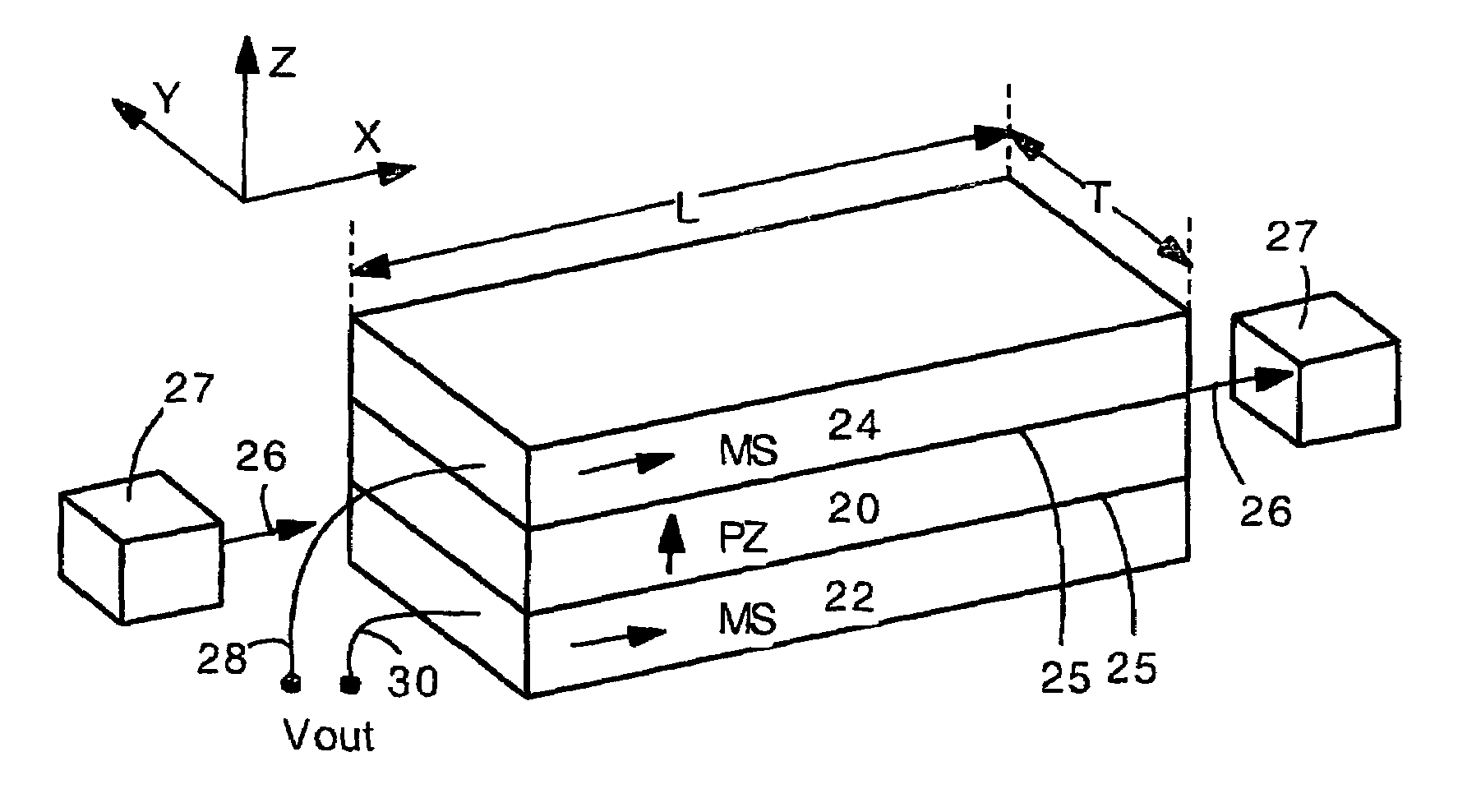
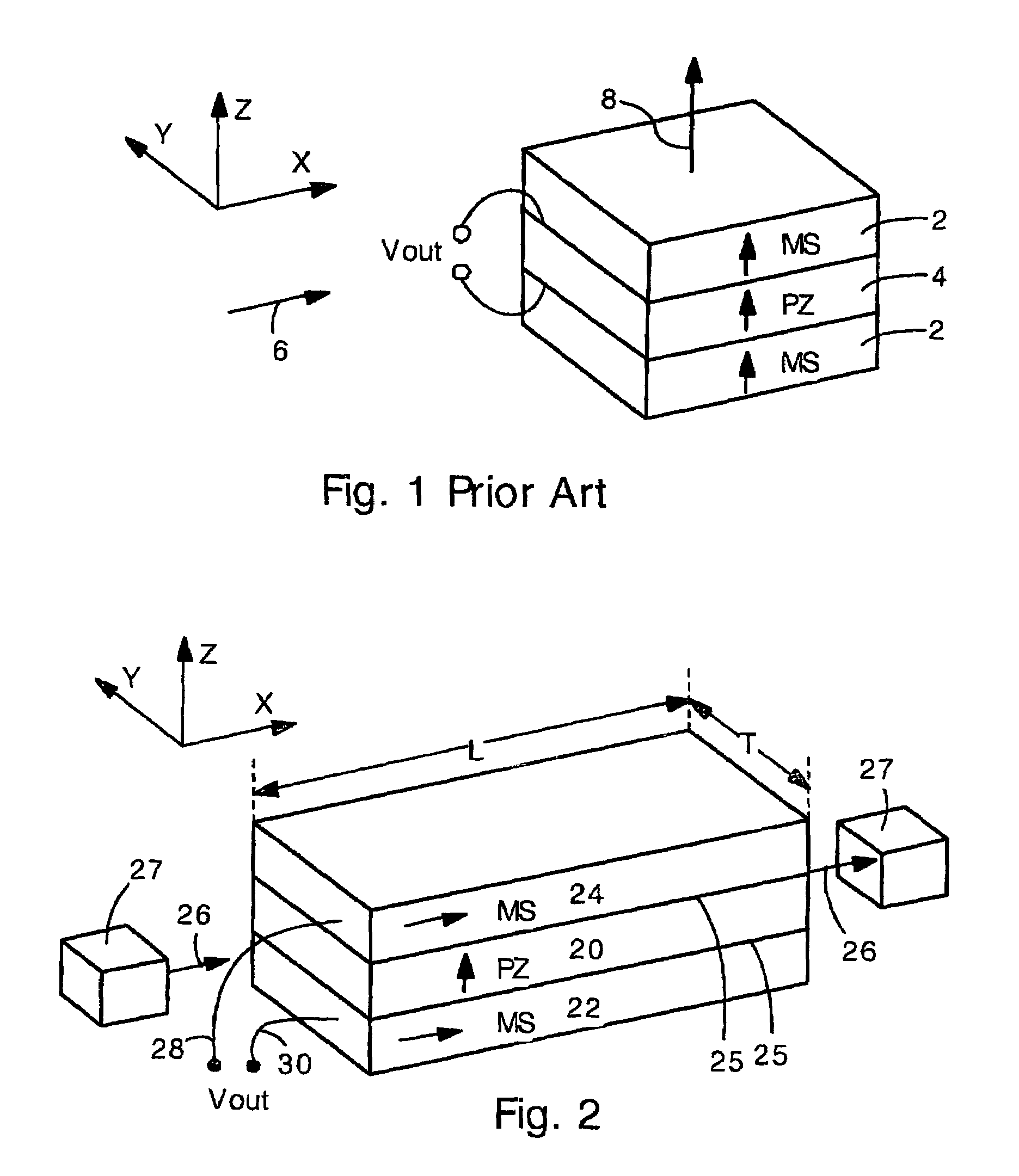
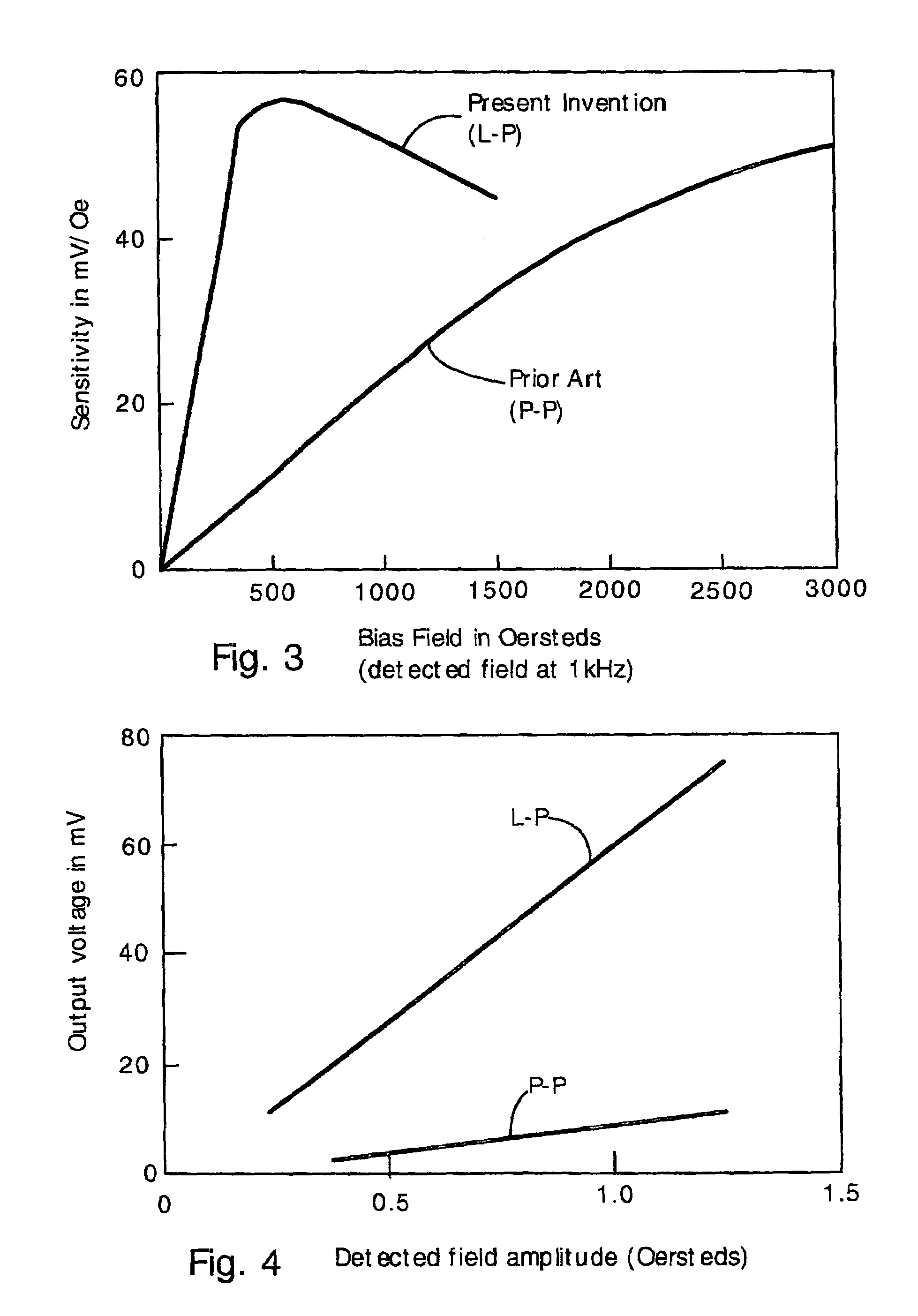
- A magnetoelectric magnetic field sensor with laminated magnetostrictive and piezoelectric layers, where the magnetostrictive layer is longitudinally magnetized and biased with a parallel bias magnetic field, optimizing the thickness ratio and poling direction for enhanced sensitivity and low power operation.

Material Stability and Degradation Analysis
Material stability represents a critical factor determining the operational lifespan and reliability of low-frequency magnetoelectric sensors in practical applications. The composite nature of these sensors, typically consisting of magnetostrictive and piezoelectric phases, introduces complex degradation mechanisms that can significantly impact long-term performance. Understanding these degradation pathways is essential for developing sensors capable of maintaining consistent sensitivity and accuracy over extended operational periods.
The magnetostrictive component, often based on materials such as Terfenol-D, Metglas, or cobalt ferrite, exhibits susceptibility to oxidation and corrosion when exposed to atmospheric conditions. Terfenol-D, while offering excellent magnetostrictive properties, demonstrates particular vulnerability to moisture-induced degradation, leading to the formation of rare earth oxides that compromise magnetic permeability. This oxidation process typically manifests as a gradual reduction in magnetic coupling efficiency, directly affecting the sensor's magnetoelectric coefficient over time.
Piezoelectric materials in magnetoelectric composites face distinct stability challenges, particularly related to domain structure evolution and depolarization phenomena. Lead-based piezoelectrics like PZT experience aging effects characterized by domain wall pinning and charge migration, resulting in decreased piezoelectric coefficients. Lead-free alternatives such as BaTiO3 and KNN-based ceramics, while environmentally preferable, often exhibit greater temperature sensitivity and accelerated performance degradation under thermal cycling conditions.
Interface degradation between magnetostrictive and piezoelectric phases represents another critical failure mode in laminated magnetoelectric sensors. Adhesive layers used for bonding can undergo chemical breakdown, thermal expansion mismatch, and mechanical fatigue, leading to delamination and reduced strain transfer efficiency. This interfacial deterioration typically accelerates under combined stress from temperature variations, mechanical vibrations, and chemical exposure.
Environmental factors significantly influence degradation rates in magnetoelectric sensors. Temperature fluctuations induce thermal stress due to coefficient of thermal expansion mismatches between different phases, potentially causing microcrack formation and propagation. Humidity exposure accelerates corrosion processes and can lead to electrical insulation breakdown. Chemical contaminants in industrial environments may catalyze specific degradation reactions, particularly affecting surface properties and electrical contacts.
Mitigation strategies for enhancing material stability include protective coating applications, hermetic packaging solutions, and material composition optimization. Advanced encapsulation techniques using polymer barriers or ceramic coatings can effectively isolate sensitive materials from environmental exposure while maintaining sensor functionality.
The magnetostrictive component, often based on materials such as Terfenol-D, Metglas, or cobalt ferrite, exhibits susceptibility to oxidation and corrosion when exposed to atmospheric conditions. Terfenol-D, while offering excellent magnetostrictive properties, demonstrates particular vulnerability to moisture-induced degradation, leading to the formation of rare earth oxides that compromise magnetic permeability. This oxidation process typically manifests as a gradual reduction in magnetic coupling efficiency, directly affecting the sensor's magnetoelectric coefficient over time.
Piezoelectric materials in magnetoelectric composites face distinct stability challenges, particularly related to domain structure evolution and depolarization phenomena. Lead-based piezoelectrics like PZT experience aging effects characterized by domain wall pinning and charge migration, resulting in decreased piezoelectric coefficients. Lead-free alternatives such as BaTiO3 and KNN-based ceramics, while environmentally preferable, often exhibit greater temperature sensitivity and accelerated performance degradation under thermal cycling conditions.
Interface degradation between magnetostrictive and piezoelectric phases represents another critical failure mode in laminated magnetoelectric sensors. Adhesive layers used for bonding can undergo chemical breakdown, thermal expansion mismatch, and mechanical fatigue, leading to delamination and reduced strain transfer efficiency. This interfacial deterioration typically accelerates under combined stress from temperature variations, mechanical vibrations, and chemical exposure.
Environmental factors significantly influence degradation rates in magnetoelectric sensors. Temperature fluctuations induce thermal stress due to coefficient of thermal expansion mismatches between different phases, potentially causing microcrack formation and propagation. Humidity exposure accelerates corrosion processes and can lead to electrical insulation breakdown. Chemical contaminants in industrial environments may catalyze specific degradation reactions, particularly affecting surface properties and electrical contacts.
Mitigation strategies for enhancing material stability include protective coating applications, hermetic packaging solutions, and material composition optimization. Advanced encapsulation techniques using polymer barriers or ceramic coatings can effectively isolate sensitive materials from environmental exposure while maintaining sensor functionality.
Power Management for Long-term Sensor Operation
Power management represents a critical engineering challenge for low-frequency magnetoelectric sensors designed for long-term deployment scenarios. The inherently low power output characteristics of magnetoelectric materials at low frequencies necessitate sophisticated energy harvesting and storage strategies to maintain continuous sensor operation over extended periods without external power intervention.
Energy harvesting techniques form the foundation of sustainable power management for these sensors. Ambient energy sources such as thermal gradients, mechanical vibrations, and electromagnetic fields can be captured and converted into usable electrical energy. Thermoelectric generators utilizing Seebeck effects can harvest temperature differentials in environmental monitoring applications, while piezoelectric elements can capture mechanical vibrations from infrastructure or natural phenomena. Additionally, radio frequency energy harvesting from ambient electromagnetic radiation provides another viable power source, particularly in urban environments with abundant RF signals.
Battery technology selection and optimization play crucial roles in long-term sensor operation. Ultra-low power lithium primary batteries offer exceptional shelf life and energy density, making them suitable for applications requiring decades of operation. Rechargeable lithium-ion and lithium-polymer batteries provide flexibility for energy harvesting integration, though they require careful charge management to prevent degradation. Emerging solid-state batteries show promise for extreme longevity applications due to their enhanced stability and reduced self-discharge rates.
Power conditioning circuits must efficiently manage the variable and often intermittent nature of harvested energy while maintaining stable sensor operation. Low-dropout voltage regulators and switching converters optimized for ultra-low power consumption ensure consistent voltage supply to sensor electronics. Energy storage capacitors and supercapacitors provide buffer storage for peak power demands and bridge power gaps during low harvesting periods.
Advanced power management strategies incorporate intelligent duty cycling and adaptive sampling techniques to minimize energy consumption. Microcontroller-based power management units can dynamically adjust sensor sampling rates based on detected signal characteristics and available energy levels. Wake-up circuits triggered by magnetic field threshold events enable sensors to remain in ultra-low power sleep modes until measurement conditions warrant active operation, significantly extending operational lifetime while maintaining measurement fidelity.
Energy harvesting techniques form the foundation of sustainable power management for these sensors. Ambient energy sources such as thermal gradients, mechanical vibrations, and electromagnetic fields can be captured and converted into usable electrical energy. Thermoelectric generators utilizing Seebeck effects can harvest temperature differentials in environmental monitoring applications, while piezoelectric elements can capture mechanical vibrations from infrastructure or natural phenomena. Additionally, radio frequency energy harvesting from ambient electromagnetic radiation provides another viable power source, particularly in urban environments with abundant RF signals.
Battery technology selection and optimization play crucial roles in long-term sensor operation. Ultra-low power lithium primary batteries offer exceptional shelf life and energy density, making them suitable for applications requiring decades of operation. Rechargeable lithium-ion and lithium-polymer batteries provide flexibility for energy harvesting integration, though they require careful charge management to prevent degradation. Emerging solid-state batteries show promise for extreme longevity applications due to their enhanced stability and reduced self-discharge rates.
Power conditioning circuits must efficiently manage the variable and often intermittent nature of harvested energy while maintaining stable sensor operation. Low-dropout voltage regulators and switching converters optimized for ultra-low power consumption ensure consistent voltage supply to sensor electronics. Energy storage capacitors and supercapacitors provide buffer storage for peak power demands and bridge power gaps during low harvesting periods.
Advanced power management strategies incorporate intelligent duty cycling and adaptive sampling techniques to minimize energy consumption. Microcontroller-based power management units can dynamically adjust sensor sampling rates based on detected signal characteristics and available energy levels. Wake-up circuits triggered by magnetic field threshold events enable sensors to remain in ultra-low power sleep modes until measurement conditions warrant active operation, significantly extending operational lifetime while maintaining measurement fidelity.
Unlock deeper insights with PatSnap Eureka Quick Research — get a full tech report to explore trends and direct your research. Try now!
Generate Your Research Report Instantly with AI Agent
Supercharge your innovation with PatSnap Eureka AI Agent Platform!