
Digital Twin vs. Multi-Scale Simulations for Critical Process Optimization
JUN 3, 20269 MIN READ
Generate Your Research Report Instantly with AI Agent
Patsnap Eureka helps you evaluate technical feasibility & market potential.
Digital Twin and Multi-Scale Simulation Background and Objectives
Digital twin technology emerged in the early 2000s as a revolutionary concept that creates real-time digital replicas of physical systems, processes, or products. This paradigm enables continuous monitoring, analysis, and optimization through bidirectional data exchange between physical and virtual environments. The technology has evolved from simple 3D modeling to sophisticated systems incorporating IoT sensors, machine learning algorithms, and advanced analytics capabilities.
Multi-scale simulation represents a complementary computational approach that addresses complex phenomena occurring across different temporal and spatial scales simultaneously. This methodology has roots in computational physics and engineering, where researchers recognized that many critical processes involve interactions between molecular, microscopic, and macroscopic levels that cannot be adequately captured by single-scale models.
The convergence of these technologies has created unprecedented opportunities for critical process optimization across industries including manufacturing, energy, healthcare, and aerospace. Digital twins provide real-time operational insights and predictive capabilities, while multi-scale simulations offer deep understanding of fundamental mechanisms governing process behavior. Together, they form a powerful framework for addressing complex optimization challenges that traditional approaches cannot solve effectively.
The primary objective of integrating digital twin and multi-scale simulation technologies is to achieve comprehensive process optimization that spans from real-time operational adjustments to long-term strategic improvements. This integration aims to bridge the gap between immediate operational needs and fundamental scientific understanding, enabling organizations to optimize processes at multiple levels simultaneously.
Key technical objectives include developing seamless data integration frameworks that can handle multi-scale information flows, creating adaptive modeling systems that can switch between different simulation scales based on operational requirements, and establishing robust validation methodologies that ensure accuracy across all scales. The ultimate goal is to create intelligent systems capable of autonomous process optimization while maintaining safety, efficiency, and quality standards.
Strategic objectives focus on transforming traditional reactive maintenance and optimization approaches into proactive, predictive systems that can anticipate and prevent process deviations before they occur. This transformation requires developing new methodologies for uncertainty quantification, risk assessment, and decision-making under complex multi-scale interactions that characterize modern industrial processes.
Multi-scale simulation represents a complementary computational approach that addresses complex phenomena occurring across different temporal and spatial scales simultaneously. This methodology has roots in computational physics and engineering, where researchers recognized that many critical processes involve interactions between molecular, microscopic, and macroscopic levels that cannot be adequately captured by single-scale models.
The convergence of these technologies has created unprecedented opportunities for critical process optimization across industries including manufacturing, energy, healthcare, and aerospace. Digital twins provide real-time operational insights and predictive capabilities, while multi-scale simulations offer deep understanding of fundamental mechanisms governing process behavior. Together, they form a powerful framework for addressing complex optimization challenges that traditional approaches cannot solve effectively.
The primary objective of integrating digital twin and multi-scale simulation technologies is to achieve comprehensive process optimization that spans from real-time operational adjustments to long-term strategic improvements. This integration aims to bridge the gap between immediate operational needs and fundamental scientific understanding, enabling organizations to optimize processes at multiple levels simultaneously.
Key technical objectives include developing seamless data integration frameworks that can handle multi-scale information flows, creating adaptive modeling systems that can switch between different simulation scales based on operational requirements, and establishing robust validation methodologies that ensure accuracy across all scales. The ultimate goal is to create intelligent systems capable of autonomous process optimization while maintaining safety, efficiency, and quality standards.
Strategic objectives focus on transforming traditional reactive maintenance and optimization approaches into proactive, predictive systems that can anticipate and prevent process deviations before they occur. This transformation requires developing new methodologies for uncertainty quantification, risk assessment, and decision-making under complex multi-scale interactions that characterize modern industrial processes.
Market Demand for Critical Process Optimization Solutions
The global market for critical process optimization solutions is experiencing unprecedented growth driven by increasing industrial complexity and the imperative for operational excellence. Manufacturing industries, particularly in sectors such as pharmaceuticals, chemicals, oil and gas, and semiconductor production, are facing mounting pressure to enhance efficiency while maintaining stringent quality standards. These industries require sophisticated optimization approaches to manage intricate processes where minor deviations can result in significant financial losses or safety hazards.
Digital twin technology has emerged as a transformative solution, enabling real-time monitoring and predictive analytics for complex industrial systems. The demand for digital twin implementations spans across process industries seeking to reduce downtime, optimize resource utilization, and improve product quality. Organizations are increasingly recognizing the value of virtual replicas that can simulate process behavior and predict potential failures before they occur in physical systems.
Multi-scale simulation approaches are gaining traction among industries dealing with processes that span multiple temporal and spatial scales. The aerospace, automotive, and advanced materials sectors demonstrate particularly strong demand for these solutions, as they require comprehensive understanding of phenomena ranging from molecular interactions to system-level behaviors. These simulations enable engineers to optimize processes that were previously too complex to model effectively.
The convergence of Industry 4.0 initiatives and digital transformation strategies has accelerated market adoption of both technologies. Companies are investing heavily in solutions that can integrate with existing enterprise systems while providing actionable insights for process improvement. The demand is particularly pronounced in regions with mature industrial bases, where legacy systems require modernization to remain competitive.
Regulatory compliance requirements in highly regulated industries are further driving market demand. Organizations must demonstrate process control and optimization capabilities to meet evolving safety and environmental standards. Both digital twins and multi-scale simulations offer the documentation and predictive capabilities necessary to satisfy regulatory frameworks while achieving operational objectives.
The market landscape reveals a growing preference for hybrid approaches that combine the strengths of both technologies, indicating that future demand will likely favor integrated solutions rather than standalone implementations.
Digital twin technology has emerged as a transformative solution, enabling real-time monitoring and predictive analytics for complex industrial systems. The demand for digital twin implementations spans across process industries seeking to reduce downtime, optimize resource utilization, and improve product quality. Organizations are increasingly recognizing the value of virtual replicas that can simulate process behavior and predict potential failures before they occur in physical systems.
Multi-scale simulation approaches are gaining traction among industries dealing with processes that span multiple temporal and spatial scales. The aerospace, automotive, and advanced materials sectors demonstrate particularly strong demand for these solutions, as they require comprehensive understanding of phenomena ranging from molecular interactions to system-level behaviors. These simulations enable engineers to optimize processes that were previously too complex to model effectively.
The convergence of Industry 4.0 initiatives and digital transformation strategies has accelerated market adoption of both technologies. Companies are investing heavily in solutions that can integrate with existing enterprise systems while providing actionable insights for process improvement. The demand is particularly pronounced in regions with mature industrial bases, where legacy systems require modernization to remain competitive.
Regulatory compliance requirements in highly regulated industries are further driving market demand. Organizations must demonstrate process control and optimization capabilities to meet evolving safety and environmental standards. Both digital twins and multi-scale simulations offer the documentation and predictive capabilities necessary to satisfy regulatory frameworks while achieving operational objectives.
The market landscape reveals a growing preference for hybrid approaches that combine the strengths of both technologies, indicating that future demand will likely favor integrated solutions rather than standalone implementations.
Current State and Challenges of Digital Twin vs Multi-Scale Methods
Digital twin technology has emerged as a transformative approach for process optimization, leveraging real-time data integration and virtual modeling to create dynamic representations of physical systems. Current implementations span across manufacturing, energy, and aerospace sectors, with companies like Siemens, GE, and Dassault Systèmes leading commercial deployments. However, the technology faces significant challenges in achieving true real-time synchronization between physical and virtual environments, particularly in complex industrial processes where sensor data quality and latency issues persist.
Multi-scale simulation methods have established themselves as powerful tools for understanding complex phenomena across different temporal and spatial scales. These approaches excel in capturing intricate physical behaviors from molecular to system levels, with applications ranging from materials science to chemical process engineering. Current multi-scale frameworks demonstrate strong capabilities in predictive modeling and fundamental understanding of process mechanisms, yet they struggle with computational intensity and the challenge of seamlessly bridging different scale domains.
The integration challenge between digital twins and multi-scale simulations represents a critical bottleneck in current implementations. While digital twins excel in real-time monitoring and operational decision-making, they often lack the deep physical understanding that multi-scale simulations provide. Conversely, multi-scale methods offer comprehensive physical insights but typically operate on extended time scales incompatible with real-time process control requirements.
Computational resource limitations pose another significant constraint, particularly for multi-scale simulations that demand substantial processing power for complex calculations. Current hardware infrastructure often cannot support the simultaneous execution of detailed multi-scale models within digital twin frameworks, forcing practitioners to choose between computational accuracy and operational responsiveness.
Data quality and validation remain persistent challenges across both methodologies. Digital twins require continuous, high-quality sensor data streams, while multi-scale simulations depend on accurate material properties and boundary conditions. The lack of standardized validation protocols for hybrid approaches further complicates the assessment of model reliability and predictive accuracy.
Model complexity management presents ongoing difficulties, as both approaches tend to become increasingly sophisticated to capture real-world phenomena. This complexity often leads to reduced transparency in decision-making processes and increased difficulty in model maintenance and updates, limiting their practical deployment in critical industrial applications.
Multi-scale simulation methods have established themselves as powerful tools for understanding complex phenomena across different temporal and spatial scales. These approaches excel in capturing intricate physical behaviors from molecular to system levels, with applications ranging from materials science to chemical process engineering. Current multi-scale frameworks demonstrate strong capabilities in predictive modeling and fundamental understanding of process mechanisms, yet they struggle with computational intensity and the challenge of seamlessly bridging different scale domains.
The integration challenge between digital twins and multi-scale simulations represents a critical bottleneck in current implementations. While digital twins excel in real-time monitoring and operational decision-making, they often lack the deep physical understanding that multi-scale simulations provide. Conversely, multi-scale methods offer comprehensive physical insights but typically operate on extended time scales incompatible with real-time process control requirements.
Computational resource limitations pose another significant constraint, particularly for multi-scale simulations that demand substantial processing power for complex calculations. Current hardware infrastructure often cannot support the simultaneous execution of detailed multi-scale models within digital twin frameworks, forcing practitioners to choose between computational accuracy and operational responsiveness.
Data quality and validation remain persistent challenges across both methodologies. Digital twins require continuous, high-quality sensor data streams, while multi-scale simulations depend on accurate material properties and boundary conditions. The lack of standardized validation protocols for hybrid approaches further complicates the assessment of model reliability and predictive accuracy.
Model complexity management presents ongoing difficulties, as both approaches tend to become increasingly sophisticated to capture real-world phenomena. This complexity often leads to reduced transparency in decision-making processes and increased difficulty in model maintenance and updates, limiting their practical deployment in critical industrial applications.
Existing Digital Twin and Multi-Scale Integration Solutions
01 Digital twin framework for industrial process modeling
Digital twin technology creates virtual replicas of physical systems to enable real-time monitoring, analysis, and optimization of industrial processes. These frameworks integrate sensor data, historical information, and predictive models to provide comprehensive digital representations that can be used for process improvement, predictive maintenance, and operational decision-making.- Digital twin modeling and simulation frameworks: Digital twin technologies enable the creation of virtual replicas of physical systems, processes, or products. These frameworks provide real-time monitoring, analysis, and simulation capabilities that allow for comprehensive understanding of system behavior. The digital twin approach facilitates predictive maintenance, performance optimization, and decision-making by creating accurate virtual representations that mirror their physical counterparts in real-time.
- Multi-scale simulation methodologies: Multi-scale simulation approaches integrate different levels of detail and temporal scales to provide comprehensive analysis of complex systems. These methodologies enable the coupling of microscopic, mesoscopic, and macroscopic models to capture phenomena occurring at various scales simultaneously. This approach is essential for understanding complex interactions and emergent behaviors in engineering systems, materials science, and process engineering.
- Process optimization algorithms and techniques: Advanced optimization algorithms are employed to enhance process efficiency, reduce costs, and improve quality in manufacturing and industrial operations. These techniques utilize machine learning, artificial intelligence, and mathematical optimization methods to identify optimal operating conditions, parameter settings, and control strategies. The optimization process considers multiple objectives and constraints to achieve the best possible performance outcomes.
- Real-time monitoring and control systems: Real-time monitoring and control systems integrate sensors, data acquisition, and feedback mechanisms to continuously track system performance and automatically adjust parameters. These systems enable immediate response to changing conditions, anomaly detection, and adaptive control strategies. The integration of real-time data with digital twin models allows for dynamic optimization and predictive control capabilities.
- Data integration and analytics platforms: Comprehensive data integration platforms collect, process, and analyze information from multiple sources including sensors, historical databases, and simulation results. These platforms employ advanced analytics, machine learning algorithms, and visualization tools to extract meaningful insights and support decision-making processes. The integration of heterogeneous data sources enables holistic system understanding and improved optimization strategies.
02 Multi-scale simulation methodologies for complex systems
Multi-scale simulation approaches combine different levels of modeling granularity to capture phenomena occurring at various temporal and spatial scales. These methodologies enable comprehensive analysis of complex systems by integrating molecular, component, and system-level simulations to provide accurate predictions and optimize performance across multiple operational parameters.Expand Specific Solutions03 Process optimization algorithms and machine learning integration
Advanced optimization algorithms combined with machine learning techniques are employed to enhance process efficiency and performance. These systems utilize artificial intelligence, neural networks, and evolutionary algorithms to automatically identify optimal operating conditions, reduce energy consumption, and improve product quality through continuous learning and adaptation.Expand Specific Solutions04 Real-time data integration and analytics platforms
Comprehensive data integration platforms collect, process, and analyze real-time information from multiple sources including sensors, control systems, and external databases. These platforms enable continuous monitoring, anomaly detection, and performance assessment to support informed decision-making and automated process adjustments for optimal operational efficiency.Expand Specific Solutions05 Predictive modeling and simulation-based control systems
Predictive modeling frameworks utilize simulation results and historical data to forecast system behavior and implement proactive control strategies. These systems enable anticipatory adjustments to process parameters, reduce operational risks, and maintain optimal performance by predicting future states and automatically implementing corrective measures before issues occur.Expand Specific Solutions
Key Players in Digital Twin and Multi-Scale Simulation Industry
The digital twin versus multi-scale simulation landscape represents a rapidly evolving sector within the broader Industry 4.0 ecosystem, currently in its growth phase with significant market expansion driven by manufacturing digitalization needs. The market demonstrates substantial scale potential, particularly in process optimization applications across automotive, aerospace, and manufacturing industries. Technology maturity varies considerably among key players, with established industrial giants like Siemens AG and General Electric leading in comprehensive digital twin platforms, while Rockwell Automation and Robert Bosch focus on specialized automation-integrated solutions. Academic institutions including Beihang University and Shandong University contribute foundational research in multi-scale modeling approaches. Technology consulting firms such as Accenture Global Solutions facilitate enterprise adoption, while specialized companies like Beijing DMS Software develop industry-specific implementations. The competitive landscape shows a clear bifurcation between mature digital twin solutions from established players and emerging multi-scale simulation capabilities, with integration challenges driving continued innovation and market consolidation opportunities.
Siemens AG
Technical Solution: Siemens has developed a comprehensive digital twin platform that integrates multi-scale simulations for critical process optimization across manufacturing and industrial operations. Their approach combines real-time data acquisition with advanced simulation models that operate at multiple temporal and spatial scales, from molecular-level processes to entire production lines. The platform utilizes machine learning algorithms to continuously update simulation parameters based on actual process data, enabling predictive maintenance and process optimization. Their digital twin solutions incorporate physics-based models with data-driven approaches, allowing for real-time process adjustments and optimization of critical parameters such as temperature, pressure, and flow rates in manufacturing processes.
Strengths: Market-leading position with extensive industrial expertise and comprehensive platform integration capabilities. Weaknesses: High implementation costs and complexity requiring significant technical expertise for deployment.
Rockwell Automation Technologies, Inc.
Technical Solution: Rockwell Automation has developed FactoryTalk InnovationSuite that combines digital twin capabilities with multi-scale simulations for industrial process optimization. Their solution integrates real-time operational data with simulation models that operate across different temporal and spatial scales, from individual machine components to entire production facilities. The platform utilizes advanced control algorithms and predictive analytics to optimize critical manufacturing processes, including material handling, quality control, and energy management. Their approach incorporates machine learning techniques to continuously improve simulation accuracy and enable autonomous optimization of process parameters, focusing on reducing downtime, improving product quality, and enhancing overall equipment effectiveness in manufacturing environments.
Strengths: Strong industrial automation expertise with comprehensive manufacturing process knowledge and proven track record in factory optimization. Weaknesses: Primarily focused on manufacturing sector with limited applicability to other industries and requires integration with existing automation infrastructure.
Core Technologies in Multi-Scale Digital Twin Implementation
Sensitivity and risk analysis of digital twin
PatentWO2020159468A1
Innovation
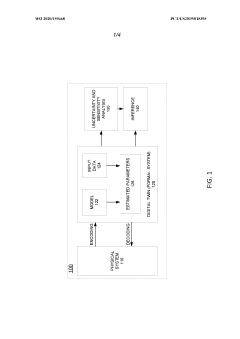
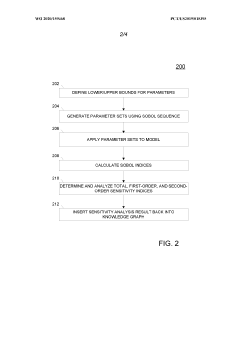
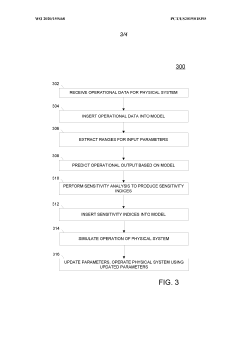
- The implementation of Sobol sensitivity analysis and the use of knowledge graphs with ensemble neural-network-based models to perform variance-based sensitivity analysis, allowing for the identification of influential parameters and their interactions, and enabling faster and more accurate simulation and optimization of physical systems.
Creating digital twins at scale
PatentPendingUS20230052327A1
Innovation
- A system and method utilizing a message queue paradigm to efficiently deploy and manage calibration engines and simulation clusters, enabling asynchronous processing and reducing resource usage, by enqueuing and dequeuing requests and results through calibration and simulation queues, allowing for concurrent model simulations and dynamic resource allocation on a cloud platform.


Data Privacy and Security Standards for Digital Twin Systems
Data privacy and security represent fundamental challenges in digital twin implementations for critical process optimization, particularly when comparing digital twin architectures against multi-scale simulation approaches. The interconnected nature of digital twin systems creates extensive attack surfaces that require comprehensive protection frameworks spanning data collection, transmission, storage, and processing phases.
Current regulatory landscapes demand adherence to multiple overlapping standards including ISO/IEC 27001 for information security management, NIST Cybersecurity Framework for critical infrastructure protection, and industry-specific regulations such as GDPR for data protection in European markets. Digital twin systems must implement privacy-by-design principles, ensuring data minimization, purpose limitation, and user consent mechanisms are embedded throughout the system architecture.
Authentication and authorization frameworks present unique challenges in digital twin environments where real-time data streams from multiple sensors and systems require seamless integration while maintaining strict access controls. Multi-factor authentication, role-based access control, and zero-trust network architectures have emerged as essential components for securing digital twin infrastructures against unauthorized access and data breaches.
Encryption standards for digital twin systems must address both data-at-rest and data-in-transit scenarios, with particular attention to edge computing environments where computational resources may be limited. Advanced encryption standard implementations, homomorphic encryption for privacy-preserving computations, and secure multi-party computation protocols are becoming increasingly relevant for protecting sensitive operational data while enabling collaborative optimization processes.
Data governance frameworks must establish clear protocols for data lifecycle management, including retention policies, deletion procedures, and cross-border data transfer compliance. The integration of blockchain technologies for immutable audit trails and smart contracts for automated compliance enforcement represents an emerging trend in digital twin security architectures, providing transparent and verifiable data handling processes that meet stringent regulatory requirements while supporting real-time optimization capabilities.
Current regulatory landscapes demand adherence to multiple overlapping standards including ISO/IEC 27001 for information security management, NIST Cybersecurity Framework for critical infrastructure protection, and industry-specific regulations such as GDPR for data protection in European markets. Digital twin systems must implement privacy-by-design principles, ensuring data minimization, purpose limitation, and user consent mechanisms are embedded throughout the system architecture.
Authentication and authorization frameworks present unique challenges in digital twin environments where real-time data streams from multiple sensors and systems require seamless integration while maintaining strict access controls. Multi-factor authentication, role-based access control, and zero-trust network architectures have emerged as essential components for securing digital twin infrastructures against unauthorized access and data breaches.
Encryption standards for digital twin systems must address both data-at-rest and data-in-transit scenarios, with particular attention to edge computing environments where computational resources may be limited. Advanced encryption standard implementations, homomorphic encryption for privacy-preserving computations, and secure multi-party computation protocols are becoming increasingly relevant for protecting sensitive operational data while enabling collaborative optimization processes.
Data governance frameworks must establish clear protocols for data lifecycle management, including retention policies, deletion procedures, and cross-border data transfer compliance. The integration of blockchain technologies for immutable audit trails and smart contracts for automated compliance enforcement represents an emerging trend in digital twin security architectures, providing transparent and verifiable data handling processes that meet stringent regulatory requirements while supporting real-time optimization capabilities.
Computational Infrastructure Requirements for Multi-Scale Digital Twins
Multi-scale digital twins for critical process optimization demand sophisticated computational infrastructure capable of handling diverse temporal and spatial scales simultaneously. The computational requirements span from molecular-level simulations operating on femtosecond timescales to system-level processes extending over hours or days, necessitating heterogeneous computing architectures that can efficiently manage this computational diversity.
High-performance computing clusters form the backbone of multi-scale digital twin infrastructure, requiring hybrid architectures combining CPU and GPU resources. CPUs excel at handling complex logic and sequential operations typical in macro-scale process models, while GPUs provide massive parallel processing capabilities essential for molecular dynamics simulations and finite element analyses. Modern implementations increasingly leverage specialized accelerators such as FPGAs and tensor processing units to optimize specific computational kernels.
Memory hierarchy design becomes critical when managing multi-scale simulations, as different scales generate vastly different data patterns and access requirements. Fast memory systems with hierarchical caching strategies ensure efficient data movement between computational scales, while distributed memory architectures enable seamless scaling across multiple compute nodes. Storage infrastructure must support both high-throughput sequential access for large-scale simulations and low-latency random access for real-time process monitoring data.
Network infrastructure requirements extend beyond traditional high-bandwidth interconnects to include edge computing capabilities for real-time data acquisition from industrial sensors and control systems. Software-defined networking enables dynamic resource allocation and quality-of-service management, ensuring critical real-time components receive priority while batch simulations utilize available bandwidth efficiently.
Container orchestration platforms and cloud-native architectures provide the flexibility needed to dynamically allocate computational resources based on current simulation demands. Kubernetes-based deployments enable automatic scaling of simulation components, while serverless computing frameworks handle sporadic computational bursts typical in multi-scale modeling scenarios.
Data management infrastructure must accommodate the heterogeneous nature of multi-scale data, from high-frequency sensor streams to large simulation datasets. Modern implementations utilize data lakes with specialized storage tiers optimized for different access patterns, ensuring both cost-effectiveness and performance optimization across the entire computational pipeline.
High-performance computing clusters form the backbone of multi-scale digital twin infrastructure, requiring hybrid architectures combining CPU and GPU resources. CPUs excel at handling complex logic and sequential operations typical in macro-scale process models, while GPUs provide massive parallel processing capabilities essential for molecular dynamics simulations and finite element analyses. Modern implementations increasingly leverage specialized accelerators such as FPGAs and tensor processing units to optimize specific computational kernels.
Memory hierarchy design becomes critical when managing multi-scale simulations, as different scales generate vastly different data patterns and access requirements. Fast memory systems with hierarchical caching strategies ensure efficient data movement between computational scales, while distributed memory architectures enable seamless scaling across multiple compute nodes. Storage infrastructure must support both high-throughput sequential access for large-scale simulations and low-latency random access for real-time process monitoring data.
Network infrastructure requirements extend beyond traditional high-bandwidth interconnects to include edge computing capabilities for real-time data acquisition from industrial sensors and control systems. Software-defined networking enables dynamic resource allocation and quality-of-service management, ensuring critical real-time components receive priority while batch simulations utilize available bandwidth efficiently.
Container orchestration platforms and cloud-native architectures provide the flexibility needed to dynamically allocate computational resources based on current simulation demands. Kubernetes-based deployments enable automatic scaling of simulation components, while serverless computing frameworks handle sporadic computational bursts typical in multi-scale modeling scenarios.
Data management infrastructure must accommodate the heterogeneous nature of multi-scale data, from high-frequency sensor streams to large simulation datasets. Modern implementations utilize data lakes with specialized storage tiers optimized for different access patterns, ensuring both cost-effectiveness and performance optimization across the entire computational pipeline.
Unlock deeper insights with Patsnap Eureka Quick Research — get a full tech report to explore trends and direct your research. Try now!
Generate Your Research Report Instantly with AI Agent
Supercharge your innovation with Patsnap Eureka AI Agent Platform!