

Direct Air Capture Sorbents Energy Consumption: Process Optimization Techniques
MAY 20, 20269 MIN READ
Generate Your Research Report Instantly with AI Agent
PatSnap Eureka helps you evaluate technical feasibility & market potential.
DAC Sorbent Technology Background and Energy Goals
Direct Air Capture (DAC) technology has emerged as a critical component in global carbon removal strategies, representing one of the most promising approaches for achieving negative emissions at scale. The fundamental principle involves extracting carbon dioxide directly from ambient air using specialized sorbent materials, which can be either solid or liquid-based systems. This technology addresses the urgent need to remove legacy CO2 emissions from the atmosphere while complementing traditional mitigation efforts.
The evolution of DAC technology traces back to early submarine and spacecraft air purification systems, where CO2 removal was essential for crew survival. However, the transition to large-scale atmospheric applications began in the early 2000s, driven by increasing awareness of climate change and the limitations of emission reduction alone. Initial developments focused on adapting existing industrial CO2 capture technologies, but the unique challenges of processing ambient air with its low CO2 concentration (approximately 420 ppm) necessitated entirely new approaches.
Current DAC systems face significant energy consumption challenges that directly impact their commercial viability and environmental effectiveness. Solid sorbent systems typically require thermal regeneration temperatures between 80-120°C for low-temperature sorbents and 300-900°C for high-temperature variants. This thermal energy demand represents 50-70% of the total energy consumption in most DAC processes. Liquid sorbent systems, while operating at lower regeneration temperatures, require substantial electrical energy for air contactors and pumping systems.
The primary technical objectives for DAC sorbent optimization center on achieving energy consumption below 1,500 kWh per ton of CO2 captured, which is considered the threshold for economic competitiveness with other carbon removal methods. Current state-of-the-art systems operate between 1,500-2,500 kWh/tCO2, indicating substantial room for improvement. Advanced targets aim for sub-1,000 kWh/tCO2 through revolutionary sorbent materials and process innovations.
Process optimization techniques focus on several key areas including heat integration strategies, advanced sorbent cycling protocols, and multi-stage capture configurations. Heat recovery systems can potentially reduce energy consumption by 20-40% through strategic thermal management. Additionally, the development of novel sorbent materials with enhanced selectivity, capacity, and regeneration kinetics represents a fundamental pathway toward achieving ambitious energy reduction goals while maintaining capture efficiency and system durability.
The evolution of DAC technology traces back to early submarine and spacecraft air purification systems, where CO2 removal was essential for crew survival. However, the transition to large-scale atmospheric applications began in the early 2000s, driven by increasing awareness of climate change and the limitations of emission reduction alone. Initial developments focused on adapting existing industrial CO2 capture technologies, but the unique challenges of processing ambient air with its low CO2 concentration (approximately 420 ppm) necessitated entirely new approaches.
Current DAC systems face significant energy consumption challenges that directly impact their commercial viability and environmental effectiveness. Solid sorbent systems typically require thermal regeneration temperatures between 80-120°C for low-temperature sorbents and 300-900°C for high-temperature variants. This thermal energy demand represents 50-70% of the total energy consumption in most DAC processes. Liquid sorbent systems, while operating at lower regeneration temperatures, require substantial electrical energy for air contactors and pumping systems.
The primary technical objectives for DAC sorbent optimization center on achieving energy consumption below 1,500 kWh per ton of CO2 captured, which is considered the threshold for economic competitiveness with other carbon removal methods. Current state-of-the-art systems operate between 1,500-2,500 kWh/tCO2, indicating substantial room for improvement. Advanced targets aim for sub-1,000 kWh/tCO2 through revolutionary sorbent materials and process innovations.
Process optimization techniques focus on several key areas including heat integration strategies, advanced sorbent cycling protocols, and multi-stage capture configurations. Heat recovery systems can potentially reduce energy consumption by 20-40% through strategic thermal management. Additionally, the development of novel sorbent materials with enhanced selectivity, capacity, and regeneration kinetics represents a fundamental pathway toward achieving ambitious energy reduction goals while maintaining capture efficiency and system durability.
Market Demand for Energy-Efficient Carbon Capture
The global carbon capture market is experiencing unprecedented growth driven by escalating climate commitments and regulatory pressures. Governments worldwide are implementing carbon pricing mechanisms and net-zero mandates, creating substantial demand for efficient carbon removal technologies. The direct air capture sector represents a critical component of this expanding market, with energy consumption optimization emerging as the primary determinant of commercial viability.
Industrial sectors are increasingly seeking carbon capture solutions that can integrate seamlessly with existing operations while minimizing energy penalties. Manufacturing facilities, power generation plants, and petrochemical complexes are evaluating DAC technologies based on their energy efficiency profiles and operational cost structures. The demand is particularly pronounced in regions with abundant renewable energy resources, where low-cost electricity can offset the inherent energy intensity of current DAC processes.
Corporate sustainability initiatives are driving significant market interest in energy-optimized carbon capture solutions. Major corporations across technology, automotive, and consumer goods sectors are establishing carbon neutrality targets that require scalable removal technologies. These organizations prioritize DAC systems with demonstrated energy efficiency improvements, as operational costs directly impact the economic feasibility of large-scale deployment.
The aviation and shipping industries represent emerging high-demand segments for efficient carbon capture technologies. These hard-to-abate sectors face limited decarbonization alternatives and are actively seeking cost-effective carbon removal solutions. Energy-efficient DAC systems offer potential pathways for achieving sector-specific emission reduction targets while maintaining operational competitiveness.
Investment patterns reveal strong market preference for DAC technologies demonstrating superior energy performance metrics. Venture capital and private equity funding increasingly flows toward companies developing novel sorbent materials and process optimization techniques that reduce energy consumption per ton of captured carbon dioxide. This investment trend reflects market recognition that energy efficiency improvements are essential for achieving commercial scale deployment.
Geographic demand distribution shows concentration in regions with supportive policy frameworks and renewable energy infrastructure. North America and Europe lead market development, driven by carbon credit markets and government incentives for negative emission technologies. Emerging markets in Asia-Pacific are showing growing interest as carbon pricing mechanisms expand and industrial decarbonization requirements intensify.
Industrial sectors are increasingly seeking carbon capture solutions that can integrate seamlessly with existing operations while minimizing energy penalties. Manufacturing facilities, power generation plants, and petrochemical complexes are evaluating DAC technologies based on their energy efficiency profiles and operational cost structures. The demand is particularly pronounced in regions with abundant renewable energy resources, where low-cost electricity can offset the inherent energy intensity of current DAC processes.
Corporate sustainability initiatives are driving significant market interest in energy-optimized carbon capture solutions. Major corporations across technology, automotive, and consumer goods sectors are establishing carbon neutrality targets that require scalable removal technologies. These organizations prioritize DAC systems with demonstrated energy efficiency improvements, as operational costs directly impact the economic feasibility of large-scale deployment.
The aviation and shipping industries represent emerging high-demand segments for efficient carbon capture technologies. These hard-to-abate sectors face limited decarbonization alternatives and are actively seeking cost-effective carbon removal solutions. Energy-efficient DAC systems offer potential pathways for achieving sector-specific emission reduction targets while maintaining operational competitiveness.
Investment patterns reveal strong market preference for DAC technologies demonstrating superior energy performance metrics. Venture capital and private equity funding increasingly flows toward companies developing novel sorbent materials and process optimization techniques that reduce energy consumption per ton of captured carbon dioxide. This investment trend reflects market recognition that energy efficiency improvements are essential for achieving commercial scale deployment.
Geographic demand distribution shows concentration in regions with supportive policy frameworks and renewable energy infrastructure. North America and Europe lead market development, driven by carbon credit markets and government incentives for negative emission technologies. Emerging markets in Asia-Pacific are showing growing interest as carbon pricing mechanisms expand and industrial decarbonization requirements intensify.
Current DAC Energy Challenges and Global Distribution
Direct Air Capture technology faces significant energy consumption challenges that represent the primary barrier to widespread commercial deployment. Current DAC systems require between 1,500 to 2,000 kWh of energy per ton of CO2 captured, with thermal energy demands accounting for approximately 80% of total energy requirements during sorbent regeneration processes. The high-temperature desorption cycles, typically operating between 80-120°C for solid sorbents and 900-950°C for high-temperature systems, create substantial energy penalties that directly impact economic viability.
The energy intensity varies considerably across different sorbent technologies and process configurations. Solid amine-based sorbents demonstrate lower regeneration temperatures but suffer from slower kinetics and reduced working capacity. Liquid solvent systems achieve higher capture rates but require extensive heat integration networks to minimize thermal energy losses. Temperature swing adsorption processes face particular challenges in heat recovery efficiency, while pressure swing systems encounter significant parasitic power consumption from compression equipment.
Geographically, DAC energy challenges manifest differently across regions due to varying energy infrastructure and climate conditions. North American installations, particularly in the United States and Canada, benefit from abundant renewable energy resources but face grid integration complexities. The concentration of DAC pilot projects in regions like Texas and Alberta reflects access to industrial-scale energy infrastructure, though fossil fuel dependency remains a concern for lifecycle carbon accounting.
European DAC development focuses heavily on energy optimization due to higher electricity costs and stringent carbon accounting requirements. Countries like Switzerland, Iceland, and Norway leverage geothermal and hydroelectric resources to address thermal energy demands, while Germany and the Netherlands emphasize industrial waste heat integration strategies. The European approach prioritizes system-level energy efficiency improvements and renewable energy coupling.
Asia-Pacific regions present unique energy landscape challenges for DAC deployment. Japan's limited renewable capacity drives focus on process intensification and heat pump integration technologies. Australia's abundant solar resources create opportunities for thermochemical energy storage coupling, while China's manufacturing capabilities enable large-scale sorbent production but face coal-dependent energy supply concerns.
The global distribution of DAC energy challenges reflects broader energy transition dynamics, with successful deployment requiring region-specific optimization strategies that align with local energy resources, regulatory frameworks, and industrial infrastructure capabilities.
The energy intensity varies considerably across different sorbent technologies and process configurations. Solid amine-based sorbents demonstrate lower regeneration temperatures but suffer from slower kinetics and reduced working capacity. Liquid solvent systems achieve higher capture rates but require extensive heat integration networks to minimize thermal energy losses. Temperature swing adsorption processes face particular challenges in heat recovery efficiency, while pressure swing systems encounter significant parasitic power consumption from compression equipment.
Geographically, DAC energy challenges manifest differently across regions due to varying energy infrastructure and climate conditions. North American installations, particularly in the United States and Canada, benefit from abundant renewable energy resources but face grid integration complexities. The concentration of DAC pilot projects in regions like Texas and Alberta reflects access to industrial-scale energy infrastructure, though fossil fuel dependency remains a concern for lifecycle carbon accounting.
European DAC development focuses heavily on energy optimization due to higher electricity costs and stringent carbon accounting requirements. Countries like Switzerland, Iceland, and Norway leverage geothermal and hydroelectric resources to address thermal energy demands, while Germany and the Netherlands emphasize industrial waste heat integration strategies. The European approach prioritizes system-level energy efficiency improvements and renewable energy coupling.
Asia-Pacific regions present unique energy landscape challenges for DAC deployment. Japan's limited renewable capacity drives focus on process intensification and heat pump integration technologies. Australia's abundant solar resources create opportunities for thermochemical energy storage coupling, while China's manufacturing capabilities enable large-scale sorbent production but face coal-dependent energy supply concerns.
The global distribution of DAC energy challenges reflects broader energy transition dynamics, with successful deployment requiring region-specific optimization strategies that align with local energy resources, regulatory frameworks, and industrial infrastructure capabilities.
Current Energy Optimization Solutions for DAC
01 Advanced sorbent materials for enhanced CO2 capture efficiency
Development of novel sorbent materials with improved adsorption capacity and selectivity for carbon dioxide capture from ambient air. These materials include metal-organic frameworks, amine-functionalized sorbents, and solid amine materials that can effectively bind CO2 molecules while maintaining structural stability during repeated adsorption-desorption cycles.- Low-energy sorbent materials for direct air capture: Development of advanced sorbent materials that require minimal energy for CO2 capture and release cycles. These materials are designed with optimized pore structures and surface properties to enhance CO2 adsorption capacity while reducing the energy penalty associated with regeneration processes. Novel material compositions and synthesis methods are employed to achieve high selectivity and low heat requirements.
- Energy-efficient regeneration processes: Innovative methods for regenerating CO2-saturated sorbents with reduced energy consumption. These processes focus on optimizing temperature and pressure conditions during desorption cycles, implementing heat recovery systems, and utilizing alternative energy sources. The approaches aim to minimize the overall energy footprint of the direct air capture system while maintaining high CO2 recovery rates.
- Heat integration and thermal management systems: Advanced thermal management strategies that optimize heat utilization throughout the direct air capture process. These systems incorporate heat exchangers, thermal storage units, and waste heat recovery mechanisms to improve overall energy efficiency. The integration of renewable energy sources and smart thermal control systems helps reduce the parasitic energy load of the capture process.
- Process optimization and system design: Comprehensive system designs that minimize energy consumption through optimized process configurations and operational parameters. These approaches include advanced control systems, process intensification techniques, and integrated system architectures that reduce energy losses. The focus is on achieving maximum CO2 capture efficiency while minimizing auxiliary power requirements and operational costs.
- Hybrid and multi-stage capture technologies: Multi-stage capture systems that combine different sorbent materials and process conditions to optimize energy consumption across the entire capture cycle. These hybrid approaches utilize cascaded processes, multi-bed configurations, and integrated separation techniques to achieve high CO2 purity while minimizing energy requirements. The systems are designed to operate efficiently under varying ambient conditions and CO2 concentrations.
02 Energy-efficient regeneration processes for sorbent materials
Optimization of thermal and pressure swing processes to minimize energy requirements during sorbent regeneration. These processes focus on reducing the temperature and energy needed to release captured carbon dioxide from sorbent materials, incorporating heat recovery systems and innovative cycling methods to improve overall system efficiency.Expand Specific Solutions03 Heat integration and thermal management systems
Implementation of advanced heat exchange networks and thermal management strategies to reduce overall energy consumption in direct air capture systems. These approaches include waste heat recovery, process integration, and thermal storage solutions that optimize energy utilization throughout the capture and regeneration cycles.Expand Specific Solutions04 Process optimization and system design improvements
Development of optimized system configurations and process control strategies that minimize energy requirements while maintaining high capture rates. These improvements include modular designs, enhanced mass transfer mechanisms, and intelligent control systems that adapt operating conditions to achieve maximum energy efficiency.Expand Specific Solutions05 Renewable energy integration and power management
Integration of renewable energy sources and advanced power management systems to reduce the carbon footprint and operational costs of direct air capture facilities. These solutions include solar and wind power integration, energy storage systems, and smart grid connectivity to optimize energy consumption patterns and reduce reliance on fossil fuel-based electricity.Expand Specific Solutions
Key Players in DAC and Sorbent Industry
The direct air capture (DAC) sorbents energy consumption optimization field represents an emerging but rapidly advancing sector within the broader carbon capture market. The industry is transitioning from early-stage research to commercial deployment, with the global DAC market projected to reach multi-billion dollar valuations by 2030. Technology maturity varies significantly across players, with established companies like Climeworks AG and Avnos Inc. leading commercial-scale operations, while research institutions such as Columbia University, Zhejiang University, and Korea Institute of Energy Research drive fundamental innovations. Industrial giants including Siemens Energy, Air Products & Chemicals, and Shell USA provide critical infrastructure and scaling capabilities. Energy companies like China National Petroleum Corporation and Equinor are integrating DAC into their decarbonization strategies, while specialized firms like Zero Carbon Systems focus on breakthrough sorbent technologies and process optimization to reduce energy penalties that currently limit widespread adoption.
Siemens Energy Global GmbH & Co. KG
Technical Solution: Siemens Energy has developed integrated DAC solutions focusing on electrification and renewable energy integration for sorbent regeneration processes. Their approach emphasizes electric heating systems powered by renewable electricity, combined with advanced thermal energy storage and heat pump technologies. The company's process optimization includes digital twin modeling for real-time process optimization, predictive maintenance algorithms, and grid-interactive operation capabilities. Their technology integrates with power-to-X pathways and utilizes industrial symbiosis concepts to leverage waste heat from adjacent industrial processes. Energy consumption optimization is achieved through smart grid integration and demand response capabilities.
Strengths: Strong electrification expertise, excellent grid integration capabilities, comprehensive digital optimization tools. Weaknesses: Higher electricity costs compared to thermal processes, dependency on renewable energy availability.
Avnos, Inc.
Technical Solution: Avnos has developed a hybrid liquid-solid DAC system that combines aqueous amine solutions with solid support materials to optimize both capture kinetics and regeneration efficiency. Their technology utilizes a novel multi-stage process with intermediate temperature levels (60-120°C) and incorporates mechanical vapor recompression (MVR) systems to minimize thermal energy requirements. The company focuses on process intensification through microstructured contactors and advanced heat exchanger networks. Their optimization approach includes predictive control algorithms and real-time process monitoring to maintain optimal operating conditions while minimizing parasitic energy losses throughout the capture-regeneration cycle.
Strengths: Innovative hybrid approach, advanced process control, efficient heat recovery systems. Weaknesses: Technology still in development phase, unproven at commercial scale, complex system integration requirements.
Core Patents in Low-Energy DAC Processes
Apparatus, method and system for direct air capture utilizing electromagnetic excitation radiation desorption of solid amine sorbents to release carbon dioxide
PatentPendingEP4609941A2
Innovation
- The use of polyamine sorbents, such as polyethylenimine (PEI), grafted onto solid supports like cellulose acetate or gamma alumina, combined with microwave or radio frequency irradiation for efficient carbon dioxide capture and regeneration, utilizing laminar-flow contactors and microwave swing desorption (MWSD) to minimize energy consumption.


System and method for direct air capture
PatentWO2025141054A1
Innovation
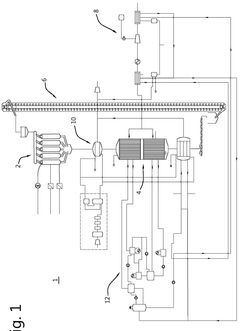
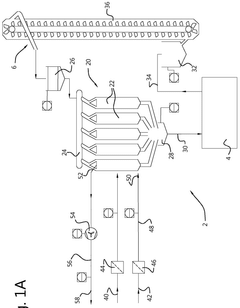
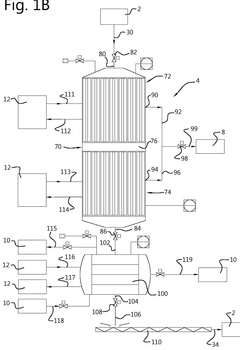
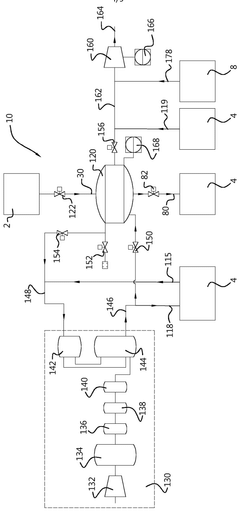
- A system utilizing an adsorber section, regeneration section with multiple desorption stages at distinct temperature levels under vacuum, a transport section, and a heat recovery system with a two-stage heat pump assembly to optimize energy use, incorporating granular sorbent material and high-purity nitrogen purge to enhance adsorption efficiency.
Carbon Policy and DAC Regulatory Framework
The regulatory landscape for Direct Air Capture (DAC) technology is rapidly evolving as governments worldwide recognize the critical role of carbon removal in achieving net-zero emissions targets. Current carbon policies primarily focus on emissions reduction through carbon pricing mechanisms, renewable energy mandates, and industrial regulations, but are increasingly incorporating negative emissions technologies like DAC into comprehensive climate frameworks.
The United States has emerged as a regulatory leader through the 45Q tax credit program, which provides substantial financial incentives for carbon capture and storage activities. The Infrastructure Investment and Jobs Act further expanded support for DAC through dedicated funding programs and research initiatives. The European Union's Green Deal and Fit for 55 package are establishing similar frameworks, with the EU ETS potentially expanding to include carbon removal credits.
International coordination is developing through the Paris Agreement's Article 6 mechanisms, which could enable DAC projects to generate internationally transferable carbon credits. However, significant regulatory gaps remain regarding measurement, reporting, and verification (MRV) standards for DAC operations, particularly concerning energy consumption optimization and sorbent performance metrics.
Key regulatory challenges include establishing standardized methodologies for quantifying net carbon removal while accounting for energy consumption patterns, defining permanence requirements for stored CO2, and creating certification frameworks for different DAC technologies. The lack of harmonized international standards creates uncertainty for technology developers and investors.
Emerging regulatory trends indicate movement toward performance-based incentives that reward energy-efficient DAC operations, mandatory carbon removal quotas for high-emission industries, and integration of DAC into existing environmental permitting processes. Several jurisdictions are developing specific regulations for DAC facility siting, environmental impact assessments, and operational monitoring requirements.
The regulatory framework's evolution will significantly influence DAC technology development priorities, particularly driving innovation in energy-efficient sorbent materials and process optimization techniques to meet increasingly stringent performance standards and cost-effectiveness requirements established by policy mechanisms.
The United States has emerged as a regulatory leader through the 45Q tax credit program, which provides substantial financial incentives for carbon capture and storage activities. The Infrastructure Investment and Jobs Act further expanded support for DAC through dedicated funding programs and research initiatives. The European Union's Green Deal and Fit for 55 package are establishing similar frameworks, with the EU ETS potentially expanding to include carbon removal credits.
International coordination is developing through the Paris Agreement's Article 6 mechanisms, which could enable DAC projects to generate internationally transferable carbon credits. However, significant regulatory gaps remain regarding measurement, reporting, and verification (MRV) standards for DAC operations, particularly concerning energy consumption optimization and sorbent performance metrics.
Key regulatory challenges include establishing standardized methodologies for quantifying net carbon removal while accounting for energy consumption patterns, defining permanence requirements for stored CO2, and creating certification frameworks for different DAC technologies. The lack of harmonized international standards creates uncertainty for technology developers and investors.
Emerging regulatory trends indicate movement toward performance-based incentives that reward energy-efficient DAC operations, mandatory carbon removal quotas for high-emission industries, and integration of DAC into existing environmental permitting processes. Several jurisdictions are developing specific regulations for DAC facility siting, environmental impact assessments, and operational monitoring requirements.
The regulatory framework's evolution will significantly influence DAC technology development priorities, particularly driving innovation in energy-efficient sorbent materials and process optimization techniques to meet increasingly stringent performance standards and cost-effectiveness requirements established by policy mechanisms.
Economic Viability of Optimized DAC Systems
The economic viability of optimized Direct Air Capture systems fundamentally depends on achieving substantial reductions in energy consumption through advanced process optimization techniques. Current DAC technologies face significant economic barriers, with costs ranging from $150 to $600 per ton of CO2 captured, primarily driven by high energy requirements that can account for 60-80% of total operational expenses.
Process optimization strategies targeting sorbent regeneration cycles present the most promising pathway for cost reduction. Advanced heat integration systems, including heat pumps and thermal energy storage, can reduce energy penalties by 25-40% compared to conventional approaches. These improvements translate directly to operational cost savings of $50-120 per ton of CO2, significantly enhancing the economic attractiveness of DAC deployment.
The implementation of multi-stage sorbent systems with optimized temperature and pressure profiles demonstrates substantial economic benefits. By operating at lower regeneration temperatures through improved sorbent materials and process design, facilities can reduce steam requirements and associated infrastructure costs. This optimization can decrease capital expenditure by 15-25% while simultaneously lowering operational energy costs.
Economic modeling indicates that optimized DAC systems achieving energy consumption below 1,500 kWh per ton of CO2 can reach cost parity with other carbon removal technologies by 2030. The integration of renewable energy sources further enhances economic viability, particularly when coupled with grid balancing services that provide additional revenue streams.
Scale effects amplify the economic benefits of process optimization, with large-scale facilities (>1 Mt CO2/year) demonstrating unit costs 40-60% lower than smaller installations. The combination of optimized processes and economies of scale positions DAC technology as economically competitive within the growing carbon removal market, projected to reach $10 billion annually by 2030.
Financial incentives and carbon pricing mechanisms significantly influence the economic landscape, with current carbon credits ranging from $50-150 per ton in voluntary markets, making optimized DAC systems increasingly attractive investment opportunities.
Process optimization strategies targeting sorbent regeneration cycles present the most promising pathway for cost reduction. Advanced heat integration systems, including heat pumps and thermal energy storage, can reduce energy penalties by 25-40% compared to conventional approaches. These improvements translate directly to operational cost savings of $50-120 per ton of CO2, significantly enhancing the economic attractiveness of DAC deployment.
The implementation of multi-stage sorbent systems with optimized temperature and pressure profiles demonstrates substantial economic benefits. By operating at lower regeneration temperatures through improved sorbent materials and process design, facilities can reduce steam requirements and associated infrastructure costs. This optimization can decrease capital expenditure by 15-25% while simultaneously lowering operational energy costs.
Economic modeling indicates that optimized DAC systems achieving energy consumption below 1,500 kWh per ton of CO2 can reach cost parity with other carbon removal technologies by 2030. The integration of renewable energy sources further enhances economic viability, particularly when coupled with grid balancing services that provide additional revenue streams.
Scale effects amplify the economic benefits of process optimization, with large-scale facilities (>1 Mt CO2/year) demonstrating unit costs 40-60% lower than smaller installations. The combination of optimized processes and economies of scale positions DAC technology as economically competitive within the growing carbon removal market, projected to reach $10 billion annually by 2030.
Financial incentives and carbon pricing mechanisms significantly influence the economic landscape, with current carbon credits ranging from $50-150 per ton in voluntary markets, making optimized DAC systems increasingly attractive investment opportunities.
Unlock deeper insights with PatSnap Eureka Quick Research — get a full tech report to explore trends and direct your research. Try now!
Generate Your Research Report Instantly with AI Agent
Supercharge your innovation with PatSnap Eureka AI Agent Platform!