

Direct Injection Engine Cycle Efficiency: Improving Metrics
MAR 12, 20269 MIN READ
Generate Your Research Report Instantly with AI Agent
PatSnap Eureka helps you evaluate technical feasibility & market potential.
Direct Injection Engine Development Background and Efficiency Goals
Direct injection technology represents a pivotal advancement in internal combustion engine development, fundamentally transforming how fuel is delivered and combusted within engine cylinders. This technology emerged from the automotive industry's relentless pursuit of enhanced fuel efficiency, reduced emissions, and improved performance characteristics. Unlike traditional port fuel injection systems that introduce fuel into the intake manifold, direct injection delivers fuel directly into the combustion chamber at precisely controlled timing and pressure levels.
The evolution of direct injection engines traces back to early diesel applications in the mid-20th century, where the technology proved essential for compression ignition systems. However, the adaptation to gasoline engines presented unique challenges related to fuel atomization, combustion control, and deposit formation. The breakthrough came in the late 1990s when advanced electronic control systems and high-pressure fuel pumps enabled practical implementation in passenger vehicles.
Modern direct injection systems have undergone continuous refinement, incorporating sophisticated fuel injection strategies, variable valve timing, and turbocharging integration. These developments have established direct injection as a cornerstone technology for meeting increasingly stringent fuel economy standards and emission regulations worldwide. The technology's ability to enable precise fuel metering, stratified charge combustion, and knock resistance has made it indispensable for contemporary engine designs.
The primary efficiency goals driving direct injection engine development center on maximizing thermal efficiency while minimizing fuel consumption and emissions. Thermal efficiency improvements target the 40-45% range for production engines, representing significant advancement over conventional port injection systems that typically achieve 30-35% efficiency. These gains stem from enhanced combustion control, reduced heat losses, and optimized air-fuel mixing strategies.
Fuel economy targets align with global regulatory requirements, including Corporate Average Fuel Economy standards and European Union emission regulations. Direct injection technology enables manufacturers to achieve 15-20% fuel consumption improvements compared to conventional systems, particularly when combined with downsizing and turbocharging strategies. Additionally, the technology supports advanced combustion modes such as homogeneous charge compression ignition and lean-burn operation, further extending efficiency potential.
Emission reduction objectives focus on simultaneously minimizing nitrogen oxides, particulate matter, and carbon dioxide emissions. Direct injection systems facilitate precise control over combustion phasing and temperature, enabling optimization of the efficiency-emissions trade-off that has historically constrained engine development efforts.
The evolution of direct injection engines traces back to early diesel applications in the mid-20th century, where the technology proved essential for compression ignition systems. However, the adaptation to gasoline engines presented unique challenges related to fuel atomization, combustion control, and deposit formation. The breakthrough came in the late 1990s when advanced electronic control systems and high-pressure fuel pumps enabled practical implementation in passenger vehicles.
Modern direct injection systems have undergone continuous refinement, incorporating sophisticated fuel injection strategies, variable valve timing, and turbocharging integration. These developments have established direct injection as a cornerstone technology for meeting increasingly stringent fuel economy standards and emission regulations worldwide. The technology's ability to enable precise fuel metering, stratified charge combustion, and knock resistance has made it indispensable for contemporary engine designs.
The primary efficiency goals driving direct injection engine development center on maximizing thermal efficiency while minimizing fuel consumption and emissions. Thermal efficiency improvements target the 40-45% range for production engines, representing significant advancement over conventional port injection systems that typically achieve 30-35% efficiency. These gains stem from enhanced combustion control, reduced heat losses, and optimized air-fuel mixing strategies.
Fuel economy targets align with global regulatory requirements, including Corporate Average Fuel Economy standards and European Union emission regulations. Direct injection technology enables manufacturers to achieve 15-20% fuel consumption improvements compared to conventional systems, particularly when combined with downsizing and turbocharging strategies. Additionally, the technology supports advanced combustion modes such as homogeneous charge compression ignition and lean-burn operation, further extending efficiency potential.
Emission reduction objectives focus on simultaneously minimizing nitrogen oxides, particulate matter, and carbon dioxide emissions. Direct injection systems facilitate precise control over combustion phasing and temperature, enabling optimization of the efficiency-emissions trade-off that has historically constrained engine development efforts.
Market Demand for High-Efficiency Direct Injection Engines
The automotive industry is experiencing unprecedented pressure to develop more fuel-efficient powertrains as global environmental regulations become increasingly stringent. Direct injection engines have emerged as a critical technology in meeting these demands, offering superior fuel economy compared to traditional port fuel injection systems. The market demand for high-efficiency direct injection engines is being driven by multiple converging factors that are reshaping the automotive landscape.
Regulatory frameworks worldwide are establishing increasingly ambitious fuel economy standards and emissions targets. The Corporate Average Fuel Economy standards in the United States, European Union emissions regulations, and similar policies in Asia-Pacific markets are compelling automakers to adopt advanced engine technologies. Direct injection systems enable manufacturers to achieve these regulatory requirements while maintaining performance characteristics that consumers expect.
Consumer preferences are shifting toward vehicles that offer both performance and efficiency. Modern buyers seek engines that deliver responsive acceleration and smooth operation while minimizing fuel consumption costs. Direct injection technology addresses this dual requirement by providing precise fuel metering and optimized combustion characteristics that enhance both power output and fuel efficiency metrics.
The commercial vehicle sector represents a particularly significant market opportunity for high-efficiency direct injection engines. Fleet operators prioritize total cost of ownership, making fuel efficiency improvements directly translatable to operational savings. Heavy-duty applications, including trucking and construction equipment, are increasingly adopting direct injection systems to reduce operating expenses and meet emissions compliance requirements.
Emerging markets are experiencing rapid motorization, creating substantial demand for efficient powertrain technologies. As vehicle ownership expands in developing economies, manufacturers are positioning direct injection engines as standard equipment rather than premium features. This democratization of advanced engine technology is expanding the addressable market significantly.
The transition period before widespread electric vehicle adoption creates a sustained market window for internal combustion engine improvements. Hybrid powertrains, which combine electric motors with internal combustion engines, particularly benefit from direct injection technology to maximize system efficiency during engine operation phases.
Technological advancements in fuel injection systems, combustion chamber design, and engine management software are enabling new levels of efficiency optimization. These developments are creating market opportunities for suppliers and manufacturers who can deliver measurable improvements in fuel economy metrics while maintaining reliability and durability standards expected in automotive applications.
Regulatory frameworks worldwide are establishing increasingly ambitious fuel economy standards and emissions targets. The Corporate Average Fuel Economy standards in the United States, European Union emissions regulations, and similar policies in Asia-Pacific markets are compelling automakers to adopt advanced engine technologies. Direct injection systems enable manufacturers to achieve these regulatory requirements while maintaining performance characteristics that consumers expect.
Consumer preferences are shifting toward vehicles that offer both performance and efficiency. Modern buyers seek engines that deliver responsive acceleration and smooth operation while minimizing fuel consumption costs. Direct injection technology addresses this dual requirement by providing precise fuel metering and optimized combustion characteristics that enhance both power output and fuel efficiency metrics.
The commercial vehicle sector represents a particularly significant market opportunity for high-efficiency direct injection engines. Fleet operators prioritize total cost of ownership, making fuel efficiency improvements directly translatable to operational savings. Heavy-duty applications, including trucking and construction equipment, are increasingly adopting direct injection systems to reduce operating expenses and meet emissions compliance requirements.
Emerging markets are experiencing rapid motorization, creating substantial demand for efficient powertrain technologies. As vehicle ownership expands in developing economies, manufacturers are positioning direct injection engines as standard equipment rather than premium features. This democratization of advanced engine technology is expanding the addressable market significantly.
The transition period before widespread electric vehicle adoption creates a sustained market window for internal combustion engine improvements. Hybrid powertrains, which combine electric motors with internal combustion engines, particularly benefit from direct injection technology to maximize system efficiency during engine operation phases.
Technological advancements in fuel injection systems, combustion chamber design, and engine management software are enabling new levels of efficiency optimization. These developments are creating market opportunities for suppliers and manufacturers who can deliver measurable improvements in fuel economy metrics while maintaining reliability and durability standards expected in automotive applications.
Current State and Challenges of DI Engine Cycle Efficiency
Direct injection (DI) engines have achieved significant technological maturity over the past two decades, with widespread adoption across gasoline and diesel powertrains. Current DI systems demonstrate substantial improvements in fuel economy compared to port fuel injection, typically achieving 10-15% better efficiency under optimal operating conditions. Modern DI engines incorporate advanced fuel injection strategies, including multiple injection events per cycle, precise timing control, and injection pressures exceeding 200 bar for gasoline applications and up to 2500 bar for diesel systems.
Despite these advances, contemporary DI engines face several critical efficiency limitations that constrain further performance gains. Combustion optimization remains challenging due to the complex interplay between fuel atomization, air-fuel mixing, and ignition timing. Current systems struggle to maintain optimal combustion phasing across varying load and speed conditions, particularly during transient operations where efficiency can drop by 20-30% compared to steady-state performance.
Thermal efficiency barriers represent another significant constraint, with most production DI engines achieving brake thermal efficiency between 35-42%. Heat losses through cylinder walls, exhaust gases, and incomplete combustion continue to limit overall cycle efficiency. The fundamental thermodynamic constraints of the Otto and Diesel cycles impose theoretical limits that current technologies approach but cannot exceed without revolutionary changes in combustion strategies.
Emissions compliance requirements create additional efficiency challenges, particularly for diesel DI engines equipped with aftertreatment systems. The energy penalty associated with diesel particulate filter regeneration and selective catalytic reduction can reduce overall system efficiency by 3-5%. Gasoline DI engines face particulate matter formation issues that require careful calibration trade-offs between efficiency and emissions performance.
Geographically, DI engine development concentrates in established automotive regions, with European manufacturers leading diesel DI technology and Asian companies advancing gasoline DI systems. North American focus emphasizes large-displacement applications with emphasis on performance rather than maximum efficiency. This regional specialization creates varying approaches to efficiency optimization, with European standards driving more aggressive efficiency targets compared to other markets.
Manufacturing precision and component durability present ongoing technical challenges. High-pressure fuel systems require extremely tight tolerances and advanced materials to maintain performance over extended operating periods. Injector fouling and carbon deposit formation continue to degrade efficiency over time, necessitating maintenance interventions that impact real-world performance metrics.
Despite these advances, contemporary DI engines face several critical efficiency limitations that constrain further performance gains. Combustion optimization remains challenging due to the complex interplay between fuel atomization, air-fuel mixing, and ignition timing. Current systems struggle to maintain optimal combustion phasing across varying load and speed conditions, particularly during transient operations where efficiency can drop by 20-30% compared to steady-state performance.
Thermal efficiency barriers represent another significant constraint, with most production DI engines achieving brake thermal efficiency between 35-42%. Heat losses through cylinder walls, exhaust gases, and incomplete combustion continue to limit overall cycle efficiency. The fundamental thermodynamic constraints of the Otto and Diesel cycles impose theoretical limits that current technologies approach but cannot exceed without revolutionary changes in combustion strategies.
Emissions compliance requirements create additional efficiency challenges, particularly for diesel DI engines equipped with aftertreatment systems. The energy penalty associated with diesel particulate filter regeneration and selective catalytic reduction can reduce overall system efficiency by 3-5%. Gasoline DI engines face particulate matter formation issues that require careful calibration trade-offs between efficiency and emissions performance.
Geographically, DI engine development concentrates in established automotive regions, with European manufacturers leading diesel DI technology and Asian companies advancing gasoline DI systems. North American focus emphasizes large-displacement applications with emphasis on performance rather than maximum efficiency. This regional specialization creates varying approaches to efficiency optimization, with European standards driving more aggressive efficiency targets compared to other markets.
Manufacturing precision and component durability present ongoing technical challenges. High-pressure fuel systems require extremely tight tolerances and advanced materials to maintain performance over extended operating periods. Injector fouling and carbon deposit formation continue to degrade efficiency over time, necessitating maintenance interventions that impact real-world performance metrics.
Current Solutions for DI Engine Efficiency Optimization
01 Fuel injection timing and control optimization
Optimizing the timing and control of fuel injection in direct injection engines can significantly improve cycle efficiency. By precisely controlling when fuel is injected into the combustion chamber, the combustion process can be optimized to achieve better fuel atomization, improved air-fuel mixing, and more complete combustion. Advanced control strategies and electronic control units enable real-time adjustments based on engine operating conditions, leading to enhanced thermal efficiency and reduced fuel consumption.- Fuel injection timing and control optimization: Optimizing the timing and control of fuel injection in direct injection engines can significantly improve cycle efficiency. By precisely controlling when fuel is injected into the combustion chamber, the combustion process can be optimized to achieve better fuel atomization, improved air-fuel mixing, and more complete combustion. Advanced control strategies including electronic control units and sensors enable real-time adjustments to injection timing based on engine operating conditions, leading to enhanced thermal efficiency and reduced fuel consumption.
- Combustion chamber design and geometry optimization: The design and geometry of the combustion chamber play a crucial role in improving direct injection engine cycle efficiency. Optimized combustion chamber shapes, including bowl designs and piston crown configurations, can enhance air motion, promote better fuel-air mixing, and improve combustion efficiency. Specific geometric features such as cavity depth, diameter, and wall angles can be tailored to create optimal turbulence and swirl patterns, resulting in more efficient combustion and higher thermal efficiency.
- Multi-stage or split injection strategies: Implementing multi-stage or split injection strategies can enhance cycle efficiency in direct injection engines. This approach involves dividing the total fuel quantity into multiple injection events during a single combustion cycle, such as pilot injection, main injection, and post injection. This technique allows for better control of combustion phasing, reduced combustion noise, lower emissions, and improved fuel economy. The strategy helps to optimize the heat release rate and reduce peak combustion temperatures.
- High-pressure fuel injection systems: Utilizing high-pressure fuel injection systems is essential for improving cycle efficiency in direct injection engines. Higher injection pressures enable finer fuel atomization, better penetration into the combustion chamber, and more homogeneous air-fuel mixture formation. This results in more complete combustion, reduced particulate emissions, and improved thermal efficiency. Advanced high-pressure common rail systems and piezoelectric injectors allow for precise control of injection pressure and duration across various engine operating conditions.
- Intake air management and charge motion control: Effective intake air management and charge motion control are critical for enhancing direct injection engine cycle efficiency. Techniques include optimizing intake port design, implementing variable valve timing, and controlling swirl and tumble motion within the cylinder. These methods improve air-fuel mixing, enhance combustion stability, and enable leaner combustion operation. Proper charge motion control facilitates better utilization of injected fuel and promotes more efficient combustion, particularly during stratified charge operation modes.
02 Combustion chamber design and geometry
The design and geometry of the combustion chamber play a crucial role in direct injection engine efficiency. Optimized chamber shapes, piston crown designs, and valve configurations can promote better fuel-air mixing, create favorable turbulence patterns, and improve combustion characteristics. These design features help achieve more uniform temperature distribution, reduce heat losses, and enable higher compression ratios, all contributing to improved cycle efficiency.Expand Specific Solutions03 Injection pressure and spray characteristics
Increasing injection pressure and optimizing spray characteristics are effective methods for improving direct injection engine efficiency. Higher injection pressures result in finer fuel atomization and better penetration into the combustion chamber, leading to more homogeneous mixture formation. The spray pattern, droplet size distribution, and injection rate can be tailored to match specific engine operating conditions, resulting in more efficient combustion and reduced emissions.Expand Specific Solutions04 Multi-stage injection strategies
Implementing multi-stage injection strategies, including pilot injection, main injection, and post-injection, can enhance cycle efficiency in direct injection engines. This approach allows for better control of combustion phasing, reduced combustion noise, lower emissions, and improved fuel economy. By splitting the fuel delivery into multiple events, the combustion process can be shaped to optimize pressure rise rates and minimize heat transfer losses.Expand Specific Solutions05 Turbocharging and air management systems
Integration of turbocharging and advanced air management systems with direct injection technology can significantly boost cycle efficiency. These systems increase the air density in the combustion chamber, allowing for higher power output from smaller displacement engines while maintaining or improving fuel efficiency. Proper coordination between boost pressure control, injection timing, and air-fuel ratio management is essential for maximizing the efficiency benefits of turbocharged direct injection engines.Expand Specific Solutions
Key Players in Direct Injection Engine Industry
The direct injection engine cycle efficiency improvement sector represents a mature automotive technology experiencing significant evolution driven by stringent emissions regulations and fuel economy standards. The market demonstrates substantial scale with established OEMs like Ford Global Technologies LLC, Toyota Motor Corp., Volkswagen AG, and GM Global Technology Operations LLC leading development alongside specialized engineering firms such as Tula Technology Inc. and FEV Europe GmbH. Technology maturity varies across applications, with gasoline direct injection widely commercialized while advanced combustion strategies and electrification integration remain in active development phases. Component suppliers including DENSO Corp., Marelli Europe SpA, and Cummins Inc. provide critical fuel system technologies, while research institutions like AVIC Shenyang Engine Research Institute contribute fundamental combustion research. The competitive landscape spans traditional powertrains to hybrid systems, with companies like Siemens AG and Astemo Ltd. bridging conventional and electrified solutions, indicating an industry transitioning toward multi-modal efficiency optimization strategies.
GM Global Technology Operations LLC
Technical Solution: General Motors has developed advanced direct injection technologies including their Ecotec Direct Injection and Small Block V8 DI systems. Their approach utilizes high-pressure fuel systems operating at pressures up to 150 bar with sophisticated injection timing control. GM implements variable injection strategies including split injection events to optimize combustion efficiency and reduce emissions. The technology incorporates advanced combustion chamber designs with optimized piston crown geometry and intake port configurations to enhance fuel-air mixing. Their direct injection engines achieve significant improvements in volumetric efficiency and thermal efficiency through reduced knock tendency and optimized compression ratios.
Strengths: Strong performance in large displacement applications, effective knock control enabling higher compression ratios, good integration with cylinder deactivation technologies. Weaknesses: Higher system complexity requiring advanced control algorithms, increased maintenance requirements for high-pressure fuel system components, potential for injector coking in severe operating conditions.
Volkswagen AG
Technical Solution: Volkswagen employs FSI (Fuel Stratified Injection) and TSI (Turbocharged Stratified Injection) technologies that utilize high-pressure direct injection systems operating at pressures up to 250 bar. Their approach integrates turbocharging with direct injection to achieve downsizing benefits while maintaining power output. The system features advanced injection strategies including multiple injection events per cycle, stratified charge operation during part-load conditions, and homogeneous charge for high-load scenarios. VW's direct injection engines demonstrate significant improvements in specific power output and fuel efficiency through precise control of mixture formation and combustion timing.
Strengths: Excellent power density through downsizing, superior low-end torque characteristics, effective integration with turbocharging systems. Weaknesses: Complexity in control systems, potential for particulate emissions requiring GPF systems, sensitivity to fuel quality variations.
Core Technologies in Direct Injection Cycle Improvement
System and method for control of volumetric efficiency in a direct injection engine
PatentActiveUS11111872B2
Innovation
- The system alters the start of injection (SOI) timing to rapidly and independently adjust volumetric efficiency for each cylinder, allowing for quicker and cylinder-specific changes in charge flow, thereby reducing imbalances and maintaining stoichiometric conditions.


Fuel injection strategy for gasoline direct injection engine during high speed/load operation
PatentInactiveUS7720593B2
Innovation
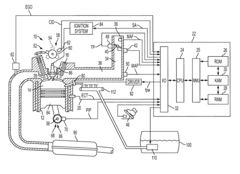
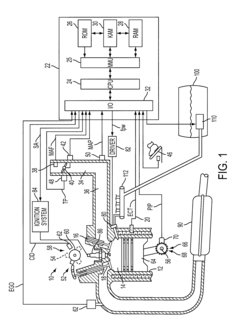
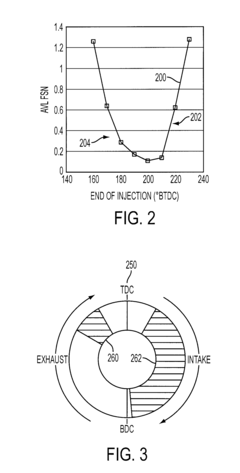
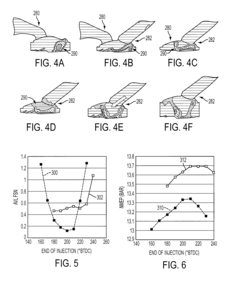
- A system and method that injects a fraction of the total fuel during the exhaust stroke, followed by a second injection during the intake or compression stroke, to enhance mixing time and reduce the impact of intake airflow, thereby improving fuel-air homogeneity and eliminating the need for an auxiliary high-pressure fuel pump.
Emission Regulations Impact on DI Engine Development
The evolution of emission regulations has fundamentally reshaped direct injection engine development trajectories over the past two decades. Stringent standards such as Euro 6d-TEMP, EPA Tier 3, and China VI have established increasingly restrictive limits for nitrogen oxides, particulate matter, and carbon dioxide emissions. These regulatory frameworks have compelled manufacturers to prioritize emission control technologies alongside efficiency improvements, creating a complex optimization challenge that directly influences engine design philosophies and development priorities.
Particulate matter regulations have emerged as a particularly significant driver in DI engine development. The introduction of particle number limits, rather than solely mass-based measurements, has necessitated substantial modifications to combustion chamber geometries and injection strategies. Manufacturers have been forced to implement gasoline particulate filters in many applications, adding system complexity and cost while potentially impacting fuel economy targets.
Real Driving Emissions testing protocols have revolutionized validation approaches for DI engines. Unlike laboratory-based certification cycles, RDE requirements demand consistent emission performance across diverse operating conditions, ambient temperatures, and driving patterns. This shift has prompted engineers to develop more robust control strategies and adaptive calibration systems that maintain emission compliance while preserving efficiency gains across broader operational envelopes.
The implementation of cold-start emission limits has particularly challenged DI engine developers. Traditional direct injection systems exhibit higher particulate emissions during engine warm-up phases, requiring innovative solutions such as dual injection systems combining port and direct injection, advanced catalyst formulations, and sophisticated thermal management strategies. These solutions often involve trade-offs between emission performance and fuel efficiency objectives.
Future regulatory trends indicate continued tightening of emission standards, with proposed Euro 7 regulations potentially introducing even more stringent limits and extended durability requirements. Additionally, lifecycle carbon assessments and well-to-wheel emission evaluations are gaining regulatory attention, potentially influencing fuel specification requirements and biofuel integration strategies for DI engines, thereby expanding the scope of compliance considerations beyond traditional tailpipe emissions.
Particulate matter regulations have emerged as a particularly significant driver in DI engine development. The introduction of particle number limits, rather than solely mass-based measurements, has necessitated substantial modifications to combustion chamber geometries and injection strategies. Manufacturers have been forced to implement gasoline particulate filters in many applications, adding system complexity and cost while potentially impacting fuel economy targets.
Real Driving Emissions testing protocols have revolutionized validation approaches for DI engines. Unlike laboratory-based certification cycles, RDE requirements demand consistent emission performance across diverse operating conditions, ambient temperatures, and driving patterns. This shift has prompted engineers to develop more robust control strategies and adaptive calibration systems that maintain emission compliance while preserving efficiency gains across broader operational envelopes.
The implementation of cold-start emission limits has particularly challenged DI engine developers. Traditional direct injection systems exhibit higher particulate emissions during engine warm-up phases, requiring innovative solutions such as dual injection systems combining port and direct injection, advanced catalyst formulations, and sophisticated thermal management strategies. These solutions often involve trade-offs between emission performance and fuel efficiency objectives.
Future regulatory trends indicate continued tightening of emission standards, with proposed Euro 7 regulations potentially introducing even more stringent limits and extended durability requirements. Additionally, lifecycle carbon assessments and well-to-wheel emission evaluations are gaining regulatory attention, potentially influencing fuel specification requirements and biofuel integration strategies for DI engines, thereby expanding the scope of compliance considerations beyond traditional tailpipe emissions.
Fuel Quality Standards for Direct Injection Systems
Fuel quality standards for direct injection systems represent a critical foundation for achieving optimal engine cycle efficiency. These standards encompass multiple parameters including octane rating, sulfur content, aromatic hydrocarbon composition, and fuel volatility characteristics. Modern direct injection engines require fuels with enhanced anti-knock properties, typically demanding minimum octane ratings of 91-95 RON to prevent premature combustion and maintain thermal efficiency.
The sulfur content specification has become increasingly stringent, with ultra-low sulfur gasoline containing less than 10 ppm sulfur being mandatory in most developed markets. This reduction is essential for direct injection systems as sulfur compounds can poison advanced emission control catalysts and contribute to injector fouling, directly impacting combustion efficiency and engine performance metrics.
Aromatic hydrocarbon content, particularly benzene and toluene concentrations, significantly influences fuel injection characteristics and combustion behavior. Standards typically limit total aromatics to 35-40% by volume, with benzene restricted to 1% maximum. These limitations ensure proper fuel atomization and reduce the formation of combustion chamber deposits that can degrade engine efficiency over time.
Fuel volatility parameters, defined by distillation curves and vapor pressure specifications, are crucial for direct injection systems operating across diverse temperature conditions. The T10, T50, and T90 distillation points must be carefully balanced to ensure adequate cold-start performance while preventing vapor lock and maintaining consistent injection spray patterns.
Additive packages specifically designed for direct injection engines include enhanced detergent systems, corrosion inhibitors, and thermal stability improvers. These additives help maintain injector cleanliness, prevent fuel system corrosion, and ensure consistent fuel delivery under high-pressure injection conditions, all contributing to sustained engine efficiency metrics.
Regional variations in fuel quality standards create challenges for global engine manufacturers. European EN 228, American ASTM D4814, and Asian fuel specifications differ in key parameters, requiring adaptive engine calibration strategies to optimize cycle efficiency across different fuel qualities while maintaining emissions compliance and durability targets.
The sulfur content specification has become increasingly stringent, with ultra-low sulfur gasoline containing less than 10 ppm sulfur being mandatory in most developed markets. This reduction is essential for direct injection systems as sulfur compounds can poison advanced emission control catalysts and contribute to injector fouling, directly impacting combustion efficiency and engine performance metrics.
Aromatic hydrocarbon content, particularly benzene and toluene concentrations, significantly influences fuel injection characteristics and combustion behavior. Standards typically limit total aromatics to 35-40% by volume, with benzene restricted to 1% maximum. These limitations ensure proper fuel atomization and reduce the formation of combustion chamber deposits that can degrade engine efficiency over time.
Fuel volatility parameters, defined by distillation curves and vapor pressure specifications, are crucial for direct injection systems operating across diverse temperature conditions. The T10, T50, and T90 distillation points must be carefully balanced to ensure adequate cold-start performance while preventing vapor lock and maintaining consistent injection spray patterns.
Additive packages specifically designed for direct injection engines include enhanced detergent systems, corrosion inhibitors, and thermal stability improvers. These additives help maintain injector cleanliness, prevent fuel system corrosion, and ensure consistent fuel delivery under high-pressure injection conditions, all contributing to sustained engine efficiency metrics.
Regional variations in fuel quality standards create challenges for global engine manufacturers. European EN 228, American ASTM D4814, and Asian fuel specifications differ in key parameters, requiring adaptive engine calibration strategies to optimize cycle efficiency across different fuel qualities while maintaining emissions compliance and durability targets.
Unlock deeper insights with PatSnap Eureka Quick Research — get a full tech report to explore trends and direct your research. Try now!
Generate Your Research Report Instantly with AI Agent
Supercharge your innovation with PatSnap Eureka AI Agent Platform!