

Electrolyte Additives vs. Doping Techniques: Performance Verdict
APR 15, 20269 MIN READ
Generate Your Research Report Instantly with AI Agent
Patsnap Eureka helps you evaluate technical feasibility & market potential.
Battery Electrolyte Enhancement Background and Objectives
Battery electrolyte enhancement has emerged as a critical frontier in energy storage technology, driven by the exponential growth in electric vehicle adoption, grid-scale energy storage deployment, and portable electronics demand. The evolution of battery electrolyte systems has progressed from simple salt solutions to sophisticated engineered formulations incorporating advanced additives and doping strategies. This technological progression reflects the industry's pursuit of higher energy density, improved safety profiles, extended cycle life, and enhanced thermal stability.
The fundamental challenge in electrolyte optimization lies in balancing multiple competing performance parameters simultaneously. Traditional liquid electrolytes, while offering excellent ionic conductivity, present inherent limitations including narrow electrochemical stability windows, thermal instability, and safety concerns related to flammability and toxicity. These constraints have catalyzed intensive research into two primary enhancement approaches: electrolyte additives and doping techniques.
Electrolyte additives represent a targeted approach to address specific performance deficiencies through the introduction of functional compounds at relatively low concentrations, typically ranging from 0.1% to 5% by weight. These additives serve diverse functions including solid electrolyte interphase formation, gas evolution suppression, thermal stability enhancement, and electrochemical window expansion. The additive approach offers advantages in terms of implementation simplicity and compatibility with existing manufacturing processes.
Doping techniques, conversely, involve the systematic modification of electrolyte composition through the incorporation of alternative salts, solvents, or ionic species that fundamentally alter the electrolyte's intrinsic properties. This approach encompasses strategies such as dual-salt systems, mixed solvent formulations, and ionic liquid integration. Doping techniques typically require more substantial compositional changes and may necessitate process modifications but offer potential for more dramatic performance improvements.
The primary objective of this comparative analysis centers on establishing definitive performance benchmarks between additive-based and doping-based enhancement strategies across key metrics including ionic conductivity, electrochemical stability, thermal performance, cycle life, and cost-effectiveness. Secondary objectives encompass identifying optimal application scenarios for each approach, evaluating scalability considerations, and determining potential synergistic combinations of both strategies for next-generation electrolyte systems.
The fundamental challenge in electrolyte optimization lies in balancing multiple competing performance parameters simultaneously. Traditional liquid electrolytes, while offering excellent ionic conductivity, present inherent limitations including narrow electrochemical stability windows, thermal instability, and safety concerns related to flammability and toxicity. These constraints have catalyzed intensive research into two primary enhancement approaches: electrolyte additives and doping techniques.
Electrolyte additives represent a targeted approach to address specific performance deficiencies through the introduction of functional compounds at relatively low concentrations, typically ranging from 0.1% to 5% by weight. These additives serve diverse functions including solid electrolyte interphase formation, gas evolution suppression, thermal stability enhancement, and electrochemical window expansion. The additive approach offers advantages in terms of implementation simplicity and compatibility with existing manufacturing processes.
Doping techniques, conversely, involve the systematic modification of electrolyte composition through the incorporation of alternative salts, solvents, or ionic species that fundamentally alter the electrolyte's intrinsic properties. This approach encompasses strategies such as dual-salt systems, mixed solvent formulations, and ionic liquid integration. Doping techniques typically require more substantial compositional changes and may necessitate process modifications but offer potential for more dramatic performance improvements.
The primary objective of this comparative analysis centers on establishing definitive performance benchmarks between additive-based and doping-based enhancement strategies across key metrics including ionic conductivity, electrochemical stability, thermal performance, cycle life, and cost-effectiveness. Secondary objectives encompass identifying optimal application scenarios for each approach, evaluating scalability considerations, and determining potential synergistic combinations of both strategies for next-generation electrolyte systems.
Market Demand for Advanced Battery Performance Solutions
The global battery industry is experiencing unprecedented demand driven by the rapid expansion of electric vehicles, renewable energy storage systems, and portable electronics. This surge has created an urgent need for advanced battery performance solutions that can deliver higher energy density, improved safety, faster charging capabilities, and extended cycle life. Market participants are increasingly seeking technologies that can address the fundamental limitations of current lithium-ion battery systems.
Electric vehicle manufacturers represent the largest and most demanding segment, requiring batteries that can provide extended driving range while maintaining safety standards and cost-effectiveness. The automotive sector's transition toward electrification has intensified the focus on battery technologies that can compete with traditional internal combustion engines in terms of performance and convenience. This has created substantial market pressure for innovations in electrolyte formulations and electrode materials.
Energy storage applications for grid-scale renewable integration constitute another rapidly growing market segment. These applications demand batteries with exceptional cycle stability and long-term reliability, as they must operate continuously for decades. The intermittent nature of renewable energy sources has amplified the need for storage solutions that can efficiently handle frequent charge-discharge cycles without significant performance degradation.
Consumer electronics continue to drive demand for compact, high-energy-density batteries with rapid charging capabilities. The proliferation of smartphones, laptops, wearable devices, and emerging technologies like augmented reality systems has created a market environment where battery performance directly impacts product competitiveness and user experience.
Both electrolyte additives and doping techniques have emerged as critical technologies to address these market demands. Electrolyte additives offer solutions for improving battery safety through enhanced thermal stability and reduced flammability, while also enabling better low-temperature performance and extended cycle life. Doping techniques provide pathways to increase energy density and improve charge-discharge rates by modifying the fundamental properties of electrode materials.
The market's emphasis on sustainability and environmental responsibility has further intensified demand for battery technologies that can extend operational lifespans and improve overall efficiency. This environmental focus has created opportunities for both additive and doping approaches that can reduce the frequency of battery replacement and minimize waste generation throughout the product lifecycle.
Electric vehicle manufacturers represent the largest and most demanding segment, requiring batteries that can provide extended driving range while maintaining safety standards and cost-effectiveness. The automotive sector's transition toward electrification has intensified the focus on battery technologies that can compete with traditional internal combustion engines in terms of performance and convenience. This has created substantial market pressure for innovations in electrolyte formulations and electrode materials.
Energy storage applications for grid-scale renewable integration constitute another rapidly growing market segment. These applications demand batteries with exceptional cycle stability and long-term reliability, as they must operate continuously for decades. The intermittent nature of renewable energy sources has amplified the need for storage solutions that can efficiently handle frequent charge-discharge cycles without significant performance degradation.
Consumer electronics continue to drive demand for compact, high-energy-density batteries with rapid charging capabilities. The proliferation of smartphones, laptops, wearable devices, and emerging technologies like augmented reality systems has created a market environment where battery performance directly impacts product competitiveness and user experience.
Both electrolyte additives and doping techniques have emerged as critical technologies to address these market demands. Electrolyte additives offer solutions for improving battery safety through enhanced thermal stability and reduced flammability, while also enabling better low-temperature performance and extended cycle life. Doping techniques provide pathways to increase energy density and improve charge-discharge rates by modifying the fundamental properties of electrode materials.
The market's emphasis on sustainability and environmental responsibility has further intensified demand for battery technologies that can extend operational lifespans and improve overall efficiency. This environmental focus has created opportunities for both additive and doping approaches that can reduce the frequency of battery replacement and minimize waste generation throughout the product lifecycle.
Current State of Electrolyte Additives vs Doping Methods
The current landscape of electrolyte modification technologies presents two distinct yet complementary approaches: electrolyte additives and doping methods. Both strategies aim to enhance battery performance through different mechanisms, with each demonstrating unique advantages and limitations in contemporary applications.
Electrolyte additives represent a mature and widely adopted approach in commercial battery systems. Current additive technologies primarily focus on functional molecules that operate at concentrations ranging from 0.1% to 5% by weight. Vinylene carbonate (VC) and fluoroethylene carbonate (FEC) dominate the solid electrolyte interphase (SEI) formation enhancement category, while lithium bis(oxalato)borate (LiBOB) and lithium difluoro(oxalato)borate (LiDFOB) serve as multifunctional additives addressing both SEI stability and thermal safety.
The additive approach has achieved significant commercial success due to its implementation simplicity and cost-effectiveness. Major battery manufacturers including CATL, BYD, and Panasonic have integrated various additive combinations into their production lines. Current formulations typically employ multi-additive systems, combining SEI-forming agents with flame retardants and conductivity enhancers to achieve comprehensive performance improvements.
Doping techniques, while less commercially prevalent, represent an emerging frontier with substantial technical potential. Current doping methods primarily target the cathode and anode materials through ionic substitution or interstitial doping. Lithium iron phosphate cathodes benefit from carbon coating and metal ion doping (such as Mn, Co, or Ni), while silicon anodes utilize lithium pre-doping and surface modification techniques.
The doping approach faces greater implementation challenges compared to additives, requiring precise control over dopant concentration and distribution. Current industrial applications remain limited to specialized high-performance applications, with companies like Sila Nanotechnologies and Amprius pioneering silicon nanowire doping technologies for next-generation anodes.
Performance comparison reveals distinct operational domains for each approach. Electrolyte additives excel in cycle life enhancement and safety improvements, typically achieving 10-30% performance gains with minimal processing modifications. Doping techniques demonstrate superior potential for capacity and power density improvements, with some silicon-doped anodes achieving 300-400% capacity increases over conventional graphite.
Current research trends indicate convergence toward hybrid approaches, combining optimized additive formulations with strategically doped electrode materials. This integrated strategy addresses the individual limitations of each method while maximizing their complementary benefits, representing the most promising direction for next-generation battery technologies.
Electrolyte additives represent a mature and widely adopted approach in commercial battery systems. Current additive technologies primarily focus on functional molecules that operate at concentrations ranging from 0.1% to 5% by weight. Vinylene carbonate (VC) and fluoroethylene carbonate (FEC) dominate the solid electrolyte interphase (SEI) formation enhancement category, while lithium bis(oxalato)borate (LiBOB) and lithium difluoro(oxalato)borate (LiDFOB) serve as multifunctional additives addressing both SEI stability and thermal safety.
The additive approach has achieved significant commercial success due to its implementation simplicity and cost-effectiveness. Major battery manufacturers including CATL, BYD, and Panasonic have integrated various additive combinations into their production lines. Current formulations typically employ multi-additive systems, combining SEI-forming agents with flame retardants and conductivity enhancers to achieve comprehensive performance improvements.
Doping techniques, while less commercially prevalent, represent an emerging frontier with substantial technical potential. Current doping methods primarily target the cathode and anode materials through ionic substitution or interstitial doping. Lithium iron phosphate cathodes benefit from carbon coating and metal ion doping (such as Mn, Co, or Ni), while silicon anodes utilize lithium pre-doping and surface modification techniques.
The doping approach faces greater implementation challenges compared to additives, requiring precise control over dopant concentration and distribution. Current industrial applications remain limited to specialized high-performance applications, with companies like Sila Nanotechnologies and Amprius pioneering silicon nanowire doping technologies for next-generation anodes.
Performance comparison reveals distinct operational domains for each approach. Electrolyte additives excel in cycle life enhancement and safety improvements, typically achieving 10-30% performance gains with minimal processing modifications. Doping techniques demonstrate superior potential for capacity and power density improvements, with some silicon-doped anodes achieving 300-400% capacity increases over conventional graphite.
Current research trends indicate convergence toward hybrid approaches, combining optimized additive formulations with strategically doped electrode materials. This integrated strategy addresses the individual limitations of each method while maximizing their complementary benefits, representing the most promising direction for next-generation battery technologies.
Current Electrolyte Modification Solutions Analysis
01 Electrolyte additives for improving ionic conductivity
Various electrolyte additives can be incorporated to enhance the ionic conductivity of battery systems. These additives work by modifying the electrolyte composition to facilitate ion transport, reduce internal resistance, and improve overall electrochemical performance. The additives may include organic compounds, inorganic salts, or polymer-based materials that optimize the electrolyte's properties for better battery efficiency and power delivery.- Electrolyte additives for improving ionic conductivity: Various electrolyte additives can be incorporated to enhance the ionic conductivity of battery systems. These additives work by modifying the electrolyte composition to facilitate ion transport, reduce internal resistance, and improve overall electrochemical performance. The additives may include organic compounds, inorganic salts, or polymeric materials that optimize the solvation structure and ion mobility within the electrolyte matrix.
- Doping techniques for electrode materials: Doping techniques involve the introduction of specific elements or compounds into electrode materials to modify their electronic structure and electrochemical properties. These techniques can enhance charge transfer kinetics, increase active site density, and improve structural stability during cycling. Various doping methods including ion implantation, chemical vapor deposition, and wet chemical processes can be employed to achieve desired performance improvements.
- Functional additives for electrolyte stability enhancement: Functional additives are designed to improve the stability and safety of electrolyte systems under various operating conditions. These additives can form protective layers on electrode surfaces, suppress unwanted side reactions, prevent electrolyte decomposition, and enhance thermal stability. The incorporation of such additives helps extend battery lifespan and maintain consistent performance over extended cycling periods.
- Surface modification and interface engineering: Surface modification techniques and interface engineering approaches are employed to optimize the electrode-electrolyte interface characteristics. These methods involve creating protective coatings, modifying surface chemistry, or introducing interfacial layers that reduce impedance and improve charge transfer efficiency. Such modifications can significantly enhance the electrochemical performance and cycling stability of energy storage devices.
- Multi-component electrolyte formulation strategies: Advanced electrolyte formulation strategies involve the combination of multiple components including solvents, salts, and additives to achieve synergistic effects. These formulations are designed to balance various performance parameters such as ionic conductivity, electrochemical window, viscosity, and compatibility with electrode materials. The optimization of multi-component systems enables the development of high-performance electrolytes suitable for diverse applications.
02 Doping techniques for electrode materials
Doping techniques involve introducing specific elements or compounds into electrode materials to modify their electronic structure and enhance electrochemical properties. These techniques can improve charge transfer kinetics, increase capacity, and extend cycle life. Various doping methods include ion implantation, chemical vapor deposition, and solid-state diffusion, which can be applied to cathode and anode materials to optimize their performance characteristics.Expand Specific Solutions03 Functional additives for electrolyte stability
Functional additives are designed to improve the stability and safety of electrolyte systems under various operating conditions. These additives can prevent electrolyte decomposition, suppress side reactions, and enhance thermal stability. They may also provide protective layers on electrode surfaces, reducing degradation and improving long-term performance. The selection of appropriate additives is crucial for maintaining electrolyte integrity throughout the battery's operational lifetime.Expand Specific Solutions04 Surface modification through additive incorporation
Surface modification techniques using additives can create protective interfaces on electrode materials, improving their compatibility with electrolytes and reducing unwanted reactions. These modifications can involve the formation of stable solid electrolyte interphase layers or coating materials that enhance charge transfer while preventing material degradation. The approach helps maintain structural integrity and improves the overall electrochemical performance of the system.Expand Specific Solutions05 Composite electrolyte systems with multiple additives
Composite electrolyte systems utilize combinations of multiple additives to achieve synergistic effects and optimize overall performance. These systems may incorporate different types of additives that address various performance aspects simultaneously, such as conductivity enhancement, stability improvement, and safety features. The careful selection and balance of multiple additives can result in electrolyte formulations with superior properties compared to single-additive systems.Expand Specific Solutions
Major Players in Electrolyte and Doping Technology Space
The electrolyte additives versus doping techniques competition represents a mature technological battleground within the rapidly expanding lithium-ion battery industry, valued at over $50 billion globally. The market demonstrates strong growth driven by electric vehicle adoption and energy storage demands. Technology maturity varies significantly across players, with established companies like EVE Energy, Svolt Energy, and Panasonic leading commercial-scale production of advanced electrolyte formulations, while specialized chemical manufacturers such as Zhangjiagang Guotai Huarong and Shenzhen Capchem focus on additive innovations. Research institutions including California Institute of Technology and Central South University drive fundamental breakthroughs in doping methodologies. The competitive landscape shows convergence toward hybrid approaches combining both techniques, with companies like JSR Corp and Samsung Electro-Mechanics integrating materials science expertise to optimize battery performance through synergistic electrolyte-electrode interactions.
EVE Energy Co., Ltd.
Technical Solution: EVE Energy has developed advanced electrolyte additive formulations focusing on fluorinated compounds and ionic liquid additives to enhance battery performance. Their approach combines multiple functional additives including film-forming agents, flame retardants, and conductivity enhancers. The company utilizes a systematic screening process to optimize additive concentrations, typically ranging from 0.1% to 5% by weight. Their electrolyte systems demonstrate improved thermal stability up to 200°C and enhanced cycling performance with over 3000 charge-discharge cycles. EVE's additive technology particularly excels in lithium iron phosphate (LFP) battery applications, where they achieve capacity retention rates exceeding 85% after 5000 cycles through strategic use of vinylene carbonate and fluoroethylene carbonate additives.
Strengths: Proven commercial scalability and cost-effective manufacturing processes. Weaknesses: Limited innovation in next-generation solid-state electrolyte systems.
California Institute of Technology
Technical Solution: Caltech researchers have developed innovative doping techniques focusing on atomic-level engineering of battery materials. Their approach utilizes advanced characterization methods including in-situ X-ray spectroscopy and electron microscopy to understand doping mechanisms at the molecular level. The research team has pioneered gradient doping strategies where dopant concentration varies across particle dimensions to optimize both surface and bulk properties. Their work on lithium metal anodes involves strategic doping with elements like magnesium and zinc to suppress dendrite formation and improve cycling stability. Caltech's doping methodologies achieve precise control over electronic and ionic conductivity through computational modeling and experimental validation. The institute has demonstrated significant improvements in battery performance with doped materials showing 40% higher capacity retention and 3x longer cycle life compared to undoped counterparts.
Strengths: Cutting-edge research capabilities and fundamental understanding of doping mechanisms. Weaknesses: Limited focus on commercial scalability and manufacturing feasibility.
Core Patents in Additive and Doping Innovations
Electrochemical device and electronic device
PatentPendingUS20250226445A1
Innovation
- Incorporation of a doping element such as aluminum, magnesium, zirconium, or titanium into the positive electrode active material, combined with a polynitrile additive in the electrolyte to form a cathode electrolyte interphase (CEI) film, which enhances structural and thermal stability by reducing surface dissolution and side reactions.


Electrolyte additives for lithium ion battery and lithium ion battery containing same
PatentWO2014066316A1
Innovation
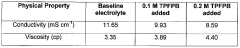
- Incorporating electron-deficient boron-containing compounds with fluorinated aryl and/or alkyl functional groups, such as tris(pentafluorophenyl)borane (TPFPB), into the electrolyte to stabilize the cathode and control SEI film growth, thereby enhancing cycling stability and rate capability.


Environmental Impact Assessment of Enhancement Methods
The environmental implications of electrolyte additives and doping techniques in battery enhancement present distinct sustainability profiles that require comprehensive evaluation. Both approaches introduce foreign materials into battery systems, yet their environmental footprints differ significantly in terms of material sourcing, manufacturing processes, and end-of-life management.
Electrolyte additives typically involve organic compounds, ionic liquids, or specialized salts that are introduced in relatively small quantities. The environmental impact of these additives primarily stems from their synthesis processes, which often require energy-intensive chemical reactions and may generate hazardous byproducts. Many common additives such as fluoroethylene carbonate or vinylene carbonate require fluorinated precursors, contributing to greenhouse gas emissions during production. However, their minimal concentration in the final battery system reduces the overall material burden.
Doping techniques present a more complex environmental scenario due to the diverse range of materials employed. Metal-based dopants, particularly those involving rare earth elements or transition metals, raise concerns about mining impacts, resource depletion, and supply chain sustainability. The extraction of lithium, cobalt, and nickel for doping applications contributes to habitat disruption and water contamination in mining regions. Conversely, organic dopants derived from renewable sources offer more sustainable alternatives but may require extensive purification processes.
Manufacturing energy consumption varies considerably between the two approaches. Electrolyte additive integration typically occurs during electrolyte preparation, requiring minimal additional processing steps. Doping techniques, particularly those involving high-temperature treatments or specialized coating processes, demand significantly higher energy inputs, increasing the carbon footprint of battery production.
End-of-life considerations favor electrolyte additives due to their lower concentrations and often biodegradable nature. Many organic additives can be processed through conventional recycling methods without introducing complex separation challenges. Doped materials, especially those containing heavy metals, require specialized recycling protocols to prevent environmental contamination and enable material recovery.
The cumulative environmental assessment suggests that electrolyte additives generally present a more favorable sustainability profile, though the specific choice of materials and implementation methods significantly influences the overall environmental impact of both enhancement strategies.
Electrolyte additives typically involve organic compounds, ionic liquids, or specialized salts that are introduced in relatively small quantities. The environmental impact of these additives primarily stems from their synthesis processes, which often require energy-intensive chemical reactions and may generate hazardous byproducts. Many common additives such as fluoroethylene carbonate or vinylene carbonate require fluorinated precursors, contributing to greenhouse gas emissions during production. However, their minimal concentration in the final battery system reduces the overall material burden.
Doping techniques present a more complex environmental scenario due to the diverse range of materials employed. Metal-based dopants, particularly those involving rare earth elements or transition metals, raise concerns about mining impacts, resource depletion, and supply chain sustainability. The extraction of lithium, cobalt, and nickel for doping applications contributes to habitat disruption and water contamination in mining regions. Conversely, organic dopants derived from renewable sources offer more sustainable alternatives but may require extensive purification processes.
Manufacturing energy consumption varies considerably between the two approaches. Electrolyte additive integration typically occurs during electrolyte preparation, requiring minimal additional processing steps. Doping techniques, particularly those involving high-temperature treatments or specialized coating processes, demand significantly higher energy inputs, increasing the carbon footprint of battery production.
End-of-life considerations favor electrolyte additives due to their lower concentrations and often biodegradable nature. Many organic additives can be processed through conventional recycling methods without introducing complex separation challenges. Doped materials, especially those containing heavy metals, require specialized recycling protocols to prevent environmental contamination and enable material recovery.
The cumulative environmental assessment suggests that electrolyte additives generally present a more favorable sustainability profile, though the specific choice of materials and implementation methods significantly influences the overall environmental impact of both enhancement strategies.
Safety Standards for Modified Battery Systems
The implementation of electrolyte additives and doping techniques in battery systems necessitates comprehensive safety standards to address the unique risks associated with these modifications. Current regulatory frameworks primarily focus on conventional lithium-ion batteries, creating significant gaps in safety protocols for chemically modified systems. The absence of specific standards for additive-enhanced electrolytes and doped electrode materials poses substantial challenges for manufacturers seeking to commercialize these advanced technologies.
International safety organizations, including IEC, UL, and UN38.3, are actively developing supplementary guidelines to address modified battery chemistries. These emerging standards emphasize thermal runaway prevention, gas emission control, and chemical compatibility assessment. The complexity of additive interactions requires new testing protocols that evaluate long-term stability under various environmental conditions, including temperature cycling, humidity exposure, and mechanical stress scenarios.
Electrolyte additive safety standards focus on toxicity assessment, flammability characteristics, and electrochemical stability windows. Regulatory bodies mandate comprehensive material safety data sheets for novel additives, including detailed toxicological profiles and environmental impact assessments. The evaluation process requires extensive testing of additive degradation products and their potential health implications during normal operation and failure modes.
Doping technique safety standards address structural integrity concerns and potential material migration issues. These protocols evaluate the mechanical stability of doped electrodes under repeated charge-discharge cycles and assess the risk of dopant leaching into the electrolyte. Special attention is given to nanomaterial dopants, which require additional safety measures due to their unique physicochemical properties and potential biological interactions.
Certification processes for modified battery systems involve multi-stage validation procedures, including component-level testing, cell-level evaluation, and system integration assessment. Manufacturers must demonstrate compliance with enhanced safety margins, typically requiring 20-30% additional safety buffers compared to conventional systems. The certification timeline for modified batteries extends 6-12 months beyond standard procedures, reflecting the complexity of evaluating novel chemical interactions and long-term performance implications.
International safety organizations, including IEC, UL, and UN38.3, are actively developing supplementary guidelines to address modified battery chemistries. These emerging standards emphasize thermal runaway prevention, gas emission control, and chemical compatibility assessment. The complexity of additive interactions requires new testing protocols that evaluate long-term stability under various environmental conditions, including temperature cycling, humidity exposure, and mechanical stress scenarios.
Electrolyte additive safety standards focus on toxicity assessment, flammability characteristics, and electrochemical stability windows. Regulatory bodies mandate comprehensive material safety data sheets for novel additives, including detailed toxicological profiles and environmental impact assessments. The evaluation process requires extensive testing of additive degradation products and their potential health implications during normal operation and failure modes.
Doping technique safety standards address structural integrity concerns and potential material migration issues. These protocols evaluate the mechanical stability of doped electrodes under repeated charge-discharge cycles and assess the risk of dopant leaching into the electrolyte. Special attention is given to nanomaterial dopants, which require additional safety measures due to their unique physicochemical properties and potential biological interactions.
Certification processes for modified battery systems involve multi-stage validation procedures, including component-level testing, cell-level evaluation, and system integration assessment. Manufacturers must demonstrate compliance with enhanced safety margins, typically requiring 20-30% additional safety buffers compared to conventional systems. The certification timeline for modified batteries extends 6-12 months beyond standard procedures, reflecting the complexity of evaluating novel chemical interactions and long-term performance implications.
Unlock deeper insights with Patsnap Eureka Quick Research — get a full tech report to explore trends and direct your research. Try now!
Generate Your Research Report Instantly with AI Agent
Supercharge your innovation with Patsnap Eureka AI Agent Platform!