

Optimizing Additive Ratios for Optimal Ionic Conductivity
APR 15, 20269 MIN READ
Generate Your Research Report Instantly with AI Agent
Patsnap Eureka helps you evaluate technical feasibility & market potential.
Ionic Conductivity Enhancement Background and Objectives
Ionic conductivity enhancement has emerged as a critical technological frontier in the development of advanced energy storage and conversion systems. The fundamental challenge lies in achieving optimal ion transport properties through precise control of material composition, particularly the strategic incorporation of additives that can significantly influence ionic mobility and overall electrochemical performance.
The historical evolution of ionic conductivity research traces back to early solid-state physics investigations in the mid-20th century, where researchers first identified the relationship between material structure and ion transport mechanisms. Initial studies focused primarily on single-phase ceramic electrolytes, but subsequent decades revealed the transformative potential of multi-component systems where carefully selected additives could dramatically enhance ionic conductivity beyond theoretical predictions for pure materials.
Contemporary technological demands have intensified the urgency for breakthrough solutions in ionic conductivity optimization. The rapid expansion of electric vehicle markets, grid-scale energy storage requirements, and portable electronics applications has created unprecedented performance expectations for electrochemical devices. These applications demand materials that can deliver high ionic conductivity while maintaining structural stability, chemical compatibility, and long-term reliability under diverse operating conditions.
The primary technical objective centers on establishing systematic methodologies for determining optimal additive ratios that maximize ionic conductivity while preserving material integrity. This involves developing comprehensive understanding of additive-matrix interactions, identifying synergistic effects between multiple additives, and establishing predictive models that can guide material design processes without extensive trial-and-error experimentation.
Current research trajectories indicate that achieving optimal ionic conductivity requires sophisticated approaches to additive selection and ratio optimization. The challenge extends beyond simple compositional adjustments to encompass complex considerations including grain boundary engineering, defect chemistry manipulation, and interface optimization. Success in this domain promises to unlock next-generation electrochemical technologies with substantially improved performance characteristics.
The strategic importance of this technological advancement cannot be overstated, as ionic conductivity optimization represents a foundational capability that will enable breakthrough innovations across multiple industrial sectors, from automotive electrification to renewable energy integration systems.
The historical evolution of ionic conductivity research traces back to early solid-state physics investigations in the mid-20th century, where researchers first identified the relationship between material structure and ion transport mechanisms. Initial studies focused primarily on single-phase ceramic electrolytes, but subsequent decades revealed the transformative potential of multi-component systems where carefully selected additives could dramatically enhance ionic conductivity beyond theoretical predictions for pure materials.
Contemporary technological demands have intensified the urgency for breakthrough solutions in ionic conductivity optimization. The rapid expansion of electric vehicle markets, grid-scale energy storage requirements, and portable electronics applications has created unprecedented performance expectations for electrochemical devices. These applications demand materials that can deliver high ionic conductivity while maintaining structural stability, chemical compatibility, and long-term reliability under diverse operating conditions.
The primary technical objective centers on establishing systematic methodologies for determining optimal additive ratios that maximize ionic conductivity while preserving material integrity. This involves developing comprehensive understanding of additive-matrix interactions, identifying synergistic effects between multiple additives, and establishing predictive models that can guide material design processes without extensive trial-and-error experimentation.
Current research trajectories indicate that achieving optimal ionic conductivity requires sophisticated approaches to additive selection and ratio optimization. The challenge extends beyond simple compositional adjustments to encompass complex considerations including grain boundary engineering, defect chemistry manipulation, and interface optimization. Success in this domain promises to unlock next-generation electrochemical technologies with substantially improved performance characteristics.
The strategic importance of this technological advancement cannot be overstated, as ionic conductivity optimization represents a foundational capability that will enable breakthrough innovations across multiple industrial sectors, from automotive electrification to renewable energy integration systems.
Market Demand for High-Performance Ionic Conductors
The global demand for high-performance ionic conductors has experienced unprecedented growth across multiple industrial sectors, driven by the accelerating transition toward electrification and energy storage solutions. This surge in demand stems primarily from the expanding electric vehicle market, where advanced battery technologies require superior ionic conductivity to achieve longer range, faster charging capabilities, and enhanced safety profiles. The optimization of additive ratios for ionic conductivity directly addresses these critical performance requirements.
Energy storage systems for renewable energy integration represent another significant demand driver. As solar and wind power installations continue to proliferate globally, the need for efficient grid-scale storage solutions has intensified. High-performance ionic conductors enable more efficient charge-discharge cycles and improved energy density, making renewable energy storage more economically viable and technically reliable.
The consumer electronics sector continues to push boundaries for miniaturization while demanding higher energy densities and faster charging speeds. Smartphones, laptops, wearable devices, and emerging technologies like augmented reality headsets require ionic conductors with optimized performance characteristics that can only be achieved through precise additive ratio control.
Industrial applications in aerospace, medical devices, and telecommunications infrastructure have created specialized market segments with stringent performance requirements. These sectors often require ionic conductors that maintain stable performance under extreme conditions, including wide temperature ranges, high vibration environments, and extended operational lifespans.
Emerging applications in solid-state battery technology have generated substantial market interest, as manufacturers seek to overcome the limitations of traditional liquid electrolyte systems. The development of solid-state ionic conductors with optimized additive compositions promises to unlock new performance levels while addressing safety concerns associated with conventional battery technologies.
The market demand is further amplified by regulatory pressures and environmental considerations. Government mandates for reduced carbon emissions and improved energy efficiency have accelerated adoption timelines across multiple industries. This regulatory environment creates sustained demand for ionic conductor technologies that can deliver measurable performance improvements through optimized additive formulations.
Manufacturing scalability represents a crucial market consideration, as laboratory-scale optimization of additive ratios must translate to industrial production capabilities. The demand increasingly focuses on ionic conductor solutions that maintain performance consistency while enabling cost-effective mass production processes.
Energy storage systems for renewable energy integration represent another significant demand driver. As solar and wind power installations continue to proliferate globally, the need for efficient grid-scale storage solutions has intensified. High-performance ionic conductors enable more efficient charge-discharge cycles and improved energy density, making renewable energy storage more economically viable and technically reliable.
The consumer electronics sector continues to push boundaries for miniaturization while demanding higher energy densities and faster charging speeds. Smartphones, laptops, wearable devices, and emerging technologies like augmented reality headsets require ionic conductors with optimized performance characteristics that can only be achieved through precise additive ratio control.
Industrial applications in aerospace, medical devices, and telecommunications infrastructure have created specialized market segments with stringent performance requirements. These sectors often require ionic conductors that maintain stable performance under extreme conditions, including wide temperature ranges, high vibration environments, and extended operational lifespans.
Emerging applications in solid-state battery technology have generated substantial market interest, as manufacturers seek to overcome the limitations of traditional liquid electrolyte systems. The development of solid-state ionic conductors with optimized additive compositions promises to unlock new performance levels while addressing safety concerns associated with conventional battery technologies.
The market demand is further amplified by regulatory pressures and environmental considerations. Government mandates for reduced carbon emissions and improved energy efficiency have accelerated adoption timelines across multiple industries. This regulatory environment creates sustained demand for ionic conductor technologies that can deliver measurable performance improvements through optimized additive formulations.
Manufacturing scalability represents a crucial market consideration, as laboratory-scale optimization of additive ratios must translate to industrial production capabilities. The demand increasingly focuses on ionic conductor solutions that maintain performance consistency while enabling cost-effective mass production processes.
Current State and Challenges in Additive Optimization
The optimization of additive ratios for enhanced ionic conductivity represents a critical frontier in solid-state electrolyte development, yet current approaches face significant methodological and practical limitations. Traditional trial-and-error methods dominate the field, where researchers systematically vary additive concentrations across broad ranges to identify optimal compositions. This approach, while yielding some successful formulations, lacks predictive capability and requires extensive experimental resources.
Contemporary research predominantly focuses on ceramic-based solid electrolytes, particularly garnet-type Li7La3Zr2O12 (LLZO) and NASICON-type materials, where dopant optimization remains empirically driven. Current methodologies typically involve substituting aliovalent cations at specific crystallographic sites, with additive concentrations ranging from 0.1 to 2.0 atomic percent. However, the complex interplay between multiple additives creates a multidimensional optimization space that conventional approaches struggle to navigate efficiently.
Computational modeling efforts, including density functional theory (DFT) calculations and molecular dynamics simulations, have emerged as complementary tools for understanding additive effects on ionic transport mechanisms. Despite these advances, significant gaps persist between theoretical predictions and experimental outcomes, particularly regarding the influence of grain boundary chemistry and processing-induced defects on overall conductivity performance.
Manufacturing scalability presents another substantial challenge in additive optimization. Laboratory-scale synthesis conditions often fail to translate directly to industrial production environments, where factors such as sintering atmosphere control, precursor purity, and thermal processing uniformity significantly impact the effectiveness of optimized additive ratios. This scale-up challenge necessitates re-optimization efforts that can substantially alter previously established optimal compositions.
The lack of standardized characterization protocols further complicates comparative analysis across different research groups. Variations in measurement conditions, sample preparation methods, and data interpretation approaches create inconsistencies in reported optimal additive concentrations, hindering the development of universal optimization principles.
Current additive optimization strategies also face limitations in addressing the dynamic nature of solid electrolyte performance. Long-term stability considerations, including additive segregation, phase evolution, and interfacial reactions with electrode materials, are often inadequately incorporated into initial optimization frameworks, leading to compositions that may perform well initially but degrade over extended operational periods.
Contemporary research predominantly focuses on ceramic-based solid electrolytes, particularly garnet-type Li7La3Zr2O12 (LLZO) and NASICON-type materials, where dopant optimization remains empirically driven. Current methodologies typically involve substituting aliovalent cations at specific crystallographic sites, with additive concentrations ranging from 0.1 to 2.0 atomic percent. However, the complex interplay between multiple additives creates a multidimensional optimization space that conventional approaches struggle to navigate efficiently.
Computational modeling efforts, including density functional theory (DFT) calculations and molecular dynamics simulations, have emerged as complementary tools for understanding additive effects on ionic transport mechanisms. Despite these advances, significant gaps persist between theoretical predictions and experimental outcomes, particularly regarding the influence of grain boundary chemistry and processing-induced defects on overall conductivity performance.
Manufacturing scalability presents another substantial challenge in additive optimization. Laboratory-scale synthesis conditions often fail to translate directly to industrial production environments, where factors such as sintering atmosphere control, precursor purity, and thermal processing uniformity significantly impact the effectiveness of optimized additive ratios. This scale-up challenge necessitates re-optimization efforts that can substantially alter previously established optimal compositions.
The lack of standardized characterization protocols further complicates comparative analysis across different research groups. Variations in measurement conditions, sample preparation methods, and data interpretation approaches create inconsistencies in reported optimal additive concentrations, hindering the development of universal optimization principles.
Current additive optimization strategies also face limitations in addressing the dynamic nature of solid electrolyte performance. Long-term stability considerations, including additive segregation, phase evolution, and interfacial reactions with electrode materials, are often inadequately incorporated into initial optimization frameworks, leading to compositions that may perform well initially but degrade over extended operational periods.
Existing Additive Ratio Optimization Solutions
01 Optimization of lithium salt concentration ratios for enhanced ionic conductivity
The ionic conductivity of electrolytes can be significantly improved by optimizing the concentration ratios of lithium salts. Different lithium salts such as lithium hexafluorophosphate, lithium bis(trifluoromethanesulfonyl)imide, and lithium perchlorate can be combined in specific ratios to achieve maximum ionic conductivity. The optimal ratio depends on the solvent system and temperature range of operation. Careful selection of salt combinations and their proportions can enhance ion transport while maintaining electrochemical stability.- Optimization of additive ratios in solid electrolytes for enhanced ionic conductivity: The ionic conductivity of solid electrolytes can be significantly improved by optimizing the ratios of various additives. These additives may include ceramic fillers, polymer matrices, and ionic salts. By carefully controlling the composition ratios, the ion transport pathways can be enhanced, leading to higher ionic conductivity values. The optimal ratio depends on the specific material system and the desired electrochemical properties.
- Effect of lithium salt concentration ratios on ionic conductivity: The concentration ratio of lithium salts in electrolyte systems plays a crucial role in determining ionic conductivity. Different lithium salts can be combined in specific ratios to achieve optimal dissociation and ion mobility. The balance between salt concentration and solvent ratio affects the formation of ion pairs and aggregates, which directly impacts the overall ionic conductivity of the electrolyte system.
- Polymer-to-plasticizer ratio optimization for ionic conductivity enhancement: In polymer electrolyte systems, the ratio between polymer host and plasticizer significantly influences ionic conductivity. Plasticizers reduce the crystallinity of the polymer matrix and increase the amorphous phase, facilitating ion transport. The optimal ratio ensures sufficient mechanical stability while maximizing the mobility of ionic species through the polymer network.
- Composite electrolyte additive ratios for improved conductivity: Composite electrolytes incorporating multiple additives at specific ratios demonstrate enhanced ionic conductivity compared to single-component systems. The synergistic effects between inorganic fillers and organic components can create continuous ion conduction pathways. The ratio of these components must be carefully balanced to achieve both high ionic conductivity and good mechanical properties.
- Solvent-to-salt ratio effects on electrolyte ionic conductivity: The ratio of solvent to salt in liquid and gel electrolytes is a critical parameter affecting ionic conductivity. An optimal ratio ensures complete salt dissociation while maintaining appropriate viscosity for ion transport. Too high salt concentration can lead to ion pairing and reduced mobility, while too low concentration results in insufficient charge carriers. The ideal ratio varies depending on the specific solvent and salt combination used.
02 Incorporation of ceramic or inorganic additives to improve ionic conductivity
Ceramic fillers and inorganic additives can be incorporated into polymer electrolytes or liquid electrolytes to enhance ionic conductivity. These additives create additional pathways for ion transport and can reduce crystallinity in polymer matrices. The ratio of these additives to the base electrolyte material is critical, with optimal ranges typically between 1-20 weight percent. The particle size, morphology, and surface chemistry of these additives also play important roles in determining the final ionic conductivity.Expand Specific Solutions03 Plasticizer and solvent ratio optimization for ionic transport
The ratio of plasticizers and solvents in electrolyte formulations directly affects ionic conductivity by influencing the mobility of charge carriers. Organic carbonates, esters, and ethers can be mixed in specific proportions to achieve optimal solvation of ions and reduced viscosity. The balance between different solvent components affects the dielectric constant, viscosity, and electrochemical window of the electrolyte. Proper ratio selection can result in ionic conductivity improvements of several orders of magnitude.Expand Specific Solutions04 Polymer blend ratios for solid-state ionic conductors
In solid-state electrolytes, the ratio of different polymer components significantly impacts ionic conductivity. Blending polymers with different glass transition temperatures, molecular weights, and chemical structures can create optimized pathways for ion migration. The ratio of crystalline to amorphous regions, controlled through polymer blending ratios, is crucial for achieving high ionic conductivity. Specific ratios of host polymers to conducting polymers or ionomers can enhance both mechanical properties and ionic transport.Expand Specific Solutions05 Additive ratios for interfacial conductivity enhancement
Interface modifying additives can be incorporated at specific ratios to improve ionic conductivity at electrode-electrolyte interfaces. These additives reduce interfacial resistance and promote uniform ion distribution. The optimal ratio of interface modifiers depends on the electrode material and electrolyte composition. Small amounts of these additives, typically in the range of 0.1-5 weight percent, can dramatically improve overall cell performance by reducing charge transfer resistance and enhancing ion flux across interfaces.Expand Specific Solutions
Key Players in Ionic Conductor and Additive Industry
The ionic conductivity optimization field represents a mature technology sector experiencing significant growth, driven by expanding applications in energy storage, electric vehicles, and electronic devices. The market demonstrates substantial scale with established players spanning chemical manufacturing, electronics, and specialized materials companies. Technology maturity varies considerably across the competitive landscape, with traditional chemical giants like Nippon Shokubai Co., Sumitomo Chemical, and Merck Patent GmbH leveraging decades of materials science expertise alongside their extensive R&D capabilities. Electronics leaders including Panasonic Holdings, Toshiba Corp., and NEC Corp. contribute advanced manufacturing and integration technologies. Emerging specialists such as PolyPlus Battery Co. and Blue Solutions SASU focus on breakthrough innovations in battery technologies. The sector benefits from strong academic-industry collaboration, evidenced by participation from institutions like Tokyo University of Science and Technische Universität München, accelerating fundamental research translation into commercial applications for next-generation ionic conductive materials.
Sumitomo Chemical Co., Ltd.
Technical Solution: Sumitomo Chemical specializes in polymer electrolyte systems with optimized plasticizer and salt ratios for flexible battery applications. Their technology platform focuses on PEO-based polymer matrices with lithium salt concentrations optimized at Li:EO ratios of 1:8 to 1:12, combined with ceramic filler additives (Al2O3, SiO2) at 5-15 wt% loadings. The company has developed proprietary cross-linking agents that enhance mechanical properties while maintaining ionic conductivity above 10^-4 S/cm at 60°C. Their additive optimization process involves systematic screening of plasticizer ratios (EC:DMC:DEC) to achieve optimal solvation environments for lithium ion transport while suppressing polymer crystallization.
Strengths: Strong polymer chemistry expertise and scalable manufacturing processes for flexible electronics. Weaknesses: Temperature-dependent performance may limit room temperature applications compared to liquid electrolytes.
Robert Bosch GmbH
Technical Solution: Bosch focuses on automotive-grade solid electrolyte systems with optimized additive compositions for high-temperature stability. Their technology centers on sulfide-based electrolytes with carefully controlled Li2S:P2S5 ratios (typically 75:25) combined with halide additives (LiI, LiBr) at 1-3 mol% concentrations. The company has developed proprietary sintering processes that optimize grain boundary chemistry through controlled atmosphere processing. Their electrolyte formulations achieve ionic conductivities exceeding 10^-3 S/cm while maintaining stability across automotive temperature ranges (-40°C to +85°C). Bosch integrates machine learning algorithms to predict optimal additive ratios based on target performance metrics.
Strengths: Strong automotive industry expertise and rigorous testing standards for harsh operating conditions. Weaknesses: Higher cost structure due to automotive-grade requirements may limit broader market applications.
Core Innovations in Ionic Conductivity Enhancement
Additives for increasing ion conductivity of molten salt type electrolyte in battery
PatentInactiveUS20080286649A1
Innovation
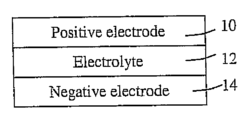
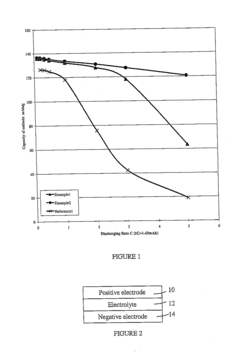
- Incorporating organic additives such as alkyl carbonates, phosphates, and other organic compounds into the molten salt electrolyte to enhance lithium ion conductivity without compromising safety by maintaining non-flammability under normal conditions.
A method of manufacturing an ionic conductor to improve oxygen ion conductivity
PatentInactiveIN2623DELNP2005A
Innovation
- A method involving the application of a solution containing an alkaline-earth metal dopant, such as calcium or strontium, to doped ceria, zirconia, or lanthanum gallate powders with high silicon content, followed by heating to decompose the salt and form an ionic conductor, which enhances oxygen ion conductivity and strength.


Safety Standards for Ionic Conductor Materials
The establishment of comprehensive safety standards for ionic conductor materials represents a critical framework for ensuring the secure deployment of advanced electrochemical systems. These standards encompass multiple dimensions of material safety, including thermal stability, chemical compatibility, mechanical integrity, and environmental impact considerations. Current regulatory frameworks primarily focus on traditional electrolyte systems, creating gaps in addressing the unique safety challenges posed by novel ionic conductors with optimized additive ratios.
Thermal safety standards constitute the foundational layer of ionic conductor material regulations. These specifications define maximum operating temperatures, thermal runaway prevention protocols, and heat dissipation requirements. Materials with enhanced ionic conductivity through additive optimization often exhibit altered thermal behavior, necessitating updated testing methodologies that account for compositional variations and their impact on thermal stability thresholds.
Chemical compatibility standards address the interaction between ionic conductors and surrounding system components. These regulations specify acceptable reactivity levels with electrode materials, packaging components, and atmospheric conditions. The introduction of novel additives to optimize ionic conductivity introduces new chemical interaction pathways that require comprehensive evaluation under standardized testing conditions to prevent degradation or hazardous reactions.
Mechanical safety requirements focus on structural integrity under operational stress conditions. Standards define minimum mechanical strength, flexibility parameters, and failure mode characteristics. Optimized additive ratios can significantly alter mechanical properties, requiring updated testing protocols that evaluate material behavior under various stress scenarios including vibration, compression, and thermal cycling.
Environmental safety standards encompass toxicity assessments, disposal protocols, and lifecycle impact evaluations. These regulations ensure that ionic conductor materials with optimized compositions do not pose risks to human health or environmental systems. Emerging additive formulations require comprehensive toxicological studies and environmental impact assessments to establish appropriate handling and disposal procedures.
Certification processes for ionic conductor materials involve multi-stage testing protocols that validate compliance with established safety standards. These procedures include accelerated aging tests, abuse condition simulations, and long-term stability evaluations. The dynamic nature of additive optimization research necessitates adaptive certification frameworks that can accommodate rapid technological developments while maintaining rigorous safety assurance.
Thermal safety standards constitute the foundational layer of ionic conductor material regulations. These specifications define maximum operating temperatures, thermal runaway prevention protocols, and heat dissipation requirements. Materials with enhanced ionic conductivity through additive optimization often exhibit altered thermal behavior, necessitating updated testing methodologies that account for compositional variations and their impact on thermal stability thresholds.
Chemical compatibility standards address the interaction between ionic conductors and surrounding system components. These regulations specify acceptable reactivity levels with electrode materials, packaging components, and atmospheric conditions. The introduction of novel additives to optimize ionic conductivity introduces new chemical interaction pathways that require comprehensive evaluation under standardized testing conditions to prevent degradation or hazardous reactions.
Mechanical safety requirements focus on structural integrity under operational stress conditions. Standards define minimum mechanical strength, flexibility parameters, and failure mode characteristics. Optimized additive ratios can significantly alter mechanical properties, requiring updated testing protocols that evaluate material behavior under various stress scenarios including vibration, compression, and thermal cycling.
Environmental safety standards encompass toxicity assessments, disposal protocols, and lifecycle impact evaluations. These regulations ensure that ionic conductor materials with optimized compositions do not pose risks to human health or environmental systems. Emerging additive formulations require comprehensive toxicological studies and environmental impact assessments to establish appropriate handling and disposal procedures.
Certification processes for ionic conductor materials involve multi-stage testing protocols that validate compliance with established safety standards. These procedures include accelerated aging tests, abuse condition simulations, and long-term stability evaluations. The dynamic nature of additive optimization research necessitates adaptive certification frameworks that can accommodate rapid technological developments while maintaining rigorous safety assurance.
Environmental Impact of Ionic Conductor Additives
The environmental implications of ionic conductor additives have become increasingly critical as the demand for high-performance energy storage systems continues to grow. Traditional additives used to optimize ionic conductivity often present significant environmental challenges throughout their lifecycle, from raw material extraction to end-of-life disposal. Many conventional additives contain heavy metals, rare earth elements, or synthetic polymers that require energy-intensive manufacturing processes and generate substantial carbon footprints.
Lithium-based additives, commonly employed in solid-state electrolytes, raise concerns about resource depletion and mining-related environmental degradation. The extraction of lithium from brine pools and hard rock deposits consumes vast quantities of water and can disrupt local ecosystems. Similarly, additives containing cobalt or nickel present ethical sourcing challenges and contribute to soil and water contamination in mining regions.
The manufacturing phase of ionic conductor additives typically involves high-temperature processing, chemical synthesis, and purification steps that consume significant energy and generate hazardous waste streams. Organic additives may release volatile organic compounds during production, while inorganic additives often require corrosive chemicals for synthesis. These processes contribute to air pollution and require careful waste management to prevent environmental contamination.
Disposal and recycling of ionic conductor systems present additional environmental challenges. Many additives are not easily separable from the host matrix, making recycling complex and economically unfeasible. When disposed of in landfills, certain additives can leach into groundwater systems, potentially causing long-term environmental damage. The lack of established recycling infrastructure for advanced ionic conductors exacerbates these concerns.
Recent research has focused on developing environmentally benign alternatives, including bio-derived additives and naturally abundant materials. Green chemistry approaches emphasize the use of renewable feedstocks, solvent-free synthesis methods, and biodegradable components. These sustainable alternatives aim to maintain optimal ionic conductivity while minimizing environmental impact throughout the product lifecycle.
Regulatory frameworks are evolving to address these environmental concerns, with stricter guidelines on hazardous substance use and mandatory environmental impact assessments for new additive formulations. Life cycle assessment methodologies are increasingly being integrated into the development process to quantify and minimize environmental footprints from cradle to grave.
Lithium-based additives, commonly employed in solid-state electrolytes, raise concerns about resource depletion and mining-related environmental degradation. The extraction of lithium from brine pools and hard rock deposits consumes vast quantities of water and can disrupt local ecosystems. Similarly, additives containing cobalt or nickel present ethical sourcing challenges and contribute to soil and water contamination in mining regions.
The manufacturing phase of ionic conductor additives typically involves high-temperature processing, chemical synthesis, and purification steps that consume significant energy and generate hazardous waste streams. Organic additives may release volatile organic compounds during production, while inorganic additives often require corrosive chemicals for synthesis. These processes contribute to air pollution and require careful waste management to prevent environmental contamination.
Disposal and recycling of ionic conductor systems present additional environmental challenges. Many additives are not easily separable from the host matrix, making recycling complex and economically unfeasible. When disposed of in landfills, certain additives can leach into groundwater systems, potentially causing long-term environmental damage. The lack of established recycling infrastructure for advanced ionic conductors exacerbates these concerns.
Recent research has focused on developing environmentally benign alternatives, including bio-derived additives and naturally abundant materials. Green chemistry approaches emphasize the use of renewable feedstocks, solvent-free synthesis methods, and biodegradable components. These sustainable alternatives aim to maintain optimal ionic conductivity while minimizing environmental impact throughout the product lifecycle.
Regulatory frameworks are evolving to address these environmental concerns, with stricter guidelines on hazardous substance use and mandatory environmental impact assessments for new additive formulations. Life cycle assessment methodologies are increasingly being integrated into the development process to quantify and minimize environmental footprints from cradle to grave.
Unlock deeper insights with Patsnap Eureka Quick Research — get a full tech report to explore trends and direct your research. Try now!
Generate Your Research Report Instantly with AI Agent
Supercharge your innovation with Patsnap Eureka AI Agent Platform!