

Evaluating Latest Shielded Welding Technologies for Relevance
FEB 25, 20269 MIN READ
Generate Your Research Report Instantly with AI Agent
Patsnap Eureka helps you evaluate technical feasibility & market potential.
Shielded Welding Technology Background and Objectives
Shielded welding technology has undergone significant evolution since its inception in the early 20th century, fundamentally transforming manufacturing and construction industries worldwide. The development trajectory began with basic stick welding processes and has progressed through multiple generations of technological advancement, incorporating sophisticated gas shielding systems, automated control mechanisms, and precision material delivery systems.
The historical progression of shielded welding can be traced through several pivotal phases. Initial developments focused on flux-coated electrodes that provided basic atmospheric protection during the welding process. The introduction of inert gas shielding in the 1940s marked a revolutionary leap, enabling higher quality welds with reduced contamination. Subsequent decades witnessed the emergence of mixed gas systems, pulsed welding techniques, and computer-controlled parameter optimization.
Contemporary shielded welding encompasses multiple process variants including Gas Metal Arc Welding (GMAW), Gas Tungsten Arc Welding (GTAW), and Flux-Cored Arc Welding (FCAW). Each methodology addresses specific application requirements while maintaining the fundamental principle of protecting the weld pool from atmospheric contamination through controlled shielding environments.
Current technological objectives center on achieving enhanced weld quality consistency, improved process efficiency, and expanded material compatibility. Industry demands increasingly focus on precision joining of advanced materials including high-strength steels, aluminum alloys, and exotic metals used in aerospace and automotive applications. Environmental considerations have also driven objectives toward reduced emissions and energy consumption optimization.
The integration of digital technologies represents a contemporary objective, with Industry 4.0 principles driving development of smart welding systems. These systems incorporate real-time monitoring, adaptive parameter control, and predictive maintenance capabilities. Artificial intelligence and machine learning algorithms are being integrated to optimize welding parameters automatically based on joint geometry, material properties, and quality requirements.
Future-oriented objectives emphasize sustainability through improved energy efficiency and reduced consumable waste. Advanced shielding gas formulations and recycling systems are being developed to minimize environmental impact while maintaining superior weld quality. The convergence of robotics, sensors, and advanced materials science continues to shape the technological roadmap for next-generation shielded welding systems.
The historical progression of shielded welding can be traced through several pivotal phases. Initial developments focused on flux-coated electrodes that provided basic atmospheric protection during the welding process. The introduction of inert gas shielding in the 1940s marked a revolutionary leap, enabling higher quality welds with reduced contamination. Subsequent decades witnessed the emergence of mixed gas systems, pulsed welding techniques, and computer-controlled parameter optimization.
Contemporary shielded welding encompasses multiple process variants including Gas Metal Arc Welding (GMAW), Gas Tungsten Arc Welding (GTAW), and Flux-Cored Arc Welding (FCAW). Each methodology addresses specific application requirements while maintaining the fundamental principle of protecting the weld pool from atmospheric contamination through controlled shielding environments.
Current technological objectives center on achieving enhanced weld quality consistency, improved process efficiency, and expanded material compatibility. Industry demands increasingly focus on precision joining of advanced materials including high-strength steels, aluminum alloys, and exotic metals used in aerospace and automotive applications. Environmental considerations have also driven objectives toward reduced emissions and energy consumption optimization.
The integration of digital technologies represents a contemporary objective, with Industry 4.0 principles driving development of smart welding systems. These systems incorporate real-time monitoring, adaptive parameter control, and predictive maintenance capabilities. Artificial intelligence and machine learning algorithms are being integrated to optimize welding parameters automatically based on joint geometry, material properties, and quality requirements.
Future-oriented objectives emphasize sustainability through improved energy efficiency and reduced consumable waste. Advanced shielding gas formulations and recycling systems are being developed to minimize environmental impact while maintaining superior weld quality. The convergence of robotics, sensors, and advanced materials science continues to shape the technological roadmap for next-generation shielded welding systems.
Market Demand Analysis for Advanced Shielded Welding
The global welding industry is experiencing unprecedented growth driven by expanding infrastructure development, renewable energy projects, and advanced manufacturing requirements. Traditional welding methods are increasingly insufficient to meet the demanding specifications of modern applications, particularly in aerospace, automotive, and energy sectors where precision, strength, and reliability are paramount.
Infrastructure modernization programs worldwide are creating substantial demand for high-quality welding solutions. Bridge construction, pipeline installation, and urban development projects require welding technologies that can deliver consistent results under varying environmental conditions while maintaining structural integrity over extended periods. The complexity of these projects necessitates advanced shielded welding capabilities that exceed conventional methods.
The renewable energy sector represents a particularly dynamic market segment for advanced shielded welding technologies. Wind turbine manufacturing requires specialized welding techniques for joining dissimilar materials and creating fatigue-resistant joints capable of withstanding decades of cyclic loading. Solar panel mounting systems and energy storage infrastructure similarly demand precision welding solutions that ensure long-term performance and safety.
Automotive industry transformation toward electric vehicles is reshaping welding requirements significantly. Battery pack assembly, lightweight aluminum chassis construction, and high-strength steel integration require welding processes that minimize heat input while maximizing joint quality. Advanced shielded welding technologies offer the precision control necessary for these applications, driving substantial market interest from automotive manufacturers.
Aerospace and defense applications continue to push the boundaries of welding technology requirements. Critical components demand zero-defect welding with full traceability and repeatability. The stringent certification requirements in these sectors create premium market opportunities for advanced welding solutions that can demonstrate superior performance and reliability.
Manufacturing automation trends are amplifying demand for welding technologies that integrate seamlessly with robotic systems. Advanced shielded welding processes offer the consistency and programmability required for automated production environments, enabling manufacturers to achieve higher throughput while maintaining quality standards.
The skilled welder shortage affecting many regions is driving interest in welding technologies that reduce operator skill requirements while improving output quality. Advanced shielded welding systems with intelligent parameter control and real-time monitoring capabilities address this market need by enabling less experienced operators to achieve professional-grade results.
Regulatory pressures regarding weld quality and safety standards are intensifying across multiple industries. Advanced shielded welding technologies that provide enhanced process monitoring, documentation capabilities, and consistent results help manufacturers meet increasingly stringent compliance requirements while reducing inspection and rework costs.
Infrastructure modernization programs worldwide are creating substantial demand for high-quality welding solutions. Bridge construction, pipeline installation, and urban development projects require welding technologies that can deliver consistent results under varying environmental conditions while maintaining structural integrity over extended periods. The complexity of these projects necessitates advanced shielded welding capabilities that exceed conventional methods.
The renewable energy sector represents a particularly dynamic market segment for advanced shielded welding technologies. Wind turbine manufacturing requires specialized welding techniques for joining dissimilar materials and creating fatigue-resistant joints capable of withstanding decades of cyclic loading. Solar panel mounting systems and energy storage infrastructure similarly demand precision welding solutions that ensure long-term performance and safety.
Automotive industry transformation toward electric vehicles is reshaping welding requirements significantly. Battery pack assembly, lightweight aluminum chassis construction, and high-strength steel integration require welding processes that minimize heat input while maximizing joint quality. Advanced shielded welding technologies offer the precision control necessary for these applications, driving substantial market interest from automotive manufacturers.
Aerospace and defense applications continue to push the boundaries of welding technology requirements. Critical components demand zero-defect welding with full traceability and repeatability. The stringent certification requirements in these sectors create premium market opportunities for advanced welding solutions that can demonstrate superior performance and reliability.
Manufacturing automation trends are amplifying demand for welding technologies that integrate seamlessly with robotic systems. Advanced shielded welding processes offer the consistency and programmability required for automated production environments, enabling manufacturers to achieve higher throughput while maintaining quality standards.
The skilled welder shortage affecting many regions is driving interest in welding technologies that reduce operator skill requirements while improving output quality. Advanced shielded welding systems with intelligent parameter control and real-time monitoring capabilities address this market need by enabling less experienced operators to achieve professional-grade results.
Regulatory pressures regarding weld quality and safety standards are intensifying across multiple industries. Advanced shielded welding technologies that provide enhanced process monitoring, documentation capabilities, and consistent results help manufacturers meet increasingly stringent compliance requirements while reducing inspection and rework costs.
Current State and Challenges in Shielded Welding Tech
Shielded welding technologies have reached a mature stage of development globally, with Gas Metal Arc Welding (GMAW), Gas Tungsten Arc Welding (GTAW), and Flux-Cored Arc Welding (FCAW) representing the dominant processes across industrial applications. These technologies demonstrate widespread adoption in sectors ranging from automotive manufacturing to heavy construction, with established performance parameters and operational protocols.
The current technological landscape is characterized by incremental improvements rather than revolutionary breakthroughs. Advanced power source technologies, including inverter-based systems and digital control mechanisms, have enhanced arc stability and energy efficiency. Automated wire feeding systems and sophisticated gas delivery mechanisms have improved weld quality consistency while reducing operator skill requirements.
Despite technological maturity, several critical challenges persist in shielded welding applications. Porosity formation remains a significant concern, particularly in high-strength steel applications where hydrogen-induced cracking poses substantial risks. Environmental factors, including wind conditions and atmospheric contamination, continue to compromise shielding gas effectiveness, leading to oxidation and inclusion defects.
Material compatibility presents ongoing difficulties, especially with advanced high-strength steels and aluminum alloys that demand precise heat input control and specialized shielding gas mixtures. The increasing use of dissimilar metal joints in modern manufacturing creates additional complexity in selecting appropriate welding parameters and consumables.
Productivity limitations represent another substantial challenge. Traditional shielded welding processes exhibit relatively low deposition rates compared to emerging alternatives, impacting manufacturing efficiency. The requirement for extensive pre-weld preparation and post-weld cleaning adds to overall production time and costs.
Operator dependency remains a critical constraint despite automation advances. Skilled welder shortages across developed nations create bottlenecks in production capacity. The learning curve for achieving consistent quality in complex joint configurations continues to be steep, particularly for critical applications in aerospace and nuclear industries.
Environmental and regulatory pressures are intensifying challenges related to fume generation and energy consumption. Stricter occupational health standards require enhanced ventilation systems and personal protective equipment, increasing operational costs. Additionally, the push toward carbon footprint reduction demands more energy-efficient welding processes and reduced consumable waste.
Quality assurance complexities have grown with tighter tolerance requirements in modern manufacturing. Non-destructive testing integration and real-time monitoring systems, while beneficial, add layers of complexity to welding operations and require additional technical expertise for effective implementation.
The current technological landscape is characterized by incremental improvements rather than revolutionary breakthroughs. Advanced power source technologies, including inverter-based systems and digital control mechanisms, have enhanced arc stability and energy efficiency. Automated wire feeding systems and sophisticated gas delivery mechanisms have improved weld quality consistency while reducing operator skill requirements.
Despite technological maturity, several critical challenges persist in shielded welding applications. Porosity formation remains a significant concern, particularly in high-strength steel applications where hydrogen-induced cracking poses substantial risks. Environmental factors, including wind conditions and atmospheric contamination, continue to compromise shielding gas effectiveness, leading to oxidation and inclusion defects.
Material compatibility presents ongoing difficulties, especially with advanced high-strength steels and aluminum alloys that demand precise heat input control and specialized shielding gas mixtures. The increasing use of dissimilar metal joints in modern manufacturing creates additional complexity in selecting appropriate welding parameters and consumables.
Productivity limitations represent another substantial challenge. Traditional shielded welding processes exhibit relatively low deposition rates compared to emerging alternatives, impacting manufacturing efficiency. The requirement for extensive pre-weld preparation and post-weld cleaning adds to overall production time and costs.
Operator dependency remains a critical constraint despite automation advances. Skilled welder shortages across developed nations create bottlenecks in production capacity. The learning curve for achieving consistent quality in complex joint configurations continues to be steep, particularly for critical applications in aerospace and nuclear industries.
Environmental and regulatory pressures are intensifying challenges related to fume generation and energy consumption. Stricter occupational health standards require enhanced ventilation systems and personal protective equipment, increasing operational costs. Additionally, the push toward carbon footprint reduction demands more energy-efficient welding processes and reduced consumable waste.
Quality assurance complexities have grown with tighter tolerance requirements in modern manufacturing. Non-destructive testing integration and real-time monitoring systems, while beneficial, add layers of complexity to welding operations and require additional technical expertise for effective implementation.
Current Mainstream Shielded Welding Solutions
01 Gas shielding methods and compositions for welding
Various gas mixtures and shielding gas compositions are used to protect the weld pool from atmospheric contamination during welding processes. These methods involve the use of inert gases, active gases, or combinations thereof to create a protective atmosphere around the welding arc. The selection and optimization of shielding gas compositions can significantly improve weld quality, reduce defects, and enhance the mechanical properties of welded joints.- Gas shielding methods and apparatus for welding processes: Various gas shielding techniques are employed in welding to protect the weld pool from atmospheric contamination. These methods involve the use of inert or active gases delivered through specialized nozzles and gas delivery systems. The shielding gas creates a protective atmosphere around the welding arc, preventing oxidation and ensuring high-quality welds. Different gas compositions and flow rates can be optimized based on the base material and welding parameters.
- Flux-cored and coated electrode welding technologies: Shielded welding can be achieved through the use of consumable electrodes that contain flux materials. These electrodes provide self-shielding capabilities as the flux decomposes during welding to create a protective gas shield and slag covering. The flux composition can be tailored to provide specific metallurgical benefits and shielding characteristics. This approach eliminates or reduces the need for external gas shielding equipment.
- Advanced welding torch and nozzle designs: Innovative torch and nozzle configurations enhance the effectiveness of gas shielding in welding operations. These designs optimize gas flow patterns, improve coverage of the weld zone, and reduce turbulence that can compromise shielding effectiveness. Features may include adjustable nozzle geometries, multi-port gas delivery systems, and integrated cooling mechanisms. Such designs are particularly beneficial for challenging welding positions and complex joint geometries.
- Automated and robotic shielded welding systems: Modern shielded welding incorporates automation and robotic systems to improve consistency and quality. These systems integrate precise control of shielding gas flow, electrode positioning, and welding parameters. Sensors and monitoring devices ensure optimal shielding conditions throughout the welding process. Automated systems can adapt to varying conditions and maintain proper shielding even in complex manufacturing environments.
- Specialized shielding compositions and gas mixtures: The development of specialized gas mixtures and shielding compositions enhances welding performance for specific applications. These formulations may combine multiple gases in precise ratios to achieve desired arc characteristics, penetration depths, and weld bead profiles. Some compositions include reactive components that provide additional metallurgical benefits. The selection of appropriate shielding media depends on base material properties, welding process, and required weld quality.
02 Flux-cored and coated electrode technologies
Shielded welding can be achieved through the use of flux-cored wires or coated electrodes that contain flux materials within or on the electrode. During welding, these flux materials decompose to generate protective gases and slag that shield the molten weld pool from atmospheric contamination. This approach eliminates or reduces the need for external shielding gas supply and is particularly useful for outdoor welding applications where wind may disperse external shielding gases.Expand Specific Solutions03 Advanced welding equipment and apparatus design
Specialized welding equipment and apparatus have been developed to improve the delivery and effectiveness of shielding during welding operations. These innovations include optimized torch designs, nozzle configurations, and gas delivery systems that ensure uniform shielding gas coverage over the weld zone. Advanced equipment designs also incorporate features for monitoring and controlling shielding gas flow rates and compositions to maintain consistent weld quality.Expand Specific Solutions04 Automated and robotic shielded welding systems
Automation and robotics have been integrated into shielded welding processes to enhance precision, repeatability, and productivity. These systems incorporate sensors, control algorithms, and adaptive technologies that automatically adjust welding parameters and shielding conditions in real-time. Automated systems can maintain optimal shielding coverage throughout complex welding operations and are particularly beneficial for high-volume manufacturing and applications requiring consistent weld quality.Expand Specific Solutions05 Novel shielding materials and consumables
Research and development efforts have focused on creating new shielding materials and welding consumables with enhanced performance characteristics. These innovations include specialized flux formulations, novel electrode coatings, and advanced filler materials that provide superior shielding effectiveness, reduce spatter, and improve weld metal properties. The development of environmentally friendly and cost-effective shielding materials has also been a focus area to meet industrial and regulatory requirements.Expand Specific Solutions
Major Players in Shielded Welding Equipment Industry
The shielded welding technology sector represents a mature yet evolving industry experiencing steady growth driven by infrastructure development and advanced manufacturing demands. The market demonstrates significant scale with established players spanning multiple regions, indicating robust global demand across automotive, construction, energy, and heavy industry applications. Technology maturity varies considerably among market participants, with companies like Lincoln Global, Illinois Tool Works, and Kobe Steel leading in advanced welding systems and materials innovation, while traditional steel manufacturers such as NIPPON STEEL CORP., JFE Steel Corp., and Daido Steel focus on consumables and base materials. Research institutions like Osaka University and Dalian University of Technology contribute to next-generation welding process development, while diversified industrial conglomerates including Hitachi, Toshiba, and Samsung Heavy Industries integrate welding technologies into broader manufacturing solutions. The competitive landscape reflects a consolidating industry where technological differentiation increasingly centers on automation, precision control, and specialized applications for demanding environments.
Kobe Steel, Ltd.
Technical Solution: Kobe Steel has developed advanced welding consumables and equipment focusing on high-strength steel applications and specialized alloys. Their FAMILIARC series of covered electrodes incorporates proprietary flux technology for improved weldability and mechanical properties in structural applications. The company's welding wire division produces specialized filler materials for shielded gas welding with enhanced corrosion resistance and fatigue properties. Kobe Steel's recent innovations include low-temperature impact toughness electrodes for offshore and arctic applications, featuring modified flux chemistry for reduced hydrogen diffusion. Their automated welding systems integrate advanced seam tracking and adaptive control for heavy industry applications including shipbuilding and construction machinery manufacturing.
Strengths: Expertise in metallurgy and materials science, strong position in Asian markets, specialized high-performance consumables. Weaknesses: Limited global distribution network, focus primarily on consumables rather than equipment.
Lincoln Global, Inc.
Technical Solution: Lincoln Global has developed advanced shielded welding technologies including their Power Wave series with STT (Surface Tension Transfer) technology for GMAW processes. Their systems feature adaptive control algorithms that automatically adjust welding parameters in real-time based on arc characteristics and material properties. The company's Flextec multi-process welders incorporate advanced inverter technology with precise current control for both SMAW and GTAW applications. Their welding consumables division produces low-hydrogen electrodes with improved slag removal characteristics and enhanced mechanical properties. Lincoln's recent innovations include digital welding systems with cloud connectivity for process monitoring and quality assurance in industrial applications.
Strengths: Market-leading position in welding equipment, extensive consumables portfolio, strong R&D capabilities. Weaknesses: Higher cost compared to competitors, complex systems requiring skilled operators.
Core Patent Analysis in Advanced Shielded Welding
Method for evaluating solidification cracking susceptibility in austenitic steels using shielding gas
PatentInactiveIN201931030928A
Innovation
- A method involving an automatic arc welding process using a curved die to apply bending loads and varying shielding gas flow to control heat input, with specimens examined for cracks to determine cracking susceptibility and threshold levels.
Shielding gas, welding method by using the same and weldment thereof
PatentInactiveUS20070034610A1
Innovation
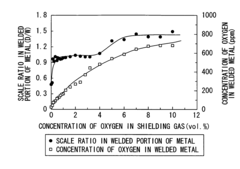
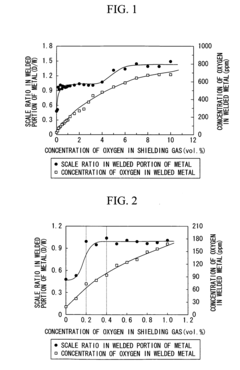
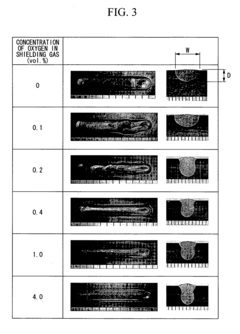
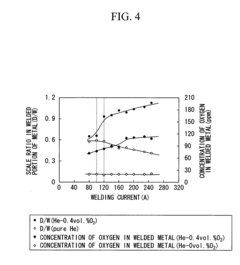
- A shielding gas composition of 0.2% or more oxidative gas, preferably 0.4% or more, with helium as the balance, is used to suppress the dragging force in the molten pool and enhance inward convection, allowing for deeper weld penetration with a D/W ratio of 0.8 or more, achieved through specific welding conditions such as current, speed, and arc length.
Safety Standards and Regulations for Welding Tech
The regulatory landscape for shielded welding technologies encompasses a comprehensive framework of international, national, and industry-specific standards designed to ensure operational safety and quality assurance. The American Welding Society (AWS) D1.1 Structural Welding Code serves as a foundational standard, establishing requirements for shielded metal arc welding (SMAW) and gas metal arc welding (GMAW) applications in structural steel fabrication. This standard mandates specific electrode classifications, joint preparation procedures, and inspection protocols that directly impact the implementation of advanced shielded welding systems.
International Organization for Standardization (ISO) 3834 series provides global harmonization for welding quality requirements, establishing four quality levels that govern personnel qualifications, equipment specifications, and documentation procedures. These standards are particularly relevant for evaluating new shielded welding technologies as they define acceptance criteria for automated and semi-automated welding processes, including advanced gas shielding systems and flux-cored arc welding (FCAW) applications.
Occupational Safety and Health Administration (OSHA) regulations, specifically 29 CFR 1910.252, establish mandatory safety requirements for welding operations, including ventilation standards, personal protective equipment specifications, and exposure limits for welding fumes and gases. Recent updates to these regulations have incorporated provisions for advanced fume extraction systems and real-time air quality monitoring, which are increasingly integrated into modern shielded welding equipment.
The European EN ISO 15614 series governs welding procedure specifications and qualifications, requiring comprehensive testing and validation of new welding technologies before industrial implementation. This regulatory framework mandates mechanical testing, non-destructive examination, and metallurgical analysis for all welding procedures, creating standardized evaluation criteria for emerging shielded welding innovations.
Industry-specific regulations, such as ASME Boiler and Pressure Vessel Code Section IX and API 1104 for pipeline welding, establish additional compliance requirements that influence technology adoption decisions. These standards define specific qualification procedures, material compatibility requirements, and performance criteria that new shielded welding technologies must satisfy to gain market acceptance in critical applications.
International Organization for Standardization (ISO) 3834 series provides global harmonization for welding quality requirements, establishing four quality levels that govern personnel qualifications, equipment specifications, and documentation procedures. These standards are particularly relevant for evaluating new shielded welding technologies as they define acceptance criteria for automated and semi-automated welding processes, including advanced gas shielding systems and flux-cored arc welding (FCAW) applications.
Occupational Safety and Health Administration (OSHA) regulations, specifically 29 CFR 1910.252, establish mandatory safety requirements for welding operations, including ventilation standards, personal protective equipment specifications, and exposure limits for welding fumes and gases. Recent updates to these regulations have incorporated provisions for advanced fume extraction systems and real-time air quality monitoring, which are increasingly integrated into modern shielded welding equipment.
The European EN ISO 15614 series governs welding procedure specifications and qualifications, requiring comprehensive testing and validation of new welding technologies before industrial implementation. This regulatory framework mandates mechanical testing, non-destructive examination, and metallurgical analysis for all welding procedures, creating standardized evaluation criteria for emerging shielded welding innovations.
Industry-specific regulations, such as ASME Boiler and Pressure Vessel Code Section IX and API 1104 for pipeline welding, establish additional compliance requirements that influence technology adoption decisions. These standards define specific qualification procedures, material compatibility requirements, and performance criteria that new shielded welding technologies must satisfy to gain market acceptance in critical applications.
Environmental Impact Assessment of Welding Processes
The environmental implications of modern shielded welding technologies have become increasingly critical as industries face mounting pressure to reduce their ecological footprint. Contemporary welding processes generate various environmental concerns including air emissions, energy consumption, waste generation, and occupational health impacts that require comprehensive evaluation.
Air quality impacts represent the most immediate environmental concern in shielded welding operations. Gas Metal Arc Welding (GMAW) and Gas Tungsten Arc Welding (GTAW) processes produce metal fumes containing hexavalent chromium, manganese, and nickel compounds. These emissions vary significantly based on base materials, filler metals, and shielding gas compositions. Recent studies indicate that pulsed welding techniques can reduce fume generation by up to 40% compared to conventional constant current methods.
Energy consumption patterns differ substantially across welding technologies. Inverter-based power sources demonstrate superior energy efficiency, consuming 20-30% less electricity than traditional transformer-based systems. Advanced welding processes like Cold Metal Transfer (CMT) and Surface Tension Transfer (STT) further optimize energy utilization through precise heat input control, reducing overall carbon footprint per weld joint.
Shielding gas selection significantly influences environmental impact profiles. Traditional argon and helium mixtures, while chemically inert, require energy-intensive production processes. Alternative gas formulations incorporating nitrogen or carbon dioxide offer reduced environmental impact, though application limitations must be considered. Gas recycling systems and flow optimization technologies can decrease consumption by 15-25%.
Waste stream management encompasses consumable materials, packaging, and post-weld cleaning requirements. Modern low-spatter welding technologies reduce grinding and finishing operations, minimizing secondary waste generation. Biodegradable anti-spatter compounds and water-based cleaning solutions replace traditional solvent-based products, reducing hazardous waste classification requirements.
Lifecycle assessment methodologies increasingly incorporate welding process selection criteria. High-deposition rate processes, while potentially increasing immediate energy consumption, can reduce overall project timelines and associated environmental impacts. Automated welding systems demonstrate consistent performance with optimized consumable utilization, contributing to sustainable manufacturing practices.
Regulatory compliance frameworks continue evolving, with stricter emission standards and reporting requirements. Advanced fume extraction systems integrated with welding equipment provide real-time monitoring capabilities, ensuring compliance while optimizing operational efficiency. These developments position environmental considerations as fundamental factors in welding technology selection and implementation strategies.
Air quality impacts represent the most immediate environmental concern in shielded welding operations. Gas Metal Arc Welding (GMAW) and Gas Tungsten Arc Welding (GTAW) processes produce metal fumes containing hexavalent chromium, manganese, and nickel compounds. These emissions vary significantly based on base materials, filler metals, and shielding gas compositions. Recent studies indicate that pulsed welding techniques can reduce fume generation by up to 40% compared to conventional constant current methods.
Energy consumption patterns differ substantially across welding technologies. Inverter-based power sources demonstrate superior energy efficiency, consuming 20-30% less electricity than traditional transformer-based systems. Advanced welding processes like Cold Metal Transfer (CMT) and Surface Tension Transfer (STT) further optimize energy utilization through precise heat input control, reducing overall carbon footprint per weld joint.
Shielding gas selection significantly influences environmental impact profiles. Traditional argon and helium mixtures, while chemically inert, require energy-intensive production processes. Alternative gas formulations incorporating nitrogen or carbon dioxide offer reduced environmental impact, though application limitations must be considered. Gas recycling systems and flow optimization technologies can decrease consumption by 15-25%.
Waste stream management encompasses consumable materials, packaging, and post-weld cleaning requirements. Modern low-spatter welding technologies reduce grinding and finishing operations, minimizing secondary waste generation. Biodegradable anti-spatter compounds and water-based cleaning solutions replace traditional solvent-based products, reducing hazardous waste classification requirements.
Lifecycle assessment methodologies increasingly incorporate welding process selection criteria. High-deposition rate processes, while potentially increasing immediate energy consumption, can reduce overall project timelines and associated environmental impacts. Automated welding systems demonstrate consistent performance with optimized consumable utilization, contributing to sustainable manufacturing practices.
Regulatory compliance frameworks continue evolving, with stricter emission standards and reporting requirements. Advanced fume extraction systems integrated with welding equipment provide real-time monitoring capabilities, ensuring compliance while optimizing operational efficiency. These developments position environmental considerations as fundamental factors in welding technology selection and implementation strategies.
Unlock deeper insights with Patsnap Eureka Quick Research — get a full tech report to explore trends and direct your research. Try now!
Generate Your Research Report Instantly with AI Agent
Supercharge your innovation with Patsnap Eureka AI Agent Platform!