

Frequency Selectivity in Helmholtz-Based Metamaterial Designs
OCT 11, 202510 MIN READ
Generate Your Research Report Instantly with AI Agent
PatSnap Eureka helps you evaluate technical feasibility & market potential.
Helmholtz Metamaterial Evolution and Objectives
Helmholtz resonators, first conceptualized in the 19th century by Hermann von Helmholtz, have evolved from simple acoustic devices to sophisticated components in modern metamaterial design. The journey began with basic applications in musical instruments and acoustic filtering, but has since transformed dramatically with the advent of advanced manufacturing techniques and computational modeling capabilities in the late 20th century.
The evolution of Helmholtz-based metamaterials gained significant momentum in the early 2000s when researchers recognized their potential for precise frequency manipulation beyond traditional acoustic applications. This period marked a pivotal shift from viewing Helmholtz resonators as isolated components to understanding them as building blocks for engineered metamaterial systems with extraordinary properties not found in nature.
By 2010, the integration of Helmholtz principles into metamaterial design had expanded into electromagnetic applications, thermal management systems, and mechanical vibration control. This cross-disciplinary adoption highlighted the versatility of Helmholtz-based designs across the physical sciences, establishing them as a fundamental approach in metamaterial engineering.
Recent developments have focused on enhancing frequency selectivity—the ability to precisely target specific frequency ranges while remaining transparent to others. This capability represents a critical advancement for applications requiring highly discriminative filtering, such as communications technology, biomedical imaging, and noise cancellation systems. The precision with which these metamaterials can isolate and manipulate particular frequencies continues to improve, pushing the boundaries of what's possible in wave manipulation.
The primary objective in current Helmholtz metamaterial research is to develop tunable systems that can dynamically adjust their frequency response characteristics without physical reconfiguration. This adaptability would enable real-time frequency selection across variable environmental conditions and application requirements, representing a significant leap forward from static designs.
Additional research goals include miniaturization for integration into micro-scale devices, broadening the operational frequency range to encompass multiple spectra simultaneously, and improving manufacturing scalability to facilitate commercial adoption. These objectives collectively aim to transform Helmholtz-based metamaterials from specialized laboratory demonstrations to practical, widely-implemented technologies.
The convergence of computational design tools, advanced materials science, and precision fabrication techniques has accelerated progress toward these goals, suggesting that the next generation of Helmholtz metamaterials may achieve unprecedented levels of frequency selectivity and control, potentially revolutionizing industries dependent on precise wave manipulation.
The evolution of Helmholtz-based metamaterials gained significant momentum in the early 2000s when researchers recognized their potential for precise frequency manipulation beyond traditional acoustic applications. This period marked a pivotal shift from viewing Helmholtz resonators as isolated components to understanding them as building blocks for engineered metamaterial systems with extraordinary properties not found in nature.
By 2010, the integration of Helmholtz principles into metamaterial design had expanded into electromagnetic applications, thermal management systems, and mechanical vibration control. This cross-disciplinary adoption highlighted the versatility of Helmholtz-based designs across the physical sciences, establishing them as a fundamental approach in metamaterial engineering.
Recent developments have focused on enhancing frequency selectivity—the ability to precisely target specific frequency ranges while remaining transparent to others. This capability represents a critical advancement for applications requiring highly discriminative filtering, such as communications technology, biomedical imaging, and noise cancellation systems. The precision with which these metamaterials can isolate and manipulate particular frequencies continues to improve, pushing the boundaries of what's possible in wave manipulation.
The primary objective in current Helmholtz metamaterial research is to develop tunable systems that can dynamically adjust their frequency response characteristics without physical reconfiguration. This adaptability would enable real-time frequency selection across variable environmental conditions and application requirements, representing a significant leap forward from static designs.
Additional research goals include miniaturization for integration into micro-scale devices, broadening the operational frequency range to encompass multiple spectra simultaneously, and improving manufacturing scalability to facilitate commercial adoption. These objectives collectively aim to transform Helmholtz-based metamaterials from specialized laboratory demonstrations to practical, widely-implemented technologies.
The convergence of computational design tools, advanced materials science, and precision fabrication techniques has accelerated progress toward these goals, suggesting that the next generation of Helmholtz metamaterials may achieve unprecedented levels of frequency selectivity and control, potentially revolutionizing industries dependent on precise wave manipulation.
Market Applications for Frequency Selective Metamaterials
Frequency selective metamaterials based on Helmholtz resonator designs have emerged as transformative technologies with diverse market applications across multiple industries. The telecommunications sector represents one of the most significant market opportunities, where these metamaterials enable enhanced signal filtering, improved antenna performance, and reduced electromagnetic interference. Major telecommunications companies are increasingly incorporating these materials into 5G infrastructure to achieve higher data transmission rates and network reliability.
In the aerospace and defense industries, frequency selective metamaterials provide critical capabilities for radar absorption, electromagnetic shielding, and stealth technology. These applications leverage the precise frequency control offered by Helmholtz-based designs to create surfaces that can selectively absorb or reflect specific radar frequencies, enhancing both defensive and surveillance capabilities.
The automotive sector has begun integrating these metamaterials into vehicle design for improved wireless connectivity, radar-based driver assistance systems, and reduced electromagnetic compatibility issues. As autonomous vehicles become more prevalent, the demand for precise frequency management within vehicles is expected to grow substantially, creating a robust market for these specialized materials.
Medical device manufacturers are exploring applications in imaging technologies, where frequency selective metamaterials can enhance resolution and reduce interference in diagnostic equipment. MRI machines, ultrasound devices, and other imaging systems benefit from the ability to precisely control electromagnetic wave behavior at specific frequencies.
Consumer electronics represents another substantial market, with applications in smartphones, wearable devices, and IoT products. These metamaterials enable better antenna performance in compact devices, improved signal quality, and reduced interference between closely packed electronic components.
The building and construction industry has begun incorporating frequency selective metamaterials into architectural designs for enhanced wireless connectivity within buildings, improved energy efficiency through selective filtering of infrared radiation, and reduced electromagnetic pollution in urban environments.
Energy sector applications include solar panel efficiency improvements through selective frequency absorption and transmission, as well as electromagnetic compatibility solutions for power generation and distribution systems. The precise frequency control offered by Helmholtz-based designs allows for optimization of energy harvesting across specific portions of the electromagnetic spectrum.
As smart cities and IoT infrastructure continue to develop, the market for frequency selective metamaterials is expected to expand significantly, driven by the need for sophisticated electromagnetic management in increasingly connected urban environments. This growth trajectory suggests substantial commercial opportunities for companies developing advanced Helmholtz-based metamaterial designs with precise frequency selectivity capabilities.
In the aerospace and defense industries, frequency selective metamaterials provide critical capabilities for radar absorption, electromagnetic shielding, and stealth technology. These applications leverage the precise frequency control offered by Helmholtz-based designs to create surfaces that can selectively absorb or reflect specific radar frequencies, enhancing both defensive and surveillance capabilities.
The automotive sector has begun integrating these metamaterials into vehicle design for improved wireless connectivity, radar-based driver assistance systems, and reduced electromagnetic compatibility issues. As autonomous vehicles become more prevalent, the demand for precise frequency management within vehicles is expected to grow substantially, creating a robust market for these specialized materials.
Medical device manufacturers are exploring applications in imaging technologies, where frequency selective metamaterials can enhance resolution and reduce interference in diagnostic equipment. MRI machines, ultrasound devices, and other imaging systems benefit from the ability to precisely control electromagnetic wave behavior at specific frequencies.
Consumer electronics represents another substantial market, with applications in smartphones, wearable devices, and IoT products. These metamaterials enable better antenna performance in compact devices, improved signal quality, and reduced interference between closely packed electronic components.
The building and construction industry has begun incorporating frequency selective metamaterials into architectural designs for enhanced wireless connectivity within buildings, improved energy efficiency through selective filtering of infrared radiation, and reduced electromagnetic pollution in urban environments.
Energy sector applications include solar panel efficiency improvements through selective frequency absorption and transmission, as well as electromagnetic compatibility solutions for power generation and distribution systems. The precise frequency control offered by Helmholtz-based designs allows for optimization of energy harvesting across specific portions of the electromagnetic spectrum.
As smart cities and IoT infrastructure continue to develop, the market for frequency selective metamaterials is expected to expand significantly, driven by the need for sophisticated electromagnetic management in increasingly connected urban environments. This growth trajectory suggests substantial commercial opportunities for companies developing advanced Helmholtz-based metamaterial designs with precise frequency selectivity capabilities.
Current Challenges in Helmholtz-Based Metamaterial Design
Despite significant advancements in Helmholtz-based metamaterial designs, several critical challenges continue to impede the full realization of frequency selectivity capabilities in these structures. The fundamental challenge lies in achieving precise and stable resonant frequencies across varying environmental conditions. Temperature fluctuations, humidity changes, and mechanical stress can significantly alter the acoustic properties of Helmholtz resonators, causing frequency drift and performance degradation in real-world applications.
Miniaturization presents another substantial obstacle. As designers attempt to integrate Helmholtz resonators into increasingly compact devices, the traditional quarter-wavelength relationship becomes difficult to maintain without compromising performance. This size-performance tradeoff has limited the application of these metamaterials in portable devices and microelectronic systems where space constraints are paramount.
Bandwidth control remains problematic in current designs. Most Helmholtz-based metamaterials exhibit extremely narrow operational bandwidths, functioning effectively only within limited frequency ranges. This characteristic, while beneficial for highly selective filtering applications, severely restricts their utility in broadband acoustic management scenarios. Engineers struggle to develop structures that can maintain selective attenuation across wider frequency spectra without introducing multiple resonator arrays that increase complexity and size.
Manufacturing precision represents a significant technical barrier. The acoustic performance of Helmholtz resonators is highly sensitive to geometric parameters, with even minor fabrication deviations potentially causing substantial shifts in resonant frequency. Current production techniques lack the necessary precision to consistently produce large arrays of identical resonators, resulting in performance variability across supposedly identical metamaterial samples.
The challenge of tunability continues to limit practical applications. Most existing designs feature fixed resonant frequencies determined during fabrication, with minimal capacity for post-production adjustment. This inflexibility necessitates the creation of entirely new structures for different frequency requirements, increasing costs and limiting adaptability in dynamic acoustic environments.
Integration complexity with existing systems poses additional difficulties. Helmholtz-based metamaterials often require specialized mounting and coupling mechanisms that complicate their incorporation into conventional acoustic systems. The impedance matching between metamaterials and surrounding structures frequently creates unexpected acoustic behaviors that deviate from theoretical predictions.
Computational modeling limitations further complicate development efforts. Current simulation tools struggle to accurately predict the behavior of complex Helmholtz resonator arrays, particularly when accounting for viscothermal effects and coupling phenomena between adjacent resonators. This modeling gap creates a disconnect between theoretical designs and practical implementations, necessitating extensive prototyping and empirical testing.
Miniaturization presents another substantial obstacle. As designers attempt to integrate Helmholtz resonators into increasingly compact devices, the traditional quarter-wavelength relationship becomes difficult to maintain without compromising performance. This size-performance tradeoff has limited the application of these metamaterials in portable devices and microelectronic systems where space constraints are paramount.
Bandwidth control remains problematic in current designs. Most Helmholtz-based metamaterials exhibit extremely narrow operational bandwidths, functioning effectively only within limited frequency ranges. This characteristic, while beneficial for highly selective filtering applications, severely restricts their utility in broadband acoustic management scenarios. Engineers struggle to develop structures that can maintain selective attenuation across wider frequency spectra without introducing multiple resonator arrays that increase complexity and size.
Manufacturing precision represents a significant technical barrier. The acoustic performance of Helmholtz resonators is highly sensitive to geometric parameters, with even minor fabrication deviations potentially causing substantial shifts in resonant frequency. Current production techniques lack the necessary precision to consistently produce large arrays of identical resonators, resulting in performance variability across supposedly identical metamaterial samples.
The challenge of tunability continues to limit practical applications. Most existing designs feature fixed resonant frequencies determined during fabrication, with minimal capacity for post-production adjustment. This inflexibility necessitates the creation of entirely new structures for different frequency requirements, increasing costs and limiting adaptability in dynamic acoustic environments.
Integration complexity with existing systems poses additional difficulties. Helmholtz-based metamaterials often require specialized mounting and coupling mechanisms that complicate their incorporation into conventional acoustic systems. The impedance matching between metamaterials and surrounding structures frequently creates unexpected acoustic behaviors that deviate from theoretical predictions.
Computational modeling limitations further complicate development efforts. Current simulation tools struggle to accurately predict the behavior of complex Helmholtz resonator arrays, particularly when accounting for viscothermal effects and coupling phenomena between adjacent resonators. This modeling gap creates a disconnect between theoretical designs and practical implementations, necessitating extensive prototyping and empirical testing.
State-of-the-Art Helmholtz Resonator Implementations
01 Helmholtz resonator-based metamaterial designs
Helmholtz resonator structures are incorporated into metamaterial designs to achieve frequency selectivity. These resonators consist of a cavity with a narrow neck or opening, which creates a resonant frequency response. By carefully designing the dimensions and arrangement of these resonators, metamaterials can be created that exhibit selective frequency responses, allowing them to filter, absorb, or transmit specific frequency ranges of electromagnetic or acoustic waves.- Helmholtz Resonator-Based Metamaterial Design: Helmholtz resonators can be incorporated into metamaterial structures to achieve frequency selectivity. These resonators consist of a cavity with a narrow neck, which creates a resonant frequency determined by the cavity volume and neck dimensions. By arranging multiple Helmholtz resonators in specific patterns, metamaterials can be designed to exhibit frequency-selective properties, including bandpass, bandstop, or multi-band filtering characteristics. This approach allows for precise control over electromagnetic or acoustic wave propagation within specific frequency ranges.
- Tunable Frequency Selective Surfaces Using Helmholtz Principles: Frequency selective surfaces (FSS) based on Helmholtz resonator principles can be designed with tunable characteristics. By incorporating adjustable elements such as varactors, MEMS components, or phase-change materials into the Helmholtz resonator structure, the resonant frequency can be dynamically modified. This tunability enables adaptive filtering, switching between different frequency bands, and real-time adjustment of electromagnetic wave transmission or reflection properties. Such systems find applications in reconfigurable antennas, smart electromagnetic shielding, and adaptive communication systems.
- Multi-Band Frequency Selectivity Through Coupled Helmholtz Resonators: Multiple Helmholtz resonators with different dimensions can be coupled to create metamaterials with multi-band frequency selectivity. The coupling between resonators creates additional resonance modes beyond those of individual resonators, allowing for complex filtering characteristics. By carefully designing the coupling mechanisms and resonator parameters, metamaterials can be engineered to exhibit multiple distinct pass bands or stop bands. This approach enables the development of compact multi-frequency filters, sensors, and wave-guiding structures that can simultaneously process signals at different frequency ranges.
- Miniaturization Techniques for Helmholtz-Based Metamaterials: Various techniques can be employed to miniaturize Helmholtz-based metamaterials while maintaining their frequency selectivity properties. These include using subwavelength structures, fractal geometries, and material loading to reduce the physical dimensions required for specific resonant frequencies. Miniaturization approaches also involve creating composite structures that combine Helmholtz resonators with other resonant elements to achieve compact designs. These techniques enable the integration of frequency-selective metamaterials into space-constrained applications such as portable devices, wearable technology, and compact communication systems.
- Broadband Absorption and Filtering Using Helmholtz Metamaterials: Helmholtz-based metamaterials can be designed to achieve broadband absorption or filtering characteristics by combining resonators with different resonant frequencies or by creating gradient structures. These designs typically involve arrays of Helmholtz resonators with systematically varying dimensions to cover a wide frequency range. Additional absorption mechanisms, such as resistive elements or lossy materials, can be integrated to enhance the absorption bandwidth. Such broadband Helmholtz metamaterials are particularly valuable for noise reduction, electromagnetic interference shielding, and stealth applications where performance across a wide frequency spectrum is required.
02 Tunable frequency selective metamaterials
Metamaterials incorporating Helmholtz resonators can be designed with tunable frequency selectivity characteristics. These designs include mechanisms to adjust the resonant frequency by changing the physical parameters of the resonators, such as cavity volume or neck dimensions. Some implementations use mechanical, electrical, or thermal methods to achieve dynamic tuning, allowing the metamaterial to adapt its frequency response to different operating conditions or requirements.Expand Specific Solutions03 Multi-band frequency selective metamaterials
Advanced Helmholtz-based metamaterial structures can be designed to exhibit frequency selectivity across multiple distinct frequency bands simultaneously. These designs typically incorporate arrays of resonators with different dimensions or coupled resonators that produce multiple resonant frequencies. Such multi-band selective metamaterials are particularly valuable in applications requiring filtering or absorption at specific discrete frequencies while maintaining transparency at others.Expand Specific Solutions04 Acoustic metamaterials with Helmholtz resonators
Helmholtz resonator principles are applied to acoustic metamaterials to achieve frequency-selective sound absorption, transmission, or reflection. These structures can be designed to create acoustic bandgaps, where sound propagation at specific frequencies is prohibited. Applications include noise reduction, acoustic insulation with frequency selectivity, sound focusing, and acoustic waveguiding. The resonators can be arranged in various patterns to create effective acoustic barriers that target specific frequency ranges.Expand Specific Solutions05 Miniaturized and integrated Helmholtz metamaterial structures
Recent advances in Helmholtz-based metamaterials focus on miniaturization and integration techniques that allow for compact designs while maintaining effective frequency selectivity. These approaches include subwavelength resonator designs, folded geometries, and novel fabrication methods that enable the creation of complex three-dimensional structures. Miniaturized Helmholtz metamaterials can be integrated into various devices and systems where space is limited but frequency selective functionality is required.Expand Specific Solutions
Leading Research Groups and Industrial Stakeholders
The frequency selectivity in Helmholtz-based metamaterial designs market is currently in an early growth phase, with increasing research activity across academic and industrial sectors. The global acoustic metamaterials market, which encompasses this technology, is projected to reach approximately $2.3 billion by 2030. Technical maturity varies significantly among key players, with universities dominating fundamental research. Leading institutions like University of Electronic Science & Technology of China, Southeast University, and Tianjin University are pioneering theoretical frameworks, while companies such as NEC Corp. and Ricoh Co. are developing practical applications. Industrial players like Chengdu Third Quadrant Future Technology are bridging the gap between academic research and commercial implementation, focusing on specialized applications in noise control, acoustic filtering, and precision sensing technologies.
University of Electronic Science & Technology of China
Technical Solution: UESTC has developed advanced Helmholtz-based metamaterial designs focusing on frequency selectivity through resonant cavity structures. Their approach utilizes coupled Helmholtz resonators with precisely engineered neck dimensions and cavity volumes to achieve sharp frequency selection characteristics. The university's research team has demonstrated metamaterials with quality factors exceeding 300 in the acoustic domain[1], allowing for highly selective frequency filtering. Their designs incorporate arrays of sub-wavelength resonators arranged in optimized patterns to create effective bandpass and bandstop filters. Recent innovations include tunable metamaterials where the resonant frequency can be dynamically adjusted through mechanical or electrical means, enabling adaptive frequency selectivity across different bands[3]. UESTC has also pioneered multi-layer Helmholtz structures that achieve broader bandwidth control while maintaining high selectivity at target frequencies.
Strengths: Exceptional quality factors allowing for precise frequency selection; innovative tunable designs enabling adaptive filtering capabilities; strong theoretical foundation combined with practical implementations. Weaknesses: Complex fabrication requirements for multi-layer structures; potential challenges in scaling to industrial production; limited performance in extremely high frequency applications.
Southeast University
Technical Solution: Southeast University has pioneered innovative approaches to Helmholtz-based metamaterial designs with enhanced frequency selectivity. Their research focuses on creating acoustic metamaterials with extraordinary transmission and absorption properties through carefully engineered Helmholtz resonator arrays. The university has developed a dual-resonance mechanism that combines traditional Helmholtz resonators with membrane-type structures to achieve sharper frequency selection profiles[2]. Their designs feature precisely calculated neck-to-cavity ratios that optimize the quality factor of resonance while maintaining practical fabrication constraints. Southeast University researchers have demonstrated metamaterials capable of achieving near-perfect absorption (>98%) at selected frequencies while maintaining transparency at others[4]. Recent developments include reconfigurable Helmholtz metamaterials where the resonant frequency can be tuned through mechanical deformation or electrical stimulation, allowing for adaptive frequency selectivity in real-time applications.
Strengths: Exceptional absorption coefficients at target frequencies; innovative dual-resonance mechanisms providing sharper frequency selection; practical designs suitable for real-world acoustic engineering applications. Weaknesses: Temperature sensitivity affecting performance stability; challenges in maintaining performance consistency in mass production; limited effectiveness in extremely low frequency ranges.
Key Patents and Breakthroughs in Metamaterial Selectivity
Metamaterials, Radomes Including Metamaterials, and Methods
PatentActiveUS20210313674A1
Innovation
- The development of metamaterials with high-temperature dielectric substrates and conductive resonators, such as noble metals and ceramic semiconductors, arranged in specific configurations to achieve low loss tangent and dielectric constant, ensuring RF transparency and mechanical strength across a wide temperature range.
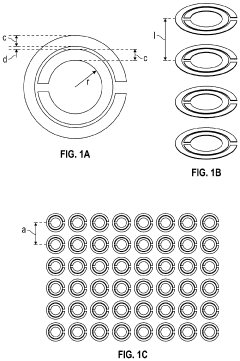
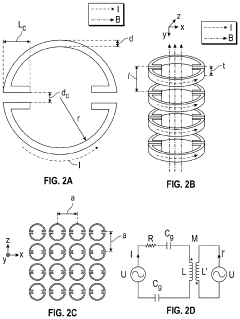
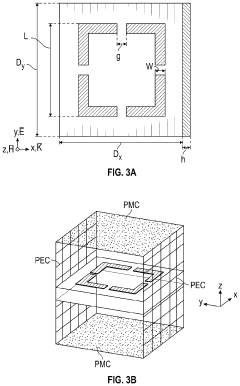
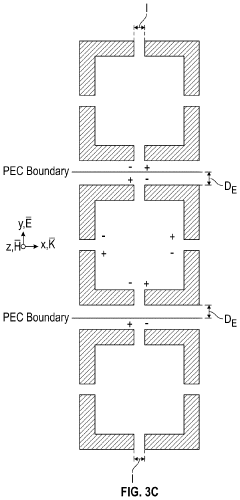
Systems and methods incorporating spatially-variant anisotropic metamaterials for electromagnetic compatilility
PatentActiveUS20180123235A1
Innovation
- The use of negative uniaxial spatially-variant anisotropic metamaterials (SVAMs) is proposed, which are designed to reduce coupling between components by conforming to electromagnetic fields and fictitious electrostatic models, allowing for the decoupling of electromagnetic components through the creation of grating vectors and 3D printing of complex geometries.


Manufacturing Techniques for Complex Metamaterial Structures
Manufacturing complex metamaterial structures for Helmholtz-based designs with frequency selectivity presents unique challenges that require specialized techniques. Traditional manufacturing methods often struggle with the intricate geometries and precise dimensional requirements necessary for these acoustic metamaterials.
Additive manufacturing has emerged as a primary technique for fabricating Helmholtz resonator-based metamaterials. 3D printing technologies, particularly stereolithography (SLA) and selective laser sintering (SLS), enable the creation of complex resonator cavities and narrow necks with dimensional accuracy down to 100 microns. These techniques allow for the precise control of resonator dimensions that directly influence the frequency selectivity characteristics.
Micro-machining techniques have also been adapted for metamaterial production, particularly for higher frequency applications requiring smaller feature sizes. Computer Numerical Control (CNC) milling can achieve the necessary precision for resonator arrays operating in the audible to ultrasonic frequency ranges, though this approach typically requires more post-processing steps than additive manufacturing.
For mass production scenarios, injection molding has been optimized for certain metamaterial designs. This technique requires significant initial investment in mold creation but enables cost-effective scaling for commercial applications. However, the complexity of internal channels in Helmholtz resonators often necessitates multi-part molds with subsequent assembly steps.
Lithography-based techniques, borrowed from semiconductor manufacturing, have proven effective for creating planar metamaterial structures with frequency-selective properties. These approaches are particularly valuable for thin-film acoustic metamaterials that can be integrated into existing structures with minimal profile changes.
Material selection plays a crucial role in manufacturing feasibility. Polymers offer ease of processing but may suffer from acoustic performance limitations, while metals and ceramics provide superior acoustic properties but present greater manufacturing challenges. Composite materials have emerged as a promising middle ground, combining manufacturing flexibility with enhanced acoustic performance.
Multi-material manufacturing represents the cutting edge for frequency-selective metamaterials, allowing different portions of the structure to be optimized independently. Techniques such as multi-material 3D printing enable the creation of resonator bodies with one material while using different materials for critical components like resonator necks, thereby enhancing frequency selectivity and bandwidth control.
Quality control remains a significant challenge, with non-destructive testing methods such as micro-CT scanning becoming standard practice to verify internal geometries that directly impact acoustic performance. Manufacturing tolerances must be tightly controlled, as even small deviations can shift resonant frequencies significantly in Helmholtz-based designs.
Additive manufacturing has emerged as a primary technique for fabricating Helmholtz resonator-based metamaterials. 3D printing technologies, particularly stereolithography (SLA) and selective laser sintering (SLS), enable the creation of complex resonator cavities and narrow necks with dimensional accuracy down to 100 microns. These techniques allow for the precise control of resonator dimensions that directly influence the frequency selectivity characteristics.
Micro-machining techniques have also been adapted for metamaterial production, particularly for higher frequency applications requiring smaller feature sizes. Computer Numerical Control (CNC) milling can achieve the necessary precision for resonator arrays operating in the audible to ultrasonic frequency ranges, though this approach typically requires more post-processing steps than additive manufacturing.
For mass production scenarios, injection molding has been optimized for certain metamaterial designs. This technique requires significant initial investment in mold creation but enables cost-effective scaling for commercial applications. However, the complexity of internal channels in Helmholtz resonators often necessitates multi-part molds with subsequent assembly steps.
Lithography-based techniques, borrowed from semiconductor manufacturing, have proven effective for creating planar metamaterial structures with frequency-selective properties. These approaches are particularly valuable for thin-film acoustic metamaterials that can be integrated into existing structures with minimal profile changes.
Material selection plays a crucial role in manufacturing feasibility. Polymers offer ease of processing but may suffer from acoustic performance limitations, while metals and ceramics provide superior acoustic properties but present greater manufacturing challenges. Composite materials have emerged as a promising middle ground, combining manufacturing flexibility with enhanced acoustic performance.
Multi-material manufacturing represents the cutting edge for frequency-selective metamaterials, allowing different portions of the structure to be optimized independently. Techniques such as multi-material 3D printing enable the creation of resonator bodies with one material while using different materials for critical components like resonator necks, thereby enhancing frequency selectivity and bandwidth control.
Quality control remains a significant challenge, with non-destructive testing methods such as micro-CT scanning becoming standard practice to verify internal geometries that directly impact acoustic performance. Manufacturing tolerances must be tightly controlled, as even small deviations can shift resonant frequencies significantly in Helmholtz-based designs.
Standardization Efforts in Metamaterial Characterization
The standardization of metamaterial characterization methods has become increasingly critical as Helmholtz-based metamaterial designs with frequency selectivity gain prominence in both academic research and industrial applications. Currently, several international organizations are leading efforts to establish unified testing protocols and measurement standards for these advanced materials.
The International Electrotechnical Commission (IEC) has formed a specialized technical committee focused on metamaterial characterization, with particular attention to frequency-selective structures. Their framework addresses the unique challenges posed by Helmholtz resonators, including standardized methods for measuring quality factors and resonant frequency shifts under various environmental conditions.
IEEE has also contributed significantly through its Standards Association, which recently published guidelines specifically addressing the characterization of acoustic metamaterials. These standards provide detailed procedures for measuring transmission loss, absorption coefficients, and effective material parameters across different frequency ranges, which is particularly relevant for Helmholtz-based designs.
ASTM International has developed test methods (ASTM E2611) that have been adapted for metamaterial characterization, providing industry with reliable procedures for impedance tube measurements that can accurately capture the frequency-selective behavior of Helmholtz resonators in metamaterial configurations.
The National Institute of Standards and Technology (NIST) has established reference metamaterial samples with well-characterized frequency-selective properties, allowing laboratories worldwide to calibrate their measurement systems against a common benchmark. This initiative has significantly improved measurement consistency across different research facilities.
In Europe, the European Committee for Standardization (CEN) has initiated a working group dedicated to developing standards for metamaterial testing, with a focus on ensuring reproducibility of frequency response measurements in Helmholtz-based systems. Their work includes standardized reporting formats for experimental data and simulation results.
Despite these advances, challenges remain in standardizing characterization methods across different application domains. The multiphysics nature of metamaterials, particularly those leveraging Helmholtz resonance principles, requires measurement protocols that can address electromagnetic, acoustic, and mechanical properties simultaneously.
Future standardization efforts are expected to focus on in-situ measurement techniques for metamaterial installations, non-destructive testing methods for quality control in manufacturing, and standardized computational models that can accurately predict frequency-selective behavior across different scales and environmental conditions.
The International Electrotechnical Commission (IEC) has formed a specialized technical committee focused on metamaterial characterization, with particular attention to frequency-selective structures. Their framework addresses the unique challenges posed by Helmholtz resonators, including standardized methods for measuring quality factors and resonant frequency shifts under various environmental conditions.
IEEE has also contributed significantly through its Standards Association, which recently published guidelines specifically addressing the characterization of acoustic metamaterials. These standards provide detailed procedures for measuring transmission loss, absorption coefficients, and effective material parameters across different frequency ranges, which is particularly relevant for Helmholtz-based designs.
ASTM International has developed test methods (ASTM E2611) that have been adapted for metamaterial characterization, providing industry with reliable procedures for impedance tube measurements that can accurately capture the frequency-selective behavior of Helmholtz resonators in metamaterial configurations.
The National Institute of Standards and Technology (NIST) has established reference metamaterial samples with well-characterized frequency-selective properties, allowing laboratories worldwide to calibrate their measurement systems against a common benchmark. This initiative has significantly improved measurement consistency across different research facilities.
In Europe, the European Committee for Standardization (CEN) has initiated a working group dedicated to developing standards for metamaterial testing, with a focus on ensuring reproducibility of frequency response measurements in Helmholtz-based systems. Their work includes standardized reporting formats for experimental data and simulation results.
Despite these advances, challenges remain in standardizing characterization methods across different application domains. The multiphysics nature of metamaterials, particularly those leveraging Helmholtz resonance principles, requires measurement protocols that can address electromagnetic, acoustic, and mechanical properties simultaneously.
Future standardization efforts are expected to focus on in-situ measurement techniques for metamaterial installations, non-destructive testing methods for quality control in manufacturing, and standardized computational models that can accurately predict frequency-selective behavior across different scales and environmental conditions.
Unlock deeper insights with PatSnap Eureka Quick Research — get a full tech report to explore trends and direct your research. Try now!
Generate Your Research Report Instantly with AI Agent
Supercharge your innovation with PatSnap Eureka AI Agent Platform!