

How Unit Cell Geometry Controls Acoustic Bandgap Formation
OCT 11, 202510 MIN READ
Generate Your Research Report Instantly with AI Agent
PatSnap Eureka helps you evaluate technical feasibility & market potential.
Acoustic Metamaterials Background and Objectives
Acoustic metamaterials represent a revolutionary class of engineered materials that exhibit extraordinary acoustic properties not found in natural materials. These artificial structures manipulate sound waves through their unique geometric configurations rather than through their chemical composition. The concept emerged in the early 2000s, inspired by electromagnetic metamaterials, and has since evolved into a vibrant research field with significant technological implications.
The development trajectory of acoustic metamaterials has been marked by several key milestones. Initially, researchers focused on creating negative effective mass density and bulk modulus materials, which enabled unprecedented control over sound propagation. This foundation led to the discovery that periodic arrangements of resonant structures could create acoustic bandgaps—frequency ranges where sound propagation is prohibited. The geometry of these unit cells emerged as the critical factor determining these bandgap properties.
Current research trends indicate a shift toward more sophisticated unit cell designs that can achieve multiple functionalities simultaneously. The integration of active components and adaptive geometries represents the cutting edge of this field, allowing for dynamic control of acoustic properties. Additionally, multi-physics approaches combining acoustic, mechanical, and electrical properties are gaining prominence as researchers seek to develop more versatile metamaterial systems.
The primary technical objective in studying unit cell geometry's influence on acoustic bandgap formation is to establish systematic design principles that enable precise control over sound wave propagation. This includes developing predictive models that can accurately relate geometric parameters to resulting bandgap characteristics such as width, center frequency, and attenuation strength. Such models would significantly accelerate the design process for application-specific acoustic metamaterials.
Another crucial objective is to overcome current limitations in bandwidth and tunability. Most existing acoustic metamaterials exhibit relatively narrow bandgaps, limiting their practical applications. By understanding the fundamental relationship between unit cell geometry and bandgap formation, researchers aim to design structures with broader and potentially multiple bandgaps that can be dynamically tuned.
The long-term vision for this technology encompasses transformative applications across multiple industries. These include advanced noise control solutions that selectively filter specific frequencies, acoustic cloaking devices that render objects acoustically invisible, super-resolution acoustic imaging systems that overcome the diffraction limit, and novel acoustic waveguides for precise sound manipulation in medical ultrasound and underwater communication systems.
The development trajectory of acoustic metamaterials has been marked by several key milestones. Initially, researchers focused on creating negative effective mass density and bulk modulus materials, which enabled unprecedented control over sound propagation. This foundation led to the discovery that periodic arrangements of resonant structures could create acoustic bandgaps—frequency ranges where sound propagation is prohibited. The geometry of these unit cells emerged as the critical factor determining these bandgap properties.
Current research trends indicate a shift toward more sophisticated unit cell designs that can achieve multiple functionalities simultaneously. The integration of active components and adaptive geometries represents the cutting edge of this field, allowing for dynamic control of acoustic properties. Additionally, multi-physics approaches combining acoustic, mechanical, and electrical properties are gaining prominence as researchers seek to develop more versatile metamaterial systems.
The primary technical objective in studying unit cell geometry's influence on acoustic bandgap formation is to establish systematic design principles that enable precise control over sound wave propagation. This includes developing predictive models that can accurately relate geometric parameters to resulting bandgap characteristics such as width, center frequency, and attenuation strength. Such models would significantly accelerate the design process for application-specific acoustic metamaterials.
Another crucial objective is to overcome current limitations in bandwidth and tunability. Most existing acoustic metamaterials exhibit relatively narrow bandgaps, limiting their practical applications. By understanding the fundamental relationship between unit cell geometry and bandgap formation, researchers aim to design structures with broader and potentially multiple bandgaps that can be dynamically tuned.
The long-term vision for this technology encompasses transformative applications across multiple industries. These include advanced noise control solutions that selectively filter specific frequencies, acoustic cloaking devices that render objects acoustically invisible, super-resolution acoustic imaging systems that overcome the diffraction limit, and novel acoustic waveguides for precise sound manipulation in medical ultrasound and underwater communication systems.
Market Applications of Acoustic Bandgap Structures
Acoustic bandgap structures have emerged as a transformative technology with diverse market applications across multiple industries. The ability to control sound wave propagation through engineered geometries has opened new possibilities in noise control and vibration management sectors. The global noise control market, valued at over $7 billion, continues to expand as urban environments face increasing noise pollution challenges, creating substantial demand for acoustic bandgap solutions in building materials and infrastructure.
In the telecommunications industry, acoustic bandgap structures are revolutionizing filter design for signal processing applications. These structures enable precise frequency filtering in mobile devices, satellite communications, and wireless networks, addressing the growing need for efficient spectrum utilization in increasingly crowded frequency bands. Companies like Qualcomm and Samsung have begun integrating these structures into their RF component designs to achieve higher performance metrics.
The medical device sector represents another significant market opportunity, particularly in ultrasonic imaging and therapeutic applications. Acoustic bandgap materials can enhance the resolution and sensitivity of diagnostic equipment while reducing unwanted artifacts. The precision offered by tailored unit cell geometries allows for improved focusing of acoustic energy in therapeutic applications such as high-intensity focused ultrasound (HIFU) treatments for cancer and neurological disorders.
Automotive manufacturers are increasingly adopting acoustic bandgap technologies to address both interior cabin noise reduction and exterior environmental noise concerns. Premium vehicle manufacturers have begun implementing these structures in strategic locations to create quieter passenger compartments while maintaining structural integrity and weight requirements. The growing electric vehicle market presents additional opportunities as manufacturers seek to address the unique noise profiles of these vehicles.
The aerospace industry has identified acoustic bandgap structures as critical components for addressing vibration and noise issues in aircraft design. These structures can be integrated into engine nacelles, cabin walls, and other critical components to reduce structural vibration and cabin noise without significant weight penalties. Major aerospace manufacturers are investing in research partnerships to develop customized acoustic bandgap solutions for next-generation aircraft.
Consumer electronics represents another expanding market, with applications in speaker design, microphone arrays, and acoustic sensors. Companies are exploring how unit cell geometry can be optimized to create directional speakers, improve voice recognition accuracy, and enhance the overall audio experience in smart devices, hearables, and home entertainment systems.
Defense applications include sonar systems, underwater acoustic communications, and stealth technologies that leverage the unique properties of acoustic bandgap structures to control sound propagation in challenging environments. These specialized applications often drive innovation in extreme performance requirements that eventually transfer to commercial markets.
In the telecommunications industry, acoustic bandgap structures are revolutionizing filter design for signal processing applications. These structures enable precise frequency filtering in mobile devices, satellite communications, and wireless networks, addressing the growing need for efficient spectrum utilization in increasingly crowded frequency bands. Companies like Qualcomm and Samsung have begun integrating these structures into their RF component designs to achieve higher performance metrics.
The medical device sector represents another significant market opportunity, particularly in ultrasonic imaging and therapeutic applications. Acoustic bandgap materials can enhance the resolution and sensitivity of diagnostic equipment while reducing unwanted artifacts. The precision offered by tailored unit cell geometries allows for improved focusing of acoustic energy in therapeutic applications such as high-intensity focused ultrasound (HIFU) treatments for cancer and neurological disorders.
Automotive manufacturers are increasingly adopting acoustic bandgap technologies to address both interior cabin noise reduction and exterior environmental noise concerns. Premium vehicle manufacturers have begun implementing these structures in strategic locations to create quieter passenger compartments while maintaining structural integrity and weight requirements. The growing electric vehicle market presents additional opportunities as manufacturers seek to address the unique noise profiles of these vehicles.
The aerospace industry has identified acoustic bandgap structures as critical components for addressing vibration and noise issues in aircraft design. These structures can be integrated into engine nacelles, cabin walls, and other critical components to reduce structural vibration and cabin noise without significant weight penalties. Major aerospace manufacturers are investing in research partnerships to develop customized acoustic bandgap solutions for next-generation aircraft.
Consumer electronics represents another expanding market, with applications in speaker design, microphone arrays, and acoustic sensors. Companies are exploring how unit cell geometry can be optimized to create directional speakers, improve voice recognition accuracy, and enhance the overall audio experience in smart devices, hearables, and home entertainment systems.
Defense applications include sonar systems, underwater acoustic communications, and stealth technologies that leverage the unique properties of acoustic bandgap structures to control sound propagation in challenging environments. These specialized applications often drive innovation in extreme performance requirements that eventually transfer to commercial markets.
Current Challenges in Unit Cell Design
Despite significant advancements in acoustic metamaterial design, several fundamental challenges persist in unit cell geometry optimization for effective bandgap formation. The primary difficulty lies in establishing a comprehensive theoretical framework that accurately predicts how specific geometric parameters influence bandgap width, position, and robustness. Current analytical models often rely on simplifications that fail to capture the complex wave interactions in intricate geometries, creating a disconnect between theoretical predictions and experimental results.
Material constraints represent another significant hurdle in unit cell design. Many theoretically optimal geometries prove impractical for manufacturing due to limitations in available materials with the required combination of density, stiffness, and damping properties. This challenge is particularly pronounced when designing broadband acoustic metamaterials, where multiple resonance mechanisms must be integrated within a single unit cell structure.
Scalability issues further complicate unit cell design, as geometries that perform well at laboratory scale often encounter difficulties when scaled for practical applications. The dimensional constraints of real-world implementation frequently necessitate compromises in geometric features that can diminish bandgap performance. Additionally, the transition from 2D to 3D unit cell designs introduces computational complexity that current simulation tools struggle to handle efficiently.
Multi-physics considerations present another layer of complexity. Unit cells operating in real environments must contend with thermal effects, mechanical stress, and fluid-structure interactions that can significantly alter bandgap characteristics. Current design methodologies typically isolate acoustic performance from these coupled physical phenomena, leading to performance degradation in practical applications.
Fabrication limitations constitute a persistent challenge, as advanced unit cell geometries often require high-precision manufacturing techniques. The inevitable geometric imperfections introduced during fabrication can significantly impact bandgap formation, particularly for designs that rely on fine structural features or precise material distribution. This creates a substantial gap between theoretical designs and practically implementable solutions.
Tunability remains an elusive goal in unit cell design. While static bandgaps are well-established, creating geometries that allow for dynamic adjustment of bandgap properties without compromising structural integrity continues to challenge researchers. Current approaches often require external actuation systems that add complexity and limit practical deployment scenarios.
Finally, optimization methodologies for unit cell design frequently encounter computational bottlenecks when handling multiple design objectives simultaneously. Balancing bandgap width, position, and mechanical stability while maintaining manufacturability requires sophisticated multi-objective optimization techniques that remain computationally intensive and time-consuming.
Material constraints represent another significant hurdle in unit cell design. Many theoretically optimal geometries prove impractical for manufacturing due to limitations in available materials with the required combination of density, stiffness, and damping properties. This challenge is particularly pronounced when designing broadband acoustic metamaterials, where multiple resonance mechanisms must be integrated within a single unit cell structure.
Scalability issues further complicate unit cell design, as geometries that perform well at laboratory scale often encounter difficulties when scaled for practical applications. The dimensional constraints of real-world implementation frequently necessitate compromises in geometric features that can diminish bandgap performance. Additionally, the transition from 2D to 3D unit cell designs introduces computational complexity that current simulation tools struggle to handle efficiently.
Multi-physics considerations present another layer of complexity. Unit cells operating in real environments must contend with thermal effects, mechanical stress, and fluid-structure interactions that can significantly alter bandgap characteristics. Current design methodologies typically isolate acoustic performance from these coupled physical phenomena, leading to performance degradation in practical applications.
Fabrication limitations constitute a persistent challenge, as advanced unit cell geometries often require high-precision manufacturing techniques. The inevitable geometric imperfections introduced during fabrication can significantly impact bandgap formation, particularly for designs that rely on fine structural features or precise material distribution. This creates a substantial gap between theoretical designs and practically implementable solutions.
Tunability remains an elusive goal in unit cell design. While static bandgaps are well-established, creating geometries that allow for dynamic adjustment of bandgap properties without compromising structural integrity continues to challenge researchers. Current approaches often require external actuation systems that add complexity and limit practical deployment scenarios.
Finally, optimization methodologies for unit cell design frequently encounter computational bottlenecks when handling multiple design objectives simultaneously. Balancing bandgap width, position, and mechanical stability while maintaining manufacturability requires sophisticated multi-objective optimization techniques that remain computationally intensive and time-consuming.
Existing Unit Cell Geometry Solutions
01 Phononic crystal structures for acoustic bandgap formation
Phononic crystals with specific unit cell geometries can create acoustic bandgaps that prevent sound waves of certain frequencies from propagating. These structures typically consist of periodic arrangements of materials with different acoustic properties. The geometry of the unit cell, including size, shape, and arrangement of components, directly influences the frequency range of the bandgap. These structures can be engineered to create complete bandgaps that block sound propagation in all directions.- Phononic crystal structures for acoustic bandgap formation: Phononic crystals with specific unit cell geometries can create acoustic bandgaps that prevent sound waves of certain frequencies from propagating. These structures typically consist of periodic arrangements of materials with different acoustic properties. The geometry of the unit cell, including size, shape, and arrangement of components, directly influences the frequency range of the bandgap. These structures can be engineered to create complete bandgaps that block sound propagation in all directions.
- Metamaterial designs for acoustic wave manipulation: Acoustic metamaterials utilize engineered unit cell geometries to create bandgaps and control sound propagation in ways not possible with conventional materials. These designs often incorporate resonant structures, cavities, or inclusions within a host medium to achieve negative effective mass density or bulk modulus. By carefully designing the geometry of these unit cells, acoustic waves can be manipulated to create bandgaps, focusing effects, or wave steering capabilities across specific frequency ranges.
- Tunable and reconfigurable acoustic bandgap structures: Acoustic bandgap structures can be designed with tunable or reconfigurable unit cell geometries to dynamically adjust the bandgap properties. These systems may incorporate materials that respond to external stimuli such as electric fields, temperature changes, or mechanical deformation. By altering the unit cell geometry in real-time, the frequency range and width of the acoustic bandgap can be controlled, allowing for adaptive noise control or filtering applications.
- Micro and nano-scale unit cell designs for high-frequency applications: Miniaturized unit cell geometries enable the formation of acoustic bandgaps at higher frequencies, suitable for applications in microelectromechanical systems (MEMS), ultrasonic devices, and thermal management. These micro and nano-scale structures often utilize advanced fabrication techniques to create precise periodic arrangements. The reduced dimensions allow for bandgap formation in the MHz to GHz frequency ranges, enabling applications in high-frequency acoustic filtering, sensing, and wave guiding.
- Defect engineering in acoustic bandgap structures: Introducing controlled defects or irregularities in the periodic unit cell arrangement can create localized acoustic modes within the bandgap frequency range. These defects can take the form of point defects (single modified cells), line defects (waveguides), or planar defects (resonant cavities). By strategically designing these defects within the unit cell geometry, acoustic waves can be guided, trapped, or amplified at specific frequencies, enabling applications such as acoustic waveguides, filters, and resonators.
02 Metamaterial designs for acoustic wave manipulation
Acoustic metamaterials utilize engineered unit cell geometries to achieve properties not found in natural materials. These designs can create negative effective mass or modulus, leading to unique wave propagation characteristics and bandgap formation. By carefully designing the geometry of resonant structures within the unit cell, these metamaterials can control acoustic wave propagation, reflection, and absorption across specific frequency ranges. Applications include sound insulation, acoustic filters, and waveguides.Expand Specific Solutions03 Micro-electromechanical systems (MEMS) for acoustic bandgap devices
MEMS technology enables the fabrication of microscale unit cell geometries for acoustic bandgap applications. These systems incorporate precise geometric features that can be tuned to create specific acoustic properties. The miniaturization allows for integration into electronic devices while maintaining effective acoustic bandgap formation. MEMS-based acoustic bandgap structures can be used in sensors, filters, and other acoustic components where size and precision are critical factors.Expand Specific Solutions04 Tunable and reconfigurable acoustic bandgap structures
Tunable acoustic bandgap structures feature unit cell geometries that can be dynamically modified to adjust the bandgap properties. These designs incorporate materials or mechanisms that respond to external stimuli such as electrical signals, mechanical forces, or temperature changes. By altering the unit cell geometry in real-time, these structures can adapt their acoustic properties to changing requirements, enabling switchable filters, adaptive noise control systems, and programmable acoustic devices.Expand Specific Solutions05 Acoustic bandgap materials for energy harvesting and sensing
Specialized unit cell geometries can create acoustic bandgap materials that not only control sound propagation but also enable energy harvesting and sensing capabilities. These designs often incorporate piezoelectric elements or other transduction mechanisms within the unit cell structure. The geometric arrangement optimizes both the bandgap formation and the conversion of acoustic energy to electrical signals. Applications include vibration energy harvesters, acoustic sensors, and structural health monitoring systems.Expand Specific Solutions
Leading Research Groups and Industry Players
The acoustic bandgap formation through unit cell geometry control is currently in a growth phase, with expanding applications in noise control, vibration isolation, and acoustic metamaterials. The market is projected to reach significant scale as technologies mature from research to commercial applications. Leading academic institutions including MIT, University of Sussex, and Hong Kong University of Science & Technology are advancing fundamental research, while companies like Fujitsu, Toyota, and 3M are developing practical applications. Electronics & Telecommunications Research Institute and Hitachi Medical are exploring specialized implementations in telecommunications and medical imaging. The technology is transitioning from theoretical exploration to early commercial applications, with increasing cross-sector collaboration between academic institutions and industry players to overcome manufacturing and scalability challenges.
Electronics & Telecommunications Research Institute
Technical Solution: ETRI has developed specialized acoustic metamaterials with engineered unit cell geometries for telecommunications and electronic applications. Their research focuses on how microscale unit cell features can be precisely controlled to create bandgaps that shield sensitive electronic components from acoustic and vibrational interference. ETRI has pioneered MEMS-based fabrication techniques for creating acoustic metamaterials with sub-millimeter unit cells that operate at high frequencies relevant to electronic devices[7]. Their approach includes multi-layer unit cell designs that create overlapping bandgaps across broader frequency ranges than single-layer structures. ETRI researchers have demonstrated how systematic variation of unit cell parameters (wall thickness, cavity dimensions, inclusion properties) affects the resulting bandgap width and position. Their recent work explores programmable acoustic metamaterials with electronically controlled unit cell properties that can adapt bandgap characteristics in real-time[8]. ETRI has also developed computational tools that optimize unit cell geometry for specific bandgap requirements while considering manufacturing constraints.
Strengths: Exceptional microfabrication capabilities for precise unit cell geometry control; strong focus on practical applications in electronics and telecommunications; integration of acoustic metamaterials with electronic systems. Weakness: Narrower focus on high-frequency applications may limit broader acoustic engineering applications.
University of Sussex
Technical Solution: The University of Sussex has conducted pioneering research on acoustic metamaterials with a focus on how unit cell geometry controls bandgap formation. Their approach emphasizes experimental validation of theoretical models through advanced fabrication and measurement techniques. Sussex researchers have developed novel unit cell designs featuring auxetic (negative Poisson's ratio) geometries that create unusually wide bandgaps through enhanced mechanical resonance effects[9]. Their work includes systematic studies of how geometric parameters like strut thickness, cell connectivity, and symmetry influence bandgap width and position. The university has demonstrated metamaterials with graded unit cell geometries that create spatial variation in bandgap properties, enabling acoustic wave steering and focusing. Recent publications showcase their advances in 3D-printed acoustic metamaterials with complex internal architectures optimized through machine learning algorithms to achieve target bandgap characteristics[10]. Sussex has also explored bio-inspired unit cell geometries that mimic natural structures with efficient wave-filtering properties.
Strengths: Strong experimental capabilities for acoustic characterization; innovative fabrication approaches for complex geometries; interdisciplinary collaboration between physics, engineering and computer science. Weakness: More limited computational resources compared to some larger institutions may constrain large-scale optimization studies.
Key Innovations in Geometric Parameter Control
Acoustic metamaterials
PatentWO2023131787A1
Innovation
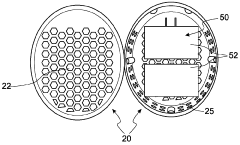
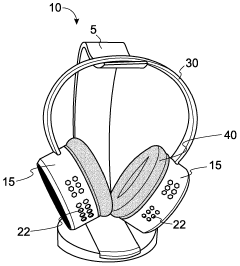
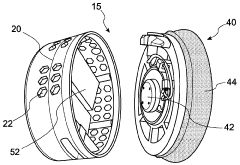
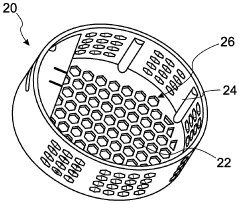
- The use of acoustic metamaterials, specifically arrays of unit cells like Helmholtz resonators and membranes, integrated into consumer devices like headphones, which are designed to attenuate sound in the frequency range of 300 to 3000 Hz by dissipating sound waves through strategically placed openings in the device housing, enhancing sound absorption and reducing reflection.
Acoustic bandgap structures for integration of MEMS resonators
PatentInactiveUS9232289B2
Innovation
- The development of acoustic bandgap devices using semiconductor fabrication tools, which include a substrate with an acoustic resonant cavity and a phononic crystal structure composed of higher and lower acoustic impedance materials in a periodic arrangement, suppressing phononic excitations in specific frequency bands and providing phononic bandgaps for enhanced elastic energy confinement.


Manufacturing Techniques for Complex Unit Cells
The manufacturing of complex unit cells for acoustic metamaterials presents significant challenges that require advanced fabrication techniques. Traditional manufacturing methods often struggle with the intricate geometries necessary for effective acoustic bandgap formation. Recent advancements in additive manufacturing have revolutionized this field, with 3D printing emerging as the predominant technique for creating complex periodic structures with precise dimensional control.
Selective Laser Sintering (SLS) and Stereolithography (SLA) have demonstrated particular efficacy for acoustic metamaterial fabrication. SLS allows for the creation of complex lattice structures using polymer or metal powders, achieving resolution down to 100 microns, which is sufficient for acoustic applications in the audible to ultrasonic range. SLA offers even finer resolution (25-50 microns) but is typically limited to photopolymer resins.
Multi-material 3D printing represents another significant advancement, enabling the fabrication of unit cells with spatially varying mechanical properties. This capability is crucial for creating gradient index acoustic metamaterials that can guide and manipulate sound waves with unprecedented control. Polyjet technology, which can simultaneously deposit multiple materials with different elastic moduli, has proven particularly valuable for this purpose.
For nanoscale acoustic metamaterials operating at higher frequencies, techniques such as two-photon polymerization lithography have emerged as viable options, achieving feature sizes below 100 nanometers. This enables the creation of phononic crystals effective in the gigahertz frequency range, opening new possibilities for thermal management and high-frequency acoustic filtering applications.
Post-processing techniques also play a critical role in optimizing the performance of manufactured unit cells. Surface treatments to reduce roughness, thermal annealing to relieve internal stresses, and precision machining to achieve tight dimensional tolerances all contribute to the acoustic performance of the final structure. These secondary processes can significantly impact the width and depth of the resulting acoustic bandgaps.
Scalable manufacturing remains a challenge, particularly for applications requiring large-area coverage. Roll-to-roll manufacturing techniques adapted for metamaterial production show promise for creating flexible acoustic barriers with engineered unit cells. Similarly, injection molding with advanced mold designs can enable mass production of certain unit cell geometries, though with limitations on complexity compared to additive approaches.
The integration of computational design tools with manufacturing processes has become increasingly important, with topology optimization algorithms now directly informing fabrication parameters. This design-to-manufacturing pipeline enables the creation of unit cells with geometries specifically optimized for targeted acoustic properties, rather than relying on conventional periodic structures.
Selective Laser Sintering (SLS) and Stereolithography (SLA) have demonstrated particular efficacy for acoustic metamaterial fabrication. SLS allows for the creation of complex lattice structures using polymer or metal powders, achieving resolution down to 100 microns, which is sufficient for acoustic applications in the audible to ultrasonic range. SLA offers even finer resolution (25-50 microns) but is typically limited to photopolymer resins.
Multi-material 3D printing represents another significant advancement, enabling the fabrication of unit cells with spatially varying mechanical properties. This capability is crucial for creating gradient index acoustic metamaterials that can guide and manipulate sound waves with unprecedented control. Polyjet technology, which can simultaneously deposit multiple materials with different elastic moduli, has proven particularly valuable for this purpose.
For nanoscale acoustic metamaterials operating at higher frequencies, techniques such as two-photon polymerization lithography have emerged as viable options, achieving feature sizes below 100 nanometers. This enables the creation of phononic crystals effective in the gigahertz frequency range, opening new possibilities for thermal management and high-frequency acoustic filtering applications.
Post-processing techniques also play a critical role in optimizing the performance of manufactured unit cells. Surface treatments to reduce roughness, thermal annealing to relieve internal stresses, and precision machining to achieve tight dimensional tolerances all contribute to the acoustic performance of the final structure. These secondary processes can significantly impact the width and depth of the resulting acoustic bandgaps.
Scalable manufacturing remains a challenge, particularly for applications requiring large-area coverage. Roll-to-roll manufacturing techniques adapted for metamaterial production show promise for creating flexible acoustic barriers with engineered unit cells. Similarly, injection molding with advanced mold designs can enable mass production of certain unit cell geometries, though with limitations on complexity compared to additive approaches.
The integration of computational design tools with manufacturing processes has become increasingly important, with topology optimization algorithms now directly informing fabrication parameters. This design-to-manufacturing pipeline enables the creation of unit cells with geometries specifically optimized for targeted acoustic properties, rather than relying on conventional periodic structures.
Standardization and Testing Protocols
The standardization of testing protocols for acoustic metamaterials with bandgap properties represents a critical challenge in advancing this field from theoretical research to practical applications. Currently, there exists significant variation in how researchers evaluate and report the performance of unit cell geometries in controlling acoustic bandgaps, making cross-study comparisons difficult and hindering industrial adoption.
A comprehensive standardization framework should include precise specifications for sample preparation, with detailed guidelines on material selection, fabrication tolerances, and dimensional accuracy requirements. These standards must account for the multi-scale nature of acoustic metamaterials, where microscopic manufacturing variations can significantly impact macroscopic acoustic properties.
Measurement methodologies require standardization across three primary testing domains: transmission loss measurement, impedance tube testing, and vibration response analysis. For transmission loss measurements, standardized protocols should specify microphone placement, signal processing techniques, and environmental control parameters. Impedance tube testing standards must address tube diameter considerations relative to the unit cell dimensions, frequency range limitations, and calibration procedures.
Data reporting formats represent another crucial aspect of standardization efforts. The scientific community would benefit from agreed-upon metrics for bandgap width, depth, and center frequency reporting. Additionally, standardized visualization techniques for dispersion curves and transmission spectra would facilitate more effective knowledge transfer between research groups and industrial partners.
Validation procedures constitute an essential component of testing protocols, requiring the establishment of reference materials with well-characterized acoustic properties. These reference materials would serve as calibration standards against which new unit cell geometries could be evaluated, ensuring measurement consistency across different laboratories and testing facilities.
International collaboration between academic institutions, industry stakeholders, and standards organizations is necessary to develop these protocols. Organizations such as ISO, ASTM, and IEEE have begun preliminary work in this area, but a more coordinated effort is required to establish universally accepted testing standards specifically for acoustic metamaterials with engineered bandgap properties.
The implementation of these standardized testing protocols would accelerate technology transfer from research laboratories to commercial applications, enabling more reliable performance predictions and facilitating the integration of acoustic metamaterials into noise control solutions, architectural acoustics, and vibration isolation systems.
A comprehensive standardization framework should include precise specifications for sample preparation, with detailed guidelines on material selection, fabrication tolerances, and dimensional accuracy requirements. These standards must account for the multi-scale nature of acoustic metamaterials, where microscopic manufacturing variations can significantly impact macroscopic acoustic properties.
Measurement methodologies require standardization across three primary testing domains: transmission loss measurement, impedance tube testing, and vibration response analysis. For transmission loss measurements, standardized protocols should specify microphone placement, signal processing techniques, and environmental control parameters. Impedance tube testing standards must address tube diameter considerations relative to the unit cell dimensions, frequency range limitations, and calibration procedures.
Data reporting formats represent another crucial aspect of standardization efforts. The scientific community would benefit from agreed-upon metrics for bandgap width, depth, and center frequency reporting. Additionally, standardized visualization techniques for dispersion curves and transmission spectra would facilitate more effective knowledge transfer between research groups and industrial partners.
Validation procedures constitute an essential component of testing protocols, requiring the establishment of reference materials with well-characterized acoustic properties. These reference materials would serve as calibration standards against which new unit cell geometries could be evaluated, ensuring measurement consistency across different laboratories and testing facilities.
International collaboration between academic institutions, industry stakeholders, and standards organizations is necessary to develop these protocols. Organizations such as ISO, ASTM, and IEEE have begun preliminary work in this area, but a more coordinated effort is required to establish universally accepted testing standards specifically for acoustic metamaterials with engineered bandgap properties.
The implementation of these standardized testing protocols would accelerate technology transfer from research laboratories to commercial applications, enabling more reliable performance predictions and facilitating the integration of acoustic metamaterials into noise control solutions, architectural acoustics, and vibration isolation systems.
Unlock deeper insights with PatSnap Eureka Quick Research — get a full tech report to explore trends and direct your research. Try now!
Generate Your Research Report Instantly with AI Agent
Supercharge your innovation with PatSnap Eureka AI Agent Platform!