Hexagonal Boron Nitride vs Silicone: Thermal Insulation Efficacy
MAR 8, 20269 MIN READ
Generate Your Research Report Instantly with AI Agent
PatSnap Eureka helps you evaluate technical feasibility & market potential.
Hexagonal Boron Nitride and Silicone Thermal Insulation Background
The development of thermal insulation materials has been driven by the increasing demand for efficient heat management across diverse industries, from electronics miniaturization to aerospace applications. Traditional thermal insulation solutions have evolved from basic organic polymers to sophisticated engineered materials, with the quest for materials that can provide superior thermal barrier properties while maintaining structural integrity under extreme conditions.
Hexagonal boron nitride emerged as a promising thermal insulation material in the late 20th century, building upon decades of research into boron-nitrogen compounds. Initially synthesized in laboratory settings during the 1950s, h-BN gained industrial attention due to its unique crystalline structure resembling graphite but with fundamentally different thermal properties. The material's layered hexagonal arrangement creates exceptional thermal stability, with the ability to maintain structural integrity at temperatures exceeding 1000°C in inert atmospheres.
Silicone-based thermal insulation materials represent a parallel evolutionary path, originating from organosilicon chemistry developments in the 1940s. These materials gained prominence through their exceptional flexibility, chemical inertness, and reliable performance across wide temperature ranges. Silicone thermal insulators have demonstrated consistent thermal barrier properties from cryogenic temperatures to several hundred degrees Celsius, making them versatile solutions for various industrial applications.
The technological objectives driving research in both material categories center on achieving optimal thermal insulation efficiency while addressing practical implementation challenges. For hexagonal boron nitride, research focuses on maximizing the material's inherent low thermal conductivity perpendicular to its basal planes, typically ranging from 0.3 to 2.0 W/mK depending on processing methods and purity levels. Manufacturing techniques aim to control crystal orientation and minimize defects that could create thermal conduction pathways.
Silicone thermal insulation development targets optimizing polymer chain structures and incorporating thermally resistive fillers to achieve thermal conductivities typically ranging from 0.15 to 0.35 W/mK. Advanced formulations integrate ceramic microspheres, aerogel particles, or hollow glass spheres to create composite materials with enhanced insulation properties while maintaining the inherent advantages of silicone matrices, including flexibility and environmental resistance.
Both material systems represent distinct approaches to thermal insulation, with hexagonal boron nitride offering superior high-temperature stability and silicone providing exceptional processability and environmental adaptability, establishing the foundation for comparative efficacy analysis.
Hexagonal boron nitride emerged as a promising thermal insulation material in the late 20th century, building upon decades of research into boron-nitrogen compounds. Initially synthesized in laboratory settings during the 1950s, h-BN gained industrial attention due to its unique crystalline structure resembling graphite but with fundamentally different thermal properties. The material's layered hexagonal arrangement creates exceptional thermal stability, with the ability to maintain structural integrity at temperatures exceeding 1000°C in inert atmospheres.
Silicone-based thermal insulation materials represent a parallel evolutionary path, originating from organosilicon chemistry developments in the 1940s. These materials gained prominence through their exceptional flexibility, chemical inertness, and reliable performance across wide temperature ranges. Silicone thermal insulators have demonstrated consistent thermal barrier properties from cryogenic temperatures to several hundred degrees Celsius, making them versatile solutions for various industrial applications.
The technological objectives driving research in both material categories center on achieving optimal thermal insulation efficiency while addressing practical implementation challenges. For hexagonal boron nitride, research focuses on maximizing the material's inherent low thermal conductivity perpendicular to its basal planes, typically ranging from 0.3 to 2.0 W/mK depending on processing methods and purity levels. Manufacturing techniques aim to control crystal orientation and minimize defects that could create thermal conduction pathways.
Silicone thermal insulation development targets optimizing polymer chain structures and incorporating thermally resistive fillers to achieve thermal conductivities typically ranging from 0.15 to 0.35 W/mK. Advanced formulations integrate ceramic microspheres, aerogel particles, or hollow glass spheres to create composite materials with enhanced insulation properties while maintaining the inherent advantages of silicone matrices, including flexibility and environmental resistance.
Both material systems represent distinct approaches to thermal insulation, with hexagonal boron nitride offering superior high-temperature stability and silicone providing exceptional processability and environmental adaptability, establishing the foundation for comparative efficacy analysis.
Market Demand for Advanced Thermal Interface Materials
The global thermal interface materials market is experiencing unprecedented growth driven by the exponential increase in electronic device miniaturization and power density. Modern electronic systems generate significantly higher heat loads within increasingly compact form factors, creating critical thermal management challenges that traditional materials struggle to address effectively.
Consumer electronics represent the largest market segment, with smartphones, tablets, and laptops requiring advanced thermal solutions to maintain optimal performance while preventing thermal throttling. The automotive industry has emerged as another major growth driver, particularly with the rapid adoption of electric vehicles and autonomous driving systems that incorporate numerous high-performance processors and power electronics requiring sophisticated thermal management.
Data centers and cloud computing infrastructure constitute a rapidly expanding market segment, where thermal interface materials play crucial roles in maintaining server reliability and energy efficiency. The increasing deployment of artificial intelligence and machine learning workloads has intensified thermal management requirements, as these applications demand sustained high-performance computing capabilities.
The telecommunications sector, particularly with the rollout of 5G networks, has created substantial demand for advanced thermal interface materials. Base stations and network equipment operate at higher frequencies and power levels, necessitating superior thermal conductivity and reliability compared to previous generation technologies.
Industrial applications including power electronics, renewable energy systems, and LED lighting continue to drive market expansion. These sectors require materials that can withstand harsh operating conditions while maintaining consistent thermal performance over extended periods.
Market dynamics increasingly favor materials offering superior thermal conductivity, electrical insulation properties, and long-term stability. Traditional silicone-based solutions face growing competition from advanced materials like hexagonal boron nitride, which offer enhanced performance characteristics for demanding applications.
The shift toward sustainable and environmentally friendly materials is influencing purchasing decisions across industries. Manufacturers are prioritizing materials that combine superior performance with reduced environmental impact throughout their lifecycle.
Regional demand patterns show strong growth in Asia-Pacific markets, driven by electronics manufacturing concentration and increasing automotive electrification. North American and European markets emphasize high-performance applications in aerospace, defense, and advanced computing systems.
Consumer electronics represent the largest market segment, with smartphones, tablets, and laptops requiring advanced thermal solutions to maintain optimal performance while preventing thermal throttling. The automotive industry has emerged as another major growth driver, particularly with the rapid adoption of electric vehicles and autonomous driving systems that incorporate numerous high-performance processors and power electronics requiring sophisticated thermal management.
Data centers and cloud computing infrastructure constitute a rapidly expanding market segment, where thermal interface materials play crucial roles in maintaining server reliability and energy efficiency. The increasing deployment of artificial intelligence and machine learning workloads has intensified thermal management requirements, as these applications demand sustained high-performance computing capabilities.
The telecommunications sector, particularly with the rollout of 5G networks, has created substantial demand for advanced thermal interface materials. Base stations and network equipment operate at higher frequencies and power levels, necessitating superior thermal conductivity and reliability compared to previous generation technologies.
Industrial applications including power electronics, renewable energy systems, and LED lighting continue to drive market expansion. These sectors require materials that can withstand harsh operating conditions while maintaining consistent thermal performance over extended periods.
Market dynamics increasingly favor materials offering superior thermal conductivity, electrical insulation properties, and long-term stability. Traditional silicone-based solutions face growing competition from advanced materials like hexagonal boron nitride, which offer enhanced performance characteristics for demanding applications.
The shift toward sustainable and environmentally friendly materials is influencing purchasing decisions across industries. Manufacturers are prioritizing materials that combine superior performance with reduced environmental impact throughout their lifecycle.
Regional demand patterns show strong growth in Asia-Pacific markets, driven by electronics manufacturing concentration and increasing automotive electrification. North American and European markets emphasize high-performance applications in aerospace, defense, and advanced computing systems.
Current State of hBN vs Silicone Thermal Performance
Hexagonal boron nitride (hBN) has emerged as a superior thermal interface material compared to traditional silicone-based solutions, demonstrating significantly enhanced thermal conductivity properties. Current research indicates that hBN exhibits thermal conductivity values ranging from 200-400 W/mK in its crystalline form, substantially outperforming conventional silicone compounds which typically achieve 0.2-3 W/mK. This dramatic performance differential positions hBN as a transformative material for high-performance thermal management applications.
The structural advantages of hBN stem from its unique hexagonal lattice arrangement, similar to graphite but with alternating boron and nitrogen atoms. This configuration enables efficient phonon transport while maintaining excellent electrical insulation properties, unlike graphite-based alternatives. Recent studies have validated that hBN-filled thermal interface materials can achieve thermal conductivities exceeding 10 W/mK when properly formulated, representing a 3-5x improvement over premium silicone formulations.
Manufacturing scalability remains a critical differentiator between these materials. Silicone-based thermal compounds benefit from mature production processes and established supply chains, enabling cost-effective mass production. Current market prices for high-performance silicone thermal materials range from $50-200 per kilogram, while hBN materials command premium pricing of $300-800 per kilogram depending on purity and particle size specifications.
Processing compatibility presents distinct challenges for each material system. Silicone compounds offer superior workability and application flexibility, maintaining stable viscosity across wide temperature ranges and demonstrating excellent adhesion to diverse substrate materials. hBN integration requires specialized dispersion techniques and often necessitates surface functionalization to achieve optimal particle distribution and prevent agglomeration during processing.
Temperature stability analysis reveals complementary performance characteristics. While silicone materials typically operate effectively up to 200-250°C, hBN maintains structural integrity and thermal performance at temperatures exceeding 800°C in inert atmospheres. This thermal stability advantage makes hBN particularly attractive for aerospace, automotive, and high-power electronics applications where extreme operating conditions are encountered.
Current commercial implementations demonstrate that hybrid approaches combining hBN fillers within silicone matrices can achieve balanced performance optimization. These composite formulations typically deliver 2-4x thermal conductivity improvements over pure silicone while maintaining processing advantages and cost competitiveness compared to pure hBN solutions.
The structural advantages of hBN stem from its unique hexagonal lattice arrangement, similar to graphite but with alternating boron and nitrogen atoms. This configuration enables efficient phonon transport while maintaining excellent electrical insulation properties, unlike graphite-based alternatives. Recent studies have validated that hBN-filled thermal interface materials can achieve thermal conductivities exceeding 10 W/mK when properly formulated, representing a 3-5x improvement over premium silicone formulations.
Manufacturing scalability remains a critical differentiator between these materials. Silicone-based thermal compounds benefit from mature production processes and established supply chains, enabling cost-effective mass production. Current market prices for high-performance silicone thermal materials range from $50-200 per kilogram, while hBN materials command premium pricing of $300-800 per kilogram depending on purity and particle size specifications.
Processing compatibility presents distinct challenges for each material system. Silicone compounds offer superior workability and application flexibility, maintaining stable viscosity across wide temperature ranges and demonstrating excellent adhesion to diverse substrate materials. hBN integration requires specialized dispersion techniques and often necessitates surface functionalization to achieve optimal particle distribution and prevent agglomeration during processing.
Temperature stability analysis reveals complementary performance characteristics. While silicone materials typically operate effectively up to 200-250°C, hBN maintains structural integrity and thermal performance at temperatures exceeding 800°C in inert atmospheres. This thermal stability advantage makes hBN particularly attractive for aerospace, automotive, and high-power electronics applications where extreme operating conditions are encountered.
Current commercial implementations demonstrate that hybrid approaches combining hBN fillers within silicone matrices can achieve balanced performance optimization. These composite formulations typically deliver 2-4x thermal conductivity improvements over pure silicone while maintaining processing advantages and cost competitiveness compared to pure hBN solutions.
Existing hBN and Silicone Thermal Insulation Solutions
01 Hexagonal boron nitride as thermal interface material in silicone composites
Hexagonal boron nitride (h-BN) can be incorporated into silicone-based composites to create thermal interface materials with enhanced thermal conductivity and insulation properties. The platelet structure of h-BN facilitates efficient heat dissipation while maintaining electrical insulation. These composites are particularly effective for electronic device thermal management applications where both heat transfer and electrical isolation are required.- Hexagonal boron nitride as thermal interface material in silicone composites: Hexagonal boron nitride (h-BN) can be incorporated into silicone-based composites to create thermal interface materials with enhanced thermal conductivity and insulation properties. The platelet structure of h-BN provides efficient heat dissipation pathways while maintaining electrical insulation. These composites are particularly effective for electronic device thermal management applications where both heat transfer and electrical isolation are required.
- Surface modification of hexagonal boron nitride for improved dispersion in silicone matrix: Surface treatment and functionalization techniques can be applied to hexagonal boron nitride particles to enhance their compatibility and dispersion within silicone matrices. Modified h-BN particles exhibit improved interfacial bonding with the polymer matrix, resulting in better thermal conductivity and mechanical properties. Various coupling agents and surface treatments can be employed to achieve optimal dispersion and prevent particle agglomeration.
- Synergistic thermal conductivity enhancement using h-BN with other fillers: Combining hexagonal boron nitride with other thermally conductive fillers in silicone composites can create synergistic effects that significantly improve overall thermal insulation efficacy. Multi-component filler systems can form interconnected thermal conduction networks that outperform single-filler systems. The hybrid approach allows for optimization of thermal, mechanical, and processing properties simultaneously.
- Alignment and orientation control of h-BN platelets in silicone: Controlling the orientation and alignment of hexagonal boron nitride platelets within silicone matrices can dramatically enhance directional thermal conductivity. Various processing techniques including magnetic field alignment, mechanical stretching, and layer-by-layer assembly can be used to achieve preferential orientation. Aligned structures provide superior through-plane or in-plane thermal conductivity depending on application requirements.
- High loading fraction h-BN silicone composites for extreme thermal management: Achieving high loading fractions of hexagonal boron nitride in silicone matrices enables exceptional thermal insulation performance for demanding applications. Advanced formulation and processing methods allow for filler contents that approach or exceed percolation thresholds while maintaining processability. These high-performance composites are suitable for applications requiring maximum heat dissipation efficiency such as power electronics and aerospace thermal management systems.
02 Surface modification and functionalization of hexagonal boron nitride for improved dispersion
Surface treatment and functionalization techniques can be applied to hexagonal boron nitride particles to improve their compatibility and dispersion within silicone matrices. Enhanced dispersion leads to better thermal conductivity pathways and more uniform thermal insulation performance. Various coupling agents and surface modifiers can be used to achieve optimal interfacial bonding between the filler and polymer matrix.Expand Specific Solutions03 Hybrid filler systems combining hexagonal boron nitride with other thermal conductive materials
Combining hexagonal boron nitride with other thermally conductive fillers in silicone matrices can create synergistic effects that enhance overall thermal management performance. The hybrid approach allows for optimization of thermal conductivity, mechanical properties, and processing characteristics. Different filler combinations can be tailored to specific application requirements for thermal insulation efficacy.Expand Specific Solutions04 Alignment and orientation control of hexagonal boron nitride platelets
Controlling the alignment and orientation of hexagonal boron nitride platelets within silicone composites can significantly improve directional thermal conductivity and insulation performance. Various processing techniques including magnetic field alignment, mechanical stretching, and layer-by-layer assembly can be employed to achieve preferential orientation. This approach enables the design of anisotropic thermal management materials with enhanced heat dissipation in specific directions.Expand Specific Solutions05 High loading content formulations for enhanced thermal performance
Achieving high loading contents of hexagonal boron nitride in silicone matrices is crucial for maximizing thermal insulation efficacy and heat dissipation capabilities. Advanced formulation strategies and processing methods enable the incorporation of elevated filler concentrations while maintaining acceptable mechanical properties and processability. Optimization of particle size distribution and packing density contributes to improved thermal conductivity at high filler loadings.Expand Specific Solutions
Key Players in hBN and Silicone Thermal Materials Industry
The hexagonal boron nitride versus silicone thermal insulation efficacy field represents an emerging competitive landscape in advanced thermal management materials. The industry is transitioning from traditional silicone-based solutions toward next-generation hexagonal boron nitride applications, driven by increasing demands for superior thermal conductivity and electrical insulation properties. Market growth is accelerated by electronics miniaturization and electric vehicle thermal management requirements. Technology maturity varies significantly across players, with established Japanese companies like Denka Corp., Tokuyama Corp., and Kaneka Corp. leading commercial-scale production capabilities. Chinese manufacturers including Anhui Estone Materials Technology and Tengjin New Material Technology are rapidly advancing manufacturing processes, while research institutions like Northwestern Polytechnical University and Shanghai Jiao Tong University contribute fundamental material science breakthroughs. The competitive dynamics show Asian dominance, particularly Japan and China, with companies like Resonac Holdings and JFE Steel leveraging industrial integration advantages for specialized applications.
Denka Corp.
Technical Solution: Denka has developed advanced hexagonal boron nitride (h-BN) products with exceptional thermal management properties. Their h-BN materials demonstrate thermal conductivity values ranging from 200-400 W/mK in the basal plane direction, significantly outperforming traditional silicone-based thermal interface materials which typically achieve 1-5 W/mK. The company's proprietary synthesis methods produce high-purity h-BN with controlled particle size distribution, enabling superior thermal pathway formation in composite materials. Their h-BN products maintain thermal stability up to 1000°C in air, compared to silicone materials which degrade around 200-300°C. Denka's manufacturing processes focus on scalable production of both powder and film forms of h-BN for various thermal management applications.
Strengths: Superior thermal conductivity, excellent high-temperature stability, established manufacturing capabilities. Weaknesses: Higher material costs compared to silicone, potential processing complexity in composite formation.
Tokuyama Corp.
Technical Solution: Tokuyama has developed specialized boron nitride materials focusing on thermal interface applications. Their technology emphasizes the production of spherical boron nitride particles that offer improved thermal conductivity while maintaining electrical insulation properties. The company's BN materials achieve thermal conductivity values of 150-300 W/mK, substantially higher than conventional silicone thermal pads. Tokuyama's manufacturing process enables precise control of particle morphology and surface treatment, allowing for better dispersion in polymer matrices. Their products are designed for electronics cooling applications where both thermal performance and electrical isolation are critical requirements. The company has established production facilities capable of meeting industrial-scale demand for high-performance thermal management materials.
Strengths: Controlled particle morphology, good electrical insulation properties, industrial-scale production capability. Weaknesses: Lower thermal conductivity compared to premium h-BN products, limited high-temperature applications.
Core Innovations in hBN Thermal Interface Technologies
Aggregate boron nitride particles, boron nitride powder, production method for boron nitride powder, resin composition, and heat dissipation member
PatentInactiveUS20210261413A1
Innovation
- Producing aggregate boron nitride particles with a high average area proportion of primary particles, low standard deviation, and high crushing strength, and incorporating them into a boron nitride powder with specific properties such as orientation index and tap density, using a method involving firing, impregnation, and pulverization processes.


Boron nitride aggregated particles, thermal conductive resin composition, and heat dissipation member
PatentInactiveUS20220154059A1
Innovation
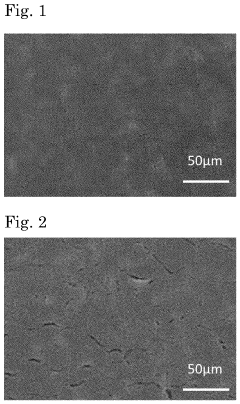
- Aggregated boron nitride particles with a specific surface area of 2 to 6 m2/g and a crushing strength of 5 MPa or more, along with a controlled particle diameter and aspect ratio, are used to enhance contact with the resin and prevent void formation, improving thermal conductivity and insulation breakdown strength.
Manufacturing Scalability of hBN vs Silicone Materials
The manufacturing scalability of hexagonal boron nitride (hBN) presents significantly greater challenges compared to silicone materials, primarily due to the complexity of synthesis processes and raw material requirements. Traditional hBN production methods, including high-temperature chemical vapor deposition and ball milling techniques, require specialized equipment operating at temperatures exceeding 1000°C and controlled atmospheric conditions. These stringent requirements limit production capacity and increase capital expenditure for manufacturing facilities.
Silicone materials demonstrate superior scalability advantages through well-established polymerization processes that operate at moderate temperatures and pressures. The silicone manufacturing infrastructure has matured over decades, enabling efficient large-scale production with standardized equipment and automated processing lines. Raw material availability for silicone production, primarily silicon-based compounds, remains abundant and cost-effective, supporting consistent supply chain management.
Current hBN production faces bottlenecks in precursor material synthesis, particularly for high-purity boron and nitrogen sources required for thermal insulation applications. The limited number of specialized suppliers creates supply chain vulnerabilities and price volatility. Additionally, quality control during hBN synthesis requires sophisticated analytical equipment and expertise, adding complexity to scaling operations.
Manufacturing yield rates further differentiate these materials. Silicone production typically achieves yields exceeding 95% with minimal waste generation, while hBN synthesis often experiences lower yields due to incomplete reactions and purification requirements. The multi-step purification processes necessary for achieving thermal-grade hBN quality increase production time and resource consumption.
Economic considerations reveal substantial cost disparities in scaling potential. Silicone manufacturing benefits from economies of scale, with per-unit costs decreasing significantly as production volumes increase. Conversely, hBN production costs remain relatively high even at increased volumes due to energy-intensive processes and specialized equipment requirements. The capital investment required for hBN manufacturing facilities typically exceeds silicone production by 300-400%, creating barriers for market expansion.
Recent developments in hBN synthesis, including plasma-enhanced chemical vapor deposition and microwave-assisted production methods, show promise for improving scalability. However, these technologies remain in early commercialization stages and require further optimization for large-scale implementation.
Silicone materials demonstrate superior scalability advantages through well-established polymerization processes that operate at moderate temperatures and pressures. The silicone manufacturing infrastructure has matured over decades, enabling efficient large-scale production with standardized equipment and automated processing lines. Raw material availability for silicone production, primarily silicon-based compounds, remains abundant and cost-effective, supporting consistent supply chain management.
Current hBN production faces bottlenecks in precursor material synthesis, particularly for high-purity boron and nitrogen sources required for thermal insulation applications. The limited number of specialized suppliers creates supply chain vulnerabilities and price volatility. Additionally, quality control during hBN synthesis requires sophisticated analytical equipment and expertise, adding complexity to scaling operations.
Manufacturing yield rates further differentiate these materials. Silicone production typically achieves yields exceeding 95% with minimal waste generation, while hBN synthesis often experiences lower yields due to incomplete reactions and purification requirements. The multi-step purification processes necessary for achieving thermal-grade hBN quality increase production time and resource consumption.
Economic considerations reveal substantial cost disparities in scaling potential. Silicone manufacturing benefits from economies of scale, with per-unit costs decreasing significantly as production volumes increase. Conversely, hBN production costs remain relatively high even at increased volumes due to energy-intensive processes and specialized equipment requirements. The capital investment required for hBN manufacturing facilities typically exceeds silicone production by 300-400%, creating barriers for market expansion.
Recent developments in hBN synthesis, including plasma-enhanced chemical vapor deposition and microwave-assisted production methods, show promise for improving scalability. However, these technologies remain in early commercialization stages and require further optimization for large-scale implementation.
Cost-Performance Analysis of hBN and Silicone Solutions
The cost-performance analysis of hexagonal boron nitride (hBN) and silicone thermal insulation solutions reveals significant disparities in both initial investment requirements and long-term operational benefits. Raw material costs for hBN typically range from $50-200 per kilogram depending on purity and particle size, while high-performance silicone compounds cost approximately $15-40 per kilogram. This substantial price differential directly impacts manufacturing economics, particularly for large-scale applications requiring extensive material volumes.
Processing and manufacturing costs further differentiate these materials. hBN requires specialized handling equipment and controlled atmosphere processing to maintain its crystalline structure, increasing production overhead by 25-35% compared to conventional materials. Silicone solutions benefit from established manufacturing infrastructure and streamlined processing techniques, resulting in lower conversion costs and faster production cycles.
Performance metrics demonstrate hBN's superior thermal conductivity of 30-400 W/mK compared to silicone's 0.2-2.0 W/mK, translating to enhanced heat dissipation efficiency. This performance advantage enables system designers to reduce material thickness by 40-60% while maintaining equivalent thermal management, partially offsetting higher material costs through reduced volume requirements.
Long-term operational considerations favor hBN solutions despite higher initial investments. The material's exceptional thermal stability up to 1000°C and chemical inertness result in extended service life, reducing replacement frequency and maintenance costs. Silicone materials, while cost-effective initially, may require more frequent replacement in high-temperature applications, increasing total cost of ownership.
Application-specific cost analysis reveals optimal deployment scenarios for each material. hBN demonstrates superior cost-effectiveness in high-performance electronics, aerospace applications, and industrial processes where thermal efficiency directly impacts operational performance. Silicone solutions remain economically advantageous for consumer electronics, automotive components, and applications with moderate thermal management requirements where initial cost sensitivity outweighs long-term performance considerations.
Processing and manufacturing costs further differentiate these materials. hBN requires specialized handling equipment and controlled atmosphere processing to maintain its crystalline structure, increasing production overhead by 25-35% compared to conventional materials. Silicone solutions benefit from established manufacturing infrastructure and streamlined processing techniques, resulting in lower conversion costs and faster production cycles.
Performance metrics demonstrate hBN's superior thermal conductivity of 30-400 W/mK compared to silicone's 0.2-2.0 W/mK, translating to enhanced heat dissipation efficiency. This performance advantage enables system designers to reduce material thickness by 40-60% while maintaining equivalent thermal management, partially offsetting higher material costs through reduced volume requirements.
Long-term operational considerations favor hBN solutions despite higher initial investments. The material's exceptional thermal stability up to 1000°C and chemical inertness result in extended service life, reducing replacement frequency and maintenance costs. Silicone materials, while cost-effective initially, may require more frequent replacement in high-temperature applications, increasing total cost of ownership.
Application-specific cost analysis reveals optimal deployment scenarios for each material. hBN demonstrates superior cost-effectiveness in high-performance electronics, aerospace applications, and industrial processes where thermal efficiency directly impacts operational performance. Silicone solutions remain economically advantageous for consumer electronics, automotive components, and applications with moderate thermal management requirements where initial cost sensitivity outweighs long-term performance considerations.
Unlock deeper insights with PatSnap Eureka Quick Research — get a full tech report to explore trends and direct your research. Try now!
Generate Your Research Report Instantly with AI Agent
Supercharge your innovation with PatSnap Eureka AI Agent Platform!