How Abscisic Acid Shapes Next-Generation Crop Biotechnology?
JUL 14, 20259 MIN READ
Generate Your Research Report Instantly with AI Agent
Patsnap Eureka helps you evaluate technical feasibility & market potential.
ABA in Crop Biotech: Background and Objectives
Abscisic acid (ABA) has emerged as a pivotal phytohormone in plant stress responses and development, playing a crucial role in shaping the future of crop biotechnology. The journey of ABA research began in the 1960s when scientists first isolated and identified this hormone. Since then, our understanding of ABA's functions and mechanisms has grown exponentially, leading to its increasing importance in agricultural applications.
The evolution of ABA research has been marked by several key milestones. Initial studies focused on its role in seed dormancy and germination. As research progressed, scientists uncovered ABA's involvement in stomatal closure, root growth, and stress tolerance. The discovery of ABA receptors in 2009 was a landmark achievement, opening new avenues for manipulating plant responses to environmental stresses.
In recent years, the focus has shifted towards leveraging ABA-mediated pathways to enhance crop resilience and productivity. This transition aligns with the growing global challenges of food security and climate change. The agricultural sector faces unprecedented pressures from extreme weather events, water scarcity, and soil degradation. ABA's ability to modulate plant responses to these stressors makes it a prime target for next-generation crop biotechnology.
The primary objective of ABA research in crop biotechnology is to develop more resilient and productive cultivars. This involves enhancing drought tolerance, improving water use efficiency, and increasing yield stability under adverse conditions. Scientists aim to fine-tune ABA signaling pathways to optimize plant growth and stress responses without compromising productivity.
Another critical goal is to exploit ABA's potential in precision agriculture. By understanding and manipulating ABA-mediated responses, researchers hope to develop crops that can adapt more effectively to specific environmental conditions. This could lead to the creation of "smart" plants capable of adjusting their physiology in real-time to changing environmental cues.
The integration of ABA research with other cutting-edge technologies, such as CRISPR-Cas9 gene editing and artificial intelligence-driven predictive modeling, is expected to accelerate progress in this field. These synergies promise to unlock new possibilities for crop improvement, potentially revolutionizing agricultural practices and food production systems.
As we look to the future, the role of ABA in crop biotechnology is set to expand further. The ongoing climate crisis and the need for sustainable agriculture underscore the importance of this research. By harnessing the power of ABA, scientists aim to create a new generation of crops that are not only more resilient to environmental stresses but also more efficient in resource utilization, paving the way for a more sustainable and food-secure future.
The evolution of ABA research has been marked by several key milestones. Initial studies focused on its role in seed dormancy and germination. As research progressed, scientists uncovered ABA's involvement in stomatal closure, root growth, and stress tolerance. The discovery of ABA receptors in 2009 was a landmark achievement, opening new avenues for manipulating plant responses to environmental stresses.
In recent years, the focus has shifted towards leveraging ABA-mediated pathways to enhance crop resilience and productivity. This transition aligns with the growing global challenges of food security and climate change. The agricultural sector faces unprecedented pressures from extreme weather events, water scarcity, and soil degradation. ABA's ability to modulate plant responses to these stressors makes it a prime target for next-generation crop biotechnology.
The primary objective of ABA research in crop biotechnology is to develop more resilient and productive cultivars. This involves enhancing drought tolerance, improving water use efficiency, and increasing yield stability under adverse conditions. Scientists aim to fine-tune ABA signaling pathways to optimize plant growth and stress responses without compromising productivity.
Another critical goal is to exploit ABA's potential in precision agriculture. By understanding and manipulating ABA-mediated responses, researchers hope to develop crops that can adapt more effectively to specific environmental conditions. This could lead to the creation of "smart" plants capable of adjusting their physiology in real-time to changing environmental cues.
The integration of ABA research with other cutting-edge technologies, such as CRISPR-Cas9 gene editing and artificial intelligence-driven predictive modeling, is expected to accelerate progress in this field. These synergies promise to unlock new possibilities for crop improvement, potentially revolutionizing agricultural practices and food production systems.
As we look to the future, the role of ABA in crop biotechnology is set to expand further. The ongoing climate crisis and the need for sustainable agriculture underscore the importance of this research. By harnessing the power of ABA, scientists aim to create a new generation of crops that are not only more resilient to environmental stresses but also more efficient in resource utilization, paving the way for a more sustainable and food-secure future.
Market Demand for ABA-Enhanced Crops
The market demand for ABA-enhanced crops has been steadily growing in recent years, driven by the increasing need for resilient and high-yielding agricultural products in the face of climate change and food security challenges. Abscisic acid (ABA) plays a crucial role in plant stress responses, particularly in drought tolerance and water use efficiency, making it a prime target for crop improvement strategies.
Farmers and agricultural companies are seeking crops that can maintain productivity under adverse environmental conditions, especially in regions prone to water scarcity. ABA-enhanced crops offer the potential to reduce water consumption while maintaining or even increasing yields, addressing a critical need in sustainable agriculture. This has led to a surge in interest from both small-scale farmers and large agribusinesses looking to optimize their crop production.
The global seed market, which is closely tied to the demand for enhanced crops, has been expanding rapidly. Crops with improved stress tolerance, including those enhanced through ABA-related technologies, are expected to capture a significant portion of this market. Major agricultural biotechnology companies have been investing heavily in research and development of ABA-related crop improvements, indicating strong market potential.
Consumer trends also play a role in driving demand for ABA-enhanced crops. With growing awareness of climate change and environmental issues, there is an increasing preference for sustainably produced food. Crops that require less water and are more resilient to environmental stresses align well with these consumer values, potentially commanding premium prices in the market.
Regulatory environments in various countries are becoming more favorable towards biotechnology-enhanced crops, particularly those that address environmental challenges. This shift is expected to further boost the market demand for ABA-enhanced crops as they become more widely accepted and approved for commercial use.
The economic benefits of ABA-enhanced crops extend beyond direct agricultural yields. These crops can potentially reduce the need for irrigation infrastructure and lower insurance costs associated with crop failures due to drought or other environmental stresses. This broader economic impact is attracting attention from policymakers and investors, further driving market demand.
In developing countries, where agriculture often forms the backbone of the economy, there is a growing recognition of the potential of ABA-enhanced crops to improve food security and farmer livelihoods. International development organizations and governments are showing increased interest in supporting the adoption of these advanced crop varieties, creating new market opportunities.
Farmers and agricultural companies are seeking crops that can maintain productivity under adverse environmental conditions, especially in regions prone to water scarcity. ABA-enhanced crops offer the potential to reduce water consumption while maintaining or even increasing yields, addressing a critical need in sustainable agriculture. This has led to a surge in interest from both small-scale farmers and large agribusinesses looking to optimize their crop production.
The global seed market, which is closely tied to the demand for enhanced crops, has been expanding rapidly. Crops with improved stress tolerance, including those enhanced through ABA-related technologies, are expected to capture a significant portion of this market. Major agricultural biotechnology companies have been investing heavily in research and development of ABA-related crop improvements, indicating strong market potential.
Consumer trends also play a role in driving demand for ABA-enhanced crops. With growing awareness of climate change and environmental issues, there is an increasing preference for sustainably produced food. Crops that require less water and are more resilient to environmental stresses align well with these consumer values, potentially commanding premium prices in the market.
Regulatory environments in various countries are becoming more favorable towards biotechnology-enhanced crops, particularly those that address environmental challenges. This shift is expected to further boost the market demand for ABA-enhanced crops as they become more widely accepted and approved for commercial use.
The economic benefits of ABA-enhanced crops extend beyond direct agricultural yields. These crops can potentially reduce the need for irrigation infrastructure and lower insurance costs associated with crop failures due to drought or other environmental stresses. This broader economic impact is attracting attention from policymakers and investors, further driving market demand.
In developing countries, where agriculture often forms the backbone of the economy, there is a growing recognition of the potential of ABA-enhanced crops to improve food security and farmer livelihoods. International development organizations and governments are showing increased interest in supporting the adoption of these advanced crop varieties, creating new market opportunities.
Current ABA Research Challenges
Despite significant advancements in understanding abscisic acid (ABA) signaling and its role in plant stress responses, several key challenges persist in current ABA research, particularly in the context of crop biotechnology. One of the primary obstacles is the complexity of ABA-mediated stress response networks. While many components of the ABA signaling pathway have been identified, the intricate interactions and feedback loops within these networks remain poorly understood, hindering efforts to manipulate ABA responses for improved crop performance.
Another major challenge lies in the temporal and spatial regulation of ABA responses. ABA-induced effects can vary significantly depending on the tissue type, developmental stage, and environmental conditions. This context-dependent nature of ABA signaling makes it difficult to achieve targeted and predictable outcomes when attempting to enhance stress tolerance in crops through ABA-related modifications.
The cross-talk between ABA and other phytohormones presents an additional layer of complexity. ABA interacts with various hormonal pathways, including those involving ethylene, jasmonic acid, and auxins. Deciphering these intricate hormonal interactions and their impact on plant physiology under different stress conditions remains a significant challenge for researchers aiming to fine-tune crop responses to environmental stresses.
Furthermore, the translation of ABA-related findings from model plants to economically important crops has proven to be a formidable task. While extensive research has been conducted on Arabidopsis thaliana, the application of this knowledge to improve stress tolerance in diverse crop species is not straightforward due to differences in genetic backgrounds and physiological responses.
The development of ABA-based agrochemicals also faces several hurdles. Although exogenous ABA application can enhance stress tolerance, its practical use in agriculture is limited by factors such as rapid degradation, high production costs, and potential negative effects on plant growth and yield under non-stress conditions. Designing stable, cost-effective ABA analogs or ABA signaling modulators that can be effectively used in field conditions remains a significant challenge.
Lastly, the potential environmental and ecological impacts of manipulating ABA responses in crops are not fully understood. Altering ABA-mediated processes could have unintended consequences on plant-microbe interactions, ecosystem dynamics, and non-target organisms. Addressing these concerns and developing strategies to mitigate potential risks is crucial for the responsible development and deployment of ABA-based crop biotechnologies.
Another major challenge lies in the temporal and spatial regulation of ABA responses. ABA-induced effects can vary significantly depending on the tissue type, developmental stage, and environmental conditions. This context-dependent nature of ABA signaling makes it difficult to achieve targeted and predictable outcomes when attempting to enhance stress tolerance in crops through ABA-related modifications.
The cross-talk between ABA and other phytohormones presents an additional layer of complexity. ABA interacts with various hormonal pathways, including those involving ethylene, jasmonic acid, and auxins. Deciphering these intricate hormonal interactions and their impact on plant physiology under different stress conditions remains a significant challenge for researchers aiming to fine-tune crop responses to environmental stresses.
Furthermore, the translation of ABA-related findings from model plants to economically important crops has proven to be a formidable task. While extensive research has been conducted on Arabidopsis thaliana, the application of this knowledge to improve stress tolerance in diverse crop species is not straightforward due to differences in genetic backgrounds and physiological responses.
The development of ABA-based agrochemicals also faces several hurdles. Although exogenous ABA application can enhance stress tolerance, its practical use in agriculture is limited by factors such as rapid degradation, high production costs, and potential negative effects on plant growth and yield under non-stress conditions. Designing stable, cost-effective ABA analogs or ABA signaling modulators that can be effectively used in field conditions remains a significant challenge.
Lastly, the potential environmental and ecological impacts of manipulating ABA responses in crops are not fully understood. Altering ABA-mediated processes could have unintended consequences on plant-microbe interactions, ecosystem dynamics, and non-target organisms. Addressing these concerns and developing strategies to mitigate potential risks is crucial for the responsible development and deployment of ABA-based crop biotechnologies.
Existing ABA-Based Crop Improvement Strategies
01 Synthesis and production of abscisic acid
Various methods for synthesizing and producing abscisic acid, including chemical synthesis, biotechnological approaches, and extraction from plant sources. These techniques aim to improve the yield and purity of abscisic acid for agricultural and research applications.- Synthesis and production of abscisic acid: Various methods for synthesizing and producing abscisic acid are described. These include chemical synthesis routes, biotechnological approaches using microorganisms, and extraction techniques from plant sources. The production methods aim to improve yield, purity, and cost-effectiveness of abscisic acid for commercial applications.
- Agricultural applications of abscisic acid: Abscisic acid is used in various agricultural applications, including as a plant growth regulator, stress tolerance enhancer, and crop yield improver. It can be applied to seeds, plants, or soil to modulate plant responses to environmental stresses such as drought, salinity, and temperature extremes.
- Formulations containing abscisic acid: Different formulations containing abscisic acid are developed for specific applications. These may include liquid formulations, granules, powders, or controlled-release formulations. The formulations often contain additional components such as carriers, adjuvants, or other active ingredients to enhance stability, efficacy, or ease of application.
- Abscisic acid analogs and derivatives: Research on abscisic acid analogs and derivatives aims to develop compounds with improved properties or specific activities. These modified forms of abscisic acid may have enhanced stability, bioavailability, or targeted effects on plant physiology, potentially leading to more effective agricultural or pharmaceutical applications.
- Detection and quantification methods for abscisic acid: Various analytical techniques are developed for detecting and quantifying abscisic acid in plant tissues, seeds, or agricultural products. These methods may include chromatography, mass spectrometry, immunoassays, or biosensors, allowing for precise measurement of abscisic acid levels in research and quality control applications.
02 Agricultural applications of abscisic acid
Use of abscisic acid in agriculture for various purposes, such as regulating plant growth, improving stress tolerance, and enhancing crop yield. Applications include seed treatment, foliar sprays, and soil amendments to optimize plant performance under different environmental conditions.Expand Specific Solutions03 Abscisic acid analogs and derivatives
Development and use of abscisic acid analogs and derivatives with enhanced stability, bioactivity, or specificity. These modified compounds aim to improve the efficacy of abscisic acid-based treatments in various applications, including agriculture and biotechnology.Expand Specific Solutions04 Abscisic acid signaling and molecular mechanisms
Research into the molecular mechanisms of abscisic acid signaling in plants, including receptor identification, signal transduction pathways, and gene expression regulation. Understanding these processes helps in developing targeted approaches for manipulating plant responses to environmental stresses.Expand Specific Solutions05 Formulations and delivery systems for abscisic acid
Development of various formulations and delivery systems for abscisic acid to improve its stability, uptake, and efficacy in different applications. These include encapsulation techniques, controlled-release systems, and combination with other active ingredients for synergistic effects.Expand Specific Solutions
Key Players in ABA Crop Biotechnology
The development of abscisic acid (ABA) technology in crop biotechnology is currently in a growth phase, with increasing market potential and advancing technical maturity. The global market for ABA-related agricultural products is expanding, driven by the need for drought-resistant and stress-tolerant crops. Companies like Valent BioSciences Corp., Evogene Ltd., and Performance Plants, Inc. are at the forefront of this technology, developing innovative solutions for crop improvement. Research institutions such as China Agricultural University and the National Research Council of Canada are contributing significantly to the scientific advancements in this field. The technology is progressing from basic research to practical applications, with several companies moving towards commercialization of ABA-based products for enhanced crop performance and yield.
Evogene Ltd.
Technical Solution: Evogene has developed a computational biology platform called GeneRator AI that integrates machine learning and big data analytics to identify key genetic elements controlling plant traits[1]. For abscisic acid (ABA) research, they use this platform to discover novel genes and promoters involved in ABA signaling and drought tolerance. Their approach involves analyzing vast genomic datasets to predict gene functions and interactions in ABA pathways[2]. Evogene has also created transgenic plants with enhanced drought tolerance by modifying ABA-responsive genes identified through their AI platform[3].
Strengths: Advanced AI-driven gene discovery, large genomic database, proven success in creating drought-tolerant crops. Weaknesses: Reliance on computational predictions may miss some complex biological interactions, potential regulatory challenges for transgenic crops.
Pioneer Hi-Bred International, Inc.
Technical Solution: Pioneer Hi-Bred, a subsidiary of Corteva Agriscience, has developed a proprietary gene editing technology called CRISPR-Cas9-mediated promoter editing to fine-tune ABA-responsive genes in crops[4]. This approach allows for precise modification of promoter regions to alter gene expression levels without introducing foreign DNA. They have successfully applied this technique to enhance drought tolerance in maize by optimizing the expression of key ABA signaling components[5]. Additionally, Pioneer has created a high-throughput phenotyping platform to rapidly assess ABA-mediated stress responses in edited plant lines[6].
Strengths: Precise gene editing capabilities, extensive field testing infrastructure, strong market presence in seed industry. Weaknesses: Public perception concerns regarding gene editing, potential limitations in modifying complex multi-gene traits.
Breakthrough ABA Receptor Modifications
Method of transforming a plant cell
PatentWO2024201414A1
Innovation
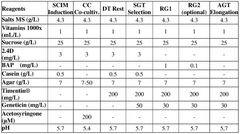
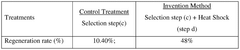
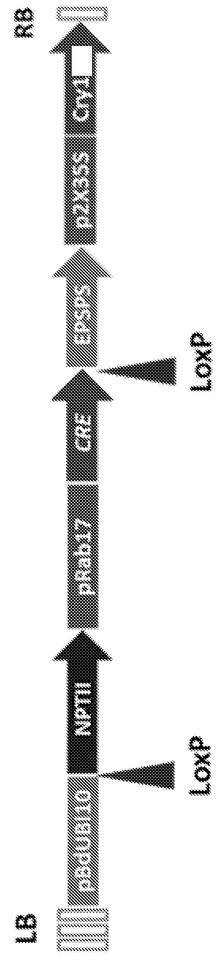
- A method involving in vitro culturing of sugarcane cells, introducing a sequence of interest, cultivating at specific temperatures, and performing heat shock treatments to enhance transformation and regeneration efficiency, using Agrobacterium-mediated transformation and other techniques to achieve robust and genotype-independent protocols.

Inhibitors of a 9-cis epoxycarotenoid dioxygenase
PatentInactiveUS8283481B2
Innovation
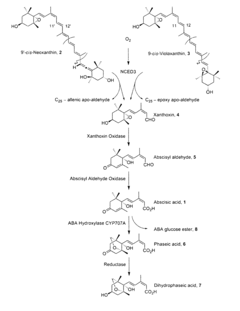
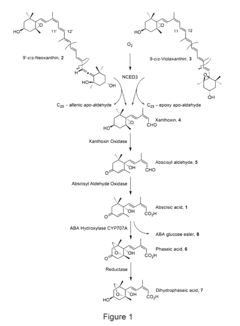
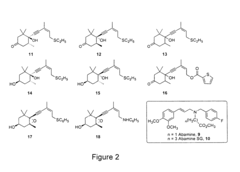
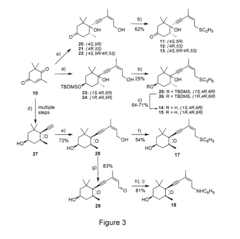
- Development of specific compounds, including sesquiterpene-like carotenoid cleavage dioxygenase (SLCCD) inhibitors like compound 13, which target the NCED enzyme to regulate abscisic acid (ABA) biosynthesis by inhibiting the 9-cis-epoxycarotenoid dioxygenase activity, thereby modulating seed maturation, desiccation tolerance, dormancy, and environmental stress responses in plants.
Environmental Impact of ABA-Modified Crops
The environmental impact of ABA-modified crops is a critical consideration in the development and implementation of next-generation crop biotechnology. Abscisic acid (ABA) plays a crucial role in plant stress responses, particularly in drought tolerance. As such, crops modified to enhance ABA signaling or production have the potential to significantly alter their interactions with the environment.
One of the primary environmental benefits of ABA-modified crops is their improved water use efficiency. These crops can maintain productivity under water-limited conditions, potentially reducing the overall water demand in agriculture. This could lead to decreased pressure on water resources, particularly in regions prone to drought or facing water scarcity. Additionally, the reduced need for irrigation may result in lower energy consumption and associated greenhouse gas emissions.
However, the introduction of ABA-modified crops may also have unintended ecological consequences. Altered ABA signaling could affect plant-insect interactions, potentially disrupting established ecosystems. For instance, changes in stomatal closure patterns might influence the emission of volatile organic compounds, which play a role in plant-insect communication and defense mechanisms.
The impact on soil health is another important consideration. ABA-modified crops with enhanced drought tolerance may alter root architecture and exudation patterns. This could influence soil microbial communities and nutrient cycling processes, potentially affecting long-term soil fertility and carbon sequestration.
Furthermore, the potential for gene flow from ABA-modified crops to wild relatives or non-target species must be carefully evaluated. While the risk may be lower compared to some other transgenic traits, the spread of enhanced drought tolerance to weedy species could have ecological implications, potentially altering competitive dynamics in natural ecosystems.
The large-scale adoption of ABA-modified crops could also influence agricultural practices and land use patterns. Improved drought tolerance might enable cultivation in previously marginal areas, potentially leading to land use changes and associated environmental impacts. This could include both positive effects, such as reduced pressure on prime agricultural land, and negative consequences, like potential encroachment into natural habitats.
Lastly, the environmental impact assessment of ABA-modified crops must consider their potential contribution to climate change adaptation strategies. As climate change is expected to increase the frequency and severity of droughts in many regions, these crops could play a crucial role in maintaining food security and agricultural sustainability. However, this must be balanced against the need to preserve biodiversity and ecosystem integrity.
One of the primary environmental benefits of ABA-modified crops is their improved water use efficiency. These crops can maintain productivity under water-limited conditions, potentially reducing the overall water demand in agriculture. This could lead to decreased pressure on water resources, particularly in regions prone to drought or facing water scarcity. Additionally, the reduced need for irrigation may result in lower energy consumption and associated greenhouse gas emissions.
However, the introduction of ABA-modified crops may also have unintended ecological consequences. Altered ABA signaling could affect plant-insect interactions, potentially disrupting established ecosystems. For instance, changes in stomatal closure patterns might influence the emission of volatile organic compounds, which play a role in plant-insect communication and defense mechanisms.
The impact on soil health is another important consideration. ABA-modified crops with enhanced drought tolerance may alter root architecture and exudation patterns. This could influence soil microbial communities and nutrient cycling processes, potentially affecting long-term soil fertility and carbon sequestration.
Furthermore, the potential for gene flow from ABA-modified crops to wild relatives or non-target species must be carefully evaluated. While the risk may be lower compared to some other transgenic traits, the spread of enhanced drought tolerance to weedy species could have ecological implications, potentially altering competitive dynamics in natural ecosystems.
The large-scale adoption of ABA-modified crops could also influence agricultural practices and land use patterns. Improved drought tolerance might enable cultivation in previously marginal areas, potentially leading to land use changes and associated environmental impacts. This could include both positive effects, such as reduced pressure on prime agricultural land, and negative consequences, like potential encroachment into natural habitats.
Lastly, the environmental impact assessment of ABA-modified crops must consider their potential contribution to climate change adaptation strategies. As climate change is expected to increase the frequency and severity of droughts in many regions, these crops could play a crucial role in maintaining food security and agricultural sustainability. However, this must be balanced against the need to preserve biodiversity and ecosystem integrity.
Regulatory Framework for ABA-Enhanced GMOs
The regulatory framework for ABA-enhanced genetically modified organisms (GMOs) is a critical aspect of their development and commercialization. As abscisic acid (ABA) plays a crucial role in plant stress responses and development, its manipulation in crops through genetic engineering requires careful consideration from regulatory bodies worldwide.
In the United States, the regulation of ABA-enhanced GMOs falls under the purview of multiple agencies. The Environmental Protection Agency (EPA) oversees the safety assessment of plant-incorporated protectants, including those related to ABA enhancement. The Food and Drug Administration (FDA) evaluates the food safety aspects of these crops, while the United States Department of Agriculture (USDA) assesses the potential environmental impacts and regulates field trials.
The European Union (EU) has implemented a stringent regulatory framework for GMOs, including those enhanced with ABA. The European Food Safety Authority (EFSA) conducts comprehensive risk assessments, evaluating both environmental and food safety aspects. The EU's precautionary approach often results in a more prolonged approval process compared to other regions.
In Asia, countries like China and Japan have established their own regulatory systems for ABA-enhanced GMOs. China's Ministry of Agriculture and Rural Affairs oversees the approval process, which includes extensive safety evaluations and field trials. Japan's regulatory framework involves multiple agencies, including the Ministry of Health, Labour and Welfare and the Ministry of Agriculture, Forestry and Fisheries.
Globally, the Cartagena Protocol on Biosafety provides an international framework for the safe handling, transport, and use of living modified organisms, including ABA-enhanced crops. This protocol emphasizes the importance of risk assessment and management in the transboundary movement of GMOs.
Key considerations in the regulatory process for ABA-enhanced GMOs include assessing potential impacts on non-target organisms, evaluating the stability of the genetic modifications, and determining any unintended effects on plant metabolism or composition. Regulators also focus on the potential for gene flow to wild relatives and the development of resistance in target pests or pathogens.
As the technology advances, regulatory frameworks are evolving to address new challenges. There is a growing emphasis on case-by-case assessments, recognizing that each ABA-enhanced GMO may have unique characteristics and potential impacts. Additionally, regulators are increasingly considering the potential benefits of these crops, such as improved drought tolerance and reduced water usage, alongside the traditional risk assessment approach.
In the United States, the regulation of ABA-enhanced GMOs falls under the purview of multiple agencies. The Environmental Protection Agency (EPA) oversees the safety assessment of plant-incorporated protectants, including those related to ABA enhancement. The Food and Drug Administration (FDA) evaluates the food safety aspects of these crops, while the United States Department of Agriculture (USDA) assesses the potential environmental impacts and regulates field trials.
The European Union (EU) has implemented a stringent regulatory framework for GMOs, including those enhanced with ABA. The European Food Safety Authority (EFSA) conducts comprehensive risk assessments, evaluating both environmental and food safety aspects. The EU's precautionary approach often results in a more prolonged approval process compared to other regions.
In Asia, countries like China and Japan have established their own regulatory systems for ABA-enhanced GMOs. China's Ministry of Agriculture and Rural Affairs oversees the approval process, which includes extensive safety evaluations and field trials. Japan's regulatory framework involves multiple agencies, including the Ministry of Health, Labour and Welfare and the Ministry of Agriculture, Forestry and Fisheries.
Globally, the Cartagena Protocol on Biosafety provides an international framework for the safe handling, transport, and use of living modified organisms, including ABA-enhanced crops. This protocol emphasizes the importance of risk assessment and management in the transboundary movement of GMOs.
Key considerations in the regulatory process for ABA-enhanced GMOs include assessing potential impacts on non-target organisms, evaluating the stability of the genetic modifications, and determining any unintended effects on plant metabolism or composition. Regulators also focus on the potential for gene flow to wild relatives and the development of resistance in target pests or pathogens.
As the technology advances, regulatory frameworks are evolving to address new challenges. There is a growing emphasis on case-by-case assessments, recognizing that each ABA-enhanced GMO may have unique characteristics and potential impacts. Additionally, regulators are increasingly considering the potential benefits of these crops, such as improved drought tolerance and reduced water usage, alongside the traditional risk assessment approach.
Unlock deeper insights with Patsnap Eureka Quick Research — get a full tech report to explore trends and direct your research. Try now!
Generate Your Research Report Instantly with AI Agent
Supercharge your innovation with Patsnap Eureka AI Agent Platform!