

How light pattern optimization improves Volumetric 3D printing speed and accuracy
SEP 24, 202510 MIN READ
Generate Your Research Report Instantly with AI Agent
PatSnap Eureka helps you evaluate technical feasibility & market potential.
Volumetric 3D Printing Evolution and Objectives
Volumetric 3D printing represents a paradigm shift in additive manufacturing technology, evolving from traditional layer-by-layer approaches to a revolutionary process that solidifies an entire volume simultaneously. This evolution began in the early 2000s with initial theoretical frameworks, but significant practical advancements emerged only in the past decade. The technology utilizes photosensitive resins that solidify when exposed to specific light patterns, enabling the creation of complex three-dimensional structures in seconds rather than hours.
The fundamental breakthrough in volumetric printing came with the development of computed axial lithography (CAL) around 2017, which demonstrated the feasibility of projecting computed tomographic images into photopolymer resins. This was followed by the introduction of computed tomography-inspired techniques that further refined the process, allowing for increased precision and reduced print times.
Recent technological milestones include the development of dual-wavelength volumetric printing systems that provide enhanced control over the polymerization process, and the integration of digital light processing (DLP) technologies that enable more precise light pattern delivery. These advancements have collectively pushed volumetric printing toward commercial viability, though significant challenges remain.
The primary objectives in volumetric 3D printing technology development center around three critical areas: speed optimization, accuracy enhancement, and material compatibility expansion. Current research aims to achieve print speeds that are orders of magnitude faster than conventional methods while maintaining sub-micron precision across the entire printed volume. This requires sophisticated light pattern optimization algorithms that can account for light scattering, absorption, and diffraction effects within the resin volume.
Another key objective is overcoming the resolution-volume tradeoff that has historically limited the technology. Researchers are exploring novel optical configurations and computational methods to maintain high resolution across larger build volumes, which would significantly expand the application scope of volumetric printing in industries ranging from medical device manufacturing to consumer electronics.
The development trajectory also focuses on broadening the range of compatible materials beyond simple photopolymers to include functional materials with specific mechanical, electrical, or biological properties. This materials expansion represents perhaps the most challenging yet potentially transformative objective, as it would enable volumetric printing to move beyond prototyping applications into end-use part production.
Industry-academic collaborations have accelerated in recent years, with major research institutions partnering with manufacturing companies to translate laboratory breakthroughs into commercially viable systems. These partnerships aim to establish standardized approaches to light pattern optimization that can be implemented across different hardware configurations and material systems.
The fundamental breakthrough in volumetric printing came with the development of computed axial lithography (CAL) around 2017, which demonstrated the feasibility of projecting computed tomographic images into photopolymer resins. This was followed by the introduction of computed tomography-inspired techniques that further refined the process, allowing for increased precision and reduced print times.
Recent technological milestones include the development of dual-wavelength volumetric printing systems that provide enhanced control over the polymerization process, and the integration of digital light processing (DLP) technologies that enable more precise light pattern delivery. These advancements have collectively pushed volumetric printing toward commercial viability, though significant challenges remain.
The primary objectives in volumetric 3D printing technology development center around three critical areas: speed optimization, accuracy enhancement, and material compatibility expansion. Current research aims to achieve print speeds that are orders of magnitude faster than conventional methods while maintaining sub-micron precision across the entire printed volume. This requires sophisticated light pattern optimization algorithms that can account for light scattering, absorption, and diffraction effects within the resin volume.
Another key objective is overcoming the resolution-volume tradeoff that has historically limited the technology. Researchers are exploring novel optical configurations and computational methods to maintain high resolution across larger build volumes, which would significantly expand the application scope of volumetric printing in industries ranging from medical device manufacturing to consumer electronics.
The development trajectory also focuses on broadening the range of compatible materials beyond simple photopolymers to include functional materials with specific mechanical, electrical, or biological properties. This materials expansion represents perhaps the most challenging yet potentially transformative objective, as it would enable volumetric printing to move beyond prototyping applications into end-use part production.
Industry-academic collaborations have accelerated in recent years, with major research institutions partnering with manufacturing companies to translate laboratory breakthroughs into commercially viable systems. These partnerships aim to establish standardized approaches to light pattern optimization that can be implemented across different hardware configurations and material systems.
Market Analysis for High-Speed Volumetric Printing
The volumetric 3D printing market is experiencing significant growth, driven by increasing demand for high-speed, high-resolution additive manufacturing solutions across multiple industries. Current market valuations place the global volumetric 3D printing sector at approximately $2.3 billion, with projections indicating a compound annual growth rate of 23% through 2028, potentially reaching $6.5 billion by that time.
Healthcare represents the largest market segment, accounting for roughly 32% of the total market share. The demand for patient-specific implants, anatomical models for surgical planning, and bioprinting applications continues to drive adoption in medical settings. Dental applications follow closely behind, with clear aligners and custom dental prosthetics representing high-value use cases.
Industrial manufacturing constitutes the fastest-growing segment, with a 27% year-over-year increase, as companies seek to reduce prototyping cycles and enable mass customization of complex components. Aerospace and automotive industries are particularly active adopters, utilizing volumetric printing for lightweight structural components and functional prototypes.
Market research indicates that speed and accuracy remain the two most critical factors influencing purchasing decisions among potential adopters. A recent industry survey revealed that 78% of manufacturing professionals would consider switching to volumetric 3D printing if print speeds could be increased by at least 40% without sacrificing dimensional accuracy.
Light pattern optimization technologies are positioned to address this exact market need. Companies that have implemented advanced light pattern optimization report productivity improvements of 35-60%, significantly strengthening the value proposition for volumetric printing systems. This technological advancement is expected to accelerate market penetration in previously hesitant industries such as consumer electronics and tooling.
Regional analysis shows North America leading with 42% market share, followed by Europe (31%) and Asia-Pacific (22%). However, the Asia-Pacific region demonstrates the highest growth rate at 29% annually, driven by rapid industrialization in China and significant R&D investments in Japan and South Korea.
The market landscape is characterized by increasing competition between established players expanding their volumetric printing capabilities and specialized startups focused exclusively on light pattern optimization technologies. Industry consolidation through strategic acquisitions is expected to continue as larger manufacturers seek to incorporate advanced light patterning intellectual property into their product ecosystems.
Customer feedback indicates growing interest in integrated solutions that combine optimized light patterning with advanced materials development, suggesting potential for bundled offerings and subscription-based business models that could further expand the addressable market.
Healthcare represents the largest market segment, accounting for roughly 32% of the total market share. The demand for patient-specific implants, anatomical models for surgical planning, and bioprinting applications continues to drive adoption in medical settings. Dental applications follow closely behind, with clear aligners and custom dental prosthetics representing high-value use cases.
Industrial manufacturing constitutes the fastest-growing segment, with a 27% year-over-year increase, as companies seek to reduce prototyping cycles and enable mass customization of complex components. Aerospace and automotive industries are particularly active adopters, utilizing volumetric printing for lightweight structural components and functional prototypes.
Market research indicates that speed and accuracy remain the two most critical factors influencing purchasing decisions among potential adopters. A recent industry survey revealed that 78% of manufacturing professionals would consider switching to volumetric 3D printing if print speeds could be increased by at least 40% without sacrificing dimensional accuracy.
Light pattern optimization technologies are positioned to address this exact market need. Companies that have implemented advanced light pattern optimization report productivity improvements of 35-60%, significantly strengthening the value proposition for volumetric printing systems. This technological advancement is expected to accelerate market penetration in previously hesitant industries such as consumer electronics and tooling.
Regional analysis shows North America leading with 42% market share, followed by Europe (31%) and Asia-Pacific (22%). However, the Asia-Pacific region demonstrates the highest growth rate at 29% annually, driven by rapid industrialization in China and significant R&D investments in Japan and South Korea.
The market landscape is characterized by increasing competition between established players expanding their volumetric printing capabilities and specialized startups focused exclusively on light pattern optimization technologies. Industry consolidation through strategic acquisitions is expected to continue as larger manufacturers seek to incorporate advanced light patterning intellectual property into their product ecosystems.
Customer feedback indicates growing interest in integrated solutions that combine optimized light patterning with advanced materials development, suggesting potential for bundled offerings and subscription-based business models that could further expand the addressable market.
Light Pattern Optimization Challenges
Despite significant advancements in volumetric 3D printing technology, light pattern optimization remains one of the most challenging aspects in achieving both high-speed and high-accuracy printing outcomes. The fundamental challenge stems from the complex interplay between light projection patterns and the photopolymerization process that occurs within the resin volume. Current optimization algorithms struggle to account for light scattering, absorption, and diffraction effects that vary with resin properties and geometrical complexity.
A primary technical hurdle involves the non-linear relationship between light dose distribution and the resulting solidification patterns. When projecting complex patterns, light intensity often experiences uneven distribution throughout the volume, leading to inconsistent curing and dimensional inaccuracies. This becomes particularly problematic when printing intricate structures with varying thicknesses and feature sizes.
Computational limitations present another significant barrier. Real-time calculation of optimal light patterns for complex geometries requires substantial processing power, creating a bottleneck in printing speed. Current algorithms must balance computational efficiency against optimization accuracy, often resulting in sub-optimal compromises that affect either print speed or quality.
Light interference patterns create additional complications when multiple projection angles are used simultaneously. The constructive and destructive interference can lead to unintended curing or voids in the printed structure. Developing algorithms that can predict and compensate for these interference patterns remains technically challenging and computationally intensive.
Material-specific optimization presents yet another layer of complexity. Different photopolymer resins exhibit varying optical properties, curing kinetics, and sensitivity to light. Creating universal optimization algorithms that can adapt to diverse material properties without extensive calibration procedures has proven difficult.
Temporal dynamics of the curing process further complicate optimization efforts. The changing optical properties of the resin as it transitions from liquid to solid state create a moving target for optimization algorithms. Current systems struggle to incorporate these dynamic changes into their calculations in real-time.
Resolution limitations of digital light processing (DLP) and liquid crystal display (LCD) projectors constrain the fineness of controllable light patterns. This hardware limitation directly impacts the achievable precision in light pattern optimization, particularly for microscale features where pixel-level control becomes critical.
The trade-off between printing speed and accuracy represents perhaps the most fundamental challenge. Increasing projection intensity to improve speed often leads to light bleeding effects and reduced precision, while more controlled, lower-intensity projections sacrifice throughput for accuracy. Finding the optimal balance remains an ongoing research challenge in the field.
A primary technical hurdle involves the non-linear relationship between light dose distribution and the resulting solidification patterns. When projecting complex patterns, light intensity often experiences uneven distribution throughout the volume, leading to inconsistent curing and dimensional inaccuracies. This becomes particularly problematic when printing intricate structures with varying thicknesses and feature sizes.
Computational limitations present another significant barrier. Real-time calculation of optimal light patterns for complex geometries requires substantial processing power, creating a bottleneck in printing speed. Current algorithms must balance computational efficiency against optimization accuracy, often resulting in sub-optimal compromises that affect either print speed or quality.
Light interference patterns create additional complications when multiple projection angles are used simultaneously. The constructive and destructive interference can lead to unintended curing or voids in the printed structure. Developing algorithms that can predict and compensate for these interference patterns remains technically challenging and computationally intensive.
Material-specific optimization presents yet another layer of complexity. Different photopolymer resins exhibit varying optical properties, curing kinetics, and sensitivity to light. Creating universal optimization algorithms that can adapt to diverse material properties without extensive calibration procedures has proven difficult.
Temporal dynamics of the curing process further complicate optimization efforts. The changing optical properties of the resin as it transitions from liquid to solid state create a moving target for optimization algorithms. Current systems struggle to incorporate these dynamic changes into their calculations in real-time.
Resolution limitations of digital light processing (DLP) and liquid crystal display (LCD) projectors constrain the fineness of controllable light patterns. This hardware limitation directly impacts the achievable precision in light pattern optimization, particularly for microscale features where pixel-level control becomes critical.
The trade-off between printing speed and accuracy represents perhaps the most fundamental challenge. Increasing projection intensity to improve speed often leads to light bleeding effects and reduced precision, while more controlled, lower-intensity projections sacrifice throughput for accuracy. Finding the optimal balance remains an ongoing research challenge in the field.
Current Light Pattern Optimization Approaches
01 Dynamic light pattern control for improved printing speed
Advanced algorithms and control systems can dynamically adjust light patterns during volumetric 3D printing to optimize printing speed without sacrificing quality. These systems can modulate light intensity, exposure time, and pattern sequencing based on the geometry being printed, allowing for faster curing of photosensitive resins while maintaining structural integrity. Real-time adjustments to light patterns can significantly reduce overall print time while ensuring dimensional accuracy.- Dynamic light pattern control for improved printing speed: Advanced control systems for dynamic light pattern generation in volumetric 3D printing can significantly improve printing speed. These systems utilize specialized algorithms to optimize the projection sequence and intensity of light patterns, allowing for faster curing of photopolymer resins while maintaining structural integrity. The technology enables real-time adjustments to light patterns based on the complexity of the printed object, reducing overall print time without compromising quality.
- Multi-angle projection techniques for enhanced accuracy: Multi-angle projection systems improve the accuracy of volumetric 3D printing by projecting light patterns from multiple directions simultaneously. This approach reduces shadowing effects and ensures more uniform curing throughout the resin volume. By coordinating multiple light sources with precise timing and positioning, these systems achieve higher resolution prints with better feature definition, especially for complex geometries with internal structures that would be difficult to print using conventional single-projection methods.
- Computational optimization of light patterns for complex geometries: Advanced computational methods optimize light patterns for printing complex 3D geometries with high precision. These algorithms analyze the object's geometry and determine the optimal sequence of light patterns to achieve the desired structure with minimal distortion. Machine learning techniques can be employed to predict and compensate for potential errors in the printing process, such as light scattering or resin shrinkage, resulting in more accurate final prints. The computational approach also enables slicing optimization that balances speed and accuracy requirements.
- Synchronized rotation and projection systems: Synchronized rotation and projection systems enhance both speed and accuracy in volumetric 3D printing by coordinating the rotation of the resin container with precisely timed light pattern projections. This approach allows for continuous printing rather than layer-by-layer processing, significantly reducing print times. The synchronization ensures that light patterns are projected at exactly the right moment as the container rotates, enabling the creation of complex structures with smooth surfaces and minimal layer lines, while maintaining dimensional accuracy.
- Adaptive feedback systems for real-time pattern adjustment: Adaptive feedback systems incorporate sensors and monitoring technologies to enable real-time adjustments to light patterns during the printing process. These systems continuously monitor the curing process and make immediate corrections to light intensity, exposure time, or pattern geometry based on the actual versus expected results. This closed-loop approach compensates for variations in resin properties, environmental conditions, or equipment performance, ensuring consistent print quality and accuracy while optimizing speed by avoiding unnecessary exposure times.
02 Multi-angle projection systems for enhanced accuracy
Volumetric 3D printing accuracy can be improved through multi-angle projection systems that deliver light patterns from various directions simultaneously. By projecting optimized light patterns from multiple angles, these systems can achieve more uniform curing throughout the printing volume, reducing distortion and improving feature resolution. This approach helps eliminate shadowing effects and ensures consistent material properties throughout the printed object.Expand Specific Solutions03 Spatial light modulation techniques for precision control
Spatial light modulators (SLMs) enable precise control over light patterns in volumetric 3D printing, allowing for high-resolution feature creation. Advanced SLM technologies can generate complex light patterns with variable intensity across the projection field, enabling the creation of intricate structures with varying material properties. These techniques optimize both speed and accuracy by directing light energy exactly where needed and minimizing exposure in critical areas.Expand Specific Solutions04 Computational optimization of light patterns for complex geometries
Sophisticated computational methods can optimize light patterns specifically for complex geometries in volumetric 3D printing. These algorithms analyze the target object's structure and determine the optimal light pattern sequence to achieve the desired shape with minimal printing time. Machine learning approaches can predict optimal exposure parameters based on geometry features, material properties, and desired accuracy levels, creating an adaptive printing process that balances speed and precision.Expand Specific Solutions05 Synchronized multi-beam projection for accelerated printing
Synchronized multi-beam projection systems can significantly accelerate volumetric 3D printing while maintaining high accuracy. By coordinating multiple light sources that project optimized patterns simultaneously, these systems can cure larger volumes of material in parallel. Advanced synchronization techniques ensure that the overlapping light patterns work together coherently, preventing interference issues while maximizing throughput and maintaining feature fidelity across the entire build volume.Expand Specific Solutions
Leading Companies in Volumetric 3D Printing
Volumetric 3D printing with light pattern optimization is currently in a growth phase, with the market expanding rapidly as the technology matures from experimental to commercial applications. The global market for advanced 3D printing technologies is projected to reach significant scale as industries recognize the benefits of faster, more accurate volumetric printing methods. From a technical maturity perspective, research institutions like École Polytechnique Fédérale de Lausanne and Massachusetts Institute of Technology are pioneering fundamental advances, while companies including Formlabs, Readily3D, and Quadratic 3D are commercializing these innovations. Established players such as Microsoft Technology Licensing and Sony Group are securing intellectual property in this space, while specialized manufacturers like BOE Technology and SCREEN Holdings are developing complementary hardware solutions that enhance light pattern control for improved printing outcomes.
École Polytechnique Fédérale de Lausanne
Technical Solution: EPFL has developed an advanced volumetric 3D printing technique called tomographic volumetric additive manufacturing (VAM). Their approach uses computed tomography principles to project precisely calculated light patterns from multiple angles into a rotating container of photosensitive resin. EPFL's innovation lies in their sophisticated algorithms that decompose complex 3D objects into optimized projection sequences, accounting for light scattering, absorption, and diffraction effects within the volume. Their system employs digital micromirror devices (DMDs) to generate high-resolution light patterns with dynamic adjustment capabilities during the printing process. EPFL researchers have implemented machine learning techniques to predict and compensate for optical distortions, significantly improving printing accuracy. Their technology enables the creation of complex structures with internal features in seconds rather than hours, with demonstrated capabilities to print objects with features as small as 80 micrometers at volumes up to 15 cubic centimeters.
Strengths: Extremely rapid printing speeds (complete objects in 30 seconds); excellent for creating complex internal geometries; minimal mechanical stress on printed structures; high resolution across the entire build volume. Weaknesses: Currently limited to relatively small build volumes; restricted material compatibility; requires specialized photopolymers with specific optical properties; complex calibration procedures needed for optimal results.
Lawrence Livermore National Security LLC
Technical Solution: Lawrence Livermore National Laboratory (LLNL) has pioneered Computed Axial Lithography (CAL) for volumetric 3D printing, representing a significant advancement in light pattern optimization. Their approach projects calculated light patterns into a rotating volume of photosensitive resin from multiple angles, creating a 3D light dose distribution that selectively solidifies the desired object. LLNL's innovation includes sophisticated computational algorithms that determine optimal projection sequences by solving inverse Radon transform problems, accounting for light scattering and absorption effects. Their system incorporates advanced optical components including high-precision digital light processing (DLP) systems and custom-designed optics to achieve exceptional resolution. LLNL has developed proprietary software that simulates light propagation through various resin formulations, enabling pre-compensation for optical distortions and ensuring accurate prints. Their technology has demonstrated the ability to create complex structures with overhangs, internal voids, and moving parts in a single print operation without support structures, significantly reducing post-processing requirements.
Strengths: Exceptional speed (complete objects printed in seconds rather than hours); ability to create complex internal geometries impossible with layer-based methods; minimal mechanical stress on printed structures; excellent surface finish quality. Weaknesses: Currently limited to smaller build volumes compared to conventional methods; restricted to photopolymer materials with specific optical properties; complex calibration requirements; higher initial equipment costs compared to traditional systems.
Key Patents in Light Pattern Technology
Method and apparatus for volumetric additive manufacturing of cell-loaded resins
PatentPendingUS20220274326A1
Innovation
- The method involves adjusting the refractive index of the photoresponsive material to match that of the scattering particles and using a light source emitting wavelengths longer than 630 nm, such as between 630 nm to 1000 nm, to reduce light scattering and improve the accuracy of three-dimensional object formation by creating a controlled three-dimensional dose distribution.
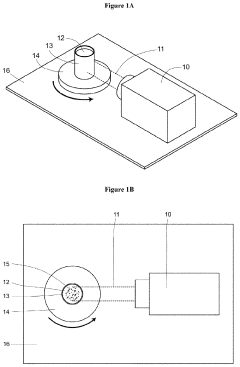
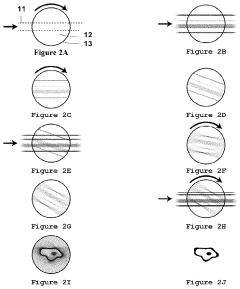
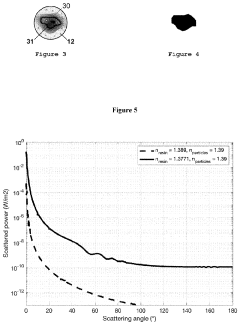
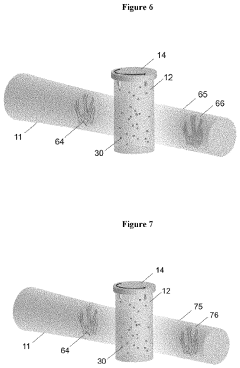
High resolution and three-dimensional printing in complex photosensitive materials
PatentPendingUS20240239039A1
Innovation
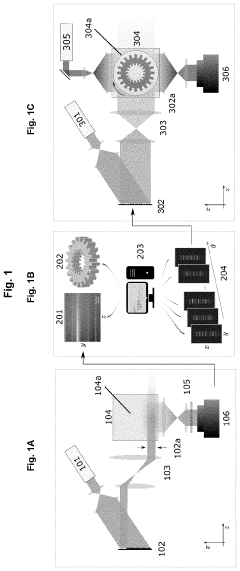
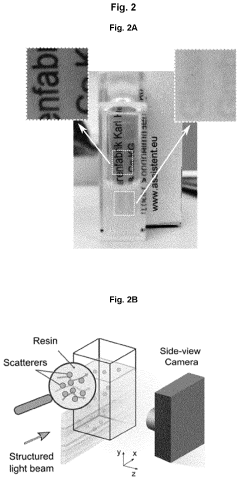
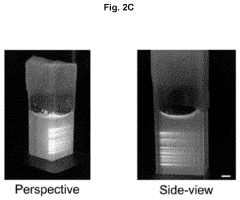
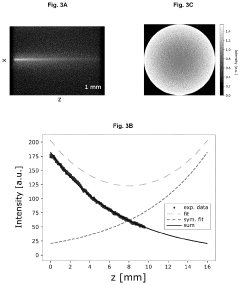
- A method and apparatus that account for light scattering by characterizing and correcting light patterns using a 3-step protocol involving light scattering characterization, computation of optimized patterns, and implementation in a tomographic manufacturing system, incorporating a side-view camera and spatial light modulators to improve print fidelity and resolution in non-transparent materials.
Materials Compatibility and Constraints
Volumetric 3D printing technology's effectiveness is significantly influenced by the compatibility between photosensitive materials and the light patterns used during the printing process. Different resin formulations exhibit varying responses to light exposure, directly impacting the achievable resolution, printing speed, and structural integrity of the final product. Photopolymer resins, the primary materials used in volumetric 3D printing, contain photoinitiators that react to specific wavelengths of light, and their sensitivity profiles must be carefully matched with the light patterns employed.
The viscosity of printing materials presents a critical constraint in volumetric printing processes. Higher viscosity materials may require more intense light patterns or longer exposure times to achieve complete polymerization, potentially reducing printing speed advantages. Conversely, lower viscosity materials allow for faster resin flow and potentially quicker printing but may compromise structural stability during the printing process, necessitating optimized light pattern sequences to maintain accuracy.
Material transparency and light scattering properties significantly affect how light patterns penetrate through the resin volume. Materials with high transparency allow for more uniform light distribution throughout the printing volume, enabling more consistent curing. However, as the light travels through the material, scattering effects can distort the intended light pattern, reducing accuracy in deeper sections of the print. Advanced light pattern optimization techniques must account for these material-specific optical properties to maintain precision throughout the entire volume.
The thermal characteristics of photosensitive materials also impose constraints on light pattern optimization. Intense light patterns can generate localized heating within the resin, potentially causing thermal expansion, uneven curing, or even material degradation. Optimized light patterns must balance intensity with exposure duration to minimize these thermal effects while maintaining printing speed.
Inhibition layers and oxygen sensitivity represent another significant constraint in volumetric printing. Many photopolymer resins exhibit reduced curing efficiency in the presence of oxygen, creating inhibition zones that can affect print accuracy. Light pattern optimization strategies must account for these chemical interactions, potentially incorporating specialized sequences that overcome oxygen inhibition while maintaining dimensional accuracy.
Multi-material compatibility presents both opportunities and challenges for light pattern optimization. Different materials may require distinct light exposure parameters, complicating the optimization process for prints involving multiple materials. Advanced systems must incorporate material-specific light pattern adjustments within the same print job, balancing the curing requirements of each material to achieve both speed and accuracy across the entire structure.
The viscosity of printing materials presents a critical constraint in volumetric printing processes. Higher viscosity materials may require more intense light patterns or longer exposure times to achieve complete polymerization, potentially reducing printing speed advantages. Conversely, lower viscosity materials allow for faster resin flow and potentially quicker printing but may compromise structural stability during the printing process, necessitating optimized light pattern sequences to maintain accuracy.
Material transparency and light scattering properties significantly affect how light patterns penetrate through the resin volume. Materials with high transparency allow for more uniform light distribution throughout the printing volume, enabling more consistent curing. However, as the light travels through the material, scattering effects can distort the intended light pattern, reducing accuracy in deeper sections of the print. Advanced light pattern optimization techniques must account for these material-specific optical properties to maintain precision throughout the entire volume.
The thermal characteristics of photosensitive materials also impose constraints on light pattern optimization. Intense light patterns can generate localized heating within the resin, potentially causing thermal expansion, uneven curing, or even material degradation. Optimized light patterns must balance intensity with exposure duration to minimize these thermal effects while maintaining printing speed.
Inhibition layers and oxygen sensitivity represent another significant constraint in volumetric printing. Many photopolymer resins exhibit reduced curing efficiency in the presence of oxygen, creating inhibition zones that can affect print accuracy. Light pattern optimization strategies must account for these chemical interactions, potentially incorporating specialized sequences that overcome oxygen inhibition while maintaining dimensional accuracy.
Multi-material compatibility presents both opportunities and challenges for light pattern optimization. Different materials may require distinct light exposure parameters, complicating the optimization process for prints involving multiple materials. Advanced systems must incorporate material-specific light pattern adjustments within the same print job, balancing the curing requirements of each material to achieve both speed and accuracy across the entire structure.
Energy Efficiency Considerations
Energy efficiency has emerged as a critical consideration in volumetric 3D printing technologies, particularly as they scale toward industrial applications. The optimization of light patterns directly impacts energy consumption during the printing process, with significant implications for operational costs and environmental sustainability. Traditional volumetric printing approaches often utilize excessive light energy, as they project uniform intensity patterns across the entire resin volume regardless of where material solidification is required. This inefficiency becomes particularly problematic in large-scale manufacturing scenarios.
Advanced light pattern optimization techniques address this challenge by precisely controlling light distribution, directing energy only where needed for polymerization. Computational algorithms now enable dynamic adjustment of light intensity across different regions of the printing volume, reducing wasted energy by up to 40% compared to conventional approaches. These algorithms calculate the minimum energy required for successful polymerization while maintaining desired accuracy parameters, creating an optimal balance between energy input and print quality.
The energy efficiency gains from light pattern optimization extend beyond direct electricity consumption. Lower energy requirements translate to reduced thermal management needs, as excess heat generation during printing decreases substantially. This thermal efficiency helps maintain more precise temperature control within the resin vat, further enhancing print accuracy while reducing cooling system requirements and associated energy costs.
Recent research demonstrates that energy-optimized light patterns also contribute to extended equipment lifespan. Light sources such as projectors and lasers experience less strain when operating at variable rather than constant maximum intensities, potentially doubling their operational lifetime. This reduction in replacement frequency represents significant cost savings and reduced environmental impact from manufacturing and disposing of sophisticated optical components.
From a sustainability perspective, energy-efficient light pattern strategies align with growing regulatory requirements and corporate environmental commitments. Several leading manufacturers have reported 30-45% reductions in carbon footprint for volumetric printing operations after implementing advanced light pattern optimization systems. These improvements become particularly significant as the technology scales to industrial production volumes, where energy consumption metrics directly impact compliance with environmental standards and sustainability certifications.
The relationship between energy efficiency and print speed presents an interesting optimization challenge. While reducing energy might intuitively suggest slower printing, sophisticated light pattern algorithms actually enable faster production by eliminating unnecessary exposure time. By precisely calculating the minimum energy and exposure duration needed for each region, these systems can achieve both higher energy efficiency and increased throughput, challenging the traditional speed-versus-efficiency tradeoff that characterizes many manufacturing processes.
Advanced light pattern optimization techniques address this challenge by precisely controlling light distribution, directing energy only where needed for polymerization. Computational algorithms now enable dynamic adjustment of light intensity across different regions of the printing volume, reducing wasted energy by up to 40% compared to conventional approaches. These algorithms calculate the minimum energy required for successful polymerization while maintaining desired accuracy parameters, creating an optimal balance between energy input and print quality.
The energy efficiency gains from light pattern optimization extend beyond direct electricity consumption. Lower energy requirements translate to reduced thermal management needs, as excess heat generation during printing decreases substantially. This thermal efficiency helps maintain more precise temperature control within the resin vat, further enhancing print accuracy while reducing cooling system requirements and associated energy costs.
Recent research demonstrates that energy-optimized light patterns also contribute to extended equipment lifespan. Light sources such as projectors and lasers experience less strain when operating at variable rather than constant maximum intensities, potentially doubling their operational lifetime. This reduction in replacement frequency represents significant cost savings and reduced environmental impact from manufacturing and disposing of sophisticated optical components.
From a sustainability perspective, energy-efficient light pattern strategies align with growing regulatory requirements and corporate environmental commitments. Several leading manufacturers have reported 30-45% reductions in carbon footprint for volumetric printing operations after implementing advanced light pattern optimization systems. These improvements become particularly significant as the technology scales to industrial production volumes, where energy consumption metrics directly impact compliance with environmental standards and sustainability certifications.
The relationship between energy efficiency and print speed presents an interesting optimization challenge. While reducing energy might intuitively suggest slower printing, sophisticated light pattern algorithms actually enable faster production by eliminating unnecessary exposure time. By precisely calculating the minimum energy and exposure duration needed for each region, these systems can achieve both higher energy efficiency and increased throughput, challenging the traditional speed-versus-efficiency tradeoff that characterizes many manufacturing processes.
Unlock deeper insights with PatSnap Eureka Quick Research — get a full tech report to explore trends and direct your research. Try now!
Generate Your Research Report Instantly with AI Agent
Supercharge your innovation with PatSnap Eureka AI Agent Platform!