

Volumetric 3D printing interface engineering for complex geometry fabrication
SEP 24, 20259 MIN READ
Generate Your Research Report Instantly with AI Agent
PatSnap Eureka helps you evaluate technical feasibility & market potential.
Volumetric 3D Printing Background and Objectives
Volumetric 3D printing represents a paradigm shift in additive manufacturing technology, moving beyond traditional layer-by-layer approaches to enable the simultaneous solidification of an entire volume of material. This revolutionary technique emerged in the late 2010s as researchers sought to overcome the speed limitations and mechanical anisotropy inherent in conventional 3D printing methods. The evolution of this technology has been driven by advances in photochemistry, computational imaging, and materials science, creating a convergence that enables unprecedented fabrication capabilities.
The fundamental principle behind volumetric 3D printing involves the projection of patterned light into a photosensitive resin from multiple angles simultaneously, creating three-dimensional energy distributions that selectively cure specific regions within the volume. This approach eliminates the need for layer-by-layer processing, dramatically reducing production times from hours to minutes or even seconds for complex structures.
Historical development of volumetric printing can be traced through several key milestones, beginning with early theoretical work in computed tomography principles applied to fabrication, followed by breakthrough demonstrations at Lawrence Livermore National Laboratory and the University of California, Berkeley around 2017-2019. These initial proofs-of-concept have since evolved into more sophisticated systems with enhanced resolution, material compatibility, and geometric complexity capabilities.
The primary objective of interface engineering in volumetric 3D printing is to overcome the current limitations in fabricating complex geometries with high fidelity. Specifically, this involves developing methods to control the interaction between light and photosensitive materials at unprecedented precision, enabling the creation of intricate internal features, overhangs, and hierarchical structures without support materials. Additionally, interface engineering aims to expand the range of printable materials beyond photopolymers to include ceramics, metals, and multi-material compositions.
Technical goals include achieving sub-micron resolution across entire build volumes, eliminating optical artifacts such as scattering and absorption heterogeneity, and developing computational algorithms that can predict and compensate for complex light-material interactions in real-time. Furthermore, there is a push toward developing systems that can dynamically adjust printing parameters based on feedback from in-situ monitoring to ensure geometric accuracy and material property consistency throughout the printed object.
The trajectory of volumetric 3D printing technology points toward integration with other advanced manufacturing techniques, creating hybrid systems capable of unprecedented versatility in materials processing. As the technology matures, we anticipate significant impacts across industries ranging from biomedical engineering and microfluidics to aerospace and consumer electronics, where complex geometries with precise internal features are highly valued but difficult to produce using conventional manufacturing methods.
The fundamental principle behind volumetric 3D printing involves the projection of patterned light into a photosensitive resin from multiple angles simultaneously, creating three-dimensional energy distributions that selectively cure specific regions within the volume. This approach eliminates the need for layer-by-layer processing, dramatically reducing production times from hours to minutes or even seconds for complex structures.
Historical development of volumetric printing can be traced through several key milestones, beginning with early theoretical work in computed tomography principles applied to fabrication, followed by breakthrough demonstrations at Lawrence Livermore National Laboratory and the University of California, Berkeley around 2017-2019. These initial proofs-of-concept have since evolved into more sophisticated systems with enhanced resolution, material compatibility, and geometric complexity capabilities.
The primary objective of interface engineering in volumetric 3D printing is to overcome the current limitations in fabricating complex geometries with high fidelity. Specifically, this involves developing methods to control the interaction between light and photosensitive materials at unprecedented precision, enabling the creation of intricate internal features, overhangs, and hierarchical structures without support materials. Additionally, interface engineering aims to expand the range of printable materials beyond photopolymers to include ceramics, metals, and multi-material compositions.
Technical goals include achieving sub-micron resolution across entire build volumes, eliminating optical artifacts such as scattering and absorption heterogeneity, and developing computational algorithms that can predict and compensate for complex light-material interactions in real-time. Furthermore, there is a push toward developing systems that can dynamically adjust printing parameters based on feedback from in-situ monitoring to ensure geometric accuracy and material property consistency throughout the printed object.
The trajectory of volumetric 3D printing technology points toward integration with other advanced manufacturing techniques, creating hybrid systems capable of unprecedented versatility in materials processing. As the technology matures, we anticipate significant impacts across industries ranging from biomedical engineering and microfluidics to aerospace and consumer electronics, where complex geometries with precise internal features are highly valued but difficult to produce using conventional manufacturing methods.
Market Analysis for Complex Geometry Fabrication
The global market for complex geometry fabrication through volumetric 3D printing is experiencing significant growth, driven by increasing demand across multiple industries. The market size for advanced 3D printing technologies was valued at approximately $13.7 billion in 2022 and is projected to reach $51.5 billion by 2030, with volumetric printing for complex geometries representing a rapidly expanding segment within this broader market.
Healthcare and medical device manufacturing currently constitute the largest application sector, accounting for nearly 35% of the market share. The ability to produce patient-specific implants, anatomical models, and complex tissue scaffolds with intricate internal structures has revolutionized personalized medicine approaches. This sector is expected to maintain dominance with a compound annual growth rate (CAGR) of 23.4% through 2028.
Aerospace and automotive industries collectively represent the second-largest market segment at 28%. These sectors particularly value volumetric 3D printing's capability to produce lightweight components with complex internal geometries that optimize strength-to-weight ratios while reducing material consumption. The demand is primarily driven by fuel efficiency requirements and the growing trend toward electric vehicle manufacturing.
Consumer electronics and jewelry manufacturing are emerging as high-growth segments, with CAGRs of 27.2% and 25.8% respectively. These industries benefit from the technology's ability to create intricate designs that would be impossible or prohibitively expensive using traditional manufacturing methods.
Geographically, North America leads the market with approximately 42% share, followed by Europe (31%) and Asia-Pacific (22%). However, the Asia-Pacific region is expected to witness the fastest growth rate of 29.3% annually, primarily due to significant investments in advanced manufacturing technologies in China, Japan, and South Korea.
Key market drivers include increasing demand for mass customization, reduced material waste compared to subtractive manufacturing processes, and the ability to produce previously impossible geometries. The elimination of support structures—a unique advantage of volumetric printing—represents a particularly valuable proposition for industries working with complex internal features.
Market challenges include high equipment costs, with industrial-grade volumetric 3D printing systems ranging from $250,000 to over $1 million, limiting adoption among small and medium enterprises. Material limitations and standardization issues also remain significant barriers to wider market penetration, though rapid advancements in photopolymer chemistry are gradually addressing these constraints.
Healthcare and medical device manufacturing currently constitute the largest application sector, accounting for nearly 35% of the market share. The ability to produce patient-specific implants, anatomical models, and complex tissue scaffolds with intricate internal structures has revolutionized personalized medicine approaches. This sector is expected to maintain dominance with a compound annual growth rate (CAGR) of 23.4% through 2028.
Aerospace and automotive industries collectively represent the second-largest market segment at 28%. These sectors particularly value volumetric 3D printing's capability to produce lightweight components with complex internal geometries that optimize strength-to-weight ratios while reducing material consumption. The demand is primarily driven by fuel efficiency requirements and the growing trend toward electric vehicle manufacturing.
Consumer electronics and jewelry manufacturing are emerging as high-growth segments, with CAGRs of 27.2% and 25.8% respectively. These industries benefit from the technology's ability to create intricate designs that would be impossible or prohibitively expensive using traditional manufacturing methods.
Geographically, North America leads the market with approximately 42% share, followed by Europe (31%) and Asia-Pacific (22%). However, the Asia-Pacific region is expected to witness the fastest growth rate of 29.3% annually, primarily due to significant investments in advanced manufacturing technologies in China, Japan, and South Korea.
Key market drivers include increasing demand for mass customization, reduced material waste compared to subtractive manufacturing processes, and the ability to produce previously impossible geometries. The elimination of support structures—a unique advantage of volumetric printing—represents a particularly valuable proposition for industries working with complex internal features.
Market challenges include high equipment costs, with industrial-grade volumetric 3D printing systems ranging from $250,000 to over $1 million, limiting adoption among small and medium enterprises. Material limitations and standardization issues also remain significant barriers to wider market penetration, though rapid advancements in photopolymer chemistry are gradually addressing these constraints.
Technical Challenges in Volumetric 3D Printing
Volumetric 3D printing represents a paradigm shift in additive manufacturing, enabling the simultaneous solidification of an entire volume rather than layer-by-layer fabrication. Despite its revolutionary potential, this technology faces significant technical hurdles that impede its widespread adoption for complex geometry fabrication.
The primary challenge lies in achieving precise control over the light distribution within the resin volume. Unlike conventional 3D printing where each layer is directly accessible, volumetric printing requires sophisticated optical systems to project specific energy patterns throughout a three-dimensional space. Current optical setups struggle to maintain consistent energy distribution, particularly in regions with varying geometric complexity, resulting in uneven curing and structural defects.
Material limitations constitute another substantial barrier. Resins must possess both high photosensitivity for rapid solidification and optical transparency to allow light penetration throughout the volume. These requirements often conflict with mechanical property needs, creating a complex optimization problem. Additionally, the heat generated during simultaneous volume curing can cause thermal distortion, particularly in geometries with varying thicknesses.
Interface engineering between different materials or between the printed structure and the surrounding uncured resin presents unique difficulties. The absence of distinct layers eliminates the opportunity for interface modification between fabrication steps, necessitating novel approaches to create multi-material structures or functional gradients within a single print operation.
Resolution limitations become particularly evident when fabricating complex geometries. While volumetric printing excels at creating smooth curved surfaces, it struggles with sharp features and internal voids. The optical diffraction limit and scattering effects within the resin volume constrain the minimum feature size achievable, typically to hundreds of micrometers—significantly larger than some conventional techniques.
Computational challenges further complicate the process. Calculating optimal light patterns for complex geometries requires solving inverse problems that are computationally intensive. Current algorithms often make simplifying assumptions that fail to account for complex light-material interactions, leading to discrepancies between designed and fabricated structures.
Real-time monitoring and feedback systems remain underdeveloped for volumetric printing. Unlike layer-by-layer methods where each layer can be inspected before proceeding, volumetric printing offers limited opportunities to detect and correct errors during fabrication. This "black box" nature increases the risk of complete print failure, particularly for time-consuming and material-intensive complex geometries.
Addressing these technical challenges requires interdisciplinary approaches combining advances in optics, materials science, computational modeling, and process engineering to unlock the full potential of volumetric 3D printing for complex geometry fabrication.
The primary challenge lies in achieving precise control over the light distribution within the resin volume. Unlike conventional 3D printing where each layer is directly accessible, volumetric printing requires sophisticated optical systems to project specific energy patterns throughout a three-dimensional space. Current optical setups struggle to maintain consistent energy distribution, particularly in regions with varying geometric complexity, resulting in uneven curing and structural defects.
Material limitations constitute another substantial barrier. Resins must possess both high photosensitivity for rapid solidification and optical transparency to allow light penetration throughout the volume. These requirements often conflict with mechanical property needs, creating a complex optimization problem. Additionally, the heat generated during simultaneous volume curing can cause thermal distortion, particularly in geometries with varying thicknesses.
Interface engineering between different materials or between the printed structure and the surrounding uncured resin presents unique difficulties. The absence of distinct layers eliminates the opportunity for interface modification between fabrication steps, necessitating novel approaches to create multi-material structures or functional gradients within a single print operation.
Resolution limitations become particularly evident when fabricating complex geometries. While volumetric printing excels at creating smooth curved surfaces, it struggles with sharp features and internal voids. The optical diffraction limit and scattering effects within the resin volume constrain the minimum feature size achievable, typically to hundreds of micrometers—significantly larger than some conventional techniques.
Computational challenges further complicate the process. Calculating optimal light patterns for complex geometries requires solving inverse problems that are computationally intensive. Current algorithms often make simplifying assumptions that fail to account for complex light-material interactions, leading to discrepancies between designed and fabricated structures.
Real-time monitoring and feedback systems remain underdeveloped for volumetric printing. Unlike layer-by-layer methods where each layer can be inspected before proceeding, volumetric printing offers limited opportunities to detect and correct errors during fabrication. This "black box" nature increases the risk of complete print failure, particularly for time-consuming and material-intensive complex geometries.
Addressing these technical challenges requires interdisciplinary approaches combining advances in optics, materials science, computational modeling, and process engineering to unlock the full potential of volumetric 3D printing for complex geometry fabrication.
Leading Companies in Volumetric 3D Printing
Volumetric 3D printing interface engineering for complex geometry fabrication is currently in a growth phase, with the market expanding rapidly as industries recognize its potential for creating intricate structures impossible with traditional manufacturing. The global market size is projected to reach significant scale as adoption increases across aerospace, medical, and industrial sectors. Technologically, the field shows varying maturity levels among key players. Industry leaders like Stratasys, 3D Systems, and Autodesk have established robust platforms, while companies such as Advanced Solutions Life Sciences and Quadratic 3D are developing specialized applications for bioprinting and high-precision manufacturing. Academic institutions including EPFL and University of Maine collaborate with industrial partners like HP Development and Siemens Energy to advance fundamental capabilities, particularly in materials science and process optimization for complex geometries.
Stratasys Ltd.
Technical Solution: Stratasys has developed PolyJet technology for volumetric 3D printing of complex geometries, which utilizes multiple print heads to simultaneously deposit photopolymer materials that are instantly cured by UV light. Their J850 Digital Anatomy Printer employs advanced software algorithms to control material deposition with microscale precision, enabling the creation of complex anatomical models with varying material properties throughout the volume. The company's GrabCAD software platform integrates with their hardware to provide a seamless interface for translating complex 3D models into printable volumetric instructions, with automatic support generation and material optimization. Stratasys has also pioneered multi-material printing capabilities that allow for gradient transitions between materials within a single print volume, enabling functionally graded parts with complex internal geometries that would be impossible with traditional manufacturing methods.
Strengths: Industry-leading multi-material capabilities allowing for complex internal structures and material gradients; robust software integration for handling complex geometries; high resolution (down to 14 microns) enabling fine feature reproduction. Weaknesses: Higher equipment and material costs compared to other technologies; limited build volumes for their most precise systems; proprietary materials ecosystem restricting third-party material usage.
Advanced Solutions Life Sciences LLC
Technical Solution: Advanced Solutions Life Sciences has developed the BioAssemblyBot, a 6-axis robotic arm system specifically designed for volumetric 3D bioprinting of complex biological structures. Their TSIM (Tissue Structure Information Modeling) software provides a specialized interface for designing and fabricating complex biological geometries with multiple cell types and biomaterials. The system employs a patented microfluidic printhead technology that can precisely deposit multiple biomaterials with cellular components in three dimensions, maintaining cell viability throughout the printing process. Their approach to complex geometry fabrication involves maintaining precise environmental controls (temperature, humidity, sterility) while depositing materials with varying viscosities and biological properties. The company's software incorporates advanced path planning algorithms that optimize the robotic arm's movement to minimize print time while ensuring structural integrity of delicate biological constructs. Their system can fabricate complex vascular networks within tissue constructs, addressing one of the major challenges in tissue engineering by enabling nutrient and oxygen delivery throughout volumetric tissues.
Strengths: Unparalleled precision in depositing multiple biomaterials with living cells; 6-axis freedom of movement allowing for complex overhanging structures without supports; specialized software for biological applications. Weaknesses: Higher costs compared to conventional 3D printing systems; requires specialized knowledge of both biological systems and manufacturing; limited to specific biomedical applications rather than general manufacturing.
Key Patents in Complex Geometry Fabrication
Systems and methods of volumetric 3D printing
PatentActiveUS20180250890A1
Innovation
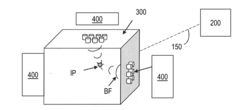
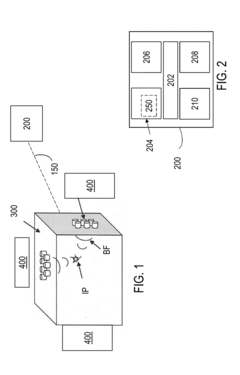
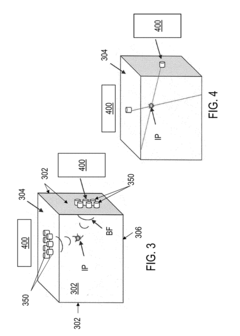
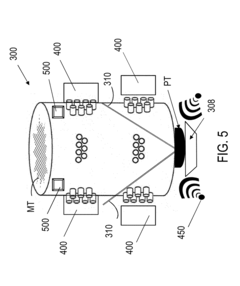
- A volumetric 3D printing method that uses intersecting energy beams to fabricate objects within a build volume, where multiple energy sources are required to create the object, and includes a controller to adjust parameters based on scanned progress, allowing for faster materialization and support through structures or acoustic levitation.
Cartridge, system, and method for volumetric 3D printing
PatentPendingUS20250073997A1
Innovation
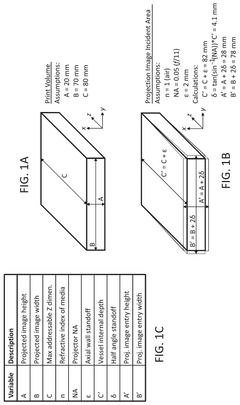
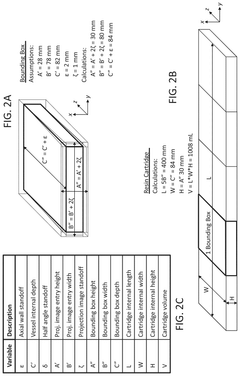
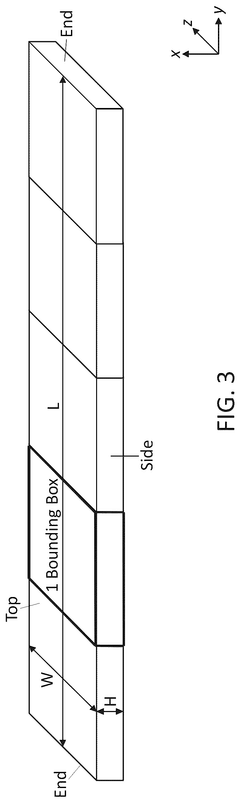
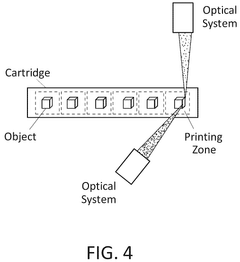
- A cartridge system for volumetric 3D printing that uses a photopolymerizable composition with non-Newtonian rheological behavior, allowing for the formation of three-dimensional objects without support structures by irradiating the composition with multiple excitation light projections.
Material Science Considerations
Material selection in volumetric 3D printing represents a critical factor that directly influences the feasibility and quality of complex geometry fabrication. The photosensitive resins employed must possess specific optical properties to enable proper light penetration and controlled polymerization throughout the volume. These materials require carefully balanced absorption coefficients that allow sufficient light transmission while maintaining spatial resolution during the printing process.
The rheological properties of printing materials significantly impact the formation of intricate structures. Lower viscosity formulations facilitate the creation of fine features and internal channels, whereas higher viscosity materials may provide better structural stability during the printing process. Engineers must carefully balance these competing requirements based on the specific geometric complexity of the target object.
Photoinitiator selection and concentration play pivotal roles in determining curing kinetics and resolution capabilities. Fast-responding photoinitiators enable shorter exposure times but may compromise depth control, while slower systems offer improved gradient control at the cost of extended processing times. Recent advances in dual-initiator systems have demonstrated promising results for complex geometry fabrication by providing both rapid initial curing and controlled solidification throughout the volume.
Cross-linking density represents another crucial parameter affecting both the printing process and final material properties. Higher cross-linking densities typically yield improved mechanical strength but may introduce brittleness and internal stress that can distort complex geometries. Conversely, lower cross-linking formulations offer enhanced flexibility but potentially sacrifice dimensional stability and resolution.
Post-processing compatibility must be considered during material development, as complex geometries often require specialized cleaning procedures to remove uncured resin from intricate internal features. Materials engineered with solubility-switching mechanisms have shown particular promise, allowing easy removal of support materials while maintaining structural integrity of the printed object.
Biocompatibility considerations have driven significant research into materials suitable for medical applications of volumetric printing. Novel formulations incorporating bioactive components enable the fabrication of complex tissue scaffolds and personalized medical devices with precisely controlled mechanical and biological properties, though challenges remain in achieving both biocompatibility and optimal printing performance.
The rheological properties of printing materials significantly impact the formation of intricate structures. Lower viscosity formulations facilitate the creation of fine features and internal channels, whereas higher viscosity materials may provide better structural stability during the printing process. Engineers must carefully balance these competing requirements based on the specific geometric complexity of the target object.
Photoinitiator selection and concentration play pivotal roles in determining curing kinetics and resolution capabilities. Fast-responding photoinitiators enable shorter exposure times but may compromise depth control, while slower systems offer improved gradient control at the cost of extended processing times. Recent advances in dual-initiator systems have demonstrated promising results for complex geometry fabrication by providing both rapid initial curing and controlled solidification throughout the volume.
Cross-linking density represents another crucial parameter affecting both the printing process and final material properties. Higher cross-linking densities typically yield improved mechanical strength but may introduce brittleness and internal stress that can distort complex geometries. Conversely, lower cross-linking formulations offer enhanced flexibility but potentially sacrifice dimensional stability and resolution.
Post-processing compatibility must be considered during material development, as complex geometries often require specialized cleaning procedures to remove uncured resin from intricate internal features. Materials engineered with solubility-switching mechanisms have shown particular promise, allowing easy removal of support materials while maintaining structural integrity of the printed object.
Biocompatibility considerations have driven significant research into materials suitable for medical applications of volumetric printing. Novel formulations incorporating bioactive components enable the fabrication of complex tissue scaffolds and personalized medical devices with precisely controlled mechanical and biological properties, though challenges remain in achieving both biocompatibility and optimal printing performance.
Sustainability and Resource Efficiency
Volumetric 3D printing technologies offer significant advantages in terms of sustainability and resource efficiency compared to traditional manufacturing methods. The ability to fabricate complex geometries in a single process reduces material waste substantially, as it eliminates the need for multiple assembly steps and associated joining materials. Studies indicate that volumetric 3D printing can achieve material utilization rates of up to 95%, compared to 60-70% in conventional subtractive manufacturing processes.
Energy consumption represents another critical sustainability factor. Recent research demonstrates that volumetric 3D printing techniques, particularly those utilizing photopolymerization approaches, consume 30-40% less energy than traditional layer-by-layer 3D printing methods. This efficiency stems from the elimination of repetitive mechanical movements required in layer-based systems and the optimization of light energy delivery throughout the entire volume simultaneously.
The environmental impact of materials used in volumetric 3D printing deserves careful consideration. Current photopolymer resins often contain potentially harmful chemicals, but significant progress has been made in developing bio-based and biodegradable alternatives. For instance, recent innovations include resins derived from cellulose, lignin, and other renewable resources that maintain the optical and mechanical properties required for volumetric printing while reducing environmental footprint.
Water usage in volumetric 3D printing processes is minimal compared to traditional manufacturing techniques. The closed-system nature of most volumetric printing setups means that minimal water is required for cooling or processing, with some systems requiring only small amounts for post-processing steps. This represents a significant advantage in regions facing water scarcity challenges.
Life cycle assessment (LCA) studies of volumetric 3D printing for complex geometries indicate potential carbon footprint reductions of 25-35% compared to conventional manufacturing methods. These benefits are particularly pronounced when considering the entire product lifecycle, including reduced transportation needs due to localized manufacturing capabilities and extended product lifespans through easier repair and replacement of complex components.
The ability to optimize internal structures through volumetric printing also contributes to resource efficiency. Complex internal lattice structures, variable density regions, and functionally graded materials can be incorporated to minimize material usage while maintaining or enhancing performance characteristics. This approach has shown particular promise in medical implants, aerospace components, and high-performance engineering applications.
Energy consumption represents another critical sustainability factor. Recent research demonstrates that volumetric 3D printing techniques, particularly those utilizing photopolymerization approaches, consume 30-40% less energy than traditional layer-by-layer 3D printing methods. This efficiency stems from the elimination of repetitive mechanical movements required in layer-based systems and the optimization of light energy delivery throughout the entire volume simultaneously.
The environmental impact of materials used in volumetric 3D printing deserves careful consideration. Current photopolymer resins often contain potentially harmful chemicals, but significant progress has been made in developing bio-based and biodegradable alternatives. For instance, recent innovations include resins derived from cellulose, lignin, and other renewable resources that maintain the optical and mechanical properties required for volumetric printing while reducing environmental footprint.
Water usage in volumetric 3D printing processes is minimal compared to traditional manufacturing techniques. The closed-system nature of most volumetric printing setups means that minimal water is required for cooling or processing, with some systems requiring only small amounts for post-processing steps. This represents a significant advantage in regions facing water scarcity challenges.
Life cycle assessment (LCA) studies of volumetric 3D printing for complex geometries indicate potential carbon footprint reductions of 25-35% compared to conventional manufacturing methods. These benefits are particularly pronounced when considering the entire product lifecycle, including reduced transportation needs due to localized manufacturing capabilities and extended product lifespans through easier repair and replacement of complex components.
The ability to optimize internal structures through volumetric printing also contributes to resource efficiency. Complex internal lattice structures, variable density regions, and functionally graded materials can be incorporated to minimize material usage while maintaining or enhancing performance characteristics. This approach has shown particular promise in medical implants, aerospace components, and high-performance engineering applications.
Unlock deeper insights with PatSnap Eureka Quick Research — get a full tech report to explore trends and direct your research. Try now!
Generate Your Research Report Instantly with AI Agent
Supercharge your innovation with PatSnap Eureka AI Agent Platform!