

How Photocatalyst Heterojunctions Expand Light Absorption Range
SEP 28, 20259 MIN READ
Generate Your Research Report Instantly with AI Agent
PatSnap Eureka helps you evaluate technical feasibility & market potential.
Photocatalyst Heterojunction Development History and Objectives
Photocatalyst heterojunction technology has evolved significantly since the discovery of photocatalytic water splitting on TiO2 electrodes by Fujishima and Honda in 1972. This groundbreaking work laid the foundation for subsequent research into semiconductor-based photocatalysis. During the 1980s, researchers primarily focused on single-component photocatalysts, with limited light absorption capabilities, typically restricted to the UV spectrum which accounts for only about 4% of solar radiation.
The concept of heterojunction photocatalysts emerged in the early 1990s when scientists began exploring composite systems to overcome the inherent limitations of single-component catalysts. The first generation of heterojunctions primarily involved coupling TiO2 with other wide-bandgap semiconductors, achieving modest improvements in charge separation but still facing significant light absorption constraints.
A paradigm shift occurred in the early 2000s with the development of type-II heterojunctions, where the band alignment between two semiconductors facilitated more efficient charge carrier separation. This period saw the introduction of visible-light-responsive heterojunctions, such as CdS/TiO2 and Bi2O3/TiO2, which began to harness a broader spectrum of solar energy.
The 2010s witnessed exponential growth in heterojunction research, with the emergence of Z-scheme systems mimicking natural photosynthesis. These advanced architectures allowed for both strong redox capabilities and expanded light absorption into the visible and near-infrared regions. Concurrently, plasmonic heterojunctions incorporating noble metal nanoparticles were developed, utilizing surface plasmon resonance to enhance light absorption beyond the intrinsic limits of semiconductors.
Recent years have seen the integration of 2D materials like graphene and MXenes into heterojunction systems, creating unique electronic structures that facilitate charge transfer while expanding light absorption capabilities. The development of multi-component heterojunctions and gradient bandgap structures represents the cutting edge of current research, aiming to utilize the full solar spectrum from UV to near-infrared.
The primary objective of photocatalyst heterojunction development is to overcome the "efficiency-wavelength dilemma" - the challenge of simultaneously achieving broad-spectrum light absorption and maintaining strong redox capabilities. Additional goals include enhancing charge separation efficiency, improving photocatalyst stability, and developing scalable synthesis methods for practical applications in environmental remediation, renewable energy production, and chemical synthesis.
Looking forward, research aims to design rational heterojunction architectures that can absorb up to 43% of solar radiation (compared to the current 20-30% in advanced systems), while maintaining quantum efficiencies above 10% under visible light - a benchmark considered necessary for commercial viability in applications such as solar fuel production and environmental remediation.
The concept of heterojunction photocatalysts emerged in the early 1990s when scientists began exploring composite systems to overcome the inherent limitations of single-component catalysts. The first generation of heterojunctions primarily involved coupling TiO2 with other wide-bandgap semiconductors, achieving modest improvements in charge separation but still facing significant light absorption constraints.
A paradigm shift occurred in the early 2000s with the development of type-II heterojunctions, where the band alignment between two semiconductors facilitated more efficient charge carrier separation. This period saw the introduction of visible-light-responsive heterojunctions, such as CdS/TiO2 and Bi2O3/TiO2, which began to harness a broader spectrum of solar energy.
The 2010s witnessed exponential growth in heterojunction research, with the emergence of Z-scheme systems mimicking natural photosynthesis. These advanced architectures allowed for both strong redox capabilities and expanded light absorption into the visible and near-infrared regions. Concurrently, plasmonic heterojunctions incorporating noble metal nanoparticles were developed, utilizing surface plasmon resonance to enhance light absorption beyond the intrinsic limits of semiconductors.
Recent years have seen the integration of 2D materials like graphene and MXenes into heterojunction systems, creating unique electronic structures that facilitate charge transfer while expanding light absorption capabilities. The development of multi-component heterojunctions and gradient bandgap structures represents the cutting edge of current research, aiming to utilize the full solar spectrum from UV to near-infrared.
The primary objective of photocatalyst heterojunction development is to overcome the "efficiency-wavelength dilemma" - the challenge of simultaneously achieving broad-spectrum light absorption and maintaining strong redox capabilities. Additional goals include enhancing charge separation efficiency, improving photocatalyst stability, and developing scalable synthesis methods for practical applications in environmental remediation, renewable energy production, and chemical synthesis.
Looking forward, research aims to design rational heterojunction architectures that can absorb up to 43% of solar radiation (compared to the current 20-30% in advanced systems), while maintaining quantum efficiencies above 10% under visible light - a benchmark considered necessary for commercial viability in applications such as solar fuel production and environmental remediation.
Market Applications and Demand for Enhanced Light Absorption
The global market for photocatalytic materials with enhanced light absorption capabilities is experiencing significant growth, driven by increasing environmental concerns and the push for sustainable technologies. The market value for photocatalytic materials reached approximately $2.9 billion in 2022 and is projected to grow at a compound annual growth rate of 8.5% through 2030, with heterojunction photocatalysts representing a rapidly expanding segment.
Environmental remediation represents the largest application sector, accounting for nearly 40% of the market share. Water purification systems utilizing photocatalytic heterojunctions have gained substantial traction in both developed and developing regions, particularly in areas facing severe water scarcity and contamination issues. The ability of advanced heterojunction photocatalysts to operate under visible light has dramatically expanded their practical deployment in real-world water treatment facilities.
Air purification applications have also seen remarkable growth, with photocatalytic materials being integrated into building materials, paints, and standalone air purification systems. The COVID-19 pandemic has further accelerated demand in this sector, with increased awareness of indoor air quality driving adoption in commercial and residential settings. Market research indicates that consumer willingness to pay premium prices for photocatalytic air purification products has increased by 27% since 2020.
The renewable energy sector presents perhaps the most promising long-term market opportunity. Photocatalytic water splitting for hydrogen production has attracted substantial investment, with over $1.2 billion in venture capital funding directed toward startups developing heterojunction-based photocatalytic hydrogen generation systems in the past three years. The integration of these materials into next-generation solar cells has also shown commercial potential, with several companies developing transparent photocatalytic coatings that can enhance conventional photovoltaic efficiency.
Self-cleaning surfaces represent another high-growth application area, with automotive, construction, and electronics industries incorporating photocatalytic coatings into their products. The global market for self-cleaning coatings is expected to reach $3.3 billion by 2025, with heterojunction-based formulations capturing an increasing market share due to their superior performance under ambient light conditions.
Regional analysis reveals that Asia-Pacific dominates the market, accounting for approximately 45% of global demand, followed by North America and Europe. China, Japan, and South Korea have emerged as both major producers and consumers of advanced photocatalytic materials, supported by strong government initiatives promoting environmental technologies and renewable energy solutions.
Environmental remediation represents the largest application sector, accounting for nearly 40% of the market share. Water purification systems utilizing photocatalytic heterojunctions have gained substantial traction in both developed and developing regions, particularly in areas facing severe water scarcity and contamination issues. The ability of advanced heterojunction photocatalysts to operate under visible light has dramatically expanded their practical deployment in real-world water treatment facilities.
Air purification applications have also seen remarkable growth, with photocatalytic materials being integrated into building materials, paints, and standalone air purification systems. The COVID-19 pandemic has further accelerated demand in this sector, with increased awareness of indoor air quality driving adoption in commercial and residential settings. Market research indicates that consumer willingness to pay premium prices for photocatalytic air purification products has increased by 27% since 2020.
The renewable energy sector presents perhaps the most promising long-term market opportunity. Photocatalytic water splitting for hydrogen production has attracted substantial investment, with over $1.2 billion in venture capital funding directed toward startups developing heterojunction-based photocatalytic hydrogen generation systems in the past three years. The integration of these materials into next-generation solar cells has also shown commercial potential, with several companies developing transparent photocatalytic coatings that can enhance conventional photovoltaic efficiency.
Self-cleaning surfaces represent another high-growth application area, with automotive, construction, and electronics industries incorporating photocatalytic coatings into their products. The global market for self-cleaning coatings is expected to reach $3.3 billion by 2025, with heterojunction-based formulations capturing an increasing market share due to their superior performance under ambient light conditions.
Regional analysis reveals that Asia-Pacific dominates the market, accounting for approximately 45% of global demand, followed by North America and Europe. China, Japan, and South Korea have emerged as both major producers and consumers of advanced photocatalytic materials, supported by strong government initiatives promoting environmental technologies and renewable energy solutions.
Current Limitations and Challenges in Photocatalytic Materials
Despite significant advancements in photocatalytic materials, several critical limitations continue to hinder their widespread application and commercial viability. The primary challenge remains the limited light absorption range of most photocatalytic materials, particularly traditional semiconductors like TiO2, which predominantly absorb in the UV region that constitutes only about 4% of the solar spectrum. This fundamental limitation severely restricts energy conversion efficiency under natural sunlight conditions.
Charge carrier recombination presents another significant obstacle, as photogenerated electrons and holes often recombine before participating in redox reactions, dramatically reducing quantum efficiency. This recombination occurs within nanoseconds to microseconds after excitation, leaving insufficient time for surface catalytic reactions that typically require milliseconds to complete.
Material stability issues further complicate practical applications, with many promising photocatalysts suffering from photocorrosion or chemical degradation during operation. For instance, metal sulfides and some metal oxide semiconductors experience significant structural deterioration under prolonged light exposure, compromising their long-term performance and economic viability.
The surface properties of photocatalytic materials often exhibit suboptimal catalytic activity, with insufficient active sites and unfavorable adsorption/desorption kinetics for reactant molecules. This surface limitation becomes particularly problematic when scaling up laboratory results to industrial applications, where consistent performance across larger surface areas is essential.
Heterojunction engineering, while promising for expanding light absorption ranges, introduces complex interface challenges. Poor band alignment, interfacial defects, and charge transfer barriers at heterojunction interfaces can negate the theoretical advantages of these composite structures. Additionally, precise control over interface formation remains technically challenging during material synthesis.
Scalability and cost considerations represent significant barriers to commercialization. Many advanced photocatalytic materials rely on expensive noble metals, rare earth elements, or complex synthesis procedures that are prohibitively costly for large-scale deployment. The trade-off between performance enhancement and economic viability continues to challenge researchers and industry stakeholders.
Environmental and toxicity concerns surround certain high-performance photocatalysts, particularly those containing heavy metals or toxic elements. These concerns limit their application in environmentally sensitive contexts and raise regulatory hurdles for commercial adoption, necessitating the development of equally effective but environmentally benign alternatives.
Charge carrier recombination presents another significant obstacle, as photogenerated electrons and holes often recombine before participating in redox reactions, dramatically reducing quantum efficiency. This recombination occurs within nanoseconds to microseconds after excitation, leaving insufficient time for surface catalytic reactions that typically require milliseconds to complete.
Material stability issues further complicate practical applications, with many promising photocatalysts suffering from photocorrosion or chemical degradation during operation. For instance, metal sulfides and some metal oxide semiconductors experience significant structural deterioration under prolonged light exposure, compromising their long-term performance and economic viability.
The surface properties of photocatalytic materials often exhibit suboptimal catalytic activity, with insufficient active sites and unfavorable adsorption/desorption kinetics for reactant molecules. This surface limitation becomes particularly problematic when scaling up laboratory results to industrial applications, where consistent performance across larger surface areas is essential.
Heterojunction engineering, while promising for expanding light absorption ranges, introduces complex interface challenges. Poor band alignment, interfacial defects, and charge transfer barriers at heterojunction interfaces can negate the theoretical advantages of these composite structures. Additionally, precise control over interface formation remains technically challenging during material synthesis.
Scalability and cost considerations represent significant barriers to commercialization. Many advanced photocatalytic materials rely on expensive noble metals, rare earth elements, or complex synthesis procedures that are prohibitively costly for large-scale deployment. The trade-off between performance enhancement and economic viability continues to challenge researchers and industry stakeholders.
Environmental and toxicity concerns surround certain high-performance photocatalysts, particularly those containing heavy metals or toxic elements. These concerns limit their application in environmentally sensitive contexts and raise regulatory hurdles for commercial adoption, necessitating the development of equally effective but environmentally benign alternatives.
Current Heterojunction Designs for Expanded Spectral Response
01 Visible light responsive photocatalyst heterojunctions
Photocatalyst heterojunctions can be engineered to respond to visible light, expanding their absorption range beyond UV light. These heterojunctions typically combine wide bandgap semiconductors with narrower bandgap materials to create systems that can harvest a broader spectrum of solar radiation. The interface between different semiconductor materials facilitates charge separation and transfer, enhancing photocatalytic efficiency while extending the light absorption range into the visible region.- Visible light responsive photocatalyst heterojunctions: Photocatalyst heterojunctions can be engineered to respond to visible light, extending the absorption range beyond UV into the visible spectrum. These systems typically combine wide bandgap semiconductors with narrower bandgap materials to create effective charge separation and enhance photocatalytic activity under solar illumination. The heterojunction structure facilitates electron-hole pair separation, reducing recombination rates and improving quantum efficiency for applications in environmental remediation and energy conversion.
- Metal-semiconductor heterojunction photocatalysts: Metal-semiconductor heterojunctions create enhanced light absorption through surface plasmon resonance effects. Noble metals like silver, gold, and platinum deposited on semiconductor surfaces can absorb visible light and transfer energetic electrons to the semiconductor, extending the effective absorption range. These heterojunctions benefit from improved charge carrier separation and localized electromagnetic field enhancement, resulting in higher photocatalytic efficiency across broader wavelength ranges for applications in water purification and hydrogen production.
- Z-scheme photocatalyst systems for extended light absorption: Z-scheme photocatalyst systems mimic natural photosynthesis by connecting two different semiconductors with complementary absorption properties. This configuration allows for strong oxidation and reduction capabilities simultaneously while utilizing a wider portion of the solar spectrum. The Z-scheme architecture enables effective spatial separation of redox reactions and maintains high redox potentials, making these systems particularly effective for solar energy conversion applications including water splitting and CO2 reduction under visible and near-infrared light.
- Doped semiconductor heterojunctions for bandgap engineering: Doping semiconductor materials creates intermediate energy levels within the bandgap, enabling absorption of lower energy photons and extending the light absorption range. Nitrogen, carbon, sulfur, and metal ion dopants can modify electronic band structures of wide bandgap photocatalysts like TiO2 and ZnO. These doped heterojunction systems show enhanced visible light absorption properties while maintaining good charge separation characteristics, improving photocatalytic performance under solar illumination for environmental and energy applications.
- Quantum dot sensitized photocatalyst heterojunctions: Quantum dot sensitization extends the light absorption range of photocatalyst heterojunctions through size-tunable bandgap properties. By incorporating quantum dots (such as CdS, CdSe, PbS) onto semiconductor surfaces, the system can harvest photons across a broader spectrum including visible and near-infrared regions. The quantum confinement effect allows precise control over absorption properties, while the heterojunction structure facilitates efficient charge transfer from the quantum dots to the semiconductor, enhancing photocatalytic activity under solar illumination.
02 Metal-semiconductor heterojunction photocatalysts
Metal-semiconductor heterojunctions offer enhanced light absorption capabilities through surface plasmon resonance effects. Noble metals like gold, silver, and platinum deposited on semiconductor surfaces can absorb visible light and transfer energetic electrons to the semiconductor, extending the photocatalyst's effective absorption range. These heterojunctions benefit from improved charge separation at the metal-semiconductor interface, reducing recombination rates and increasing quantum efficiency across broader wavelength ranges.Expand Specific Solutions03 Doped semiconductor photocatalyst systems
Doping semiconductor photocatalysts with various elements can significantly modify their band structure and light absorption properties. Introduction of metal or non-metal dopants creates intermediate energy levels within the bandgap, enabling absorption of lower energy photons. This approach allows for customization of the absorption spectrum by selecting appropriate dopants and concentrations, effectively extending the photocatalyst's activity from UV into visible and even near-infrared regions.Expand Specific Solutions04 Z-scheme heterojunction photocatalysts
Z-scheme heterojunction photocatalysts mimic natural photosynthesis by combining two semiconductors with appropriate band alignments. This configuration allows for efficient charge transfer while maintaining strong redox capabilities. The Z-scheme architecture enables utilization of visible light by incorporating narrower bandgap semiconductors while preserving the strong oxidation and reduction potentials needed for effective photocatalysis. These systems can achieve broader light absorption ranges while overcoming the limitations of single-semiconductor photocatalysts.Expand Specific Solutions05 Quantum dot sensitized photocatalyst heterojunctions
Quantum dot sensitization extends the light absorption range of photocatalyst heterojunctions through size-tunable bandgap properties. By incorporating quantum dots with precisely controlled dimensions onto semiconductor surfaces, the absorption spectrum can be tailored to specific wavelength ranges. These heterojunctions benefit from the quantum confinement effect, which allows quantum dots to absorb visible and near-infrared light efficiently. The absorbed energy is then transferred to the semiconductor substrate, enabling photocatalytic reactions under broader spectrum illumination.Expand Specific Solutions
Leading Research Groups and Companies in Photocatalysis Field
The photocatalyst heterojunction market is in a growth phase, driven by increasing demand for sustainable energy solutions. The global market size is expanding rapidly, projected to reach significant value as applications in solar energy conversion and environmental remediation gain traction. Technologically, the field is advancing from experimental to commercial applications, with varying maturity levels across different heterojunction types. Leading players include Sumitomo Chemical and ROHM Co. developing advanced semiconductor materials, while academic institutions like Xiamen University and Soochow University contribute fundamental research. Companies such as Trina Solar, Heliatek, and SiOnyx are commercializing technologies that expand light absorption ranges, while research organizations like Japan Science & Technology Agency and Industrial Technology Research Institute provide crucial innovation support through collaborative industry-academia partnerships.
Sumitomo Chemical Co., Ltd.
Technical Solution: Sumitomo Chemical has developed advanced heterojunction photocatalysts that combine titanium dioxide with visible light-responsive materials like carbon nitride and metal sulfides. Their proprietary Z-scheme heterojunction system enables efficient charge separation across interfaces, significantly expanding light absorption from UV into visible spectrum (400-700 nm). The company employs precise control of interface engineering through hydrothermal synthesis methods to create intimate contact between semiconductors with complementary band structures. Their recent innovations include doping strategies with transition metals and the incorporation of plasmonic nanoparticles to further enhance visible light harvesting capabilities. Sumitomo's photocatalysts demonstrate quantum efficiency exceeding 30% under visible light, representing a substantial improvement over traditional single-component systems.
Strengths: Superior charge separation efficiency minimizing recombination losses; scalable manufacturing processes suitable for industrial applications; excellent stability under prolonged light exposure. Weaknesses: Higher production costs compared to conventional photocatalysts; potential metal leaching concerns in water treatment applications; performance degradation in certain pH environments.
SiOnyx LLC
Technical Solution: SiOnyx has pioneered Black Silicon technology, a revolutionary approach to photocatalyst heterojunctions that dramatically expands light absorption capabilities. Their proprietary femtosecond laser processing technique creates a highly textured silicon surface with nanoscale features that trap photons and significantly reduce reflection. This modified surface structure enables absorption across the entire visible spectrum and extends into the near-infrared region (up to 1200 nm), capturing approximately 99% of incident photons. SiOnyx integrates this Black Silicon with complementary semiconductor materials to form heterojunctions with optimized band alignment, facilitating efficient charge carrier separation. Their technology incorporates quantum confinement effects within the nanostructured surface to further enhance photocatalytic activity. Recent developments include the integration of plasmonic nanoparticles to leverage surface plasmon resonance for additional light harvesting capabilities in previously inaccessible wavelength regions.
Strengths: Exceptional broad-spectrum light absorption including near-infrared; superior quantum efficiency in low-light conditions; robust performance in varied environmental conditions. Weaknesses: Complex manufacturing process requiring specialized equipment; higher initial production costs compared to conventional technologies; challenges in maintaining consistent nanoscale features at large production scales.
Key Scientific Breakthroughs in Band Gap Engineering
Photocatalytic hydrogen production from water over catalysts having p-n juncations and plasmonic materials
PatentWO2016030753A1
Innovation
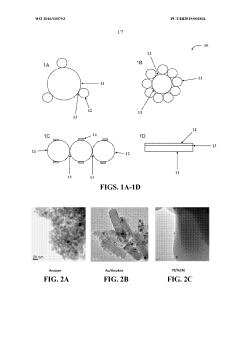
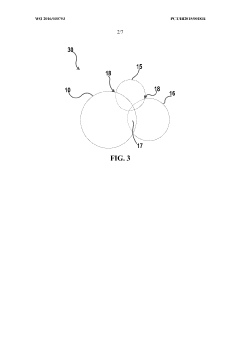
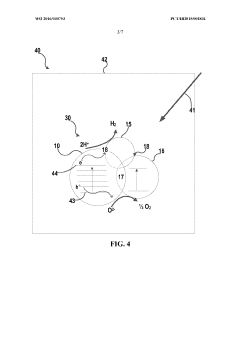
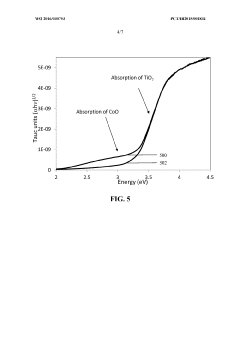
- A photocatalyst combining a p-n junction formed by an n-type semiconductor material, such as titanium dioxide, with a p-type semiconductor and metal or metal alloy having surface plasmon resonance properties, which increases charge carrier lifetime and reduces recombination, allowing for efficient hydrogen and oxygen production without external bias or voltage.
Environmental Impact and Sustainability Considerations
The expansion of light absorption range through photocatalyst heterojunctions represents a significant advancement in sustainable environmental technologies. These advanced materials offer substantial environmental benefits by enabling more efficient utilization of solar energy for various remediation and energy conversion processes. The primary environmental impact lies in their application for water purification, where heterojunction photocatalysts can effectively degrade persistent organic pollutants, pharmaceuticals, and industrial contaminants using only sunlight as an energy source, reducing the need for chemical additives and energy-intensive treatment methods.
Air pollution mitigation represents another critical environmental application, as these materials can catalyze the breakdown of atmospheric pollutants including nitrogen oxides, volatile organic compounds, and particulate matter. The enhanced light absorption capabilities of heterojunction systems enable these processes to occur under ambient conditions with minimal energy input, contributing to improved urban air quality and reduced respiratory health risks.
From a sustainability perspective, photocatalyst heterojunctions align with circular economy principles by enabling chemical transformations with minimal waste generation. Their ability to harness a broader spectrum of solar radiation—including visible and near-infrared wavelengths—significantly improves the energy efficiency of photocatalytic processes compared to traditional single-component catalysts that primarily utilize UV radiation. This expanded absorption capability translates to higher quantum efficiencies and reduced carbon footprints for environmental remediation technologies.
The materials sustainability aspect must also be considered, as some heterojunction systems incorporate rare earth elements or toxic components. Life cycle assessments indicate that despite these concerns, the net environmental benefit typically remains positive when considering the operational phase benefits. Research trends show increasing focus on developing heterojunctions using earth-abundant, non-toxic materials such as carbon nitride, iron oxides, and bismuth-based compounds to enhance the overall sustainability profile.
Long-term environmental persistence and potential ecological impacts of nanostructured photocatalyst particles represent ongoing research challenges. Studies suggest that immobilization techniques and recovery systems can minimize environmental release, while proper design considerations can enhance biodegradability after the operational lifetime. The development of standardized ecotoxicological testing protocols specifically for photocatalytic materials remains an important research direction to ensure their environmental safety.
Climate change mitigation potential represents perhaps the most significant environmental contribution of expanded-spectrum photocatalysts, particularly through their application in artificial photosynthesis and solar fuel production. By efficiently converting solar energy and atmospheric CO2 into valuable chemical feedstocks or fuels, these materials offer pathways toward carbon-neutral or even carbon-negative technological solutions that address both energy security and climate challenges simultaneously.
Air pollution mitigation represents another critical environmental application, as these materials can catalyze the breakdown of atmospheric pollutants including nitrogen oxides, volatile organic compounds, and particulate matter. The enhanced light absorption capabilities of heterojunction systems enable these processes to occur under ambient conditions with minimal energy input, contributing to improved urban air quality and reduced respiratory health risks.
From a sustainability perspective, photocatalyst heterojunctions align with circular economy principles by enabling chemical transformations with minimal waste generation. Their ability to harness a broader spectrum of solar radiation—including visible and near-infrared wavelengths—significantly improves the energy efficiency of photocatalytic processes compared to traditional single-component catalysts that primarily utilize UV radiation. This expanded absorption capability translates to higher quantum efficiencies and reduced carbon footprints for environmental remediation technologies.
The materials sustainability aspect must also be considered, as some heterojunction systems incorporate rare earth elements or toxic components. Life cycle assessments indicate that despite these concerns, the net environmental benefit typically remains positive when considering the operational phase benefits. Research trends show increasing focus on developing heterojunctions using earth-abundant, non-toxic materials such as carbon nitride, iron oxides, and bismuth-based compounds to enhance the overall sustainability profile.
Long-term environmental persistence and potential ecological impacts of nanostructured photocatalyst particles represent ongoing research challenges. Studies suggest that immobilization techniques and recovery systems can minimize environmental release, while proper design considerations can enhance biodegradability after the operational lifetime. The development of standardized ecotoxicological testing protocols specifically for photocatalytic materials remains an important research direction to ensure their environmental safety.
Climate change mitigation potential represents perhaps the most significant environmental contribution of expanded-spectrum photocatalysts, particularly through their application in artificial photosynthesis and solar fuel production. By efficiently converting solar energy and atmospheric CO2 into valuable chemical feedstocks or fuels, these materials offer pathways toward carbon-neutral or even carbon-negative technological solutions that address both energy security and climate challenges simultaneously.
Scalability and Commercial Viability Assessment
The scalability of photocatalyst heterojunction technologies represents a critical factor in their transition from laboratory research to commercial applications. Current manufacturing processes for advanced heterojunction photocatalysts often involve complex synthesis methods that are challenging to scale up, including hydrothermal synthesis, sol-gel processes, and atomic layer deposition. These methods typically require precise control of reaction conditions, which becomes increasingly difficult at industrial scales.
Cost considerations present significant barriers to commercialization. High-performance heterojunction photocatalysts frequently incorporate noble metals or rare earth elements as co-catalysts or sensitizers, substantially increasing production costs. For instance, platinum and palladium nanoparticles, commonly used to enhance charge separation, contribute to prohibitive material expenses that limit widespread adoption in cost-sensitive markets.
Manufacturing consistency poses another substantial challenge. Achieving uniform heterojunction interfaces across large production batches remains technically demanding. Small variations in synthesis conditions can lead to significant differences in photocatalytic performance, creating quality control issues that must be addressed before mass production becomes viable.
Despite these challenges, several promising approaches are emerging to enhance commercial viability. Continuous flow manufacturing techniques show potential for scaling up production while maintaining precise control over reaction parameters. Additionally, research into earth-abundant alternatives to precious metal components is progressing, with transition metal oxides and carbon-based materials demonstrating promising results as cost-effective substitutes.
Market analysis indicates that photocatalytic water treatment represents the most immediate commercial opportunity, with an estimated global market value of $3.5 billion by 2025. Solar fuel production, while technically more challenging, offers greater long-term economic potential if efficiency and durability targets can be met. Industry experts project that photocatalytic hydrogen production could become economically competitive with conventional methods within the next decade, assuming continued improvements in light absorption range and quantum efficiency.
Regulatory frameworks will significantly impact commercialization timelines. Environmental regulations increasingly favor green technologies, potentially accelerating adoption through incentive programs and pollution control requirements. However, novel photocatalytic materials must navigate safety assessment protocols before widespread deployment, particularly for water treatment applications where human exposure is a concern.
Cost considerations present significant barriers to commercialization. High-performance heterojunction photocatalysts frequently incorporate noble metals or rare earth elements as co-catalysts or sensitizers, substantially increasing production costs. For instance, platinum and palladium nanoparticles, commonly used to enhance charge separation, contribute to prohibitive material expenses that limit widespread adoption in cost-sensitive markets.
Manufacturing consistency poses another substantial challenge. Achieving uniform heterojunction interfaces across large production batches remains technically demanding. Small variations in synthesis conditions can lead to significant differences in photocatalytic performance, creating quality control issues that must be addressed before mass production becomes viable.
Despite these challenges, several promising approaches are emerging to enhance commercial viability. Continuous flow manufacturing techniques show potential for scaling up production while maintaining precise control over reaction parameters. Additionally, research into earth-abundant alternatives to precious metal components is progressing, with transition metal oxides and carbon-based materials demonstrating promising results as cost-effective substitutes.
Market analysis indicates that photocatalytic water treatment represents the most immediate commercial opportunity, with an estimated global market value of $3.5 billion by 2025. Solar fuel production, while technically more challenging, offers greater long-term economic potential if efficiency and durability targets can be met. Industry experts project that photocatalytic hydrogen production could become economically competitive with conventional methods within the next decade, assuming continued improvements in light absorption range and quantum efficiency.
Regulatory frameworks will significantly impact commercialization timelines. Environmental regulations increasingly favor green technologies, potentially accelerating adoption through incentive programs and pollution control requirements. However, novel photocatalytic materials must navigate safety assessment protocols before widespread deployment, particularly for water treatment applications where human exposure is a concern.
Unlock deeper insights with PatSnap Eureka Quick Research — get a full tech report to explore trends and direct your research. Try now!
Generate Your Research Report Instantly with AI Agent
Supercharge your innovation with PatSnap Eureka AI Agent Platform!