

How to Customize Cyclone Separator Features to Meet Unique Client Needs
FEB 11, 20269 MIN READ
Generate Your Research Report Instantly with AI Agent
Patsnap Eureka helps you evaluate technical feasibility & market potential.
Cyclone Separator Customization Background and Objectives
Cyclone separators have been fundamental components in industrial gas-solid separation processes for over a century, with their origins tracing back to the late 1800s when they were first employed in grain processing facilities. The technology has since evolved significantly, finding applications across diverse industries including petrochemical processing, power generation, cement manufacturing, pharmaceutical production, and environmental pollution control. The fundamental principle remains consistent: utilizing centrifugal force to separate particulate matter from gas streams through controlled vortex motion.
The evolution of cyclone separator technology reflects the increasing complexity and specificity of industrial requirements. Early designs followed standardized geometries with limited adaptability, primarily focusing on basic separation efficiency. However, contemporary industrial processes demand far more sophisticated solutions that address multiple performance parameters simultaneously, including separation efficiency, pressure drop, throughput capacity, wear resistance, and footprint constraints. This shift has necessitated a transition from one-size-fits-all approaches to highly customized engineering solutions.
The primary objective of cyclone separator customization is to optimize performance characteristics according to specific operational requirements and process conditions. Different industries present unique challenges: pharmaceutical applications require stringent hygiene standards and minimal product degradation, while mining operations prioritize durability under abrasive conditions. Chemical processing facilities may need explosion-proof designs or corrosion-resistant materials, whereas food processing demands compliance with sanitary regulations. Each application scenario presents distinct particle size distributions, gas flow rates, temperature ranges, and chemical environments that fundamentally influence design parameters.
Customization efforts aim to achieve optimal balance among competing performance metrics. Enhanced separation efficiency often comes at the cost of increased pressure drop, which directly impacts energy consumption. Similarly, compact designs may compromise throughput capacity, while specialized materials for corrosion resistance increase capital costs. The customization process therefore requires comprehensive understanding of client priorities, operational constraints, and long-term performance expectations to deliver solutions that maximize value within specific application contexts.
The evolution of cyclone separator technology reflects the increasing complexity and specificity of industrial requirements. Early designs followed standardized geometries with limited adaptability, primarily focusing on basic separation efficiency. However, contemporary industrial processes demand far more sophisticated solutions that address multiple performance parameters simultaneously, including separation efficiency, pressure drop, throughput capacity, wear resistance, and footprint constraints. This shift has necessitated a transition from one-size-fits-all approaches to highly customized engineering solutions.
The primary objective of cyclone separator customization is to optimize performance characteristics according to specific operational requirements and process conditions. Different industries present unique challenges: pharmaceutical applications require stringent hygiene standards and minimal product degradation, while mining operations prioritize durability under abrasive conditions. Chemical processing facilities may need explosion-proof designs or corrosion-resistant materials, whereas food processing demands compliance with sanitary regulations. Each application scenario presents distinct particle size distributions, gas flow rates, temperature ranges, and chemical environments that fundamentally influence design parameters.
Customization efforts aim to achieve optimal balance among competing performance metrics. Enhanced separation efficiency often comes at the cost of increased pressure drop, which directly impacts energy consumption. Similarly, compact designs may compromise throughput capacity, while specialized materials for corrosion resistance increase capital costs. The customization process therefore requires comprehensive understanding of client priorities, operational constraints, and long-term performance expectations to deliver solutions that maximize value within specific application contexts.
Client-Specific Cyclone Separator Market Demand Analysis
The market demand for customized cyclone separators has experienced substantial growth across multiple industrial sectors, driven by increasingly stringent environmental regulations and the need for process optimization. Industries such as petrochemical processing, pharmaceutical manufacturing, food and beverage production, mining operations, and power generation represent the primary demand sources. Each sector presents distinct separation challenges that require tailored solutions rather than standardized equipment.
In the petrochemical industry, clients demand cyclone separators capable of handling high-temperature streams with corrosive components while maintaining precise particle size cut-points. The pharmaceutical sector prioritizes hygienic design features, easy cleaning protocols, and contamination prevention mechanisms that comply with regulatory standards. Food processing facilities require separators constructed from food-grade materials with smooth internal surfaces to prevent product buildup and facilitate sanitation procedures.
Mining and mineral processing operations generate demand for heavy-duty cyclone separators that can withstand abrasive particle streams and operate continuously under harsh conditions. These clients typically require larger diameter units with wear-resistant linings and reinforced construction. The power generation sector, particularly biomass and coal-fired plants, seeks separators optimized for specific fuel characteristics and emission control requirements.
Emerging market segments include waste-to-energy facilities, battery material processing plants, and advanced manufacturing operations involving nanomaterials. These applications demand innovative separator designs with enhanced efficiency ratings, compact footprints, and integration capabilities with automated control systems. The growing emphasis on circular economy principles has also created demand for separators that maximize material recovery and minimize waste generation.
Geographic demand patterns reveal strong growth in Asia-Pacific regions due to rapid industrialization and environmental compliance enforcement. European markets demonstrate preference for energy-efficient designs with lower pressure drops, while North American clients increasingly seek modular systems that allow capacity expansion. The customization trend reflects a fundamental shift from commodity equipment purchasing toward engineered solutions that address specific operational challenges, improve process economics, and ensure regulatory compliance across diverse industrial applications.
In the petrochemical industry, clients demand cyclone separators capable of handling high-temperature streams with corrosive components while maintaining precise particle size cut-points. The pharmaceutical sector prioritizes hygienic design features, easy cleaning protocols, and contamination prevention mechanisms that comply with regulatory standards. Food processing facilities require separators constructed from food-grade materials with smooth internal surfaces to prevent product buildup and facilitate sanitation procedures.
Mining and mineral processing operations generate demand for heavy-duty cyclone separators that can withstand abrasive particle streams and operate continuously under harsh conditions. These clients typically require larger diameter units with wear-resistant linings and reinforced construction. The power generation sector, particularly biomass and coal-fired plants, seeks separators optimized for specific fuel characteristics and emission control requirements.
Emerging market segments include waste-to-energy facilities, battery material processing plants, and advanced manufacturing operations involving nanomaterials. These applications demand innovative separator designs with enhanced efficiency ratings, compact footprints, and integration capabilities with automated control systems. The growing emphasis on circular economy principles has also created demand for separators that maximize material recovery and minimize waste generation.
Geographic demand patterns reveal strong growth in Asia-Pacific regions due to rapid industrialization and environmental compliance enforcement. European markets demonstrate preference for energy-efficient designs with lower pressure drops, while North American clients increasingly seek modular systems that allow capacity expansion. The customization trend reflects a fundamental shift from commodity equipment purchasing toward engineered solutions that address specific operational challenges, improve process economics, and ensure regulatory compliance across diverse industrial applications.
Current Cyclone Technology Status and Customization Challenges
Cyclone separator technology has evolved significantly since its inception in the late 19th century, establishing itself as a fundamental solution for particle separation across industries including mining, chemical processing, power generation, and environmental control. Modern cyclone separators operate on centrifugal force principles, achieving separation efficiencies ranging from 50% to 99% depending on particle size and design parameters. The technology has matured to include various configurations such as reverse-flow, uniflow, and axial-flow designs, each optimized for specific operational requirements.
Despite technological advancements, the industry faces substantial challenges in meeting diverse client customization demands. The primary technical constraint lies in balancing multiple performance parameters simultaneously. When clients require enhanced separation efficiency for fine particles below 5 microns, modifications to cyclone geometry often result in increased pressure drop and energy consumption. This trade-off becomes particularly problematic in applications where operational costs are critical factors.
Material compatibility presents another significant customization challenge. Industries handling corrosive substances, high-temperature gases, or abrasive particles require specialized construction materials and surface treatments. However, material selection directly impacts manufacturing costs, lead times, and maintenance requirements. The challenge intensifies when clients operate in extreme conditions requiring both chemical resistance and structural integrity at elevated temperatures exceeding 800°C.
Scalability issues further complicate customization efforts. While laboratory-scale cyclones demonstrate predictable performance, scaling up to industrial capacities introduces complex fluid dynamics phenomena that are difficult to model accurately. Clients requiring throughput capacities ranging from pilot-scale operations to large industrial installations often encounter performance deviations from predicted values, necessitating iterative design adjustments and extended development cycles.
Current manufacturing limitations also constrain customization possibilities. Traditional fabrication methods struggle to produce complex internal geometries that computational fluid dynamics studies suggest could enhance performance. The gap between theoretically optimal designs and practically manufacturable configurations remains a persistent challenge. Additionally, standardization pressures from supply chain economics conflict with the need for highly customized solutions, creating tension between cost-effectiveness and performance optimization.
The integration of monitoring and control systems into customized cyclone designs presents emerging challenges. Clients increasingly demand real-time performance monitoring, automated adjustment capabilities, and predictive maintenance features. However, retrofitting traditional cyclone designs with sensors and control mechanisms without compromising separation performance requires innovative engineering approaches that are still under development across the industry.
Despite technological advancements, the industry faces substantial challenges in meeting diverse client customization demands. The primary technical constraint lies in balancing multiple performance parameters simultaneously. When clients require enhanced separation efficiency for fine particles below 5 microns, modifications to cyclone geometry often result in increased pressure drop and energy consumption. This trade-off becomes particularly problematic in applications where operational costs are critical factors.
Material compatibility presents another significant customization challenge. Industries handling corrosive substances, high-temperature gases, or abrasive particles require specialized construction materials and surface treatments. However, material selection directly impacts manufacturing costs, lead times, and maintenance requirements. The challenge intensifies when clients operate in extreme conditions requiring both chemical resistance and structural integrity at elevated temperatures exceeding 800°C.
Scalability issues further complicate customization efforts. While laboratory-scale cyclones demonstrate predictable performance, scaling up to industrial capacities introduces complex fluid dynamics phenomena that are difficult to model accurately. Clients requiring throughput capacities ranging from pilot-scale operations to large industrial installations often encounter performance deviations from predicted values, necessitating iterative design adjustments and extended development cycles.
Current manufacturing limitations also constrain customization possibilities. Traditional fabrication methods struggle to produce complex internal geometries that computational fluid dynamics studies suggest could enhance performance. The gap between theoretically optimal designs and practically manufacturable configurations remains a persistent challenge. Additionally, standardization pressures from supply chain economics conflict with the need for highly customized solutions, creating tension between cost-effectiveness and performance optimization.
The integration of monitoring and control systems into customized cyclone designs presents emerging challenges. Clients increasingly demand real-time performance monitoring, automated adjustment capabilities, and predictive maintenance features. However, retrofitting traditional cyclone designs with sensors and control mechanisms without compromising separation performance requires innovative engineering approaches that are still under development across the industry.
Mainstream Customizable Cyclone Separator Solutions
01 Multi-stage separation structure
Cyclone separators can be designed with multi-stage separation structures to enhance separation efficiency. This involves using multiple cyclone chambers arranged in series or parallel configurations, where particles are progressively separated based on size and density. The multi-stage design allows for better classification of particles and improved overall separation performance, particularly for handling materials with wide particle size distributions.- Multi-stage separation structure: Cyclone separators can be designed with multi-stage separation structures to enhance separation efficiency. This configuration typically includes primary and secondary separation chambers that work in series to remove particles of different sizes. The multi-stage design allows for better classification of particles and improved overall separation performance by utilizing different centrifugal forces at each stage.
- Optimized inlet and outlet configurations: The inlet and outlet design of cyclone separators significantly affects separation performance. Advanced configurations include tangential or spiral inlet designs that maximize rotational flow, and specialized outlet structures such as vortex finders with optimized dimensions and positions. These design features help reduce pressure drop while maintaining high separation efficiency and preventing re-entrainment of separated particles.
- Compact and integrated design: Modern cyclone separators feature compact designs that integrate multiple functional components into a single unit. This includes integrated collection chambers, dust bins, and filtration elements that reduce overall footprint and simplify installation. The compact design is particularly beneficial for applications with space constraints while maintaining effective separation capabilities.
- Enhanced particle collection and discharge mechanisms: Cyclone separators incorporate specialized mechanisms for efficient particle collection and discharge. These features include conical bottom sections with optimized angles, automatic discharge valves, and anti-blocking devices that prevent accumulation of separated materials. Such mechanisms ensure continuous operation and reduce maintenance requirements while improving overall system reliability.
- Flow optimization and turbulence reduction features: Advanced cyclone separators include features designed to optimize internal flow patterns and reduce turbulence. These include guide vanes, flow straighteners, and specially shaped internal surfaces that minimize energy losses and improve separation efficiency. The optimization of flow characteristics helps achieve better particle separation while reducing pressure drop across the separator.
02 Optimized inlet and outlet configurations
The inlet and outlet designs of cyclone separators significantly affect separation performance. Advanced configurations include tangential or spiral inlets that create optimal vortex flow patterns, and specially designed outlets with vortex finders that minimize particle re-entrainment. These optimized configurations help maintain stable flow patterns and reduce pressure drop while maximizing separation efficiency.Expand Specific Solutions03 Wear-resistant internal components
Cyclone separators incorporate wear-resistant materials and protective linings in high-wear areas to extend service life. This includes the use of ceramic coatings, hardened steel inserts, or composite materials in the cone section and inlet areas where particle impact is most severe. These features reduce maintenance requirements and ensure consistent performance over extended operating periods.Expand Specific Solutions04 Adjustable separation parameters
Modern cyclone separators feature adjustable components that allow operators to optimize separation parameters for different operating conditions. This includes variable cone angles, adjustable vortex finder depths, and modifiable inlet dimensions. These adjustable features enable the separator to handle varying feed rates, particle sizes, and material properties while maintaining optimal separation efficiency.Expand Specific Solutions05 Integrated dust collection and discharge systems
Cyclone separators are equipped with integrated systems for efficient collection and discharge of separated materials. These systems include sealed dust collection hoppers, rotary valves for continuous discharge, and pneumatic conveying connections. The integrated design prevents material leakage, facilitates automated operation, and allows for easy integration into larger processing systems.Expand Specific Solutions
Major Cyclone Separator Manufacturers and Competitors
The cyclone separator customization market is experiencing steady growth driven by increasing demand across industrial filtration, petrochemical processing, and environmental control applications. The competitive landscape features a diverse mix of established engineering conglomerates, specialized filtration manufacturers, and emerging technology providers. Major industrial players like MANN+HUMMEL GmbH, Siemens AG, and Robert Bosch GmbH leverage their extensive R&D capabilities and global manufacturing networks to deliver highly customized solutions. Chinese petrochemical engineering firms including SINOPEC Engineering Group and Sinopec Ningbo Engineering Co., Ltd. demonstrate strong technical maturity in large-scale industrial applications. Specialized filtration companies such as Donaldson Filtration Deutschland GmbH and Esta Apparatebau GmbH & Co. KG focus on niche customization for specific industrial sectors. Academic institutions like Donghua University, Lanzhou University, and China Petroleum University Beijing contribute to advancing separation technology fundamentals. The technology has reached commercial maturity with ongoing innovation in computational fluid dynamics modeling, material science, and IoT-enabled performance monitoring to meet increasingly specific client requirements across diverse industrial applications.
MANN+HUMMEL GmbH
Technical Solution: MANN+HUMMEL develops customized cyclone separator solutions through modular design architecture that allows flexible configuration of inlet geometry, cone angles, and vortex finder dimensions based on specific particle size distributions and flow rates. Their approach integrates computational fluid dynamics (CFD) simulation to optimize separation efficiency for different industrial applications, ranging from automotive air filtration to industrial dust collection. The company offers adjustable cyclone body materials including stainless steel, polymer composites, and ceramic linings to handle corrosive environments and high-temperature operations. Their customization process includes on-site flow analysis, particle characterization testing, and prototype validation to ensure the cyclone design meets client-specific performance targets for pressure drop, separation efficiency, and operational durability.
Strengths: Extensive experience in filtration technology with strong R&D capabilities and global manufacturing network enabling rapid prototyping. Weaknesses: Higher cost compared to standard solutions and longer lead times for highly customized designs.
SINOPEC Engineering (Group) Co., Ltd.
Technical Solution: SINOPEC Engineering specializes in customizing large-scale industrial cyclone separators for petrochemical and refining applications through parametric design methodology. Their customization approach focuses on scaling cyclone dimensions to handle varying volumetric flow rates from 1,000 to 100,000 m³/h while maintaining separation efficiency above 95% for particles larger than 10 microns. The company employs advanced numerical modeling to optimize cyclone geometry including inlet duct configuration, cylindrical section length-to-diameter ratios, and cone apex angles tailored to specific process conditions. They offer multi-cyclone arrangements with customized manifold designs for uniform flow distribution and provide material selection guidance for handling corrosive gases, high temperatures up to 800°C, and abrasive particle streams. Integration with existing process equipment and compliance with client-specific safety standards are core elements of their customization service.
Strengths: Deep expertise in large-scale industrial applications with proven track record in petrochemical sector and cost-effective solutions for high-capacity systems. Weaknesses: Limited presence in specialized niche markets and slower adaptation to emerging technologies compared to specialized filtration companies.
Key Patents in Modular Cyclone Design
Cyclone separator
PatentInactiveAU1988013983A1
Innovation
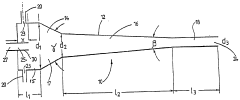
- A cyclone separator of the de-watering type is designed with specific geometrical modifications, including a reduced cross-sectional dimension at the downstream end of the feed inlet section and a vortex finder to prevent re-entrainment of droplets, allowing for efficient separation of denser and less dense components.
Cyclone separator
PatentInactiveCA1117441A
Innovation
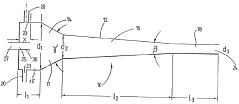
- A cyclone separator with a cylindrical design featuring tangentially directed feeds, axial overflow outlets, and optional flow-smoothing tapers, optimized by specific diameter and length ratios to facilitate the separation of lighter phases from denser phases, allowing for efficient separation of oil from water.

Industry Standards for Cyclone Separator Performance
Industry standards for cyclone separator performance serve as fundamental benchmarks that guide both manufacturers and end-users in evaluating equipment effectiveness and ensuring operational reliability. These standards establish quantifiable metrics for separation efficiency, pressure drop characteristics, particle size cut points, and overall system performance. Organizations such as ISO, ASME, and various national standards bodies have developed comprehensive frameworks that define testing methodologies, performance criteria, and quality assurance protocols specific to cyclone separation technology.
The most widely recognized performance parameters include collection efficiency curves, which typically specify minimum separation rates for different particle size ranges, and pressure drop limitations that balance energy consumption against separation effectiveness. Standards such as ISO 14644 for cleanroom applications and EPA guidelines for industrial emissions control provide specific performance thresholds that cyclone separators must achieve. These benchmarks directly influence customization decisions, as client-specific requirements must align with or exceed established regulatory minimums while optimizing for particular operational conditions.
Compliance with industry standards becomes particularly critical when customizing cyclone separators for specialized applications. Standards dictate material selection criteria, structural integrity requirements, and safety factors that must be maintained regardless of design modifications. For instance, ASME pressure vessel codes govern wall thickness calculations and stress analysis procedures, while ATEX directives in Europe mandate specific design features for explosive atmosphere applications. Understanding these mandatory requirements enables engineers to identify the permissible scope of customization without compromising regulatory compliance.
Performance testing protocols standardized by organizations like ASTM provide reproducible methodologies for validating customized designs against baseline specifications. These testing frameworks ensure that modifications intended to meet unique client needs do not inadvertently degrade performance below acceptable thresholds. Documentation requirements embedded within these standards also facilitate quality assurance processes and enable meaningful performance comparisons across different customization approaches, ultimately supporting informed decision-making in tailoring cyclone separator features to specific industrial applications.
The most widely recognized performance parameters include collection efficiency curves, which typically specify minimum separation rates for different particle size ranges, and pressure drop limitations that balance energy consumption against separation effectiveness. Standards such as ISO 14644 for cleanroom applications and EPA guidelines for industrial emissions control provide specific performance thresholds that cyclone separators must achieve. These benchmarks directly influence customization decisions, as client-specific requirements must align with or exceed established regulatory minimums while optimizing for particular operational conditions.
Compliance with industry standards becomes particularly critical when customizing cyclone separators for specialized applications. Standards dictate material selection criteria, structural integrity requirements, and safety factors that must be maintained regardless of design modifications. For instance, ASME pressure vessel codes govern wall thickness calculations and stress analysis procedures, while ATEX directives in Europe mandate specific design features for explosive atmosphere applications. Understanding these mandatory requirements enables engineers to identify the permissible scope of customization without compromising regulatory compliance.
Performance testing protocols standardized by organizations like ASTM provide reproducible methodologies for validating customized designs against baseline specifications. These testing frameworks ensure that modifications intended to meet unique client needs do not inadvertently degrade performance below acceptable thresholds. Documentation requirements embedded within these standards also facilitate quality assurance processes and enable meaningful performance comparisons across different customization approaches, ultimately supporting informed decision-making in tailoring cyclone separator features to specific industrial applications.
Cost-Benefit Analysis of Customization Strategies
Customization strategies for cyclone separators require careful economic evaluation to ensure that tailored solutions deliver measurable value without compromising profitability. The cost-benefit analysis framework must account for both direct financial impacts and indirect operational advantages that customization brings to specific industrial applications. Initial investment considerations include engineering design modifications, prototype development, specialized material procurement, and extended manufacturing lead times. These upfront costs typically range from fifteen to forty percent above standard product pricing, depending on the complexity of modifications requested by clients.
The benefit side encompasses multiple dimensions that extend beyond simple performance metrics. Enhanced separation efficiency directly translates to reduced material loss, lower energy consumption per unit of processed material, and decreased maintenance frequency due to optimized wear patterns. For instance, customized inlet configurations can improve particle capture rates by twelve to twenty-five percent in specific applications, generating substantial annual savings in raw material recovery. Extended equipment lifespan through application-specific material selection often justifies premium pricing, particularly in highly abrasive or corrosive environments where standard units require frequent replacement.
Operational flexibility represents another significant benefit category. Customized cyclone separators designed for variable flow rates or multiple particle size distributions enable clients to adapt to changing production demands without capital equipment replacement. This adaptability reduces long-term capital expenditure and minimizes production disruptions during market fluctuations. The quantifiable value of this flexibility varies by industry but typically represents eight to fifteen percent of total ownership cost over a ten-year operational period.
Risk mitigation constitutes a critical yet often undervalued benefit. Customization that addresses specific safety concerns, regulatory compliance requirements, or environmental standards reduces potential liability exposure and regulatory penalties. These risk-adjusted benefits can substantially alter the economic equation, particularly in heavily regulated industries such as pharmaceuticals or food processing.
The break-even analysis for customization strategies generally indicates payback periods ranging from eighteen months to four years, depending on production scale and operational intensity. High-volume operations with continuous processing schedules typically achieve faster returns on customization investments compared to batch processing facilities. Strategic customization decisions should therefore incorporate comprehensive lifecycle cost modeling that accounts for maintenance patterns, energy price projections, and anticipated regulatory changes to ensure robust economic justification across varying operational scenarios.
The benefit side encompasses multiple dimensions that extend beyond simple performance metrics. Enhanced separation efficiency directly translates to reduced material loss, lower energy consumption per unit of processed material, and decreased maintenance frequency due to optimized wear patterns. For instance, customized inlet configurations can improve particle capture rates by twelve to twenty-five percent in specific applications, generating substantial annual savings in raw material recovery. Extended equipment lifespan through application-specific material selection often justifies premium pricing, particularly in highly abrasive or corrosive environments where standard units require frequent replacement.
Operational flexibility represents another significant benefit category. Customized cyclone separators designed for variable flow rates or multiple particle size distributions enable clients to adapt to changing production demands without capital equipment replacement. This adaptability reduces long-term capital expenditure and minimizes production disruptions during market fluctuations. The quantifiable value of this flexibility varies by industry but typically represents eight to fifteen percent of total ownership cost over a ten-year operational period.
Risk mitigation constitutes a critical yet often undervalued benefit. Customization that addresses specific safety concerns, regulatory compliance requirements, or environmental standards reduces potential liability exposure and regulatory penalties. These risk-adjusted benefits can substantially alter the economic equation, particularly in heavily regulated industries such as pharmaceuticals or food processing.
The break-even analysis for customization strategies generally indicates payback periods ranging from eighteen months to four years, depending on production scale and operational intensity. High-volume operations with continuous processing schedules typically achieve faster returns on customization investments compared to batch processing facilities. Strategic customization decisions should therefore incorporate comprehensive lifecycle cost modeling that accounts for maintenance patterns, energy price projections, and anticipated regulatory changes to ensure robust economic justification across varying operational scenarios.
Unlock deeper insights with Patsnap Eureka Quick Research — get a full tech report to explore trends and direct your research. Try now!
Generate Your Research Report Instantly with AI Agent
Supercharge your innovation with Patsnap Eureka AI Agent Platform!