How to Enhance Polydimethylsiloxane for Seamless Application
MAR 10, 20269 MIN READ
Generate Your Research Report Instantly with AI Agent
PatSnap Eureka helps you evaluate technical feasibility & market potential.
PDMS Enhancement Background and Technical Objectives
Polydimethylsiloxane (PDMS) has emerged as a cornerstone material in numerous industrial applications since its commercial introduction in the 1940s. This silicon-based polymer exhibits exceptional properties including thermal stability, chemical inertness, low surface energy, and optical transparency, making it indispensable across diverse sectors from microfluidics to biomedical devices. However, the evolution of modern applications demands enhanced performance characteristics that exceed conventional PDMS capabilities.
The historical development of PDMS enhancement technologies traces back to the 1960s when researchers first recognized the need for improved mechanical properties and surface functionalization. Early enhancement efforts focused primarily on crosslinking modifications and filler incorporation to address brittleness and limited adhesion properties. The advent of microelectronics and biotechnology in the 1980s and 1990s accelerated research into PDMS modifications, particularly for applications requiring precise dimensional stability and biocompatibility.
Contemporary technological trends indicate a paradigm shift toward multifunctional PDMS systems capable of seamless integration across complex application environments. The increasing miniaturization of devices, coupled with demands for sustainable manufacturing processes, has created unprecedented challenges for traditional PDMS formulations. Current enhancement approaches encompass surface modification techniques, nanocomposite integration, and molecular-level structural optimization to achieve superior performance metrics.
The primary technical objectives for PDMS enhancement center on achieving seamless application compatibility through improved mechanical robustness, enhanced surface properties, and optimized processing characteristics. Mechanical enhancement targets include increased tensile strength, improved tear resistance, and reduced creep behavior under sustained loading conditions. These improvements are essential for applications in automotive sealing systems, aerospace components, and high-performance electronic encapsulation.
Surface property optimization represents another critical objective, focusing on controlled wettability, enhanced adhesion to diverse substrates, and improved chemical resistance. Advanced surface functionalization techniques aim to create PDMS variants with tunable hydrophilic-hydrophobic balance, enabling seamless integration with both organic and inorganic materials. This capability is particularly crucial for biomedical applications and advanced coating systems.
Processing enhancement objectives encompass improved curing kinetics, reduced volatile emissions, and enhanced dimensional stability during fabrication. These improvements facilitate seamless manufacturing integration while maintaining the inherent advantages of PDMS, such as low-temperature processing and excellent mold release properties. The ultimate goal involves developing PDMS formulations that combine enhanced performance with simplified processing requirements, enabling broader adoption across emerging technological applications.
The historical development of PDMS enhancement technologies traces back to the 1960s when researchers first recognized the need for improved mechanical properties and surface functionalization. Early enhancement efforts focused primarily on crosslinking modifications and filler incorporation to address brittleness and limited adhesion properties. The advent of microelectronics and biotechnology in the 1980s and 1990s accelerated research into PDMS modifications, particularly for applications requiring precise dimensional stability and biocompatibility.
Contemporary technological trends indicate a paradigm shift toward multifunctional PDMS systems capable of seamless integration across complex application environments. The increasing miniaturization of devices, coupled with demands for sustainable manufacturing processes, has created unprecedented challenges for traditional PDMS formulations. Current enhancement approaches encompass surface modification techniques, nanocomposite integration, and molecular-level structural optimization to achieve superior performance metrics.
The primary technical objectives for PDMS enhancement center on achieving seamless application compatibility through improved mechanical robustness, enhanced surface properties, and optimized processing characteristics. Mechanical enhancement targets include increased tensile strength, improved tear resistance, and reduced creep behavior under sustained loading conditions. These improvements are essential for applications in automotive sealing systems, aerospace components, and high-performance electronic encapsulation.
Surface property optimization represents another critical objective, focusing on controlled wettability, enhanced adhesion to diverse substrates, and improved chemical resistance. Advanced surface functionalization techniques aim to create PDMS variants with tunable hydrophilic-hydrophobic balance, enabling seamless integration with both organic and inorganic materials. This capability is particularly crucial for biomedical applications and advanced coating systems.
Processing enhancement objectives encompass improved curing kinetics, reduced volatile emissions, and enhanced dimensional stability during fabrication. These improvements facilitate seamless manufacturing integration while maintaining the inherent advantages of PDMS, such as low-temperature processing and excellent mold release properties. The ultimate goal involves developing PDMS formulations that combine enhanced performance with simplified processing requirements, enabling broader adoption across emerging technological applications.
Market Demand for Advanced PDMS Applications
The global demand for advanced polydimethylsiloxane applications has experienced substantial growth across multiple industrial sectors, driven by the material's unique combination of thermal stability, chemical inertness, and mechanical flexibility. Healthcare and medical device manufacturing represent the largest consumption segment, where enhanced PDMS formulations are essential for biocompatible implants, microfluidic devices, and drug delivery systems. The stringent regulatory requirements in these applications necessitate seamless integration capabilities and superior surface properties.
Electronics and semiconductor industries constitute another major demand driver, particularly for advanced packaging solutions and flexible electronic components. The proliferation of wearable technology and Internet of Things devices has intensified requirements for PDMS materials that can maintain electrical insulation properties while providing mechanical durability under repeated stress cycles. Automotive applications increasingly rely on enhanced PDMS for gaskets, seals, and sensor components that must withstand extreme temperature variations and chemical exposure.
The aerospace sector presents growing opportunities for specialized PDMS applications, where seamless performance under harsh environmental conditions is critical. Enhanced formulations capable of maintaining structural integrity across wide temperature ranges while providing reliable sealing performance are particularly sought after for satellite components and aircraft systems.
Emerging applications in renewable energy systems, particularly solar panel encapsulation and wind turbine components, are creating new market segments for advanced PDMS materials. These applications demand enhanced UV resistance, weatherability, and long-term mechanical stability that exceed conventional PDMS capabilities.
The cosmetics and personal care industry represents a rapidly expanding market segment, where enhanced PDMS formulations enable improved texture, spreadability, and skin compatibility in premium product lines. Consumer preferences for high-performance formulations with superior sensory properties continue to drive innovation requirements.
Regional demand patterns show concentrated growth in Asia-Pacific manufacturing hubs, North American technology centers, and European automotive and healthcare markets. The increasing emphasis on sustainable manufacturing processes and bio-based alternatives is shaping future demand specifications, requiring enhanced PDMS solutions that balance performance with environmental considerations.
Electronics and semiconductor industries constitute another major demand driver, particularly for advanced packaging solutions and flexible electronic components. The proliferation of wearable technology and Internet of Things devices has intensified requirements for PDMS materials that can maintain electrical insulation properties while providing mechanical durability under repeated stress cycles. Automotive applications increasingly rely on enhanced PDMS for gaskets, seals, and sensor components that must withstand extreme temperature variations and chemical exposure.
The aerospace sector presents growing opportunities for specialized PDMS applications, where seamless performance under harsh environmental conditions is critical. Enhanced formulations capable of maintaining structural integrity across wide temperature ranges while providing reliable sealing performance are particularly sought after for satellite components and aircraft systems.
Emerging applications in renewable energy systems, particularly solar panel encapsulation and wind turbine components, are creating new market segments for advanced PDMS materials. These applications demand enhanced UV resistance, weatherability, and long-term mechanical stability that exceed conventional PDMS capabilities.
The cosmetics and personal care industry represents a rapidly expanding market segment, where enhanced PDMS formulations enable improved texture, spreadability, and skin compatibility in premium product lines. Consumer preferences for high-performance formulations with superior sensory properties continue to drive innovation requirements.
Regional demand patterns show concentrated growth in Asia-Pacific manufacturing hubs, North American technology centers, and European automotive and healthcare markets. The increasing emphasis on sustainable manufacturing processes and bio-based alternatives is shaping future demand specifications, requiring enhanced PDMS solutions that balance performance with environmental considerations.
Current PDMS Limitations and Processing Challenges
Polydimethylsiloxane faces significant mechanical property limitations that restrict its seamless application across various industries. The inherently low tensile strength and tear resistance of conventional PDMS formulations present substantial challenges in applications requiring mechanical durability. Standard PDMS exhibits poor adhesion to most substrates, particularly metals and ceramics, leading to delamination issues in multilayer systems and compromising long-term reliability in critical applications.
Processing challenges emerge prominently during the curing phase, where achieving uniform crosslinking density remains problematic. Incomplete curing often results in tacky surfaces and dimensional instability, while overcuring can lead to brittleness and reduced flexibility. The temperature-sensitive nature of PDMS curing processes creates narrow processing windows, making large-scale manufacturing operations particularly challenging to control consistently.
Thermal stability limitations become apparent at elevated temperatures, where PDMS undergoes degradation through chain scission and crosslink breakdown. This thermal sensitivity restricts applications in high-temperature environments and limits the material's utility in automotive, aerospace, and industrial processing applications where thermal cycling is common.
Surface modification challenges represent another critical limitation area. The hydrophobic nature of PDMS surfaces makes functionalization difficult, limiting biocompatibility enhancements and specialized surface treatments. Traditional surface modification techniques often result in temporary improvements that degrade over time due to hydrophobic recovery phenomena.
Manufacturing scalability issues arise from the material's sensitivity to contamination and moisture during processing. Even trace amounts of impurities can significantly affect curing kinetics and final properties, necessitating stringent environmental controls that increase production costs. The pot life limitations of mixed PDMS systems create additional constraints in manufacturing workflows.
Optical clarity maintenance presents ongoing challenges, particularly in applications requiring long-term transparency. PDMS is susceptible to yellowing under UV exposure and can develop haze due to low molecular weight species migration, limiting its effectiveness in optical and display applications where clarity is paramount.
Processing challenges emerge prominently during the curing phase, where achieving uniform crosslinking density remains problematic. Incomplete curing often results in tacky surfaces and dimensional instability, while overcuring can lead to brittleness and reduced flexibility. The temperature-sensitive nature of PDMS curing processes creates narrow processing windows, making large-scale manufacturing operations particularly challenging to control consistently.
Thermal stability limitations become apparent at elevated temperatures, where PDMS undergoes degradation through chain scission and crosslink breakdown. This thermal sensitivity restricts applications in high-temperature environments and limits the material's utility in automotive, aerospace, and industrial processing applications where thermal cycling is common.
Surface modification challenges represent another critical limitation area. The hydrophobic nature of PDMS surfaces makes functionalization difficult, limiting biocompatibility enhancements and specialized surface treatments. Traditional surface modification techniques often result in temporary improvements that degrade over time due to hydrophobic recovery phenomena.
Manufacturing scalability issues arise from the material's sensitivity to contamination and moisture during processing. Even trace amounts of impurities can significantly affect curing kinetics and final properties, necessitating stringent environmental controls that increase production costs. The pot life limitations of mixed PDMS systems create additional constraints in manufacturing workflows.
Optical clarity maintenance presents ongoing challenges, particularly in applications requiring long-term transparency. PDMS is susceptible to yellowing under UV exposure and can develop haze due to low molecular weight species migration, limiting its effectiveness in optical and display applications where clarity is paramount.
Existing PDMS Modification and Enhancement Solutions
01 Polydimethylsiloxane in cosmetic and personal care formulations
Polydimethylsiloxane (PDMS) is widely used in cosmetic and personal care products as an emollient, skin conditioning agent, and film-forming ingredient. It provides smooth texture, water resistance, and enhanced spreadability to formulations. PDMS can improve the sensory properties of sunscreen and tanning products while maintaining product stability and enhancing skin feel.- Use of polydimethylsiloxane as a film-forming agent in cosmetic formulations: Polydimethylsiloxane can be incorporated into cosmetic and personal care products as a film-forming agent to create a protective barrier on the skin surface. This silicone polymer helps to improve water resistance and enhance the longevity of active ingredients in tanning and sun protection products. The film-forming properties contribute to better adhesion of the formulation to the skin, thereby improving the overall efficacy and durability of the sun protection factor.
- Incorporation of polydimethylsiloxane for improved texture and spreadability: Polydimethylsiloxane serves as an excellent emollient and texture modifier in tanning formulations. It provides a smooth, silky feel upon application and enhances the spreadability of the product across the skin surface. This improved sensory profile encourages uniform application, which is critical for achieving consistent sun protection coverage. The lightweight nature of this silicone compound also prevents the heavy or greasy feeling often associated with sun protection products.
- Use of polydimethylsiloxane as a carrier for UV filters and active ingredients: Polydimethylsiloxane can function as an effective carrier system for dispersing and stabilizing UV filters and other active ingredients in tanning formulations. Its compatibility with both organic and inorganic sunscreen agents allows for better distribution of these protective compounds throughout the formulation. This carrier function helps maintain the stability of photosensitive ingredients and ensures their uniform delivery to the skin surface, thereby enhancing the sun protection factor.
- Application of polydimethylsiloxane for water-resistant formulations: Polydimethylsiloxane exhibits excellent water-repellent properties that can be leveraged to create water-resistant tanning and sun protection products. The hydrophobic nature of this silicone polymer helps to maintain the integrity of the formulation even when exposed to water, sweat, or humidity. This water resistance is particularly valuable for beach and outdoor tanning products, as it ensures that the sun protection factor remains effective during extended exposure to aqueous environments.
- Use of polydimethylsiloxane for enhanced photostability of formulations: Polydimethylsiloxane can contribute to the photostability of tanning formulations by providing a protective matrix that shields UV-sensitive ingredients from degradation. The silicone polymer helps to minimize the breakdown of active compounds when exposed to sunlight, thereby maintaining the efficacy of the sun protection factor over extended periods. This photostabilizing effect is particularly important for products intended for prolonged outdoor use, as it ensures consistent protection throughout the duration of sun exposure.
02 Polydimethylsiloxane as a carrier and delivery system
PDMS serves as an effective carrier system for active ingredients in topical formulations. Its unique properties allow for controlled release and improved penetration of active compounds through the skin barrier. The silicone-based carrier can enhance the bioavailability of UV filters and other protective agents, making it valuable in sun protection formulations.Expand Specific Solutions03 Water-resistant and film-forming properties of polydimethylsiloxane
PDMS exhibits excellent water-resistant and film-forming characteristics that are particularly beneficial in sunscreen and tanning products. It creates a protective barrier on the skin surface that helps maintain the efficacy of UV filters during water exposure or perspiration. These properties contribute to longer-lasting sun protection and improved product performance.Expand Specific Solutions04 Polydimethylsiloxane in combination with UV filters and sunscreen agents
PDMS can be formulated in combination with various UV filters and sunscreen agents to enhance sun protection factor. The silicone component helps to uniformly disperse UV filters, improve their photostability, and maintain their effectiveness over extended periods. This combination approach allows for the development of more effective and stable sun protection products.Expand Specific Solutions05 Polydimethylsiloxane for improved texture and sensory properties
PDMS significantly enhances the sensory and aesthetic properties of tanning and sun protection products. It provides a silky, non-greasy feel, improves spreadability, and reduces the white cast often associated with mineral sunscreens. These improvements in texture and application properties increase consumer acceptance and compliance with regular use of sun protection products.Expand Specific Solutions
Key Players in PDMS and Silicone Material Industry
The polydimethylsiloxane (PDMS) enhancement market represents a mature yet evolving competitive landscape characterized by established chemical giants and emerging specialized players. The industry is in a consolidation phase with significant market concentration among key players including Dow Silicones Corp., Momentive Performance Materials, Wacker Chemie AG, and Shin-Etsu Chemical Co., representing a multi-billion dollar global market. Technology maturity varies across applications, with traditional PDMS formulations being well-established while advanced enhancement techniques for seamless applications remain in development stages. Leading companies like Dow Silicones Corp. and Wacker Chemie AG demonstrate high technological sophistication through extensive R&D investments and patent portfolios, while newer entrants such as Nanocyl SA focus on specialized nanotube-enhanced solutions. The competitive dynamics show a blend of large-scale manufacturers leveraging economies of scale and innovative companies developing next-generation enhancement technologies for improved seamless application properties.
Dow Silicones Corp.
Technical Solution: Dow Silicones has developed advanced PDMS formulations with enhanced crosslinking mechanisms using platinum-catalyzed hydrosilylation chemistry. Their technology incorporates modified siloxane polymers with optimized molecular weight distribution and functional end groups to improve adhesion properties. The company's seamless application solutions include low-viscosity formulations that cure at room temperature while maintaining excellent thermal stability up to 200°C. Their proprietary additive systems enhance wetting characteristics and reduce surface tension, enabling uniform coating formation across various substrates including metals, plastics, and glass surfaces.
Strengths: Market leader with extensive R&D capabilities and proven industrial-scale manufacturing. Weaknesses: Higher cost compared to generic alternatives and complex formulation requirements.
Momentive Performance Materials, Inc.
Technical Solution: Momentive has developed silicone elastomer systems specifically designed for seamless applications through their RTV (Room Temperature Vulcanizing) technology. Their approach utilizes condensation-cure mechanisms with alkoxy functional groups that provide excellent adhesion without primers on most substrates. The company's formulations incorporate rheology modifiers and flow control agents that enable self-leveling properties while maintaining structural integrity. Their technology includes moisture-cure systems that form durable, flexible seals with shore hardness ranging from 15 to 80 durometer, suitable for various industrial and consumer applications requiring seamless integration.
Strengths: Strong technical expertise in silicone chemistry and established customer relationships. Weaknesses: Limited global manufacturing footprint compared to larger competitors.
Core Innovations in PDMS Surface and Bulk Properties
Amphiphilic surface-segregating polymer mixtures
PatentInactiveUS20200071563A1
Innovation
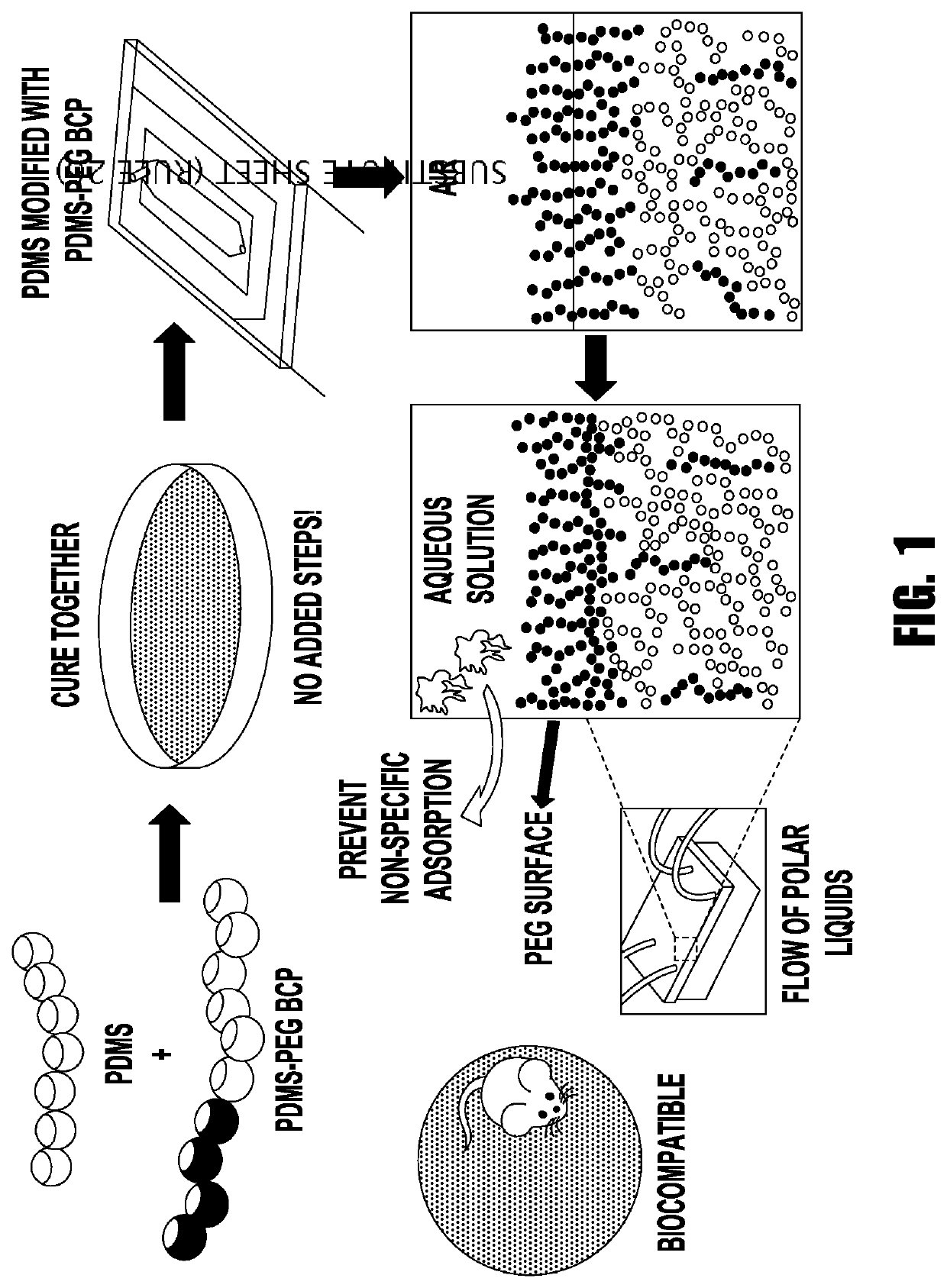
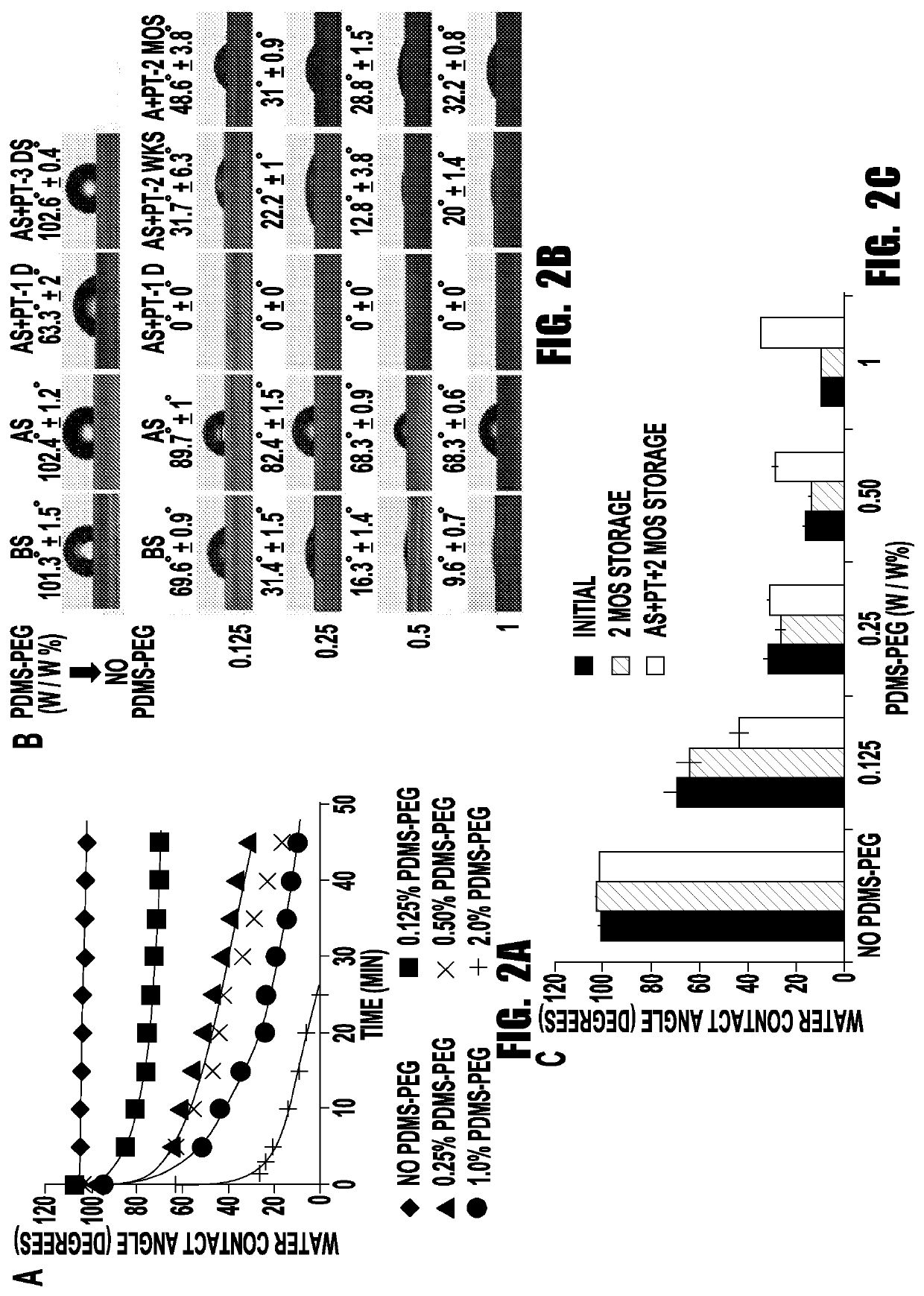
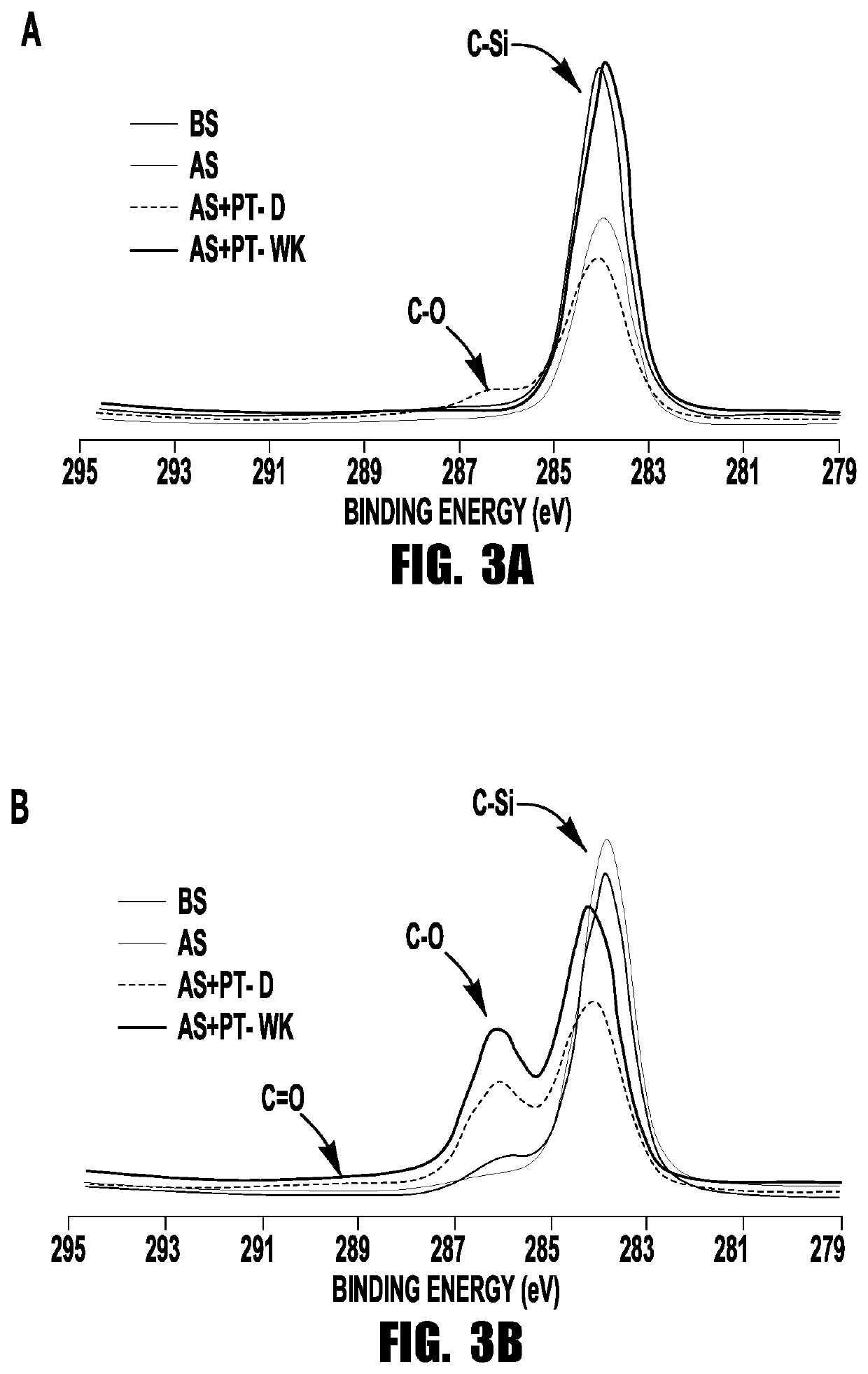
- Incorporating a PDMS-PEG block copolymer additive during device manufacture, which segregates to the surface upon contact with aqueous solutions, reducing hydrophobicity and preventing protein adsorption without compromising mechanical or optical properties, and ensuring biocompatibility.

Hyrdophilic Surface Modification of Polydimethylsiloxane
PatentInactiveUS20120061877A1
Innovation
- The use of a polymeric surfactant additive, such as an amphiphilic block copolymer or end-functionalized polymer, which is compatible with the PDMS base and anchors within the elastomer matrix to impart stable hydrophilic surface properties through van der Waals forces and hydrophobic interactions, allowing for tuning of surface modification and optical properties.


Environmental Impact and Sustainability of PDMS
The environmental implications of polydimethylsiloxane (PDMS) present a complex landscape of challenges and opportunities that significantly influence its enhancement strategies for seamless applications. Traditional PDMS production relies heavily on silicon-based raw materials derived from energy-intensive processes, contributing to substantial carbon footprints during manufacturing phases. The polymer's inherent chemical stability, while advantageous for performance applications, poses significant challenges for end-of-life disposal and biodegradation.
Current environmental concerns center around PDMS accumulation in aquatic ecosystems, where its persistence can affect marine life and bioaccumulation patterns. Studies indicate that conventional PDMS formulations exhibit limited biodegradability, with degradation half-lives extending beyond several decades under natural conditions. This persistence has prompted regulatory scrutiny in various jurisdictions, particularly within the European Union's REACH framework and similar environmental protection protocols.
Sustainability initiatives in PDMS enhancement focus on developing bio-based siloxane precursors and implementing circular economy principles. Recent advances include the integration of renewable feedstocks, such as rice husk-derived silica, which can reduce dependency on traditional silicon sources by up to 30%. Additionally, solvent-free synthesis routes and green chemistry approaches are being explored to minimize volatile organic compound emissions during production processes.
The development of recyclable PDMS formulations represents a critical advancement pathway, with researchers investigating thermally reversible crosslinking mechanisms that enable material recovery and reprocessing. These innovations could potentially reduce waste generation by 40-60% compared to conventional thermoset PDMS systems. Furthermore, biodegradable additives and controlled degradation triggers are being incorporated to address end-of-life environmental concerns.
Life cycle assessment studies reveal that enhanced PDMS formulations with improved durability and performance characteristics can offset their environmental impact through extended service life and reduced replacement frequency. This approach aligns with sustainable development goals while maintaining the seamless application properties essential for industrial and consumer applications.
Current environmental concerns center around PDMS accumulation in aquatic ecosystems, where its persistence can affect marine life and bioaccumulation patterns. Studies indicate that conventional PDMS formulations exhibit limited biodegradability, with degradation half-lives extending beyond several decades under natural conditions. This persistence has prompted regulatory scrutiny in various jurisdictions, particularly within the European Union's REACH framework and similar environmental protection protocols.
Sustainability initiatives in PDMS enhancement focus on developing bio-based siloxane precursors and implementing circular economy principles. Recent advances include the integration of renewable feedstocks, such as rice husk-derived silica, which can reduce dependency on traditional silicon sources by up to 30%. Additionally, solvent-free synthesis routes and green chemistry approaches are being explored to minimize volatile organic compound emissions during production processes.
The development of recyclable PDMS formulations represents a critical advancement pathway, with researchers investigating thermally reversible crosslinking mechanisms that enable material recovery and reprocessing. These innovations could potentially reduce waste generation by 40-60% compared to conventional thermoset PDMS systems. Furthermore, biodegradable additives and controlled degradation triggers are being incorporated to address end-of-life environmental concerns.
Life cycle assessment studies reveal that enhanced PDMS formulations with improved durability and performance characteristics can offset their environmental impact through extended service life and reduced replacement frequency. This approach aligns with sustainable development goals while maintaining the seamless application properties essential for industrial and consumer applications.
Biocompatibility Standards for Enhanced PDMS Materials
Biocompatibility standards for enhanced PDMS materials represent a critical framework governing the safe integration of modified polydimethylsiloxane in biological environments. The International Organization for Standardization (ISO) 10993 series serves as the primary regulatory foundation, establishing comprehensive evaluation protocols for biological compatibility assessment. These standards encompass cytotoxicity testing, sensitization evaluation, irritation assessment, and systemic toxicity analysis, forming the cornerstone of PDMS material validation for medical and biological applications.
Enhanced PDMS formulations must undergo rigorous testing according to ISO 10993-5 for cytotoxicity evaluation, utilizing standardized cell culture methodologies including MTT assays and direct contact testing. The standard requires assessment of cell viability, morphological changes, and metabolic activity when exposed to PDMS extracts or direct material contact. Additionally, ISO 10993-10 addresses irritation and skin sensitization testing, particularly relevant for topical PDMS applications in medical devices and cosmetic formulations.
Genotoxicity assessment under ISO 10993-3 becomes increasingly important for enhanced PDMS materials incorporating novel additives or surface modifications. The standard mandates bacterial reverse mutation tests, chromosomal aberration studies, and micronucleus assays to evaluate potential genetic damage. These requirements are particularly stringent for long-term implantable PDMS devices where chronic exposure necessitates comprehensive safety validation.
The United States Pharmacopeia (USP) Class VI certification provides additional biocompatibility benchmarks specifically relevant to medical-grade PDMS materials. This classification system evaluates acute systemic toxicity, intracutaneous reactivity, and implantation responses through standardized animal testing protocols. Enhanced PDMS formulations targeting medical applications must demonstrate compliance with USP Class VI requirements to ensure regulatory approval and clinical acceptance.
European Medical Device Regulation (MDR) 2017/745 introduces additional complexity for enhanced PDMS materials, requiring comprehensive biological evaluation documentation and post-market surveillance data. The regulation emphasizes risk-based assessment approaches, demanding detailed characterization of material modifications and their potential biological impacts. This regulatory framework necessitates extensive documentation of enhancement methodologies and their influence on biocompatibility profiles.
Emerging biocompatibility standards specifically address nanomaterial incorporation and surface functionalization techniques commonly employed in PDMS enhancement strategies. ISO/TR 10993-22 provides guidance for nanomaterial biological evaluation, establishing protocols for characterizing nanoparticle release, cellular uptake, and inflammatory responses. These evolving standards reflect the increasing sophistication of PDMS enhancement technologies and their unique biocompatibility considerations.
Enhanced PDMS formulations must undergo rigorous testing according to ISO 10993-5 for cytotoxicity evaluation, utilizing standardized cell culture methodologies including MTT assays and direct contact testing. The standard requires assessment of cell viability, morphological changes, and metabolic activity when exposed to PDMS extracts or direct material contact. Additionally, ISO 10993-10 addresses irritation and skin sensitization testing, particularly relevant for topical PDMS applications in medical devices and cosmetic formulations.
Genotoxicity assessment under ISO 10993-3 becomes increasingly important for enhanced PDMS materials incorporating novel additives or surface modifications. The standard mandates bacterial reverse mutation tests, chromosomal aberration studies, and micronucleus assays to evaluate potential genetic damage. These requirements are particularly stringent for long-term implantable PDMS devices where chronic exposure necessitates comprehensive safety validation.
The United States Pharmacopeia (USP) Class VI certification provides additional biocompatibility benchmarks specifically relevant to medical-grade PDMS materials. This classification system evaluates acute systemic toxicity, intracutaneous reactivity, and implantation responses through standardized animal testing protocols. Enhanced PDMS formulations targeting medical applications must demonstrate compliance with USP Class VI requirements to ensure regulatory approval and clinical acceptance.
European Medical Device Regulation (MDR) 2017/745 introduces additional complexity for enhanced PDMS materials, requiring comprehensive biological evaluation documentation and post-market surveillance data. The regulation emphasizes risk-based assessment approaches, demanding detailed characterization of material modifications and their potential biological impacts. This regulatory framework necessitates extensive documentation of enhancement methodologies and their influence on biocompatibility profiles.
Emerging biocompatibility standards specifically address nanomaterial incorporation and surface functionalization techniques commonly employed in PDMS enhancement strategies. ISO/TR 10993-22 provides guidance for nanomaterial biological evaluation, establishing protocols for characterizing nanoparticle release, cellular uptake, and inflammatory responses. These evolving standards reflect the increasing sophistication of PDMS enhancement technologies and their unique biocompatibility considerations.
Unlock deeper insights with PatSnap Eureka Quick Research — get a full tech report to explore trends and direct your research. Try now!
Generate Your Research Report Instantly with AI Agent
Supercharge your innovation with PatSnap Eureka AI Agent Platform!