

How to Estimate Force for Force Control Without a Force Sensor
MAY 8, 20269 MIN READ
Generate Your Research Report Instantly with AI Agent
PatSnap Eureka helps you evaluate technical feasibility & market potential.
Force Estimation Technology Background and Control Objectives
Force estimation technology has emerged as a critical enabler for advanced robotic control systems, addressing the fundamental challenge of achieving precise force control without relying on dedicated force sensors. This technological domain encompasses computational methods, algorithmic approaches, and sensor fusion techniques that enable robots to infer contact forces through indirect measurements and mathematical modeling.
The evolution of force estimation technology stems from the inherent limitations and costs associated with traditional force sensing approaches. Direct force measurement systems, while accurate, introduce additional hardware complexity, calibration requirements, and potential points of failure in robotic systems. Moreover, force sensors are often expensive, require careful mounting considerations, and may not be suitable for all operational environments or applications.
Contemporary force estimation methodologies leverage existing sensor modalities commonly found in robotic systems, including joint position encoders, motor current sensors, and inertial measurement units. These approaches utilize the fundamental relationships between motor torques, joint dynamics, and external forces to reconstruct contact force information through mathematical inference rather than direct measurement.
The primary technological objective centers on developing robust algorithms capable of accurately estimating external forces acting on robotic manipulators or mobile platforms during interaction tasks. This involves creating mathematical models that can effectively separate internal system dynamics from external disturbances, enabling precise force reconstruction under varying operational conditions.
Key technical goals include achieving real-time force estimation with minimal computational overhead, maintaining estimation accuracy across different contact scenarios, and ensuring robustness against model uncertainties and sensor noise. The technology aims to provide force feedback quality comparable to dedicated force sensors while eliminating associated hardware costs and complexity.
Advanced implementations target adaptive estimation capabilities that can automatically adjust to changing system parameters, varying payloads, and different contact surface properties. This adaptability is crucial for practical deployment in dynamic industrial environments where operational conditions frequently change.
The strategic importance of sensorless force estimation extends beyond cost reduction, encompassing enhanced system reliability, simplified mechanical design, and expanded application possibilities in environments where traditional force sensors may be impractical or impossible to implement effectively.
The evolution of force estimation technology stems from the inherent limitations and costs associated with traditional force sensing approaches. Direct force measurement systems, while accurate, introduce additional hardware complexity, calibration requirements, and potential points of failure in robotic systems. Moreover, force sensors are often expensive, require careful mounting considerations, and may not be suitable for all operational environments or applications.
Contemporary force estimation methodologies leverage existing sensor modalities commonly found in robotic systems, including joint position encoders, motor current sensors, and inertial measurement units. These approaches utilize the fundamental relationships between motor torques, joint dynamics, and external forces to reconstruct contact force information through mathematical inference rather than direct measurement.
The primary technological objective centers on developing robust algorithms capable of accurately estimating external forces acting on robotic manipulators or mobile platforms during interaction tasks. This involves creating mathematical models that can effectively separate internal system dynamics from external disturbances, enabling precise force reconstruction under varying operational conditions.
Key technical goals include achieving real-time force estimation with minimal computational overhead, maintaining estimation accuracy across different contact scenarios, and ensuring robustness against model uncertainties and sensor noise. The technology aims to provide force feedback quality comparable to dedicated force sensors while eliminating associated hardware costs and complexity.
Advanced implementations target adaptive estimation capabilities that can automatically adjust to changing system parameters, varying payloads, and different contact surface properties. This adaptability is crucial for practical deployment in dynamic industrial environments where operational conditions frequently change.
The strategic importance of sensorless force estimation extends beyond cost reduction, encompassing enhanced system reliability, simplified mechanical design, and expanded application possibilities in environments where traditional force sensors may be impractical or impossible to implement effectively.
Market Demand for Sensorless Force Control Systems
The global market for sensorless force control systems is experiencing significant growth driven by the increasing demand for cost-effective automation solutions across multiple industries. Traditional force-controlled systems requiring dedicated force sensors face limitations in terms of installation complexity, maintenance requirements, and overall system costs, creating substantial market opportunities for sensorless alternatives.
Manufacturing industries represent the largest market segment for sensorless force control technologies. Automotive assembly lines, electronics manufacturing, and precision machining operations increasingly require force-controlled processes without the added expense and complexity of force sensors. The push toward Industry 4.0 and smart manufacturing has accelerated adoption rates, as companies seek integrated solutions that reduce component count while maintaining operational precision.
Collaborative robotics emerges as a particularly promising application area. The cobot market demands inherently safe force control capabilities for human-robot interaction, where sensorless force estimation provides both safety compliance and cost advantages. Medical robotics and surgical automation also drive demand, where precise force control without additional sensors reduces system complexity and potential failure points in critical applications.
The aerospace and defense sectors show growing interest in sensorless force control for assembly operations and maintenance tasks. Weight reduction requirements and harsh operating environments make sensor-free solutions attractive alternatives to traditional force measurement approaches. Space applications particularly benefit from reduced component complexity and enhanced reliability.
Market drivers include the rising labor costs in developed economies, pushing manufacturers toward automated solutions that can perform delicate assembly tasks previously requiring human operators. Supply chain disruptions have also highlighted the need for more resilient automation systems with fewer external dependencies, favoring integrated sensorless approaches over multi-component force sensing systems.
Regional demand patterns show strong growth in Asia-Pacific markets, particularly in China, Japan, and South Korea, where manufacturing automation adoption rates continue accelerating. European markets demonstrate steady demand driven by automotive and precision manufacturing sectors, while North American markets focus on collaborative robotics and medical device applications.
The market faces challenges from established force sensor technologies and concerns about accuracy limitations in sensorless approaches. However, advancing computational capabilities and improved estimation algorithms are progressively addressing these limitations, expanding the addressable market for sensorless force control solutions across diverse industrial applications.
Manufacturing industries represent the largest market segment for sensorless force control technologies. Automotive assembly lines, electronics manufacturing, and precision machining operations increasingly require force-controlled processes without the added expense and complexity of force sensors. The push toward Industry 4.0 and smart manufacturing has accelerated adoption rates, as companies seek integrated solutions that reduce component count while maintaining operational precision.
Collaborative robotics emerges as a particularly promising application area. The cobot market demands inherently safe force control capabilities for human-robot interaction, where sensorless force estimation provides both safety compliance and cost advantages. Medical robotics and surgical automation also drive demand, where precise force control without additional sensors reduces system complexity and potential failure points in critical applications.
The aerospace and defense sectors show growing interest in sensorless force control for assembly operations and maintenance tasks. Weight reduction requirements and harsh operating environments make sensor-free solutions attractive alternatives to traditional force measurement approaches. Space applications particularly benefit from reduced component complexity and enhanced reliability.
Market drivers include the rising labor costs in developed economies, pushing manufacturers toward automated solutions that can perform delicate assembly tasks previously requiring human operators. Supply chain disruptions have also highlighted the need for more resilient automation systems with fewer external dependencies, favoring integrated sensorless approaches over multi-component force sensing systems.
Regional demand patterns show strong growth in Asia-Pacific markets, particularly in China, Japan, and South Korea, where manufacturing automation adoption rates continue accelerating. European markets demonstrate steady demand driven by automotive and precision manufacturing sectors, while North American markets focus on collaborative robotics and medical device applications.
The market faces challenges from established force sensor technologies and concerns about accuracy limitations in sensorless approaches. However, advancing computational capabilities and improved estimation algorithms are progressively addressing these limitations, expanding the addressable market for sensorless force control solutions across diverse industrial applications.
Current State and Challenges in Force Estimation Methods
Force estimation without dedicated force sensors has emerged as a critical research area in robotics and automation, driven by the need for cost-effective solutions and enhanced system reliability. Current methodologies primarily rely on indirect measurement techniques that leverage existing actuator hardware and control systems to infer contact forces during manipulation tasks.
Model-based approaches represent the most established category of force estimation methods. These techniques utilize inverse dynamics calculations combined with motor current measurements to estimate external forces. By monitoring the difference between expected and actual motor currents, systems can deduce the presence and magnitude of external forces acting on the robot end-effector. However, these methods face significant challenges in achieving high accuracy due to model uncertainties, friction compensation difficulties, and parameter variations over time.
Observer-based estimation techniques have gained considerable attention as an alternative approach. Disturbance observers and momentum-based methods attempt to isolate external forces from internal system dynamics. These approaches show promise in controlled environments but struggle with robustness issues when faced with model mismatches, sensor noise, and varying operating conditions. The computational complexity of real-time implementation also presents practical limitations for many industrial applications.
Machine learning and data-driven approaches are increasingly being explored to overcome traditional model-based limitations. Neural networks and regression techniques can learn complex relationships between measurable system states and external forces. While these methods demonstrate improved adaptability and can handle nonlinear system behaviors, they require extensive training data and may lack generalizability across different operating scenarios or robot configurations.
The primary technical challenges facing current force estimation methods include achieving sufficient accuracy for precise force control tasks, maintaining robustness across varying operational conditions, and ensuring real-time performance requirements. Friction modeling remains particularly problematic, as static and dynamic friction effects significantly impact estimation accuracy. Additionally, the trade-off between estimation bandwidth and noise rejection continues to limit the practical applicability of many proposed solutions.
Sensor fusion approaches combining multiple indirect measurement sources show potential for improving estimation reliability. However, the complexity of integrating diverse data streams while maintaining computational efficiency presents ongoing challenges. The lack of standardized benchmarking methodologies also hampers objective comparison of different estimation techniques, slowing the advancement of the field toward practical industrial deployment.
Model-based approaches represent the most established category of force estimation methods. These techniques utilize inverse dynamics calculations combined with motor current measurements to estimate external forces. By monitoring the difference between expected and actual motor currents, systems can deduce the presence and magnitude of external forces acting on the robot end-effector. However, these methods face significant challenges in achieving high accuracy due to model uncertainties, friction compensation difficulties, and parameter variations over time.
Observer-based estimation techniques have gained considerable attention as an alternative approach. Disturbance observers and momentum-based methods attempt to isolate external forces from internal system dynamics. These approaches show promise in controlled environments but struggle with robustness issues when faced with model mismatches, sensor noise, and varying operating conditions. The computational complexity of real-time implementation also presents practical limitations for many industrial applications.
Machine learning and data-driven approaches are increasingly being explored to overcome traditional model-based limitations. Neural networks and regression techniques can learn complex relationships between measurable system states and external forces. While these methods demonstrate improved adaptability and can handle nonlinear system behaviors, they require extensive training data and may lack generalizability across different operating scenarios or robot configurations.
The primary technical challenges facing current force estimation methods include achieving sufficient accuracy for precise force control tasks, maintaining robustness across varying operational conditions, and ensuring real-time performance requirements. Friction modeling remains particularly problematic, as static and dynamic friction effects significantly impact estimation accuracy. Additionally, the trade-off between estimation bandwidth and noise rejection continues to limit the practical applicability of many proposed solutions.
Sensor fusion approaches combining multiple indirect measurement sources show potential for improving estimation reliability. However, the complexity of integrating diverse data streams while maintaining computational efficiency presents ongoing challenges. The lack of standardized benchmarking methodologies also hampers objective comparison of different estimation techniques, slowing the advancement of the field toward practical industrial deployment.
Existing Sensorless Force Estimation Solutions
01 Servo motor force control systems
Advanced servo motor systems that implement precise force control through feedback mechanisms and closed-loop control algorithms. These systems utilize position and force sensors to maintain accurate force output while compensating for external disturbances and load variations.- Servo motor force control systems: Advanced servo motor systems that implement precise force control through feedback mechanisms and closed-loop control algorithms. These systems utilize position and force sensors to maintain accurate force output while compensating for external disturbances and load variations.
- Robotic force feedback and haptic control: Robotic systems incorporating force feedback mechanisms for haptic applications and human-machine interaction. These technologies enable robots to sense and control applied forces during manipulation tasks, providing tactile feedback and ensuring safe interaction with objects and humans.
- Adaptive force control algorithms: Intelligent control algorithms that automatically adjust force parameters based on real-time conditions and system requirements. These adaptive systems learn from operational data and modify control strategies to optimize performance across varying load conditions and environmental factors.
- Multi-axis force control mechanisms: Complex control systems designed to manage forces across multiple axes simultaneously, enabling precise manipulation in three-dimensional space. These mechanisms coordinate force distribution and control across different directional components for enhanced operational precision.
- Force limiting and safety control systems: Safety-oriented control systems that monitor and limit applied forces to prevent damage to equipment or injury to operators. These systems incorporate threshold detection, emergency stop mechanisms, and force capping features to ensure safe operation within predetermined force boundaries.
02 Robotic force feedback and haptic control
Robotic systems incorporating force feedback mechanisms for haptic applications and human-machine interaction. These technologies enable robots to sense and control applied forces during manipulation tasks, providing tactile feedback and ensuring safe interaction with objects and humans.Expand Specific Solutions03 Hydraulic and pneumatic force control mechanisms
Fluid power systems that regulate force output through pressure control valves and actuators. These mechanisms provide high force capabilities with precise control characteristics, commonly used in industrial automation and heavy machinery applications.Expand Specific Solutions04 Electronic force sensing and measurement devices
Electronic sensors and measurement systems designed to detect, quantify, and monitor applied forces in real-time. These devices incorporate strain gauges, load cells, and digital signal processing to provide accurate force measurements for control system feedback.Expand Specific Solutions05 Adaptive force control algorithms and software
Intelligent control algorithms that automatically adjust force parameters based on system conditions and requirements. These software-based solutions implement machine learning, neural networks, and adaptive control strategies to optimize force control performance across varying operational scenarios.Expand Specific Solutions
Key Players in Force Control and Robotics Industry
The force control without force sensors technology represents an emerging field within industrial automation, currently in its early-to-growth stage with significant development potential. The market demonstrates moderate size but rapid expansion, driven by cost-reduction demands and sensor-free control requirements across manufacturing sectors. Technology maturity varies considerably among key players, with established industrial giants like YASKAWA Electric Corp., FANUC Corp., and Hitachi Ltd. leading advanced servo control and motion systems development. Automotive suppliers including Magna International, Hyundai Motor, and HL Mando are integrating sensorless force estimation into vehicle systems. Academic institutions such as Beihang University, Institute of Science Tokyo, and Tohoku University contribute fundamental research breakthroughs. Emerging companies like Estun Automation represent growing regional capabilities, while aerospace leaders including Safran Electronics & Defense and IHI Corp. push specialized applications. The competitive landscape shows traditional automation leaders maintaining technological advantages while newer entrants focus on cost-effective implementations.
YASKAWA Electric Corp.
Technical Solution: YASKAWA implements model-based force estimation using their Sigma-7 servo system architecture. Their approach leverages advanced motion control algorithms that analyze motor torque ripple and velocity variations to infer external forces. The system employs real-time parameter identification and adaptive control techniques, utilizing high-resolution encoders and current sensors already present in servo motors. Their MotionWorks software platform processes these signals through proprietary filtering algorithms to estimate contact forces with response times under 1ms, making it suitable for precision assembly and material handling applications.
Strengths: Fast response time, seamless integration with existing servo systems, robust performance in industrial settings. Weaknesses: Requires precise system modeling, sensitivity to mechanical wear and parameter drift over time.
FANUC Corp.
Technical Solution: FANUC develops advanced sensorless force control algorithms using motor current feedback and disturbance observer techniques. Their approach combines real-time torque estimation through motor current analysis with machine learning algorithms to predict contact forces during robotic operations. The system utilizes proprietary servo motor controllers that can detect minute changes in motor load, enabling precise force estimation without dedicated force sensors. This technology is integrated into their industrial robot controllers, providing force feedback accuracy within 5-10% of actual applied forces for typical manufacturing applications.
Strengths: Cost-effective solution eliminating expensive force sensors, proven reliability in industrial environments. Weaknesses: Limited accuracy compared to direct force sensing, performance degradation in high-frequency applications.
Core Innovations in Model-Based Force Estimation
Method of force control by disturbance load estimation
PatentWO1994024621A1
Innovation
- A force control method that estimates disturbance load torque using a disturbance estimation observer, allowing feedback control without the need for a force sensor, by calculating the estimated disturbance load torque from motor torque and speed, and using this estimation to adjust motor input and prevent runaway.


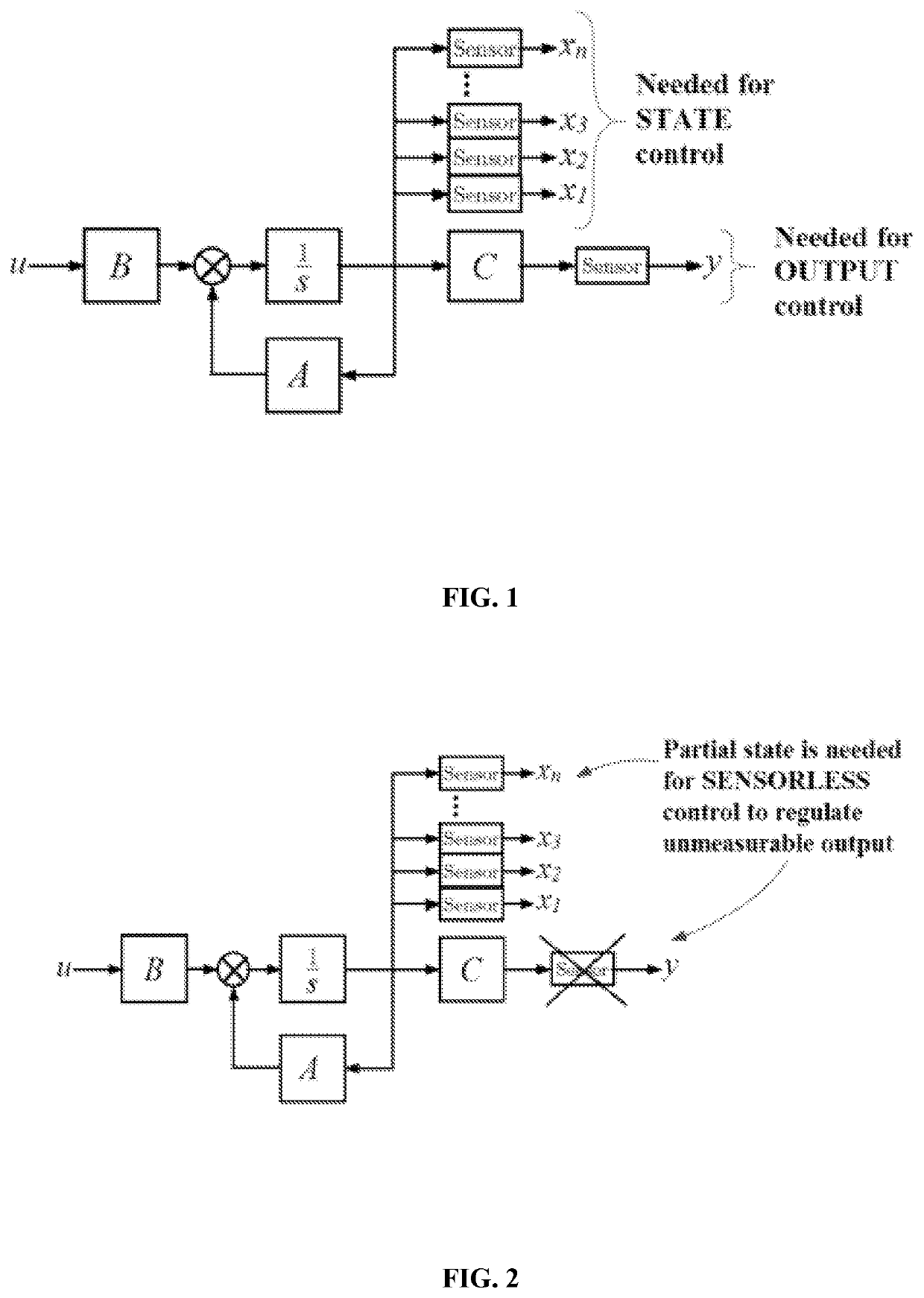
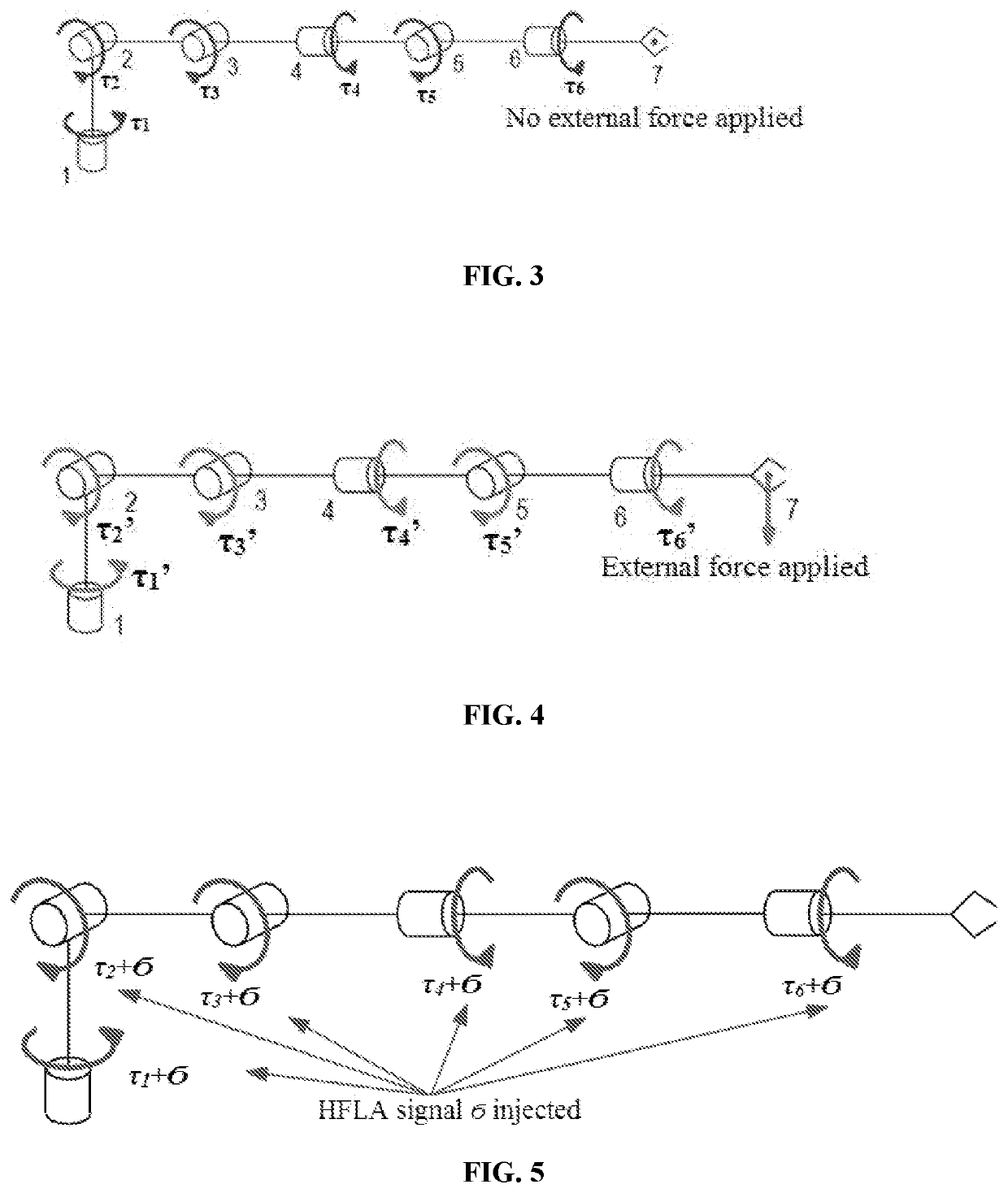
Sensor-free force/torque sensing in an articulated electromechanical actuator-driven robot
PatentActiveUS20220009097A1
Innovation
- A sensorless technique that estimates external forces and torques on an electromechanical actuator-driven robot by identifying gravitational and frictional components in load torques using joint current signals and a Jacobian matrix, eliminating the need for physical sensors.
Safety Standards for Force Control Applications
Safety standards for force control applications without dedicated force sensors represent a critical regulatory framework that addresses the unique challenges of sensorless force estimation systems. These standards encompass multiple layers of safety requirements, from hardware redundancy to software validation protocols, ensuring that force control systems maintain operational safety even when relying on indirect force measurement methods.
The primary safety standards governing sensorless force control applications include ISO 10218 for industrial robots, IEC 61508 for functional safety of electrical systems, and ISO 13849 for safety-related control systems. These standards establish fundamental requirements for risk assessment, safety integrity levels, and fail-safe mechanisms specifically applicable to force control systems that estimate forces through motor current analysis, model-based approaches, or observer-based techniques.
Functional safety requirements mandate that sensorless force control systems achieve appropriate Safety Integrity Levels (SIL) based on their application context. For collaborative robotics applications, systems must demonstrate SIL 2 or higher performance, requiring redundant force estimation algorithms and independent monitoring systems. The standards specify maximum allowable force thresholds, response times for safety shutdowns, and validation procedures for force estimation accuracy under various operating conditions.
Certification processes for sensorless force control systems involve rigorous testing protocols that validate force estimation accuracy across the entire operational envelope. Standards require demonstration of force estimation precision within specified tolerance bands, typically ±5% to ±10% depending on the application. Testing must cover dynamic conditions, varying payloads, and potential system degradation scenarios to ensure consistent safety performance throughout the system lifecycle.
Risk assessment frameworks specifically address the inherent uncertainties in sensorless force estimation. Standards mandate comprehensive hazard analysis considering estimation errors, algorithm failures, and environmental factors that could compromise force measurement accuracy. Safety measures must account for worst-case scenarios where force estimation algorithms may provide incorrect readings, requiring implementation of multiple independent estimation methods and continuous system health monitoring.
Compliance verification requires extensive documentation demonstrating adherence to safety standards, including validation test results, failure mode analysis, and ongoing monitoring protocols. Regular recertification ensures that sensorless force control systems maintain safety compliance as algorithms evolve and operating conditions change, establishing a framework for continuous safety assurance in force control applications.
The primary safety standards governing sensorless force control applications include ISO 10218 for industrial robots, IEC 61508 for functional safety of electrical systems, and ISO 13849 for safety-related control systems. These standards establish fundamental requirements for risk assessment, safety integrity levels, and fail-safe mechanisms specifically applicable to force control systems that estimate forces through motor current analysis, model-based approaches, or observer-based techniques.
Functional safety requirements mandate that sensorless force control systems achieve appropriate Safety Integrity Levels (SIL) based on their application context. For collaborative robotics applications, systems must demonstrate SIL 2 or higher performance, requiring redundant force estimation algorithms and independent monitoring systems. The standards specify maximum allowable force thresholds, response times for safety shutdowns, and validation procedures for force estimation accuracy under various operating conditions.
Certification processes for sensorless force control systems involve rigorous testing protocols that validate force estimation accuracy across the entire operational envelope. Standards require demonstration of force estimation precision within specified tolerance bands, typically ±5% to ±10% depending on the application. Testing must cover dynamic conditions, varying payloads, and potential system degradation scenarios to ensure consistent safety performance throughout the system lifecycle.
Risk assessment frameworks specifically address the inherent uncertainties in sensorless force estimation. Standards mandate comprehensive hazard analysis considering estimation errors, algorithm failures, and environmental factors that could compromise force measurement accuracy. Safety measures must account for worst-case scenarios where force estimation algorithms may provide incorrect readings, requiring implementation of multiple independent estimation methods and continuous system health monitoring.
Compliance verification requires extensive documentation demonstrating adherence to safety standards, including validation test results, failure mode analysis, and ongoing monitoring protocols. Regular recertification ensures that sensorless force control systems maintain safety compliance as algorithms evolve and operating conditions change, establishing a framework for continuous safety assurance in force control applications.
Cost-Benefit Analysis of Sensorless Force Systems
The economic evaluation of sensorless force estimation systems reveals compelling advantages that extend beyond initial hardware cost savings. Traditional force-controlled systems incorporating dedicated force sensors typically require investments ranging from $500 to $5,000 per sensor unit, depending on precision requirements and environmental specifications. In contrast, sensorless approaches leverage existing actuator hardware and computational resources, reducing direct component costs by 60-80% while eliminating sensor-specific maintenance requirements.
Implementation costs for sensorless force control systems demonstrate favorable economics through reduced system complexity. The absence of force sensors eliminates calibration procedures, sensor mounting hardware, and specialized signal conditioning electronics. Software-based force estimation algorithms, while requiring initial development investment, can be replicated across multiple systems without additional hardware costs. This scalability factor becomes particularly advantageous in high-volume manufacturing applications where cost per unit significantly impacts overall profitability.
Operational benefits extend to enhanced system reliability and reduced downtime. Force sensors represent potential failure points susceptible to overload damage, environmental contamination, and drift over time. Sensorless systems eliminate these vulnerabilities, resulting in improved mean time between failures and reduced maintenance intervals. Field data indicates 25-40% reduction in maintenance-related downtime for sensorless implementations compared to sensor-based alternatives.
However, performance trade-offs must be carefully evaluated against cost savings. Sensorless force estimation typically achieves 70-85% of the accuracy provided by dedicated force sensors, which may be insufficient for precision assembly operations or delicate material handling tasks. The computational overhead required for real-time force estimation algorithms can necessitate upgraded control hardware, partially offsetting initial cost advantages.
Return on investment analysis demonstrates break-even points typically occurring within 12-18 months for medium to large-scale deployments. The combination of reduced hardware costs, simplified maintenance procedures, and improved system availability creates compelling economic justification for sensorless force control adoption in applications where moderate force estimation accuracy meets operational requirements.
Implementation costs for sensorless force control systems demonstrate favorable economics through reduced system complexity. The absence of force sensors eliminates calibration procedures, sensor mounting hardware, and specialized signal conditioning electronics. Software-based force estimation algorithms, while requiring initial development investment, can be replicated across multiple systems without additional hardware costs. This scalability factor becomes particularly advantageous in high-volume manufacturing applications where cost per unit significantly impacts overall profitability.
Operational benefits extend to enhanced system reliability and reduced downtime. Force sensors represent potential failure points susceptible to overload damage, environmental contamination, and drift over time. Sensorless systems eliminate these vulnerabilities, resulting in improved mean time between failures and reduced maintenance intervals. Field data indicates 25-40% reduction in maintenance-related downtime for sensorless implementations compared to sensor-based alternatives.
However, performance trade-offs must be carefully evaluated against cost savings. Sensorless force estimation typically achieves 70-85% of the accuracy provided by dedicated force sensors, which may be insufficient for precision assembly operations or delicate material handling tasks. The computational overhead required for real-time force estimation algorithms can necessitate upgraded control hardware, partially offsetting initial cost advantages.
Return on investment analysis demonstrates break-even points typically occurring within 12-18 months for medium to large-scale deployments. The combination of reduced hardware costs, simplified maintenance procedures, and improved system availability creates compelling economic justification for sensorless force control adoption in applications where moderate force estimation accuracy meets operational requirements.
Unlock deeper insights with PatSnap Eureka Quick Research — get a full tech report to explore trends and direct your research. Try now!
Generate Your Research Report Instantly with AI Agent
Supercharge your innovation with PatSnap Eureka AI Agent Platform!