

How to Evaluate Structural Steel Deformation Using FEM Simulation
JUN 9, 20269 MIN READ
Generate Your Research Report Instantly with AI Agent
Patsnap Eureka helps you evaluate technical feasibility & market potential.
FEM Steel Deformation Analysis Background and Objectives
Structural steel deformation analysis represents a critical engineering discipline that has evolved significantly with the advancement of computational methods. The integration of Finite Element Method (FEM) simulation into structural engineering practice emerged in the 1960s and has since become indispensable for predicting material behavior under various loading conditions. This computational approach enables engineers to model complex geometries and loading scenarios that would be impractical or impossible to analyze using traditional analytical methods.
The historical development of steel deformation analysis began with classical beam theory and progressed through experimental testing methods before embracing numerical simulation techniques. Early approaches relied heavily on simplified assumptions and empirical formulas, which often provided limited accuracy for complex structural configurations. The introduction of computer-aided analysis revolutionized the field, allowing for more sophisticated modeling of material nonlinearity, geometric complexity, and dynamic loading effects.
Current technological trends in FEM simulation focus on enhanced material modeling capabilities, including advanced plasticity models, fracture mechanics integration, and multi-scale analysis approaches. The evolution toward high-performance computing has enabled the analysis of increasingly complex structures with millions of degrees of freedom, while developments in mesh generation algorithms have improved simulation accuracy and reduced preprocessing time.
The primary objective of implementing FEM simulation for structural steel deformation evaluation centers on achieving accurate prediction of displacement patterns, stress distributions, and failure modes under realistic loading conditions. This capability is essential for optimizing structural designs, ensuring safety compliance, and reducing material costs while maintaining performance requirements.
Secondary objectives include the development of standardized simulation protocols that can be consistently applied across different project types and the establishment of validation methodologies that ensure simulation results align with experimental observations. The integration of uncertainty quantification methods represents another key objective, enabling engineers to account for material property variations and loading uncertainties in their analyses.
Advanced objectives encompass the implementation of real-time monitoring integration, where simulation models can be updated based on sensor data from actual structures, and the development of predictive maintenance strategies based on accumulated deformation patterns over time.
Market Demand for Advanced Steel Structure Simulation
The global construction industry's increasing emphasis on structural safety and performance optimization has created substantial demand for advanced steel structure simulation technologies. Modern infrastructure projects, including high-rise buildings, bridges, and industrial facilities, require precise deformation analysis to ensure structural integrity under various loading conditions. This demand is particularly pronounced in seismically active regions where accurate prediction of steel structure behavior during earthquakes is critical for public safety.
The aerospace and automotive sectors represent rapidly expanding markets for sophisticated FEM simulation capabilities. Aircraft manufacturers require detailed analysis of steel components subjected to extreme stress conditions, while automotive companies need precise deformation modeling for crash safety analysis and lightweight design optimization. These industries drive demand for simulation tools that can handle complex material behaviors and nonlinear deformation patterns with high accuracy.
Energy infrastructure development, particularly in renewable energy sectors, has emerged as a significant market driver. Wind turbine towers, offshore platforms, and solar panel support structures require comprehensive deformation analysis to withstand environmental loads over extended operational periods. The transition toward sustainable energy solutions has intensified the need for reliable simulation tools that can predict long-term structural performance under cyclic loading conditions.
Digital transformation initiatives across engineering disciplines have accelerated adoption of cloud-based simulation platforms and real-time analysis capabilities. Engineering firms increasingly seek integrated solutions that combine FEM simulation with building information modeling and digital twin technologies. This convergence creates demand for simulation tools that can seamlessly interface with existing design workflows while providing enhanced visualization and collaboration features.
Regulatory compliance requirements in various jurisdictions continue to drive market growth for advanced simulation technologies. Updated building codes and safety standards mandate more rigorous structural analysis, particularly for critical infrastructure projects. Engineering consultancies require simulation tools that can generate comprehensive documentation and validation reports to meet evolving regulatory frameworks while maintaining competitive project timelines.
Current FEM Steel Deformation Analysis Challenges
The evaluation of structural steel deformation through finite element method simulation faces several critical challenges that significantly impact the accuracy and reliability of analytical results. These challenges stem from the complex nature of steel behavior under various loading conditions and the inherent limitations of current computational approaches.
Material modeling complexity represents one of the most significant obstacles in FEM steel deformation analysis. Steel exhibits highly nonlinear behavior under different stress states, including elastic-plastic transitions, strain hardening, and potential strain rate effects. Current constitutive models often struggle to accurately capture the full spectrum of steel behavior, particularly under combined loading scenarios involving tension, compression, bending, and torsion simultaneously.
Mesh sensitivity and convergence issues pose substantial computational challenges. The accuracy of deformation predictions heavily depends on mesh quality and refinement, yet achieving optimal mesh configurations remains computationally expensive and time-consuming. Inadequate mesh density can lead to significant errors in stress concentration areas, while excessive refinement dramatically increases computational costs without proportional accuracy improvements.
Boundary condition specification and contact modeling present additional complexities in real-world applications. Accurately representing connection details, support conditions, and member interactions requires sophisticated modeling techniques that often exceed the capabilities of standard FEM software packages. The idealization of actual structural connections frequently introduces uncertainties that propagate throughout the analysis.
Large deformation and geometric nonlinearity handling remains problematic for many commercial FEM packages. When steel structures undergo significant deformations, the updated geometry affects load distribution and structural response. Current algorithms often struggle with convergence issues during large deformation analysis, particularly when combined with material nonlinearity.
Validation and verification challenges persist due to limited experimental data for complex loading scenarios. While simple beam and column tests provide basic validation, real structural behavior under combined loading conditions lacks comprehensive experimental benchmarks. This limitation makes it difficult to assess the accuracy of FEM predictions for practical engineering applications.
Computational efficiency versus accuracy trade-offs continue to constrain practical implementation. High-fidelity models require substantial computational resources and time, making them impractical for routine design applications. Simplified models, while computationally efficient, may not capture critical behavioral aspects necessary for accurate deformation prediction.
Existing FEM Solutions for Steel Deformation Evaluation
01 Steel deformation monitoring and measurement systems
Advanced monitoring systems and measurement techniques are employed to detect and quantify structural steel deformation in real-time. These systems utilize various sensors, strain gauges, and digital measurement technologies to continuously monitor structural integrity and deformation patterns. The monitoring data helps in early detection of potential structural failures and enables preventive maintenance strategies.- Steel deformation monitoring and measurement systems: Advanced monitoring systems and measurement techniques are employed to detect and quantify structural steel deformation in real-time. These systems utilize various sensors, strain gauges, and digital measurement technologies to continuously monitor structural changes and provide early warning of potential failures. The monitoring data helps engineers assess structural integrity and make informed decisions about maintenance and safety measures.
- Deformation prevention and control methods: Various techniques and methods are developed to prevent or control structural steel deformation during construction and service life. These approaches include proper design considerations, installation procedures, and structural reinforcement strategies that minimize unwanted deformation. The methods focus on maintaining structural stability and ensuring that deformation remains within acceptable limits for safe operation.
- Structural support and reinforcement devices: Specialized devices and structural components are designed to provide additional support and reinforcement to steel structures prone to deformation. These devices help distribute loads more effectively and reduce stress concentrations that could lead to excessive deformation. The reinforcement solutions are tailored to specific structural requirements and loading conditions.
- Deformation analysis and prediction techniques: Computational methods and analytical techniques are developed to predict and analyze structural steel deformation under various loading conditions. These approaches use mathematical models, finite element analysis, and simulation tools to understand deformation behavior and optimize structural design. The analysis helps engineers anticipate potential deformation issues and implement preventive measures.
- Construction and fabrication methods for deformation control: Specialized construction techniques and fabrication methods are employed to minimize deformation during steel structure assembly and installation. These methods include controlled welding procedures, proper sequencing of construction activities, and temperature management during fabrication. The techniques ensure that structures maintain their intended geometry and performance characteristics throughout the construction process.
02 Deformation prevention and control mechanisms
Various mechanical devices and structural reinforcement methods are designed to prevent or control steel deformation under different loading conditions. These mechanisms include specialized joints, bracing systems, and structural modifications that distribute loads more effectively and reduce localized stress concentrations that could lead to deformation.Expand Specific Solutions03 Computational analysis and simulation methods
Sophisticated computational models and simulation techniques are developed to predict and analyze steel deformation behavior under various conditions. These methods incorporate finite element analysis, material property modeling, and stress-strain relationships to simulate deformation scenarios and optimize structural designs for improved performance.Expand Specific Solutions04 Structural connection and joint design
Specialized connection systems and joint designs are developed to accommodate and manage steel deformation while maintaining structural integrity. These innovations focus on creating flexible connections that can absorb deformation forces without compromising the overall structural stability, including bolted, welded, and hybrid connection systems.Expand Specific Solutions05 Material treatment and processing techniques
Advanced material processing methods and heat treatment techniques are employed to improve steel properties and reduce susceptibility to deformation. These approaches modify the microstructure and mechanical properties of steel to enhance its resistance to various types of deformation including thermal expansion, creep, and plastic deformation under load.Expand Specific Solutions
Key Players in FEM Software and Steel Analysis Industry
The structural steel deformation evaluation using FEM simulation field represents a mature technology sector experiencing steady growth driven by increasing infrastructure demands and digitalization trends. The market demonstrates significant scale with applications spanning construction, automotive, aerospace, and energy sectors, supported by substantial investments from both industrial players and research institutions. Technology maturity varies across different market segments, with established simulation software providers like ANSYS leading commercial solutions, while specialized companies such as Livermore Software Technology Corp. and SimuForm GmbH focus on advanced modeling capabilities. Major industrial adopters including Boeing, BMW, Volkswagen, and Toyota Motor demonstrate practical implementation maturity, particularly in automotive and aerospace applications. Academic institutions like Osaka University, Southeast University, and Beihang University contribute to fundamental research advancement, while materials companies such as Kobe Steel and UBE Corp. drive industry-specific applications, indicating a well-established ecosystem with continued innovation potential.
ANSYS, Inc.
Technical Solution: ANSYS provides comprehensive FEM simulation solutions for structural steel deformation evaluation through its flagship software ANSYS Mechanical. The platform offers advanced nonlinear analysis capabilities including geometric and material nonlinearity, enabling accurate prediction of steel structure behavior under various loading conditions. Their solution incorporates sophisticated material models for steel including plasticity, creep, and fatigue analysis. The software features automated mesh generation with adaptive refinement capabilities, ensuring optimal element quality for accurate deformation calculations. ANSYS Workbench provides integrated pre and post-processing environment with parametric design optimization tools, allowing engineers to evaluate multiple design scenarios efficiently.
Strengths: Industry-leading accuracy in nonlinear analysis, comprehensive material libraries, excellent integration capabilities. Weaknesses: High licensing costs, steep learning curve for complex simulations.
The Boeing Co.
Technical Solution: Boeing has developed proprietary FEM simulation methodologies for evaluating structural steel deformation in aerospace applications, focusing on lightweight steel alloys and composite-steel hybrid structures. Their approach integrates multi-scale modeling techniques combining macro-level structural analysis with micro-level material behavior prediction. Boeing's simulation framework incorporates advanced fatigue analysis capabilities specifically tailored for cyclic loading conditions typical in aircraft structures. The company utilizes high-performance computing clusters to perform large-scale simulations of complete aircraft sections, enabling comprehensive deformation analysis under various flight conditions. Their methodology includes specialized algorithms for predicting residual stresses from manufacturing processes and their impact on structural performance.
Strengths: Cutting-edge multi-scale modeling capabilities, extensive validation through real-world testing, advanced fatigue analysis. Weaknesses: Proprietary solutions with limited commercial availability, highly specialized for aerospace applications.
Core FEM Algorithms for Steel Structure Analysis
Fully-integrated hexahedral elements configured for reducing shear locking in finite element method
PatentActiveUS20110191072A1
Innovation
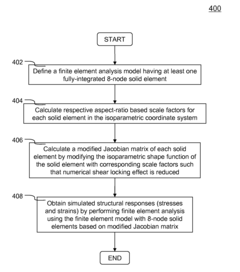
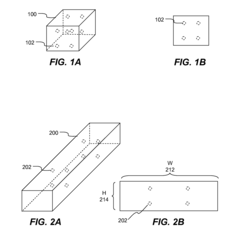
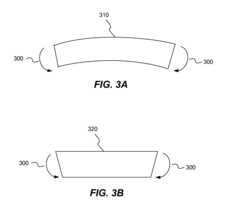
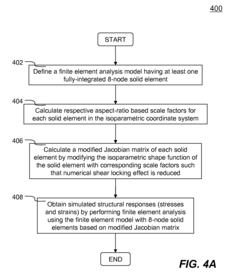
- Introducing aspect-ratio based scale factors to modify partial derivatives of the isoparametric shape function and directly modifying off-diagonal components in the local Jacobian matrix to alleviate spurious shear deformation modes, effectively reducing artificial transverse shear locking.
Structural analysis apparatus and structural analysis method
PatentInactiveEP2003581A1
Innovation
- A structural analysis apparatus and method that adjusts the breakage threshold conditions for elements adjacent to a broken element, specifically reducing the threshold in directions perpendicular to the crack face to simulate stress concentration and crack propagation, allowing for accurate breakage simulation without reducing element size.


Safety Standards for Steel Structure Analysis
Safety standards for structural steel analysis using finite element method (FEM) simulation are governed by multiple international and national codes that establish rigorous requirements for computational modeling and validation. The primary frameworks include AISC 360 (American Institute of Steel Construction), Eurocode 3 (European Committee for Standardization), and ISO 19902 for offshore structures, each providing specific guidelines for FEM-based deformation analysis.
These standards mandate comprehensive verification procedures for FEM models, requiring validation against experimental data or simplified analytical solutions before application to complex structural problems. The acceptance criteria typically specify maximum allowable deviations between numerical predictions and benchmark results, commonly set at 5-10% for displacement calculations and 15% for stress concentrations in critical regions.
Material property specifications within safety standards demand the use of certified steel grades with well-documented mechanical properties, including elastic modulus, yield strength, and strain-hardening characteristics. Standards require consideration of temperature effects, strain rate sensitivity, and potential material degradation over the structure's service life, particularly for dynamic loading scenarios.
Mesh quality requirements are explicitly defined in modern safety codes, establishing minimum element aspect ratios, maximum skewness angles, and convergence criteria for displacement and stress fields. Standards typically require mesh independence studies to demonstrate solution stability, with successive refinements showing less than 2% variation in critical response parameters.
Load combination protocols specified in safety standards ensure comprehensive evaluation of structural performance under various loading scenarios, including dead loads, live loads, wind forces, seismic excitations, and thermal effects. The standards mandate the use of appropriate load factors and resistance factors based on reliability theory and probabilistic analysis.
Verification and validation procedures outlined in safety standards require documentation of modeling assumptions, boundary condition implementations, and solution convergence metrics. Regular benchmarking against established test cases and peer review processes are mandated to maintain computational accuracy and reliability in structural steel deformation assessments.
Computational Efficiency in Large-Scale FEM Models
Computational efficiency represents a critical bottleneck in large-scale finite element modeling of structural steel deformation analysis. As structural systems become increasingly complex and require higher resolution meshes to capture localized phenomena such as stress concentrations and plastic deformation zones, the computational demands grow exponentially. Traditional direct solvers face significant memory limitations when dealing with systems containing millions of degrees of freedom, often requiring computational resources that exceed practical constraints for routine engineering analysis.
The primary computational challenges stem from the nonlinear nature of steel deformation analysis, particularly when considering material plasticity, geometric nonlinearity, and contact interactions. These nonlinearities necessitate iterative solution procedures that dramatically increase computational time compared to linear elastic analyses. Matrix assembly and factorization operations become prohibitively expensive as model size increases, with memory requirements scaling quadratically for direct solution methods.
Modern approaches to addressing computational efficiency focus on several key strategies. Iterative solvers, particularly preconditioned conjugate gradient methods and multigrid techniques, offer significant advantages for large sparse systems typical in FEM applications. These methods reduce memory requirements from quadratic to linear scaling while maintaining acceptable convergence rates for well-conditioned problems. Domain decomposition methods enable parallel processing capabilities, distributing computational loads across multiple processors to achieve substantial speedup factors.
Adaptive mesh refinement techniques provide another avenue for computational optimization. By concentrating fine mesh resolution only in regions experiencing high stress gradients or plastic deformation, these methods maintain accuracy while reducing overall system size. Error estimators guide the refinement process, ensuring computational resources are allocated efficiently to critical areas of the structural model.
Hardware acceleration through GPU computing has emerged as a transformative approach for FEM computations. Graphics processing units excel at the parallel matrix operations fundamental to finite element analysis, offering potential speedup factors of 10-100x for suitable algorithms. However, effective GPU implementation requires careful consideration of memory hierarchy and data transfer bottlenecks that can limit performance gains.
Model order reduction techniques represent an advanced approach for repetitive analyses or parametric studies. These methods extract dominant response modes from full-order models, enabling rapid evaluation of structural behavior under varying loading conditions. While initial computational investment is required to establish reduced-order models, subsequent analyses achieve dramatic efficiency improvements for design optimization and uncertainty quantification applications.
Unlock deeper insights with Patsnap Eureka Quick Research — get a full tech report to explore trends and direct your research. Try now!
Generate Your Research Report Instantly with AI Agent
Supercharge your innovation with Patsnap Eureka AI Agent Platform!