

How to Improve Solar Radiation Prediction Models Using AI Algorithms
JUL 10, 20269 MIN READ
Generate Your Research Report Instantly with AI Agent
Patsnap Eureka helps you evaluate technical feasibility & market potential.
Solar Radiation Prediction Background and AI Goals
Solar radiation prediction has evolved from simple empirical models to sophisticated computational frameworks over the past several decades. Early prediction methods relied primarily on statistical correlations and historical weather patterns, which provided limited accuracy and struggled with dynamic atmospheric conditions. The advent of numerical weather prediction models in the late 20th century marked a significant advancement, yet these physics-based approaches remained computationally intensive and often failed to capture localized variations in solar irradiance.
The integration of artificial intelligence into solar radiation forecasting represents a paradigm shift in renewable energy planning and grid management. Traditional prediction models face inherent limitations in handling non-linear relationships between meteorological variables and solar radiation output. Machine learning algorithms, particularly deep learning architectures, have demonstrated remarkable capabilities in identifying complex patterns within multi-dimensional datasets that conventional methods cannot effectively process.
The primary technical objective of applying AI algorithms to solar radiation prediction is to achieve higher forecast accuracy across multiple temporal scales, from minutes-ahead predictions for grid stability to day-ahead forecasts for energy trading and resource allocation. This involves developing models that can effectively integrate diverse data sources including satellite imagery, ground-based measurements, atmospheric parameters, and historical radiation patterns. Enhanced prediction accuracy directly translates to improved operational efficiency of solar power plants, reduced curtailment rates, and optimized energy storage deployment.
Another critical goal centers on developing adaptive models that can maintain prediction reliability across varying geographical locations and climatic conditions without extensive retraining. This generalization capability is essential for scalable deployment across distributed solar installations. Furthermore, AI-enhanced models aim to provide probabilistic forecasts with quantified uncertainty estimates, enabling more informed decision-making in energy management systems. The ultimate technical aspiration is to create hybrid frameworks that combine the physical understanding embedded in traditional models with the pattern recognition strengths of AI, thereby achieving both interpretability and superior predictive performance.
Market Demand for AI-Enhanced Solar Forecasting
The global transition toward renewable energy has positioned solar power as a cornerstone of sustainable energy infrastructure. As solar installations proliferate across residential, commercial, and utility-scale applications, the ability to accurately forecast solar radiation has become increasingly critical for grid operators, energy traders, and system planners. Traditional forecasting methods, while functional, often struggle with the inherent variability and complexity of atmospheric conditions that influence solar irradiance. This gap has created substantial market demand for advanced prediction solutions that leverage artificial intelligence algorithms to enhance forecasting accuracy and reliability.
Energy market participants face significant financial and operational risks associated with solar generation uncertainty. Grid operators require precise short-term forecasts to maintain system stability and optimize dispatch schedules, while energy traders depend on accurate predictions to minimize imbalance penalties and maximize revenue from solar assets. The economic impact of forecast errors extends beyond immediate operational costs, affecting long-term investment decisions and the integration capacity of solar resources into existing power systems. This operational imperative has driven utilities and independent power producers to actively seek AI-enhanced forecasting tools that can reduce prediction errors and improve decision-making confidence.
The solar energy sector has witnessed accelerating adoption of AI-driven forecasting solutions across multiple market segments. Utility-scale solar farms, which represent the largest capacity installations, demonstrate particularly strong demand for sophisticated prediction models that can handle complex spatial and temporal patterns. Distributed solar systems, including rooftop installations and community solar projects, also require accurate forecasting capabilities to support virtual power plant operations and peer-to-peer energy trading platforms. This diverse application landscape has stimulated investment in AI-based forecasting technologies from both established energy companies and emerging technology startups.
Regulatory frameworks and market structures increasingly incentivize accurate solar forecasting. Many jurisdictions have implemented penalties for generation forecast deviations, while others offer preferential market access to resources demonstrating superior prediction capabilities. These policy mechanisms have transformed accurate forecasting from a competitive advantage into a market necessity, accelerating the commercial deployment of AI-enhanced prediction systems. The convergence of technological capability, economic incentive, and regulatory pressure has established a robust and expanding market for advanced solar radiation forecasting solutions.
Current State of Solar Prediction Models and Challenges
Solar radiation prediction has evolved significantly over the past decades, transitioning from simple empirical models to sophisticated computational approaches. Traditional methods primarily relied on statistical techniques such as autoregressive models, moving averages, and persistence forecasting, which utilized historical weather data and astronomical calculations. These conventional approaches, while providing baseline accuracy, often struggled to capture the complex nonlinear relationships inherent in solar radiation patterns influenced by atmospheric conditions, cloud dynamics, and seasonal variations.
The integration of artificial intelligence algorithms has marked a transformative shift in solar prediction capabilities. Machine learning techniques, particularly artificial neural networks, support vector machines, and ensemble methods, have demonstrated superior performance in handling multidimensional datasets and identifying intricate patterns. Deep learning architectures, including convolutional neural networks and long short-term memory networks, have further enhanced prediction accuracy by processing temporal sequences and spatial features from satellite imagery and ground-based measurements.
Despite these advancements, several critical challenges persist in current solar radiation prediction models. Data quality and availability remain fundamental obstacles, as prediction accuracy heavily depends on comprehensive, high-resolution meteorological datasets that are often sparse in certain geographical regions. The temporal resolution of predictions presents another significant challenge, with short-term forecasts requiring different modeling strategies compared to long-term projections.
Model generalization across diverse climatic zones and geographical locations continues to pose difficulties. Algorithms trained on data from specific regions frequently exhibit degraded performance when applied to different environmental conditions. The computational complexity of advanced AI models also presents practical constraints, particularly for real-time prediction systems that require rapid processing capabilities.
Furthermore, the interpretability of AI-based prediction models remains a concern for operational deployment. While deep learning approaches may achieve high accuracy, their black-box nature complicates understanding of the underlying physical processes and limits confidence in predictions during extreme weather events. Uncertainty quantification and the integration of physical constraints into data-driven models represent ongoing research priorities to enhance model reliability and trustworthiness in practical applications.
Existing AI Algorithms for Solar Radiation Modeling
01 Machine learning and artificial intelligence models for solar radiation prediction
Advanced machine learning algorithms and artificial intelligence techniques are employed to improve the accuracy of solar radiation predictions. These methods utilize neural networks, deep learning architectures, and ensemble learning approaches to process historical weather data, satellite imagery, and atmospheric parameters. The models can adapt to various geographical locations and temporal patterns, providing enhanced forecasting capabilities for solar energy applications.- Machine learning and artificial intelligence models for solar radiation prediction: Advanced machine learning algorithms and artificial intelligence techniques are employed to improve the accuracy of solar radiation predictions. These models utilize neural networks, deep learning architectures, and ensemble methods to process historical weather data, atmospheric conditions, and temporal patterns. The models can adapt to various geographical locations and climate conditions, providing more precise forecasts by learning complex non-linear relationships between input parameters and solar radiation output.
- Integration of meteorological data and satellite imagery for prediction enhancement: Solar radiation prediction accuracy is enhanced by combining multiple data sources including ground-based meteorological measurements, satellite observations, and atmospheric parameters. This integration approach utilizes cloud cover information, aerosol optical depth, water vapor content, and other atmospheric variables to refine prediction models. The fusion of diverse data streams enables more comprehensive analysis of factors affecting solar radiation intensity and improves forecasting reliability across different time scales.
- Real-time monitoring and adaptive prediction systems: Real-time solar radiation prediction systems incorporate continuous monitoring capabilities and adaptive algorithms that update forecasts based on current conditions. These systems utilize sensor networks, IoT devices, and dynamic modeling techniques to adjust predictions as new data becomes available. The adaptive nature of these systems allows for correction of prediction errors and improvement of accuracy over short-term and long-term forecasting horizons, particularly useful for solar energy management applications.
- Statistical and hybrid modeling approaches for accuracy improvement: Hybrid prediction models combine statistical methods with physical models to enhance solar radiation forecasting accuracy. These approaches integrate time series analysis, regression techniques, and stochastic modeling with radiative transfer calculations and atmospheric physics. The combination of empirical and theoretical methods helps to reduce prediction uncertainties and provides robust forecasts under varying atmospheric conditions. Validation techniques and error analysis methods are incorporated to continuously assess and improve model performance.
- Spatial and temporal resolution optimization in prediction models: Advanced prediction models focus on optimizing both spatial and temporal resolution to improve accuracy for specific applications. These systems employ high-resolution grid-based modeling, localized correction factors, and temporal decomposition techniques to capture variations in solar radiation at different scales. The models account for geographical features, seasonal variations, and diurnal patterns to provide detailed predictions suitable for solar power plant operations, agricultural planning, and climate studies.
02 Integration of meteorological data and atmospheric parameters
Solar radiation prediction models incorporate comprehensive meteorological data including temperature, humidity, cloud cover, and atmospheric conditions to enhance prediction accuracy. These systems collect real-time weather information from multiple sources such as ground stations, satellites, and sensors. The integration of diverse atmospheric parameters allows for more precise modeling of solar irradiance variations and improved forecasting performance across different weather conditions.Expand Specific Solutions03 Satellite-based remote sensing and imaging techniques
Remote sensing technologies and satellite imaging systems are utilized to capture solar radiation data over large geographical areas. These methods provide high-resolution spatial and temporal information about cloud movements, atmospheric transparency, and surface conditions. The satellite-derived data enhances prediction models by offering comprehensive coverage and real-time monitoring capabilities that ground-based measurements cannot achieve alone.Expand Specific Solutions04 Hybrid prediction models combining multiple forecasting methods
Hybrid approaches combine statistical methods, physical models, and data-driven techniques to achieve superior prediction accuracy. These integrated systems leverage the strengths of different forecasting methodologies, including numerical weather prediction models, empirical correlations, and machine learning algorithms. The combination of multiple prediction techniques reduces individual model limitations and provides more reliable solar radiation forecasts for various time horizons.Expand Specific Solutions05 Real-time data processing and adaptive calibration systems
Advanced prediction systems incorporate real-time data processing capabilities and adaptive calibration mechanisms to continuously improve forecast accuracy. These systems automatically adjust model parameters based on recent observations and performance metrics. The adaptive approach accounts for seasonal variations, local climate characteristics, and changing environmental conditions, ensuring that predictions remain accurate over time and across different operational scenarios.Expand Specific Solutions
Key Players in AI Solar Prediction Solutions
The solar radiation prediction using AI algorithms field is experiencing rapid growth as renewable energy integration becomes critical for grid modernization. The competitive landscape spans established technology giants like IBM and Toshiba Corp., major energy utilities including State Grid Corp. of China and China Three Gorges Corp., specialized research institutions such as Korea Institute of Energy Research and China Electric Power Research Institute Ltd., and emerging AI-focused players like Brightnight Power LLC and SI Analytics Co. Ltd. Academic institutions including North China Electric Power University, Hohai University, and Tianjin University contribute foundational research. The technology has reached early maturity stage, with hybrid approaches combining machine learning, deep learning, and meteorological data becoming standard. Market expansion is driven by increasing solar capacity deployment, particularly in China and Asia-Pacific regions, where grid operators like Guizhou Power Supply Co. and East China Grid Co. require accurate forecasting for grid stability and energy management optimization.
International Business Machines Corp.
Technical Solution: IBM leverages advanced AI algorithms including deep learning neural networks and ensemble machine learning methods to enhance solar radiation prediction accuracy. Their approach integrates multiple data sources such as satellite imagery, ground-based sensor networks, and historical meteorological data through hybrid AI models combining LSTM (Long Short-Term Memory) networks with CNN (Convolutional Neural Networks) for spatial-temporal pattern recognition. The system employs transfer learning techniques to adapt models across different geographical locations and climate zones, while utilizing IBM's Watson AI platform for real-time data processing and prediction refinement. Their solution incorporates uncertainty quantification methods to provide confidence intervals for predictions, enabling better decision-making for solar energy management systems.
Strengths: Robust enterprise-grade AI infrastructure with proven scalability; comprehensive data integration capabilities; strong research foundation in meteorological AI applications. Weaknesses: High implementation costs; requires substantial computational resources; complex system integration requirements for smaller-scale deployments.
State Grid Corp. of China
Technical Solution: State Grid Corporation develops AI-driven solar radiation forecasting systems specifically designed for large-scale power grid operations. Their technical solution employs gradient boosting decision trees (GBDT) combined with recurrent neural networks to process multi-dimensional meteorological parameters including cloud cover dynamics, atmospheric pressure variations, and temperature fluctuations. The system integrates distributed sensor networks across vast geographical areas to collect real-time solar irradiance data, utilizing edge computing nodes for preliminary data processing before centralized AI model inference. Their approach includes adaptive learning mechanisms that continuously update prediction models based on actual measured values, incorporating seasonal pattern recognition and extreme weather event detection algorithms to improve forecast reliability for grid stability management.
Strengths: Extensive deployment experience across diverse climate regions; strong integration with existing power infrastructure; massive data collection capabilities from nationwide sensor networks. Weaknesses: Primary focus on grid-scale applications may limit flexibility for distributed solar installations; proprietary system architecture may restrict third-party integration.
Core AI Innovations in Solar Forecasting Accuracy
Short-term solar radiation prediction method and device based on CNN-LSTM
PatentActiveCN111260154A
Innovation
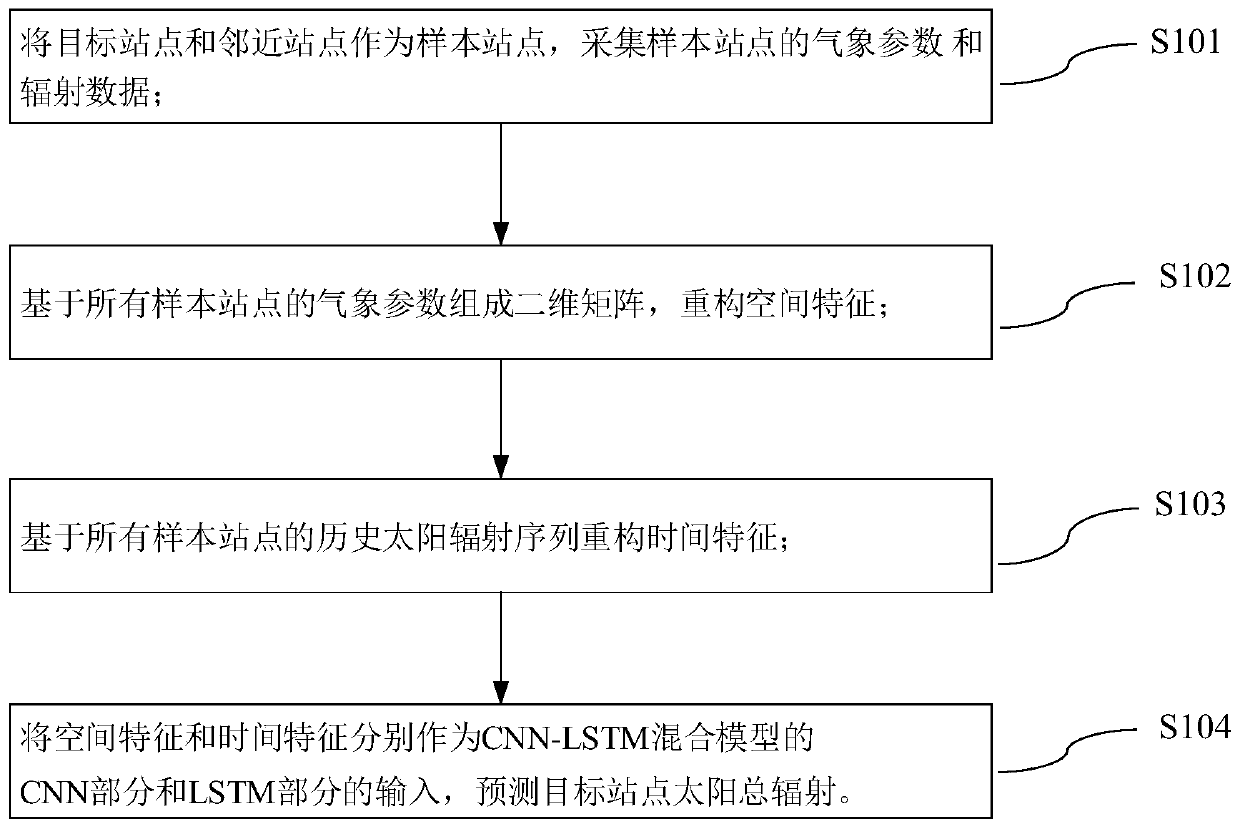
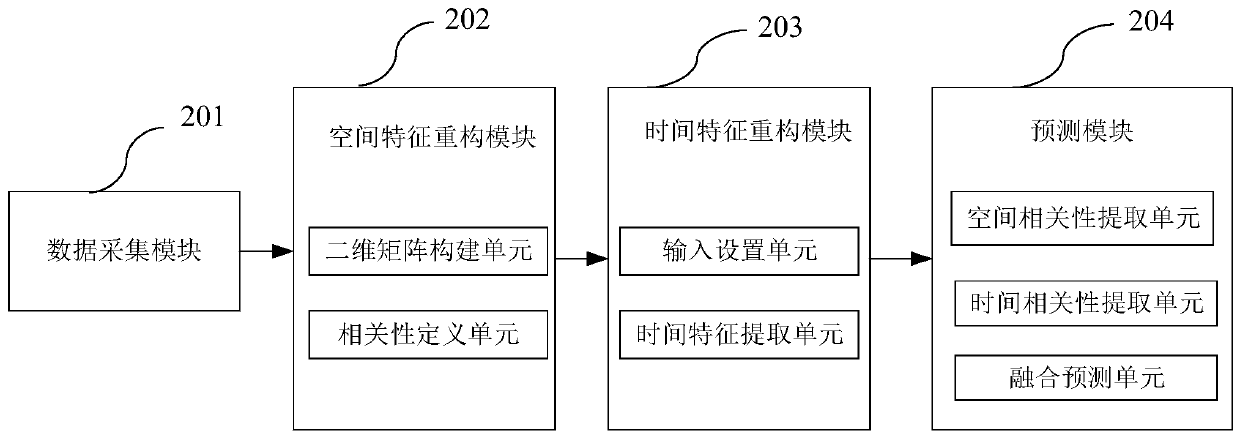
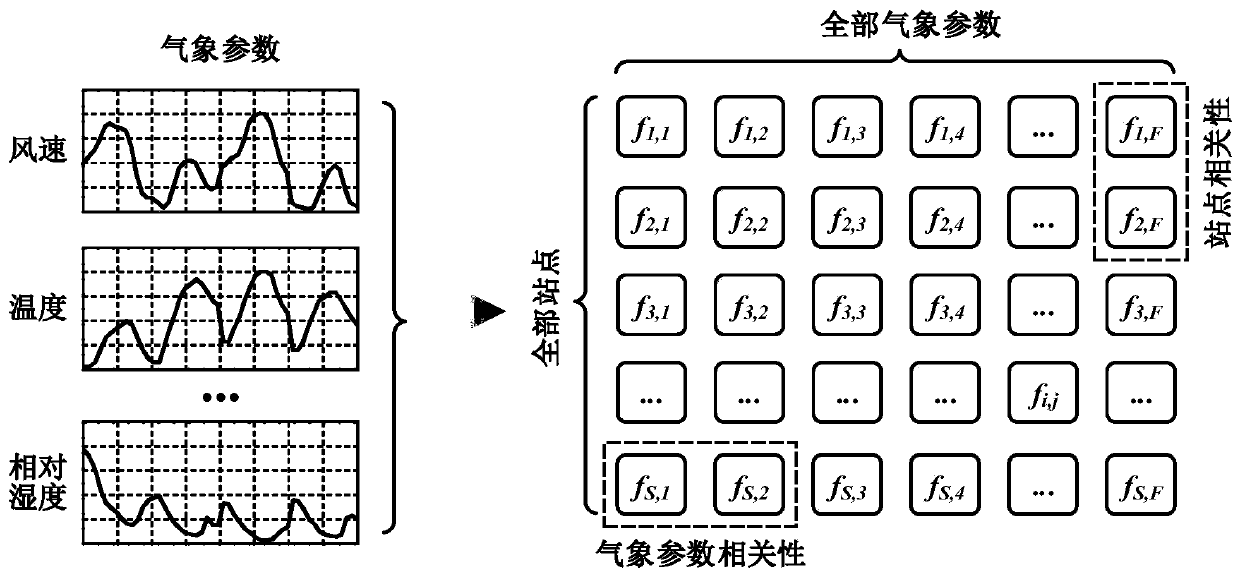
- A hybrid model based on CNN-LSTM is used to reconstruct the spatial and temporal characteristics by reconstructing the meteorological parameters and radiation data of the target site and neighboring sites, and input them into the CNN-LSTM model to extract spatial and temporal correlations for prediction.

Short-term solar radiation prediction method and device based on CNN-LSTM
PatentActiveCN111260154A
Innovation
- A hybrid model based on CNN-LSTM is used to reconstruct the spatial and temporal characteristics by reconstructing the meteorological parameters and radiation data of the target site and neighboring sites, and input them into the CNN-LSTM model to extract spatial and temporal correlations for prediction.
Data Quality and Availability for AI Training
The effectiveness of AI algorithms in solar radiation prediction fundamentally depends on the quality and availability of training data. High-quality datasets must encompass comprehensive meteorological parameters including cloud cover, atmospheric pressure, temperature, humidity, and aerosol optical depth, collected at sufficient temporal and spatial resolutions. However, many existing datasets suffer from inconsistencies in measurement standards, missing values, and sensor calibration errors that can significantly degrade model performance. Ground-based pyranometer networks, while providing accurate point measurements, often have limited spatial coverage and temporal gaps due to maintenance issues or equipment failures.
Satellite-derived solar radiation data offers broader spatial coverage but introduces challenges related to retrieval algorithm uncertainties and temporal resolution limitations. The integration of multiple data sources—including ground stations, satellite observations, and numerical weather prediction outputs—requires sophisticated preprocessing and quality control procedures to ensure data consistency and reliability. Data harmonization becomes particularly critical when combining historical records from different measurement systems or geographical regions with varying data collection protocols.
The availability of labeled training data poses another significant constraint, especially for advanced deep learning architectures that require large volumes of annotated samples. Many regions, particularly in developing countries, lack adequate solar radiation monitoring infrastructure, creating geographical biases in available datasets. This data scarcity limits the generalizability of AI models across different climatic zones and geographical contexts. Furthermore, extreme weather events and rare atmospheric conditions are typically underrepresented in historical datasets, affecting model robustness during unusual meteorological scenarios.
Addressing these data challenges requires establishing standardized data collection protocols, implementing automated quality assurance systems, and developing data augmentation techniques specific to solar radiation prediction. Collaborative efforts to create open-access, high-quality datasets with comprehensive metadata documentation are essential for advancing AI-based prediction capabilities. Additionally, transfer learning approaches and physics-informed neural networks can help mitigate data scarcity issues by leveraging knowledge from data-rich regions or incorporating physical constraints into model architectures.
Integration with Smart Grid and Energy Systems
The integration of AI-enhanced solar radiation prediction models with smart grid and energy systems represents a critical pathway toward optimizing renewable energy utilization and grid stability. Advanced prediction capabilities enable grid operators to anticipate solar power generation fluctuations with greater precision, facilitating proactive load balancing and resource allocation decisions. By embedding AI-driven forecasting models directly into energy management systems, utilities can minimize reliance on fossil fuel backup generation while maintaining grid reliability during variable solar conditions.
Smart grid architectures benefit substantially from real-time solar radiation predictions through enhanced demand response mechanisms and dynamic pricing strategies. When AI algorithms provide accurate short-term and medium-term forecasts, energy storage systems can be optimally scheduled to charge during peak solar production periods and discharge during anticipated generation deficits. This coordination reduces energy waste and maximizes the economic value of both solar installations and battery storage infrastructure, creating a more resilient and cost-effective energy ecosystem.
The bidirectional communication capabilities inherent in smart grid technologies enable continuous feedback loops that further refine AI prediction models. Actual generation data from distributed solar installations can be aggregated and fed back into machine learning systems, allowing models to adapt to local microclimatic conditions and equipment performance characteristics. This creates a self-improving system where prediction accuracy progressively increases through operational experience.
Integration challenges primarily involve data standardization across heterogeneous systems, latency requirements for real-time decision-making, and cybersecurity considerations for interconnected infrastructure. Successful implementations require robust application programming interfaces that facilitate seamless data exchange between forecasting platforms, supervisory control and data acquisition systems, and energy market platforms. Additionally, edge computing solutions are increasingly deployed to reduce latency in time-critical grid management operations while maintaining prediction model sophistication.
The convergence of AI-based solar forecasting with smart grid technologies ultimately enables higher renewable energy penetration rates while preserving grid stability, representing a foundational element in the transition toward sustainable energy systems.
Unlock deeper insights with Patsnap Eureka Quick Research — get a full tech report to explore trends and direct your research. Try now!
Generate Your Research Report Instantly with AI Agent
Supercharge your innovation with Patsnap Eureka AI Agent Platform!