
How to Manage Gradient Descent in Asynchronous Systems
OCT 9, 20268 MIN READ
Generate Your Research Report Instantly with AI Agent
Patsnap Eureka helps you evaluate technical feasibility & market potential.
Asynchronous Gradient Descent Background and Objectives
Gradient descent has served as the cornerstone optimization algorithm in machine learning and deep learning since the 1950s, evolving from simple batch processing methods to sophisticated distributed computing paradigms. Traditional synchronous gradient descent requires all computing nodes to complete their calculations before updating model parameters, creating significant bottlenecks in large-scale distributed systems. As datasets and model architectures have grown exponentially, the limitations of synchronous approaches have become increasingly apparent, particularly in terms of computational efficiency and resource utilization.
The emergence of asynchronous gradient descent represents a paradigm shift in distributed optimization, allowing computing nodes to update shared parameters independently without waiting for synchronization barriers. This approach gained prominence in the early 2010s when researchers recognized that tolerating some degree of staleness in gradient information could dramatically improve system throughput. The fundamental challenge lies in managing the trade-off between computational speed and convergence quality, as asynchronous updates introduce inherent inconsistencies in the optimization process.
The technical evolution has progressed through several distinct phases. Initial implementations focused on lock-free parameter servers that enabled non-blocking updates, followed by the development of delay-tolerant algorithms that could mathematically bound the impact of stale gradients. Recent advances have incorporated adaptive learning rates, momentum-based corrections, and sophisticated synchronization protocols that dynamically balance consistency and performance based on system conditions.
The primary objective of managing asynchronous gradient descent is to maximize training throughput while maintaining convergence guarantees and model accuracy comparable to synchronous methods. This requires addressing critical challenges including gradient staleness, race conditions in parameter updates, load balancing across heterogeneous computing resources, and ensuring theoretical convergence properties. Secondary objectives encompass fault tolerance, scalability to thousands of nodes, and adaptability to varying network conditions and hardware configurations.
Contemporary research aims to develop intelligent coordination mechanisms that can automatically adjust synchronization frequency, detect and mitigate the adverse effects of stale gradients, and optimize communication patterns to minimize overhead while preserving training effectiveness across diverse application scenarios.
The emergence of asynchronous gradient descent represents a paradigm shift in distributed optimization, allowing computing nodes to update shared parameters independently without waiting for synchronization barriers. This approach gained prominence in the early 2010s when researchers recognized that tolerating some degree of staleness in gradient information could dramatically improve system throughput. The fundamental challenge lies in managing the trade-off between computational speed and convergence quality, as asynchronous updates introduce inherent inconsistencies in the optimization process.
The technical evolution has progressed through several distinct phases. Initial implementations focused on lock-free parameter servers that enabled non-blocking updates, followed by the development of delay-tolerant algorithms that could mathematically bound the impact of stale gradients. Recent advances have incorporated adaptive learning rates, momentum-based corrections, and sophisticated synchronization protocols that dynamically balance consistency and performance based on system conditions.
The primary objective of managing asynchronous gradient descent is to maximize training throughput while maintaining convergence guarantees and model accuracy comparable to synchronous methods. This requires addressing critical challenges including gradient staleness, race conditions in parameter updates, load balancing across heterogeneous computing resources, and ensuring theoretical convergence properties. Secondary objectives encompass fault tolerance, scalability to thousands of nodes, and adaptability to varying network conditions and hardware configurations.
Contemporary research aims to develop intelligent coordination mechanisms that can automatically adjust synchronization frequency, detect and mitigate the adverse effects of stale gradients, and optimize communication patterns to minimize overhead while preserving training effectiveness across diverse application scenarios.
Market Demand for Distributed Training Systems
The market demand for distributed training systems has experienced substantial growth driven by the exponential increase in model complexity and dataset sizes across multiple industries. Organizations in sectors such as artificial intelligence research, autonomous vehicles, natural language processing, and computer vision require systems capable of training models with billions or even trillions of parameters. Traditional single-machine training approaches have become insufficient, creating urgent demand for scalable distributed solutions that can leverage multiple computing nodes simultaneously.
Enterprise adoption of deep learning technologies has accelerated the need for efficient distributed training infrastructure. Cloud service providers and technology companies are investing heavily in building platforms that support large-scale model training, recognizing that competitive advantage increasingly depends on the ability to iterate quickly on complex models. The rise of foundation models and large language models has particularly intensified this demand, as these applications require coordinated training across hundreds or thousands of GPUs.
Financial institutions, healthcare organizations, and e-commerce platforms represent significant market segments seeking distributed training capabilities. These industries handle massive datasets and require rapid model development cycles to maintain competitive positioning. The ability to reduce training time from weeks to days or hours directly translates to faster time-to-market for AI-powered products and services, creating strong economic incentives for adoption.
The market also reflects growing demand for systems that can handle asynchronous gradient descent efficiently. Organizations recognize that synchronous training methods often lead to resource underutilization and bottlenecks, particularly in heterogeneous computing environments. Solutions that effectively manage asynchronous updates while maintaining model convergence quality are increasingly valued, as they promise better hardware utilization and cost efficiency.
Emerging markets in Asia-Pacific and increased AI adoption in traditional industries further expand the addressable market. The proliferation of edge computing and federated learning scenarios introduces additional requirements for distributed training systems that can operate across geographically dispersed and resource-constrained environments, broadening the scope of market opportunities beyond centralized data center deployments.
Enterprise adoption of deep learning technologies has accelerated the need for efficient distributed training infrastructure. Cloud service providers and technology companies are investing heavily in building platforms that support large-scale model training, recognizing that competitive advantage increasingly depends on the ability to iterate quickly on complex models. The rise of foundation models and large language models has particularly intensified this demand, as these applications require coordinated training across hundreds or thousands of GPUs.
Financial institutions, healthcare organizations, and e-commerce platforms represent significant market segments seeking distributed training capabilities. These industries handle massive datasets and require rapid model development cycles to maintain competitive positioning. The ability to reduce training time from weeks to days or hours directly translates to faster time-to-market for AI-powered products and services, creating strong economic incentives for adoption.
The market also reflects growing demand for systems that can handle asynchronous gradient descent efficiently. Organizations recognize that synchronous training methods often lead to resource underutilization and bottlenecks, particularly in heterogeneous computing environments. Solutions that effectively manage asynchronous updates while maintaining model convergence quality are increasingly valued, as they promise better hardware utilization and cost efficiency.
Emerging markets in Asia-Pacific and increased AI adoption in traditional industries further expand the addressable market. The proliferation of edge computing and federated learning scenarios introduces additional requirements for distributed training systems that can operate across geographically dispersed and resource-constrained environments, broadening the scope of market opportunities beyond centralized data center deployments.
Current Challenges in Asynchronous Optimization
Asynchronous optimization in distributed machine learning systems faces several fundamental challenges that significantly impact convergence behavior and model performance. The primary obstacle stems from the inherent delay between when gradients are computed and when they are applied to the model parameters. This temporal gap, known as gradient staleness, occurs because workers compute gradients based on outdated parameter versions while the central server continues updating the model with contributions from other workers.
The staleness problem becomes particularly severe in heterogeneous computing environments where workers exhibit varying computational speeds and network latencies. Fast workers may complete multiple iterations while slower workers are still processing earlier batches, leading to inconsistent gradient information. This asynchrony can cause the optimization trajectory to deviate substantially from the ideal synchronous path, potentially resulting in slower convergence or even divergence in extreme cases.
Another critical challenge involves maintaining consistency across distributed parameter servers. When multiple workers simultaneously update shared parameters without proper coordination, race conditions and conflicting updates can corrupt the model state. The lack of global synchronization barriers means that workers may read partially updated parameters, introducing additional noise into the gradient computation process.
Convergence guarantees become significantly more difficult to establish in asynchronous settings. Traditional convergence proofs for gradient descent rely on assumptions that break down when gradients are stale or inconsistent. The bounded delay assumption, which requires that gradient staleness remains within acceptable limits, is often violated in practice, especially under system failures or network congestion.
Communication overhead presents another substantial bottleneck. While asynchronous methods aim to reduce idle time, frequent parameter synchronization can saturate network bandwidth, particularly in large-scale deployments with thousands of workers. Balancing communication frequency against gradient freshness remains an ongoing challenge without universal solutions.
System-level failures and stragglers further complicate asynchronous optimization. When workers crash or experience significant slowdowns, their stale gradients can poison the optimization process. Existing fault tolerance mechanisms often introduce additional latency or require complex checkpoint-recovery protocols that undermine the efficiency benefits of asynchronous execution.
The staleness problem becomes particularly severe in heterogeneous computing environments where workers exhibit varying computational speeds and network latencies. Fast workers may complete multiple iterations while slower workers are still processing earlier batches, leading to inconsistent gradient information. This asynchrony can cause the optimization trajectory to deviate substantially from the ideal synchronous path, potentially resulting in slower convergence or even divergence in extreme cases.
Another critical challenge involves maintaining consistency across distributed parameter servers. When multiple workers simultaneously update shared parameters without proper coordination, race conditions and conflicting updates can corrupt the model state. The lack of global synchronization barriers means that workers may read partially updated parameters, introducing additional noise into the gradient computation process.
Convergence guarantees become significantly more difficult to establish in asynchronous settings. Traditional convergence proofs for gradient descent rely on assumptions that break down when gradients are stale or inconsistent. The bounded delay assumption, which requires that gradient staleness remains within acceptable limits, is often violated in practice, especially under system failures or network congestion.
Communication overhead presents another substantial bottleneck. While asynchronous methods aim to reduce idle time, frequent parameter synchronization can saturate network bandwidth, particularly in large-scale deployments with thousands of workers. Balancing communication frequency against gradient freshness remains an ongoing challenge without universal solutions.
System-level failures and stragglers further complicate asynchronous optimization. When workers crash or experience significant slowdowns, their stale gradients can poison the optimization process. Existing fault tolerance mechanisms often introduce additional latency or require complex checkpoint-recovery protocols that undermine the efficiency benefits of asynchronous execution.
Existing Asynchronous SGD Solutions
01 Dynamic step size and adaptive parameter adjustment
Strategies such as dynamic step sizes, variable gains, and sign-based gradients are utilized to adjust parameters dynamically during gradient descent optimization. By adaptively tuning step sizes and learning parameters, these techniques mitigate issues like slow initial convergence and trapped iterations, thereby significantly accelerating the overall convergence speed.- Adaptive step size and dynamic parameter optimization: Techniques utilizing dynamic step sizes, variable gains, or symbol-based gradient strategies to adaptively modify optimization parameters during iterations, effectively addressing slow initial convergence and accelerating overall training speed.
- Parallelized and distributed computing architectures: Implementations leveraging parallelized stochastic gradient descent, parameter multiplexing, or specialized hardware architectures to distribute computation loads, reducing execution times and improving convergence throughput.
- Hybrid algorithms and heuristic search integration: Methods combining gradient descent with complementary optimization techniques, such as recursive least squares or heuristic search strategies, to improve convergence accuracy and speed while preventing algorithm oscillation.
- Application-specific algorithmic acceleration: Specialized gradient descent frameworks tailored for domain-specific tasks, such as low-permeability reservoir modeling and ARX parameter identification, designed to minimize redundant mathematical operations and speed up convergence.
- Neural network training and learning rate balancing: Optimization schemes integrated into backpropagation and deep learning frameworks that balance learning speed and precision, overcoming slow initial convergence issues while maintaining robust feature extraction performance.
02 Parallelized and distributed gradient descent optimization
Execution of gradient descent calculations across parallel architectures, multiple parameter channels, or distributed machine-learning frameworks allows for faster processing of complex loss landscapes. This parallelized execution improves computational throughput, reduces training latency, and boosts convergence performance.Expand Specific Solutions03 Hybrid algorithms combining gradient descent with secondary optimization methods
Integrating gradient descent with complementary optimization techniques—such as recursive least squares, heuristic global searches, or variational methods—helps overcome local minima and stabilizes step trajectories. This hybrid approach streamlines the path toward the optimal solution, enhancing convergence speed and precision.Expand Specific Solutions04 Optimization of neural network learning and variable selection
Applying modified stochastic gradient descent techniques directly to model parameter tuning, BP neural networks, and variable selection improves initial training phases. Resolving trade-offs between learning rate and precision allows models to reach optimal convergence quickly while preserving high output accuracy.Expand Specific Solutions05 Sequential and iterative search refinement
Utilizing sequential iterative optimization and structured search workflows streamlines the space of potential solutions during gradient descent operations. By targeting search pathways and avoiding redundant operations, these methods enhance computational efficiency, prevent local convergence, and ensure fast evaluation speeds.Expand Specific Solutions
Key Players in Distributed Machine Learning
The competitive landscape for managing gradient descent in asynchronous systems reflects a maturing technology domain driven by distributed machine learning and large-scale AI infrastructure demands. Major technology corporations including Huawei Technologies, IBM, Microsoft Technology Licensing, Amazon Technologies, Alibaba Group, and Tencent Technology dominate this space, leveraging their extensive cloud computing platforms and AI research capabilities. Leading Chinese research institutions such as Sun Yat-Sen University, Huazhong University of Science & Technology, and National University of Defense Technology contribute fundamental algorithmic innovations. The market demonstrates significant growth potential as enterprises increasingly adopt distributed training frameworks for deep learning models. Technology maturity varies across implementations, with established players like IBM and Microsoft offering production-ready solutions, while emerging approaches from Huawei Cloud Computing and Alibaba continue advancing asynchronous optimization techniques for next-generation AI workloads.
Huawei Technologies Co., Ltd.
Technical Solution: Huawei has developed advanced asynchronous gradient descent solutions for distributed deep learning systems. Their approach implements a parameter server architecture with adaptive synchronization mechanisms that balance convergence speed and model accuracy. The system employs delayed gradient aggregation with bounded staleness constraints, allowing worker nodes to proceed asynchronously while maintaining convergence guarantees. They utilize momentum-based compensation techniques to mitigate the impact of stale gradients, and implement dynamic learning rate adjustment algorithms that adapt to the degree of asynchrony in the system. Their solution also incorporates gradient compression and sparse communication protocols to reduce network overhead in asynchronous training scenarios[2][5].
Strengths: Robust industrial implementation with proven scalability across large-scale distributed systems; effective staleness mitigation strategies. Weaknesses: Requires careful hyperparameter tuning for optimal performance; may experience slower convergence compared to synchronous methods in certain scenarios.
International Business Machines Corp.
Technical Solution: IBM has pioneered asynchronous stochastic gradient descent (ASGD) frameworks optimized for heterogeneous computing environments. Their technology leverages elastic averaging SGD (EASGD) which maintains local worker models that periodically synchronize with a master model through elastic force mechanisms. This approach allows workers to explore different regions of the parameter space while preventing divergence. IBM's solution incorporates sophisticated gradient staleness handling through importance weighting schemes and implements lock-free parameter updates using atomic operations. They have developed adaptive batch sizing techniques that dynamically adjust based on system load and gradient variance, optimizing resource utilization in asynchronous settings[3][8][11].
Strengths: Strong theoretical foundations with convergence guarantees; excellent performance in heterogeneous environments with varying worker speeds. Weaknesses: Increased memory overhead due to maintaining multiple model copies; complexity in implementation and debugging.
Core Innovations in Staleness Mitigation
Asychronous training of machine learning model
PatentActiveEP3504666A1
Innovation
- The server receives feedback data from workers, determines differences in model parameters, and updates them to compensate for delays, incorporating both the training results and delay differences, rather than trying to eliminate delays, thereby reducing mismatches and enhancing training efficiency.
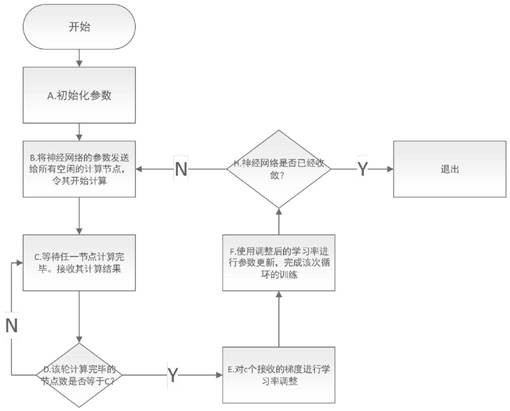
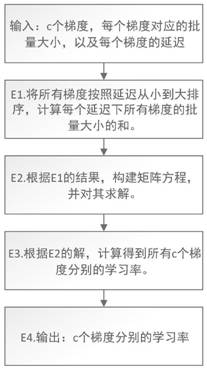
Neural network asynchronous training-oriented learning rate adjustment method
PatentActiveCN112861991A
Innovation
- Adopt a learning rate adjustment method that balances the learning rate by initializing parameters and hyperparameters, merging and sorting gradient latencies and batch sizes, using a matrix equation to calculate the final learning rate for each gradient, taking into account the latency and batch size of each gradient Adjust to avoid linear increases.


System Architecture for Async Training
Asynchronous training systems require carefully designed architectures to handle the inherent challenges of managing gradient descent across distributed computing nodes. The fundamental architecture typically consists of three core components: parameter servers, worker nodes, and a coordination layer. Parameter servers maintain the global model parameters and serve as the central repository for gradient updates, while worker nodes independently compute gradients on local data batches. The coordination layer manages communication protocols and synchronization strategies between these components.
The parameter server architecture can be implemented in centralized or decentralized configurations. In centralized designs, a single parameter server or a cluster of servers handles all gradient aggregation and model updates. This approach simplifies implementation but may create communication bottlenecks as the number of workers scales. Decentralized architectures distribute parameter management across multiple nodes, enabling peer-to-peer communication patterns that reduce single points of failure and improve scalability.
Worker nodes in asynchronous systems operate with varying degrees of independence. Each worker maintains a local copy of model parameters, computes gradients on assigned data partitions, and pushes updates to parameter servers without waiting for other workers. The architecture must support efficient gradient communication mechanisms, including compression techniques and sparse update protocols, to minimize network overhead. Buffer management systems are essential for handling the queue of incoming gradients at parameter servers.
The coordination layer implements staleness control mechanisms to manage the temporal inconsistency between worker-computed gradients and current model states. This includes version tracking systems that monitor parameter freshness and adaptive scheduling algorithms that prioritize updates based on staleness thresholds. Modern architectures incorporate elastic scaling capabilities, allowing dynamic adjustment of worker populations based on computational demands and resource availability, ensuring optimal resource utilization while maintaining training stability.
The parameter server architecture can be implemented in centralized or decentralized configurations. In centralized designs, a single parameter server or a cluster of servers handles all gradient aggregation and model updates. This approach simplifies implementation but may create communication bottlenecks as the number of workers scales. Decentralized architectures distribute parameter management across multiple nodes, enabling peer-to-peer communication patterns that reduce single points of failure and improve scalability.
Worker nodes in asynchronous systems operate with varying degrees of independence. Each worker maintains a local copy of model parameters, computes gradients on assigned data partitions, and pushes updates to parameter servers without waiting for other workers. The architecture must support efficient gradient communication mechanisms, including compression techniques and sparse update protocols, to minimize network overhead. Buffer management systems are essential for handling the queue of incoming gradients at parameter servers.
The coordination layer implements staleness control mechanisms to manage the temporal inconsistency between worker-computed gradients and current model states. This includes version tracking systems that monitor parameter freshness and adaptive scheduling algorithms that prioritize updates based on staleness thresholds. Modern architectures incorporate elastic scaling capabilities, allowing dynamic adjustment of worker populations based on computational demands and resource availability, ensuring optimal resource utilization while maintaining training stability.
Convergence Guarantees and Theoretical Foundations
Establishing convergence guarantees for asynchronous gradient descent requires rigorous mathematical frameworks that account for the inherent unpredictability of delayed and stale gradient information. Classical convergence proofs for synchronous optimization rely on assumptions of consistent gradient computation and immediate parameter updates, which break down in asynchronous environments. The theoretical foundation must therefore address how bounded delays, inconsistent read-write operations, and potential gradient staleness affect the optimization trajectory toward local or global minima.
The fundamental convergence analysis typically begins with defining a bounded delay model, where the maximum staleness of gradients is constrained by a parameter τ. Under convex objective functions with Lipschitz-continuous gradients, theoretical results demonstrate that asynchronous stochastic gradient descent converges to an optimal solution when the learning rate is appropriately scaled relative to the delay bound. Specifically, convergence rates of O(1/√T) can be maintained when learning rates decrease proportionally to ensure that accumulated errors from stale gradients remain controllable.
For non-convex optimization scenarios common in deep learning, convergence guarantees become more nuanced. Research establishes that asynchronous methods can converge to stationary points under assumptions of sufficient gradient diversity and bounded delay conditions. The key theoretical insight involves proving that despite asynchronous updates, the expected descent direction remains sufficiently correlated with the true gradient direction, ensuring progress toward critical points over time.
Lock-free algorithms introduce additional theoretical complexity, as they permit race conditions and inconsistent reads. Perturbed iterate analysis provides a framework for understanding these systems, treating asynchronous updates as noisy approximations of synchronous steps. Theoretical bounds demonstrate that when perturbations remain within acceptable thresholds relative to gradient magnitudes, convergence properties are preserved with only marginal degradation in convergence rates.
Recent theoretical advances have extended convergence guarantees to incorporate adaptive learning rates and momentum-based methods in asynchronous settings. These results show that careful algorithmic design can maintain the benefits of advanced optimization techniques while accommodating system asynchrony, provided that delay-aware compensation mechanisms are integrated into the theoretical framework.
The fundamental convergence analysis typically begins with defining a bounded delay model, where the maximum staleness of gradients is constrained by a parameter τ. Under convex objective functions with Lipschitz-continuous gradients, theoretical results demonstrate that asynchronous stochastic gradient descent converges to an optimal solution when the learning rate is appropriately scaled relative to the delay bound. Specifically, convergence rates of O(1/√T) can be maintained when learning rates decrease proportionally to ensure that accumulated errors from stale gradients remain controllable.
For non-convex optimization scenarios common in deep learning, convergence guarantees become more nuanced. Research establishes that asynchronous methods can converge to stationary points under assumptions of sufficient gradient diversity and bounded delay conditions. The key theoretical insight involves proving that despite asynchronous updates, the expected descent direction remains sufficiently correlated with the true gradient direction, ensuring progress toward critical points over time.
Lock-free algorithms introduce additional theoretical complexity, as they permit race conditions and inconsistent reads. Perturbed iterate analysis provides a framework for understanding these systems, treating asynchronous updates as noisy approximations of synchronous steps. Theoretical bounds demonstrate that when perturbations remain within acceptable thresholds relative to gradient magnitudes, convergence properties are preserved with only marginal degradation in convergence rates.
Recent theoretical advances have extended convergence guarantees to incorporate adaptive learning rates and momentum-based methods in asynchronous settings. These results show that careful algorithmic design can maintain the benefits of advanced optimization techniques while accommodating system asynchrony, provided that delay-aware compensation mechanisms are integrated into the theoretical framework.
Unlock deeper insights with Patsnap Eureka Quick Research — get a full tech report to explore trends and direct your research. Try now!
Generate Your Research Report Instantly with AI Agent
Supercharge your innovation with Patsnap Eureka AI Agent Platform!