
Quantify Gradient Descent Tradeoffs in Multi-Objective Models
OCT 9, 20269 MIN READ
Generate Your Research Report Instantly with AI Agent
Patsnap Eureka helps you evaluate technical feasibility & market potential.
Multi-Objective Optimization Background and Research Goals
Multi-objective optimization has emerged as a critical paradigm in machine learning and artificial intelligence, addressing scenarios where multiple conflicting objectives must be simultaneously optimized. Unlike traditional single-objective optimization, which seeks to minimize or maximize a single loss function, multi-objective problems require balancing trade-offs among competing goals such as accuracy, fairness, robustness, and computational efficiency. This complexity has become increasingly relevant as modern applications demand models that satisfy diverse performance criteria across different stakeholder requirements and operational constraints.
The historical development of multi-objective optimization traces back to classical operations research and economic theory, where Pareto optimality provided the foundational framework for understanding non-dominated solutions. In recent years, the integration of gradient-based methods with multi-objective frameworks has gained momentum, particularly with the rise of deep learning architectures that naturally accommodate multiple loss terms. However, the fundamental challenge lies in understanding how gradient descent navigates the conflicting directional information from multiple objectives, and how different weighting schemes or scalarization methods affect convergence properties and solution quality.
The primary research goal centers on developing rigorous quantitative frameworks to characterize the inherent trade-offs that gradient descent encounters when optimizing multiple objectives simultaneously. This involves establishing mathematical metrics to measure conflict intensity among objective gradients, analyzing how these conflicts evolve during training, and understanding their impact on final model performance across the objective space. A deeper understanding of these dynamics is essential for designing more effective optimization algorithms and providing practitioners with principled guidance on hyperparameter selection and training strategies.
Furthermore, this research aims to bridge theoretical analysis with practical implementation by investigating how different multi-objective gradient descent variants—including weighted sum methods, gradient manipulation techniques, and Pareto-based approaches—quantitatively differ in their trade-off characteristics. The ultimate objective is to establish predictive models that can forecast optimization behavior and solution quality based on problem structure and algorithmic choices, thereby enabling more informed decision-making in multi-objective model development.
The historical development of multi-objective optimization traces back to classical operations research and economic theory, where Pareto optimality provided the foundational framework for understanding non-dominated solutions. In recent years, the integration of gradient-based methods with multi-objective frameworks has gained momentum, particularly with the rise of deep learning architectures that naturally accommodate multiple loss terms. However, the fundamental challenge lies in understanding how gradient descent navigates the conflicting directional information from multiple objectives, and how different weighting schemes or scalarization methods affect convergence properties and solution quality.
The primary research goal centers on developing rigorous quantitative frameworks to characterize the inherent trade-offs that gradient descent encounters when optimizing multiple objectives simultaneously. This involves establishing mathematical metrics to measure conflict intensity among objective gradients, analyzing how these conflicts evolve during training, and understanding their impact on final model performance across the objective space. A deeper understanding of these dynamics is essential for designing more effective optimization algorithms and providing practitioners with principled guidance on hyperparameter selection and training strategies.
Furthermore, this research aims to bridge theoretical analysis with practical implementation by investigating how different multi-objective gradient descent variants—including weighted sum methods, gradient manipulation techniques, and Pareto-based approaches—quantitatively differ in their trade-off characteristics. The ultimate objective is to establish predictive models that can forecast optimization behavior and solution quality based on problem structure and algorithmic choices, thereby enabling more informed decision-making in multi-objective model development.
Market Demand for Multi-Objective Model Solutions
The demand for multi-objective model solutions has experienced substantial growth across diverse industries as organizations increasingly recognize the limitations of single-objective optimization approaches. Traditional machine learning models typically optimize for a single metric, which often fails to capture the complex tradeoffs inherent in real-world applications. This gap has created significant market opportunities for solutions that can effectively balance multiple competing objectives simultaneously.
In the financial services sector, there is growing demand for models that can optimize portfolio returns while simultaneously managing risk exposure, regulatory compliance costs, and environmental social governance criteria. Investment firms and banking institutions are actively seeking frameworks that quantify the tradeoffs between these objectives, enabling more informed decision-making processes. The complexity of modern financial products and increasing regulatory scrutiny have made multi-objective optimization capabilities essential rather than optional.
Healthcare and pharmaceutical industries represent another major market segment driving demand for multi-objective solutions. Drug discovery processes require balancing efficacy, safety profiles, manufacturing costs, and time-to-market considerations. Clinical decision support systems must weigh treatment effectiveness against patient quality of life, side effects, and healthcare costs. The ability to quantify gradient descent tradeoffs in these scenarios directly impacts patient outcomes and operational efficiency.
Manufacturing and supply chain management sectors are experiencing accelerated adoption of multi-objective optimization techniques. Companies need to simultaneously optimize production costs, delivery times, quality standards, and sustainability metrics. The rise of Industry 4.0 and smart manufacturing has intensified the need for sophisticated models that can navigate these competing priorities in real-time operational environments.
The autonomous systems and robotics market presents emerging opportunities for multi-objective model solutions. Self-driving vehicles must balance safety, efficiency, passenger comfort, and regulatory compliance. Similarly, industrial robots require optimization across productivity, energy consumption, equipment longevity, and workplace safety parameters. These applications demand robust frameworks for understanding and managing objective tradeoffs.
E-commerce and recommendation systems constitute a rapidly expanding market segment. Platforms must optimize user engagement, revenue generation, content diversity, and long-term customer satisfaction simultaneously. The ability to quantify how gradient descent navigates these tradeoffs directly influences platform competitiveness and user retention rates.
In the financial services sector, there is growing demand for models that can optimize portfolio returns while simultaneously managing risk exposure, regulatory compliance costs, and environmental social governance criteria. Investment firms and banking institutions are actively seeking frameworks that quantify the tradeoffs between these objectives, enabling more informed decision-making processes. The complexity of modern financial products and increasing regulatory scrutiny have made multi-objective optimization capabilities essential rather than optional.
Healthcare and pharmaceutical industries represent another major market segment driving demand for multi-objective solutions. Drug discovery processes require balancing efficacy, safety profiles, manufacturing costs, and time-to-market considerations. Clinical decision support systems must weigh treatment effectiveness against patient quality of life, side effects, and healthcare costs. The ability to quantify gradient descent tradeoffs in these scenarios directly impacts patient outcomes and operational efficiency.
Manufacturing and supply chain management sectors are experiencing accelerated adoption of multi-objective optimization techniques. Companies need to simultaneously optimize production costs, delivery times, quality standards, and sustainability metrics. The rise of Industry 4.0 and smart manufacturing has intensified the need for sophisticated models that can navigate these competing priorities in real-time operational environments.
The autonomous systems and robotics market presents emerging opportunities for multi-objective model solutions. Self-driving vehicles must balance safety, efficiency, passenger comfort, and regulatory compliance. Similarly, industrial robots require optimization across productivity, energy consumption, equipment longevity, and workplace safety parameters. These applications demand robust frameworks for understanding and managing objective tradeoffs.
E-commerce and recommendation systems constitute a rapidly expanding market segment. Platforms must optimize user engagement, revenue generation, content diversity, and long-term customer satisfaction simultaneously. The ability to quantify how gradient descent navigates these tradeoffs directly influences platform competitiveness and user retention rates.
Current Challenges in Gradient Descent Tradeoff Quantification
Quantifying gradient descent tradeoffs in multi-objective optimization models faces several fundamental challenges that impede both theoretical understanding and practical implementation. The primary difficulty lies in the inherent conflict between multiple objectives, where improving performance on one objective often necessitates degradation in others. This creates a complex optimization landscape where traditional single-objective metrics become insufficient for evaluating convergence quality and solution optimality.
A critical challenge involves the lack of standardized metrics for measuring tradeoff quality across diverse problem domains. Current approaches struggle to provide unified quantitative frameworks that can consistently evaluate how gradient descent algorithms balance competing objectives. The absence of such standardization makes it difficult to compare different optimization strategies or assess whether a particular tradeoff configuration represents a genuine Pareto-optimal solution or merely a local compromise.
The computational complexity of tradeoff quantification presents another significant obstacle. As the number of objectives increases, the dimensionality of the tradeoff space grows exponentially, making exhaustive evaluation computationally prohibitive. Existing gradient-based methods often rely on scalarization techniques or weighted sum approaches, but these methods introduce their own biases and may fail to capture the full spectrum of possible tradeoffs, particularly in non-convex optimization landscapes.
Dynamic tradeoff relationships pose additional complications. In many real-world applications, the relative importance of different objectives may shift during the optimization process or vary across different regions of the solution space. Current quantification methods typically assume static tradeoff preferences, limiting their ability to adapt to evolving optimization requirements or capture context-dependent objective interactions.
Furthermore, the challenge of gradient conflict resolution remains inadequately addressed. When gradients from different objectives point in opposing directions, determining the optimal descent direction requires sophisticated conflict resolution mechanisms. Existing approaches often lack rigorous theoretical foundations for quantifying the degree of gradient conflict and its impact on convergence behavior, making it difficult to predict optimization outcomes or diagnose performance bottlenecks in multi-objective scenarios.
A critical challenge involves the lack of standardized metrics for measuring tradeoff quality across diverse problem domains. Current approaches struggle to provide unified quantitative frameworks that can consistently evaluate how gradient descent algorithms balance competing objectives. The absence of such standardization makes it difficult to compare different optimization strategies or assess whether a particular tradeoff configuration represents a genuine Pareto-optimal solution or merely a local compromise.
The computational complexity of tradeoff quantification presents another significant obstacle. As the number of objectives increases, the dimensionality of the tradeoff space grows exponentially, making exhaustive evaluation computationally prohibitive. Existing gradient-based methods often rely on scalarization techniques or weighted sum approaches, but these methods introduce their own biases and may fail to capture the full spectrum of possible tradeoffs, particularly in non-convex optimization landscapes.
Dynamic tradeoff relationships pose additional complications. In many real-world applications, the relative importance of different objectives may shift during the optimization process or vary across different regions of the solution space. Current quantification methods typically assume static tradeoff preferences, limiting their ability to adapt to evolving optimization requirements or capture context-dependent objective interactions.
Furthermore, the challenge of gradient conflict resolution remains inadequately addressed. When gradients from different objectives point in opposing directions, determining the optimal descent direction requires sophisticated conflict resolution mechanisms. Existing approaches often lack rigorous theoretical foundations for quantifying the degree of gradient conflict and its impact on convergence behavior, making it difficult to predict optimization outcomes or diagnose performance bottlenecks in multi-objective scenarios.
Existing Gradient Descent Tradeoff Quantification Methods
01 Tradeoffs between Efficacy, Side Effects, and Constraints in Gradient Descent Optimization
Gradient descent optimization can be applied to balance multiple competing objectives and constraints, such as optimizing medical dosage to balance efficacy against side effects, or managing vehicle kinematics during trajectory planning to resolve motion oscillations.- Tradeoffs between Efficacy, Side Effects, and Optimization Objectives: Gradient descent techniques are adapted to balance competing objectives, such as maximizing treatment efficacy while minimizing side effects in personalized dosing, or optimizing parameters under constraints. By modeling these tradeoffs, algorithms can effectively navigate multi-objective landscape challenges.
- Tradeoffs in Privacy Protection, Data Security, and Communication Efficiency: In federated learning and distributed computing, applying gradient descent involves balancing privacy protection against communication overhead and model performance. Methods such as local privacy preservation, differential privacy, and stochastic gradient descent are used to mitigate privacy leakages and high communication costs.
- Tradeoffs between Convergence Speed, Computation Time, and Accuracy: Modifying gradient descent step sizes and learning rates allows systems to manage the balance between fast convergence and solution precision. Dynamic step sizes, batch size adjustments, and sequential iterations help avoid local convergence while reducing computational time and redundant operations.
- Tradeoffs in Engineering Systems and Hardware Optimization: Gradient descent algorithms are implemented in domain-specific hardware and physical systems to balance performance requirements with resource constraints. Applications range from autonomous vehicle trajectory planning and power network decoupling capacitance optimization to chip architecture designs.
- Tradeoffs in Algorithm Efficiency, Parallelization, and Computational Complexity: Selecting between standard gradient descent, stochastic variants, and advanced optimizers involves balancing computational complexity with training efficiency. Techniques like mini-batch processing, parallel computing, and parameter multiplexing optimize resource utilization during deep learning model training.
02 Tradeoffs between Privacy Protection, Malicious Risks, and Communication Overhead
In federated and shared learning applications, gradient descent techniques must manage the tradeoff between safeguarding local data privacy and reducing high communication costs or risks of malicious privacy leaks.Expand Specific Solutions03 Tradeoffs between Computational Time, Memory/Hardware Complexity, and Result Accuracy
Modifying step sizes, hyper-parameters, and batch learning rates in gradient descent methods allows systems to navigate tradeoffs between convergence speed, computational overhead, and parameter identification accuracy.Expand Specific Solutions04 Tradeoffs between Local Convergence Avoidance and Global Search Efficiency
Advanced iterative and heuristic gradient descent variants balance fast calculation speeds against the risk of getting trapped in local optima, ensuring overall model robustness without suffering from premature convergence.Expand Specific Solutions05 Tradeoffs between Model Complexity, Feature Overlap, and Generalization Robustness
When applying gradient descent optimization to regression and spectral analysis, models must balance component feature overlaps against generalization ability to prevent poor robustness and inaccurate predictive performance.Expand Specific Solutions
Key Players in Multi-Objective Machine Learning Research
The research on quantifying gradient descent tradeoffs in multi-objective models represents an evolving technical domain within the mature field of machine learning optimization. The competitive landscape features established technology leaders including IBM, Google, Intel, Qualcomm, and DeepMind Technologies, alongside specialized AI innovators such as Baidu USA and Ping An Technology. Academic institutions like Beijing Institute of Technology and Jilin University contribute foundational research, while enterprise software providers including Salesforce, Intuit, and Cognizant integrate these techniques into commercial applications. The technology demonstrates moderate-to-high maturity, with active patent activity indicating ongoing algorithmic refinements in Pareto optimization, gradient balancing, and multi-task learning frameworks. Market adoption spans diverse sectors from autonomous systems to financial services, reflecting broad applicability and growing commercial interest in efficient multi-objective optimization solutions.
International Business Machines Corp.
Technical Solution: IBM has developed enterprise-grade multi-objective optimization solutions that quantify gradient descent tradeoffs through their AI optimization toolkit. Their approach integrates constraint-based optimization with gradient descent methods, allowing practitioners to specify hard constraints on certain objectives while optimizing others. IBM's system provides quantitative sensitivity analysis showing how changes in one objective's gradient magnitude affect other objectives, enabling data-driven decision-making about tradeoff acceptance. The platform includes automated reporting features that generate tradeoff curves and Pareto frontiers, making complex optimization results accessible to business stakeholders. Their solution emphasizes explainability, providing detailed attribution of how each objective contributes to the final model performance, which is critical for regulated industries requiring transparent AI systems.
Strengths: Enterprise-ready solutions with strong governance and explainability features, excellent integration with existing business systems, robust support infrastructure. Weaknesses: May lack cutting-edge research innovations compared to pure research organizations, potentially higher licensing costs for commercial deployment.
Intel Corp.
Technical Solution: Intel has developed hardware-accelerated multi-objective optimization frameworks that leverage their specialized AI processors to efficiently compute gradient tradeoffs across multiple objectives. Their approach focuses on computational efficiency, implementing parallel gradient computation architectures that can simultaneously evaluate multiple objective functions with minimal overhead. Intel's solution includes profiling tools that quantify the computational cost of each objective, enabling practitioners to make informed decisions about which objectives to prioritize based on both performance impact and computational budget. Their framework integrates with popular deep learning libraries and provides optimized kernels for multi-gradient operations, significantly reducing training time for multi-objective models. The system includes visualization dashboards that display real-time tradeoff metrics during training, allowing for dynamic adjustment of objective weights based on observed gradient conflicts.
Strengths: Superior computational efficiency through hardware optimization, excellent performance on Intel architectures, strong integration with existing ML frameworks. Weaknesses: Potential vendor lock-in to Intel hardware ecosystem, may not fully utilize capabilities of competing hardware platforms, limited theoretical innovation compared to research-focused organizations.
Core Techniques for Pareto Frontier Analysis
Gradient-based methods for multi-objective optimization
PatentInactiveUS20070005313A1
Innovation
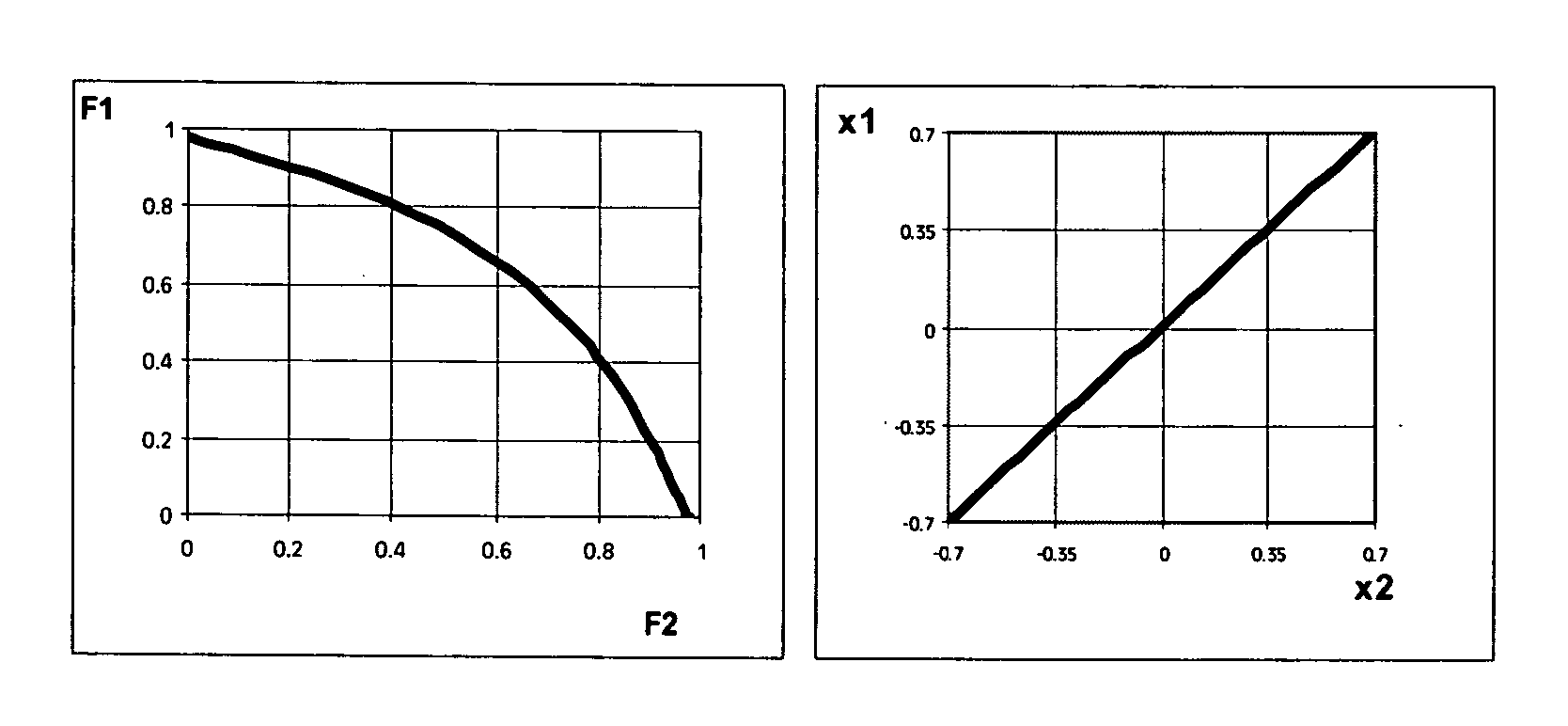
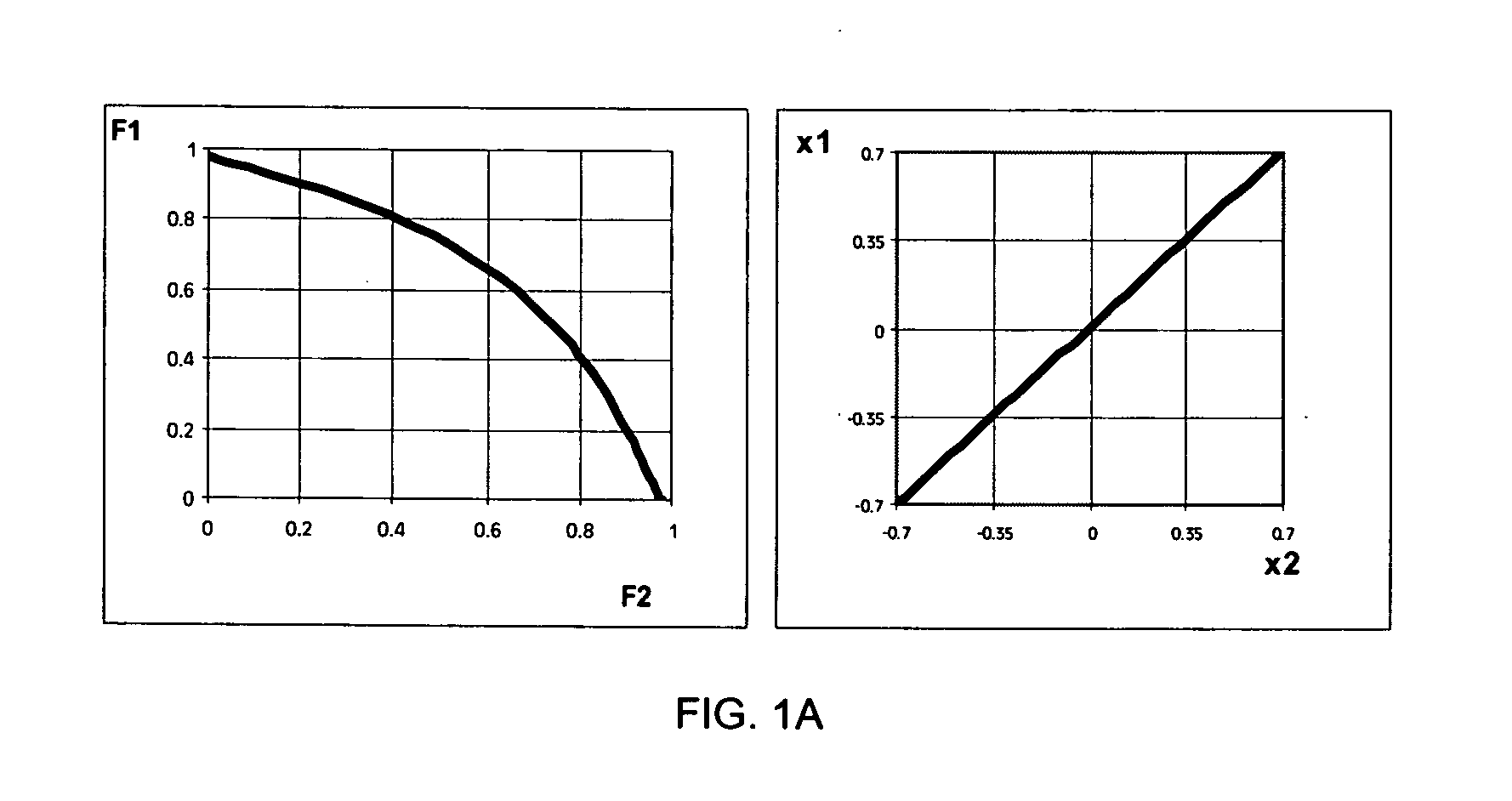
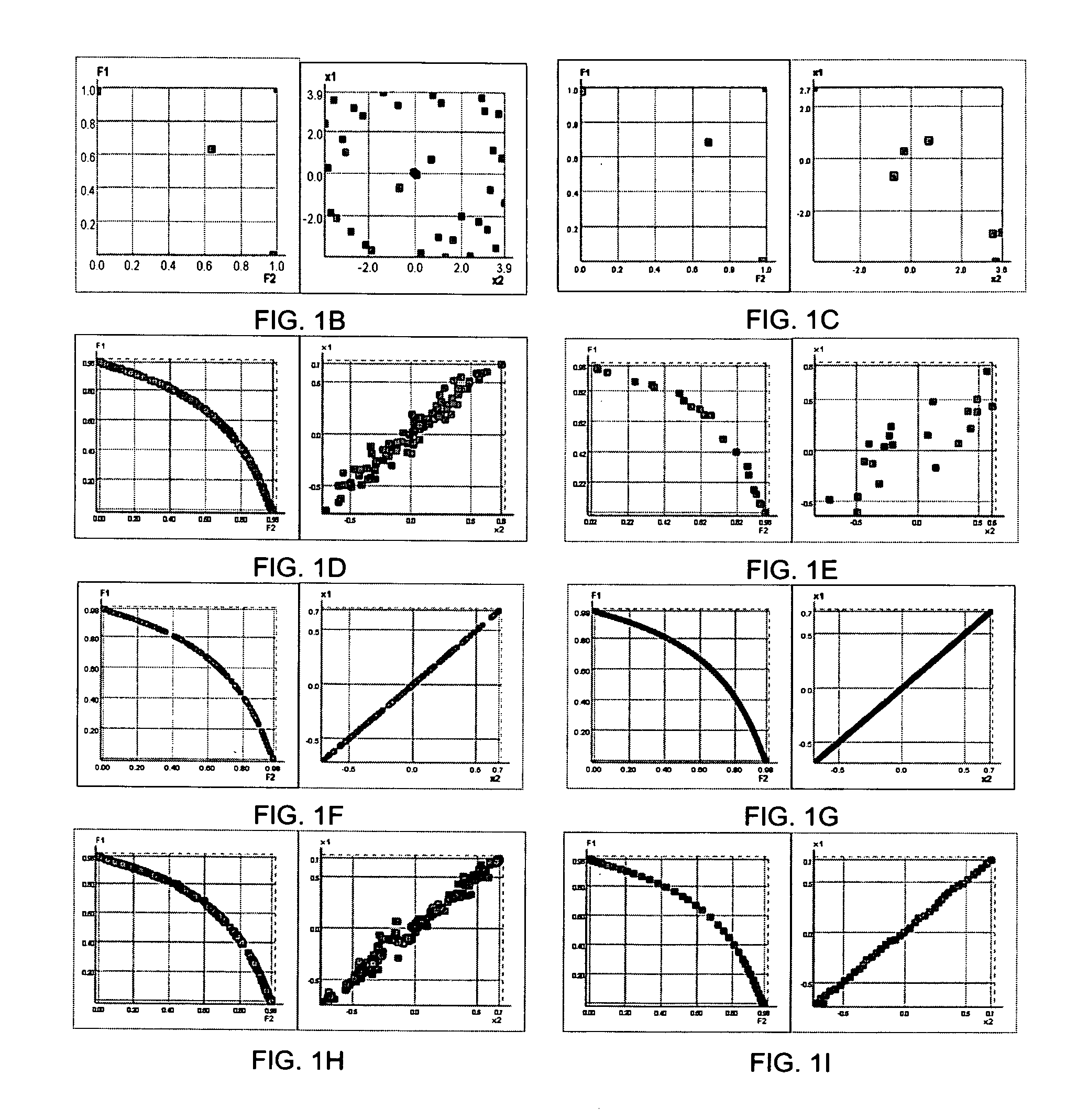
- The development of Concurrent Gradients Analysis (CGA) and related methods like Concurrent Gradients Method (CGM) and Pareto Navigator Method (PNM), which analyze gradients to determine simultaneous improvement directions for multiple objective functions, along with Dimensionally Independent Response Surface Method (DIRSM) to reduce computational complexity and improve accuracy.

Decision tree-mathematical programming hierarchical machining scheduling method considering multi-objective tradeoff
PatentPendingCN121348968A
Innovation
- By constructing a decision tree structure to generate a multi-objective trade-off function and calculating its gradient information, the optimization space is partitioned and controlled based on the gradient of the trade-off function to identify and avoid local deterioration areas. The optimal machining scheduling scheme is obtained by combining mathematical programming.


Benchmark Datasets and Evaluation Metrics
Evaluating gradient descent tradeoffs in multi-objective optimization requires carefully selected benchmark datasets that capture diverse problem characteristics and complexity levels. Standard datasets commonly employed include multi-task learning benchmarks such as Multi-MNIST, CelebA with multiple attribute prediction tasks, and NYUv2 for dense prediction problems combining semantic segmentation and depth estimation. These datasets provide varying degrees of task conflict and complementarity, enabling comprehensive assessment of optimization strategies. Additionally, synthetic multi-objective test functions like ZDT and DTLZ suites offer controlled environments where ground truth Pareto fronts are known, facilitating precise quantification of convergence behavior and solution quality.
The evaluation framework must incorporate multiple complementary metrics to capture different aspects of multi-objective optimization performance. Pareto dominance-based metrics such as hypervolume indicator and inverted generational distance measure solution set quality relative to the true Pareto front, quantifying both convergence and diversity of obtained solutions. Task-specific performance metrics including per-task accuracy, loss values, and their statistical distributions across objectives provide granular insights into individual task optimization effectiveness. Gradient conflict metrics, such as cosine similarity between task gradients and conflict frequency measurements, directly quantify the degree of objective interference during training.
Temporal dynamics assessment requires tracking metrics throughout the optimization trajectory rather than solely at convergence. Learning curves for each objective, gradient magnitude evolution, and Pareto front approximation quality over iterations reveal how different gradient descent strategies navigate tradeoff landscapes. Computational efficiency metrics including wall-clock time, iteration count to convergence, and memory consumption are essential for practical applicability evaluation. Furthermore, robustness analysis through multiple random initializations and cross-validation protocols ensures statistical significance of observed performance differences. Standardized evaluation protocols combining these diverse metrics enable rigorous comparison of gradient descent variants and facilitate reproducible research in multi-objective optimization.
The evaluation framework must incorporate multiple complementary metrics to capture different aspects of multi-objective optimization performance. Pareto dominance-based metrics such as hypervolume indicator and inverted generational distance measure solution set quality relative to the true Pareto front, quantifying both convergence and diversity of obtained solutions. Task-specific performance metrics including per-task accuracy, loss values, and their statistical distributions across objectives provide granular insights into individual task optimization effectiveness. Gradient conflict metrics, such as cosine similarity between task gradients and conflict frequency measurements, directly quantify the degree of objective interference during training.
Temporal dynamics assessment requires tracking metrics throughout the optimization trajectory rather than solely at convergence. Learning curves for each objective, gradient magnitude evolution, and Pareto front approximation quality over iterations reveal how different gradient descent strategies navigate tradeoff landscapes. Computational efficiency metrics including wall-clock time, iteration count to convergence, and memory consumption are essential for practical applicability evaluation. Furthermore, robustness analysis through multiple random initializations and cross-validation protocols ensures statistical significance of observed performance differences. Standardized evaluation protocols combining these diverse metrics enable rigorous comparison of gradient descent variants and facilitate reproducible research in multi-objective optimization.
Computational Complexity and Scalability Considerations
Computational complexity represents a fundamental constraint when implementing gradient descent algorithms for multi-objective optimization problems. The time complexity of standard gradient descent scales linearly with the number of objectives, but this relationship becomes significantly more intricate when considering trade-off quantification methods. Computing Pareto fronts or maintaining diverse solution sets typically requires O(m·n·d) operations per iteration, where m denotes the number of objectives, n represents population or batch size, and d indicates dimensionality. Advanced quantification techniques that track gradient conflicts or compute projection matrices can escalate complexity to O(m²·d²), potentially rendering real-time applications infeasible for high-dimensional problems.
Scalability challenges emerge across multiple dimensions in multi-objective gradient descent systems. As the number of objectives increases beyond ten, traditional scalarization approaches encounter exponential growth in computational requirements for maintaining solution diversity. Memory consumption becomes particularly problematic when storing historical gradient information or maintaining archives of non-dominated solutions, with storage requirements potentially reaching O(t·m·d) for t iterations. Distributed computing frameworks offer partial mitigation, yet communication overhead between nodes can offset parallelization benefits, especially when frequent gradient synchronization is necessary for trade-off quantification.
The scalability of different quantification methodologies varies substantially based on architectural choices. Gradient projection methods demonstrate better scalability for problems with sparse objective interactions, maintaining near-linear complexity growth. Conversely, methods employing second-order information or explicit conflict resolution mechanisms face quadratic or higher complexity scaling. Batch processing strategies can amortize computational costs, but introduce additional considerations regarding convergence guarantees and solution quality. Approximation techniques, including sampling-based gradient estimation or dimensionality reduction, provide practical pathways for handling large-scale problems while accepting controlled accuracy trade-offs.
Emerging hardware accelerators and algorithmic innovations continue reshaping the computational landscape. GPU-accelerated implementations can achieve order-of-magnitude speedups for matrix operations inherent in multi-objective optimization, while specialized tensor processing units show promise for handling high-dimensional gradient computations. Adaptive complexity management strategies that dynamically adjust quantification granularity based on convergence progress represent a promising direction for balancing computational efficiency with solution quality requirements.
Scalability challenges emerge across multiple dimensions in multi-objective gradient descent systems. As the number of objectives increases beyond ten, traditional scalarization approaches encounter exponential growth in computational requirements for maintaining solution diversity. Memory consumption becomes particularly problematic when storing historical gradient information or maintaining archives of non-dominated solutions, with storage requirements potentially reaching O(t·m·d) for t iterations. Distributed computing frameworks offer partial mitigation, yet communication overhead between nodes can offset parallelization benefits, especially when frequent gradient synchronization is necessary for trade-off quantification.
The scalability of different quantification methodologies varies substantially based on architectural choices. Gradient projection methods demonstrate better scalability for problems with sparse objective interactions, maintaining near-linear complexity growth. Conversely, methods employing second-order information or explicit conflict resolution mechanisms face quadratic or higher complexity scaling. Batch processing strategies can amortize computational costs, but introduce additional considerations regarding convergence guarantees and solution quality. Approximation techniques, including sampling-based gradient estimation or dimensionality reduction, provide practical pathways for handling large-scale problems while accepting controlled accuracy trade-offs.
Emerging hardware accelerators and algorithmic innovations continue reshaping the computational landscape. GPU-accelerated implementations can achieve order-of-magnitude speedups for matrix operations inherent in multi-objective optimization, while specialized tensor processing units show promise for handling high-dimensional gradient computations. Adaptive complexity management strategies that dynamically adjust quantification granularity based on convergence progress represent a promising direction for balancing computational efficiency with solution quality requirements.
Unlock deeper insights with Patsnap Eureka Quick Research — get a full tech report to explore trends and direct your research. Try now!
Generate Your Research Report Instantly with AI Agent
Supercharge your innovation with Patsnap Eureka AI Agent Platform!