

How to Maximize Polydimethylsiloxane Hydrophobicity
MAR 10, 20269 MIN READ
Generate Your Research Report Instantly with AI Agent
Patsnap Eureka helps you evaluate technical feasibility & market potential.
PDMS Hydrophobicity Enhancement Background and Objectives
Polydimethylsiloxane (PDMS) has emerged as a critical material in numerous industrial applications due to its inherent hydrophobic properties, chemical inertness, and thermal stability. Since its commercial introduction in the 1940s, PDMS has evolved from a specialty silicone polymer to a ubiquitous material spanning microfluidics, biomedical devices, protective coatings, and advanced manufacturing processes. The polymer's unique silicon-oxygen backbone structure, combined with methyl side groups, naturally confers hydrophobic characteristics that have made it indispensable across diverse technological domains.
The historical development of PDMS hydrophobicity enhancement has progressed through several distinct phases. Initial research focused on understanding the fundamental surface chemistry mechanisms governing water repellency. Subsequently, surface modification techniques emerged, including plasma treatment, chemical functionalization, and physical texturing methods. Recent decades have witnessed the integration of nanotechnology approaches, enabling unprecedented control over surface morphology and chemical composition to achieve superhydrophobic properties.
Current technological trends indicate a growing emphasis on achieving extreme hydrophobicity while maintaining material durability and processability. The convergence of advanced surface engineering techniques with computational modeling has opened new avenues for rational design of hydrophobic PDMS surfaces. Emerging applications in self-cleaning surfaces, anti-fouling coatings, and water harvesting systems demand increasingly sophisticated approaches to hydrophobicity optimization.
The primary objective of maximizing PDMS hydrophobicity centers on achieving contact angles exceeding 150 degrees while ensuring long-term stability under operational conditions. This involves optimizing both surface chemistry and topography to minimize water-surface interactions. Secondary objectives include maintaining mechanical integrity, preserving optical transparency where required, and ensuring compatibility with existing manufacturing processes.
Strategic goals encompass developing scalable enhancement methods that can be readily implemented in industrial settings. The ultimate aim is establishing robust, cost-effective protocols for producing consistently superhydrophobic PDMS surfaces that retain their properties throughout extended service life, thereby enabling next-generation applications requiring extreme water repellency combined with PDMS's inherent material advantages.
Market Demand for Super-Hydrophobic PDMS Applications
The global market for super-hydrophobic PDMS applications is experiencing unprecedented growth driven by diverse industrial sectors seeking advanced surface modification solutions. Electronics manufacturing represents the largest demand segment, where super-hydrophobic PDMS coatings provide critical moisture protection for circuit boards, sensors, and microelectronic components. The automotive industry demonstrates substantial appetite for these materials in applications ranging from windshield treatments to engine component protection, where enhanced water repellency translates directly to improved performance and longevity.
Medical device manufacturers increasingly specify super-hydrophobic PDMS for biocompatible applications, particularly in implantable devices and diagnostic equipment where surface properties directly impact functionality. The material's inherent biocompatibility combined with maximized hydrophobicity creates unique value propositions for catheter coatings, microfluidic devices, and surgical instruments. Pharmaceutical companies leverage these properties for drug delivery systems and packaging applications where moisture control remains paramount.
Textile and apparel industries drive significant demand for super-hydrophobic PDMS treatments, particularly in outdoor gear, protective clothing, and high-performance sportswear. The ability to achieve extreme water repellency while maintaining fabric breathability positions these materials as premium solutions in competitive markets. Construction and building materials sectors increasingly adopt super-hydrophobic PDMS for concrete treatments, window coatings, and architectural applications where long-term weather resistance justifies premium pricing.
Marine and offshore industries present emerging high-value markets for super-hydrophobic PDMS applications, particularly in anti-fouling coatings and corrosion protection systems. The harsh operating environments in these sectors create willingness to invest in advanced materials that demonstrate superior performance characteristics. Aerospace applications, while representing smaller volumes, command premium pricing for specialized components requiring extreme environmental resistance.
Market dynamics indicate growing preference for environmentally sustainable super-hydrophobic solutions, driving demand for PDMS formulations that minimize environmental impact while maximizing performance. Industrial cleaning and maintenance sectors recognize the cost-reduction potential of super-hydrophobic PDMS treatments that reduce cleaning frequency and extend equipment lifecycles. The convergence of performance requirements and sustainability considerations continues shaping market demand patterns across all application segments.
Current PDMS Hydrophobicity Limitations and Challenges
Despite its inherently hydrophobic nature, PDMS faces several fundamental limitations that constrain its maximum achievable hydrophobicity. The theoretical contact angle limit for smooth PDMS surfaces typically reaches only 110-120 degrees, which falls short of superhydrophobic requirements exceeding 150 degrees. This limitation stems from the intrinsic surface energy characteristics of siloxane bonds and methyl groups, creating a ceiling effect that cannot be overcome through material composition alone.
Surface contamination represents a persistent challenge in maintaining PDMS hydrophobicity over extended periods. The material's low surface energy paradoxically makes it susceptible to adsorption of hydrophilic contaminants from environmental exposure, including polar organic compounds, proteins, and atmospheric moisture. These contaminants gradually reduce the effective contact angle, leading to hydrophobicity degradation that compromises long-term performance in practical applications.
Manufacturing and processing constraints significantly impact the achievable hydrophobic performance of PDMS products. Conventional molding and curing processes often result in surface defects, residual catalyst contamination, and incomplete crosslinking that create hydrophilic sites. The thermal curing process can also lead to low molecular weight oligomer migration to the surface, reducing overall hydrophobicity and creating variability in surface properties across different production batches.
Mechanical durability poses another critical limitation for PDMS hydrophobic applications. The material's inherently soft nature makes it vulnerable to surface damage from abrasion, compression, and repeated contact cycles. Even minor surface modifications can dramatically reduce contact angles and compromise hydrophobic functionality, particularly in dynamic applications where mechanical stress is unavoidable.
Environmental stability challenges further constrain PDMS hydrophobicity optimization. Prolonged exposure to UV radiation, ozone, and extreme temperatures can cause surface oxidation and chain scission, leading to the formation of silanol groups that increase surface polarity. Additionally, plasma treatments commonly used for surface modification, while initially enhancing hydrophobicity, often suffer from hydrophobic recovery phenomena where the surface gradually reverts to a more hydrophilic state due to molecular reorganization and environmental interactions.
Existing PDMS Hydrophobicity Enhancement Solutions
01 Surface modification of polydimethylsiloxane to enhance hydrophobicity
Various surface modification techniques can be applied to polydimethylsiloxane to enhance its hydrophobic properties. These modifications may include plasma treatment, chemical grafting, or coating with hydrophobic materials. The surface modification can create micro or nano-scale roughness that increases the water contact angle and improves the overall hydrophobic performance of the material.- Surface modification of polydimethylsiloxane to enhance hydrophobicity: Various surface modification techniques can be applied to polydimethylsiloxane to enhance its hydrophobic properties. These modifications may include plasma treatment, chemical grafting, or coating with hydrophobic materials. The surface treatment can create micro or nano-scale roughness that increases the water contact angle and improves the overall hydrophobic performance of the material.
- Composite materials incorporating polydimethylsiloxane for hydrophobic applications: Polydimethylsiloxane can be combined with other materials to form composite structures with enhanced hydrophobic properties. These composites may include inorganic particles, fibers, or other polymers that work synergistically with polydimethylsiloxane to achieve superior water repellency. The composite approach allows for tailoring of mechanical properties while maintaining excellent hydrophobic characteristics.
- Crosslinking and curing methods for polydimethylsiloxane hydrophobic coatings: Different crosslinking and curing methods can be employed to optimize the hydrophobic properties of polydimethylsiloxane coatings. These methods may include thermal curing, UV curing, or catalyst-based crosslinking systems. The curing process affects the network structure, surface energy, and durability of the hydrophobic coating, thereby influencing its water-repellent performance.
- Nanostructured polydimethylsiloxane surfaces for superhydrophobicity: Creating nanostructured surfaces on polydimethylsiloxane can achieve superhydrophobic properties with extremely high water contact angles. These nanostructures can be fabricated through various methods such as etching, templating, or self-assembly processes. The hierarchical surface structure mimics natural superhydrophobic surfaces and provides enhanced water repellency and self-cleaning properties.
- Functional additives for improving polydimethylsiloxane hydrophobicity: Various functional additives can be incorporated into polydimethylsiloxane formulations to enhance hydrophobic performance. These additives may include fluorinated compounds, silica nanoparticles, or other hydrophobic agents that reduce surface energy. The additives can improve long-term stability, durability, and resistance to environmental degradation while maintaining or enhancing the water-repellent properties.
02 Composite materials incorporating polydimethylsiloxane for hydrophobic applications
Polydimethylsiloxane can be combined with other materials to form composite structures with enhanced hydrophobic properties. These composites may include inorganic particles, fibers, or other polymers that work synergistically with polydimethylsiloxane to achieve superior water repellency. The composite approach allows for tailoring of mechanical properties while maintaining excellent hydrophobicity.Expand Specific Solutions03 Crosslinking and curing methods for polydimethylsiloxane hydrophobic coatings
Different crosslinking and curing methods can be employed to optimize the hydrophobic characteristics of polydimethylsiloxane coatings. These methods may involve thermal curing, UV curing, or catalyst-based crosslinking systems. The curing process affects the network structure and surface properties, which directly influence the hydrophobic performance and durability of the coating.Expand Specific Solutions04 Nanostructured polydimethylsiloxane surfaces for superhydrophobicity
Creating nanostructured surfaces on polydimethylsiloxane can achieve superhydrophobic properties with extremely high water contact angles. These nanostructures can be fabricated through various methods including lithography, etching, or self-assembly processes. The hierarchical surface structures trap air pockets that minimize water contact and create lotus-effect like behavior.Expand Specific Solutions05 Additives and fillers for enhancing polydimethylsiloxane hydrophobicity
Various additives and fillers can be incorporated into polydimethylsiloxane formulations to improve hydrophobic properties. These may include hydrophobic silica particles, fluorinated compounds, or other low surface energy materials. The additives can modify the surface chemistry and roughness, leading to improved water repellency and long-term stability of the hydrophobic characteristics.Expand Specific Solutions
Key Players in PDMS and Surface Treatment Industry
The polydimethylsiloxane (PDMS) hydrophobicity enhancement field represents a mature technology sector experiencing steady growth driven by diverse applications across electronics, biomedical devices, and surface coatings. The market demonstrates significant scale with established chemical giants like Wacker Chemie AG, BASF Corp., and Evonik Operations GmbH leading commercial production and innovation. Technology maturity varies across applications, with specialty suppliers like Gelest, Inc. advancing novel organosilicon formulations while academic institutions including Johns Hopkins University, Zhejiang University, and Peking University drive fundamental research breakthroughs. The competitive landscape shows strong collaboration between industry and academia, particularly in developing next-generation surface modification techniques and understanding molecular-level hydrophobic mechanisms, positioning the field for continued expansion into emerging applications.
Wacker Chemie AG
Technical Solution: Wacker Chemie develops advanced silicone formulations to maximize PDMS hydrophobicity through molecular engineering and surface modification techniques. Their approach involves optimizing siloxane chain length and incorporating hydrophobic functional groups to achieve water contact angles exceeding 120°. The company utilizes proprietary crosslinking technologies and surface texturing methods to create micro and nano-scale roughness that enhances the lotus effect. Their PDMS systems incorporate fluorinated compounds and specialized catalysts to improve long-term hydrophobic stability under various environmental conditions.
Strengths: Leading silicone manufacturer with extensive R&D capabilities and proven industrial-scale production. Weaknesses: Higher cost compared to standard PDMS formulations and potential environmental concerns with fluorinated additives.
Evonik Operations GmbH
Technical Solution: Evonik focuses on specialty silicone additives and surface modification technologies to enhance PDMS hydrophobicity. Their technical approach combines organosilane coupling agents with nanoparticle incorporation to create superhydrophobic surfaces with contact angles above 150°. The company develops plasma treatment processes and chemical vapor deposition methods to functionalize PDMS surfaces with hydrophobic moieties. Their solutions include hybrid organic-inorganic coatings that maintain hydrophobic properties while providing mechanical durability and UV resistance.
Strengths: Strong expertise in specialty chemicals and surface modification technologies with global market presence. Weaknesses: Limited focus specifically on PDMS compared to broader silicone applications and higher processing complexity.
Core Patents in PDMS Super-Hydrophobic Technologies
Superhydrophobic poly(dimethylsiloxane) and methods for making the same
PatentInactiveUS20130129982A1
Innovation
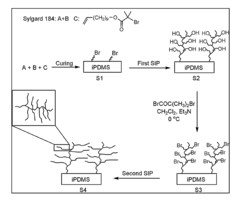
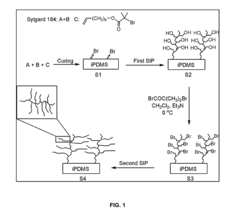
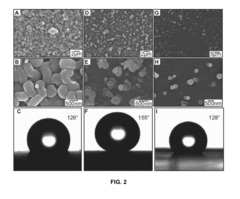
- A relayed surface-initiated polymerization (SIP) strategy with ultra-low initiator density and the use of a hydrophobic monomer to create a multi-layered polymer structure on a polymer substrate, specifically incorporating a first linker at a controlled surface density and subsequent polymer layers to achieve a contact angle of at least 150 degrees.
Organosilicon compounds and their use for producing hydrophilic surfaces
PatentInactiveEP2820024A1
Innovation
- Compounds with an oligo(ethylene glycol) chain and an acrylic acid function at one end and a triorganosilyl group at the other end are used to bond with silicone surfaces via hydrosilylation, creating a permanent hydrophilic surface.
Environmental Impact of PDMS Surface Treatments
The environmental implications of PDMS surface treatments for hydrophobicity enhancement represent a critical consideration in the development and deployment of these technologies. Traditional surface modification approaches, including plasma treatment, chemical vapor deposition, and fluorinated compound applications, generate varying degrees of environmental impact throughout their lifecycle. Plasma-based treatments typically consume significant electrical energy and may produce ozone and other reactive species as byproducts, though these effects are generally localized and temporary.
Chemical modification processes involving fluorinated silanes or perfluorinated compounds raise more substantial environmental concerns due to the persistence and bioaccumulation potential of fluorinated materials. These compounds can contribute to long-term environmental contamination and have been associated with adverse ecological effects. The manufacturing and disposal phases of fluorinated treatments require careful management to prevent environmental release and subsequent ecosystem disruption.
Solvent-based surface treatments present additional challenges related to volatile organic compound emissions and waste generation. Many traditional hydrophobicity enhancement methods rely on organic solvents that contribute to air quality degradation and require specialized disposal procedures. The carbon footprint associated with solvent production, transportation, and waste management adds to the overall environmental burden of these approaches.
Emerging green chemistry alternatives are addressing these environmental concerns through the development of water-based formulations, bio-derived surface modifiers, and solvent-free application methods. Supercritical carbon dioxide processing and UV-initiated surface grafting represent promising approaches that minimize harmful byproduct formation while maintaining treatment effectiveness.
The end-of-life considerations for PDMS materials with enhanced hydrophobic treatments also warrant attention. Modified surfaces may exhibit altered degradation pathways and leaching behaviors compared to untreated PDMS, potentially affecting recycling processes and environmental fate. Comprehensive lifecycle assessments are increasingly being employed to evaluate the total environmental impact of hydrophobicity enhancement strategies, enabling more informed decision-making in treatment selection and application design.
Quality Standards for Hydrophobic PDMS Products
Establishing comprehensive quality standards for hydrophobic PDMS products requires a multi-dimensional approach that encompasses surface characterization, performance metrics, and durability assessments. These standards serve as critical benchmarks for ensuring consistent product quality and meeting specific application requirements across various industries.
Surface hydrophobicity measurement represents the cornerstone of quality evaluation for PDMS products. Contact angle measurement using deionized water serves as the primary metric, with high-quality hydrophobic PDMS typically exhibiting static contact angles exceeding 110 degrees. Advanced characterization methods include dynamic contact angle analysis, measuring advancing and receding angles to assess surface heterogeneity and hysteresis effects. Surface energy calculations derived from multi-liquid contact angle measurements provide additional insights into the hydrophobic nature of PDMS surfaces.
Chemical composition verification ensures the integrity of hydrophobic PDMS formulations. Fourier-transform infrared spectroscopy (FTIR) analysis confirms the presence of characteristic Si-O-Si backbone structures and methyl group concentrations. X-ray photoelectron spectroscopy (XPS) provides surface elemental composition data, particularly silicon and carbon ratios that correlate with hydrophobic performance. Gas chromatography-mass spectrometry (GC-MS) analysis identifies residual catalysts, unreacted monomers, and potential contaminants that could compromise hydrophobic properties.
Mechanical property standards define the structural integrity requirements for hydrophobic PDMS products. Shore hardness measurements establish baseline mechanical characteristics, while tensile strength and elongation at break values ensure adequate flexibility and durability. Tear resistance testing evaluates the material's ability to withstand mechanical stress without compromising surface hydrophobicity.
Environmental stability testing protocols assess long-term performance under various conditions. UV exposure testing determines photochemical stability, while thermal cycling evaluates hydrophobic retention across temperature ranges. Chemical resistance testing against common solvents, acids, and bases ensures maintained hydrophobicity in challenging environments. Accelerated aging studies predict long-term performance degradation patterns.
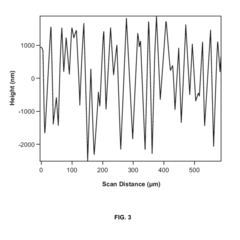
Surface roughness parameters significantly influence hydrophobic performance and require standardized measurement protocols. Atomic force microscopy (AFM) and profilometry techniques quantify surface topography, with specific roughness values correlating to enhanced hydrophobic behavior through micro-scale surface structuring.
Quality control procedures must incorporate statistical process control methods to ensure consistent production outcomes. Batch-to-batch variability assessment through contact angle measurements and surface energy calculations maintains product uniformity. Traceability systems document raw material sources, processing conditions, and final product characteristics to enable quality assurance and continuous improvement initiatives.
Unlock deeper insights with Patsnap Eureka Quick Research — get a full tech report to explore trends and direct your research. Try now!
Generate Your Research Report Instantly with AI Agent
Supercharge your innovation with Patsnap Eureka AI Agent Platform!