How to Measure Abscisic Acid Levels in Plants Accurately?
JUL 14, 20259 MIN READ
Generate Your Research Report Instantly with AI Agent
Patsnap Eureka helps you evaluate technical feasibility & market potential.
ABA Measurement Background and Objectives
Abscisic acid (ABA) is a crucial plant hormone that plays a vital role in regulating various physiological processes, including stress responses, seed dormancy, and plant growth. Accurate measurement of ABA levels in plants is essential for understanding plant biology, improving crop productivity, and developing stress-resistant varieties. The evolution of ABA measurement techniques has been driven by the need for increased sensitivity, specificity, and efficiency in quantifying this important phytohormone.
The primary objective of ABA measurement is to obtain precise and reliable data on the concentration of ABA in plant tissues under different environmental conditions and developmental stages. This information is critical for elucidating the mechanisms of plant stress responses, optimizing agricultural practices, and developing strategies to enhance crop resilience. Accurate ABA quantification also enables researchers to study the intricate signaling pathways and regulatory networks involved in plant stress adaptation.
Over the years, various methods have been developed to measure ABA levels in plants, each with its own advantages and limitations. Early techniques relied on bioassays, which were time-consuming and lacked specificity. The advent of chromatography-based methods, such as thin-layer chromatography (TLC) and high-performance liquid chromatography (HPLC), marked a significant improvement in ABA quantification. These techniques offered better separation and identification of ABA from other plant metabolites.
The introduction of immunoassay-based methods, particularly enzyme-linked immunosorbent assays (ELISA), revolutionized ABA measurement by providing a more sensitive and high-throughput approach. However, cross-reactivity with other plant hormones remained a challenge. The development of gas chromatography-mass spectrometry (GC-MS) and liquid chromatography-mass spectrometry (LC-MS) techniques further enhanced the accuracy and specificity of ABA quantification.
Recent advancements in analytical technologies have led to the emergence of ultra-high-performance liquid chromatography-tandem mass spectrometry (UHPLC-MS/MS) as the gold standard for ABA measurement. This technique offers unparalleled sensitivity, specificity, and the ability to simultaneously quantify multiple plant hormones. Additionally, the integration of stable isotope-labeled internal standards has significantly improved the accuracy and reproducibility of ABA measurements.
As research in plant biology continues to evolve, there is a growing need for non-invasive and real-time ABA measurement techniques. This has led to the exploration of biosensor-based approaches and imaging technologies that can provide spatial and temporal information on ABA distribution within plant tissues. These emerging methods hold promise for advancing our understanding of ABA dynamics in living plants and their responses to environmental stimuli.
The primary objective of ABA measurement is to obtain precise and reliable data on the concentration of ABA in plant tissues under different environmental conditions and developmental stages. This information is critical for elucidating the mechanisms of plant stress responses, optimizing agricultural practices, and developing strategies to enhance crop resilience. Accurate ABA quantification also enables researchers to study the intricate signaling pathways and regulatory networks involved in plant stress adaptation.
Over the years, various methods have been developed to measure ABA levels in plants, each with its own advantages and limitations. Early techniques relied on bioassays, which were time-consuming and lacked specificity. The advent of chromatography-based methods, such as thin-layer chromatography (TLC) and high-performance liquid chromatography (HPLC), marked a significant improvement in ABA quantification. These techniques offered better separation and identification of ABA from other plant metabolites.
The introduction of immunoassay-based methods, particularly enzyme-linked immunosorbent assays (ELISA), revolutionized ABA measurement by providing a more sensitive and high-throughput approach. However, cross-reactivity with other plant hormones remained a challenge. The development of gas chromatography-mass spectrometry (GC-MS) and liquid chromatography-mass spectrometry (LC-MS) techniques further enhanced the accuracy and specificity of ABA quantification.
Recent advancements in analytical technologies have led to the emergence of ultra-high-performance liquid chromatography-tandem mass spectrometry (UHPLC-MS/MS) as the gold standard for ABA measurement. This technique offers unparalleled sensitivity, specificity, and the ability to simultaneously quantify multiple plant hormones. Additionally, the integration of stable isotope-labeled internal standards has significantly improved the accuracy and reproducibility of ABA measurements.
As research in plant biology continues to evolve, there is a growing need for non-invasive and real-time ABA measurement techniques. This has led to the exploration of biosensor-based approaches and imaging technologies that can provide spatial and temporal information on ABA distribution within plant tissues. These emerging methods hold promise for advancing our understanding of ABA dynamics in living plants and their responses to environmental stimuli.
Market Demand for ABA Quantification
The market demand for accurate quantification of abscisic acid (ABA) in plants has been steadily growing, driven by various factors in agriculture, horticulture, and plant research sectors. ABA plays a crucial role in plant stress responses, growth regulation, and developmental processes, making its precise measurement essential for understanding and optimizing plant performance.
In the agricultural industry, there is an increasing need for ABA quantification to enhance crop productivity and stress tolerance. Farmers and agronomists require accurate ABA measurements to assess plant health, predict drought stress, and optimize irrigation strategies. This demand is particularly pronounced in regions facing water scarcity and climate change impacts, where efficient water management is critical for sustainable agriculture.
The horticultural sector also contributes significantly to the market demand for ABA quantification. Nurseries, greenhouse operators, and ornamental plant producers rely on ABA measurements to improve plant quality, control flowering time, and manage post-harvest shelf life. Accurate ABA quantification enables precise manipulation of plant growth and development, leading to higher-quality products and reduced losses during transportation and storage.
In the realm of plant research and biotechnology, the demand for ABA quantification is driven by the need to understand plant physiology, genetics, and stress responses at a molecular level. Academic institutions, research organizations, and biotechnology companies require precise ABA measurements to study gene expression, signaling pathways, and develop stress-resistant crop varieties. This research-driven demand is expected to grow as efforts to enhance food security and develop climate-resilient crops intensify.
The pharmaceutical and nutraceutical industries have also shown interest in ABA quantification, as the compound has potential applications in human health. Studies exploring ABA's anti-inflammatory and anti-diabetic properties have created a niche market for its accurate measurement in both plant-based products and human samples.
Environmental monitoring and conservation efforts contribute to the market demand as well. Ecologists and environmental scientists use ABA quantification to assess ecosystem health, monitor plant stress in natural habitats, and study the impacts of climate change on vegetation.
The global seed industry represents another significant driver of demand for ABA quantification. Seed companies require accurate ABA measurements to evaluate seed quality, dormancy, and germination potential, ensuring the production of high-quality seeds for various crops.
As precision agriculture and smart farming technologies continue to advance, the integration of ABA quantification into these systems is expected to further boost market demand. Real-time monitoring of plant stress hormones like ABA could become an integral part of decision support systems for crop management, creating new opportunities for sensor development and data analytics in agriculture.
In the agricultural industry, there is an increasing need for ABA quantification to enhance crop productivity and stress tolerance. Farmers and agronomists require accurate ABA measurements to assess plant health, predict drought stress, and optimize irrigation strategies. This demand is particularly pronounced in regions facing water scarcity and climate change impacts, where efficient water management is critical for sustainable agriculture.
The horticultural sector also contributes significantly to the market demand for ABA quantification. Nurseries, greenhouse operators, and ornamental plant producers rely on ABA measurements to improve plant quality, control flowering time, and manage post-harvest shelf life. Accurate ABA quantification enables precise manipulation of plant growth and development, leading to higher-quality products and reduced losses during transportation and storage.
In the realm of plant research and biotechnology, the demand for ABA quantification is driven by the need to understand plant physiology, genetics, and stress responses at a molecular level. Academic institutions, research organizations, and biotechnology companies require precise ABA measurements to study gene expression, signaling pathways, and develop stress-resistant crop varieties. This research-driven demand is expected to grow as efforts to enhance food security and develop climate-resilient crops intensify.
The pharmaceutical and nutraceutical industries have also shown interest in ABA quantification, as the compound has potential applications in human health. Studies exploring ABA's anti-inflammatory and anti-diabetic properties have created a niche market for its accurate measurement in both plant-based products and human samples.
Environmental monitoring and conservation efforts contribute to the market demand as well. Ecologists and environmental scientists use ABA quantification to assess ecosystem health, monitor plant stress in natural habitats, and study the impacts of climate change on vegetation.
The global seed industry represents another significant driver of demand for ABA quantification. Seed companies require accurate ABA measurements to evaluate seed quality, dormancy, and germination potential, ensuring the production of high-quality seeds for various crops.
As precision agriculture and smart farming technologies continue to advance, the integration of ABA quantification into these systems is expected to further boost market demand. Real-time monitoring of plant stress hormones like ABA could become an integral part of decision support systems for crop management, creating new opportunities for sensor development and data analytics in agriculture.
Current ABA Detection Challenges
Accurately measuring abscisic acid (ABA) levels in plants presents several significant challenges that researchers and scientists continue to grapple with. One of the primary difficulties lies in the extremely low concentrations of ABA present in plant tissues, often in the range of nanograms per gram of fresh weight. This necessitates highly sensitive detection methods capable of accurately quantifying such minute amounts.
The complex matrix of plant tissues further complicates ABA detection. Plants contain a myriad of compounds, including other phytohormones, metabolites, and cellular components that can interfere with ABA measurements. These interfering substances may have similar chemical properties or molecular structures to ABA, leading to potential false positives or inaccurate quantification if not properly accounted for in the detection method.
Another challenge is the spatial and temporal variability of ABA within plants. ABA levels can fluctuate rapidly in response to environmental stimuli, and its distribution is not uniform across different plant tissues or even within individual cells. This heterogeneity makes it difficult to obtain representative samples and requires careful consideration of sampling techniques and timing to ensure accurate measurements.
The stability of ABA during sample preparation and analysis is also a concern. ABA is sensitive to light, heat, and pH changes, which can lead to degradation or chemical modifications during extraction and processing steps. This instability necessitates careful handling and storage procedures to preserve the integrity of ABA molecules throughout the analytical process.
Current detection methods also face limitations in terms of throughput and cost-effectiveness. While highly sensitive techniques like liquid chromatography-mass spectrometry (LC-MS) offer excellent accuracy, they often require expensive equipment and specialized expertise. This can limit the accessibility of ABA measurements, particularly for large-scale studies or routine analyses in agricultural settings.
The lack of standardization across different detection methods poses another challenge. Various techniques, including immunoassays, chromatographic methods, and mass spectrometry-based approaches, are used for ABA quantification. However, these methods can yield different results when applied to the same samples, making it difficult to compare data across studies and establish consistent reference values for ABA levels in plants.
Addressing these challenges requires ongoing research and development in analytical techniques, sample preparation methods, and data interpretation strategies. Advances in areas such as metabolomics, high-resolution mass spectrometry, and machine learning algorithms offer promising avenues for improving the accuracy, sensitivity, and reliability of ABA measurements in plants.
The complex matrix of plant tissues further complicates ABA detection. Plants contain a myriad of compounds, including other phytohormones, metabolites, and cellular components that can interfere with ABA measurements. These interfering substances may have similar chemical properties or molecular structures to ABA, leading to potential false positives or inaccurate quantification if not properly accounted for in the detection method.
Another challenge is the spatial and temporal variability of ABA within plants. ABA levels can fluctuate rapidly in response to environmental stimuli, and its distribution is not uniform across different plant tissues or even within individual cells. This heterogeneity makes it difficult to obtain representative samples and requires careful consideration of sampling techniques and timing to ensure accurate measurements.
The stability of ABA during sample preparation and analysis is also a concern. ABA is sensitive to light, heat, and pH changes, which can lead to degradation or chemical modifications during extraction and processing steps. This instability necessitates careful handling and storage procedures to preserve the integrity of ABA molecules throughout the analytical process.
Current detection methods also face limitations in terms of throughput and cost-effectiveness. While highly sensitive techniques like liquid chromatography-mass spectrometry (LC-MS) offer excellent accuracy, they often require expensive equipment and specialized expertise. This can limit the accessibility of ABA measurements, particularly for large-scale studies or routine analyses in agricultural settings.
The lack of standardization across different detection methods poses another challenge. Various techniques, including immunoassays, chromatographic methods, and mass spectrometry-based approaches, are used for ABA quantification. However, these methods can yield different results when applied to the same samples, making it difficult to compare data across studies and establish consistent reference values for ABA levels in plants.
Addressing these challenges requires ongoing research and development in analytical techniques, sample preparation methods, and data interpretation strategies. Advances in areas such as metabolomics, high-resolution mass spectrometry, and machine learning algorithms offer promising avenues for improving the accuracy, sensitivity, and reliability of ABA measurements in plants.
Existing ABA Quantification Methods
01 Methods for measuring abscisic acid levels
Various techniques have been developed to accurately measure abscisic acid levels in plants. These methods include immunoassays, chromatography, and mass spectrometry. Improved accuracy in measuring abscisic acid concentrations helps researchers better understand plant stress responses and hormone signaling pathways.- Methods for measuring abscisic acid levels: Various techniques have been developed to accurately measure abscisic acid levels in plants. These methods include immunoassays, chromatography, and mass spectrometry. Improved accuracy in measuring abscisic acid concentrations helps researchers better understand plant stress responses and hormone signaling pathways.
- Abscisic acid analogs and derivatives: Researchers have synthesized and studied abscisic acid analogs and derivatives to enhance the accuracy of abscisic acid-related experiments. These compounds can mimic or antagonize abscisic acid activity, allowing for more precise control and measurement of abscisic acid-mediated responses in plants.
- Genetic engineering for abscisic acid production: Genetic modification techniques have been employed to alter abscisic acid biosynthesis and signaling pathways in plants. This approach allows for more accurate control and measurement of abscisic acid levels, enabling researchers to study its effects on plant growth, development, and stress responses with greater precision.
- Abscisic acid formulations for agricultural applications: Improved formulations of abscisic acid have been developed for agricultural use, focusing on enhancing stability, bioavailability, and efficacy. These advancements contribute to more accurate and consistent results when applying abscisic acid to crops for various purposes, such as stress tolerance or fruit ripening.
- Abscisic acid detection in plant tissues: Novel methods have been developed for detecting and quantifying abscisic acid in plant tissues with high accuracy. These techniques include improved extraction procedures, sensitive biosensors, and advanced imaging technologies, allowing researchers to precisely localize and measure abscisic acid within plant cells and organs.
02 Abscisic acid analogs and derivatives
Researchers have synthesized and studied abscisic acid analogs and derivatives to enhance the accuracy of abscisic acid-related experiments. These compounds can mimic or antagonize abscisic acid activity, allowing for more precise control and measurement of abscisic acid effects in plants.Expand Specific Solutions03 Genetic engineering for abscisic acid production
Genetic modification techniques have been employed to alter abscisic acid biosynthesis and signaling pathways in plants. This approach allows for more accurate control and study of abscisic acid levels and responses, leading to improved understanding of its role in plant physiology.Expand Specific Solutions04 Abscisic acid detection in agricultural applications
Accurate detection and measurement of abscisic acid levels in crops and soil have been developed for agricultural applications. These methods help farmers and researchers optimize plant growth, stress tolerance, and crop yield by providing precise information about abscisic acid concentrations in the field.Expand Specific Solutions05 Formulations for enhancing abscisic acid stability
Various formulations and compositions have been developed to enhance the stability and accuracy of abscisic acid in solutions and plant tissues. These formulations improve the reliability of abscisic acid measurements and applications in research and agricultural settings.Expand Specific Solutions
Key Players in Plant Hormone Analysis
The measurement of abscisic acid (ABA) levels in plants is a critical area of research in plant biology, with the market currently in a growth phase. The global plant hormone market, which includes ABA, is expected to expand significantly in the coming years. Technologically, the field is advancing rapidly, with companies and research institutions developing increasingly sophisticated methods for ABA quantification. Key players like Valent BioSciences Corp. and Syngenta are at the forefront, leveraging their expertise in agricultural biotechnology. Academic institutions such as The Rockefeller University and Fudan University are contributing to fundamental research, while specialized entities like the Institute of Crop Science, Chinese Academy of Agricultural Sciences are focusing on practical applications. The competition is intensifying as more precise and efficient measurement techniques emerge, driving innovation in this crucial aspect of plant science.
Valent BioSciences Corp.
Technical Solution: Valent BioSciences Corp. has developed a highly sensitive and specific enzyme-linked immunosorbent assay (ELISA) for measuring abscisic acid (ABA) levels in plants. Their method utilizes monoclonal antibodies specifically designed to recognize ABA molecules, allowing for accurate quantification in plant tissues. The assay can detect ABA concentrations as low as 0.1 ng/mL, making it suitable for analyzing even minute changes in ABA levels[1]. Additionally, they have optimized sample preparation techniques to minimize interference from other plant metabolites, ensuring reliable results across various plant species and tissue types[2].
Strengths: High sensitivity and specificity, wide applicability across plant species. Weaknesses: Requires specialized equipment and trained personnel, potentially time-consuming for large-scale analyses.
The Regents of the University of California
Technical Solution: The University of California has pioneered a novel approach using liquid chromatography-tandem mass spectrometry (LC-MS/MS) for accurate ABA quantification. Their method employs isotope-labeled internal standards and multiple reaction monitoring (MRM) to achieve high precision and selectivity. This technique can simultaneously measure ABA and its metabolites, providing a comprehensive profile of ABA dynamics in plants[3]. The method has been validated across various plant tissues and can detect ABA levels as low as 0.5 pmol/g fresh weight. Furthermore, they have developed an automated sample preparation protocol that significantly reduces processing time and improves throughput[4].
Strengths: High accuracy and precision, ability to measure multiple ABA-related compounds simultaneously. Weaknesses: Requires expensive instrumentation, may not be suitable for field-based measurements.
Innovative ABA Detection Technologies
method for determining the content of free abscisic acid in the vegetative organs of plants by capillary electrophoresis
PatentPendingRU2014126532A
Innovation
- Use of capillary electrophoresis for determining free abscisic acid content in plant vegetative organs, providing high sensitivity and resolution.
- Optimized electrolyte composition containing boric acid, sodium tetraborate, and isopropanol for effective separation of abscisic acid.
- Specific capillary dimensions and detection parameters (254 nm wavelength) tailored for abscisic acid analysis.
(s)-3'-methyl-abscisic acid and esters thereof
PatentWO2015106050A1
Innovation
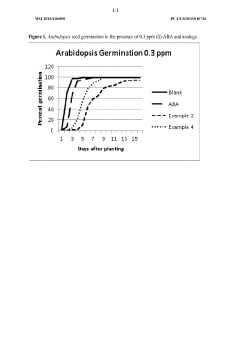
- Development of enantiomerically pure (S)-3'-methyl-abscisic acid and its esters through efficient chemical synthesis methods, including reacting (S)-ABA with an alkylating agent and a methylating agent, followed by optional ester hydrolysis, to produce compounds with improved biological activity and commercial viability.
Environmental Factors Affecting ABA Levels
Environmental factors play a crucial role in regulating abscisic acid (ABA) levels in plants. Understanding these factors is essential for accurately measuring ABA concentrations and interpreting the results in the context of plant physiology and stress responses.
Water availability is one of the most significant environmental factors affecting ABA levels. Drought stress triggers a rapid increase in ABA production, which initiates various physiological responses to conserve water. Conversely, excessive water or flooding can also lead to changes in ABA levels, although the response may differ depending on the plant species and duration of exposure.
Temperature fluctuations have a substantial impact on ABA concentrations. Both heat and cold stress can induce ABA accumulation, with the magnitude of the response varying among plant species and cultivars. The temperature-induced changes in ABA levels are often associated with alterations in plant growth, development, and stress tolerance.
Light intensity and quality are important factors influencing ABA biosynthesis and signaling. High light conditions can lead to increased ABA production, particularly when combined with other stressors such as drought. Additionally, changes in day length and light spectral composition can modulate ABA levels, affecting various physiological processes, including seed dormancy and germination.
Soil salinity is another critical environmental factor that affects ABA concentrations in plants. Elevated soil salt levels trigger ABA accumulation, which helps plants adapt to osmotic stress and maintain ion homeostasis. The ABA-mediated responses to salinity stress involve complex interactions with other phytohormones and signaling pathways.
Atmospheric carbon dioxide (CO2) concentrations can indirectly influence ABA levels by affecting plant water status and stomatal behavior. Elevated CO2 levels may lead to reduced ABA production in some plant species, potentially altering their drought tolerance and water use efficiency.
Nutrient availability in the soil can also impact ABA levels. Deficiencies in essential nutrients, such as nitrogen, phosphorus, and potassium, can trigger ABA accumulation as part of the plant's stress response. Conversely, optimal nutrient conditions may result in lower baseline ABA levels.
Biotic factors, including pathogen infection and herbivory, can induce changes in ABA concentrations. These interactions often involve complex crosstalk between ABA and other defense-related hormones, such as jasmonic acid and salicylic acid.
When measuring ABA levels in plants, it is crucial to consider the dynamic nature of these environmental influences. Researchers must carefully control and document environmental conditions during sample collection and analysis to ensure accurate and reproducible results. Furthermore, interpreting ABA measurements requires a comprehensive understanding of the plant's growth conditions, developmental stage, and recent exposure to environmental stressors.
Water availability is one of the most significant environmental factors affecting ABA levels. Drought stress triggers a rapid increase in ABA production, which initiates various physiological responses to conserve water. Conversely, excessive water or flooding can also lead to changes in ABA levels, although the response may differ depending on the plant species and duration of exposure.
Temperature fluctuations have a substantial impact on ABA concentrations. Both heat and cold stress can induce ABA accumulation, with the magnitude of the response varying among plant species and cultivars. The temperature-induced changes in ABA levels are often associated with alterations in plant growth, development, and stress tolerance.
Light intensity and quality are important factors influencing ABA biosynthesis and signaling. High light conditions can lead to increased ABA production, particularly when combined with other stressors such as drought. Additionally, changes in day length and light spectral composition can modulate ABA levels, affecting various physiological processes, including seed dormancy and germination.
Soil salinity is another critical environmental factor that affects ABA concentrations in plants. Elevated soil salt levels trigger ABA accumulation, which helps plants adapt to osmotic stress and maintain ion homeostasis. The ABA-mediated responses to salinity stress involve complex interactions with other phytohormones and signaling pathways.
Atmospheric carbon dioxide (CO2) concentrations can indirectly influence ABA levels by affecting plant water status and stomatal behavior. Elevated CO2 levels may lead to reduced ABA production in some plant species, potentially altering their drought tolerance and water use efficiency.
Nutrient availability in the soil can also impact ABA levels. Deficiencies in essential nutrients, such as nitrogen, phosphorus, and potassium, can trigger ABA accumulation as part of the plant's stress response. Conversely, optimal nutrient conditions may result in lower baseline ABA levels.
Biotic factors, including pathogen infection and herbivory, can induce changes in ABA concentrations. These interactions often involve complex crosstalk between ABA and other defense-related hormones, such as jasmonic acid and salicylic acid.
When measuring ABA levels in plants, it is crucial to consider the dynamic nature of these environmental influences. Researchers must carefully control and document environmental conditions during sample collection and analysis to ensure accurate and reproducible results. Furthermore, interpreting ABA measurements requires a comprehensive understanding of the plant's growth conditions, developmental stage, and recent exposure to environmental stressors.
Standardization of ABA Quantification Protocols
The standardization of ABA quantification protocols is crucial for ensuring accurate and reproducible measurements of abscisic acid levels in plants. This process involves establishing consistent methods and guidelines for sample preparation, extraction, purification, and analysis across different laboratories and research institutions.
One of the primary challenges in ABA quantification is the variability in sample preparation techniques. To address this, standardized protocols should specify precise methods for tissue collection, storage, and homogenization. These protocols should consider factors such as plant species, tissue type, and developmental stage, as these can significantly influence ABA levels and extraction efficiency.
Extraction methods play a critical role in the accuracy of ABA measurements. Standardized protocols should outline optimal solvent systems, extraction times, and temperatures to maximize ABA recovery while minimizing interference from other plant metabolites. Additionally, the use of internal standards, such as deuterated ABA, should be incorporated to account for extraction losses and matrix effects.
Purification steps are essential for removing interfering compounds and concentrating ABA prior to analysis. Standardized protocols should detail specific solid-phase extraction (SPE) or liquid-liquid extraction (LLE) procedures, including column types, elution solvents, and clean-up steps. These methods should be optimized to achieve high recovery rates and minimize matrix effects.
Analytical techniques for ABA quantification have evolved significantly, with liquid chromatography-tandem mass spectrometry (LC-MS/MS) emerging as the gold standard. Standardized protocols should provide detailed guidelines for LC-MS/MS analysis, including chromatographic conditions, ionization parameters, and multiple reaction monitoring (MRM) transitions. The use of certified reference materials and participation in inter-laboratory comparisons should be encouraged to ensure method validity and comparability of results across different laboratories.
Data analysis and reporting are critical components of standardized ABA quantification protocols. Guidelines should be established for calibration curve preparation, limit of detection (LOD) and limit of quantification (LOQ) determination, and quality control measures. Standardized reporting formats should be developed to facilitate data sharing and meta-analysis across studies.
Implementing these standardized protocols will significantly enhance the reliability and comparability of ABA measurements in plant research. However, it is essential to regularly review and update these protocols as new technologies and methodologies emerge, ensuring that they remain at the forefront of analytical capabilities in plant hormone research.
One of the primary challenges in ABA quantification is the variability in sample preparation techniques. To address this, standardized protocols should specify precise methods for tissue collection, storage, and homogenization. These protocols should consider factors such as plant species, tissue type, and developmental stage, as these can significantly influence ABA levels and extraction efficiency.
Extraction methods play a critical role in the accuracy of ABA measurements. Standardized protocols should outline optimal solvent systems, extraction times, and temperatures to maximize ABA recovery while minimizing interference from other plant metabolites. Additionally, the use of internal standards, such as deuterated ABA, should be incorporated to account for extraction losses and matrix effects.
Purification steps are essential for removing interfering compounds and concentrating ABA prior to analysis. Standardized protocols should detail specific solid-phase extraction (SPE) or liquid-liquid extraction (LLE) procedures, including column types, elution solvents, and clean-up steps. These methods should be optimized to achieve high recovery rates and minimize matrix effects.
Analytical techniques for ABA quantification have evolved significantly, with liquid chromatography-tandem mass spectrometry (LC-MS/MS) emerging as the gold standard. Standardized protocols should provide detailed guidelines for LC-MS/MS analysis, including chromatographic conditions, ionization parameters, and multiple reaction monitoring (MRM) transitions. The use of certified reference materials and participation in inter-laboratory comparisons should be encouraged to ensure method validity and comparability of results across different laboratories.
Data analysis and reporting are critical components of standardized ABA quantification protocols. Guidelines should be established for calibration curve preparation, limit of detection (LOD) and limit of quantification (LOQ) determination, and quality control measures. Standardized reporting formats should be developed to facilitate data sharing and meta-analysis across studies.
Implementing these standardized protocols will significantly enhance the reliability and comparability of ABA measurements in plant research. However, it is essential to regularly review and update these protocols as new technologies and methodologies emerge, ensuring that they remain at the forefront of analytical capabilities in plant hormone research.
Unlock deeper insights with Patsnap Eureka Quick Research — get a full tech report to explore trends and direct your research. Try now!
Generate Your Research Report Instantly with AI Agent
Supercharge your innovation with Patsnap Eureka AI Agent Platform!