

How to Optimize Intercooling Airflow Patterns
APR 3, 20269 MIN READ
Generate Your Research Report Instantly with AI Agent
PatSnap Eureka helps you evaluate technical feasibility & market potential.
Intercooling Technology Background and Thermal Management Goals
Intercooling technology emerged as a critical component in turbocharged and supercharged engine systems during the early 20th century, fundamentally addressing the challenge of compressed air heating that reduces engine efficiency and performance. The technology has evolved from simple air-to-air heat exchangers to sophisticated thermal management systems incorporating advanced materials, optimized geometries, and integrated cooling circuits.
The historical development of intercooling systems traces back to aviation applications in the 1930s, where altitude performance demanded efficient charge air cooling. Automotive applications gained prominence in the 1980s with the widespread adoption of turbocharging technology. Early systems utilized basic tube-and-fin configurations with limited airflow optimization, gradually evolving toward more complex designs incorporating computational fluid dynamics and advanced manufacturing techniques.
Modern intercooling technology encompasses multiple architectural approaches, including air-to-air, air-to-water, and hybrid cooling systems. Each configuration presents distinct advantages in thermal efficiency, packaging constraints, and system integration complexity. The evolution has been driven by increasingly stringent emissions regulations, fuel economy requirements, and performance expectations across automotive, marine, and industrial applications.
Contemporary thermal management goals center on maximizing heat transfer effectiveness while minimizing pressure drop penalties that reduce overall system efficiency. Primary objectives include achieving optimal charge air temperatures typically ranging from 40-60°C above ambient conditions, maintaining consistent thermal performance across varying operating conditions, and ensuring rapid thermal response during transient engine operations.
Advanced intercooling systems now target integrated thermal management strategies that coordinate with engine cooling circuits, exhaust heat recovery systems, and cabin climate control. These holistic approaches aim to optimize overall powertrain thermal efficiency rather than treating intercooling as an isolated subsystem. Key performance metrics include volumetric efficiency improvement, knock resistance enhancement, and emissions reduction through precise charge air temperature control.
The technological trajectory emphasizes compact, lightweight designs with enhanced heat transfer coefficients, reduced thermal inertia, and improved durability under extreme operating conditions. Future developments focus on adaptive cooling strategies, smart thermal management integration, and advanced materials enabling higher temperature differentials with improved corrosion resistance and manufacturing scalability.
The historical development of intercooling systems traces back to aviation applications in the 1930s, where altitude performance demanded efficient charge air cooling. Automotive applications gained prominence in the 1980s with the widespread adoption of turbocharging technology. Early systems utilized basic tube-and-fin configurations with limited airflow optimization, gradually evolving toward more complex designs incorporating computational fluid dynamics and advanced manufacturing techniques.
Modern intercooling technology encompasses multiple architectural approaches, including air-to-air, air-to-water, and hybrid cooling systems. Each configuration presents distinct advantages in thermal efficiency, packaging constraints, and system integration complexity. The evolution has been driven by increasingly stringent emissions regulations, fuel economy requirements, and performance expectations across automotive, marine, and industrial applications.
Contemporary thermal management goals center on maximizing heat transfer effectiveness while minimizing pressure drop penalties that reduce overall system efficiency. Primary objectives include achieving optimal charge air temperatures typically ranging from 40-60°C above ambient conditions, maintaining consistent thermal performance across varying operating conditions, and ensuring rapid thermal response during transient engine operations.
Advanced intercooling systems now target integrated thermal management strategies that coordinate with engine cooling circuits, exhaust heat recovery systems, and cabin climate control. These holistic approaches aim to optimize overall powertrain thermal efficiency rather than treating intercooling as an isolated subsystem. Key performance metrics include volumetric efficiency improvement, knock resistance enhancement, and emissions reduction through precise charge air temperature control.
The technological trajectory emphasizes compact, lightweight designs with enhanced heat transfer coefficients, reduced thermal inertia, and improved durability under extreme operating conditions. Future developments focus on adaptive cooling strategies, smart thermal management integration, and advanced materials enabling higher temperature differentials with improved corrosion resistance and manufacturing scalability.
Market Demand for Enhanced Intercooling Systems
The global automotive industry is experiencing unprecedented demand for enhanced intercooling systems, driven primarily by stringent emissions regulations and fuel efficiency mandates across major markets. European Union's Euro 7 standards and similar regulations in North America and Asia-Pacific regions are compelling manufacturers to adopt advanced thermal management solutions. This regulatory pressure creates substantial market opportunities for optimized intercooling technologies that can deliver superior heat dissipation while maintaining compact packaging requirements.
Turbocharged and supercharged engines have become mainstream across passenger vehicles, commercial trucks, and high-performance applications, significantly expanding the addressable market for intercooling solutions. The shift toward downsized, high-output engines necessitates more efficient charge air cooling to prevent knock, maintain power density, and ensure durability. Fleet operators particularly value intercooling improvements that translate to measurable fuel savings and extended maintenance intervals.
The commercial vehicle segment represents a substantial growth driver, where enhanced intercooling directly impacts operational economics through improved fuel efficiency and reduced emissions compliance costs. Long-haul trucking companies are increasingly prioritizing thermal management upgrades that provide quantifiable return on investment through lower operating expenses and enhanced vehicle reliability.
Emerging hybrid powertrains create additional complexity and opportunity within the intercooling market. These systems require sophisticated thermal management strategies that coordinate between internal combustion engines and electric components, demanding innovative airflow optimization solutions that can adapt to varying operational modes and thermal loads.
Performance and motorsport applications continue driving technological advancement, where extreme operating conditions demand cutting-edge intercooling solutions. Innovations developed for racing applications frequently migrate to production vehicles, creating a technology transfer pathway that benefits the broader automotive market.
The aftermarket segment shows robust demand for intercooling upgrades, particularly among enthusiasts seeking enhanced performance and commercial operators looking to optimize existing fleet assets. This market segment values proven thermal efficiency improvements and straightforward installation procedures that minimize vehicle downtime.
Industrial and stationary engine applications present additional market opportunities, where optimized intercooling contributes to improved generator efficiency, reduced maintenance requirements, and extended equipment lifespan in demanding operational environments.
Turbocharged and supercharged engines have become mainstream across passenger vehicles, commercial trucks, and high-performance applications, significantly expanding the addressable market for intercooling solutions. The shift toward downsized, high-output engines necessitates more efficient charge air cooling to prevent knock, maintain power density, and ensure durability. Fleet operators particularly value intercooling improvements that translate to measurable fuel savings and extended maintenance intervals.
The commercial vehicle segment represents a substantial growth driver, where enhanced intercooling directly impacts operational economics through improved fuel efficiency and reduced emissions compliance costs. Long-haul trucking companies are increasingly prioritizing thermal management upgrades that provide quantifiable return on investment through lower operating expenses and enhanced vehicle reliability.
Emerging hybrid powertrains create additional complexity and opportunity within the intercooling market. These systems require sophisticated thermal management strategies that coordinate between internal combustion engines and electric components, demanding innovative airflow optimization solutions that can adapt to varying operational modes and thermal loads.
Performance and motorsport applications continue driving technological advancement, where extreme operating conditions demand cutting-edge intercooling solutions. Innovations developed for racing applications frequently migrate to production vehicles, creating a technology transfer pathway that benefits the broader automotive market.
The aftermarket segment shows robust demand for intercooling upgrades, particularly among enthusiasts seeking enhanced performance and commercial operators looking to optimize existing fleet assets. This market segment values proven thermal efficiency improvements and straightforward installation procedures that minimize vehicle downtime.
Industrial and stationary engine applications present additional market opportunities, where optimized intercooling contributes to improved generator efficiency, reduced maintenance requirements, and extended equipment lifespan in demanding operational environments.
Current Airflow Optimization Challenges in Intercoolers
Intercooler airflow optimization faces significant thermal management challenges that directly impact engine performance and efficiency. The primary obstacle lies in achieving uniform air distribution across the entire intercooler core surface while maintaining adequate cooling capacity. Non-uniform airflow patterns create hot spots and temperature gradients that reduce overall heat transfer effectiveness, leading to inconsistent charge air temperatures entering the engine cylinders.
Pressure drop optimization represents another critical challenge in current intercooler designs. Engineers must balance the competing requirements of maximizing heat transfer surface area while minimizing airflow resistance. Excessive pressure drops reduce turbocharger efficiency and increase pumping losses, while insufficient surface area compromises cooling performance. This trade-off becomes particularly complex in compact automotive applications where space constraints limit design flexibility.
Flow separation and recirculation zones pose substantial obstacles to effective intercooler performance. These phenomena occur when airflow encounters sharp edges, sudden expansions, or poorly designed inlet geometries. Separated flows create dead zones with minimal heat transfer while increasing overall system pressure losses. Current computational fluid dynamics models struggle to accurately predict these complex flow behaviors under varying operating conditions.
Manufacturing constraints significantly limit the implementation of theoretically optimal airflow patterns. Traditional intercooler manufacturing processes, including brazing and welding techniques, restrict the complexity of internal flow channels and fin geometries. Cost considerations often force designers to compromise between aerodynamic efficiency and production feasibility, resulting in suboptimal airflow distribution patterns.
Integration challenges within existing engine bay architectures create additional complications for airflow optimization. Intercoolers must operate effectively despite interference from surrounding components, limited air intake pathways, and varying ambient conditions. The proximity of heat sources, such as exhaust manifolds and radiators, further complicates thermal management and airflow pattern design.
Scale-up difficulties emerge when translating laboratory-optimized designs to production vehicles. Airflow patterns that perform well in controlled testing environments may exhibit different characteristics under real-world operating conditions, including varying vehicle speeds, ambient temperatures, and engine load conditions. These scaling challenges require robust design methodologies that account for operational variability while maintaining consistent performance across diverse applications.
Pressure drop optimization represents another critical challenge in current intercooler designs. Engineers must balance the competing requirements of maximizing heat transfer surface area while minimizing airflow resistance. Excessive pressure drops reduce turbocharger efficiency and increase pumping losses, while insufficient surface area compromises cooling performance. This trade-off becomes particularly complex in compact automotive applications where space constraints limit design flexibility.
Flow separation and recirculation zones pose substantial obstacles to effective intercooler performance. These phenomena occur when airflow encounters sharp edges, sudden expansions, or poorly designed inlet geometries. Separated flows create dead zones with minimal heat transfer while increasing overall system pressure losses. Current computational fluid dynamics models struggle to accurately predict these complex flow behaviors under varying operating conditions.
Manufacturing constraints significantly limit the implementation of theoretically optimal airflow patterns. Traditional intercooler manufacturing processes, including brazing and welding techniques, restrict the complexity of internal flow channels and fin geometries. Cost considerations often force designers to compromise between aerodynamic efficiency and production feasibility, resulting in suboptimal airflow distribution patterns.
Integration challenges within existing engine bay architectures create additional complications for airflow optimization. Intercoolers must operate effectively despite interference from surrounding components, limited air intake pathways, and varying ambient conditions. The proximity of heat sources, such as exhaust manifolds and radiators, further complicates thermal management and airflow pattern design.
Scale-up difficulties emerge when translating laboratory-optimized designs to production vehicles. Airflow patterns that perform well in controlled testing environments may exhibit different characteristics under real-world operating conditions, including varying vehicle speeds, ambient temperatures, and engine load conditions. These scaling challenges require robust design methodologies that account for operational variability while maintaining consistent performance across diverse applications.
Current Airflow Pattern Optimization Solutions
01 Multi-stage intercooling systems with optimized airflow distribution
Advanced intercooling systems employ multi-stage cooling configurations with strategically designed airflow channels to enhance heat dissipation efficiency. These systems utilize multiple cooling stages with optimized air distribution patterns to maximize cooling performance while minimizing pressure losses. The airflow is directed through carefully engineered passages that ensure uniform temperature reduction across the cooling surfaces.- Multi-stage intercooling systems with optimized airflow distribution: Advanced intercooling systems utilize multi-stage cooling configurations with strategically designed airflow channels to enhance heat dissipation efficiency. These systems incorporate multiple cooling stages with optimized air distribution patterns that ensure uniform cooling across the heat exchanger surfaces. The airflow is directed through specifically designed passages that maximize contact time and surface area exposure, resulting in improved thermal management and reduced outlet temperatures.
- Turbulent airflow enhancement structures in intercooler design: Intercooler designs incorporate specialized internal structures such as fins, vanes, or turbulence generators to create controlled turbulent airflow patterns. These structures disrupt laminar flow and promote mixing, which significantly increases heat transfer coefficients. The turbulent patterns ensure better thermal boundary layer disruption and more effective heat exchange between the hot compressed air and the cooling medium.
- Parallel and cross-flow airflow configurations: Intercooling systems employ various airflow arrangement strategies including parallel flow, counter flow, and cross-flow configurations to optimize cooling performance. These configurations determine how the cooling air interacts with the hot charge air, affecting the temperature gradient and overall heat transfer efficiency. The selection of flow pattern depends on packaging constraints, pressure drop requirements, and desired cooling effectiveness.
- Variable geometry airflow control mechanisms: Advanced intercooling systems incorporate adjustable components such as movable louvers, variable inlet guides, or adaptive duct geometries that allow dynamic control of airflow patterns based on operating conditions. These mechanisms enable optimization of cooling performance across different engine loads and ambient conditions by modulating airflow velocity, direction, and distribution. The variable geometry approach helps balance cooling effectiveness with aerodynamic efficiency and pressure loss.
- Integrated airflow separation and distribution chambers: Intercooler designs feature specialized plenum chambers and distribution manifolds that separate incoming airflow into multiple streams and direct them through optimized pathways. These chambers ensure uniform flow distribution across the entire heat exchanger core, preventing localized hot spots and flow maldistribution. The separation and distribution approach improves overall cooling uniformity and system efficiency by ensuring all cooling surfaces receive adequate airflow.
02 Turbulent airflow enhancement structures in intercooler designs
Intercooler designs incorporate specialized structures such as fins, vanes, or turbulence generators to create controlled turbulent airflow patterns. These features increase the heat transfer coefficient by disrupting laminar flow and promoting better mixing of air streams. The turbulent flow patterns enhance thermal exchange between the cooling medium and the heated air, resulting in improved overall cooling efficiency.Expand Specific Solutions03 Directional airflow control mechanisms for intercooling applications
Specialized airflow control mechanisms are implemented to direct and regulate air movement within intercooling systems. These mechanisms include adjustable louvers, guide vanes, or flow directors that optimize the air path through the cooling components. The controlled airflow patterns ensure maximum contact time between air and cooling surfaces while preventing flow separation and dead zones.Expand Specific Solutions04 Parallel and series airflow path configurations
Intercooling systems utilize various airflow path arrangements including parallel flow, counter-flow, and cross-flow configurations to optimize cooling performance. These configurations determine how the cooling air interacts with the heated medium, affecting heat transfer rates and pressure drop characteristics. The selection of airflow patterns depends on specific application requirements such as space constraints, cooling capacity needs, and efficiency targets.Expand Specific Solutions05 Integrated airflow monitoring and adaptive control systems
Modern intercooling systems incorporate sensors and control mechanisms to monitor and adjust airflow patterns in real-time. These systems measure parameters such as air velocity, temperature distribution, and pressure differentials to optimize cooling performance dynamically. Adaptive control algorithms adjust flow rates, valve positions, or fan speeds to maintain optimal airflow patterns under varying operating conditions.Expand Specific Solutions
Major Players in Intercooling and Thermal Management
The intercooling airflow optimization market represents a mature yet evolving sector within automotive thermal management, driven by stringent emission regulations and electrification trends. The industry demonstrates significant market potential as manufacturers seek enhanced engine efficiency and reduced emissions. Technology maturity varies considerably across market players, with established automotive giants like Volkswagen AG, Mercedes-Benz Group AG, BMW, and Nissan Motor leading advanced intercooling integration in their powertrain systems. Specialized thermal management companies such as DENSO Corp., Modine Manufacturing, and MAHLE Thermal & Fluid Systems possess deep technical expertise in heat exchanger design and airflow optimization. Chinese manufacturers including Geely Powertrain, Chery Automobile, and Great Wall Motor are rapidly advancing their capabilities, while component specialists like K&N Engineering focus on aftermarket performance solutions. The competitive landscape shows convergence toward integrated thermal management systems combining traditional intercooling with hybrid and electric vehicle cooling requirements.
DENSO Corp.
Technical Solution: DENSO has developed advanced intercooler designs with optimized fin structures and multi-pass airflow configurations to enhance heat exchange efficiency. Their technology incorporates computational fluid dynamics (CFD) modeling to optimize air distribution patterns, reducing pressure drop by up to 15% while maintaining cooling performance. The company utilizes variable geometry intercooler designs that adapt airflow patterns based on engine operating conditions, featuring integrated bypass valves and flow directors to minimize turbulence and maximize heat transfer coefficient.
Strengths: Industry-leading thermal management expertise and extensive automotive OEM partnerships. Weaknesses: Higher manufacturing costs due to complex geometries and limited aftermarket presence.
Modine Manufacturing Co.
Technical Solution: Modine specializes in heat exchanger technology with focus on optimizing intercooler airflow through enhanced core designs and advanced manufacturing techniques. Their solutions include micro-channel technology that provides superior heat transfer performance with reduced size and weight. The company develops custom airflow optimization solutions using 3D modeling and simulation tools to create optimal flow paths, reducing pressure drop while maximizing cooling efficiency. Their intercoolers feature proprietary header designs that ensure uniform air distribution across the entire core surface area.
Strengths: Specialized heat exchanger expertise and strong commercial vehicle market presence. Weaknesses: Limited brand recognition in passenger vehicle segment and smaller scale compared to major automotive suppliers.
Core Patents in Advanced Intercooling Airflow Design
Intercooler System
PatentInactiveUS20190063845A1
Innovation
- The use of unique coil configurations and profiled passage separators to enhance airflow through the intercooler, allowing for improved cooling and reduced size, by applying basic fluid mechanics to the entry and exit of cooling fluid passageways.


Intercooler system
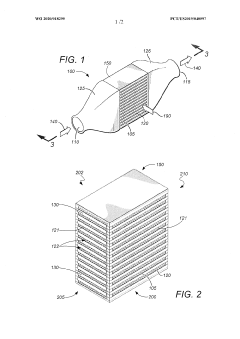
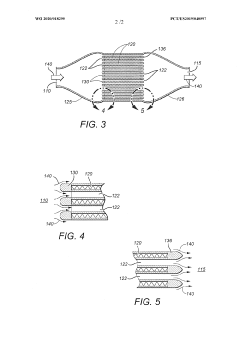
PatentWO2020018295A1
Innovation
- An intercooler design featuring an intercooler core with alternating air flow and charge flow passageways, contoured end tanks, and strategically placed partitions to promote laminar flow and minimize turbulence, along with fin configurations for enhanced heat transfer, maximizing airflow and heat removal.
Environmental Regulations for Automotive Cooling Systems
The automotive industry faces increasingly stringent environmental regulations that directly impact intercooling airflow pattern optimization. The European Union's Euro 7 emission standards, scheduled for implementation in 2025, establish more rigorous limits on nitrogen oxides and particulate matter emissions, requiring enhanced cooling system efficiency to maintain optimal combustion temperatures. These regulations mandate that intercooling systems achieve specific thermal management targets while minimizing environmental impact through reduced refrigerant leakage and improved energy efficiency.
The United States Environmental Protection Agency has implemented Corporate Average Fuel Economy standards that indirectly influence intercooling design requirements. These regulations push manufacturers to optimize airflow patterns to reduce parasitic losses and improve overall vehicle efficiency. The California Air Resources Board's Advanced Clean Cars II program further intensifies these requirements, establishing zero-emission vehicle mandates that affect how intercooling systems must be designed for hybrid and electric vehicle applications.
International regulations under the Montreal Protocol continue to phase out high global warming potential refrigerants, forcing intercooling system designers to adapt airflow patterns for alternative cooling media. The Kigali Amendment specifically targets hydrofluorocarbon reduction, requiring automotive manufacturers to redesign intercooling airflow management systems to accommodate lower-impact refrigerants that may have different thermodynamic properties.
Regional compliance frameworks vary significantly across global markets. The Chinese National VI emission standards impose specific requirements on intercooling efficiency that influence airflow optimization strategies. Japanese regulations focus on energy consumption reduction, while Indian Bharat Stage VI standards emphasize particulate matter control through improved thermal management.
Regulatory compliance testing protocols now include specific intercooling performance metrics under standardized airflow conditions. The Worldwide Harmonized Light Vehicles Test Procedure incorporates real-world driving conditions that challenge traditional intercooling airflow designs, requiring manufacturers to optimize patterns for variable operating scenarios rather than steady-state conditions.
Future regulatory trends indicate increasing focus on lifecycle environmental impact assessment, pushing intercooling airflow optimization toward sustainable materials and manufacturing processes. Emerging regulations on microplastic emissions from automotive components may also influence intercooling system design and airflow pattern optimization strategies.
The United States Environmental Protection Agency has implemented Corporate Average Fuel Economy standards that indirectly influence intercooling design requirements. These regulations push manufacturers to optimize airflow patterns to reduce parasitic losses and improve overall vehicle efficiency. The California Air Resources Board's Advanced Clean Cars II program further intensifies these requirements, establishing zero-emission vehicle mandates that affect how intercooling systems must be designed for hybrid and electric vehicle applications.
International regulations under the Montreal Protocol continue to phase out high global warming potential refrigerants, forcing intercooling system designers to adapt airflow patterns for alternative cooling media. The Kigali Amendment specifically targets hydrofluorocarbon reduction, requiring automotive manufacturers to redesign intercooling airflow management systems to accommodate lower-impact refrigerants that may have different thermodynamic properties.
Regional compliance frameworks vary significantly across global markets. The Chinese National VI emission standards impose specific requirements on intercooling efficiency that influence airflow optimization strategies. Japanese regulations focus on energy consumption reduction, while Indian Bharat Stage VI standards emphasize particulate matter control through improved thermal management.
Regulatory compliance testing protocols now include specific intercooling performance metrics under standardized airflow conditions. The Worldwide Harmonized Light Vehicles Test Procedure incorporates real-world driving conditions that challenge traditional intercooling airflow designs, requiring manufacturers to optimize patterns for variable operating scenarios rather than steady-state conditions.
Future regulatory trends indicate increasing focus on lifecycle environmental impact assessment, pushing intercooling airflow optimization toward sustainable materials and manufacturing processes. Emerging regulations on microplastic emissions from automotive components may also influence intercooling system design and airflow pattern optimization strategies.
CFD Simulation Standards for Intercooling Design
Computational Fluid Dynamics simulation has emerged as the cornerstone methodology for analyzing and optimizing intercooling airflow patterns, necessitating the establishment of rigorous simulation standards to ensure accuracy and reliability in design processes. The complexity of intercooling systems, characterized by intricate geometries, varying thermal conditions, and multiphase flow phenomena, demands standardized approaches that can consistently predict real-world performance while minimizing computational overhead.
The foundation of effective CFD simulation standards begins with mesh generation protocols that balance computational efficiency with solution accuracy. Grid independence studies must be systematically conducted to establish optimal mesh densities, with particular attention to boundary layer resolution near heat transfer surfaces. Standard practices dictate minimum y-plus values below unity for accurate viscous sublayer capture, while ensuring adequate cell aspect ratios to prevent numerical diffusion in critical flow regions.
Turbulence modeling selection represents a critical standardization aspect, where Reynolds-Averaged Navier-Stokes models such as k-epsilon and k-omega SST are typically employed for their computational efficiency and reasonable accuracy in separated flows common in intercooling applications. Advanced Large Eddy Simulation approaches may be reserved for detailed analysis of specific flow phenomena, though their computational demands often limit practical implementation in routine design workflows.
Boundary condition specification requires standardized protocols encompassing inlet velocity profiles, temperature distributions, and outlet pressure conditions that accurately reflect operational environments. Heat transfer modeling must incorporate appropriate wall functions and thermal boundary conditions, with particular emphasis on conjugate heat transfer analysis when solid-fluid thermal interactions significantly influence performance.
Convergence criteria establishment forms another crucial standard, typically requiring residual reduction of at least three orders of magnitude combined with monitoring of key performance parameters such as pressure drop and heat transfer coefficients. Solution verification through grid refinement studies and validation against experimental data or analytical solutions ensures simulation reliability and builds confidence in optimization predictions for intercooling airflow pattern development.
The foundation of effective CFD simulation standards begins with mesh generation protocols that balance computational efficiency with solution accuracy. Grid independence studies must be systematically conducted to establish optimal mesh densities, with particular attention to boundary layer resolution near heat transfer surfaces. Standard practices dictate minimum y-plus values below unity for accurate viscous sublayer capture, while ensuring adequate cell aspect ratios to prevent numerical diffusion in critical flow regions.
Turbulence modeling selection represents a critical standardization aspect, where Reynolds-Averaged Navier-Stokes models such as k-epsilon and k-omega SST are typically employed for their computational efficiency and reasonable accuracy in separated flows common in intercooling applications. Advanced Large Eddy Simulation approaches may be reserved for detailed analysis of specific flow phenomena, though their computational demands often limit practical implementation in routine design workflows.
Boundary condition specification requires standardized protocols encompassing inlet velocity profiles, temperature distributions, and outlet pressure conditions that accurately reflect operational environments. Heat transfer modeling must incorporate appropriate wall functions and thermal boundary conditions, with particular emphasis on conjugate heat transfer analysis when solid-fluid thermal interactions significantly influence performance.
Convergence criteria establishment forms another crucial standard, typically requiring residual reduction of at least three orders of magnitude combined with monitoring of key performance parameters such as pressure drop and heat transfer coefficients. Solution verification through grid refinement studies and validation against experimental data or analytical solutions ensures simulation reliability and builds confidence in optimization predictions for intercooling airflow pattern development.
Unlock deeper insights with PatSnap Eureka Quick Research — get a full tech report to explore trends and direct your research. Try now!
Generate Your Research Report Instantly with AI Agent
Supercharge your innovation with PatSnap Eureka AI Agent Platform!