

How to Resolve Graphene Battery's Performance Issues?
AUG 6, 20259 MIN READ
Generate Your Research Report Instantly with AI Agent
Patsnap Eureka helps you evaluate technical feasibility & market potential.
Graphene Battery Evolution and Objectives
Graphene batteries have emerged as a promising technology in the energy storage landscape, offering potential solutions to the limitations of traditional lithium-ion batteries. The evolution of graphene batteries can be traced back to the discovery of graphene in 2004, which sparked intense research into its applications across various fields, including energy storage.
The primary objective in developing graphene batteries is to harness the unique properties of graphene to enhance battery performance. These properties include high electrical conductivity, large surface area, and excellent mechanical strength. Researchers aim to leverage these characteristics to create batteries with higher energy density, faster charging capabilities, and longer lifespan compared to conventional batteries.
One of the key goals in graphene battery development is to increase energy density. By incorporating graphene into battery electrodes, scientists seek to enhance the storage capacity of batteries without significantly increasing their size or weight. This could lead to more compact and efficient energy storage solutions for various applications, from portable electronics to electric vehicles.
Another critical objective is to improve charging speed. Graphene's high electrical conductivity offers the potential for rapid electron transfer, which could enable batteries to charge much faster than current technologies. This advancement could address one of the major limitations of electric vehicles and portable devices, making them more practical for widespread adoption.
Enhancing battery lifespan and cycle stability is also a primary focus. Graphene's mechanical strength and flexibility could help mitigate the degradation of battery components over time, potentially extending the operational life of batteries and reducing the need for frequent replacements.
Researchers are also exploring ways to use graphene to improve the safety of batteries. By incorporating graphene into battery designs, they aim to create more stable and heat-resistant batteries, reducing the risk of thermal runaway and other safety hazards associated with high-energy-density storage systems.
As the technology progresses, there is a growing emphasis on developing environmentally friendly and sustainable battery solutions. This includes exploring ways to use graphene to reduce the reliance on rare or toxic materials in battery production and to improve the recyclability of battery components.
The evolution of graphene batteries is driven by the need to overcome the performance limitations of current energy storage technologies. By addressing issues such as energy density, charging speed, lifespan, and safety, graphene batteries have the potential to revolutionize various industries and contribute to the advancement of clean energy technologies.
The primary objective in developing graphene batteries is to harness the unique properties of graphene to enhance battery performance. These properties include high electrical conductivity, large surface area, and excellent mechanical strength. Researchers aim to leverage these characteristics to create batteries with higher energy density, faster charging capabilities, and longer lifespan compared to conventional batteries.
One of the key goals in graphene battery development is to increase energy density. By incorporating graphene into battery electrodes, scientists seek to enhance the storage capacity of batteries without significantly increasing their size or weight. This could lead to more compact and efficient energy storage solutions for various applications, from portable electronics to electric vehicles.
Another critical objective is to improve charging speed. Graphene's high electrical conductivity offers the potential for rapid electron transfer, which could enable batteries to charge much faster than current technologies. This advancement could address one of the major limitations of electric vehicles and portable devices, making them more practical for widespread adoption.
Enhancing battery lifespan and cycle stability is also a primary focus. Graphene's mechanical strength and flexibility could help mitigate the degradation of battery components over time, potentially extending the operational life of batteries and reducing the need for frequent replacements.
Researchers are also exploring ways to use graphene to improve the safety of batteries. By incorporating graphene into battery designs, they aim to create more stable and heat-resistant batteries, reducing the risk of thermal runaway and other safety hazards associated with high-energy-density storage systems.
As the technology progresses, there is a growing emphasis on developing environmentally friendly and sustainable battery solutions. This includes exploring ways to use graphene to reduce the reliance on rare or toxic materials in battery production and to improve the recyclability of battery components.
The evolution of graphene batteries is driven by the need to overcome the performance limitations of current energy storage technologies. By addressing issues such as energy density, charging speed, lifespan, and safety, graphene batteries have the potential to revolutionize various industries and contribute to the advancement of clean energy technologies.
Market Demand Analysis for Advanced Energy Storage
The market demand for advanced energy storage solutions, particularly those addressing graphene battery performance issues, has been steadily increasing in recent years. This growth is driven by the expanding applications of portable electronics, electric vehicles, and renewable energy systems. The global energy storage market is projected to reach significant value by 2025, with a substantial portion attributed to advanced battery technologies.
Graphene batteries, despite their potential advantages, face several performance challenges that have limited their widespread adoption. These issues include capacity fade, self-discharge, and stability concerns. However, the market continues to show strong interest in overcoming these obstacles due to the promising benefits of graphene-based energy storage systems, such as high energy density, rapid charging capabilities, and improved cycle life.
The automotive sector represents a key driver for advanced energy storage demand. As electric vehicle adoption accelerates worldwide, manufacturers are seeking battery technologies that can offer longer range, faster charging times, and improved safety. Graphene batteries, once their performance issues are resolved, could potentially meet these requirements, making them highly attractive for the automotive industry.
Consumer electronics is another significant market segment driving demand for advanced energy storage solutions. With the proliferation of smartphones, tablets, and wearable devices, there is a growing need for batteries that can provide longer-lasting power in compact form factors. Graphene batteries' theoretical high energy density and fast-charging capabilities align well with these consumer demands, further fueling research and development efforts to overcome existing performance limitations.
The renewable energy sector also presents substantial opportunities for advanced energy storage technologies. As the integration of intermittent renewable sources like solar and wind power increases, there is a critical need for efficient and reliable energy storage systems to balance supply and demand. Graphene batteries, with their potential for high capacity and rapid charge/discharge rates, could play a crucial role in grid-scale energy storage applications once their performance issues are addressed.
Industrial and aerospace applications are emerging as additional markets for advanced energy storage solutions. These sectors require batteries with high power density, extended cycle life, and the ability to operate in extreme conditions. Resolving graphene battery performance issues could open up new opportunities in these high-value markets, driving further investment and innovation in the technology.
Graphene batteries, despite their potential advantages, face several performance challenges that have limited their widespread adoption. These issues include capacity fade, self-discharge, and stability concerns. However, the market continues to show strong interest in overcoming these obstacles due to the promising benefits of graphene-based energy storage systems, such as high energy density, rapid charging capabilities, and improved cycle life.
The automotive sector represents a key driver for advanced energy storage demand. As electric vehicle adoption accelerates worldwide, manufacturers are seeking battery technologies that can offer longer range, faster charging times, and improved safety. Graphene batteries, once their performance issues are resolved, could potentially meet these requirements, making them highly attractive for the automotive industry.
Consumer electronics is another significant market segment driving demand for advanced energy storage solutions. With the proliferation of smartphones, tablets, and wearable devices, there is a growing need for batteries that can provide longer-lasting power in compact form factors. Graphene batteries' theoretical high energy density and fast-charging capabilities align well with these consumer demands, further fueling research and development efforts to overcome existing performance limitations.
The renewable energy sector also presents substantial opportunities for advanced energy storage technologies. As the integration of intermittent renewable sources like solar and wind power increases, there is a critical need for efficient and reliable energy storage systems to balance supply and demand. Graphene batteries, with their potential for high capacity and rapid charge/discharge rates, could play a crucial role in grid-scale energy storage applications once their performance issues are addressed.
Industrial and aerospace applications are emerging as additional markets for advanced energy storage solutions. These sectors require batteries with high power density, extended cycle life, and the ability to operate in extreme conditions. Resolving graphene battery performance issues could open up new opportunities in these high-value markets, driving further investment and innovation in the technology.
Current Challenges in Graphene Battery Technology
Graphene batteries have garnered significant attention in recent years due to their potential to revolutionize energy storage technology. However, several challenges persist in their development and commercialization. One of the primary issues is the scalability of graphene production. While laboratory-scale synthesis of high-quality graphene is achievable, mass production of consistent, defect-free graphene remains a significant hurdle.
Another major challenge is the integration of graphene into existing battery architectures. The unique properties of graphene, such as its high surface area and excellent conductivity, can lead to unintended side reactions and electrolyte decomposition. This results in capacity fading and reduced cycle life, limiting the long-term performance of graphene-based batteries.
The formation of a stable solid-electrolyte interphase (SEI) layer is crucial for battery performance, but graphene's high surface reactivity can lead to continuous SEI formation, consuming electrolyte and active materials. This process not only reduces the battery's capacity but also increases its internal resistance over time.
Graphene's tendency to restack and agglomerate during battery operation poses another significant challenge. This restacking reduces the effective surface area and hinders ion transport, negatively impacting the battery's power density and rate capability. Developing methods to maintain graphene's dispersed state throughout the battery's lifecycle is essential for optimal performance.
The cost of graphene production and integration into battery systems remains a substantial barrier to commercialization. Current manufacturing processes are energy-intensive and often involve expensive precursors or complex equipment, making graphene batteries economically uncompetitive with traditional lithium-ion batteries.
Safety concerns also persist, particularly regarding the potential for graphene nanoparticles to cause short circuits or penetrate cell membranes. Addressing these safety issues is crucial for widespread adoption of graphene battery technology.
Furthermore, the lack of standardization in graphene quality and characterization methods makes it challenging to compare results across different research groups and scale up production. Establishing industry-wide standards for graphene materials used in battery applications is essential for consistent performance and reliability.
Overcoming these challenges requires a multidisciplinary approach, combining advances in materials science, electrochemistry, and manufacturing processes. Researchers and industry players must collaborate to develop innovative solutions that address these issues while maintaining the promising advantages of graphene in energy storage applications.
Another major challenge is the integration of graphene into existing battery architectures. The unique properties of graphene, such as its high surface area and excellent conductivity, can lead to unintended side reactions and electrolyte decomposition. This results in capacity fading and reduced cycle life, limiting the long-term performance of graphene-based batteries.
The formation of a stable solid-electrolyte interphase (SEI) layer is crucial for battery performance, but graphene's high surface reactivity can lead to continuous SEI formation, consuming electrolyte and active materials. This process not only reduces the battery's capacity but also increases its internal resistance over time.
Graphene's tendency to restack and agglomerate during battery operation poses another significant challenge. This restacking reduces the effective surface area and hinders ion transport, negatively impacting the battery's power density and rate capability. Developing methods to maintain graphene's dispersed state throughout the battery's lifecycle is essential for optimal performance.
The cost of graphene production and integration into battery systems remains a substantial barrier to commercialization. Current manufacturing processes are energy-intensive and often involve expensive precursors or complex equipment, making graphene batteries economically uncompetitive with traditional lithium-ion batteries.
Safety concerns also persist, particularly regarding the potential for graphene nanoparticles to cause short circuits or penetrate cell membranes. Addressing these safety issues is crucial for widespread adoption of graphene battery technology.
Furthermore, the lack of standardization in graphene quality and characterization methods makes it challenging to compare results across different research groups and scale up production. Establishing industry-wide standards for graphene materials used in battery applications is essential for consistent performance and reliability.
Overcoming these challenges requires a multidisciplinary approach, combining advances in materials science, electrochemistry, and manufacturing processes. Researchers and industry players must collaborate to develop innovative solutions that address these issues while maintaining the promising advantages of graphene in energy storage applications.
Existing Solutions for Graphene Battery Performance
01 Enhanced energy density and capacity
Graphene-based batteries demonstrate significantly improved energy density and capacity compared to traditional lithium-ion batteries. The unique properties of graphene, such as its high surface area and excellent conductivity, allow for more efficient energy storage and faster charge/discharge cycles. This results in batteries that can store more energy in a smaller volume and provide longer-lasting power for various applications.- Graphene-based electrode materials: Graphene is used as an electrode material in batteries to enhance performance. Its high surface area and excellent electrical conductivity contribute to improved energy density and faster charge/discharge rates. Graphene can be incorporated into both anode and cathode materials, often in combination with other materials to create composite electrodes.
- Graphene-enhanced electrolytes: Graphene or graphene oxide can be used to modify battery electrolytes. This can lead to improved ionic conductivity, better electrode-electrolyte interface stability, and enhanced overall battery performance. The addition of graphene to electrolytes may also help in reducing dendrite formation in certain battery types.
- Graphene-based composite materials: Composite materials incorporating graphene are developed to enhance battery performance. These composites often combine graphene with other materials such as metal oxides, polymers, or other carbon-based materials. The resulting composites can offer improved capacity, cycling stability, and rate capability compared to traditional battery materials.
- Graphene for thermal management: Graphene's excellent thermal conductivity is utilized to improve heat dissipation in batteries. This can lead to better temperature control during charging and discharging, potentially extending battery life and improving safety. Graphene-based thermal management systems may be integrated into battery packs or individual cells.
- Graphene in flexible and wearable batteries: Graphene's flexibility and strength make it suitable for use in flexible and wearable battery designs. These batteries can maintain performance while being bent or stretched, opening up new possibilities for integration into wearable devices and flexible electronics. Graphene may be used in various components of these batteries, including electrodes and current collectors.
02 Improved charging speed and efficiency
Graphene-enhanced batteries exhibit faster charging speeds and higher charging efficiency. The superior electron mobility of graphene enables rapid ion transfer, reducing charging times significantly. This feature is particularly beneficial for electric vehicles and portable electronic devices, where quick charging is crucial. Additionally, the improved efficiency translates to less energy loss during the charging process.Expand Specific Solutions03 Enhanced thermal management
Graphene's excellent thermal conductivity properties contribute to better heat dissipation in batteries. This improved thermal management helps prevent overheating issues, enhances safety, and extends the overall lifespan of the battery. The efficient heat distribution also allows for more stable performance under various operating conditions, including high-power applications.Expand Specific Solutions04 Increased cycle life and durability
Graphene-based batteries demonstrate superior cycle life and durability compared to conventional batteries. The structural stability of graphene helps prevent electrode degradation and reduces capacity fade over time. This results in batteries that can withstand a higher number of charge-discharge cycles while maintaining their performance, making them ideal for long-term use in various applications.Expand Specific Solutions05 Flexible and lightweight design
The incorporation of graphene in battery design allows for the development of flexible and lightweight power sources. Graphene's mechanical properties enable the creation of thin, bendable batteries that can be integrated into wearable devices and other applications where traditional rigid batteries are impractical. This flexibility opens up new possibilities for innovative product designs and form factors.Expand Specific Solutions
Key Players in Graphene Battery Research
The graphene battery market is in its early growth stage, characterized by significant research and development efforts across academia and industry. While the technology shows promise for addressing energy storage challenges, it has not yet reached full commercial maturity. Key players like Global Graphene Group, Vorbeck Materials, and Nanotek Instruments are driving innovation, with established companies such as Panasonic Energy and NEC also investing in the field. The market size is projected to expand rapidly, driven by demand for high-performance energy storage solutions in electric vehicles and consumer electronics. However, technical hurdles related to scalability, cost-effectiveness, and long-term stability need to be overcome before widespread adoption can occur.
Global Graphene Group, Inc.
Technical Solution: Global Graphene Group has developed a proprietary graphene-silicon composite anode material that addresses key performance issues in graphene batteries. Their technology utilizes a 3D porous graphene network to encapsulate silicon nanoparticles, which helps mitigate silicon expansion during charging cycles[1]. This composite structure allows for higher energy density while maintaining structural stability. The company has also implemented advanced surface modification techniques to improve the electrode-electrolyte interface, reducing unwanted side reactions and enhancing overall battery life[2]. Their approach combines the high theoretical capacity of silicon with the excellent conductivity and mechanical strength of graphene, potentially resolving issues related to capacity fade and cycle life in graphene-based batteries.
Strengths: High energy density, improved cycle life, and enhanced structural stability. Weaknesses: Potential high production costs and scalability challenges for mass production.
Nexeon Ltd.
Technical Solution: Nexeon has developed a novel approach to address graphene battery performance issues by focusing on silicon-graphene composite anodes. Their technology involves creating a structured silicon material with a graphene coating, which helps to stabilize the silicon during charge-discharge cycles[3]. This composite structure allows for higher capacity retention and improved cycle life compared to traditional graphite anodes. Nexeon's process also incorporates a proprietary electrolyte formulation that forms a stable Solid Electrolyte Interphase (SEI) layer, crucial for long-term battery performance[4]. Additionally, they have implemented advanced manufacturing techniques to ensure uniform distribution of graphene within the silicon matrix, addressing issues related to conductivity and charge transfer kinetics in graphene-based batteries.
Strengths: High capacity retention, improved cycle life, and enhanced conductivity. Weaknesses: Potential challenges in large-scale production and integration with existing battery manufacturing processes.
Core Innovations in Graphene-Based Energy Storage
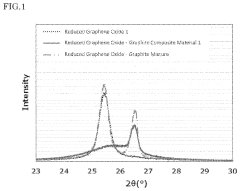
Reduced graphene oxide-graphite composite material, method for producing same, and lithium ion secondary battery using same
PatentActiveUS20210399300A1
Innovation
- A reduced graphene oxide-graphite composite material is formed through thermal treatment of graphene oxide and graphite, resulting in a higher C—O/C═O functional group ratio, which improves the charge and discharge efficiency by suppressing side reactions and reducing irreversible capacity.
Method for forming aligned structure of graphite, method for fabricating electrode for battery having aligned graphite and lithium secondary battery having aligned graphite
PatentPendingUS20230129924A1
Innovation
- A method involving coating a graphite composition with a binder and solvent on a substrate, applying a magnetic field for alignment, freezing, and subliming the solvent to fix the alignment, using solvents like water or N-methyl pyrrolidone, and omitting iron oxide to enhance graphite alignment and battery performance.


Environmental Impact of Graphene Battery Production
The production of graphene batteries raises significant environmental concerns that must be carefully considered. The manufacturing process of graphene involves energy-intensive methods such as chemical vapor deposition or exfoliation of graphite, which can contribute to increased carbon emissions. Additionally, the use of harsh chemicals and solvents in graphene synthesis may lead to potential environmental contamination if not properly managed.
One of the primary environmental challenges is the disposal and recycling of graphene batteries at the end of their lifecycle. The complex composition of these batteries, combining graphene with other materials, makes recycling processes more complicated than traditional lithium-ion batteries. Developing efficient recycling techniques for graphene batteries is crucial to minimize waste and recover valuable materials.
Water usage and potential water pollution are also important factors to consider. The production of graphene often requires substantial amounts of water, and the discharge of process water containing graphene particles or chemical residues could harm aquatic ecosystems if not adequately treated.
The extraction and processing of raw materials for graphene production, such as graphite, may have localized environmental impacts, including habitat disruption and potential soil and water contamination. Sustainable sourcing practices and responsible mining techniques are essential to mitigate these effects.
On the positive side, graphene batteries have the potential to offer longer lifespans and higher energy densities compared to conventional batteries. This could lead to reduced electronic waste and more efficient energy storage solutions, potentially offsetting some of the environmental costs associated with their production.
To address these environmental concerns, research efforts are focusing on developing greener synthesis methods for graphene, such as using renewable precursors or environmentally friendly reduction agents. Additionally, improving the efficiency of production processes and implementing closed-loop systems for water and chemical recycling can significantly reduce the environmental footprint of graphene battery manufacturing.
As the technology advances, it is crucial to conduct comprehensive life cycle assessments to fully understand and quantify the environmental impacts of graphene battery production. This will enable the development of more sustainable manufacturing practices and guide policy decisions to ensure that the potential benefits of graphene batteries are realized without compromising environmental integrity.
One of the primary environmental challenges is the disposal and recycling of graphene batteries at the end of their lifecycle. The complex composition of these batteries, combining graphene with other materials, makes recycling processes more complicated than traditional lithium-ion batteries. Developing efficient recycling techniques for graphene batteries is crucial to minimize waste and recover valuable materials.
Water usage and potential water pollution are also important factors to consider. The production of graphene often requires substantial amounts of water, and the discharge of process water containing graphene particles or chemical residues could harm aquatic ecosystems if not adequately treated.
The extraction and processing of raw materials for graphene production, such as graphite, may have localized environmental impacts, including habitat disruption and potential soil and water contamination. Sustainable sourcing practices and responsible mining techniques are essential to mitigate these effects.
On the positive side, graphene batteries have the potential to offer longer lifespans and higher energy densities compared to conventional batteries. This could lead to reduced electronic waste and more efficient energy storage solutions, potentially offsetting some of the environmental costs associated with their production.
To address these environmental concerns, research efforts are focusing on developing greener synthesis methods for graphene, such as using renewable precursors or environmentally friendly reduction agents. Additionally, improving the efficiency of production processes and implementing closed-loop systems for water and chemical recycling can significantly reduce the environmental footprint of graphene battery manufacturing.
As the technology advances, it is crucial to conduct comprehensive life cycle assessments to fully understand and quantify the environmental impacts of graphene battery production. This will enable the development of more sustainable manufacturing practices and guide policy decisions to ensure that the potential benefits of graphene batteries are realized without compromising environmental integrity.
Scalability and Commercialization Prospects
The scalability and commercialization prospects of graphene batteries are closely tied to overcoming their current performance issues. As the technology matures, several key factors will determine its potential for widespread adoption and market success.
Manufacturing scalability remains a significant challenge for graphene batteries. Current production methods for high-quality graphene are limited in scale and cost-effectiveness. Researchers are exploring various approaches to enhance scalability, including chemical vapor deposition (CVD) and liquid-phase exfoliation techniques. Advances in these areas could dramatically reduce production costs and increase output, making graphene batteries more commercially viable.
The integration of graphene into existing battery manufacturing processes presents another hurdle. Adapting current production lines to incorporate graphene-based materials requires substantial investment and retooling. However, as the technology progresses, hybrid approaches that combine graphene with traditional battery materials may offer a more gradual and cost-effective path to commercialization.
Market demand for high-performance energy storage solutions continues to grow across various sectors, including electric vehicles, consumer electronics, and renewable energy systems. Graphene batteries' potential for faster charging times, increased energy density, and improved cycle life aligns well with these market needs. This alignment creates a strong incentive for continued research and development efforts.
Regulatory considerations will play a crucial role in the commercialization of graphene batteries. Safety standards, environmental impact assessments, and performance certifications must be established and met before widespread adoption can occur. Collaboration between industry players, research institutions, and regulatory bodies will be essential in addressing these challenges.
Investment in graphene battery technology has been increasing, with major battery manufacturers and tech companies showing interest. This influx of capital and expertise is likely to accelerate the development of scalable production methods and commercially viable products. Strategic partnerships between graphene producers, battery manufacturers, and end-users could further drive innovation and market penetration.
As performance issues are resolved and production scales up, the cost of graphene batteries is expected to decrease, making them more competitive with existing battery technologies. Initial applications may focus on high-value markets where performance advantages outweigh cost considerations, gradually expanding to more price-sensitive segments as economies of scale are achieved.
Manufacturing scalability remains a significant challenge for graphene batteries. Current production methods for high-quality graphene are limited in scale and cost-effectiveness. Researchers are exploring various approaches to enhance scalability, including chemical vapor deposition (CVD) and liquid-phase exfoliation techniques. Advances in these areas could dramatically reduce production costs and increase output, making graphene batteries more commercially viable.
The integration of graphene into existing battery manufacturing processes presents another hurdle. Adapting current production lines to incorporate graphene-based materials requires substantial investment and retooling. However, as the technology progresses, hybrid approaches that combine graphene with traditional battery materials may offer a more gradual and cost-effective path to commercialization.
Market demand for high-performance energy storage solutions continues to grow across various sectors, including electric vehicles, consumer electronics, and renewable energy systems. Graphene batteries' potential for faster charging times, increased energy density, and improved cycle life aligns well with these market needs. This alignment creates a strong incentive for continued research and development efforts.
Regulatory considerations will play a crucial role in the commercialization of graphene batteries. Safety standards, environmental impact assessments, and performance certifications must be established and met before widespread adoption can occur. Collaboration between industry players, research institutions, and regulatory bodies will be essential in addressing these challenges.
Investment in graphene battery technology has been increasing, with major battery manufacturers and tech companies showing interest. This influx of capital and expertise is likely to accelerate the development of scalable production methods and commercially viable products. Strategic partnerships between graphene producers, battery manufacturers, and end-users could further drive innovation and market penetration.
As performance issues are resolved and production scales up, the cost of graphene batteries is expected to decrease, making them more competitive with existing battery technologies. Initial applications may focus on high-value markets where performance advantages outweigh cost considerations, gradually expanding to more price-sensitive segments as economies of scale are achieved.
Unlock deeper insights with Patsnap Eureka Quick Research — get a full tech report to explore trends and direct your research. Try now!
Generate Your Research Report Instantly with AI Agent
Supercharge your innovation with Patsnap Eureka AI Agent Platform!