

How to Set Network Parameters for Spiking Efficiency
APR 24, 20269 MIN READ
Generate Your Research Report Instantly with AI Agent
Patsnap Eureka helps you evaluate technical feasibility & market potential.
Spiking Neural Network Parameter Optimization Background and Goals
Spiking Neural Networks (SNNs) represent a paradigm shift from traditional artificial neural networks by incorporating temporal dynamics and event-driven computation that closely mimics biological neural systems. Unlike conventional deep learning models that process continuous values, SNNs communicate through discrete spikes, offering inherent advantages in energy efficiency and temporal information processing. The evolution of SNNs traces back to the pioneering work of Hodgkin and Huxley in the 1950s, progressing through integrate-and-fire models to modern large-scale neuromorphic implementations.
The historical development of SNN parameter optimization has been marked by several critical milestones. Early approaches relied heavily on biological plausibility constraints, limiting practical applications. The introduction of surrogate gradient methods in the 2010s revolutionized SNN training by addressing the non-differentiable nature of spike functions. Subsequently, the emergence of neuromorphic hardware platforms like Intel's Loihi and IBM's TrueNorth created new demands for efficient parameter setting methodologies that could leverage hardware-specific optimizations.
Current technological trends indicate a convergence toward hybrid learning approaches that combine supervised, unsupervised, and reinforcement learning paradigms for SNN parameter optimization. The integration of meta-learning techniques and neural architecture search methods represents the cutting edge of this field, enabling automated discovery of optimal network configurations across diverse application domains.
The primary technical objectives center on developing systematic methodologies for setting critical network parameters including synaptic weights, membrane time constants, threshold voltages, and refractory periods to maximize spiking efficiency. This encompasses achieving optimal trade-offs between computational accuracy, energy consumption, and processing latency while maintaining biological plausibility where required.
Strategic goals include establishing standardized benchmarking frameworks for evaluating parameter optimization techniques across different SNN architectures and application scenarios. The ultimate aim is to enable widespread adoption of SNNs in edge computing, autonomous systems, and real-time processing applications where energy efficiency and temporal precision are paramount considerations for next-generation intelligent systems.
The historical development of SNN parameter optimization has been marked by several critical milestones. Early approaches relied heavily on biological plausibility constraints, limiting practical applications. The introduction of surrogate gradient methods in the 2010s revolutionized SNN training by addressing the non-differentiable nature of spike functions. Subsequently, the emergence of neuromorphic hardware platforms like Intel's Loihi and IBM's TrueNorth created new demands for efficient parameter setting methodologies that could leverage hardware-specific optimizations.
Current technological trends indicate a convergence toward hybrid learning approaches that combine supervised, unsupervised, and reinforcement learning paradigms for SNN parameter optimization. The integration of meta-learning techniques and neural architecture search methods represents the cutting edge of this field, enabling automated discovery of optimal network configurations across diverse application domains.
The primary technical objectives center on developing systematic methodologies for setting critical network parameters including synaptic weights, membrane time constants, threshold voltages, and refractory periods to maximize spiking efficiency. This encompasses achieving optimal trade-offs between computational accuracy, energy consumption, and processing latency while maintaining biological plausibility where required.
Strategic goals include establishing standardized benchmarking frameworks for evaluating parameter optimization techniques across different SNN architectures and application scenarios. The ultimate aim is to enable widespread adoption of SNNs in edge computing, autonomous systems, and real-time processing applications where energy efficiency and temporal precision are paramount considerations for next-generation intelligent systems.
Market Demand for Efficient SNN Applications
The market demand for efficient Spiking Neural Network applications is experiencing unprecedented growth across multiple sectors, driven by the increasing need for energy-efficient artificial intelligence solutions. Traditional deep learning models consume substantial computational resources and power, creating a significant market opportunity for SNN-based alternatives that can deliver comparable performance with dramatically reduced energy consumption.
Edge computing represents one of the most promising market segments for efficient SNN applications. Internet of Things devices, autonomous vehicles, and mobile robotics require real-time processing capabilities while operating under strict power constraints. The ability to optimize network parameters for spiking efficiency directly addresses these requirements, enabling deployment of sophisticated AI capabilities in resource-constrained environments where traditional neural networks would be impractical.
Healthcare and biomedical applications constitute another rapidly expanding market segment. Brain-computer interfaces, neural prosthetics, and real-time medical monitoring systems demand ultra-low power consumption and high temporal precision. Efficient SNN parameter optimization enables these applications to operate continuously without frequent battery replacements, significantly improving patient outcomes and device usability.
The neuromorphic computing market is driving substantial demand for efficient SNN implementations. Major technology companies and research institutions are investing heavily in neuromorphic chips that can leverage optimized spiking networks. Proper parameter tuning for spiking efficiency becomes crucial for maximizing the performance benefits of specialized neuromorphic hardware platforms.
Industrial automation and smart manufacturing sectors are increasingly adopting SNN-based solutions for predictive maintenance, quality control, and process optimization. The temporal dynamics inherent in spiking networks, when properly parameterized, provide superior performance for time-series analysis and anomaly detection in industrial environments.
Consumer electronics manufacturers are exploring SNN integration for always-on applications such as voice activation, gesture recognition, and environmental sensing. The market demand centers on achieving high accuracy while maintaining battery life, making parameter optimization for spiking efficiency a critical competitive advantage.
The growing emphasis on sustainable AI and green computing is creating additional market pressure for energy-efficient neural network solutions, positioning optimized SNNs as essential components of environmentally responsible AI systems.
Edge computing represents one of the most promising market segments for efficient SNN applications. Internet of Things devices, autonomous vehicles, and mobile robotics require real-time processing capabilities while operating under strict power constraints. The ability to optimize network parameters for spiking efficiency directly addresses these requirements, enabling deployment of sophisticated AI capabilities in resource-constrained environments where traditional neural networks would be impractical.
Healthcare and biomedical applications constitute another rapidly expanding market segment. Brain-computer interfaces, neural prosthetics, and real-time medical monitoring systems demand ultra-low power consumption and high temporal precision. Efficient SNN parameter optimization enables these applications to operate continuously without frequent battery replacements, significantly improving patient outcomes and device usability.
The neuromorphic computing market is driving substantial demand for efficient SNN implementations. Major technology companies and research institutions are investing heavily in neuromorphic chips that can leverage optimized spiking networks. Proper parameter tuning for spiking efficiency becomes crucial for maximizing the performance benefits of specialized neuromorphic hardware platforms.
Industrial automation and smart manufacturing sectors are increasingly adopting SNN-based solutions for predictive maintenance, quality control, and process optimization. The temporal dynamics inherent in spiking networks, when properly parameterized, provide superior performance for time-series analysis and anomaly detection in industrial environments.
Consumer electronics manufacturers are exploring SNN integration for always-on applications such as voice activation, gesture recognition, and environmental sensing. The market demand centers on achieving high accuracy while maintaining battery life, making parameter optimization for spiking efficiency a critical competitive advantage.
The growing emphasis on sustainable AI and green computing is creating additional market pressure for energy-efficient neural network solutions, positioning optimized SNNs as essential components of environmentally responsible AI systems.
Current SNN Parameter Setting Challenges and Limitations
Setting network parameters for spiking neural networks presents significant computational and methodological challenges that currently limit their widespread adoption and optimal performance. The parameter space in SNNs is substantially more complex than traditional artificial neural networks, encompassing temporal dynamics, membrane potentials, synaptic weights, and firing thresholds that must be carefully coordinated to achieve efficient spiking behavior.
One of the primary limitations lies in the lack of standardized parameter optimization frameworks specifically designed for SNNs. Unlike conventional neural networks where backpropagation provides a clear gradient-based optimization path, SNNs require specialized training algorithms that can handle the discrete, event-driven nature of spike generation. Current approaches often rely on surrogate gradient methods or evolutionary algorithms, which are computationally expensive and may not guarantee convergence to optimal solutions.
The temporal dimension adds another layer of complexity to parameter setting challenges. SNNs must balance between maintaining sufficient membrane potential dynamics for meaningful computation while avoiding excessive energy consumption through unnecessary spike generation. This trade-off is particularly difficult to optimize as it depends on both the network architecture and the specific computational task, making it challenging to develop universal parameter setting guidelines.
Hardware implementation constraints further complicate parameter optimization efforts. Neuromorphic chips have specific limitations regarding precision, dynamic range, and parameter storage capabilities that must be considered during the parameter setting process. These hardware constraints often require quantization and approximation of ideal parameter values, potentially degrading network performance and spiking efficiency.
Current parameter search methodologies also suffer from scalability issues when applied to large-scale SNN architectures. Grid search and random search approaches become computationally prohibitive as network size increases, while more sophisticated optimization techniques like Bayesian optimization require careful tuning of their own hyperparameters. The high-dimensional parameter space combined with the stochastic nature of spike generation makes it difficult to establish reliable performance metrics for parameter evaluation.
Additionally, the interdependence between different parameter types creates optimization challenges where adjusting one parameter category may require simultaneous modifications across multiple other parameters to maintain network stability and performance. This coupling effect makes it difficult to develop modular parameter setting strategies and often requires holistic optimization approaches that are computationally intensive and time-consuming.
One of the primary limitations lies in the lack of standardized parameter optimization frameworks specifically designed for SNNs. Unlike conventional neural networks where backpropagation provides a clear gradient-based optimization path, SNNs require specialized training algorithms that can handle the discrete, event-driven nature of spike generation. Current approaches often rely on surrogate gradient methods or evolutionary algorithms, which are computationally expensive and may not guarantee convergence to optimal solutions.
The temporal dimension adds another layer of complexity to parameter setting challenges. SNNs must balance between maintaining sufficient membrane potential dynamics for meaningful computation while avoiding excessive energy consumption through unnecessary spike generation. This trade-off is particularly difficult to optimize as it depends on both the network architecture and the specific computational task, making it challenging to develop universal parameter setting guidelines.
Hardware implementation constraints further complicate parameter optimization efforts. Neuromorphic chips have specific limitations regarding precision, dynamic range, and parameter storage capabilities that must be considered during the parameter setting process. These hardware constraints often require quantization and approximation of ideal parameter values, potentially degrading network performance and spiking efficiency.
Current parameter search methodologies also suffer from scalability issues when applied to large-scale SNN architectures. Grid search and random search approaches become computationally prohibitive as network size increases, while more sophisticated optimization techniques like Bayesian optimization require careful tuning of their own hyperparameters. The high-dimensional parameter space combined with the stochastic nature of spike generation makes it difficult to establish reliable performance metrics for parameter evaluation.
Additionally, the interdependence between different parameter types creates optimization challenges where adjusting one parameter category may require simultaneous modifications across multiple other parameters to maintain network stability and performance. This coupling effect makes it difficult to develop modular parameter setting strategies and often requires holistic optimization approaches that are computationally intensive and time-consuming.
Existing SNN Parameter Configuration Solutions
01 Spike timing optimization and temporal coding mechanisms
Techniques for improving spiking efficiency through precise control of spike timing and temporal coding schemes. These methods focus on optimizing when neurons fire to maximize information transmission while minimizing energy consumption. Temporal coding strategies encode information in the precise timing of spikes rather than firing rates, enabling more efficient neural computation and reducing unnecessary spike generation.- Spike timing optimization and temporal coding mechanisms: Techniques for improving spiking efficiency through precise control of spike timing and temporal coding schemes. These methods focus on optimizing when neurons fire to maximize information transmission while minimizing energy consumption. Approaches include adaptive timing windows, temporal pattern recognition, and spike-timing-dependent plasticity mechanisms that enhance the network's ability to process information efficiently.
- Energy-efficient hardware architectures for spiking neural networks: Hardware implementations designed to reduce power consumption in spiking neural networks through specialized circuit designs and neuromorphic computing architectures. These solutions include event-driven processing units, asynchronous circuits, and low-power synaptic structures that only activate when spikes occur, significantly reducing idle power consumption compared to traditional neural network implementations.
- Sparse connectivity and pruning techniques: Methods for enhancing spiking efficiency by reducing unnecessary connections and computational overhead through network pruning and sparse connectivity patterns. These techniques identify and eliminate redundant synaptic connections while maintaining network performance, resulting in fewer spike transmissions and reduced computational requirements. The approaches often incorporate dynamic pruning strategies that adapt during training or operation.
- Adaptive learning algorithms for spike rate optimization: Learning algorithms specifically designed to optimize spike rates and firing patterns in spiking neural networks. These methods adjust synaptic weights and neuron parameters to achieve desired computational outcomes with minimal spike activity. Techniques include reinforcement learning approaches, bio-inspired plasticity rules, and gradient-based optimization methods adapted for discrete spike events.
- Multi-scale temporal processing and hierarchical spike encoding: Approaches that leverage multiple time scales and hierarchical structures to improve information encoding efficiency in spiking neural networks. These methods organize neurons into layers or modules that process information at different temporal resolutions, allowing the network to capture both fast transient features and slow temporal dynamics efficiently. This hierarchical organization reduces redundant spike activity while maintaining representational capacity.
02 Hardware architecture and neuromorphic chip design for efficient spike processing
Specialized hardware architectures and neuromorphic computing platforms designed to efficiently process spiking neural networks. These implementations focus on reducing power consumption and computational overhead through custom circuit designs, event-driven processing, and parallel spike handling mechanisms. The architectures optimize data flow and memory access patterns specific to spike-based computation.Expand Specific Solutions03 Sparse spike generation and activity regulation
Methods for controlling and reducing spike activity through sparsity constraints and activity regulation mechanisms. These approaches implement techniques to ensure neurons only fire when necessary, eliminating redundant spikes and maintaining sparse activation patterns. Sparsity-inducing algorithms and threshold adaptation mechanisms help achieve efficient information encoding with minimal spike counts.Expand Specific Solutions04 Learning algorithms and synaptic plasticity rules for efficiency optimization
Training methods and synaptic plasticity mechanisms specifically designed to improve spiking efficiency during learning. These algorithms optimize network parameters to achieve desired functionality with reduced spike rates and energy consumption. Spike-timing-dependent plasticity rules and efficiency-aware learning objectives guide the network toward more economical spike patterns while maintaining performance.Expand Specific Solutions05 Event-driven processing and asynchronous computation
Asynchronous and event-driven computational paradigms that process spikes only when they occur, eliminating clock-based overhead. These methods leverage the inherent sparsity of spike trains to activate computations on-demand, significantly reducing idle power consumption and unnecessary operations. Event-driven architectures enable fine-grained power management and scalable spike processing.Expand Specific Solutions
Key Players in SNN Research and Development
The competitive landscape for setting network parameters for spiking efficiency is characterized by an emerging market in the early development stage, driven by the convergence of neuromorphic computing and telecommunications optimization. The market remains relatively nascent with significant growth potential as organizations seek energy-efficient network solutions. Technology maturity varies considerably across players, with established telecommunications giants like Huawei Technologies, ZTE Corp., and Ericsson leading in traditional network optimization, while Intel Corp. and NEC Corp. advance neuromorphic hardware implementations. Chinese carriers including China Mobile and China Telecom are actively exploring practical deployments, supported by research institutions like Beijing University of Posts & Telecommunications and University of Electronic Science & Technology of China providing foundational research. The fragmented ecosystem indicates early-stage competition with substantial innovation opportunities ahead.
Huawei Technologies Co., Ltd.
Technical Solution: Huawei has developed comprehensive spiking neural network optimization techniques focusing on dynamic parameter adjustment and energy-efficient computation. Their approach involves adaptive threshold tuning mechanisms that automatically adjust neuron firing thresholds based on input signal characteristics and network load conditions. The company implements hierarchical parameter optimization where different network layers utilize distinct spiking parameters optimized for their specific computational roles. Their solution incorporates temporal coding schemes that maximize information density while minimizing unnecessary spike generation, achieving up to 40% reduction in power consumption compared to traditional approaches. The system features real-time parameter adaptation algorithms that continuously monitor network performance metrics and adjust spiking rates, refractory periods, and synaptic weights to maintain optimal efficiency across varying operational conditions.
Strengths: Industry-leading research capabilities and extensive patent portfolio in neuromorphic computing. Weaknesses: Limited commercial deployment experience in specialized spiking neural network applications.
Nokia Telecommunications Oy
Technical Solution: Nokia has developed advanced parameter optimization frameworks for spiking neural networks integrated into their network infrastructure solutions. Their approach emphasizes context-aware parameter adaptation that considers both network topology and traffic patterns when optimizing spiking efficiency. The system implements reinforcement learning-based parameter tuning algorithms that learn optimal configurations through continuous interaction with network environments. Nokia's solution features hierarchical parameter management with global coordination mechanisms that ensure consistent optimization across distributed spiking neural network deployments. Their methodology incorporates energy-aware scheduling algorithms that dynamically adjust spiking rates and processing priorities based on available power budgets and performance requirements. The platform supports multi-tenant parameter isolation, allowing different applications to maintain independent optimization strategies while sharing underlying neuromorphic computing resources.
Strengths: Extensive experience in network optimization and strong research partnerships with academic institutions. Weaknesses: Primarily focused on telecommunications applications with limited diversification into other spiking neural network domains.
Core Innovations in SNN Efficiency Optimization
Device and method for executing spiking neural network, and spiking neuromorphic system
PatentWO2023074798A1
Innovation
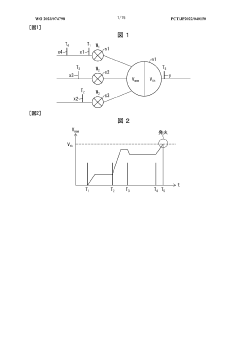
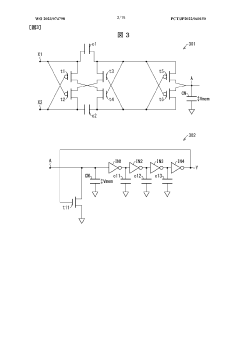
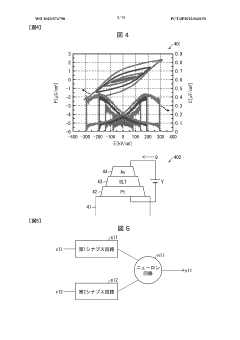
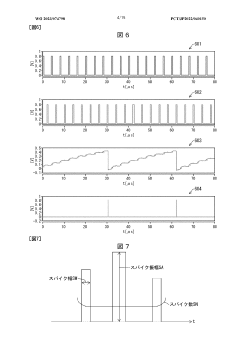
- Implementing a spiking neural network apparatus and method that uses variable weights to generate membrane potential displacement based on spike number, width, and amplitude, enabling more efficient coding and processing by integrating these parameters into the spike pattern.
Methods and systems for training multi-bit spiking neural networks for efficient implementation on digital hardware
PatentActiveUS20210133568A1
Innovation
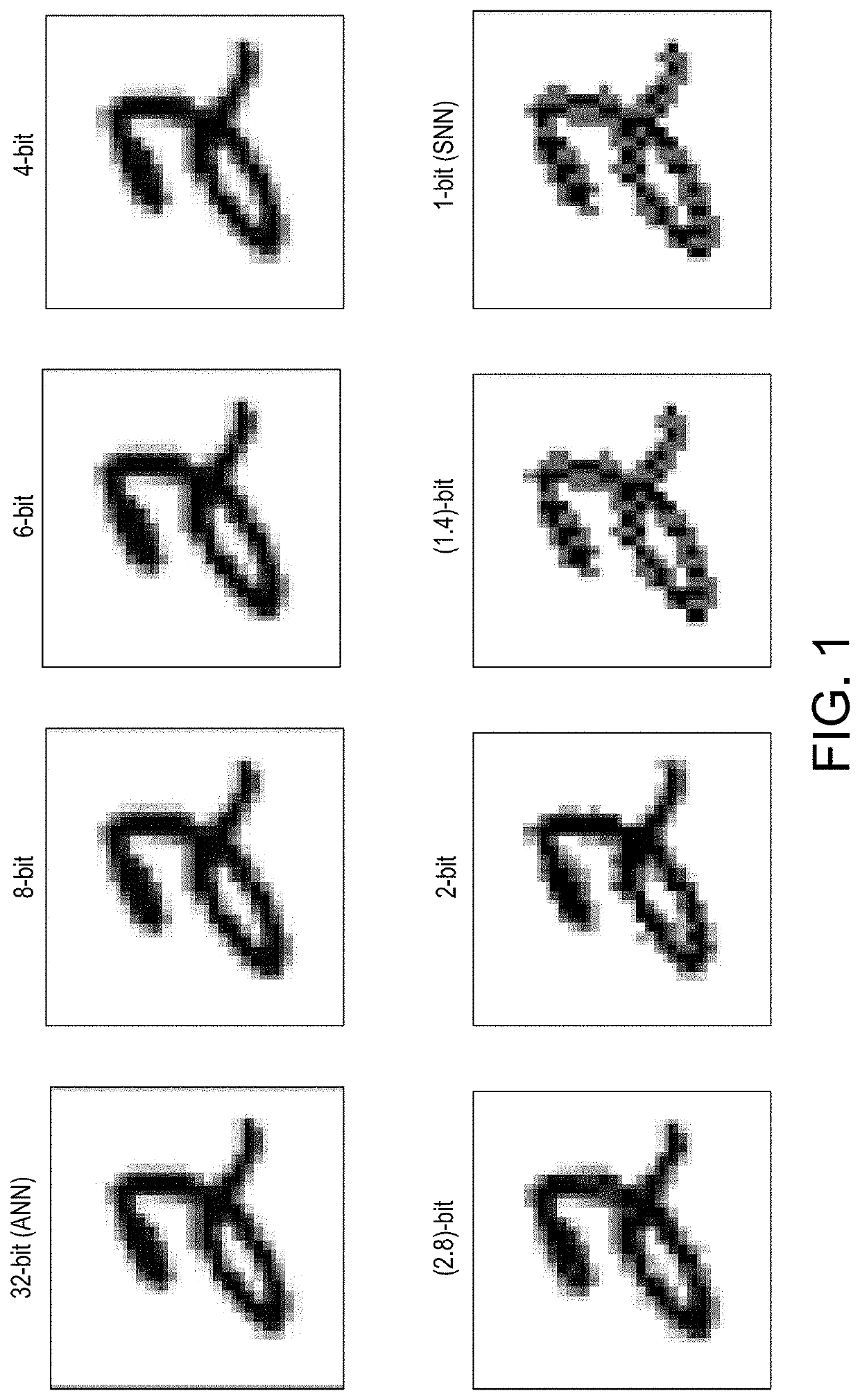
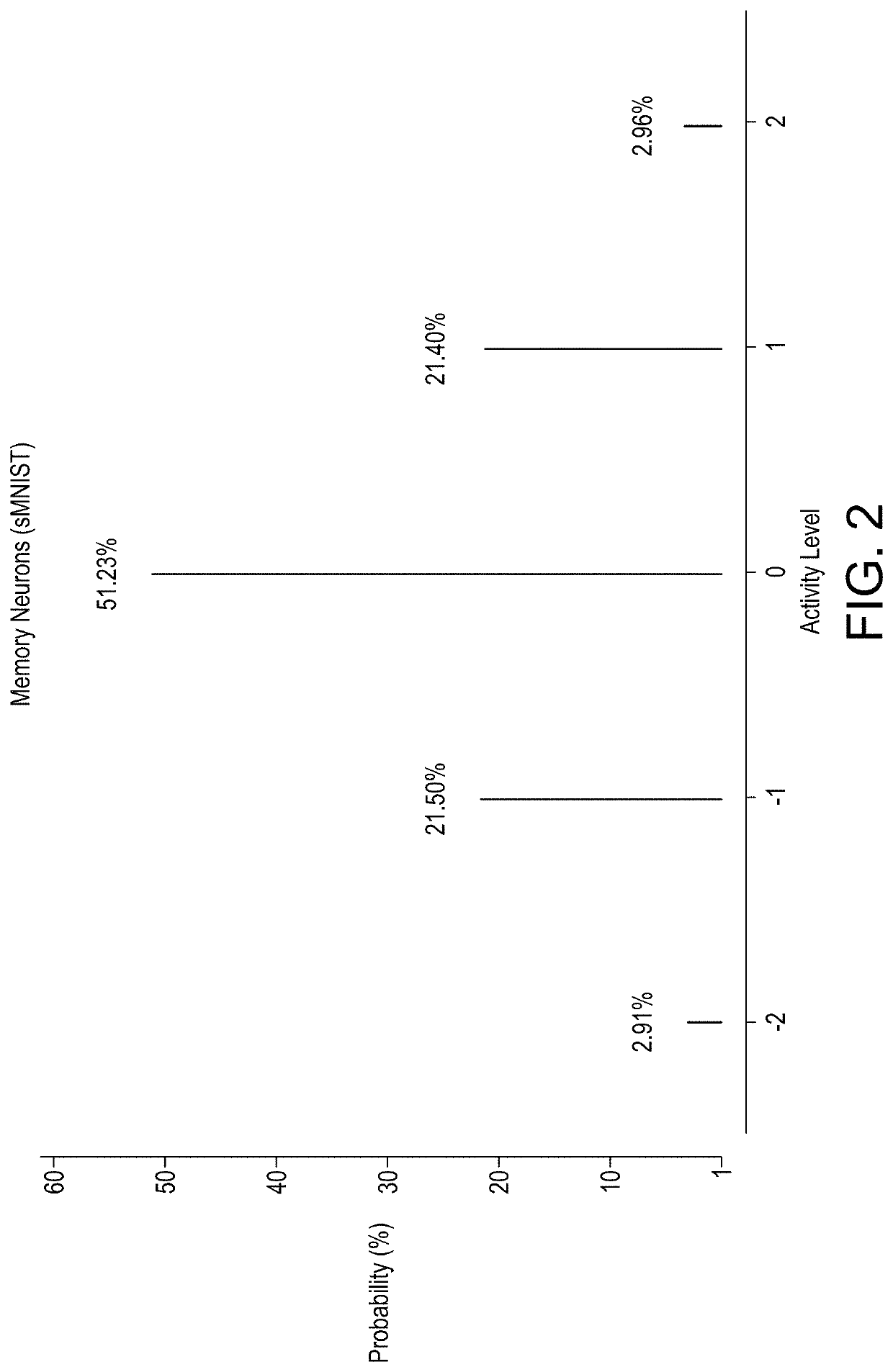
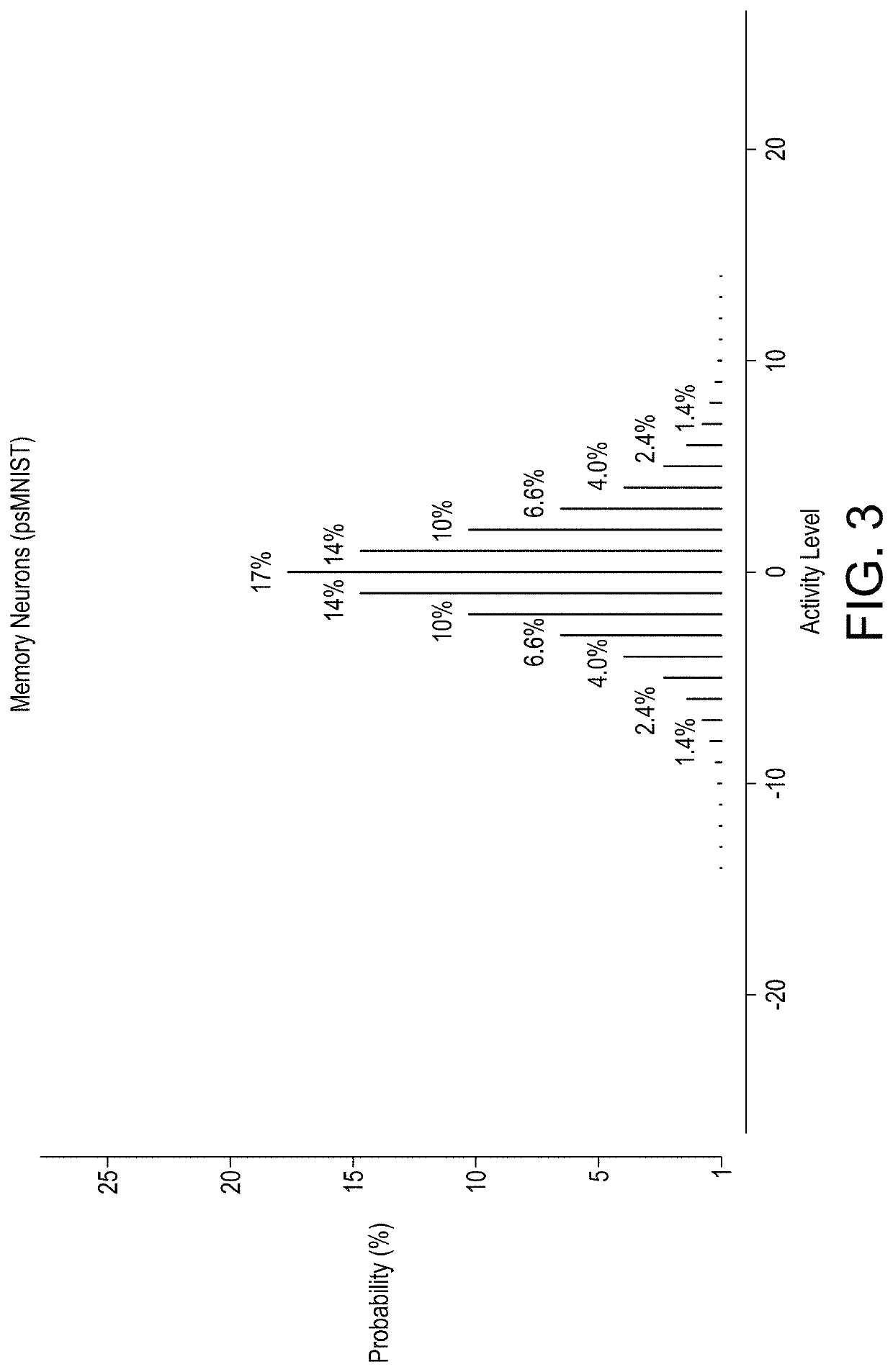
- The introduction of temporal dithering, which interprets spiking neurons as one-bit quantizers that diffuse quantization errors across time steps, allowing for the creation of hybrid-spiking neural networks (hSNNs) that interpolate between 1-bit SNNs and 32-bit ANNs, using algorithms like dithered quantization, stochastic rounding, poisson spiking, and time dilation to optimize spike precision and reduce energy consumption.

Hardware Constraints for SNN Implementation
The implementation of Spiking Neural Networks (SNNs) faces significant hardware constraints that directly impact network parameter optimization for spiking efficiency. These constraints fundamentally shape how network parameters must be configured to achieve optimal performance within the physical limitations of available computing platforms.
Memory bandwidth represents one of the most critical bottlenecks in SNN hardware implementation. Unlike traditional artificial neural networks that process data in batches, SNNs require continuous state updates for each neuron across multiple time steps. This temporal processing demands frequent memory access to store and retrieve neuron states, synaptic weights, and spike histories. The limited memory bandwidth forces designers to carefully balance network size, temporal resolution, and processing speed when setting parameters such as membrane time constants and refractory periods.
Power consumption constraints significantly influence parameter selection strategies for neuromorphic hardware platforms. Event-driven processing, while theoretically energy-efficient, requires careful tuning of firing thresholds and synaptic delays to minimize unnecessary spike generation. Hardware implementations must optimize the trade-off between computational accuracy and power efficiency, often requiring reduced precision arithmetic and simplified neuron models that constrain the range of achievable network parameters.
Processing latency limitations impose strict bounds on temporal dynamics within SNN implementations. Real-time applications demand that spike propagation delays and synaptic integration windows align with hardware clock cycles and processing pipelines. This synchronization requirement restricts the flexibility in setting biologically-inspired time constants and forces quantization of temporal parameters to discrete hardware-compatible values.
Specialized neuromorphic chips introduce unique architectural constraints that affect parameter configuration. Platforms like Intel's Loihi and IBM's TrueNorth impose specific limitations on connectivity patterns, neuron model complexity, and parameter precision. These constraints require careful mapping of network topologies and parameter ranges to match the underlying hardware architecture, often necessitating approximations or modifications to ideal network configurations.
Scalability challenges emerge when transitioning from small-scale prototypes to large-scale SNN implementations. Hardware resource limitations, including available processing cores, memory capacity, and interconnect bandwidth, directly constrain the maximum network size and complexity achievable while maintaining target spiking efficiency levels.
Memory bandwidth represents one of the most critical bottlenecks in SNN hardware implementation. Unlike traditional artificial neural networks that process data in batches, SNNs require continuous state updates for each neuron across multiple time steps. This temporal processing demands frequent memory access to store and retrieve neuron states, synaptic weights, and spike histories. The limited memory bandwidth forces designers to carefully balance network size, temporal resolution, and processing speed when setting parameters such as membrane time constants and refractory periods.
Power consumption constraints significantly influence parameter selection strategies for neuromorphic hardware platforms. Event-driven processing, while theoretically energy-efficient, requires careful tuning of firing thresholds and synaptic delays to minimize unnecessary spike generation. Hardware implementations must optimize the trade-off between computational accuracy and power efficiency, often requiring reduced precision arithmetic and simplified neuron models that constrain the range of achievable network parameters.
Processing latency limitations impose strict bounds on temporal dynamics within SNN implementations. Real-time applications demand that spike propagation delays and synaptic integration windows align with hardware clock cycles and processing pipelines. This synchronization requirement restricts the flexibility in setting biologically-inspired time constants and forces quantization of temporal parameters to discrete hardware-compatible values.
Specialized neuromorphic chips introduce unique architectural constraints that affect parameter configuration. Platforms like Intel's Loihi and IBM's TrueNorth impose specific limitations on connectivity patterns, neuron model complexity, and parameter precision. These constraints require careful mapping of network topologies and parameter ranges to match the underlying hardware architecture, often necessitating approximations or modifications to ideal network configurations.
Scalability challenges emerge when transitioning from small-scale prototypes to large-scale SNN implementations. Hardware resource limitations, including available processing cores, memory capacity, and interconnect bandwidth, directly constrain the maximum network size and complexity achievable while maintaining target spiking efficiency levels.
Energy Efficiency Standards for Neuromorphic Computing
The establishment of comprehensive energy efficiency standards for neuromorphic computing represents a critical milestone in the maturation of brain-inspired computing technologies. As spiking neural networks transition from research prototypes to commercial applications, the need for standardized metrics and benchmarks becomes increasingly urgent to ensure sustainable and scalable deployment across various computing environments.
Current energy efficiency evaluation methods in neuromorphic systems lack uniformity, with different research groups and manufacturers employing disparate measurement techniques and reporting standards. This fragmentation hinders meaningful performance comparisons and impedes the development of optimized network parameter configurations. The absence of standardized benchmarks particularly affects the assessment of spiking efficiency, where energy consumption patterns vary significantly based on network topology, spike timing, and synaptic plasticity mechanisms.
International standardization bodies are beginning to recognize the importance of establishing formal guidelines for neuromorphic energy assessment. Proposed standards encompass multiple dimensions including static power consumption, dynamic energy per spike operation, and overall computational efficiency measured in operations per joule. These standards must account for the unique characteristics of event-driven processing, where energy consumption correlates directly with neural activity levels and temporal spike patterns.
The development of energy efficiency standards requires careful consideration of application-specific requirements and operational contexts. Standards for edge computing applications prioritize ultra-low power consumption and extended battery life, while high-performance neuromorphic systems focus on maximizing computational throughput per watt. This diversity necessitates tiered standard classifications that accommodate different performance categories and use cases.
Emerging standardization efforts emphasize the importance of holistic system-level energy assessment rather than component-level measurements alone. These comprehensive standards evaluate energy efficiency across the entire neuromorphic computing stack, including spike generation, synaptic transmission, learning algorithms, and memory operations. Such integrated approaches provide more accurate representations of real-world energy consumption patterns and enable more effective parameter optimization strategies.
The implementation of robust energy efficiency standards will accelerate the adoption of neuromorphic computing technologies by providing clear performance benchmarks and facilitating informed decision-making in system design and deployment. These standards serve as essential foundations for developing energy-aware parameter setting methodologies that optimize spiking efficiency while maintaining computational performance requirements.
Current energy efficiency evaluation methods in neuromorphic systems lack uniformity, with different research groups and manufacturers employing disparate measurement techniques and reporting standards. This fragmentation hinders meaningful performance comparisons and impedes the development of optimized network parameter configurations. The absence of standardized benchmarks particularly affects the assessment of spiking efficiency, where energy consumption patterns vary significantly based on network topology, spike timing, and synaptic plasticity mechanisms.
International standardization bodies are beginning to recognize the importance of establishing formal guidelines for neuromorphic energy assessment. Proposed standards encompass multiple dimensions including static power consumption, dynamic energy per spike operation, and overall computational efficiency measured in operations per joule. These standards must account for the unique characteristics of event-driven processing, where energy consumption correlates directly with neural activity levels and temporal spike patterns.
The development of energy efficiency standards requires careful consideration of application-specific requirements and operational contexts. Standards for edge computing applications prioritize ultra-low power consumption and extended battery life, while high-performance neuromorphic systems focus on maximizing computational throughput per watt. This diversity necessitates tiered standard classifications that accommodate different performance categories and use cases.
Emerging standardization efforts emphasize the importance of holistic system-level energy assessment rather than component-level measurements alone. These comprehensive standards evaluate energy efficiency across the entire neuromorphic computing stack, including spike generation, synaptic transmission, learning algorithms, and memory operations. Such integrated approaches provide more accurate representations of real-world energy consumption patterns and enable more effective parameter optimization strategies.
The implementation of robust energy efficiency standards will accelerate the adoption of neuromorphic computing technologies by providing clear performance benchmarks and facilitating informed decision-making in system design and deployment. These standards serve as essential foundations for developing energy-aware parameter setting methodologies that optimize spiking efficiency while maintaining computational performance requirements.
Unlock deeper insights with Patsnap Eureka Quick Research — get a full tech report to explore trends and direct your research. Try now!
Generate Your Research Report Instantly with AI Agent
Supercharge your innovation with Patsnap Eureka AI Agent Platform!