How to Use Simulation for Predicting Part Deformation
MAR 25, 20269 MIN READ
Generate Your Research Report Instantly with AI Agent
Patsnap Eureka helps you evaluate technical feasibility & market potential.
Simulation-Based Deformation Prediction Background and Objectives
Simulation-based deformation prediction has emerged as a critical technology in modern manufacturing and engineering design, fundamentally transforming how industries approach product development and quality assurance. This computational methodology leverages advanced mathematical models and numerical analysis techniques to forecast how components will behave under various loading conditions, environmental factors, and manufacturing processes before physical prototypes are created.
The evolution of deformation prediction simulation traces back to the early finite element method developments in the 1960s, initially applied to structural analysis in aerospace and civil engineering. Over subsequent decades, the technology has expanded dramatically, incorporating sophisticated material models, nonlinear analysis capabilities, and multi-physics coupling effects. Today's simulation tools can predict complex deformation behaviors including plastic deformation, creep, fatigue, and thermal expansion across diverse materials ranging from metals and polymers to composites and ceramics.
Current technological trends indicate a shift toward real-time simulation capabilities, cloud-based computational resources, and artificial intelligence integration. Machine learning algorithms are increasingly being incorporated to enhance prediction accuracy and reduce computational time. Additionally, the integration of Internet of Things sensors with simulation models enables continuous validation and refinement of predictive capabilities through real-world data feedback loops.
The primary objective of implementing simulation-based deformation prediction is to achieve comprehensive understanding of component behavior throughout its operational lifecycle while minimizing physical testing requirements. This approach aims to reduce development costs, accelerate time-to-market, and improve product reliability by identifying potential failure modes early in the design phase.
Secondary objectives include optimizing material utilization, enhancing manufacturing process efficiency, and enabling predictive maintenance strategies. The technology seeks to establish robust digital twins that accurately represent physical components, facilitating scenario analysis and design optimization without the constraints and expenses associated with extensive physical experimentation.
The evolution of deformation prediction simulation traces back to the early finite element method developments in the 1960s, initially applied to structural analysis in aerospace and civil engineering. Over subsequent decades, the technology has expanded dramatically, incorporating sophisticated material models, nonlinear analysis capabilities, and multi-physics coupling effects. Today's simulation tools can predict complex deformation behaviors including plastic deformation, creep, fatigue, and thermal expansion across diverse materials ranging from metals and polymers to composites and ceramics.
Current technological trends indicate a shift toward real-time simulation capabilities, cloud-based computational resources, and artificial intelligence integration. Machine learning algorithms are increasingly being incorporated to enhance prediction accuracy and reduce computational time. Additionally, the integration of Internet of Things sensors with simulation models enables continuous validation and refinement of predictive capabilities through real-world data feedback loops.
The primary objective of implementing simulation-based deformation prediction is to achieve comprehensive understanding of component behavior throughout its operational lifecycle while minimizing physical testing requirements. This approach aims to reduce development costs, accelerate time-to-market, and improve product reliability by identifying potential failure modes early in the design phase.
Secondary objectives include optimizing material utilization, enhancing manufacturing process efficiency, and enabling predictive maintenance strategies. The technology seeks to establish robust digital twins that accurately represent physical components, facilitating scenario analysis and design optimization without the constraints and expenses associated with extensive physical experimentation.
Market Demand for Part Deformation Simulation Solutions
The global manufacturing industry is experiencing unprecedented demand for advanced simulation technologies to predict part deformation, driven by increasing complexity in product designs and stringent quality requirements. Traditional trial-and-error approaches are becoming economically unsustainable as manufacturers face mounting pressure to reduce development cycles while maintaining precision and reliability.
Automotive manufacturers represent the largest market segment for deformation simulation solutions, particularly in body panel manufacturing, engine component design, and crash safety analysis. The aerospace sector follows closely, where weight optimization and structural integrity requirements necessitate precise deformation predictions for critical components. Electronics manufacturing has emerged as a rapidly growing segment, especially with the miniaturization of devices requiring accurate thermal and mechanical deformation analysis.
The shift toward Industry 4.0 and digital twin implementations has significantly amplified market demand. Manufacturing companies are increasingly integrating simulation capabilities into their digital workflows to enable predictive maintenance and real-time quality control. This integration trend has created substantial opportunities for simulation software providers to develop more sophisticated and user-friendly solutions.
Small and medium-sized enterprises are becoming increasingly important market drivers as cloud-based simulation platforms reduce entry barriers. These companies previously unable to afford expensive simulation software and hardware are now accessing advanced deformation prediction capabilities through subscription-based models, expanding the total addressable market considerably.
Regional demand patterns show strong growth in Asia-Pacific markets, particularly China and India, where rapid industrialization and manufacturing expansion drive adoption of advanced simulation technologies. European markets demonstrate steady demand focused on high-precision applications in automotive and aerospace sectors, while North American markets emphasize integration with existing CAD/CAM systems.
The medical device manufacturing sector presents emerging opportunities, particularly for implant design and surgical instrument development where biocompatibility and mechanical performance require precise deformation analysis. Additive manufacturing applications are also generating new demand as layer-by-layer printing processes introduce unique deformation challenges requiring specialized simulation approaches.
Market research indicates sustained growth potential driven by regulatory compliance requirements in safety-critical industries, increasing material complexity including composites and smart materials, and growing emphasis on sustainable manufacturing practices requiring optimization of material usage and waste reduction through accurate deformation prediction.
Automotive manufacturers represent the largest market segment for deformation simulation solutions, particularly in body panel manufacturing, engine component design, and crash safety analysis. The aerospace sector follows closely, where weight optimization and structural integrity requirements necessitate precise deformation predictions for critical components. Electronics manufacturing has emerged as a rapidly growing segment, especially with the miniaturization of devices requiring accurate thermal and mechanical deformation analysis.
The shift toward Industry 4.0 and digital twin implementations has significantly amplified market demand. Manufacturing companies are increasingly integrating simulation capabilities into their digital workflows to enable predictive maintenance and real-time quality control. This integration trend has created substantial opportunities for simulation software providers to develop more sophisticated and user-friendly solutions.
Small and medium-sized enterprises are becoming increasingly important market drivers as cloud-based simulation platforms reduce entry barriers. These companies previously unable to afford expensive simulation software and hardware are now accessing advanced deformation prediction capabilities through subscription-based models, expanding the total addressable market considerably.
Regional demand patterns show strong growth in Asia-Pacific markets, particularly China and India, where rapid industrialization and manufacturing expansion drive adoption of advanced simulation technologies. European markets demonstrate steady demand focused on high-precision applications in automotive and aerospace sectors, while North American markets emphasize integration with existing CAD/CAM systems.
The medical device manufacturing sector presents emerging opportunities, particularly for implant design and surgical instrument development where biocompatibility and mechanical performance require precise deformation analysis. Additive manufacturing applications are also generating new demand as layer-by-layer printing processes introduce unique deformation challenges requiring specialized simulation approaches.
Market research indicates sustained growth potential driven by regulatory compliance requirements in safety-critical industries, increasing material complexity including composites and smart materials, and growing emphasis on sustainable manufacturing practices requiring optimization of material usage and waste reduction through accurate deformation prediction.
Current State and Challenges in Deformation Simulation
Deformation simulation has evolved significantly over the past decades, with finite element analysis (FEA) emerging as the dominant computational approach for predicting part deformation under various loading conditions. Current simulation capabilities span multiple physics domains, including structural mechanics, thermal analysis, and coupled multi-physics phenomena. Modern commercial software packages such as ANSYS, Abaqus, and COMSOL Multiphysics offer sophisticated material models and nonlinear analysis capabilities that can handle complex deformation scenarios.
The accuracy of deformation predictions heavily depends on material characterization and constitutive modeling. While linear elastic models provide reasonable approximations for small deformations, real-world applications often require advanced material models including plasticity, viscoelasticity, and hyperelasticity. Current challenges in material modeling include accurately capturing rate-dependent behavior, temperature effects, and long-term creep phenomena. The availability of comprehensive material property databases remains limited, particularly for newer materials and additive manufacturing processes.
Mesh generation and computational efficiency represent significant technical hurdles in deformation simulation. High-fidelity predictions require fine mesh resolution, leading to computationally expensive analyses that may be impractical for industrial applications. Adaptive mesh refinement techniques and high-performance computing solutions have partially addressed these limitations, but optimal balance between accuracy and computational cost remains challenging. Contact mechanics and large deformation problems further complicate mesh management and solution convergence.
Validation and verification of simulation results pose ongoing challenges in the field. Experimental validation requires sophisticated measurement techniques such as digital image correlation and strain gauging, which may not capture the full three-dimensional deformation field predicted by simulations. Uncertainty quantification in simulation inputs, including material properties, boundary conditions, and loading scenarios, significantly impacts prediction reliability. Current practices often lack systematic approaches to propagate input uncertainties through the simulation workflow.
Integration of simulation tools into design and manufacturing workflows faces practical obstacles. Real-time or near-real-time deformation prediction capabilities are essential for design optimization and process control applications. Current simulation turnaround times often exceed practical requirements for iterative design processes. Additionally, the expertise required to set up and interpret complex deformation simulations limits widespread adoption across engineering teams, highlighting the need for more automated and user-friendly simulation environments.
The accuracy of deformation predictions heavily depends on material characterization and constitutive modeling. While linear elastic models provide reasonable approximations for small deformations, real-world applications often require advanced material models including plasticity, viscoelasticity, and hyperelasticity. Current challenges in material modeling include accurately capturing rate-dependent behavior, temperature effects, and long-term creep phenomena. The availability of comprehensive material property databases remains limited, particularly for newer materials and additive manufacturing processes.
Mesh generation and computational efficiency represent significant technical hurdles in deformation simulation. High-fidelity predictions require fine mesh resolution, leading to computationally expensive analyses that may be impractical for industrial applications. Adaptive mesh refinement techniques and high-performance computing solutions have partially addressed these limitations, but optimal balance between accuracy and computational cost remains challenging. Contact mechanics and large deformation problems further complicate mesh management and solution convergence.
Validation and verification of simulation results pose ongoing challenges in the field. Experimental validation requires sophisticated measurement techniques such as digital image correlation and strain gauging, which may not capture the full three-dimensional deformation field predicted by simulations. Uncertainty quantification in simulation inputs, including material properties, boundary conditions, and loading scenarios, significantly impacts prediction reliability. Current practices often lack systematic approaches to propagate input uncertainties through the simulation workflow.
Integration of simulation tools into design and manufacturing workflows faces practical obstacles. Real-time or near-real-time deformation prediction capabilities are essential for design optimization and process control applications. Current simulation turnaround times often exceed practical requirements for iterative design processes. Additionally, the expertise required to set up and interpret complex deformation simulations limits widespread adoption across engineering teams, highlighting the need for more automated and user-friendly simulation environments.
Current Simulation Methods for Part Deformation Prediction
01 Finite element analysis methods for part deformation simulation
Advanced finite element analysis (FEA) techniques are employed to simulate and predict part deformation under various loading conditions. These methods involve creating detailed mesh models of components and applying computational algorithms to calculate stress, strain, and displacement. The simulation accounts for material properties, boundary conditions, and external forces to accurately predict how parts will deform during manufacturing or operational processes.- Finite Element Analysis (FEA) methods for part deformation simulation: Advanced finite element analysis techniques are employed to simulate and predict part deformation under various loading conditions. These methods involve creating detailed mesh models of components and applying numerical algorithms to calculate stress, strain, and displacement fields. The simulation accounts for material properties, boundary conditions, and external forces to accurately predict how parts will deform during manufacturing processes or operational use.
- Material constitutive models for deformation prediction: Sophisticated material models are integrated into simulation systems to accurately represent the mechanical behavior of parts during deformation. These models incorporate elastic-plastic properties, strain hardening, temperature dependencies, and anisotropic characteristics. By utilizing appropriate constitutive equations and material parameters, the simulation can predict realistic deformation patterns for different materials including metals, polymers, and composites under various processing conditions.
- Thermal-mechanical coupled simulation for deformation analysis: Coupled thermal-mechanical simulation approaches are used to analyze part deformation resulting from temperature variations and thermal gradients. These methods simultaneously solve heat transfer equations and mechanical equilibrium equations to capture the interaction between thermal expansion, residual stresses, and structural deformation. This is particularly important for processes involving heating, cooling, or welding operations where thermal effects significantly influence final part geometry.
- Compensation strategies based on deformation simulation results: Deformation simulation results are utilized to develop compensation strategies that pre-distort part designs or adjust manufacturing parameters. By predicting the expected deformation, inverse calculations can determine the optimal initial geometry or process settings needed to achieve desired final dimensions. These compensation methods help minimize dimensional errors and reduce the need for post-processing corrections in manufacturing operations.
- Real-time deformation monitoring and adaptive control systems: Advanced systems integrate simulation models with real-time monitoring technologies to track actual part deformation during manufacturing processes. Sensors measure displacement, strain, or temperature data which is compared against simulation predictions. Adaptive control algorithms use this feedback to dynamically adjust process parameters, ensuring that actual deformation remains within acceptable tolerances and improving overall manufacturing quality and consistency.
02 Thermal deformation simulation and compensation
Simulation techniques focus on predicting thermal-induced deformations in parts subjected to temperature variations during processing or operation. These methods model heat transfer, thermal expansion, and resulting structural changes. The simulation results enable the development of compensation strategies to minimize dimensional errors caused by thermal effects, improving manufacturing accuracy and product quality.Expand Specific Solutions03 Plastic deformation and forming process simulation
Specialized simulation approaches are used to model plastic deformation processes such as stamping, forging, and bending. These simulations predict material flow, springback, and final part geometry after forming operations. The techniques incorporate material constitutive models, strain hardening behavior, and tool-part interactions to optimize process parameters and reduce defects in manufactured components.Expand Specific Solutions04 Multi-physics coupling deformation simulation
Comprehensive simulation frameworks integrate multiple physical phenomena including mechanical stress, thermal effects, and material phase changes to predict complex deformation behaviors. These coupled simulations provide more accurate predictions for parts experiencing simultaneous multiple loading conditions. The approach is particularly valuable for analyzing components in demanding applications where various physical factors interact to cause deformation.Expand Specific Solutions05 Real-time deformation monitoring and adaptive simulation
Advanced systems combine real-time measurement technologies with adaptive simulation models to monitor and predict part deformation during actual manufacturing or service conditions. These methods use sensor data to update simulation parameters dynamically, enabling immediate process adjustments. The integration of measurement feedback with predictive models enhances accuracy and allows for proactive control of deformation-related quality issues.Expand Specific Solutions
Key Players in Simulation Software and Deformation Analysis
The simulation-based part deformation prediction field represents a mature technology sector experiencing steady growth, driven by increasing demand for precision manufacturing across automotive, aerospace, and industrial applications. The market demonstrates significant scale with established players spanning automotive giants like BMW, Volkswagen, and GM Global Technology Operations, alongside specialized tire manufacturers including Sumitomo Rubber Industries and Toyo Tire Corp. Technology maturity varies across segments, with automotive applications showing advanced implementation while emerging areas like medical simulation through companies such as Brainlab and InSimo represent growing frontiers. Leading Chinese universities including Tsinghua University, Beijing Institute of Technology, and Northwestern Polytechnical University contribute substantial research capabilities, while industrial manufacturers like Mitsubishi Heavy Industries and Sumitomo Heavy Industries provide comprehensive engineering solutions, indicating a well-established ecosystem with continued innovation potential.
Bayerische Motoren Werke AG
Technical Solution: BMW employs advanced finite element analysis (FEA) simulation technologies to predict part deformation in automotive manufacturing processes. Their simulation framework integrates multi-physics modeling capabilities that account for thermal, mechanical, and material property variations during manufacturing processes such as stamping, welding, and assembly operations. The company utilizes high-performance computing clusters to run complex deformation simulations that predict springback effects in sheet metal forming, thermal distortion in casting processes, and stress-induced deformation in structural components. BMW's simulation approach incorporates machine learning algorithms to enhance prediction accuracy by learning from historical manufacturing data and real-world measurement feedback.
Strengths: Extensive automotive manufacturing expertise, advanced computational resources, integration of AI/ML for improved accuracy. Weaknesses: High computational costs, complexity in multi-physics coupling, requires significant expertise to operate effectively.
GM Global Technology Operations LLC
Technical Solution: General Motors has developed comprehensive simulation methodologies for predicting part deformation across various manufacturing processes including stamping, hydroforming, and assembly operations. Their approach combines traditional FEA with advanced material modeling techniques that capture nonlinear behavior, anisotropic properties, and time-dependent effects. GM's simulation platform integrates process-specific models for different manufacturing stages, enabling prediction of cumulative deformation effects throughout the production chain. The company employs parallel computing architectures and cloud-based simulation services to handle large-scale deformation analyses. Their methodology includes validation protocols that compare simulation results with physical measurements using coordinate measuring machines and optical scanning technologies.
Strengths: Comprehensive process coverage, validated methodologies, scalable computing infrastructure. Weaknesses: Limited to automotive applications, requires extensive calibration, high implementation costs for smaller manufacturers.
Core Technologies in Advanced Deformation Simulation
Deformation prediction method of micro-milling thin-walled parts
PatentInactiveUS20220164498A1
Innovation
- A deformation prediction method using finite element simulation, incorporating the Johnson-Cook material model and birth-death element method, to establish a simulation model for micro-milling thin-walled parts, predicting milling forces and deformation by loading the output from the finite element simulation model into a deformation prediction model.


Apparatus and method for simulating machining and other forming operations
PatentActiveUS20180173829A1
Innovation
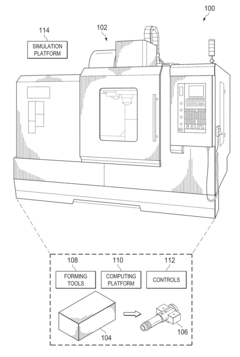
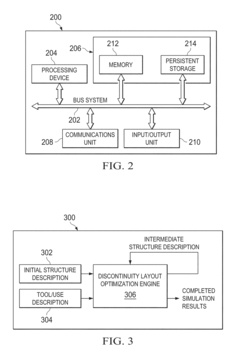
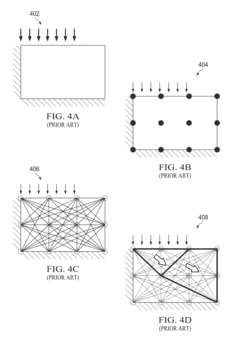
- The use of discontinuity layout optimization (DLO) to simulate material deformation by evaluating and predicting shear planes, calculating deformed shapes, and repeating these processes iteratively to model material removal during forming operations, allowing for more accurate and efficient prediction of CNC manufacturing machine behaviors.
Validation and Accuracy Standards for Simulation Results
Establishing robust validation and accuracy standards for simulation results in part deformation prediction requires a multi-tiered approach that encompasses both quantitative metrics and qualitative assessment criteria. The foundation of validation lies in defining acceptable tolerance levels that align with manufacturing requirements and end-use performance specifications. Industry standards typically establish accuracy thresholds ranging from 5-15% deviation from experimental results, depending on the application criticality and material properties involved.
Experimental validation serves as the cornerstone for establishing simulation credibility. This involves conducting controlled physical tests using standardized loading conditions, material specimens, and measurement techniques. Key validation methods include tensile testing, three-point bending tests, and compression analyses that provide benchmark data for comparison with simulation predictions. The validation process must account for material variability, environmental conditions, and measurement uncertainties to establish realistic accuracy expectations.
Statistical validation metrics play a crucial role in quantifying simulation performance. Root Mean Square Error (RMSE), Mean Absolute Percentage Error (MAPE), and correlation coefficients provide quantitative measures of prediction accuracy. Additionally, implementing confidence intervals and uncertainty quantification methods helps establish the reliability bounds of simulation results. These statistical tools enable systematic comparison between different simulation approaches and facilitate continuous improvement of predictive models.
Mesh convergence studies represent a fundamental requirement for ensuring numerical accuracy in finite element simulations. Establishing mesh-independent solutions through systematic refinement studies helps eliminate discretization errors that can significantly impact deformation predictions. Grid convergence index calculations and Richardson extrapolation methods provide standardized approaches for determining optimal mesh densities while balancing computational efficiency with accuracy requirements.
Cross-validation protocols enhance the robustness of accuracy assessments by testing simulation models against diverse loading scenarios and geometric configurations. This includes validating predictions across different strain rates, temperature conditions, and boundary constraint variations. Implementing blind validation studies, where simulation teams predict outcomes for undisclosed experimental conditions, provides unbiased assessment of model reliability and helps identify potential limitations in current simulation approaches.
Documentation and traceability standards ensure reproducibility and facilitate continuous improvement of validation processes. Establishing standardized reporting formats for validation studies, including detailed descriptions of material properties, boundary conditions, and convergence criteria, enables systematic knowledge accumulation and benchmarking across different simulation platforms and research groups.
Experimental validation serves as the cornerstone for establishing simulation credibility. This involves conducting controlled physical tests using standardized loading conditions, material specimens, and measurement techniques. Key validation methods include tensile testing, three-point bending tests, and compression analyses that provide benchmark data for comparison with simulation predictions. The validation process must account for material variability, environmental conditions, and measurement uncertainties to establish realistic accuracy expectations.
Statistical validation metrics play a crucial role in quantifying simulation performance. Root Mean Square Error (RMSE), Mean Absolute Percentage Error (MAPE), and correlation coefficients provide quantitative measures of prediction accuracy. Additionally, implementing confidence intervals and uncertainty quantification methods helps establish the reliability bounds of simulation results. These statistical tools enable systematic comparison between different simulation approaches and facilitate continuous improvement of predictive models.
Mesh convergence studies represent a fundamental requirement for ensuring numerical accuracy in finite element simulations. Establishing mesh-independent solutions through systematic refinement studies helps eliminate discretization errors that can significantly impact deformation predictions. Grid convergence index calculations and Richardson extrapolation methods provide standardized approaches for determining optimal mesh densities while balancing computational efficiency with accuracy requirements.
Cross-validation protocols enhance the robustness of accuracy assessments by testing simulation models against diverse loading scenarios and geometric configurations. This includes validating predictions across different strain rates, temperature conditions, and boundary constraint variations. Implementing blind validation studies, where simulation teams predict outcomes for undisclosed experimental conditions, provides unbiased assessment of model reliability and helps identify potential limitations in current simulation approaches.
Documentation and traceability standards ensure reproducibility and facilitate continuous improvement of validation processes. Establishing standardized reporting formats for validation studies, including detailed descriptions of material properties, boundary conditions, and convergence criteria, enables systematic knowledge accumulation and benchmarking across different simulation platforms and research groups.
Integration Challenges in Manufacturing Process Simulation
Manufacturing process simulation for part deformation prediction faces significant integration challenges that stem from the complexity of modern production environments. The primary obstacle lies in establishing seamless data flow between disparate simulation platforms, CAD systems, and manufacturing execution systems. These systems often operate with different data formats, coordinate systems, and temporal resolutions, creating substantial barriers to effective integration.
Multi-physics coupling represents another critical challenge in simulation integration. Part deformation prediction requires simultaneous consideration of thermal, mechanical, and sometimes electromagnetic effects. Integrating these different physics domains within a unified simulation framework demands sophisticated coupling algorithms and substantial computational resources. The temporal and spatial scales of these phenomena often differ significantly, necessitating advanced multi-scale modeling approaches.
Real-time data integration poses additional complexity for manufacturing process simulation. Modern smart manufacturing environments generate continuous streams of sensor data from temperature monitors, force sensors, and dimensional measurement systems. Incorporating this real-time information into deformation prediction models requires robust data preprocessing, filtering, and synchronization mechanisms to ensure simulation accuracy and relevance.
Software interoperability remains a persistent challenge across the simulation ecosystem. Different simulation packages utilize proprietary file formats and solver algorithms, making it difficult to combine results from multiple tools. This fragmentation forces organizations to develop custom interfaces and data translation protocols, increasing implementation costs and maintenance overhead.
Computational resource management becomes increasingly complex when integrating multiple simulation domains. Part deformation prediction often requires high-fidelity finite element analysis combined with process simulation, demanding significant computing power and memory resources. Balancing computational accuracy with practical time constraints requires sophisticated resource allocation strategies and parallel processing capabilities.
Validation and verification of integrated simulation systems present unique challenges compared to standalone simulations. The interaction between different simulation components can introduce unexpected errors or amplify existing uncertainties. Establishing comprehensive validation protocols that account for these integration effects requires extensive experimental data and systematic testing procedures across multiple manufacturing scenarios.
Multi-physics coupling represents another critical challenge in simulation integration. Part deformation prediction requires simultaneous consideration of thermal, mechanical, and sometimes electromagnetic effects. Integrating these different physics domains within a unified simulation framework demands sophisticated coupling algorithms and substantial computational resources. The temporal and spatial scales of these phenomena often differ significantly, necessitating advanced multi-scale modeling approaches.
Real-time data integration poses additional complexity for manufacturing process simulation. Modern smart manufacturing environments generate continuous streams of sensor data from temperature monitors, force sensors, and dimensional measurement systems. Incorporating this real-time information into deformation prediction models requires robust data preprocessing, filtering, and synchronization mechanisms to ensure simulation accuracy and relevance.
Software interoperability remains a persistent challenge across the simulation ecosystem. Different simulation packages utilize proprietary file formats and solver algorithms, making it difficult to combine results from multiple tools. This fragmentation forces organizations to develop custom interfaces and data translation protocols, increasing implementation costs and maintenance overhead.
Computational resource management becomes increasingly complex when integrating multiple simulation domains. Part deformation prediction often requires high-fidelity finite element analysis combined with process simulation, demanding significant computing power and memory resources. Balancing computational accuracy with practical time constraints requires sophisticated resource allocation strategies and parallel processing capabilities.
Validation and verification of integrated simulation systems present unique challenges compared to standalone simulations. The interaction between different simulation components can introduce unexpected errors or amplify existing uncertainties. Establishing comprehensive validation protocols that account for these integration effects requires extensive experimental data and systematic testing procedures across multiple manufacturing scenarios.
Unlock deeper insights with Patsnap Eureka Quick Research — get a full tech report to explore trends and direct your research. Try now!
Generate Your Research Report Instantly with AI Agent
Supercharge your innovation with Patsnap Eureka AI Agent Platform!