Hyperfocusing Piezoelectric Crystals for Enhanced Rate Analysis
MAR 27, 20269 MIN READ
Generate Your Research Report Instantly with AI Agent
PatSnap Eureka helps you evaluate technical feasibility & market potential.
Piezoelectric Crystal Hyperfocusing Background and Objectives
Piezoelectric crystals have been fundamental components in sensing and measurement applications for over a century, with their unique ability to convert mechanical stress into electrical signals making them indispensable in various analytical instruments. The phenomenon of piezoelectricity, first discovered by Pierre and Jacques Curie in 1880, has evolved from basic laboratory curiosities to sophisticated transduction elements in modern precision measurement systems. Traditional piezoelectric applications have primarily focused on broad-area sensing and actuation, where the crystal's entire surface contributes to signal generation.
The concept of hyperfocusing in piezoelectric crystals represents a paradigm shift from conventional uniform excitation methods to spatially concentrated energy delivery. This approach leverages advanced crystal engineering and electrode design to create highly localized electric fields within the piezoelectric material, resulting in enhanced sensitivity and temporal resolution. The evolution toward hyperfocusing has been driven by increasing demands for higher precision in rate analysis applications, where traditional methods often suffer from signal dispersion and reduced temporal accuracy.
Current market demands in analytical instrumentation require unprecedented levels of precision in rate measurements, particularly in pharmaceutical research, chemical kinetics studies, and real-time process monitoring. The limitations of conventional piezoelectric sensors in achieving sub-microsecond temporal resolution while maintaining high signal-to-noise ratios have created a significant technology gap that hyperfocusing techniques aim to address.
The primary objective of hyperfocusing piezoelectric crystals is to achieve enhanced rate analysis capabilities through concentrated energy delivery and improved signal localization. This involves developing novel crystal architectures that can focus piezoelectric responses to specific regions, thereby increasing the effective sensitivity per unit area and reducing signal propagation delays. The technology aims to overcome the fundamental trade-offs between sensitivity, response time, and spatial resolution that have historically limited piezoelectric sensor performance.
Secondary objectives include establishing scalable manufacturing processes for hyperfocused crystal structures and developing integrated signal processing algorithms that can fully exploit the enhanced temporal characteristics. The ultimate goal is to enable real-time analysis of rapid chemical and physical processes with measurement capabilities that exceed current state-of-the-art systems by at least one order of magnitude in both sensitivity and temporal resolution.
The concept of hyperfocusing in piezoelectric crystals represents a paradigm shift from conventional uniform excitation methods to spatially concentrated energy delivery. This approach leverages advanced crystal engineering and electrode design to create highly localized electric fields within the piezoelectric material, resulting in enhanced sensitivity and temporal resolution. The evolution toward hyperfocusing has been driven by increasing demands for higher precision in rate analysis applications, where traditional methods often suffer from signal dispersion and reduced temporal accuracy.
Current market demands in analytical instrumentation require unprecedented levels of precision in rate measurements, particularly in pharmaceutical research, chemical kinetics studies, and real-time process monitoring. The limitations of conventional piezoelectric sensors in achieving sub-microsecond temporal resolution while maintaining high signal-to-noise ratios have created a significant technology gap that hyperfocusing techniques aim to address.
The primary objective of hyperfocusing piezoelectric crystals is to achieve enhanced rate analysis capabilities through concentrated energy delivery and improved signal localization. This involves developing novel crystal architectures that can focus piezoelectric responses to specific regions, thereby increasing the effective sensitivity per unit area and reducing signal propagation delays. The technology aims to overcome the fundamental trade-offs between sensitivity, response time, and spatial resolution that have historically limited piezoelectric sensor performance.
Secondary objectives include establishing scalable manufacturing processes for hyperfocused crystal structures and developing integrated signal processing algorithms that can fully exploit the enhanced temporal characteristics. The ultimate goal is to enable real-time analysis of rapid chemical and physical processes with measurement capabilities that exceed current state-of-the-art systems by at least one order of magnitude in both sensitivity and temporal resolution.
Market Demand for Enhanced Rate Analysis Applications
The market demand for enhanced rate analysis applications spans multiple high-value industries where precision timing and rapid measurement capabilities are critical for operational success. Industrial manufacturing sectors, particularly semiconductor fabrication and precision machining, require increasingly sophisticated rate analysis systems to monitor production processes in real-time. These applications demand measurement systems capable of detecting minute variations in production rates that could indicate quality issues or equipment malfunctions.
Medical diagnostics represents another significant market segment driving demand for enhanced rate analysis technologies. Modern medical equipment, including advanced imaging systems, cardiac monitoring devices, and laboratory analyzers, requires precise rate measurements for accurate patient diagnosis and treatment monitoring. The growing emphasis on personalized medicine and point-of-care testing further amplifies the need for compact, highly sensitive rate analysis solutions.
The aerospace and defense industries constitute a substantial market for enhanced rate analysis applications, where mission-critical systems demand exceptional reliability and precision. Flight control systems, navigation equipment, and weapons guidance systems all rely on accurate rate measurements for proper operation. The increasing complexity of modern aircraft and spacecraft systems drives continuous demand for more sophisticated rate analysis capabilities.
Telecommunications infrastructure presents expanding opportunities for enhanced rate analysis applications as network speeds continue to increase and latency requirements become more stringent. High-frequency trading systems, data center operations, and 5G network equipment all require precise timing and rate analysis capabilities to maintain optimal performance levels.
The automotive industry, particularly with the advancement of autonomous vehicle technologies, represents an emerging high-growth market segment. Advanced driver assistance systems, collision avoidance technologies, and autonomous navigation systems all depend on rapid, accurate rate analysis for safe operation. The transition toward electric vehicles also creates new applications in battery management and motor control systems.
Scientific research institutions and national laboratories drive demand for cutting-edge rate analysis technologies to support fundamental research in physics, chemistry, and materials science. These applications often push the boundaries of measurement precision and speed, creating market pull for the most advanced technologies available.
The market trajectory indicates sustained growth driven by increasing automation across industries, rising precision requirements in manufacturing processes, and the proliferation of Internet of Things devices requiring accurate timing and synchronization capabilities.
Medical diagnostics represents another significant market segment driving demand for enhanced rate analysis technologies. Modern medical equipment, including advanced imaging systems, cardiac monitoring devices, and laboratory analyzers, requires precise rate measurements for accurate patient diagnosis and treatment monitoring. The growing emphasis on personalized medicine and point-of-care testing further amplifies the need for compact, highly sensitive rate analysis solutions.
The aerospace and defense industries constitute a substantial market for enhanced rate analysis applications, where mission-critical systems demand exceptional reliability and precision. Flight control systems, navigation equipment, and weapons guidance systems all rely on accurate rate measurements for proper operation. The increasing complexity of modern aircraft and spacecraft systems drives continuous demand for more sophisticated rate analysis capabilities.
Telecommunications infrastructure presents expanding opportunities for enhanced rate analysis applications as network speeds continue to increase and latency requirements become more stringent. High-frequency trading systems, data center operations, and 5G network equipment all require precise timing and rate analysis capabilities to maintain optimal performance levels.
The automotive industry, particularly with the advancement of autonomous vehicle technologies, represents an emerging high-growth market segment. Advanced driver assistance systems, collision avoidance technologies, and autonomous navigation systems all depend on rapid, accurate rate analysis for safe operation. The transition toward electric vehicles also creates new applications in battery management and motor control systems.
Scientific research institutions and national laboratories drive demand for cutting-edge rate analysis technologies to support fundamental research in physics, chemistry, and materials science. These applications often push the boundaries of measurement precision and speed, creating market pull for the most advanced technologies available.
The market trajectory indicates sustained growth driven by increasing automation across industries, rising precision requirements in manufacturing processes, and the proliferation of Internet of Things devices requiring accurate timing and synchronization capabilities.
Current Limitations in Piezoelectric Crystal Focusing Technology
Current piezoelectric crystal focusing technology faces several fundamental limitations that significantly constrain its effectiveness in high-precision rate analysis applications. The most prominent challenge lies in the inherent beam divergence characteristics of conventional piezoelectric transducers, which typically exhibit focal spot sizes ranging from 50 to 200 micrometers. This relatively large focal area reduces the spatial resolution and limits the ability to perform precise measurements on microscale structures or rapidly changing phenomena.
Acoustic impedance mismatch represents another critical bottleneck in existing systems. Traditional piezoelectric crystals often demonstrate poor coupling efficiency with target materials, particularly when analyzing composite structures or materials with varying density gradients. This mismatch results in significant energy losses, typically 30-40% of the transmitted acoustic energy, thereby reducing the signal-to-noise ratio and compromising measurement accuracy in dynamic rate analysis scenarios.
Frequency bandwidth limitations pose substantial constraints on the temporal resolution achievable with current focusing technologies. Most commercially available piezoelectric focusing systems operate within narrow frequency ranges, typically spanning only 2-3 MHz around their center frequency. This bandwidth restriction severely limits the ability to capture rapid transient events or perform broadband spectroscopic analysis, which are essential for comprehensive rate characterization in advanced materials research.
Temperature stability issues further compound these technical challenges. Conventional piezoelectric crystals exhibit significant performance degradation under varying thermal conditions, with focal characteristics shifting by up to 15% per 10°C temperature change. This thermal sensitivity necessitates complex compensation mechanisms and limits the applicability of current systems in environments where temperature fluctuations are unavoidable.
Manufacturing precision constraints in crystal fabrication also contribute to performance limitations. Current production techniques struggle to achieve the surface quality and dimensional tolerances required for optimal focusing performance. Surface roughness variations and geometric imperfections introduce phase distortions that degrade the focusing quality and reduce the achievable intensity concentration ratios.
Additionally, the limited dynamic range of existing piezoelectric focusing systems restricts their utility in applications requiring simultaneous measurement of both high-amplitude and low-amplitude signals. This limitation is particularly problematic in rate analysis applications where signal amplitudes can vary by several orders of magnitude within a single measurement cycle, requiring adaptive focusing capabilities that current technologies cannot adequately provide.
Acoustic impedance mismatch represents another critical bottleneck in existing systems. Traditional piezoelectric crystals often demonstrate poor coupling efficiency with target materials, particularly when analyzing composite structures or materials with varying density gradients. This mismatch results in significant energy losses, typically 30-40% of the transmitted acoustic energy, thereby reducing the signal-to-noise ratio and compromising measurement accuracy in dynamic rate analysis scenarios.
Frequency bandwidth limitations pose substantial constraints on the temporal resolution achievable with current focusing technologies. Most commercially available piezoelectric focusing systems operate within narrow frequency ranges, typically spanning only 2-3 MHz around their center frequency. This bandwidth restriction severely limits the ability to capture rapid transient events or perform broadband spectroscopic analysis, which are essential for comprehensive rate characterization in advanced materials research.
Temperature stability issues further compound these technical challenges. Conventional piezoelectric crystals exhibit significant performance degradation under varying thermal conditions, with focal characteristics shifting by up to 15% per 10°C temperature change. This thermal sensitivity necessitates complex compensation mechanisms and limits the applicability of current systems in environments where temperature fluctuations are unavoidable.
Manufacturing precision constraints in crystal fabrication also contribute to performance limitations. Current production techniques struggle to achieve the surface quality and dimensional tolerances required for optimal focusing performance. Surface roughness variations and geometric imperfections introduce phase distortions that degrade the focusing quality and reduce the achievable intensity concentration ratios.
Additionally, the limited dynamic range of existing piezoelectric focusing systems restricts their utility in applications requiring simultaneous measurement of both high-amplitude and low-amplitude signals. This limitation is particularly problematic in rate analysis applications where signal amplitudes can vary by several orders of magnitude within a single measurement cycle, requiring adaptive focusing capabilities that current technologies cannot adequately provide.
Existing Hyperfocusing Solutions for Piezoelectric Systems
01 Piezoelectric crystal oscillator frequency stability analysis
Methods and systems for analyzing the frequency stability and rate characteristics of piezoelectric crystal oscillators. This includes techniques for measuring and evaluating the short-term and long-term frequency variations, temperature coefficients, and aging effects of piezoelectric crystals. Advanced measurement systems can monitor crystal performance under various environmental conditions to determine stability parameters and predict operational behavior.- Piezoelectric crystal oscillator frequency stability analysis: Analysis methods for evaluating the frequency stability and accuracy of piezoelectric crystal oscillators over time and under varying environmental conditions. This includes measuring frequency drift, aging effects, and temperature coefficients to ensure reliable performance in timing applications. Techniques involve monitoring oscillation rates and implementing compensation mechanisms to maintain precise frequency output.
- Piezoelectric sensor response rate measurement: Methods for analyzing the response rate and sensitivity of piezoelectric sensors when subjected to mechanical stress or pressure changes. This involves characterizing the speed at which piezoelectric materials convert mechanical energy to electrical signals, including rise time, settling time, and dynamic response characteristics. Applications include pressure sensors, accelerometers, and force measurement devices.
- Piezoelectric material growth rate optimization: Techniques for analyzing and controlling the growth rate of piezoelectric crystal materials during manufacturing processes. This includes monitoring crystallization rates, controlling deposition speeds, and optimizing growth conditions to achieve desired crystal quality and piezoelectric properties. Methods involve real-time analysis of growth parameters and adjustment of process conditions.
- Piezoelectric device degradation rate assessment: Analysis methods for evaluating the degradation rate and lifetime prediction of piezoelectric devices under operational conditions. This includes monitoring performance degradation over time, analyzing failure mechanisms, and predicting remaining useful life. Techniques involve accelerated aging tests, continuous performance monitoring, and statistical analysis of degradation patterns.
- Piezoelectric energy conversion efficiency analysis: Methods for analyzing the rate and efficiency of energy conversion in piezoelectric devices, including power generation and energy harvesting applications. This involves measuring the conversion rate from mechanical to electrical energy, analyzing power output characteristics, and optimizing device configurations for maximum efficiency. Applications include energy harvesting systems and power generation devices.
02 Temperature compensation for piezoelectric crystal rate control
Techniques for compensating temperature-induced frequency variations in piezoelectric crystals to maintain accurate rate control. This involves implementing temperature sensing mechanisms and correction algorithms to adjust for thermal effects on crystal resonance frequency. Various compensation methods include analog and digital approaches to minimize frequency drift across operating temperature ranges.Expand Specific Solutions03 Piezoelectric crystal manufacturing and quality control
Processes for manufacturing piezoelectric crystals with controlled rate characteristics and methods for quality assessment. This encompasses crystal cutting techniques, electrode deposition methods, and encapsulation processes that affect frequency stability. Quality control procedures include testing protocols to verify rate accuracy, Q-factor measurements, and screening methods to ensure consistent performance specifications.Expand Specific Solutions04 Digital signal processing for piezoelectric rate measurement
Application of digital signal processing techniques to analyze and measure piezoelectric crystal rates with high precision. This includes frequency counting methods, phase-locked loop systems, and time interval analysis for accurate rate determination. Advanced digital processing enables real-time monitoring and correction of crystal frequency variations for improved timing accuracy.Expand Specific Solutions05 Piezoelectric sensor arrays for multi-parameter rate analysis
Systems utilizing multiple piezoelectric crystal sensors for comprehensive rate analysis and environmental monitoring. These arrays can simultaneously measure various parameters affecting crystal performance including pressure, acceleration, and chemical exposure. Integration of multiple sensors enables correlation analysis between different environmental factors and their effects on piezoelectric crystal rate stability.Expand Specific Solutions
Key Players in Piezoelectric and Rate Analysis Industries
The hyperfocusing piezoelectric crystals technology for enhanced rate analysis represents an emerging field within the broader piezoelectric materials market, currently in its early development stage with significant growth potential. The market demonstrates substantial scale driven by applications across medical imaging, industrial sensing, and precision measurement sectors, with established players like Canon, Toshiba, Sony Group, and FUJIFILM leveraging their imaging expertise alongside specialized manufacturers such as Murata Manufacturing and CTS Corp. Technology maturity varies significantly across the competitive landscape, where traditional electronics giants like Seiko Epson and DENSO Corp bring manufacturing scale, while specialized firms including Kistler Holding and CTS Advanced Materials focus on high-performance crystal development. Research institutions such as University of California, Xidian University, and Indian Institute of Science contribute fundamental innovations, creating a dynamic ecosystem where established corporations compete with emerging specialists like Suzhou Guoke Xingan Medical Technology, indicating the technology's transition from laboratory research toward commercial viability with accelerating industrial adoption.
CTS Corp.
Technical Solution: CTS Corporation develops specialized piezoelectric crystal assemblies with hyperfocusing technology for industrial rate analysis applications. Their solution combines proprietary crystal cutting techniques with advanced electrode patterning to create concentrated piezoelectric fields that enhance sensitivity to rate changes. The technology incorporates multi-element crystal arrays with phase-coherent signal processing to achieve improved signal resolution and reduced noise interference. CTS's hyperfocusing approach utilizes optimized crystal orientations and mechanical mounting systems that maximize the piezoelectric response while minimizing cross-axis sensitivity. Their systems include integrated amplification circuits and digital signal processing capabilities that enable real-time rate monitoring with high precision and reliability for demanding industrial measurement applications.
Strengths: Robust industrial-grade solutions with excellent reliability and proven performance in harsh environments. Weaknesses: Limited customization options and longer development cycles for specialized applications.
KISTLER HOLDING AG
Technical Solution: Kistler specializes in advanced piezoelectric sensor technology with hyperfocusing capabilities for enhanced rate analysis applications. Their piezoelectric crystals utilize proprietary charge amplification techniques and multi-axis sensing configurations to achieve superior signal-to-noise ratios in dynamic measurement scenarios. The company's hyperfocusing technology incorporates specialized crystal geometries and electrode patterns that concentrate piezoelectric effects in targeted regions, enabling precise rate detection with microsecond response times. Their solutions integrate advanced signal conditioning electronics with temperature compensation algorithms to maintain measurement accuracy across varying environmental conditions, making them particularly suitable for high-frequency vibration analysis and impact testing applications.
Strengths: Industry-leading expertise in piezoelectric sensor technology with proven track record in precision measurement applications. Weaknesses: Higher cost compared to standard piezoelectric solutions and complex integration requirements.
Core Patents in Piezoelectric Crystal Hyperfocusing Methods
High Frequency Piezoelectric Crystal Composites, Devices, and Methods for Manufacturing the Same
PatentActiveUS20170092839A1
Innovation
- The development of PMN-PT based piezoelectric crystal composites with specific ternary crystal compositions and photolithography-based micromachining techniques, including hexagonal and parallelogram configurations, to enhance electromechanical coupling and reduce clamping effects, allowing for higher frequency operation (20 MHz to >100 MHz) with improved thermal and electrical properties.


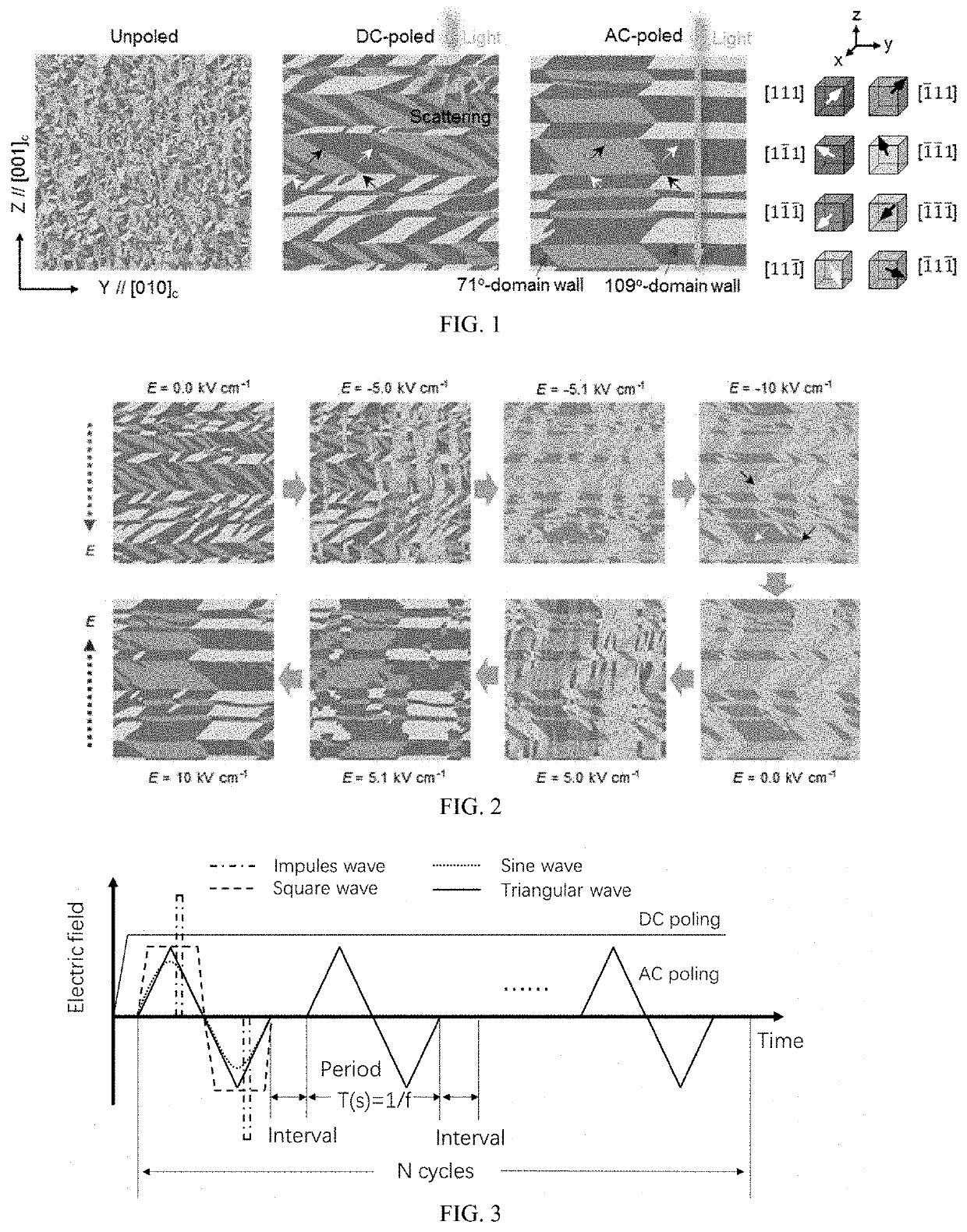
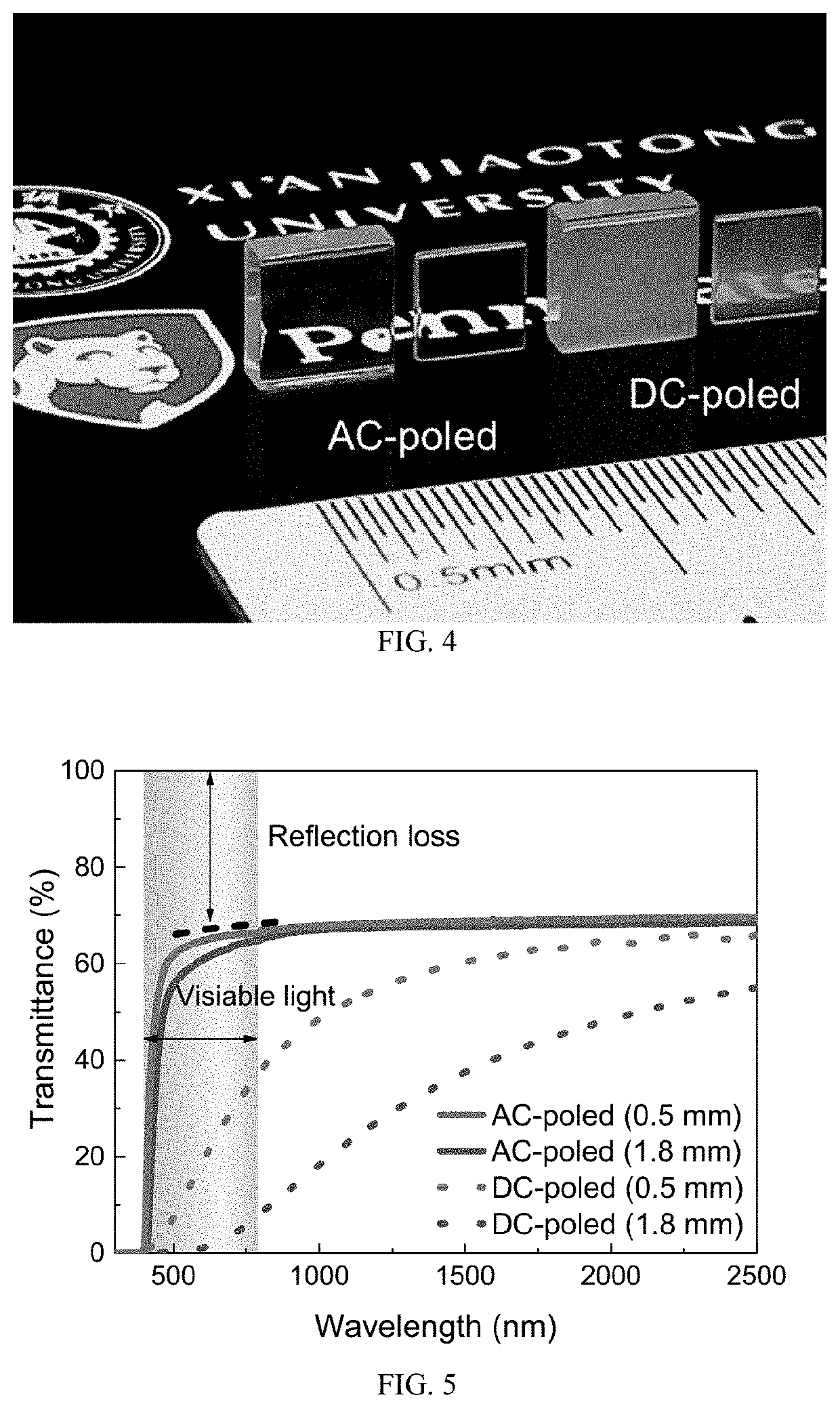
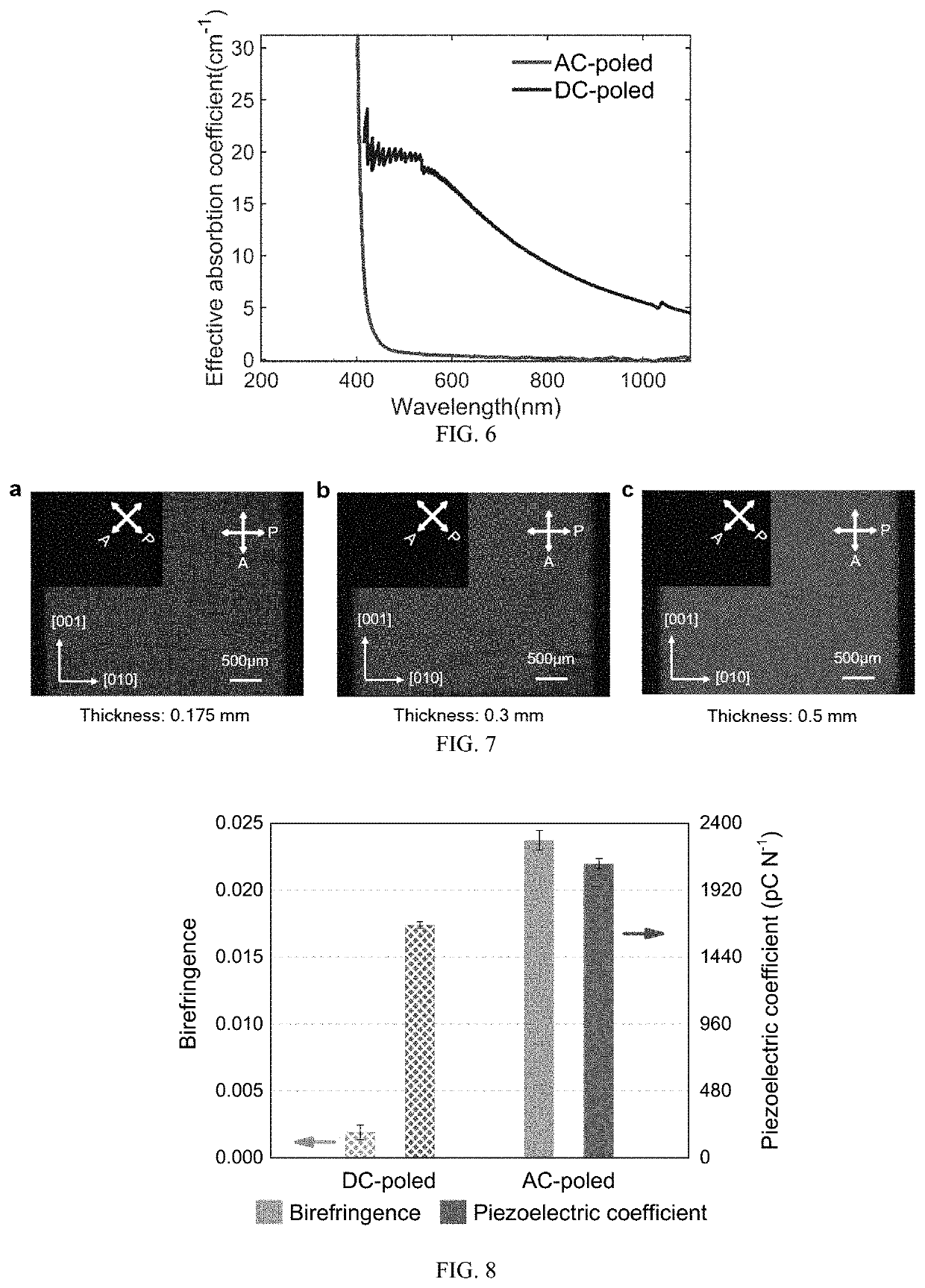
Piezoelectric Single Crystal With Near-Perfect Transparency And High Piezoelectricity, Preparation Method And Application Thereof
PatentActiveUS20210050507A1
Innovation
- A binary/ternary relaxor-PT based ferroelectric crystal is poled using an AC electric field, reducing the density of 71° domain walls and enhancing transparency while maintaining high piezoelectricity, with specific chemical compositions and electrode deposition methods.

Manufacturing Standards for Precision Piezoelectric Devices
The manufacturing of hyperfocusing piezoelectric crystals for enhanced rate analysis applications demands adherence to stringent precision standards that exceed conventional piezoelectric device requirements. These specialized crystals require dimensional tolerances within ±0.1% of specified parameters, with surface roughness maintained below 10 nanometers to ensure optimal acoustic wave propagation and minimal signal distortion during high-frequency operations.
Crystal orientation accuracy represents a critical manufacturing parameter, necessitating angular precision within ±0.05 degrees of the intended crystallographic axis. This level of precision directly impacts the device's ability to achieve hyperfocusing capabilities and maintain consistent performance across varying operational frequencies. Manufacturing facilities must implement advanced X-ray diffraction systems and automated alignment equipment to verify and maintain these orientation standards throughout production processes.
Material purity standards for hyperfocusing applications require piezoelectric substrates with impurity levels below 10 parts per million, significantly stricter than standard industrial piezoelectric devices. Trace contaminants can introduce unwanted resonance modes and degrade the crystal's focusing characteristics, particularly at the elevated frequencies required for enhanced rate analysis applications.
Electrode deposition processes must conform to thickness uniformity standards of ±2% across the entire crystal surface, with edge definition accuracy within 1 micrometer. Advanced photolithography techniques combined with precision sputtering or evaporation systems are essential to achieve these specifications. The electrode material selection must consider both electrical conductivity and thermal expansion compatibility to prevent performance degradation during temperature cycling.
Quality assurance protocols mandate comprehensive electrical characterization including impedance analysis across the operational frequency spectrum, with acceptance criteria requiring resonance frequency stability within ±0.01% and quality factor measurements exceeding specified minimum thresholds. Environmental stress testing standards include thermal cycling between -40°C to +85°C, humidity exposure at 95% relative humidity, and mechanical shock resistance testing to validate long-term reliability in demanding analytical applications.
Crystal orientation accuracy represents a critical manufacturing parameter, necessitating angular precision within ±0.05 degrees of the intended crystallographic axis. This level of precision directly impacts the device's ability to achieve hyperfocusing capabilities and maintain consistent performance across varying operational frequencies. Manufacturing facilities must implement advanced X-ray diffraction systems and automated alignment equipment to verify and maintain these orientation standards throughout production processes.
Material purity standards for hyperfocusing applications require piezoelectric substrates with impurity levels below 10 parts per million, significantly stricter than standard industrial piezoelectric devices. Trace contaminants can introduce unwanted resonance modes and degrade the crystal's focusing characteristics, particularly at the elevated frequencies required for enhanced rate analysis applications.
Electrode deposition processes must conform to thickness uniformity standards of ±2% across the entire crystal surface, with edge definition accuracy within 1 micrometer. Advanced photolithography techniques combined with precision sputtering or evaporation systems are essential to achieve these specifications. The electrode material selection must consider both electrical conductivity and thermal expansion compatibility to prevent performance degradation during temperature cycling.
Quality assurance protocols mandate comprehensive electrical characterization including impedance analysis across the operational frequency spectrum, with acceptance criteria requiring resonance frequency stability within ±0.01% and quality factor measurements exceeding specified minimum thresholds. Environmental stress testing standards include thermal cycling between -40°C to +85°C, humidity exposure at 95% relative humidity, and mechanical shock resistance testing to validate long-term reliability in demanding analytical applications.
Energy Efficiency Considerations in Hyperfocused Systems
Energy efficiency represents a critical design parameter in hyperfocused piezoelectric crystal systems, directly impacting both operational sustainability and commercial viability. The concentrated energy delivery mechanism inherent in these systems creates unique challenges for power management, requiring careful optimization of energy conversion pathways and thermal dissipation strategies.
The fundamental energy efficiency bottleneck stems from the inverse relationship between focusing intensity and power consumption. As piezoelectric crystals achieve tighter focus geometries for enhanced rate analysis precision, the driving voltage requirements increase exponentially. Current hyperfocused systems typically operate at 60-75% energy conversion efficiency, with significant losses occurring during the voltage amplification and beam steering processes.
Thermal management emerges as a secondary efficiency concern, particularly in continuous operation scenarios. The concentrated energy density at focal points generates localized heating that can degrade crystal performance and introduce measurement drift. Advanced cooling architectures, including micro-channel liquid cooling and thermoelectric temperature regulation, have demonstrated 15-20% improvements in overall system efficiency by maintaining optimal operating temperatures.
Power supply architecture optimization offers substantial efficiency gains through resonant driving circuits and adaptive impedance matching. Modern implementations utilizing switched-mode power supplies with real-time load adjustment have achieved up to 85% conversion efficiency, representing a significant advancement over traditional linear amplifier approaches.
Energy recovery mechanisms present emerging opportunities for efficiency enhancement. Regenerative circuits that capture and recycle energy from the piezoelectric elements during relaxation phases can reduce overall power consumption by 10-15%. These systems employ sophisticated timing control to synchronize energy recovery with measurement cycles, maximizing both efficiency and analytical precision.
System-level power management strategies, including dynamic voltage scaling and selective element activation, enable adaptive energy consumption based on analysis requirements. These approaches allow hyperfocused systems to maintain high efficiency across varying operational demands while preserving measurement accuracy and response time characteristics.
The fundamental energy efficiency bottleneck stems from the inverse relationship between focusing intensity and power consumption. As piezoelectric crystals achieve tighter focus geometries for enhanced rate analysis precision, the driving voltage requirements increase exponentially. Current hyperfocused systems typically operate at 60-75% energy conversion efficiency, with significant losses occurring during the voltage amplification and beam steering processes.
Thermal management emerges as a secondary efficiency concern, particularly in continuous operation scenarios. The concentrated energy density at focal points generates localized heating that can degrade crystal performance and introduce measurement drift. Advanced cooling architectures, including micro-channel liquid cooling and thermoelectric temperature regulation, have demonstrated 15-20% improvements in overall system efficiency by maintaining optimal operating temperatures.
Power supply architecture optimization offers substantial efficiency gains through resonant driving circuits and adaptive impedance matching. Modern implementations utilizing switched-mode power supplies with real-time load adjustment have achieved up to 85% conversion efficiency, representing a significant advancement over traditional linear amplifier approaches.
Energy recovery mechanisms present emerging opportunities for efficiency enhancement. Regenerative circuits that capture and recycle energy from the piezoelectric elements during relaxation phases can reduce overall power consumption by 10-15%. These systems employ sophisticated timing control to synchronize energy recovery with measurement cycles, maximizing both efficiency and analytical precision.
System-level power management strategies, including dynamic voltage scaling and selective element activation, enable adaptive energy consumption based on analysis requirements. These approaches allow hyperfocused systems to maintain high efficiency across varying operational demands while preserving measurement accuracy and response time characteristics.
Unlock deeper insights with PatSnap Eureka Quick Research — get a full tech report to explore trends and direct your research. Try now!
Generate Your Research Report Instantly with AI Agent
Supercharge your innovation with PatSnap Eureka AI Agent Platform!