

Improving Electrolyte-Electrode Interface in Anode-Free Batteries
MAY 22, 20269 MIN READ
Generate Your Research Report Instantly with AI Agent
PatSnap Eureka helps you evaluate technical feasibility & market potential.
Anode-Free Battery Interface Challenges and Goals
Anode-free batteries represent a paradigm shift in energy storage technology, emerging from the fundamental limitations of conventional lithium-ion systems. Traditional batteries rely on pre-formed anodes containing active materials like graphite or silicon, which inherently limit energy density due to their weight and volume contributions. The anode-free approach eliminates this constraint by depositing lithium metal directly onto a current collector during charging, theoretically achieving the highest possible energy density for lithium-based systems.
The historical development of anode-free concepts traces back to early lithium metal battery research in the 1970s, where scientists first observed direct lithium plating phenomena. However, safety concerns and cycling instability led the industry toward intercalation-based anodes. Recent advances in electrolyte chemistry, interface engineering, and manufacturing precision have renewed interest in this approach, driven by the urgent demand for higher energy density in electric vehicles and grid storage applications.
Current technological evolution focuses on three critical areas: electrolyte formulation optimization, current collector surface engineering, and interface stabilization mechanisms. Advanced electrolyte additives and solid-state systems are being developed to control lithium nucleation and growth patterns. Simultaneously, novel current collector designs incorporating artificial solid electrolyte interphase layers and three-dimensional architectures aim to provide uniform lithium deposition sites.
The primary technical objectives center on achieving stable, uniform lithium plating while preventing dendrite formation and electrolyte decomposition. Target specifications include achieving over 300 Wh/kg energy density with cycling stability exceeding 500 cycles at 80% capacity retention. Interface resistance must be minimized to enable fast charging capabilities while maintaining safety standards equivalent to conventional systems.
Manufacturing scalability represents another crucial goal, requiring development of cost-effective production processes compatible with existing battery manufacturing infrastructure. The technology must demonstrate consistent performance across various operating conditions, including temperature extremes and high-rate charging scenarios, to meet commercial viability requirements for automotive and stationary storage applications.
The historical development of anode-free concepts traces back to early lithium metal battery research in the 1970s, where scientists first observed direct lithium plating phenomena. However, safety concerns and cycling instability led the industry toward intercalation-based anodes. Recent advances in electrolyte chemistry, interface engineering, and manufacturing precision have renewed interest in this approach, driven by the urgent demand for higher energy density in electric vehicles and grid storage applications.
Current technological evolution focuses on three critical areas: electrolyte formulation optimization, current collector surface engineering, and interface stabilization mechanisms. Advanced electrolyte additives and solid-state systems are being developed to control lithium nucleation and growth patterns. Simultaneously, novel current collector designs incorporating artificial solid electrolyte interphase layers and three-dimensional architectures aim to provide uniform lithium deposition sites.
The primary technical objectives center on achieving stable, uniform lithium plating while preventing dendrite formation and electrolyte decomposition. Target specifications include achieving over 300 Wh/kg energy density with cycling stability exceeding 500 cycles at 80% capacity retention. Interface resistance must be minimized to enable fast charging capabilities while maintaining safety standards equivalent to conventional systems.
Manufacturing scalability represents another crucial goal, requiring development of cost-effective production processes compatible with existing battery manufacturing infrastructure. The technology must demonstrate consistent performance across various operating conditions, including temperature extremes and high-rate charging scenarios, to meet commercial viability requirements for automotive and stationary storage applications.
Market Demand for High-Energy Anode-Free Battery Systems
The global battery market is experiencing unprecedented demand for high-energy density solutions, driven primarily by the rapid expansion of electric vehicles and grid-scale energy storage systems. Traditional lithium-ion batteries with graphite anodes are approaching their theoretical energy density limits, creating substantial market pressure for next-generation technologies that can deliver significantly higher energy storage capabilities while maintaining safety and cost-effectiveness.
Anode-free battery systems represent a transformative approach to addressing these energy density limitations by eliminating the traditional anode material entirely, allowing lithium metal to plate directly onto a current collector during charging. This configuration can theoretically achieve energy densities exceeding conventional lithium-ion batteries by substantial margins, making them particularly attractive for applications where weight and volume constraints are critical factors.
The electric vehicle sector constitutes the primary driver for high-energy anode-free battery demand, as automotive manufacturers seek to extend driving ranges while reducing battery pack weight and size. Premium electric vehicle segments are increasingly willing to adopt advanced battery technologies that can deliver superior performance characteristics, even at higher initial costs, provided they offer compelling advantages in range and charging efficiency.
Consumer electronics manufacturers are simultaneously pursuing anode-free battery technologies to enable thinner device profiles and longer operational times without compromising portability. The smartphone and laptop markets particularly value the potential for reduced battery thickness while maintaining or improving energy capacity, as device miniaturization continues to be a key competitive differentiator.
Grid-scale energy storage applications present another significant market opportunity, where the higher energy density of anode-free systems can reduce installation footprints and infrastructure costs. Utility companies and renewable energy developers are actively seeking battery technologies that can maximize energy storage capacity within limited physical spaces, making anode-free systems increasingly attractive for large-scale deployment.
The aerospace and defense sectors represent emerging high-value markets for anode-free battery technology, where the combination of high energy density and reduced weight can provide substantial operational advantages. These applications often justify premium pricing for advanced battery technologies that deliver superior performance characteristics compared to conventional alternatives.
Anode-free battery systems represent a transformative approach to addressing these energy density limitations by eliminating the traditional anode material entirely, allowing lithium metal to plate directly onto a current collector during charging. This configuration can theoretically achieve energy densities exceeding conventional lithium-ion batteries by substantial margins, making them particularly attractive for applications where weight and volume constraints are critical factors.
The electric vehicle sector constitutes the primary driver for high-energy anode-free battery demand, as automotive manufacturers seek to extend driving ranges while reducing battery pack weight and size. Premium electric vehicle segments are increasingly willing to adopt advanced battery technologies that can deliver superior performance characteristics, even at higher initial costs, provided they offer compelling advantages in range and charging efficiency.
Consumer electronics manufacturers are simultaneously pursuing anode-free battery technologies to enable thinner device profiles and longer operational times without compromising portability. The smartphone and laptop markets particularly value the potential for reduced battery thickness while maintaining or improving energy capacity, as device miniaturization continues to be a key competitive differentiator.
Grid-scale energy storage applications present another significant market opportunity, where the higher energy density of anode-free systems can reduce installation footprints and infrastructure costs. Utility companies and renewable energy developers are actively seeking battery technologies that can maximize energy storage capacity within limited physical spaces, making anode-free systems increasingly attractive for large-scale deployment.
The aerospace and defense sectors represent emerging high-value markets for anode-free battery technology, where the combination of high energy density and reduced weight can provide substantial operational advantages. These applications often justify premium pricing for advanced battery technologies that deliver superior performance characteristics compared to conventional alternatives.
Current Interface Issues and Technical Barriers
Anode-free batteries face significant interface challenges that fundamentally limit their commercial viability and cycling performance. The primary issue stems from the absence of a pre-formed anode structure, requiring lithium metal to plate directly onto the current collector during the first charge cycle. This process creates an inherently unstable interface prone to continuous morphological changes and chemical degradation.
Dendrite formation represents the most critical technical barrier in anode-free systems. During lithium deposition, non-uniform nucleation and growth patterns lead to needle-like metallic structures that penetrate through the electrolyte and separator. These dendrites not only pose severe safety risks through potential short-circuiting but also consume active lithium, resulting in rapid capacity fade. The root cause lies in the heterogeneous surface energy distribution on current collectors and the lack of effective nucleation control mechanisms.
Solid electrolyte interphase instability constitutes another major challenge. Unlike conventional lithium-ion batteries where the SEI forms on a stable graphite surface, anode-free systems experience continuous SEI reformation due to volume changes during cycling. The repeated breaking and healing of this protective layer leads to electrolyte consumption, increased impedance, and poor cycling efficiency. Current electrolyte formulations struggle to maintain SEI integrity under the dynamic conditions present in anode-free configurations.
Electrolyte decomposition accelerates at the highly reactive lithium metal surface, particularly in the presence of trace moisture and oxygen. This parasitic reaction not only depletes the electrolyte but also generates gaseous byproducts that can cause cell swelling and performance degradation. The challenge is compounded by the high surface area of deposited lithium, which maximizes the interface available for unwanted side reactions.
Current collector compatibility issues further complicate interface optimization. Traditional copper foils exhibit poor lithium wetting properties and limited adhesion, leading to non-uniform deposition patterns. The surface roughness, oxide layers, and chemical composition of current collectors significantly influence nucleation behavior, yet existing materials are not specifically designed for direct lithium plating applications.
Temperature sensitivity of the electrolyte-electrode interface presents additional operational constraints. Low temperatures exacerbate dendrite formation due to reduced ionic conductivity and increased overpotentials, while elevated temperatures accelerate electrolyte decomposition and thermal runaway risks. This narrow operational window limits the practical applications of anode-free battery technology.
The cumulative effect of these interface issues results in poor coulombic efficiency, typically below 99.5% in early cycles, compared to the 99.9% required for commercial viability. Addressing these fundamental barriers requires coordinated advances in electrolyte chemistry, current collector design, and interface engineering strategies.
Dendrite formation represents the most critical technical barrier in anode-free systems. During lithium deposition, non-uniform nucleation and growth patterns lead to needle-like metallic structures that penetrate through the electrolyte and separator. These dendrites not only pose severe safety risks through potential short-circuiting but also consume active lithium, resulting in rapid capacity fade. The root cause lies in the heterogeneous surface energy distribution on current collectors and the lack of effective nucleation control mechanisms.
Solid electrolyte interphase instability constitutes another major challenge. Unlike conventional lithium-ion batteries where the SEI forms on a stable graphite surface, anode-free systems experience continuous SEI reformation due to volume changes during cycling. The repeated breaking and healing of this protective layer leads to electrolyte consumption, increased impedance, and poor cycling efficiency. Current electrolyte formulations struggle to maintain SEI integrity under the dynamic conditions present in anode-free configurations.
Electrolyte decomposition accelerates at the highly reactive lithium metal surface, particularly in the presence of trace moisture and oxygen. This parasitic reaction not only depletes the electrolyte but also generates gaseous byproducts that can cause cell swelling and performance degradation. The challenge is compounded by the high surface area of deposited lithium, which maximizes the interface available for unwanted side reactions.
Current collector compatibility issues further complicate interface optimization. Traditional copper foils exhibit poor lithium wetting properties and limited adhesion, leading to non-uniform deposition patterns. The surface roughness, oxide layers, and chemical composition of current collectors significantly influence nucleation behavior, yet existing materials are not specifically designed for direct lithium plating applications.
Temperature sensitivity of the electrolyte-electrode interface presents additional operational constraints. Low temperatures exacerbate dendrite formation due to reduced ionic conductivity and increased overpotentials, while elevated temperatures accelerate electrolyte decomposition and thermal runaway risks. This narrow operational window limits the practical applications of anode-free battery technology.
The cumulative effect of these interface issues results in poor coulombic efficiency, typically below 99.5% in early cycles, compared to the 99.9% required for commercial viability. Addressing these fundamental barriers requires coordinated advances in electrolyte chemistry, current collector design, and interface engineering strategies.
Existing Interface Enhancement Solutions
01 Electrolyte composition optimization for anode-free battery systems
Advanced electrolyte formulations are developed to enhance the performance of anode-free batteries by improving ionic conductivity and reducing side reactions at the electrolyte-electrode interface. These formulations often include specialized salts, solvents, and additives that promote stable lithium deposition and prevent dendrite formation during charging cycles.- Electrolyte composition optimization for anode-free battery systems: Advanced electrolyte formulations are developed to enhance the performance of anode-free batteries by improving ionic conductivity and reducing side reactions at the electrode interface. These formulations include specific salt concentrations, additives, and solvents that promote stable lithium deposition and prevent dendrite formation during cycling.
- Interface stabilization through protective layers: Formation of stable protective layers at the electrolyte-electrode interface is crucial for anode-free battery operation. These layers help control lithium plating morphology, reduce electrolyte decomposition, and maintain interface integrity during repeated charge-discharge cycles. The protective layers can be formed through electrolyte additives or surface treatments.
- Current collector surface modification: Surface engineering of current collectors plays a vital role in anode-free battery performance by providing nucleation sites for uniform lithium deposition. Modified surfaces can include textured patterns, coatings, or chemical treatments that promote even lithium distribution and prevent hot spot formation that leads to dendrite growth.
- Separator and membrane technologies: Specialized separator materials and membrane technologies are employed to control ion transport and maintain interface stability in anode-free batteries. These components help regulate lithium ion flux, prevent short circuits, and maintain uniform current distribution across the electrode surface during operation.
- Battery management and cycling protocols: Optimized charging protocols and battery management systems are essential for maintaining stable electrolyte-electrode interfaces in anode-free batteries. These systems control current density, voltage limits, and temperature conditions to ensure proper lithium deposition and stripping while minimizing interface degradation over extended cycling.
02 Interface stabilization through protective layer formation
Methods for creating stable protective layers at the electrolyte-electrode interface to prevent unwanted reactions and improve battery longevity. These approaches focus on forming solid electrolyte interphase layers that can accommodate volume changes during lithium plating and stripping while maintaining electrical contact and preventing electrolyte decomposition.Expand Specific Solutions03 Surface modification techniques for electrode materials
Various surface treatment methods are employed to modify electrode surfaces in anode-free battery configurations. These techniques aim to create favorable nucleation sites for lithium deposition, improve wettability with electrolytes, and enhance the overall electrochemical performance by reducing interfacial resistance and promoting uniform current distribution.Expand Specific Solutions04 Current collector design and material selection
Specialized current collector materials and architectures are developed to support efficient lithium deposition in anode-free systems. These designs focus on providing optimal surface properties, mechanical stability, and electrical conductivity while minimizing parasitic reactions that can occur at the current collector-electrolyte interface during battery operation.Expand Specific Solutions05 Additive systems for interface enhancement
Specialized additive packages are incorporated into anode-free battery systems to improve the electrolyte-electrode interface characteristics. These additives work to suppress dendrite growth, enhance lithium ion transport, reduce interfacial impedance, and promote the formation of stable interphase layers that can withstand repeated charge-discharge cycles.Expand Specific Solutions
Key Players in Anode-Free Battery Development
The electrolyte-electrode interface improvement in anode-free batteries represents an emerging technology segment within the rapidly evolving battery industry, currently in early-to-mid development stages with significant growth potential driven by electric vehicle adoption and energy storage demands. The competitive landscape spans diverse players from established battery manufacturers like LG Energy Solution, Samsung SDI, and CATL (Ningde Amperex Technology) who possess manufacturing scale advantages, to automotive giants Toyota, Mercedes-Benz, Honda, and Ford integrating next-generation battery technologies into their electrification strategies. Technology maturity varies considerably, with specialized companies like Sila Nanotechnologies, Xinjie Energy, and Qingtao Energy focusing on advanced materials and solid-state solutions, while research institutions including KAIST, University of Southern California, and Argonne National Laboratory drive fundamental breakthroughs. Material suppliers such as TDK, ZEON, and Capchem Technology provide critical components, positioning this sector for substantial expansion as technical challenges around interface stability, dendrite formation, and cycle life are progressively resolved through collaborative innovation across the value chain.
LG Energy Solution Ltd.
Technical Solution: LG Energy Solution has developed advanced electrolyte formulations and interface engineering techniques for anode-free lithium metal batteries. Their approach focuses on creating stable solid electrolyte interphase (SEI) layers through optimized electrolyte additives and surface treatments. The company employs multi-layered protection strategies including artificial SEI formation and electrolyte stabilization to prevent dendrite growth and improve cycling stability. Their technology incorporates specialized lithium salts and solvents that promote uniform lithium deposition while minimizing side reactions at the electrode-electrolyte interface.
Strengths: Strong manufacturing capabilities and extensive R&D resources. Weaknesses: High production costs and scalability challenges for specialized electrolyte formulations.
Toyota Motor Corp.
Technical Solution: Toyota has developed solid-state electrolyte technology specifically designed to address interface challenges in anode-free battery configurations. Their approach utilizes sulfide-based solid electrolytes with engineered interface layers that provide stable lithium ion conduction while preventing chemical reactions between the electrolyte and current collector. The technology includes surface modification techniques and buffer layers that accommodate volume changes during lithium plating and stripping cycles. Toyota's system integrates advanced materials science with precise manufacturing processes to achieve consistent interface properties across large-scale battery production.
Strengths: Proven automotive battery expertise and solid-state technology leadership. Weaknesses: Limited commercial deployment and high manufacturing complexity for solid-state systems.
Core Innovations in Electrolyte-Electrode Interface Design
Method of improving electrode-to-solid-electrolyte interface contact in solid-state batteries
PatentPendingUS20230361266A1
Innovation
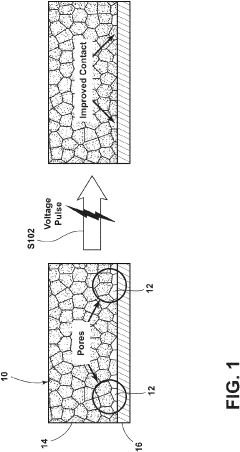
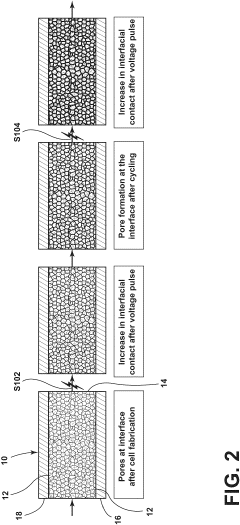
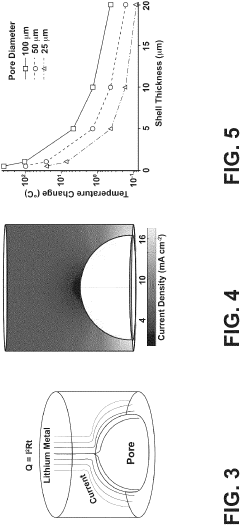
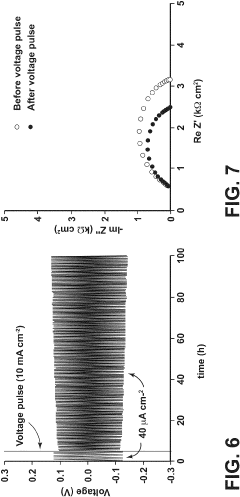
- Applying a voltage pulse at high current density for a short duration to electrochemically improve interfacial contact by causing electrode material to diffuse into pores in the solid electrolyte, thereby healing the interface and eliminating space charge effects, which can be repeated in-operando to maintain contact and prevent failure.
Polymer electrolyte batteries having improved electrode/electrolyte interface
PatentInactiveUS6355379B1
Innovation
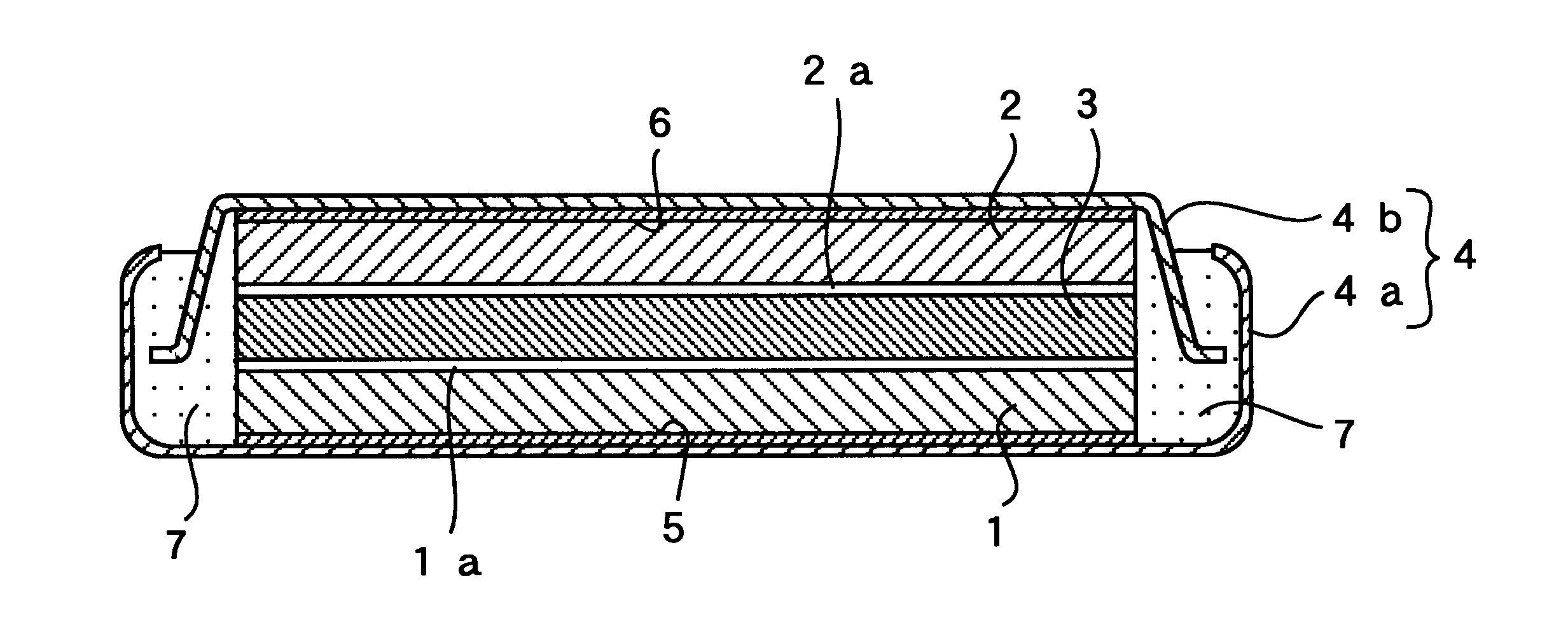
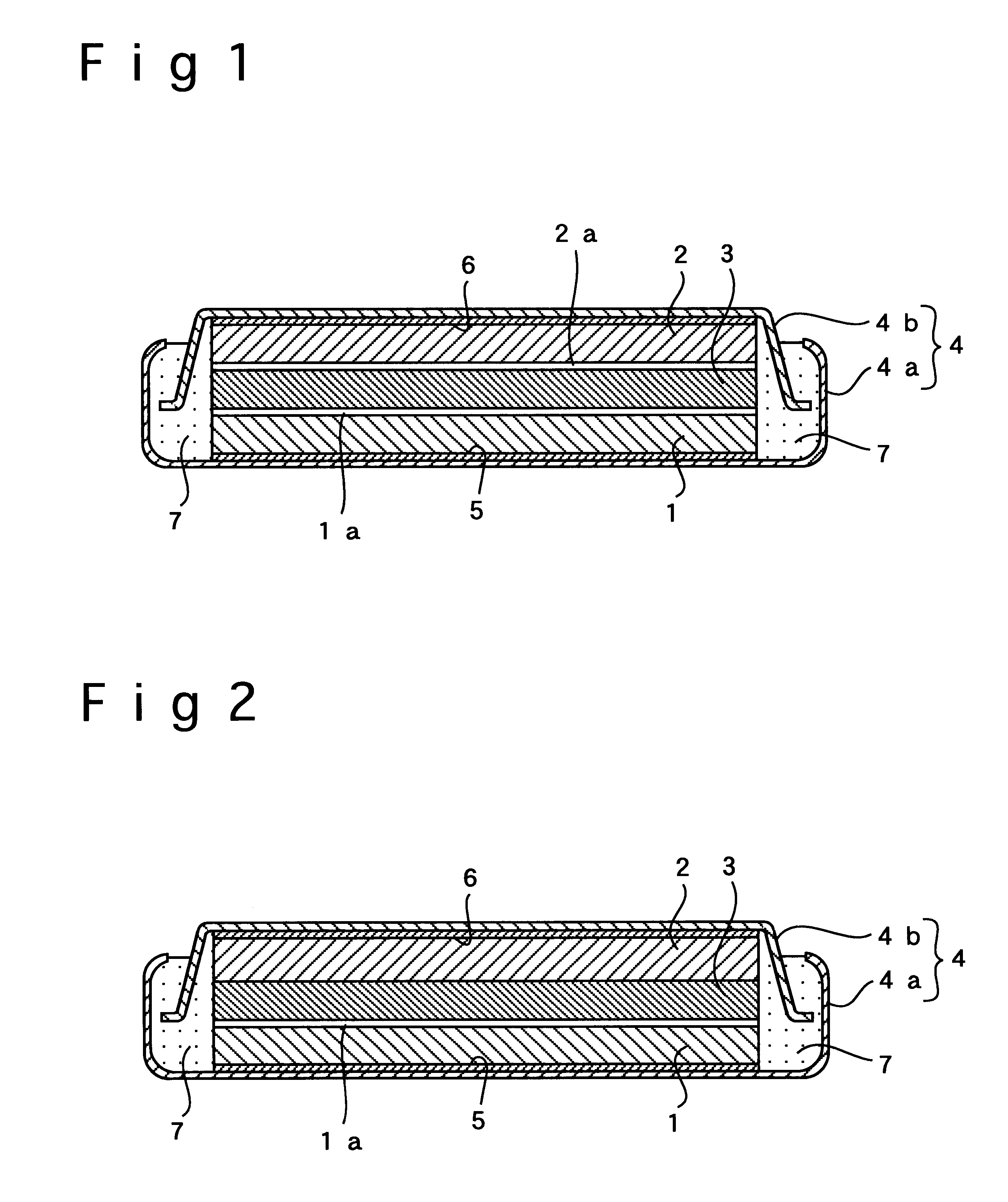
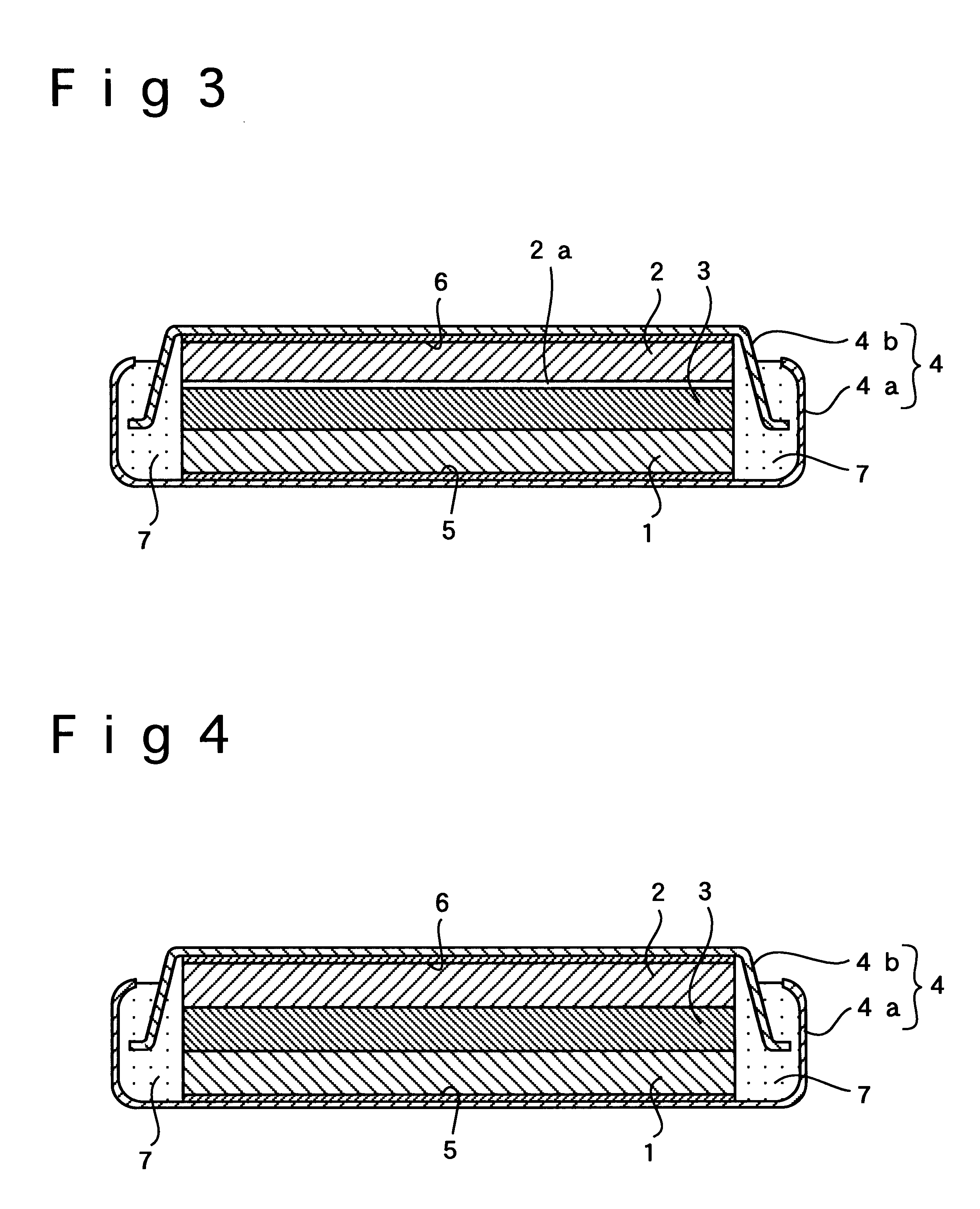
- Incorporating an inorganic amorphous solid electrolyte film at the interface between the electrodes and polymer electrolyte to enhance adhesion and ionic conductivity, using materials like Li3N, LiTi2(PO4)3, or LiI--Li2S--B2S3, which are deposited via sputtering to reduce interface resistance.
Safety Standards for Advanced Battery Technologies
The development of anode-free batteries presents unique safety challenges that necessitate comprehensive regulatory frameworks and standardization efforts. Current safety standards for conventional lithium-ion batteries, such as IEC 62133 and UL 1642, require significant adaptation to address the specific risks associated with anode-free architectures, particularly concerning electrolyte-electrode interface stability and lithium metal deposition behaviors.
Existing safety protocols primarily focus on thermal runaway prevention, overcharge protection, and mechanical abuse tolerance. However, anode-free batteries introduce additional safety considerations related to dendrite formation, interface degradation, and electrolyte decomposition at the current collector surface. The absence of a pre-formed anode creates dynamic interface conditions that traditional safety testing methods may not adequately evaluate.
International standardization bodies, including the International Electrotechnical Commission (IEC) and Underwriters Laboratories (UL), are actively developing specialized testing protocols for next-generation battery technologies. These emerging standards emphasize interface characterization methods, including impedance spectroscopy requirements and surface analysis protocols to assess electrolyte-electrode compatibility over extended cycling periods.
Key safety parameters under development include maximum allowable interface resistance thresholds, electrolyte stability voltage windows, and standardized accelerated aging tests that simulate long-term interface evolution. Proposed testing methodologies incorporate real-time monitoring of interface properties during charge-discharge cycles to identify potential failure modes before catastrophic events occur.
Regulatory frameworks are evolving to mandate comprehensive interface characterization as part of battery certification processes. This includes requirements for detailed documentation of electrolyte formulations, current collector surface treatments, and interface stabilization strategies. Manufacturing quality control standards are being enhanced to ensure consistent interface properties across production batches.
The integration of advanced diagnostic techniques, such as in-situ X-ray photoelectron spectroscopy and electrochemical impedance spectroscopy, is becoming standard practice for interface evaluation. These methods enable precise monitoring of solid electrolyte interphase formation and evolution, providing critical safety data for regulatory approval processes.
Future safety standards will likely incorporate predictive modeling requirements, mandating manufacturers to demonstrate comprehensive understanding of interface degradation mechanisms through validated computational models that can predict long-term safety performance under various operating conditions.
Existing safety protocols primarily focus on thermal runaway prevention, overcharge protection, and mechanical abuse tolerance. However, anode-free batteries introduce additional safety considerations related to dendrite formation, interface degradation, and electrolyte decomposition at the current collector surface. The absence of a pre-formed anode creates dynamic interface conditions that traditional safety testing methods may not adequately evaluate.
International standardization bodies, including the International Electrotechnical Commission (IEC) and Underwriters Laboratories (UL), are actively developing specialized testing protocols for next-generation battery technologies. These emerging standards emphasize interface characterization methods, including impedance spectroscopy requirements and surface analysis protocols to assess electrolyte-electrode compatibility over extended cycling periods.
Key safety parameters under development include maximum allowable interface resistance thresholds, electrolyte stability voltage windows, and standardized accelerated aging tests that simulate long-term interface evolution. Proposed testing methodologies incorporate real-time monitoring of interface properties during charge-discharge cycles to identify potential failure modes before catastrophic events occur.
Regulatory frameworks are evolving to mandate comprehensive interface characterization as part of battery certification processes. This includes requirements for detailed documentation of electrolyte formulations, current collector surface treatments, and interface stabilization strategies. Manufacturing quality control standards are being enhanced to ensure consistent interface properties across production batches.
The integration of advanced diagnostic techniques, such as in-situ X-ray photoelectron spectroscopy and electrochemical impedance spectroscopy, is becoming standard practice for interface evaluation. These methods enable precise monitoring of solid electrolyte interphase formation and evolution, providing critical safety data for regulatory approval processes.
Future safety standards will likely incorporate predictive modeling requirements, mandating manufacturers to demonstrate comprehensive understanding of interface degradation mechanisms through validated computational models that can predict long-term safety performance under various operating conditions.
Environmental Impact of Anode-Free Battery Manufacturing
The manufacturing of anode-free batteries presents significant environmental implications that differ substantially from conventional lithium-ion battery production. The elimination of traditional graphite or silicon anodes fundamentally alters the material supply chain and manufacturing processes, creating both environmental benefits and new challenges that require careful assessment.
Material extraction and processing represent the most substantial environmental impact reduction in anode-free battery manufacturing. The absence of anode materials eliminates the need for graphite mining, which typically involves energy-intensive purification processes and generates considerable carbon emissions. Additionally, the reduced requirement for silicon-based anode materials decreases the environmental burden associated with silicon purification and processing, which traditionally consumes substantial amounts of energy and produces hazardous byproducts.
However, anode-free battery manufacturing introduces unique environmental considerations related to electrolyte composition and electrode interface optimization. The specialized electrolytes required for stable lithium plating often contain fluorinated compounds and advanced additives that present disposal challenges. These materials may require specialized waste treatment processes and could potentially introduce new categories of industrial waste that existing recycling infrastructure is not equipped to handle.
The manufacturing process itself demonstrates improved energy efficiency compared to traditional battery production. The simplified cell architecture reduces the number of coating and drying steps typically required for anode preparation, resulting in lower energy consumption during production. This streamlined manufacturing approach also reduces solvent usage and associated volatile organic compound emissions, contributing to improved air quality around manufacturing facilities.
Water consumption patterns in anode-free battery manufacturing show mixed environmental impacts. While the elimination of anode slurry preparation reduces water usage in certain production stages, the enhanced focus on electrolyte-electrode interface optimization may require additional cleaning and purification steps that increase water consumption elsewhere in the process.
End-of-life considerations present both opportunities and challenges for environmental sustainability. The simplified material composition facilitates certain aspects of recycling, particularly the recovery of lithium and other valuable metals. However, the specialized electrolyte formulations may complicate recycling processes and require development of new separation techniques to ensure complete material recovery and prevent environmental contamination.
Material extraction and processing represent the most substantial environmental impact reduction in anode-free battery manufacturing. The absence of anode materials eliminates the need for graphite mining, which typically involves energy-intensive purification processes and generates considerable carbon emissions. Additionally, the reduced requirement for silicon-based anode materials decreases the environmental burden associated with silicon purification and processing, which traditionally consumes substantial amounts of energy and produces hazardous byproducts.
However, anode-free battery manufacturing introduces unique environmental considerations related to electrolyte composition and electrode interface optimization. The specialized electrolytes required for stable lithium plating often contain fluorinated compounds and advanced additives that present disposal challenges. These materials may require specialized waste treatment processes and could potentially introduce new categories of industrial waste that existing recycling infrastructure is not equipped to handle.
The manufacturing process itself demonstrates improved energy efficiency compared to traditional battery production. The simplified cell architecture reduces the number of coating and drying steps typically required for anode preparation, resulting in lower energy consumption during production. This streamlined manufacturing approach also reduces solvent usage and associated volatile organic compound emissions, contributing to improved air quality around manufacturing facilities.
Water consumption patterns in anode-free battery manufacturing show mixed environmental impacts. While the elimination of anode slurry preparation reduces water usage in certain production stages, the enhanced focus on electrolyte-electrode interface optimization may require additional cleaning and purification steps that increase water consumption elsewhere in the process.
End-of-life considerations present both opportunities and challenges for environmental sustainability. The simplified material composition facilitates certain aspects of recycling, particularly the recovery of lithium and other valuable metals. However, the specialized electrolyte formulations may complicate recycling processes and require development of new separation techniques to ensure complete material recovery and prevent environmental contamination.
Unlock deeper insights with PatSnap Eureka Quick Research — get a full tech report to explore trends and direct your research. Try now!
Generate Your Research Report Instantly with AI Agent
Supercharge your innovation with PatSnap Eureka AI Agent Platform!