

Improving High-C-Rate Performance With Binderless Dry Electrode Designs
JUN 3, 20269 MIN READ
Generate Your Research Report Instantly with AI Agent
Patsnap Eureka helps you evaluate technical feasibility & market potential.
Binderless Dry Electrode Background and Performance Goals
The evolution of electrode manufacturing in lithium-ion batteries has been fundamentally shaped by the pursuit of higher energy density, faster charging capabilities, and improved manufacturing efficiency. Traditional electrode production relies heavily on wet processing methods that incorporate polymeric binders and conductive additives dissolved in organic solvents. This conventional approach, while widely adopted, presents inherent limitations including complex drying processes, solvent recovery requirements, and potential performance constraints at high charge-discharge rates.
The emergence of binderless dry electrode technology represents a paradigm shift in battery manufacturing methodology. This innovative approach eliminates the need for liquid binders and solvents, instead utilizing mechanical compression, thermal treatment, or alternative bonding mechanisms to create cohesive electrode structures. The technology has gained significant momentum as manufacturers seek to address the growing demand for rapid charging capabilities in electric vehicles and energy storage systems.
Historical development of dry electrode concepts can be traced back to early powder metallurgy techniques, but practical implementation in lithium-ion batteries has accelerated dramatically over the past decade. Key technological milestones include the development of fibrillated PTFE-based dry mixing processes, mechanical calendering optimization, and advanced particle engineering methods that enable effective particle-to-particle adhesion without traditional liquid binders.
The primary performance goals driving binderless dry electrode development center on achieving superior high C-rate performance while maintaining or improving energy density metrics. Specifically, the technology aims to deliver sustained discharge rates exceeding 5C with minimal capacity fade, reduce charging times to under 15 minutes for 80% state-of-charge, and maintain cycle life performance comparable to conventional electrodes. Additionally, manufacturing objectives include reducing production costs by 15-20% through elimination of solvent processing steps and enabling higher loading densities that translate to improved volumetric energy density.
Environmental sustainability considerations have also become integral performance targets, with dry electrode processes offering potential reductions in volatile organic compound emissions and simplified recycling pathways. The technology roadmap envisions achieving these multifaceted goals while ensuring scalable manufacturing processes suitable for gigafactory-scale production environments.
The emergence of binderless dry electrode technology represents a paradigm shift in battery manufacturing methodology. This innovative approach eliminates the need for liquid binders and solvents, instead utilizing mechanical compression, thermal treatment, or alternative bonding mechanisms to create cohesive electrode structures. The technology has gained significant momentum as manufacturers seek to address the growing demand for rapid charging capabilities in electric vehicles and energy storage systems.
Historical development of dry electrode concepts can be traced back to early powder metallurgy techniques, but practical implementation in lithium-ion batteries has accelerated dramatically over the past decade. Key technological milestones include the development of fibrillated PTFE-based dry mixing processes, mechanical calendering optimization, and advanced particle engineering methods that enable effective particle-to-particle adhesion without traditional liquid binders.
The primary performance goals driving binderless dry electrode development center on achieving superior high C-rate performance while maintaining or improving energy density metrics. Specifically, the technology aims to deliver sustained discharge rates exceeding 5C with minimal capacity fade, reduce charging times to under 15 minutes for 80% state-of-charge, and maintain cycle life performance comparable to conventional electrodes. Additionally, manufacturing objectives include reducing production costs by 15-20% through elimination of solvent processing steps and enabling higher loading densities that translate to improved volumetric energy density.
Environmental sustainability considerations have also become integral performance targets, with dry electrode processes offering potential reductions in volatile organic compound emissions and simplified recycling pathways. The technology roadmap envisions achieving these multifaceted goals while ensuring scalable manufacturing processes suitable for gigafactory-scale production environments.
Market Demand for High-C-Rate Battery Applications
The global battery market is experiencing unprecedented growth driven by the accelerating adoption of electric vehicles, energy storage systems, and portable electronics requiring rapid charging capabilities. Electric vehicle manufacturers are increasingly prioritizing fast-charging technologies to address consumer range anxiety and reduce charging downtime, creating substantial demand for batteries capable of sustaining high discharge and charge rates without compromising safety or longevity.
Energy storage systems for grid-scale applications represent another significant growth driver, particularly as renewable energy integration expands worldwide. These systems require batteries that can rapidly respond to grid fluctuations and provide instantaneous power delivery during peak demand periods. The ability to maintain stable performance at high C-rates becomes critical for grid stability and energy management efficiency.
Consumer electronics markets continue evolving toward devices with higher power requirements and faster charging expectations. Smartphones, laptops, and wearable devices increasingly demand batteries that can charge rapidly while maintaining compact form factors and extended operational lifespans. This trend extends to emerging applications including electric aircraft, autonomous vehicles, and industrial robotics where high power density and rapid energy delivery are essential.
The automotive sector specifically drives significant demand for high-C-rate battery technologies as manufacturers compete to reduce charging times below industry benchmarks. Fast-charging infrastructure development worldwide creates additional pressure for battery technologies that can safely handle extreme charging rates without thermal runaway or capacity degradation.
Industrial applications including power tools, medical devices, and backup power systems require batteries capable of delivering high instantaneous power while maintaining reliability under demanding operational conditions. These applications often involve intermittent high-power demands that stress conventional battery designs and create opportunities for advanced electrode technologies.
Market research indicates substantial growth potential for battery technologies that can simultaneously achieve high C-rate performance, extended cycle life, and enhanced safety characteristics. The convergence of electrification trends across multiple industries creates a robust market foundation for innovative electrode designs that address current performance limitations while meeting increasingly stringent safety and environmental requirements.
Energy storage systems for grid-scale applications represent another significant growth driver, particularly as renewable energy integration expands worldwide. These systems require batteries that can rapidly respond to grid fluctuations and provide instantaneous power delivery during peak demand periods. The ability to maintain stable performance at high C-rates becomes critical for grid stability and energy management efficiency.
Consumer electronics markets continue evolving toward devices with higher power requirements and faster charging expectations. Smartphones, laptops, and wearable devices increasingly demand batteries that can charge rapidly while maintaining compact form factors and extended operational lifespans. This trend extends to emerging applications including electric aircraft, autonomous vehicles, and industrial robotics where high power density and rapid energy delivery are essential.
The automotive sector specifically drives significant demand for high-C-rate battery technologies as manufacturers compete to reduce charging times below industry benchmarks. Fast-charging infrastructure development worldwide creates additional pressure for battery technologies that can safely handle extreme charging rates without thermal runaway or capacity degradation.
Industrial applications including power tools, medical devices, and backup power systems require batteries capable of delivering high instantaneous power while maintaining reliability under demanding operational conditions. These applications often involve intermittent high-power demands that stress conventional battery designs and create opportunities for advanced electrode technologies.
Market research indicates substantial growth potential for battery technologies that can simultaneously achieve high C-rate performance, extended cycle life, and enhanced safety characteristics. The convergence of electrification trends across multiple industries creates a robust market foundation for innovative electrode designs that address current performance limitations while meeting increasingly stringent safety and environmental requirements.
Current State and Challenges of Binderless Electrode Technology
Binderless dry electrode technology represents a paradigm shift in battery manufacturing, eliminating the need for traditional polymer binders and solvent-based processing. Current implementations primarily focus on mechanical compression techniques, where active materials are directly pressed onto current collectors without adhesive agents. This approach has gained significant traction in lithium-ion battery production, particularly for applications requiring enhanced power density and thermal stability.
The technology landscape is dominated by several distinct manufacturing approaches. Physical vapor deposition methods enable precise control over electrode microstructure but remain limited by scalability constraints. Dry coating processes, including powder-based application techniques, offer improved manufacturing throughput while maintaining structural integrity. Advanced compression molding has emerged as a viable alternative, allowing for higher active material loading densities compared to conventional wet processing methods.
Despite promising developments, binderless electrode technology faces substantial technical barriers that limit widespread adoption. Mechanical adhesion between active materials and current collectors remains inconsistent, particularly under high-rate cycling conditions. The absence of polymeric binders creates challenges in maintaining electrode structural stability during repeated charge-discharge cycles, leading to capacity degradation and reduced cycle life performance.
Manufacturing scalability presents another critical challenge, as current production methods struggle to achieve the uniformity and quality control standards required for commercial battery applications. Process optimization for different active material chemistries requires extensive parameter tuning, increasing development costs and time-to-market considerations. Additionally, the technology exhibits sensitivity to environmental conditions during manufacturing, necessitating controlled atmosphere processing that adds complexity to production workflows.
Geographically, research and development activities are concentrated in regions with established battery manufacturing ecosystems. Asian markets, particularly China, Japan, and South Korea, lead in pilot-scale production implementations, while European and North American efforts focus primarily on fundamental research and specialized applications. This distribution reflects varying regulatory environments and market demands for high-performance energy storage solutions.
The current technological maturity level indicates that binderless dry electrode technology remains in the early commercialization phase, with most applications limited to niche markets requiring specific performance characteristics. Integration challenges with existing battery management systems and quality assurance protocols continue to impede broader market penetration, requiring continued innovation in both materials science and manufacturing processes.
The technology landscape is dominated by several distinct manufacturing approaches. Physical vapor deposition methods enable precise control over electrode microstructure but remain limited by scalability constraints. Dry coating processes, including powder-based application techniques, offer improved manufacturing throughput while maintaining structural integrity. Advanced compression molding has emerged as a viable alternative, allowing for higher active material loading densities compared to conventional wet processing methods.
Despite promising developments, binderless electrode technology faces substantial technical barriers that limit widespread adoption. Mechanical adhesion between active materials and current collectors remains inconsistent, particularly under high-rate cycling conditions. The absence of polymeric binders creates challenges in maintaining electrode structural stability during repeated charge-discharge cycles, leading to capacity degradation and reduced cycle life performance.
Manufacturing scalability presents another critical challenge, as current production methods struggle to achieve the uniformity and quality control standards required for commercial battery applications. Process optimization for different active material chemistries requires extensive parameter tuning, increasing development costs and time-to-market considerations. Additionally, the technology exhibits sensitivity to environmental conditions during manufacturing, necessitating controlled atmosphere processing that adds complexity to production workflows.
Geographically, research and development activities are concentrated in regions with established battery manufacturing ecosystems. Asian markets, particularly China, Japan, and South Korea, lead in pilot-scale production implementations, while European and North American efforts focus primarily on fundamental research and specialized applications. This distribution reflects varying regulatory environments and market demands for high-performance energy storage solutions.
The current technological maturity level indicates that binderless dry electrode technology remains in the early commercialization phase, with most applications limited to niche markets requiring specific performance characteristics. Integration challenges with existing battery management systems and quality assurance protocols continue to impede broader market penetration, requiring continued innovation in both materials science and manufacturing processes.
Existing Solutions for High-C-Rate Electrode Design
01 Electrode material composition and structure optimization
Development of specialized electrode materials with optimized particle size, morphology, and crystal structure to enhance conductivity and reduce internal resistance. These materials focus on creating direct pathways for electron transport without requiring traditional binding agents, utilizing advanced carbon materials and conductive additives to maintain structural integrity during high-rate charging and discharging cycles.- Electrode material composition and structure optimization: Development of electrode materials with optimized composition and structure to achieve high C-rate performance without the need for traditional binders. This involves creating materials with enhanced conductivity and structural integrity that can maintain performance during rapid charge-discharge cycles. The focus is on developing active materials that can inherently provide the necessary mechanical and electrical properties.
- Carbon-based conductive additives and frameworks: Implementation of carbon-based materials and conductive frameworks to replace traditional binders while maintaining electrical conductivity and mechanical stability. These approaches utilize carbon nanotubes, graphene, or other carbon structures to create a conductive network that supports high-rate performance. The carbon framework serves both as a conductive agent and structural support.
- Surface modification and coating techniques: Application of surface modification methods and specialized coatings to enhance electrode performance without conventional binders. These techniques involve creating functional surface layers that improve ion transport, electrical conductivity, and structural stability during high-rate operations. The modifications help maintain electrode integrity under demanding cycling conditions.
- Nanostructured electrode architectures: Design and fabrication of nanostructured electrode architectures that eliminate the need for binders while achieving superior high C-rate performance. These structures utilize nanoscale engineering to create electrodes with optimized porosity, surface area, and ion diffusion pathways. The nanostructured approach enables rapid ion and electron transport essential for high-rate applications.
- Manufacturing processes and electrode preparation methods: Development of specialized manufacturing processes and preparation methods for creating binderless electrodes with enhanced high C-rate capabilities. These methods focus on innovative fabrication techniques that can produce electrodes with the required mechanical properties and electrochemical performance without traditional binding agents. The processes are designed to maintain electrode structural integrity during operation.
02 Surface modification and coating technologies
Implementation of surface treatment methods and specialized coatings to improve electrode performance at high charge rates. These techniques involve creating conductive layers or modifying surface properties to enhance ion transport and electron conductivity while maintaining mechanical stability without conventional binders.Expand Specific Solutions03 Manufacturing processes for binderless electrode fabrication
Advanced manufacturing techniques specifically designed for producing electrodes without traditional binding materials. These processes include novel pressing, sintering, or deposition methods that create mechanically stable electrodes with enhanced electrical properties suitable for high-rate applications.Expand Specific Solutions04 Electrolyte and interface engineering
Optimization of electrolyte formulations and electrode-electrolyte interfaces to support high-rate performance in binderless electrode systems. This includes development of specialized electrolyte additives and interface modifications that facilitate rapid ion transport and minimize resistance at electrode surfaces.Expand Specific Solutions05 Battery architecture and design optimization
Comprehensive battery design approaches that integrate binderless electrodes with optimized cell architecture for enhanced high-rate performance. These designs focus on current collector modifications, cell geometry optimization, and thermal management systems specifically tailored for binderless electrode configurations.Expand Specific Solutions
Key Players in Binderless Electrode and Battery Industry
The binderless dry electrode technology for high-C-rate battery performance represents a rapidly evolving sector within the advanced battery manufacturing industry, currently in its growth phase with significant market expansion potential. The global battery market, valued at over $120 billion, is driving substantial investment in next-generation electrode technologies. Technology maturity varies significantly across key players, with established manufacturers like Tesla, LG Energy Solution, and Ningde Amperex Technology leading commercial implementation, while companies such as Licap Technologies and Northvolt are pioneering specialized dry electrode processes. Asian manufacturers including SK On, Svolt Energy, and EVE Energy are aggressively developing competitive solutions, supported by research institutions like the Chinese Academy of Sciences Institute of Physics. Material suppliers such as Arkema and Cabot Corp provide critical components, while emerging players like Valgotech focus on innovative manufacturing approaches, creating a diverse competitive landscape with varying technological readiness levels.
LG Energy Solution Ltd.
Technical Solution: LG Energy Solution has developed proprietary binderless dry electrode technology focusing on advanced cathode materials with enhanced structural integrity. Their approach utilizes specialized carbon nanotube networks and conductive additives that eliminate traditional PVDF binders while maintaining excellent mechanical properties. The technology incorporates nano-structured active materials with optimized particle size distribution to achieve superior high C-rate performance, enabling discharge rates up to 10C with minimal capacity fade. Their dry electrode design features enhanced electronic conductivity pathways and reduced tortuosity, resulting in improved lithium-ion diffusion kinetics and thermal stability during high-rate operations.
Strengths: Excellent high C-rate performance, strong manufacturing expertise, proven thermal stability. Weaknesses: Higher initial material costs, complex quality control requirements.
Tesla, Inc.
Technical Solution: Tesla has developed advanced binderless dry electrode technology through their acquisition and collaboration with Maxwell Technologies. Their dry electrode process eliminates the need for traditional binders and solvents, using a dry coating method that directly applies active materials to current collectors. This approach significantly reduces manufacturing complexity and cost while improving energy density by 15-20%. The technology enables faster ion transport pathways and reduces internal resistance, leading to superior high C-rate performance with charging capabilities up to 4C rates. Tesla's implementation focuses on silicon nanowire anodes and high-nickel cathodes optimized for rapid charge/discharge cycles.
Strengths: Proven scalability in mass production, significant cost reduction, improved energy density and fast charging capabilities. Weaknesses: Limited public technical details, potential durability concerns under extreme conditions.
Core Innovations in Binderless Dry Electrode Patents
Electrode, electrochemical device, and electronic device
PatentPendingEP4447140A1
Innovation
- A binder-free electrode design utilizing rope-shaped carbon nanotube aggregates to form a cage-like network around active materials, enhancing long-range conductivity and structural stability, thereby improving energy density without compromising electrical performance.
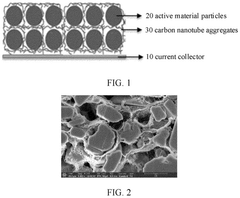


Dry Electrode for Electrochemical Device and Method for Manufacturing the Same
PatentPendingUS20260128317A1
Innovation
- A dry electrode with a structured electrode active material layer having a uniform binder/conductive material distribution, controlled porosity, and optimized pore size and tortuosity, achieved through a method involving kneading, grinding, and calendering of a powdery blend to form a porous film with fibrillated binder resin.


Environmental Impact Assessment of Binderless Technologies
The environmental implications of binderless dry electrode technologies represent a paradigm shift toward sustainable battery manufacturing processes. Traditional electrode production relies heavily on toxic organic solvents such as N-methyl-2-pyrrolidone (NMP) and polyvinylidene fluoride (PVDF) binders, which generate substantial volatile organic compound emissions and require energy-intensive drying processes. Binderless technologies eliminate these environmental burdens by removing solvent-based processing entirely.
Carbon footprint analysis reveals significant reductions in greenhouse gas emissions through binderless manufacturing. The elimination of solvent recovery systems, thermal drying equipment, and associated energy consumption can reduce manufacturing energy requirements by 30-40%. Additionally, the absence of NMP handling eliminates the need for specialized ventilation systems and waste treatment facilities, further reducing operational carbon intensity.
Water consumption patterns show marked improvement with binderless processes. Conventional electrode manufacturing requires substantial water usage for solvent recovery and cleaning operations, typically consuming 15-20 liters per kilogram of electrode material. Binderless dry processing eliminates this water dependency, presenting particular advantages in water-scarce manufacturing regions.
Waste stream analysis demonstrates substantial environmental benefits. Traditional processes generate contaminated solvent waste requiring specialized disposal or energy-intensive recycling. Binderless technologies produce minimal chemical waste, with primary waste streams consisting of recyclable metal powders and carbon materials that can be reprocessed without chemical treatment.
Life cycle assessment studies indicate that binderless electrodes exhibit superior end-of-life recyclability. The absence of polymer binders simplifies material separation during battery recycling, enabling more efficient recovery of valuable metals like lithium, cobalt, and nickel. This enhanced recyclability supports circular economy principles and reduces dependence on virgin material extraction.
However, environmental considerations must account for potential trade-offs in manufacturing equipment requirements. Dry processing techniques may require specialized compression and sintering equipment with different energy profiles, necessitating comprehensive environmental impact assessments to optimize overall sustainability benefits.
Carbon footprint analysis reveals significant reductions in greenhouse gas emissions through binderless manufacturing. The elimination of solvent recovery systems, thermal drying equipment, and associated energy consumption can reduce manufacturing energy requirements by 30-40%. Additionally, the absence of NMP handling eliminates the need for specialized ventilation systems and waste treatment facilities, further reducing operational carbon intensity.
Water consumption patterns show marked improvement with binderless processes. Conventional electrode manufacturing requires substantial water usage for solvent recovery and cleaning operations, typically consuming 15-20 liters per kilogram of electrode material. Binderless dry processing eliminates this water dependency, presenting particular advantages in water-scarce manufacturing regions.
Waste stream analysis demonstrates substantial environmental benefits. Traditional processes generate contaminated solvent waste requiring specialized disposal or energy-intensive recycling. Binderless technologies produce minimal chemical waste, with primary waste streams consisting of recyclable metal powders and carbon materials that can be reprocessed without chemical treatment.
Life cycle assessment studies indicate that binderless electrodes exhibit superior end-of-life recyclability. The absence of polymer binders simplifies material separation during battery recycling, enabling more efficient recovery of valuable metals like lithium, cobalt, and nickel. This enhanced recyclability supports circular economy principles and reduces dependence on virgin material extraction.
However, environmental considerations must account for potential trade-offs in manufacturing equipment requirements. Dry processing techniques may require specialized compression and sintering equipment with different energy profiles, necessitating comprehensive environmental impact assessments to optimize overall sustainability benefits.
Manufacturing Scalability and Cost Analysis
The manufacturing scalability of binderless dry electrode technology presents both significant opportunities and challenges for large-scale battery production. Current pilot-scale demonstrations have shown promising results, but transitioning to gigawatt-hour production capacities requires substantial process optimization and equipment development. The dry coating process eliminates the need for solvent-based slurry preparation and lengthy drying steps, potentially reducing manufacturing footprint by 30-40% compared to conventional wet processes.
Equipment scalability remains a critical bottleneck, particularly for roll-to-roll dry coating systems capable of handling wide electrode substrates at industrial speeds. Existing dry coating technologies, including powder coating and compression methods, require significant modifications to achieve the precision and uniformity demanded for high-performance battery electrodes. The capital expenditure for specialized dry coating equipment is estimated to be 15-25% higher than traditional wet coating lines, though this is offset by reduced facility requirements for solvent handling and environmental control systems.
Cost analysis reveals a complex economic landscape where initial capital investments are balanced against operational savings. The elimination of N-methylpyrrolidone (NMP) solvent reduces material costs by approximately $2-4 per kWh of battery capacity while eliminating solvent recovery infrastructure requirements. Energy consumption decreases substantially due to the absence of thermal drying processes, contributing to operational cost reductions of 8-12% in electrode manufacturing.
Labor requirements shift toward higher-skilled technicians capable of managing sophisticated dry coating processes, though overall workforce needs may decrease by 10-15% due to process simplification. Quality control systems require adaptation to monitor particle adhesion and electrode integrity without traditional binder-mediated cohesion, necessitating investment in advanced inspection technologies.
Supply chain considerations include securing consistent supplies of specialized active materials optimized for binderless applications and developing relationships with equipment manufacturers capable of delivering scaled dry coating solutions. The technology's economic viability becomes increasingly attractive at production scales exceeding 10 GWh annually, where operational savings compound to offset higher initial investments.
Equipment scalability remains a critical bottleneck, particularly for roll-to-roll dry coating systems capable of handling wide electrode substrates at industrial speeds. Existing dry coating technologies, including powder coating and compression methods, require significant modifications to achieve the precision and uniformity demanded for high-performance battery electrodes. The capital expenditure for specialized dry coating equipment is estimated to be 15-25% higher than traditional wet coating lines, though this is offset by reduced facility requirements for solvent handling and environmental control systems.
Cost analysis reveals a complex economic landscape where initial capital investments are balanced against operational savings. The elimination of N-methylpyrrolidone (NMP) solvent reduces material costs by approximately $2-4 per kWh of battery capacity while eliminating solvent recovery infrastructure requirements. Energy consumption decreases substantially due to the absence of thermal drying processes, contributing to operational cost reductions of 8-12% in electrode manufacturing.
Labor requirements shift toward higher-skilled technicians capable of managing sophisticated dry coating processes, though overall workforce needs may decrease by 10-15% due to process simplification. Quality control systems require adaptation to monitor particle adhesion and electrode integrity without traditional binder-mediated cohesion, necessitating investment in advanced inspection technologies.
Supply chain considerations include securing consistent supplies of specialized active materials optimized for binderless applications and developing relationships with equipment manufacturers capable of delivering scaled dry coating solutions. The technology's economic viability becomes increasingly attractive at production scales exceeding 10 GWh annually, where operational savings compound to offset higher initial investments.
Unlock deeper insights with Patsnap Eureka Quick Research — get a full tech report to explore trends and direct your research. Try now!
Generate Your Research Report Instantly with AI Agent
Supercharge your innovation with Patsnap Eureka AI Agent Platform!