

Maximize Sensor Sensitivity with Magnetoelectric Materials
APR 16, 20269 MIN READ
Generate Your Research Report Instantly with AI Agent
PatSnap Eureka helps you evaluate technical feasibility & market potential.
Magnetoelectric Sensor Technology Background and Objectives
Magnetoelectric materials represent a revolutionary class of multifunctional materials that exhibit coupling between magnetic and electric properties, enabling direct conversion between magnetic and electric fields. This unique characteristic positions them as ideal candidates for next-generation sensor applications where enhanced sensitivity is paramount. The magnetoelectric effect occurs through various mechanisms, including strain-mediated coupling in composite structures and intrinsic coupling in single-phase multiferroic materials.
The historical development of magnetoelectric materials traces back to the 1960s when the phenomenon was first theoretically predicted and experimentally observed in single-phase compounds like Cr2O3. However, these early materials exhibited weak magnetoelectric coupling at room temperature, limiting their practical applications. The field experienced significant advancement in the early 2000s with the development of composite magnetoelectric materials, particularly laminated structures combining piezoelectric and magnetostrictive phases.
Current technological evolution focuses on maximizing the magnetoelectric coefficient, which directly correlates to sensor sensitivity. Researchers have achieved remarkable progress through engineered composite architectures, including bilayer, trilayer, and particulate composites. The strain-mediated coupling mechanism in these structures has demonstrated magnetoelectric coefficients several orders of magnitude higher than single-phase materials, reaching values exceeding 10 V/cm·Oe in optimized configurations.
The primary objective of magnetoelectric sensor technology centers on achieving unprecedented sensitivity levels for magnetic field detection while maintaining operational stability across diverse environmental conditions. This involves optimizing material composition, structural design, and interface engineering to maximize the magnetoelectric response. Key performance targets include achieving sub-picotesla magnetic field detection capabilities, broadband frequency response, and miniaturization compatibility for integrated sensor systems.
Strategic development goals encompass establishing reliable fabrication processes for scalable production, ensuring long-term stability under varying temperature and humidity conditions, and developing signal processing algorithms that leverage the unique characteristics of magnetoelectric transduction. The technology aims to surpass conventional magnetic sensors in terms of sensitivity, power consumption, and form factor constraints, particularly for applications requiring ultra-low magnetic field detection in compact, portable devices.
The historical development of magnetoelectric materials traces back to the 1960s when the phenomenon was first theoretically predicted and experimentally observed in single-phase compounds like Cr2O3. However, these early materials exhibited weak magnetoelectric coupling at room temperature, limiting their practical applications. The field experienced significant advancement in the early 2000s with the development of composite magnetoelectric materials, particularly laminated structures combining piezoelectric and magnetostrictive phases.
Current technological evolution focuses on maximizing the magnetoelectric coefficient, which directly correlates to sensor sensitivity. Researchers have achieved remarkable progress through engineered composite architectures, including bilayer, trilayer, and particulate composites. The strain-mediated coupling mechanism in these structures has demonstrated magnetoelectric coefficients several orders of magnitude higher than single-phase materials, reaching values exceeding 10 V/cm·Oe in optimized configurations.
The primary objective of magnetoelectric sensor technology centers on achieving unprecedented sensitivity levels for magnetic field detection while maintaining operational stability across diverse environmental conditions. This involves optimizing material composition, structural design, and interface engineering to maximize the magnetoelectric response. Key performance targets include achieving sub-picotesla magnetic field detection capabilities, broadband frequency response, and miniaturization compatibility for integrated sensor systems.
Strategic development goals encompass establishing reliable fabrication processes for scalable production, ensuring long-term stability under varying temperature and humidity conditions, and developing signal processing algorithms that leverage the unique characteristics of magnetoelectric transduction. The technology aims to surpass conventional magnetic sensors in terms of sensitivity, power consumption, and form factor constraints, particularly for applications requiring ultra-low magnetic field detection in compact, portable devices.
Market Demand for High-Sensitivity Magnetoelectric Sensors
The global sensor market is experiencing unprecedented growth driven by the proliferation of Internet of Things applications, autonomous systems, and precision measurement requirements across multiple industries. High-sensitivity magnetoelectric sensors represent a critical segment within this expanding market, addressing the increasing demand for ultra-precise magnetic field detection and measurement capabilities that traditional sensor technologies cannot adequately fulfill.
Healthcare and medical diagnostics constitute one of the most promising application domains for high-sensitivity magnetoelectric sensors. The growing emphasis on non-invasive diagnostic techniques has created substantial demand for sensors capable of detecting minute biomagnetic signals from the human body, including cardiac and neural activities. Medical device manufacturers are actively seeking sensor solutions that can operate effectively in clinical environments while providing the sensitivity required for early disease detection and continuous patient monitoring.
Industrial automation and manufacturing sectors are driving significant demand for enhanced magnetic sensing capabilities. Modern production facilities require precise position sensing, current monitoring, and quality control systems that can detect microscopic variations in magnetic fields. The trend toward Industry 4.0 and smart manufacturing has intensified the need for sensors that can provide real-time feedback with exceptional accuracy and reliability.
The automotive industry represents another major market driver, particularly with the advancement of electric vehicles and autonomous driving technologies. High-sensitivity magnetoelectric sensors are essential for battery management systems, motor control applications, and navigation systems that require precise magnetic field measurements. The transition toward electrification has created new opportunities for sensor technologies that can operate effectively in electromagnetically complex environments.
Aerospace and defense applications demand the highest levels of sensor performance, creating a premium market segment for advanced magnetoelectric sensing solutions. Navigation systems, satellite communications, and military equipment require sensors capable of detecting extremely weak magnetic signals while maintaining stability under harsh environmental conditions.
The consumer electronics market continues to expand the application scope for high-sensitivity sensors, particularly in smartphones, wearable devices, and smart home systems. Manufacturers are seeking compact, energy-efficient sensor solutions that can enhance user experiences through improved gesture recognition, compass functionality, and health monitoring capabilities.
Market growth is further accelerated by increasing regulatory requirements for precision measurement and monitoring across various industries, creating sustained demand for advanced sensor technologies that can meet stringent performance standards while offering cost-effective implementation pathways.
Healthcare and medical diagnostics constitute one of the most promising application domains for high-sensitivity magnetoelectric sensors. The growing emphasis on non-invasive diagnostic techniques has created substantial demand for sensors capable of detecting minute biomagnetic signals from the human body, including cardiac and neural activities. Medical device manufacturers are actively seeking sensor solutions that can operate effectively in clinical environments while providing the sensitivity required for early disease detection and continuous patient monitoring.
Industrial automation and manufacturing sectors are driving significant demand for enhanced magnetic sensing capabilities. Modern production facilities require precise position sensing, current monitoring, and quality control systems that can detect microscopic variations in magnetic fields. The trend toward Industry 4.0 and smart manufacturing has intensified the need for sensors that can provide real-time feedback with exceptional accuracy and reliability.
The automotive industry represents another major market driver, particularly with the advancement of electric vehicles and autonomous driving technologies. High-sensitivity magnetoelectric sensors are essential for battery management systems, motor control applications, and navigation systems that require precise magnetic field measurements. The transition toward electrification has created new opportunities for sensor technologies that can operate effectively in electromagnetically complex environments.
Aerospace and defense applications demand the highest levels of sensor performance, creating a premium market segment for advanced magnetoelectric sensing solutions. Navigation systems, satellite communications, and military equipment require sensors capable of detecting extremely weak magnetic signals while maintaining stability under harsh environmental conditions.
The consumer electronics market continues to expand the application scope for high-sensitivity sensors, particularly in smartphones, wearable devices, and smart home systems. Manufacturers are seeking compact, energy-efficient sensor solutions that can enhance user experiences through improved gesture recognition, compass functionality, and health monitoring capabilities.
Market growth is further accelerated by increasing regulatory requirements for precision measurement and monitoring across various industries, creating sustained demand for advanced sensor technologies that can meet stringent performance standards while offering cost-effective implementation pathways.
Current State and Challenges of Magnetoelectric Materials
Magnetoelectric materials represent a cutting-edge class of multifunctional materials that exhibit coupled magnetic and electric properties, enabling direct conversion between magnetic and electric fields. Currently, these materials exist in three primary forms: single-phase multiferroics, composite structures combining ferroelectric and ferromagnetic phases, and artificially engineered heterostructures. Single-phase multiferroics like BiFeO3 demonstrate intrinsic magnetoelectric coupling but typically suffer from weak coupling coefficients at room temperature.
Composite magnetoelectric materials, particularly laminated structures of piezoelectric and magnetostrictive layers, have achieved significantly higher magnetoelectric coefficients. Leading examples include Terfenol-D/PZT and Metglas/PZT composites, which can reach magnetoelectric coefficients exceeding 10 V/cm·Oe under optimized conditions. However, these achievements are primarily demonstrated in laboratory environments with limited scalability for commercial sensor applications.
The geographical distribution of magnetoelectric research shows concentrated efforts in the United States, Europe, China, and Japan. American institutions lead in fundamental research and theoretical modeling, while Asian countries, particularly China and Japan, focus heavily on material synthesis and device fabrication. European research centers excel in characterization techniques and application development for industrial sensors.
Despite significant progress, several critical challenges impede the widespread adoption of magnetoelectric materials in high-sensitivity sensors. Temperature stability remains a primary concern, as magnetoelectric coupling coefficients typically decrease dramatically with increasing temperature, limiting operational ranges for practical sensors. Most high-performance magnetoelectric materials exhibit optimal properties only within narrow temperature windows, often requiring controlled environments.
Frequency response limitations present another significant obstacle. While some magnetoelectric composites show enhanced coupling at mechanical resonance frequencies, this creates narrow operational bandwidths unsuitable for broadband sensing applications. The mechanical resonance also introduces unwanted noise and stability issues in sensor systems.
Manufacturing reproducibility and quality control pose substantial challenges for commercial viability. The complex multi-phase nature of composite magnetoelectric materials makes consistent production difficult, resulting in significant batch-to-batch variations in magnetoelectric coefficients. Interface quality between different phases critically affects performance, yet remains difficult to control during large-scale manufacturing processes.
Additionally, long-term stability and aging effects of magnetoelectric materials under operational conditions are not fully understood. Mechanical stress, electromagnetic cycling, and environmental factors can degrade magnetoelectric properties over time, potentially compromising sensor reliability and accuracy in long-term deployments.
Composite magnetoelectric materials, particularly laminated structures of piezoelectric and magnetostrictive layers, have achieved significantly higher magnetoelectric coefficients. Leading examples include Terfenol-D/PZT and Metglas/PZT composites, which can reach magnetoelectric coefficients exceeding 10 V/cm·Oe under optimized conditions. However, these achievements are primarily demonstrated in laboratory environments with limited scalability for commercial sensor applications.
The geographical distribution of magnetoelectric research shows concentrated efforts in the United States, Europe, China, and Japan. American institutions lead in fundamental research and theoretical modeling, while Asian countries, particularly China and Japan, focus heavily on material synthesis and device fabrication. European research centers excel in characterization techniques and application development for industrial sensors.
Despite significant progress, several critical challenges impede the widespread adoption of magnetoelectric materials in high-sensitivity sensors. Temperature stability remains a primary concern, as magnetoelectric coupling coefficients typically decrease dramatically with increasing temperature, limiting operational ranges for practical sensors. Most high-performance magnetoelectric materials exhibit optimal properties only within narrow temperature windows, often requiring controlled environments.
Frequency response limitations present another significant obstacle. While some magnetoelectric composites show enhanced coupling at mechanical resonance frequencies, this creates narrow operational bandwidths unsuitable for broadband sensing applications. The mechanical resonance also introduces unwanted noise and stability issues in sensor systems.
Manufacturing reproducibility and quality control pose substantial challenges for commercial viability. The complex multi-phase nature of composite magnetoelectric materials makes consistent production difficult, resulting in significant batch-to-batch variations in magnetoelectric coefficients. Interface quality between different phases critically affects performance, yet remains difficult to control during large-scale manufacturing processes.
Additionally, long-term stability and aging effects of magnetoelectric materials under operational conditions are not fully understood. Mechanical stress, electromagnetic cycling, and environmental factors can degrade magnetoelectric properties over time, potentially compromising sensor reliability and accuracy in long-term deployments.
Existing Solutions for Magnetoelectric Sensor Enhancement
01 Composite magnetoelectric materials with enhanced coupling coefficient
Magnetoelectric sensors utilize composite materials combining magnetostrictive and piezoelectric phases to achieve enhanced magnetoelectric coupling coefficients. The sensitivity can be improved by optimizing the volume ratio, interface bonding, and material selection of the constituent phases. Laminated or particulate composite structures are designed to maximize the strain transfer between phases, resulting in higher voltage output per unit magnetic field change.- Composite magnetoelectric materials with enhanced coupling coefficient: Magnetoelectric sensors utilize composite materials combining magnetostrictive and piezoelectric phases to achieve enhanced magnetoelectric coupling coefficients. The sensitivity can be improved by optimizing the volume ratio, interface bonding, and material selection of the constituent phases. Laminated or particulate composite structures are designed to maximize the strain transfer between phases, resulting in higher voltage output per unit magnetic field change.
- Structural design and geometry optimization for sensitivity enhancement: The sensor sensitivity is significantly influenced by structural configurations such as cantilever beam designs, multilayer stacks, and resonant structures. Geometric parameters including thickness ratios, aspect ratios, and electrode arrangements are optimized to enhance mechanical coupling and reduce noise. Resonant operation at specific frequencies can amplify the magnetoelectric response by orders of magnitude compared to non-resonant modes.
- Signal processing and noise reduction techniques: Advanced signal processing methods are employed to improve the detection limit and sensitivity of magnetoelectric sensors. These include lock-in amplification, frequency modulation techniques, differential measurement configurations, and shielding designs to minimize electromagnetic interference. Digital filtering algorithms and temperature compensation circuits further enhance the signal-to-noise ratio and measurement accuracy.
- Novel magnetoelectric material compositions: Research focuses on developing new material systems with superior magnetoelectric properties. This includes rare-earth doped ferrites, lead-free piezoelectric ceramics, polymer-based flexible composites, and nanostructured materials. Material engineering at the nanoscale and crystal structure modification can significantly enhance the intrinsic magnetoelectric coupling and thermal stability, leading to improved sensor sensitivity across wider operating ranges.
- Application-specific sensor configurations and calibration methods: Magnetoelectric sensors are configured for specific applications such as biomedical sensing, current detection, and magnetic field mapping. Sensitivity optimization involves application-specific calibration procedures, bias magnetic field tuning, and adaptive measurement protocols. Integration with microelectromechanical systems and miniaturization techniques enable high-sensitivity detection in compact form factors suitable for various industrial and medical applications.
02 Structural design and geometry optimization for sensitivity enhancement
The sensor sensitivity is significantly influenced by structural configurations such as cantilever beams, multilayer laminates, and resonant structures. Geometric parameters including thickness ratios, aspect ratios, and electrode arrangements are optimized to maximize mechanical coupling and electrical output. Resonant operation at mechanical resonance frequencies can amplify the magnetoelectric response by several orders of magnitude.Expand Specific Solutions03 Signal processing and noise reduction techniques
Advanced signal processing methods are employed to enhance the effective sensitivity of magnetoelectric sensors. These include lock-in amplification, frequency modulation techniques, and differential measurement configurations to suppress environmental noise and thermal fluctuations. Shielding designs and gradiometer configurations help eliminate common-mode interference, improving the signal-to-noise ratio and detection limits.Expand Specific Solutions04 Temperature compensation and stability improvement
Temperature variations affect both magnetostrictive and piezoelectric properties, leading to sensitivity drift in magnetoelectric sensors. Compensation strategies include using temperature-stable material compositions, implementing reference sensors for differential measurements, and applying algorithmic corrections based on temperature coefficients. Multi-material designs with complementary temperature dependencies can achieve improved stability over wide operating ranges.Expand Specific Solutions05 Miniaturization and integration for high-sensitivity applications
Micro-scale and nano-scale magnetoelectric sensors are developed using thin-film deposition and microfabrication techniques to achieve high sensitivity in compact form factors. Integration with CMOS circuits enables on-chip signal amplification and processing. MEMS-based magnetoelectric sensors with suspended structures reduce substrate clamping effects, enhancing mechanical quality factors and overall sensitivity for applications in biomedical sensing and magnetic field detection.Expand Specific Solutions
Key Players in Magnetoelectric Materials and Sensor Industry
The magnetoelectric materials sector for sensor sensitivity enhancement represents an emerging technology field in its early commercialization stage, with significant growth potential driven by increasing demand for ultra-sensitive sensing applications across automotive, healthcare, and industrial sectors. The market remains relatively nascent but shows promising expansion as applications in magnetic field detection, biomedical sensing, and IoT devices proliferate. Technology maturity varies considerably across players, with established electronics giants like TDK Corp., Toshiba Corp., and Mitsubishi Electric Corp. leading commercial development through their extensive R&D capabilities and manufacturing infrastructure. Academic institutions including Carnegie Mellon University, University of Kiel, and Jiangsu University contribute fundamental research breakthroughs, while government entities like the Naval Research Laboratory provide strategic research funding. The competitive landscape features a hybrid ecosystem where traditional semiconductor companies leverage existing expertise, emerging specialists like Headway Technologies focus on niche applications, and research institutions drive innovation, creating a dynamic environment poised for technological advancement and market growth.
TDK Corp.
Technical Solution: TDK has developed advanced magnetoelectric composite materials combining ferroelectric and ferromagnetic phases to create highly sensitive magnetic field sensors. Their approach utilizes multilayer ceramic capacitor technology to fabricate magnetoelectric laminates with optimized interfacial coupling between piezoelectric and magnetostrictive layers. The company's magnetoelectric sensors demonstrate enhanced sensitivity through strain-mediated coupling mechanisms, achieving detection capabilities in the picotesla range for biomedical applications and industrial monitoring systems.
Strengths: Strong manufacturing capabilities and established supply chain for ceramic materials. Weaknesses: Limited flexibility in material composition compared to research institutions.
Toshiba Corp.
Technical Solution: Toshiba has developed magnetoelectric sensor technologies focusing on spintronic applications and magnetic memory devices. Their research emphasizes voltage-controlled magnetic anisotropy in magnetoelectric heterostructures, enabling ultra-low power magnetic field detection. The company's approach integrates magnetoelectric materials with semiconductor processing techniques to create compact, high-sensitivity sensors suitable for consumer electronics and automotive applications. Their technology leverages electric field control of magnetism to achieve rapid response times and reduced power consumption.
Strengths: Advanced semiconductor fabrication capabilities and system integration expertise. Weaknesses: Focus primarily on digital applications may limit analog sensor performance optimization.
Core Innovations in Magnetoelectric Coupling Mechanisms
Method and Apparatus for High-Permeability Magnetostrictive/Piezo-Fiber Laminates Having Colossal, Near-Ideal Magnetoelectricity
PatentActiveUS7771846B2
Innovation
- The use of high-permeability magnetostrictive alloy layers, such as FeBSiC, coupled with (1-3) piezo-fiber layers in (L-L) configurations, enhances stress transfer and magnetic flux concentration, achieving colossal magnetoelectric coefficients by optimizing the arrangement and connectivity of layers.


Magnetoelectric magnetic field sensor with longitudinally biased magnetostrictive layer
PatentInactiveUS7023206B2
Innovation
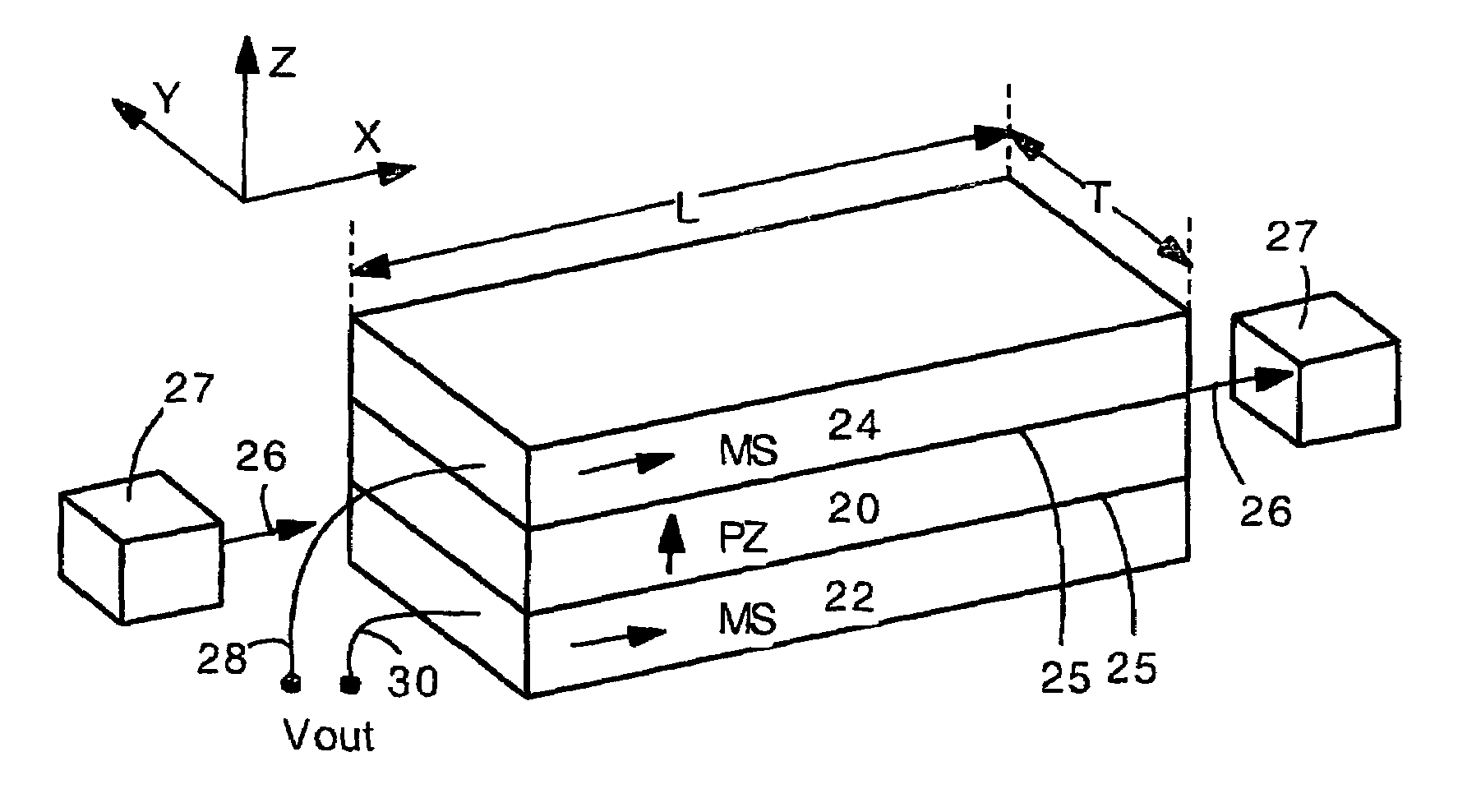
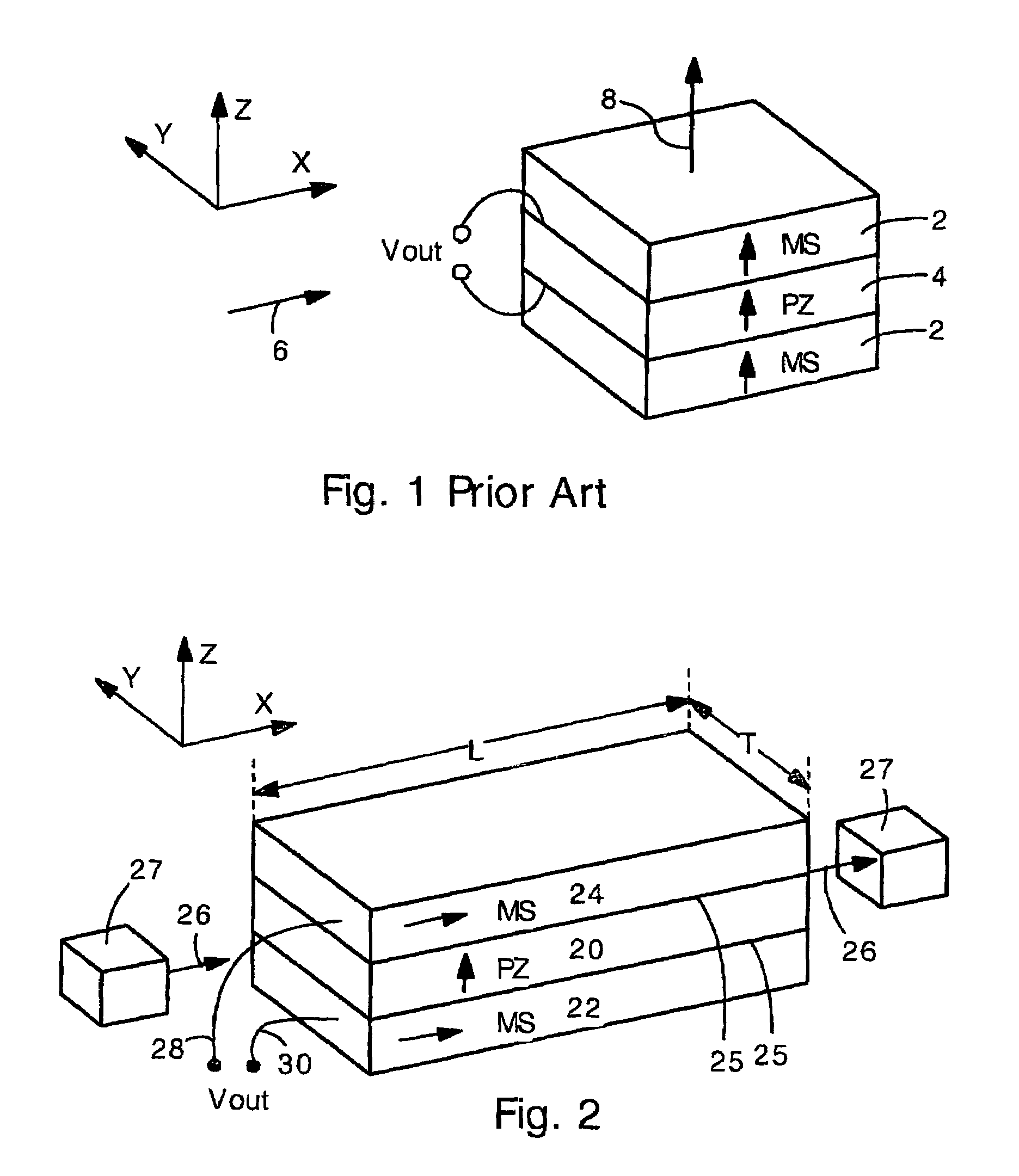
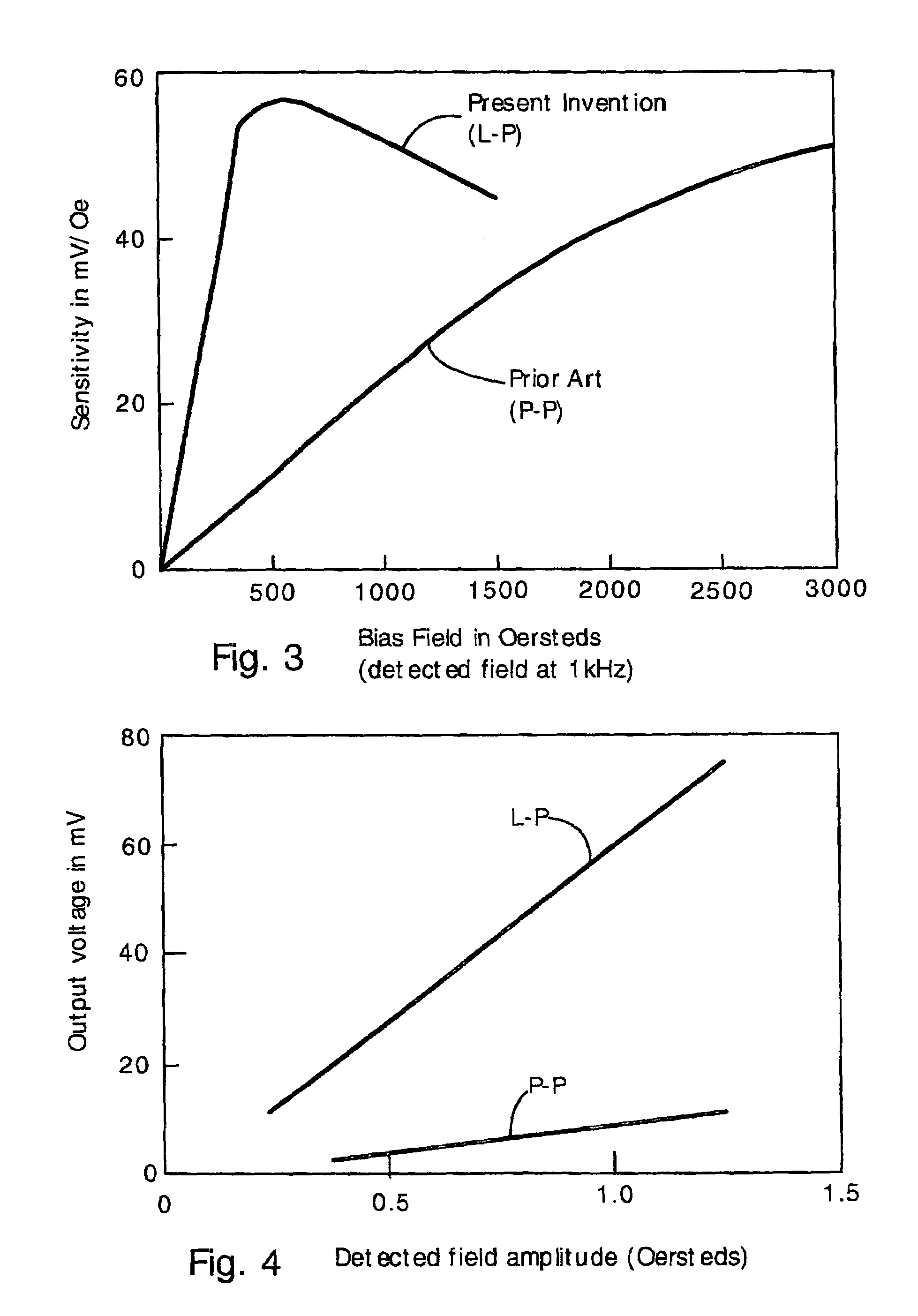
- A magnetoelectric magnetic field sensor with laminated magnetostrictive and piezoelectric layers, where the magnetostrictive layer is longitudinally magnetized and biased with a parallel bias magnetic field, optimizing the thickness ratio and poling direction for enhanced sensitivity and low power operation.

Manufacturing Scalability of Magnetoelectric Devices
The manufacturing scalability of magnetoelectric devices represents a critical bottleneck in transitioning from laboratory demonstrations to commercial sensor applications. Current production methods primarily rely on thin-film deposition techniques such as pulsatile laser deposition and sputtering, which are inherently limited in throughput and substrate size. These processes typically achieve device yields of 60-75% for research-scale batches, but yield rates drop significantly when scaling to wafer-level production due to interface quality variations and stress-induced defects.
Composite magnetoelectric structures face particular challenges in mass production due to their multi-layered architecture requiring precise control of interfacial bonding. The epoxy-bonded laminate approach, while offering superior magnetoelectric coefficients in laboratory settings, suffers from inconsistent adhesive layer thickness and thermal expansion mismatches during large-scale manufacturing. Alternative approaches using direct growth methods show promise but require substrate temperatures exceeding 600°C, limiting compatible substrate materials and increasing energy costs.
Process standardization remains fragmented across different magnetoelectric material systems. Piezoelectric-magnetostrictive composites require sequential processing steps with intermediate quality control checkpoints, extending manufacturing cycle times to 48-72 hours per batch. The lack of established industry standards for interface characterization and performance metrics further complicates quality assurance protocols, particularly for devices targeting sub-picotesla sensitivity requirements.
Equipment scalability presents additional constraints, as specialized deposition chambers capable of maintaining the required vacuum levels and temperature uniformity across large substrates represent significant capital investments. Current manufacturing equipment typically accommodates substrates up to 4-inch diameter, while commercial sensor applications increasingly demand 6-inch or larger wafer compatibility to achieve cost-effective unit economics.
Supply chain considerations for rare earth elements used in magnetostrictive phases introduce potential bottlenecks in scaled production. Terbium and dysprosium availability fluctuations could impact manufacturing consistency, necessitating alternative material formulations or strategic inventory management approaches to ensure continuous production capabilities for high-sensitivity magnetoelectric sensor devices.
Composite magnetoelectric structures face particular challenges in mass production due to their multi-layered architecture requiring precise control of interfacial bonding. The epoxy-bonded laminate approach, while offering superior magnetoelectric coefficients in laboratory settings, suffers from inconsistent adhesive layer thickness and thermal expansion mismatches during large-scale manufacturing. Alternative approaches using direct growth methods show promise but require substrate temperatures exceeding 600°C, limiting compatible substrate materials and increasing energy costs.
Process standardization remains fragmented across different magnetoelectric material systems. Piezoelectric-magnetostrictive composites require sequential processing steps with intermediate quality control checkpoints, extending manufacturing cycle times to 48-72 hours per batch. The lack of established industry standards for interface characterization and performance metrics further complicates quality assurance protocols, particularly for devices targeting sub-picotesla sensitivity requirements.
Equipment scalability presents additional constraints, as specialized deposition chambers capable of maintaining the required vacuum levels and temperature uniformity across large substrates represent significant capital investments. Current manufacturing equipment typically accommodates substrates up to 4-inch diameter, while commercial sensor applications increasingly demand 6-inch or larger wafer compatibility to achieve cost-effective unit economics.
Supply chain considerations for rare earth elements used in magnetostrictive phases introduce potential bottlenecks in scaled production. Terbium and dysprosium availability fluctuations could impact manufacturing consistency, necessitating alternative material formulations or strategic inventory management approaches to ensure continuous production capabilities for high-sensitivity magnetoelectric sensor devices.
Integration Challenges in Magnetoelectric Sensor Systems
The integration of magnetoelectric materials into practical sensor systems presents multifaceted challenges that significantly impact the realization of enhanced sensitivity capabilities. These challenges span across material compatibility, manufacturing processes, signal processing requirements, and system-level optimization considerations.
Material interface compatibility represents a primary integration hurdle. Magnetoelectric sensors typically require precise coupling between magnetic and electric components, demanding careful selection of substrate materials and interconnect technologies. The coefficient of thermal expansion mismatch between magnetoelectric materials and conventional semiconductor substrates can introduce mechanical stress, potentially degrading sensor performance and long-term reliability. Additionally, the chemical compatibility between different material layers must be thoroughly evaluated to prevent interdiffusion or unwanted reactions during processing.
Manufacturing scalability poses another significant challenge for widespread adoption. Current fabrication techniques for high-performance magnetoelectric materials often involve complex multi-step processes including specialized annealing procedures, precise compositional control, and sophisticated thin-film deposition methods. These processes frequently require non-standard equipment and specialized expertise, making them difficult to integrate into existing semiconductor manufacturing lines. The yield rates for complex magnetoelectric structures remain relatively low compared to conventional sensor technologies.
Signal conditioning and readout electronics integration presents unique technical obstacles. Magnetoelectric sensors generate complex output signals that require sophisticated amplification and filtering circuits. The impedance matching between the sensor element and readout electronics becomes critical for maintaining sensitivity advantages. Furthermore, the frequency response characteristics of magnetoelectric materials may not align optimally with standard signal processing architectures, necessitating custom electronic designs.
Environmental stability and packaging considerations add another layer of complexity. Magnetoelectric materials can exhibit sensitivity to humidity, temperature variations, and mechanical vibrations that may compromise sensor performance in real-world applications. Developing appropriate encapsulation strategies while maintaining sensor accessibility to target magnetic fields requires innovative packaging solutions. The magnetic shielding requirements for preventing interference from external sources must be balanced against the need for sensor responsiveness.
System-level calibration and compensation mechanisms represent ongoing integration challenges. Magnetoelectric sensors may require individual calibration due to material property variations, and the development of automated calibration procedures suitable for mass production remains an active area of development. Cross-sensitivity effects and drift compensation algorithms must be implemented to ensure consistent performance across diverse operating conditions.
Material interface compatibility represents a primary integration hurdle. Magnetoelectric sensors typically require precise coupling between magnetic and electric components, demanding careful selection of substrate materials and interconnect technologies. The coefficient of thermal expansion mismatch between magnetoelectric materials and conventional semiconductor substrates can introduce mechanical stress, potentially degrading sensor performance and long-term reliability. Additionally, the chemical compatibility between different material layers must be thoroughly evaluated to prevent interdiffusion or unwanted reactions during processing.
Manufacturing scalability poses another significant challenge for widespread adoption. Current fabrication techniques for high-performance magnetoelectric materials often involve complex multi-step processes including specialized annealing procedures, precise compositional control, and sophisticated thin-film deposition methods. These processes frequently require non-standard equipment and specialized expertise, making them difficult to integrate into existing semiconductor manufacturing lines. The yield rates for complex magnetoelectric structures remain relatively low compared to conventional sensor technologies.
Signal conditioning and readout electronics integration presents unique technical obstacles. Magnetoelectric sensors generate complex output signals that require sophisticated amplification and filtering circuits. The impedance matching between the sensor element and readout electronics becomes critical for maintaining sensitivity advantages. Furthermore, the frequency response characteristics of magnetoelectric materials may not align optimally with standard signal processing architectures, necessitating custom electronic designs.
Environmental stability and packaging considerations add another layer of complexity. Magnetoelectric materials can exhibit sensitivity to humidity, temperature variations, and mechanical vibrations that may compromise sensor performance in real-world applications. Developing appropriate encapsulation strategies while maintaining sensor accessibility to target magnetic fields requires innovative packaging solutions. The magnetic shielding requirements for preventing interference from external sources must be balanced against the need for sensor responsiveness.
System-level calibration and compensation mechanisms represent ongoing integration challenges. Magnetoelectric sensors may require individual calibration due to material property variations, and the development of automated calibration procedures suitable for mass production remains an active area of development. Cross-sensitivity effects and drift compensation algorithms must be implemented to ensure consistent performance across diverse operating conditions.
Unlock deeper insights with PatSnap Eureka Quick Research — get a full tech report to explore trends and direct your research. Try now!
Generate Your Research Report Instantly with AI Agent
Supercharge your innovation with PatSnap Eureka AI Agent Platform!