Modular Electrolyzer Design for Distributed Hydrogen Production
OCT 13, 20259 MIN READ
Generate Your Research Report Instantly with AI Agent
Patsnap Eureka helps you evaluate technical feasibility & market potential.
Modular Electrolyzer Technology Background and Objectives
Hydrogen production through water electrolysis has emerged as a cornerstone technology in the global transition towards sustainable energy systems. The concept of modular electrolyzers represents a significant evolution in hydrogen production methodology, moving away from centralized large-scale facilities towards distributed, scalable units that can be deployed closer to points of consumption or renewable energy generation.
The historical development of electrolysis technology dates back to the early 19th century with Faraday's fundamental electrochemical principles. However, industrial-scale implementation remained limited until recent decades due to efficiency constraints and high costs. Traditional electrolyzers were predominantly designed as large, fixed installations requiring substantial capital investment and infrastructure support.
The paradigm shift towards modular designs began in the early 2000s, driven by advancements in materials science, manufacturing techniques, and the growing imperative for decarbonization solutions. This evolution has been accelerated by the increasing penetration of intermittent renewable energy sources, which benefit from flexible hydrogen production capabilities as an energy storage mechanism.
Modular electrolyzer technology encompasses several key electrolysis methods, including alkaline (AEL), proton exchange membrane (PEM), and solid oxide (SOEC) systems, each with distinct operational characteristics and applications. The modularization of these technologies aims to achieve standardized, factory-assembled units that can be rapidly deployed and scaled according to demand.
The primary technical objectives for modular electrolyzer development center around enhancing efficiency, reducing capital costs, extending operational lifespans, and improving system responsiveness to variable power inputs. Current research focuses on achieving electrolyzer efficiencies exceeding 80% (LHV basis), capital cost reductions below $500/kW, and operational flexibility capable of responding to renewable energy fluctuations within seconds.
Additionally, modular designs seek to address challenges related to transportation, installation, and maintenance through standardized interfaces and plug-and-play capabilities. This approach enables gradual capacity expansion and facilitates integration with diverse energy systems, from industrial facilities to community microgrids.
The trajectory of modular electrolyzer technology is increasingly aligned with the concept of sector coupling, where hydrogen serves as a versatile energy carrier connecting electricity, transportation, industrial, and heating sectors. This positions modular electrolyzers as critical infrastructure components in future energy landscapes characterized by decentralization, digitalization, and decarbonization.
The historical development of electrolysis technology dates back to the early 19th century with Faraday's fundamental electrochemical principles. However, industrial-scale implementation remained limited until recent decades due to efficiency constraints and high costs. Traditional electrolyzers were predominantly designed as large, fixed installations requiring substantial capital investment and infrastructure support.
The paradigm shift towards modular designs began in the early 2000s, driven by advancements in materials science, manufacturing techniques, and the growing imperative for decarbonization solutions. This evolution has been accelerated by the increasing penetration of intermittent renewable energy sources, which benefit from flexible hydrogen production capabilities as an energy storage mechanism.
Modular electrolyzer technology encompasses several key electrolysis methods, including alkaline (AEL), proton exchange membrane (PEM), and solid oxide (SOEC) systems, each with distinct operational characteristics and applications. The modularization of these technologies aims to achieve standardized, factory-assembled units that can be rapidly deployed and scaled according to demand.
The primary technical objectives for modular electrolyzer development center around enhancing efficiency, reducing capital costs, extending operational lifespans, and improving system responsiveness to variable power inputs. Current research focuses on achieving electrolyzer efficiencies exceeding 80% (LHV basis), capital cost reductions below $500/kW, and operational flexibility capable of responding to renewable energy fluctuations within seconds.
Additionally, modular designs seek to address challenges related to transportation, installation, and maintenance through standardized interfaces and plug-and-play capabilities. This approach enables gradual capacity expansion and facilitates integration with diverse energy systems, from industrial facilities to community microgrids.
The trajectory of modular electrolyzer technology is increasingly aligned with the concept of sector coupling, where hydrogen serves as a versatile energy carrier connecting electricity, transportation, industrial, and heating sectors. This positions modular electrolyzers as critical infrastructure components in future energy landscapes characterized by decentralization, digitalization, and decarbonization.
Market Analysis for Distributed Hydrogen Production
The global market for distributed hydrogen production is experiencing significant growth, driven by increasing demand for clean energy solutions and the strategic advantages of localized production. Current market valuation stands at approximately $2.5 billion, with projections indicating a compound annual growth rate of 11.8% through 2030, potentially reaching $7.6 billion by the end of the decade.
Geographically, Europe leads the distributed hydrogen market with approximately 38% market share, followed by North America (27%) and Asia-Pacific (24%). The remaining 11% is distributed across other regions. This distribution reflects varying levels of renewable energy integration, policy support, and industrial demand across different markets.
Key market segments for modular electrolyzers include industrial applications (42%), transportation (28%), power generation (18%), and building heat and power (12%). The industrial segment currently dominates due to established hydrogen requirements in sectors like ammonia production, refining, and metallurgy. However, the transportation segment is experiencing the fastest growth rate at 16.3% annually as hydrogen fuel cell vehicles gain traction.
Customer demand is increasingly focused on scalable solutions that can grow with evolving needs. End-users are seeking systems with capacities ranging from 0.5 MW to 20 MW, with particular interest in units that can be deployed in 1-5 MW increments. This reflects the market's preference for flexibility and modular expansion capabilities.
Price sensitivity remains a significant market factor, with current levelized cost of hydrogen production from distributed electrolyzers ranging from $4-7/kg depending on electricity costs, utilization rates, and capital expenditure. Market analysis indicates that achieving price parity with centralized production (currently $2-4/kg) is a critical threshold for widespread adoption.
Regulatory environments vary significantly by region, creating a fragmented market landscape. The European Union's Hydrogen Strategy provides the most comprehensive support framework, while North American markets operate under more localized incentive structures. This regulatory diversity creates both challenges and opportunities for modular electrolyzer manufacturers.
Market research indicates that end-users prioritize five key purchasing factors: initial capital cost (28%), operational efficiency (24%), maintenance requirements (19%), scalability (17%), and integration capabilities with existing infrastructure (12%). Successful market penetration strategies must address these priorities while demonstrating clear value propositions against both conventional hydrogen sources and competing clean energy technologies.
Geographically, Europe leads the distributed hydrogen market with approximately 38% market share, followed by North America (27%) and Asia-Pacific (24%). The remaining 11% is distributed across other regions. This distribution reflects varying levels of renewable energy integration, policy support, and industrial demand across different markets.
Key market segments for modular electrolyzers include industrial applications (42%), transportation (28%), power generation (18%), and building heat and power (12%). The industrial segment currently dominates due to established hydrogen requirements in sectors like ammonia production, refining, and metallurgy. However, the transportation segment is experiencing the fastest growth rate at 16.3% annually as hydrogen fuel cell vehicles gain traction.
Customer demand is increasingly focused on scalable solutions that can grow with evolving needs. End-users are seeking systems with capacities ranging from 0.5 MW to 20 MW, with particular interest in units that can be deployed in 1-5 MW increments. This reflects the market's preference for flexibility and modular expansion capabilities.
Price sensitivity remains a significant market factor, with current levelized cost of hydrogen production from distributed electrolyzers ranging from $4-7/kg depending on electricity costs, utilization rates, and capital expenditure. Market analysis indicates that achieving price parity with centralized production (currently $2-4/kg) is a critical threshold for widespread adoption.
Regulatory environments vary significantly by region, creating a fragmented market landscape. The European Union's Hydrogen Strategy provides the most comprehensive support framework, while North American markets operate under more localized incentive structures. This regulatory diversity creates both challenges and opportunities for modular electrolyzer manufacturers.
Market research indicates that end-users prioritize five key purchasing factors: initial capital cost (28%), operational efficiency (24%), maintenance requirements (19%), scalability (17%), and integration capabilities with existing infrastructure (12%). Successful market penetration strategies must address these priorities while demonstrating clear value propositions against both conventional hydrogen sources and competing clean energy technologies.
Current Electrolyzer Technology Landscape and Barriers
The current electrolyzer market is dominated by three main technologies: alkaline electrolyzers (AEL), proton exchange membrane electrolyzers (PEMEL), and solid oxide electrolyzers (SOEL). Each technology presents distinct advantages and limitations for distributed hydrogen production applications. AEL systems offer mature technology with lower capital costs and longer lifetimes, but suffer from limited dynamic operation capabilities and lower efficiency. PEMEL systems provide rapid response times and higher efficiency, yet face challenges with expensive noble metal catalysts and shorter lifespans. SOEL technology demonstrates the highest theoretical efficiency but operates at extremely high temperatures, limiting its practical deployment in distributed settings.
Scale remains a significant barrier to modular electrolyzer deployment. Current commercial systems are predominantly designed for centralized production, with limited standardization in smaller-scale units suitable for distributed applications. This creates challenges in achieving economies of scale for components and subsystems specifically designed for modular implementation.
Energy efficiency presents another critical challenge, with most commercial electrolyzers operating at 65-75% efficiency (LHV basis). This efficiency gap significantly impacts the economic viability of distributed hydrogen production, particularly in regions with high electricity costs. Improving efficiency while maintaining system durability represents a key technical hurdle.
Material constraints further complicate widespread adoption. PEMEL systems rely heavily on platinum group metals and titanium components, creating supply chain vulnerabilities and cost pressures. AEL systems face durability challenges with diaphragm materials in intermittent operation scenarios common in renewable energy integration.
System integration complexity poses additional barriers. Modular electrolyzers require sophisticated balance-of-plant components including power electronics, water purification systems, gas handling equipment, and control systems. These subsystems often lack standardization across different scales, increasing engineering costs for distributed applications.
Regulatory frameworks and safety standards for distributed hydrogen production remain underdeveloped in many regions. This creates uncertainty for deployment and increases compliance costs, particularly for smaller-scale installations where safety engineering expertise may be limited.
Cost trajectories show promise but remain challenging. Current capital costs range from $500-1,500/kW depending on technology and scale, with modular systems typically at the higher end of this range. While costs have declined approximately 40% over the past decade, further reductions of 50-70% are likely necessary to enable widespread distributed hydrogen production without significant subsidies.
Scale remains a significant barrier to modular electrolyzer deployment. Current commercial systems are predominantly designed for centralized production, with limited standardization in smaller-scale units suitable for distributed applications. This creates challenges in achieving economies of scale for components and subsystems specifically designed for modular implementation.
Energy efficiency presents another critical challenge, with most commercial electrolyzers operating at 65-75% efficiency (LHV basis). This efficiency gap significantly impacts the economic viability of distributed hydrogen production, particularly in regions with high electricity costs. Improving efficiency while maintaining system durability represents a key technical hurdle.
Material constraints further complicate widespread adoption. PEMEL systems rely heavily on platinum group metals and titanium components, creating supply chain vulnerabilities and cost pressures. AEL systems face durability challenges with diaphragm materials in intermittent operation scenarios common in renewable energy integration.
System integration complexity poses additional barriers. Modular electrolyzers require sophisticated balance-of-plant components including power electronics, water purification systems, gas handling equipment, and control systems. These subsystems often lack standardization across different scales, increasing engineering costs for distributed applications.
Regulatory frameworks and safety standards for distributed hydrogen production remain underdeveloped in many regions. This creates uncertainty for deployment and increases compliance costs, particularly for smaller-scale installations where safety engineering expertise may be limited.
Cost trajectories show promise but remain challenging. Current capital costs range from $500-1,500/kW depending on technology and scale, with modular systems typically at the higher end of this range. While costs have declined approximately 40% over the past decade, further reductions of 50-70% are likely necessary to enable widespread distributed hydrogen production without significant subsidies.
Current Modular Design Approaches for Electrolyzers
01 Modular electrolyzer stack design
Modular electrolyzer stack designs allow for scalable hydrogen production systems. These designs feature standardized cell components that can be assembled in various configurations to meet different capacity requirements. The modularity enables easy maintenance, replacement of individual components, and system expansion without redesigning the entire unit. This approach optimizes space utilization and allows for distributed hydrogen production installations.- Modular electrolyzer stack design: Modular electrolyzer stack designs allow for scalable hydrogen production systems. These designs feature standardized cell components that can be assembled in various configurations to meet different capacity requirements. The modularity enables easy maintenance, replacement of individual components, and system expansion without redesigning the entire unit. This approach optimizes space utilization and allows for distributed hydrogen production across various applications.
- Interconnection systems for modular electrolyzers: Advanced interconnection systems enable efficient integration of multiple electrolyzer modules. These systems include standardized electrical connections, fluid distribution manifolds, and control interfaces that allow modules to operate as a unified system. The interconnection designs facilitate hot-swapping of modules without shutting down the entire system, improving operational flexibility and reducing downtime during maintenance or capacity adjustments.
- Control systems for modular electrolyzer arrays: Sophisticated control systems manage the operation of modular electrolyzer arrays, optimizing performance across multiple units. These systems include distributed control architectures that allow individual modules to operate independently while coordinating with the overall system. Advanced monitoring capabilities track performance metrics across modules, enabling load balancing, predictive maintenance, and adaptive response to varying input conditions such as fluctuating renewable energy sources.
- Modular power supply integration: Modular power supply systems are designed to efficiently distribute electrical power to electrolyzer modules. These systems include power conditioning units that can adapt to various input sources, including renewable energy with fluctuating outputs. The modular approach allows for redundancy in power supply, ensuring continuous operation even if individual power modules fail. Advanced power management algorithms optimize energy distribution across modules based on efficiency curves and operational priorities.
- Transportable modular electrolyzer systems: Transportable modular electrolyzer systems are designed for deployment in various locations with minimal site preparation. These systems integrate all necessary components including water purification, power conditioning, gas processing, and storage within standardized shipping containers or skid-mounted platforms. The modular design allows for rapid deployment and relocation, making hydrogen production possible in remote areas or temporary installations. These systems often include self-diagnostic capabilities and remote monitoring for operation in areas with limited technical support.
02 Integrated control systems for modular electrolyzers
Advanced control systems are integrated into modular electrolyzers to manage operation across multiple modules. These systems enable coordinated function of separate electrolyzer units, optimize energy consumption, and balance production loads. The control architecture allows for plug-and-play addition of new modules, remote monitoring capabilities, and automated response to varying power inputs, particularly important for integration with renewable energy sources.Expand Specific Solutions03 Modular power supply and electrical connections
Modular power supply systems for electrolyzers feature standardized electrical interfaces that allow for flexible configuration. These designs incorporate power conditioning units that can be added or removed as needed, enabling adaptation to different power sources. The modular electrical architecture includes redundant connection pathways, fault isolation capabilities, and standardized bus systems that facilitate scaling while maintaining operational reliability.Expand Specific Solutions04 Fluid handling and balance of plant modularity
Modular fluid handling systems for electrolyzers incorporate standardized components for water purification, gas separation, drying, and compression. These systems feature quick-connect interfaces for easy integration of additional processing modules. The modular approach allows for tailored configurations based on specific purity requirements, pressure needs, and production scale, while maintaining consistent performance across different installation sizes.Expand Specific Solutions05 Transportable and containerized electrolyzer solutions
Containerized electrolyzer systems offer complete hydrogen production facilities in standardized, transportable modules. These pre-assembled units include all necessary components for operation, from power conditioning to gas processing. The containerized approach enables rapid deployment, relocation flexibility, and simplified site preparation. Multiple containers can be networked together to create larger production facilities, with each module maintaining independent operation capability while sharing resources.Expand Specific Solutions
Key Industry Players in Modular Electrolyzer Development
The modular electrolyzer market for distributed hydrogen production is in a growth phase, characterized by increasing adoption of decentralized energy solutions. The market is expanding rapidly, driven by renewable energy integration and decarbonization initiatives, with projections suggesting significant scaling in the next decade. Technologically, the field shows varying maturity levels across players. Companies like Ohmium International and Enapter are advancing modular PEM electrolyzer designs with standardized, stackable units, while established industrial giants such as Linde, Siemens Energy, and Robert Bosch bring manufacturing expertise and system integration capabilities. McPhy Energy and Fusion Fuel are developing innovative hydrogen solutions with integrated approaches. Research institutions like Korea Institute of Energy Research and China's engineering companies are accelerating technological development, particularly in cost reduction and efficiency improvements for distributed hydrogen applications.
McPhy Energy SA
Technical Solution: McPhy Energy专注于模块化碱性电解槽技术,其McLyzer系列采用高效模块化设计,可根据需求灵活扩展产能。该系统采用先进的电极材料和优化的电解池结构,每个模块可独立运行,实现30-100kg/天的氢气产量[1]。其Augmented McLyzer平台整合了多个电解单元,可实现数兆瓦级的氢气生产能力,同时保持系统的灵活性和可扩展性。McPhy的模块化设计允许在不同地点部署小型分布式系统,特别适合与可再生能源集成,实现绿色氢气生产。系统配备先进的控制软件,可根据能源供应波动自动调整生产参数,优化能源利用效率[3]。
优势:高度模块化设计使系统可根据需求灵活扩展;与可再生能源集成能力强;维护简便,单个模块故障不影响整体系统运行。劣势:初始投资成本较高;在大规模生产时,其模块化特性可能导致系统整体效率略低于一体化大型系统;对电网稳定性要求较高。
Ohmium International, Inc.
Technical Solution: Ohmium开发了创新的模块化PEM电解槽平台,其Ohmium Proton Exchange Membrane (PEM)电解槽采用独特的"积木式"设计理念。每个基本模块功率为2.5MW,可产生约1吨/天的氢气,多个模块可无缝集成形成更大规模的系统[9]。Ohmium的技术特点是采用专利的互锁式电池堆设计,显著提高了系统的紧凑性和效率。其电解槽采用先进的膜电极组件技术,减少了贵金属催化剂的使用量,同时保持高效率和快速响应能力。系统集成了智能控制平台,可实现远程监控和预测性维护,优化运行参数以适应不同的电力供应条件。Ohmium特别注重系统的可扩展性和适应性,其模块化设计允许客户从小规模开始,随着需求增长逐步扩大产能,而无需重新设计整个系统[10]。该公司的电解槽还针对与可再生能源集成进行了优化,能够有效处理间歇性电力输入。
优势:高度标准化的模块设计简化了扩展和维护;先进的电池堆技术提高了效率和耐久性;智能控制系统优化运行参数;减少贵金属使用降低了成本。劣势:作为相对较新的市场参与者,长期运行数据有限;大规模部署经验相对较少;系统集成的复杂性可能影响初始安装和调试。
Critical Patents and Innovations in Electrolyzer Modularity
Water electrolyzer system
PatentWO2023222741A2
Innovation
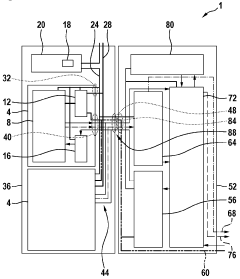
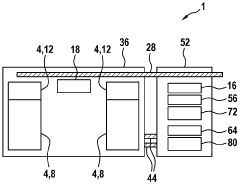
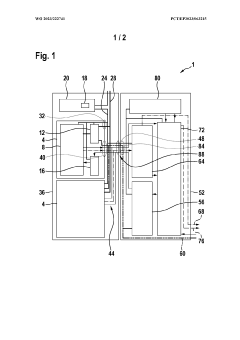
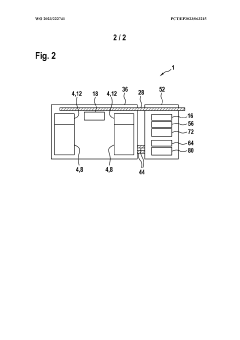
- A modular water electrolyzer system comprising electrolyzer, process, and control modules, designed for automated production, with standardized plug and flange connections, and a common busbar for electrical supply, allowing for faster and more cost-effective assembly and scalability.
Module for producing hydrogen and system having a plurality of modules of this type
PatentWO2023227568A2
Innovation
- A modular hydrogen production system comprising a buoyant support structure with integrated solar cells, electrolyzers, and water supply systems, allowing for flexible and scalable hydrogen production, with components designed for easy maintenance and operation, including hydrogen storage and energy generation, and the ability to connect multiple modules for increased capacity.


Scalability and Integration Challenges for Distributed Systems
Distributed hydrogen production systems face significant scalability and integration challenges that must be addressed for successful implementation. The modular nature of these systems presents unique difficulties when scaling from laboratory prototypes to commercial installations. One primary challenge is maintaining efficiency across different scales - small electrolyzer units often demonstrate promising performance in controlled environments, but efficiency can degrade when multiple units are integrated into larger systems due to uneven load distribution and thermal management issues.
Power supply integration represents another critical challenge. Distributed electrolyzers require stable power sources, yet many are designed to operate with renewable energy inputs that are inherently intermittent. This variability creates stress on electrolyzer components and reduces overall system lifespan. Advanced power electronics and control systems are necessary to buffer these fluctuations, adding complexity and cost to distributed installations.
Water management presents significant integration difficulties, particularly in remote locations. Modular electrolyzers require high-purity water, necessitating pre-treatment systems that must be appropriately sized for each installation. The water purification subsystems must scale proportionally with hydrogen production capacity while maintaining consistent water quality across distributed networks.
Heat management becomes increasingly complex in scaled distributed systems. While individual electrolyzer modules may effectively dissipate heat, clusters of units create thermal hotspots that can accelerate degradation of critical components. Integrated cooling systems must be designed to address these thermal challenges without significantly increasing parasitic energy consumption.
Network communication and control architecture pose substantial integration challenges. Distributed hydrogen production requires sophisticated monitoring and control systems to optimize performance across multiple units. Standardized communication protocols are lacking, creating interoperability issues between components from different manufacturers and limiting the flexibility of modular systems.
Maintenance logistics represent a practical scalability challenge often overlooked in technical assessments. Distributed systems require decentralized maintenance capabilities, which increases operational complexity compared to centralized production facilities. Predictive maintenance algorithms and remote monitoring capabilities must be developed specifically for distributed architectures to ensure reliable operation without excessive service requirements.
Regulatory compliance across diverse installation environments further complicates scalability. Safety standards for hydrogen production vary significantly between jurisdictions, requiring modular systems to incorporate adaptable safety features that can meet different regional requirements without complete redesign.
Power supply integration represents another critical challenge. Distributed electrolyzers require stable power sources, yet many are designed to operate with renewable energy inputs that are inherently intermittent. This variability creates stress on electrolyzer components and reduces overall system lifespan. Advanced power electronics and control systems are necessary to buffer these fluctuations, adding complexity and cost to distributed installations.
Water management presents significant integration difficulties, particularly in remote locations. Modular electrolyzers require high-purity water, necessitating pre-treatment systems that must be appropriately sized for each installation. The water purification subsystems must scale proportionally with hydrogen production capacity while maintaining consistent water quality across distributed networks.
Heat management becomes increasingly complex in scaled distributed systems. While individual electrolyzer modules may effectively dissipate heat, clusters of units create thermal hotspots that can accelerate degradation of critical components. Integrated cooling systems must be designed to address these thermal challenges without significantly increasing parasitic energy consumption.
Network communication and control architecture pose substantial integration challenges. Distributed hydrogen production requires sophisticated monitoring and control systems to optimize performance across multiple units. Standardized communication protocols are lacking, creating interoperability issues between components from different manufacturers and limiting the flexibility of modular systems.
Maintenance logistics represent a practical scalability challenge often overlooked in technical assessments. Distributed systems require decentralized maintenance capabilities, which increases operational complexity compared to centralized production facilities. Predictive maintenance algorithms and remote monitoring capabilities must be developed specifically for distributed architectures to ensure reliable operation without excessive service requirements.
Regulatory compliance across diverse installation environments further complicates scalability. Safety standards for hydrogen production vary significantly between jurisdictions, requiring modular systems to incorporate adaptable safety features that can meet different regional requirements without complete redesign.
Regulatory Framework and Green Hydrogen Incentives
The regulatory landscape for hydrogen production is rapidly evolving globally, with governments implementing various frameworks to accelerate the transition to green hydrogen. In the United States, the Inflation Reduction Act (IRA) offers production tax credits of up to $3/kg for green hydrogen, significantly improving the economics of modular electrolyzer deployment. This represents one of the most substantial incentives worldwide, potentially reducing production costs by 30-50% for qualifying projects.
The European Union has established the European Clean Hydrogen Alliance and allocated €470 billion through 2050 for hydrogen development. The EU Hydrogen Strategy specifically targets 40GW of electrolyzer capacity by 2030, with regulatory frameworks that include the Renewable Energy Directive II (RED II) establishing certification schemes for renewable hydrogen. These frameworks create a conducive environment for distributed hydrogen production using modular electrolyzers.
Japan and South Korea have implemented hydrogen roadmaps with specific subsidies for electrolyzer deployment. Japan's Green Innovation Fund allocates approximately $15 billion toward hydrogen technologies, while South Korea's Hydrogen Economy Roadmap includes tax incentives and direct subsidies for hydrogen production facilities.
Permitting processes for modular electrolyzers vary significantly by jurisdiction. Several countries have begun streamlining these processes specifically for small-scale hydrogen production. For instance, Germany's National Hydrogen Strategy includes provisions for expedited permitting of electrolyzers below 10MW capacity, recognizing the reduced environmental impact of distributed systems.
Grid connection regulations present both challenges and opportunities for modular electrolyzer deployment. In many regions, electrolyzers can qualify for grid services revenue streams through demand response programs, frequency regulation, and grid balancing services. However, grid connection fees and electricity surcharges remain significant barriers in some jurisdictions.
Carbon pricing mechanisms increasingly favor green hydrogen production. The EU Emissions Trading System (ETS) and similar carbon pricing schemes in Canada and parts of Asia improve the competitiveness of electrolytic hydrogen against fossil-derived alternatives. As carbon prices continue to rise—projected to reach €90-120/tonne CO2 in the EU by 2030—the economic case for modular electrolyzers strengthens considerably.
Safety standards and codes for hydrogen production are being harmonized internationally through organizations like ISO and IEC. These standards are increasingly recognizing the unique characteristics of modular systems, with specific provisions for distributed production scenarios that can simplify compliance for smaller installations.
The European Union has established the European Clean Hydrogen Alliance and allocated €470 billion through 2050 for hydrogen development. The EU Hydrogen Strategy specifically targets 40GW of electrolyzer capacity by 2030, with regulatory frameworks that include the Renewable Energy Directive II (RED II) establishing certification schemes for renewable hydrogen. These frameworks create a conducive environment for distributed hydrogen production using modular electrolyzers.
Japan and South Korea have implemented hydrogen roadmaps with specific subsidies for electrolyzer deployment. Japan's Green Innovation Fund allocates approximately $15 billion toward hydrogen technologies, while South Korea's Hydrogen Economy Roadmap includes tax incentives and direct subsidies for hydrogen production facilities.
Permitting processes for modular electrolyzers vary significantly by jurisdiction. Several countries have begun streamlining these processes specifically for small-scale hydrogen production. For instance, Germany's National Hydrogen Strategy includes provisions for expedited permitting of electrolyzers below 10MW capacity, recognizing the reduced environmental impact of distributed systems.
Grid connection regulations present both challenges and opportunities for modular electrolyzer deployment. In many regions, electrolyzers can qualify for grid services revenue streams through demand response programs, frequency regulation, and grid balancing services. However, grid connection fees and electricity surcharges remain significant barriers in some jurisdictions.
Carbon pricing mechanisms increasingly favor green hydrogen production. The EU Emissions Trading System (ETS) and similar carbon pricing schemes in Canada and parts of Asia improve the competitiveness of electrolytic hydrogen against fossil-derived alternatives. As carbon prices continue to rise—projected to reach €90-120/tonne CO2 in the EU by 2030—the economic case for modular electrolyzers strengthens considerably.
Safety standards and codes for hydrogen production are being harmonized internationally through organizations like ISO and IEC. These standards are increasingly recognizing the unique characteristics of modular systems, with specific provisions for distributed production scenarios that can simplify compliance for smaller installations.
Unlock deeper insights with Patsnap Eureka Quick Research — get a full tech report to explore trends and direct your research. Try now!
Generate Your Research Report Instantly with AI Agent
Supercharge your innovation with Patsnap Eureka AI Agent Platform!