
Optimize ATS Sensing to Reduce Nuisance Transfers
AUG 25, 20269 MIN READ
Generate Your Research Report Instantly with AI Agent
Patsnap Eureka helps you evaluate technical feasibility & market potential.
ATS Sensing Optimization Background and Objectives
Automatic Transfer Switch (ATS) systems serve as critical components in power distribution infrastructure, designed to automatically switch electrical loads between primary and backup power sources during utility outages or voltage anomalies. However, contemporary ATS implementations frequently experience nuisance transfers, which are unnecessary switching events triggered by transient power disturbances, voltage sags, or sensing inaccuracies that do not represent genuine power failures. These false transfers impose substantial operational costs, accelerate equipment wear, disrupt sensitive electronic loads, and compromise system reliability.
The persistent challenge of nuisance transfers stems from limitations in current sensing technologies and decision algorithms. Traditional ATS sensing mechanisms often employ simplistic voltage threshold detection with fixed time delays, lacking the sophistication to distinguish between momentary disturbances and actual power loss conditions. This results in premature switching decisions that unnecessarily engage backup generators or alternative power sources, leading to fuel consumption, mechanical stress on transfer contactors, and potential service interruptions for connected loads.
The primary objective of optimizing ATS sensing technology is to dramatically reduce the frequency of nuisance transfers while maintaining rapid response to legitimate power failures. This requires developing advanced sensing algorithms capable of analyzing multiple power quality parameters simultaneously, including voltage magnitude, frequency stability, harmonic distortion, and phase relationships. Enhanced discrimination between transient events and sustained outages represents a fundamental goal.
Secondary objectives encompass improving system intelligence through adaptive learning capabilities that can adjust sensitivity thresholds based on historical power quality patterns specific to each installation site. Integration of predictive analytics to anticipate power disturbances before they trigger transfers, and implementation of configurable ride-through capabilities for different load types constitute additional targets. Ultimately, the optimization effort aims to achieve a balance between protective responsiveness and operational stability, reducing unnecessary transfers by at least sixty percent while ensuring no increase in response time to actual power failures, thereby enhancing overall system reliability and reducing total cost of ownership for critical power infrastructure.
The persistent challenge of nuisance transfers stems from limitations in current sensing technologies and decision algorithms. Traditional ATS sensing mechanisms often employ simplistic voltage threshold detection with fixed time delays, lacking the sophistication to distinguish between momentary disturbances and actual power loss conditions. This results in premature switching decisions that unnecessarily engage backup generators or alternative power sources, leading to fuel consumption, mechanical stress on transfer contactors, and potential service interruptions for connected loads.
The primary objective of optimizing ATS sensing technology is to dramatically reduce the frequency of nuisance transfers while maintaining rapid response to legitimate power failures. This requires developing advanced sensing algorithms capable of analyzing multiple power quality parameters simultaneously, including voltage magnitude, frequency stability, harmonic distortion, and phase relationships. Enhanced discrimination between transient events and sustained outages represents a fundamental goal.
Secondary objectives encompass improving system intelligence through adaptive learning capabilities that can adjust sensitivity thresholds based on historical power quality patterns specific to each installation site. Integration of predictive analytics to anticipate power disturbances before they trigger transfers, and implementation of configurable ride-through capabilities for different load types constitute additional targets. Ultimately, the optimization effort aims to achieve a balance between protective responsiveness and operational stability, reducing unnecessary transfers by at least sixty percent while ensuring no increase in response time to actual power failures, thereby enhancing overall system reliability and reducing total cost of ownership for critical power infrastructure.
Market Demand for Reliable ATS Systems
The global market for Automatic Transfer Switch (ATS) systems is experiencing robust growth driven by escalating demands for uninterrupted power supply across critical infrastructure sectors. Data centers, healthcare facilities, telecommunications networks, and industrial manufacturing plants represent primary demand drivers, where even momentary power disruptions can result in substantial operational losses, safety hazards, and regulatory compliance failures. As digital transformation accelerates across industries, the dependency on continuous electrical power has intensified, positioning reliable ATS systems as essential components rather than optional safeguards.
Healthcare institutions exemplify the critical nature of this demand, where life-support equipment, surgical theaters, and emergency departments require seamless power transitions during utility failures. Similarly, the exponential growth of cloud computing and edge computing infrastructure has created unprecedented requirements for ATS reliability, as service level agreements increasingly mandate uptime percentages exceeding industry standards. Financial services, government facilities, and emergency response centers further amplify market demand, where power continuity directly correlates with operational integrity and public safety.
However, the market increasingly recognizes that traditional ATS reliability metrics focused solely on transfer speed are insufficient. End users now prioritize systems that minimize nuisance transfers—unnecessary switching events triggered by transient voltage fluctuations, frequency variations, or sensing inaccuracies. These false transfers introduce wear on electrical components, disrupt sensitive electronic equipment, and undermine user confidence in system performance. Industry feedback indicates that nuisance transfers represent a significant pain point, often resulting in costly service calls, equipment damage, and operational disruptions that negate the protective value of ATS installations.
This evolving market demand has created a clear differentiation opportunity for manufacturers who can deliver enhanced sensing intelligence. Procurement specifications increasingly incorporate requirements for adaptive sensing algorithms, configurable voltage and frequency thresholds, and predictive analytics capabilities that distinguish genuine power failures from transient disturbances. The market is shifting toward ATS solutions that combine rapid response capabilities with intelligent discrimination, reflecting a maturation beyond simple electromechanical switching toward sophisticated power management systems that balance protection with operational stability.
Healthcare institutions exemplify the critical nature of this demand, where life-support equipment, surgical theaters, and emergency departments require seamless power transitions during utility failures. Similarly, the exponential growth of cloud computing and edge computing infrastructure has created unprecedented requirements for ATS reliability, as service level agreements increasingly mandate uptime percentages exceeding industry standards. Financial services, government facilities, and emergency response centers further amplify market demand, where power continuity directly correlates with operational integrity and public safety.
However, the market increasingly recognizes that traditional ATS reliability metrics focused solely on transfer speed are insufficient. End users now prioritize systems that minimize nuisance transfers—unnecessary switching events triggered by transient voltage fluctuations, frequency variations, or sensing inaccuracies. These false transfers introduce wear on electrical components, disrupt sensitive electronic equipment, and undermine user confidence in system performance. Industry feedback indicates that nuisance transfers represent a significant pain point, often resulting in costly service calls, equipment damage, and operational disruptions that negate the protective value of ATS installations.
This evolving market demand has created a clear differentiation opportunity for manufacturers who can deliver enhanced sensing intelligence. Procurement specifications increasingly incorporate requirements for adaptive sensing algorithms, configurable voltage and frequency thresholds, and predictive analytics capabilities that distinguish genuine power failures from transient disturbances. The market is shifting toward ATS solutions that combine rapid response capabilities with intelligent discrimination, reflecting a maturation beyond simple electromechanical switching toward sophisticated power management systems that balance protection with operational stability.
Current ATS Sensing Challenges and Nuisance Transfer Issues
Automatic Transfer Switch (ATS) systems serve as critical components in power distribution networks, designed to seamlessly transition loads between primary and backup power sources during utility failures. However, current ATS sensing mechanisms face significant challenges that frequently result in nuisance transfers, where the system unnecessarily switches power sources despite the primary supply remaining within acceptable operational parameters. These false triggers not only reduce system reliability but also impose substantial operational costs and accelerate equipment wear.
The primary challenge stems from the sensitivity thresholds configured in traditional ATS sensing circuits. Most conventional systems rely on voltage and frequency monitoring to detect power quality issues. When utility voltage sags briefly below preset thresholds—often due to transient disturbances, motor starting events, or momentary grid fluctuations—the ATS interprets these temporary conditions as genuine power failures. This oversensitivity creates a fundamental dilemma: setting thresholds too tight causes excessive nuisance transfers, while loosening them risks delayed response during actual outages.
Voltage sag discrimination presents another critical obstacle. Current sensing technologies struggle to differentiate between momentary voltage dips lasting milliseconds and sustained undervoltage conditions requiring transfer action. Many existing ATS units employ simple time-delay mechanisms, but these fixed delays cannot adapt to varying power quality environments. Industrial facilities with heavy inductive loads or locations with poor utility infrastructure experience particularly high rates of false transfers due to frequent voltage transients.
Harmonic distortion and waveform irregularities further complicate accurate power quality assessment. Modern non-linear loads generate significant harmonic content that can distort voltage waveforms, potentially triggering nuisance transfers in ATS systems using basic RMS voltage sensing. The inability to distinguish between harmonic-induced voltage variations and genuine supply degradation represents a major technical constraint in current implementations.
Environmental factors and aging infrastructure compound these sensing challenges. Temperature variations affect component tolerances in analog sensing circuits, causing threshold drift over time. Electromagnetic interference from nearby equipment can introduce noise into sensing signals, while oxidation of electrical contacts may create intermittent resistance changes that mimic power quality issues. These factors collectively contribute to the high incidence of nuisance transfers observed across deployed ATS installations, highlighting the urgent need for more sophisticated sensing approaches.
The primary challenge stems from the sensitivity thresholds configured in traditional ATS sensing circuits. Most conventional systems rely on voltage and frequency monitoring to detect power quality issues. When utility voltage sags briefly below preset thresholds—often due to transient disturbances, motor starting events, or momentary grid fluctuations—the ATS interprets these temporary conditions as genuine power failures. This oversensitivity creates a fundamental dilemma: setting thresholds too tight causes excessive nuisance transfers, while loosening them risks delayed response during actual outages.
Voltage sag discrimination presents another critical obstacle. Current sensing technologies struggle to differentiate between momentary voltage dips lasting milliseconds and sustained undervoltage conditions requiring transfer action. Many existing ATS units employ simple time-delay mechanisms, but these fixed delays cannot adapt to varying power quality environments. Industrial facilities with heavy inductive loads or locations with poor utility infrastructure experience particularly high rates of false transfers due to frequent voltage transients.
Harmonic distortion and waveform irregularities further complicate accurate power quality assessment. Modern non-linear loads generate significant harmonic content that can distort voltage waveforms, potentially triggering nuisance transfers in ATS systems using basic RMS voltage sensing. The inability to distinguish between harmonic-induced voltage variations and genuine supply degradation represents a major technical constraint in current implementations.
Environmental factors and aging infrastructure compound these sensing challenges. Temperature variations affect component tolerances in analog sensing circuits, causing threshold drift over time. Electromagnetic interference from nearby equipment can introduce noise into sensing signals, while oxidation of electrical contacts may create intermittent resistance changes that mimic power quality issues. These factors collectively contribute to the high incidence of nuisance transfers observed across deployed ATS installations, highlighting the urgent need for more sophisticated sensing approaches.
Existing ATS Sensing Optimization Approaches
01 Advanced signal processing algorithms for nuisance transfer detection
Implementation of sophisticated signal processing techniques and algorithms to distinguish between genuine transfer conditions and nuisance transfers in automatic transfer switch systems. These methods analyze electrical parameters, waveform characteristics, and system behavior patterns to improve detection accuracy and reduce false triggering events.- Advanced signal processing algorithms for nuisance transfer detection: Implementation of sophisticated signal processing techniques and algorithms to distinguish between genuine transfer conditions and nuisance transfers in automatic transfer switch systems. These methods analyze electrical parameters, waveform characteristics, and system behavior patterns to improve detection accuracy and reduce false triggering events.
- Time delay and threshold adjustment mechanisms: Incorporation of adjustable time delay settings and dynamic threshold mechanisms to prevent premature or unnecessary transfer operations. These systems allow for configurable parameters that can be tuned based on specific application requirements and environmental conditions to minimize nuisance transfers while maintaining system reliability.
- Multi-parameter monitoring and analysis systems: Utilization of comprehensive monitoring systems that track multiple electrical parameters simultaneously, including voltage, frequency, phase relationships, and power quality metrics. By analyzing combinations of these parameters rather than single values, the system can better differentiate between actual power failures and transient disturbances that should not trigger transfers.
- Intelligent filtering and noise rejection techniques: Application of filtering methods and noise rejection circuits designed to eliminate electrical interference, transients, and other disturbances that could cause false transfer signals. These techniques help ensure that only legitimate power quality issues result in transfer operations, thereby reducing nuisance switching events.
- Adaptive learning and self-calibration features: Integration of adaptive control systems that learn from historical operating conditions and automatically adjust sensitivity settings to optimize performance. These systems can self-calibrate based on the specific electrical environment and load characteristics, continuously improving their ability to distinguish between nuisance conditions and genuine transfer requirements.
02 Time delay and threshold adjustment mechanisms
Incorporation of adjustable time delay settings and dynamic threshold mechanisms to prevent premature or unnecessary transfer operations. These systems allow for configurable delay periods and adaptive threshold values that can be tuned based on specific load requirements and power quality conditions to minimize nuisance transfers.Expand Specific Solutions03 Multi-parameter monitoring and analysis systems
Utilization of comprehensive monitoring systems that track multiple electrical parameters simultaneously, including voltage, frequency, phase angle, and power quality metrics. By analyzing combinations of these parameters rather than single values, the system can better differentiate between actual power failures and temporary disturbances that do not require transfer.Expand Specific Solutions04 Intelligent filtering and noise rejection techniques
Application of filtering methods and noise rejection circuits to eliminate transient disturbances, voltage spikes, and electromagnetic interference that could trigger false transfer operations. These techniques include digital filters, analog filtering circuits, and software-based noise cancellation algorithms that improve signal quality before decision-making.Expand Specific Solutions05 Adaptive learning and predictive control systems
Integration of adaptive learning capabilities and predictive control mechanisms that analyze historical data and system behavior patterns to optimize transfer decision-making. These systems can learn from past events, adjust sensitivity parameters automatically, and predict potential nuisance conditions before they trigger unnecessary transfers.Expand Specific Solutions
Key Players in ATS and Power Transfer Solutions
The optimization of ATS (Automatic Transfer Switch) sensing to reduce nuisance transfers represents a mature technology domain within the power management and telecommunications infrastructure sectors. The competitive landscape is characterized by established industry leaders including Qualcomm, Intel, Nokia Solutions & Networks, and Ericsson, who dominate the telecommunications infrastructure space, alongside power management specialists like Eaton Intelligent Power and ASCO Power Technologies. The market demonstrates significant scale driven by increasing demand for reliable power continuity in data centers, telecommunications networks, and critical infrastructure. Technology maturity varies across segments, with companies like Samsung Electronics, LG Electronics, and Microsoft Technology Licensing advancing intelligent sensing algorithms and IoT-enabled monitoring systems, while traditional players focus on hardware reliability improvements. The convergence of power electronics with smart grid technologies is reshaping competitive dynamics, creating opportunities for innovation in predictive analytics and AI-driven transfer decision systems.
QUALCOMM, Inc.
Technical Solution: Qualcomm has developed intelligent sensing technologies applicable to ATS systems through their power management and signal processing expertise, particularly in their Power Management IC (PMIC) solutions. Their approach leverages advanced analog-to-digital conversion with high sampling rates and low-latency digital signal processing to accurately detect power anomalies while filtering out noise and transients. The technology incorporates machine learning algorithms that can be trained to recognize site-specific power quality signatures and distinguish between events requiring transfer versus temporary disturbances. Qualcomm's sensing solutions feature adaptive threshold management that dynamically adjusts sensitivity based on historical data and environmental conditions. The system utilizes multi-sensor fusion techniques combining voltage, current, and frequency measurements to create a comprehensive power quality assessment before triggering transfer decisions.
Strengths: Advanced semiconductor technology and signal processing capabilities enable highly accurate and fast sensing; machine learning integration allows continuous improvement in transfer decision accuracy. Weaknesses: Primary focus on mobile and IoT power management rather than industrial ATS applications; limited market presence in traditional power transfer switch markets.
Intel Corp.
Technical Solution: Intel has developed intelligent power management technologies that can be applied to ATS sensing optimization through their embedded systems and edge computing platforms. Their solution approach involves deploying edge AI processors that analyze power quality data in real-time using trained neural networks to predict and classify power disturbances. The technology enables sophisticated pattern recognition that can differentiate between nuisance events (voltage sags, momentary interruptions, harmonic distortions) and genuine outages requiring transfer. Intel's platform supports high-frequency sampling and processing of multiple power parameters simultaneously, with latency under 1 millisecond for critical decision-making. The system incorporates predictive maintenance capabilities that monitor ATS component health and power quality trends to optimize sensing thresholds dynamically. Cloud connectivity enables fleet-wide learning where insights from multiple installations improve sensing algorithms across all deployed systems.
Strengths: Powerful edge computing capabilities enable sophisticated AI-based analysis for accurate disturbance classification; scalable platform supports continuous algorithm improvement through cloud connectivity. Weaknesses: Requires integration with traditional ATS hardware manufacturers; higher complexity and cost compared to conventional sensing approaches.
Core Innovations in Nuisance Transfer Reduction
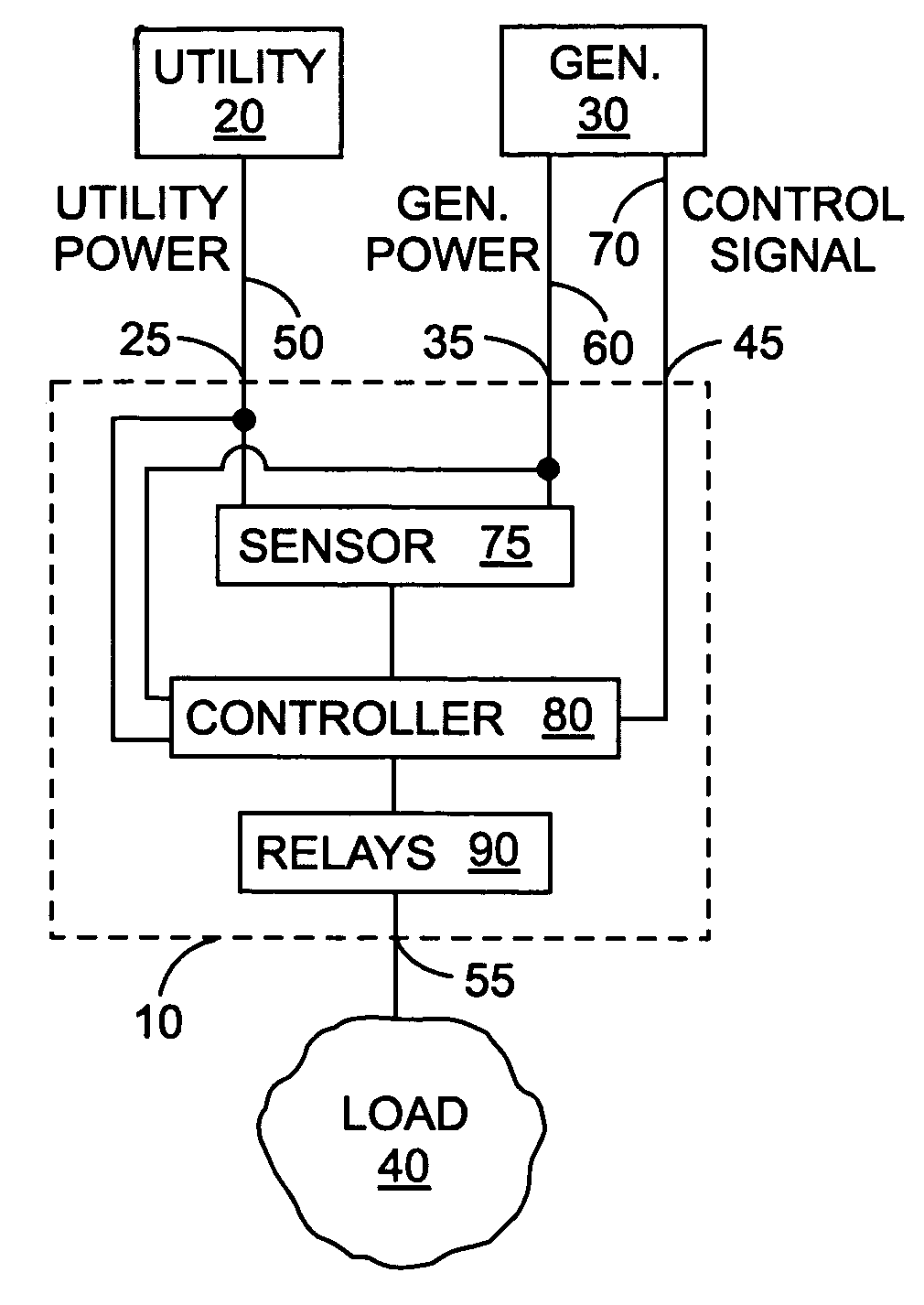
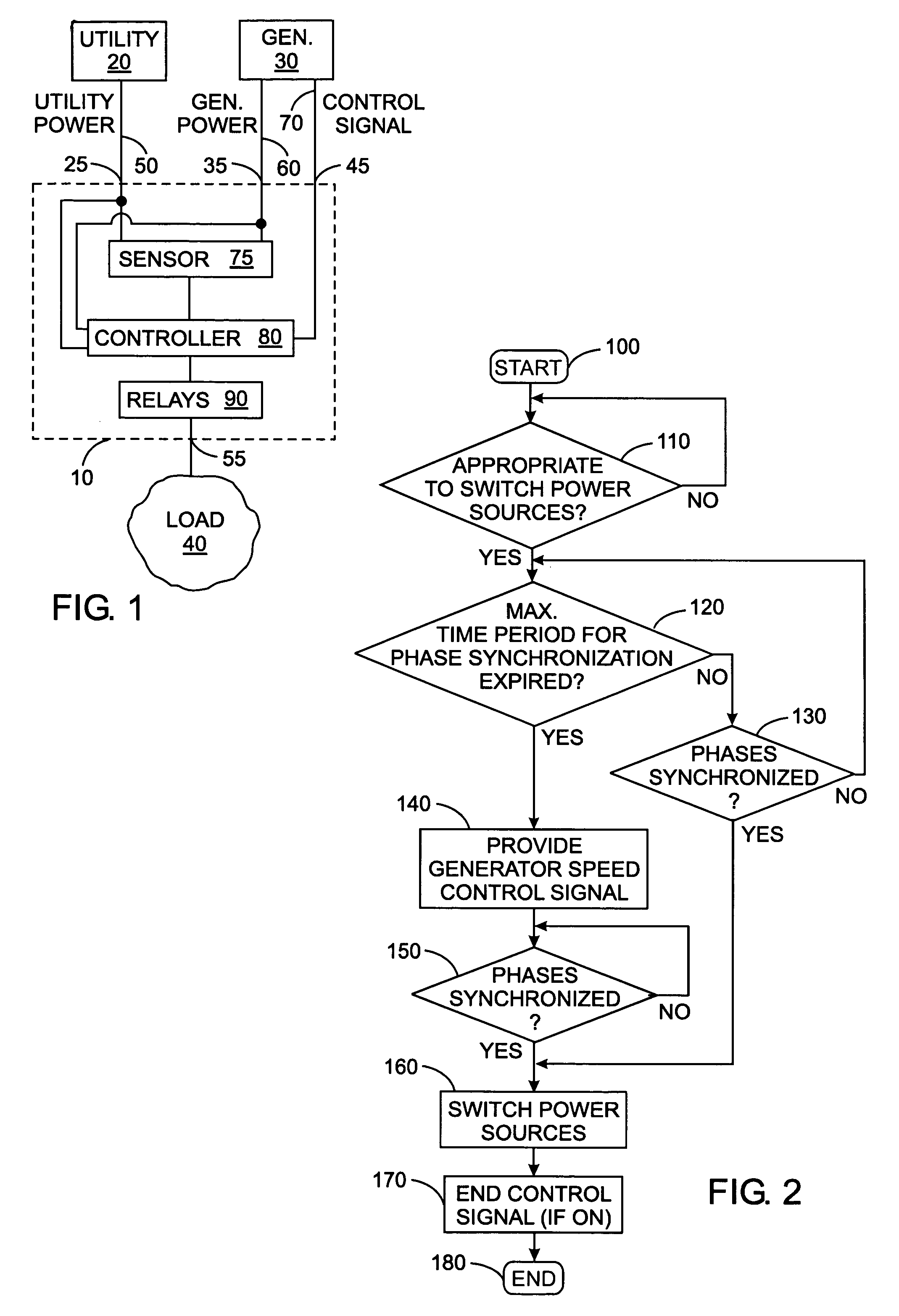
Automatic transfer switch system with synchronization control
PatentInactiveUS6980911B2
Innovation
- An ATS system that includes a sensing device to monitor phase synchronization between power sources, a control device to generate a speed control signal for the generator if synchronization is delayed, allowing the generator to adjust its frequency and synchronize with the utility power source more rapidly.
Method and apparatus for sensing voltage in an automatic transfer switch system
PatentInactiveUS20040169421A1
Innovation
- The implementation of high frequency line matching transformers operating between 200-4 kHz, coupled with a processing unit and temperature sensor, allows for accurate voltage sensing and switching between AC power sources, using a look-up table or empirically-derived equations to correlate sensed voltage, frequency, and temperature to determine actual voltage levels, thereby reducing system size and cost.


Grid Code and Standards for ATS Operations
The regulatory landscape governing Automatic Transfer Switch (ATS) operations plays a critical role in defining acceptable sensing parameters and transfer behaviors. International standards such as IEC 61439-6 and IEEE 1547 establish fundamental requirements for voltage and frequency deviation thresholds that trigger transfer actions. These standards typically mandate transfer initiation when utility voltage drops below 70-80% of nominal or exceeds 110-120%, with frequency deviations beyond ±3-5 Hz also requiring action. However, these broad ranges were primarily designed to ensure safety and equipment protection rather than optimizing operational efficiency or minimizing unnecessary transfers.
Regional grid codes introduce additional complexity by imposing jurisdiction-specific requirements that may conflict with nuisance transfer reduction objectives. For instance, certain European grid codes require faster transfer response times during voltage sags to maintain critical load continuity, while North American standards like NFPA 110 emphasize reliability over sensitivity optimization. These variations create challenges for manufacturers developing globally deployable ATS solutions, as overly conservative sensing parameters mandated in one region may lead to excessive nuisance transfers in more stable grid environments.
Recent regulatory developments reflect growing awareness of grid modernization impacts on ATS performance. Updated standards are beginning to incorporate provisions for adaptive sensing capabilities and ride-through requirements that allow ATS systems to tolerate transient disturbances without initiating transfers. The IEEE 1547-2018 revision, for example, introduces abnormal performance categories that permit configurable voltage and frequency ride-through settings, enabling better alignment between regulatory compliance and operational optimization.
Compliance with these evolving standards requires ATS manufacturers to implement flexible sensing architectures capable of meeting diverse regulatory requirements while incorporating intelligence to distinguish between genuine grid failures and transient anomalies. The challenge lies in developing sensing algorithms that satisfy mandatory safety thresholds while leveraging permissible adjustment ranges to reduce nuisance transfers, ultimately requiring close collaboration between standards bodies, utilities, and equipment manufacturers to harmonize technical requirements with operational realities.
Regional grid codes introduce additional complexity by imposing jurisdiction-specific requirements that may conflict with nuisance transfer reduction objectives. For instance, certain European grid codes require faster transfer response times during voltage sags to maintain critical load continuity, while North American standards like NFPA 110 emphasize reliability over sensitivity optimization. These variations create challenges for manufacturers developing globally deployable ATS solutions, as overly conservative sensing parameters mandated in one region may lead to excessive nuisance transfers in more stable grid environments.
Recent regulatory developments reflect growing awareness of grid modernization impacts on ATS performance. Updated standards are beginning to incorporate provisions for adaptive sensing capabilities and ride-through requirements that allow ATS systems to tolerate transient disturbances without initiating transfers. The IEEE 1547-2018 revision, for example, introduces abnormal performance categories that permit configurable voltage and frequency ride-through settings, enabling better alignment between regulatory compliance and operational optimization.
Compliance with these evolving standards requires ATS manufacturers to implement flexible sensing architectures capable of meeting diverse regulatory requirements while incorporating intelligence to distinguish between genuine grid failures and transient anomalies. The challenge lies in developing sensing algorithms that satisfy mandatory safety thresholds while leveraging permissible adjustment ranges to reduce nuisance transfers, ultimately requiring close collaboration between standards bodies, utilities, and equipment manufacturers to harmonize technical requirements with operational realities.
Cost-Benefit Analysis of ATS Sensing Upgrades
Implementing advanced ATS sensing technologies requires substantial upfront investment in hardware upgrades, software integration, and system commissioning. Initial capital expenditures typically include high-precision voltage and frequency sensors, enhanced microprocessor-based control units, and communication infrastructure for real-time data exchange. Installation costs encompass engineering design, equipment procurement, labor for retrofitting existing systems, and comprehensive testing protocols. Organizations must also account for training expenses to ensure maintenance personnel can effectively operate and troubleshoot upgraded systems.
The operational benefits of optimized ATS sensing manifest through multiple revenue-preserving and cost-avoidance mechanisms. Reduced nuisance transfers directly translate to decreased equipment wear on both ATS components and connected loads, extending asset lifespan by an estimated 15-25% based on industry data. Minimizing unnecessary switching events prevents production interruptions that typically cost industrial facilities between $10,000 to $50,000 per incident depending on sector and scale. Enhanced sensing accuracy also reduces energy waste associated with premature generator starts, yielding annual fuel savings of 8-12% in facilities with frequent power quality disturbances.
Risk mitigation represents a critical but often undervalued benefit component. Improved discrimination between actual power failures and transient disturbances reduces liability exposure from false transfers that can damage sensitive electronic equipment. Insurance premium reductions of 5-8% are achievable when facilities demonstrate advanced power management capabilities. Additionally, regulatory compliance becomes more manageable as modern sensing systems provide detailed event logging and analytics that satisfy increasingly stringent power quality documentation requirements.
The payback period for ATS sensing upgrades varies significantly based on facility criticality and existing infrastructure age. Data centers and healthcare facilities typically achieve return on investment within 18-36 months due to high downtime costs and frequent power quality events. Manufacturing operations with moderate sensitivity generally realize payback in 3-5 years, while commercial buildings may require 5-7 years. Lifecycle analysis over a 15-year horizon consistently demonstrates net positive value, with benefit-to-cost ratios ranging from 2.5:1 to 4.5:1 depending on application context and local power grid reliability characteristics.
The operational benefits of optimized ATS sensing manifest through multiple revenue-preserving and cost-avoidance mechanisms. Reduced nuisance transfers directly translate to decreased equipment wear on both ATS components and connected loads, extending asset lifespan by an estimated 15-25% based on industry data. Minimizing unnecessary switching events prevents production interruptions that typically cost industrial facilities between $10,000 to $50,000 per incident depending on sector and scale. Enhanced sensing accuracy also reduces energy waste associated with premature generator starts, yielding annual fuel savings of 8-12% in facilities with frequent power quality disturbances.
Risk mitigation represents a critical but often undervalued benefit component. Improved discrimination between actual power failures and transient disturbances reduces liability exposure from false transfers that can damage sensitive electronic equipment. Insurance premium reductions of 5-8% are achievable when facilities demonstrate advanced power management capabilities. Additionally, regulatory compliance becomes more manageable as modern sensing systems provide detailed event logging and analytics that satisfy increasingly stringent power quality documentation requirements.
The payback period for ATS sensing upgrades varies significantly based on facility criticality and existing infrastructure age. Data centers and healthcare facilities typically achieve return on investment within 18-36 months due to high downtime costs and frequent power quality events. Manufacturing operations with moderate sensitivity generally realize payback in 3-5 years, while commercial buildings may require 5-7 years. Lifecycle analysis over a 15-year horizon consistently demonstrates net positive value, with benefit-to-cost ratios ranging from 2.5:1 to 4.5:1 depending on application context and local power grid reliability characteristics.
Unlock deeper insights with Patsnap Eureka Quick Research — get a full tech report to explore trends and direct your research. Try now!
Generate Your Research Report Instantly with AI Agent
Supercharge your innovation with Patsnap Eureka AI Agent Platform!