

Optimize Boron Carbide Bonding for Structural Components
JUN 9, 20269 MIN READ
Generate Your Research Report Instantly with AI Agent
PatSnap Eureka helps you evaluate technical feasibility & market potential.
Boron Carbide Bonding Background and Structural Goals
Boron carbide (B4C) represents one of the hardest known materials, ranking third after diamond and cubic boron nitride on the Mohs hardness scale. This ultra-hard ceramic material has garnered significant attention in structural applications due to its exceptional properties, including low density, high melting point, and superior wear resistance. The development of boron carbide as a structural material traces back to the early 20th century when it was first synthesized, but its practical applications remained limited due to processing challenges and bonding difficulties.
The evolution of boron carbide utilization has progressed through distinct phases, beginning with its initial use in abrasive applications during the 1930s. The aerospace and defense industries later recognized its potential for lightweight armor systems in the 1960s, driving research into structural applications. However, the inherent brittleness and poor sinterability of boron carbide presented significant obstacles to its widespread adoption in load-bearing components.
Contemporary research focuses on overcoming the fundamental challenge of achieving reliable bonding in boron carbide structural components. The material's covalent bonding structure and low self-diffusion coefficient create difficulties in conventional sintering processes, often resulting in components with inadequate mechanical properties for structural applications. These limitations have historically restricted boron carbide to specialized applications where its unique properties outweigh processing complexities.
Current technological objectives center on developing advanced bonding techniques that can harness boron carbide's exceptional hardness while addressing its inherent brittleness. Key goals include achieving near-theoretical density in sintered components, improving fracture toughness through microstructural optimization, and establishing reliable joining methods for complex geometries. The integration of additive manufacturing techniques with optimized bonding processes represents a promising avenue for expanding structural applications.
The strategic importance of optimizing boron carbide bonding extends beyond traditional applications, encompassing emerging fields such as nuclear reactor components, high-temperature structural elements, and next-generation protective systems. Success in this domain could revolutionize industries requiring materials that combine extreme hardness with structural integrity under demanding operational conditions.
The evolution of boron carbide utilization has progressed through distinct phases, beginning with its initial use in abrasive applications during the 1930s. The aerospace and defense industries later recognized its potential for lightweight armor systems in the 1960s, driving research into structural applications. However, the inherent brittleness and poor sinterability of boron carbide presented significant obstacles to its widespread adoption in load-bearing components.
Contemporary research focuses on overcoming the fundamental challenge of achieving reliable bonding in boron carbide structural components. The material's covalent bonding structure and low self-diffusion coefficient create difficulties in conventional sintering processes, often resulting in components with inadequate mechanical properties for structural applications. These limitations have historically restricted boron carbide to specialized applications where its unique properties outweigh processing complexities.
Current technological objectives center on developing advanced bonding techniques that can harness boron carbide's exceptional hardness while addressing its inherent brittleness. Key goals include achieving near-theoretical density in sintered components, improving fracture toughness through microstructural optimization, and establishing reliable joining methods for complex geometries. The integration of additive manufacturing techniques with optimized bonding processes represents a promising avenue for expanding structural applications.
The strategic importance of optimizing boron carbide bonding extends beyond traditional applications, encompassing emerging fields such as nuclear reactor components, high-temperature structural elements, and next-generation protective systems. Success in this domain could revolutionize industries requiring materials that combine extreme hardness with structural integrity under demanding operational conditions.
Market Demand for Advanced Ceramic Structural Components
The global market for advanced ceramic structural components is experiencing unprecedented growth driven by increasing demands across multiple high-performance industries. Aerospace and defense sectors represent the largest consumption segments, where the exceptional properties of boron carbide and similar advanced ceramics are essential for applications requiring superior hardness, lightweight characteristics, and ballistic protection capabilities. The automotive industry is emerging as a significant growth driver, particularly with the expansion of electric vehicles requiring lightweight yet durable structural materials for battery protection systems and high-performance brake components.
Industrial manufacturing sectors are increasingly adopting advanced ceramic structural components for wear-resistant applications, cutting tools, and high-temperature processing equipment. The semiconductor industry's continuous expansion has created substantial demand for precision ceramic components used in wafer processing and electronic packaging applications. Nuclear energy applications represent another critical market segment, where boron carbide's neutron absorption properties make it indispensable for control rod assemblies and radiation shielding structures.
Market growth is significantly influenced by the ongoing technological advancement in manufacturing processes and the increasing emphasis on material performance optimization. Industries are seeking components that can withstand extreme operating conditions while maintaining dimensional stability and structural integrity. The trend toward miniaturization in electronics and the development of next-generation aerospace systems are creating new application opportunities for advanced ceramic structural components with enhanced bonding characteristics.
Regional market dynamics show strong demand concentration in North America, Europe, and Asia-Pacific regions, with emerging markets beginning to adopt these advanced materials for infrastructure and industrial applications. The market expansion is supported by increasing research and development investments focused on improving ceramic bonding technologies and manufacturing scalability.
Supply chain considerations and raw material availability continue to influence market dynamics, with manufacturers seeking reliable sources of high-purity boron carbide and compatible bonding agents. The market trajectory indicates sustained growth potential, driven by the continuous development of new applications and the increasing recognition of advanced ceramics as critical materials for next-generation technological solutions across diverse industrial sectors.
Industrial manufacturing sectors are increasingly adopting advanced ceramic structural components for wear-resistant applications, cutting tools, and high-temperature processing equipment. The semiconductor industry's continuous expansion has created substantial demand for precision ceramic components used in wafer processing and electronic packaging applications. Nuclear energy applications represent another critical market segment, where boron carbide's neutron absorption properties make it indispensable for control rod assemblies and radiation shielding structures.
Market growth is significantly influenced by the ongoing technological advancement in manufacturing processes and the increasing emphasis on material performance optimization. Industries are seeking components that can withstand extreme operating conditions while maintaining dimensional stability and structural integrity. The trend toward miniaturization in electronics and the development of next-generation aerospace systems are creating new application opportunities for advanced ceramic structural components with enhanced bonding characteristics.
Regional market dynamics show strong demand concentration in North America, Europe, and Asia-Pacific regions, with emerging markets beginning to adopt these advanced materials for infrastructure and industrial applications. The market expansion is supported by increasing research and development investments focused on improving ceramic bonding technologies and manufacturing scalability.
Supply chain considerations and raw material availability continue to influence market dynamics, with manufacturers seeking reliable sources of high-purity boron carbide and compatible bonding agents. The market trajectory indicates sustained growth potential, driven by the continuous development of new applications and the increasing recognition of advanced ceramics as critical materials for next-generation technological solutions across diverse industrial sectors.
Current Bonding Challenges in Boron Carbide Applications
Boron carbide (B4C) faces significant bonding challenges that limit its widespread adoption in structural applications despite its exceptional properties. The primary obstacle stems from the material's inherent covalent bonding structure and low surface energy, which create poor wettability with conventional bonding agents and adhesives. This fundamental incompatibility results in weak interfacial adhesion between boron carbide components and other materials in composite structures.
The high hardness and chemical inertness of boron carbide present additional complications for mechanical bonding methods. Traditional fastening techniques often fail due to the material's brittleness, which leads to crack initiation and propagation under stress concentration points. The coefficient of thermal expansion mismatch between boron carbide and metallic bonding materials creates thermal stress concentrations that compromise joint integrity during temperature cycling.
Surface preparation represents another critical challenge in boron carbide bonding applications. The material's resistance to chemical etching and surface modification techniques limits the effectiveness of conventional surface treatment methods. Standard cleaning and activation processes that work well with metals and ceramics often prove inadequate for creating reactive surface sites on boron carbide substrates.
Diffusion bonding processes encounter difficulties due to boron carbide's low atomic mobility at practical processing temperatures. The high temperatures required for effective diffusion bonding often exceed the thermal stability limits of surrounding materials or cause unwanted phase transformations. Additionally, the formation of brittle intermetallic compounds at bonding interfaces frequently occurs, leading to reduced mechanical properties and premature failure.
Chemical compatibility issues arise when attempting to bond boron carbide with reactive metals or alloys. The formation of carbide phases and boride compounds can create brittle interfacial layers that act as stress concentrators. These reaction products often exhibit different thermal expansion characteristics, further exacerbating thermal stress problems in service conditions.
The limited availability of specialized bonding agents designed specifically for boron carbide applications constrains manufacturing options. Most commercial adhesives and brazing materials are optimized for conventional engineering materials and demonstrate poor performance with boron carbide substrates. This limitation forces manufacturers to rely on suboptimal bonding solutions that compromise overall structural performance and reliability.
The high hardness and chemical inertness of boron carbide present additional complications for mechanical bonding methods. Traditional fastening techniques often fail due to the material's brittleness, which leads to crack initiation and propagation under stress concentration points. The coefficient of thermal expansion mismatch between boron carbide and metallic bonding materials creates thermal stress concentrations that compromise joint integrity during temperature cycling.
Surface preparation represents another critical challenge in boron carbide bonding applications. The material's resistance to chemical etching and surface modification techniques limits the effectiveness of conventional surface treatment methods. Standard cleaning and activation processes that work well with metals and ceramics often prove inadequate for creating reactive surface sites on boron carbide substrates.
Diffusion bonding processes encounter difficulties due to boron carbide's low atomic mobility at practical processing temperatures. The high temperatures required for effective diffusion bonding often exceed the thermal stability limits of surrounding materials or cause unwanted phase transformations. Additionally, the formation of brittle intermetallic compounds at bonding interfaces frequently occurs, leading to reduced mechanical properties and premature failure.
Chemical compatibility issues arise when attempting to bond boron carbide with reactive metals or alloys. The formation of carbide phases and boride compounds can create brittle interfacial layers that act as stress concentrators. These reaction products often exhibit different thermal expansion characteristics, further exacerbating thermal stress problems in service conditions.
The limited availability of specialized bonding agents designed specifically for boron carbide applications constrains manufacturing options. Most commercial adhesives and brazing materials are optimized for conventional engineering materials and demonstrate poor performance with boron carbide substrates. This limitation forces manufacturers to rely on suboptimal bonding solutions that compromise overall structural performance and reliability.
Existing Boron Carbide Bonding Solutions
01 Sintering and densification methods for boron carbide bonding
Various sintering techniques are employed to achieve strong bonding in boron carbide materials. These methods involve controlling temperature, pressure, and atmosphere conditions to promote particle bonding and reduce porosity. Hot pressing, spark plasma sintering, and pressureless sintering are commonly used approaches that enhance the mechanical properties and structural integrity of boron carbide components through improved inter-particle bonding mechanisms.- Sintering and hot pressing techniques for boron carbide bonding: Various sintering and hot pressing methods are employed to achieve strong bonding in boron carbide materials. These techniques involve applying controlled temperature and pressure conditions to promote particle-to-particle bonding and densification. The processes typically require specific temperature ranges and pressure applications to optimize the mechanical properties and structural integrity of the final bonded boron carbide components.
- Binder systems and additives for boron carbide consolidation: Different binder materials and chemical additives are utilized to enhance the bonding characteristics of boron carbide particles. These systems help improve the consolidation process by providing intermediate bonding phases that facilitate particle adhesion and reduce porosity. The selection of appropriate binders is crucial for achieving desired mechanical properties while maintaining the inherent characteristics of boron carbide.
- Composite formation with boron carbide matrix bonding: Boron carbide serves as a matrix material in composite structures where bonding mechanisms involve the integration of reinforcing phases or secondary materials. These composite systems rely on interfacial bonding between boron carbide and other constituents to achieve enhanced properties such as improved toughness, thermal conductivity, or specific mechanical characteristics tailored for particular applications.
- Surface treatment and activation methods for improved bonding: Surface modification techniques are applied to boron carbide particles or substrates to enhance bonding effectiveness. These methods involve chemical or physical treatments that alter surface properties, increase surface area, or introduce reactive sites that promote better adhesion between particles or between boron carbide and other materials during the bonding process.
- Joining and brazing techniques for boron carbide components: Specialized joining methods including brazing and welding techniques are developed for connecting boron carbide components or bonding them to dissimilar materials. These processes require careful selection of filler materials and processing parameters to achieve reliable joints while preserving the properties of the base boron carbide material and ensuring compatibility between different materials in the assembly.
02 Additive systems for enhanced boron carbide bonding
The incorporation of specific additives and binder systems significantly improves the bonding characteristics of boron carbide materials. These additives act as sintering aids, flux agents, or bonding promoters that facilitate particle-to-particle adhesion and reduce processing temperatures. The selection and optimization of additive compositions are crucial for achieving desired mechanical properties and bonding strength in the final product.Expand Specific Solutions03 Surface treatment and activation for improved bonding
Surface modification techniques are employed to enhance the bonding capability of boron carbide particles or substrates. These treatments involve chemical, physical, or thermal processes that alter surface chemistry, increase surface area, or create reactive sites that promote better adhesion. Surface activation methods are particularly important when bonding boron carbide to other materials or when preparing composite structures.Expand Specific Solutions04 Composite formation and interfacial bonding
The development of boron carbide composites requires careful attention to interfacial bonding between the carbide phase and matrix or reinforcement materials. This involves understanding the chemical compatibility, thermal expansion matching, and mechanical interlocking mechanisms that contribute to strong composite structures. Processing parameters and material selection play critical roles in achieving optimal interfacial bonding strength.Expand Specific Solutions05 Joining and assembly techniques for boron carbide components
Specialized joining methods are required to bond boron carbide components together or to other materials in assembly applications. These techniques include brazing, diffusion bonding, adhesive bonding, and mechanical fastening methods. The selection of appropriate joining techniques depends on the application requirements, operating conditions, and the need to maintain the inherent properties of boron carbide while achieving reliable structural connections.Expand Specific Solutions
Key Players in Advanced Ceramics and Bonding Industry
The boron carbide bonding optimization field represents a mature yet evolving technology sector within the advanced ceramics industry, currently in a growth phase driven by increasing demand for lightweight, high-strength structural components in aerospace and defense applications. The market demonstrates significant potential with established players like Dow Global Technologies LLC and Goodrich Corp. leading chemical and aerospace applications, while specialized materials companies including Plansee SE and Elektroschmelzwerk Kempten GmbH focus on refractory metal technologies. Technology maturity varies across applications, with companies like Siemens AG and Honeywell International Technologies Ltd. advancing industrial implementations, while research institutions such as Shanghai Institute of Ceramics and Max Planck Gesellschaft drive fundamental innovations. The competitive landscape shows strong collaboration between industrial manufacturers like Resonac Holdings Corp. and academic institutions including École Polytechnique Fédérale de Lausanne, indicating robust R&D investment supporting continued technological advancement in bonding methodologies and structural integration techniques.
Dow Global Technologies LLC
Technical Solution: Dow Global Technologies has developed polymer-based bonding systems specifically designed for boron carbide structural components. Their technology involves high-performance thermosetting resins with enhanced thermal stability and mechanical properties optimized for boron carbide reinforcement. The company utilizes advanced polymer chemistry to create strong interfacial adhesion through chemical bonding mechanisms and controlled crosslinking processes. Their solutions include development of hybrid organic-inorganic systems that provide flexibility while maintaining structural integrity under demanding service conditions.
Strengths: Advanced polymer chemistry expertise and established manufacturing infrastructure for specialty materials. Weaknesses: Temperature limitations of polymer-based systems restrict applications in high-temperature environments.
Goodrich Corp.
Technical Solution: Goodrich Corporation has developed specialized boron carbide bonding technologies for aerospace structural applications. Their approach utilizes advanced brazing techniques with custom-formulated metallic interlayers to create robust joints between boron carbide components and metallic structures. The company employs vacuum brazing processes with precisely controlled temperature profiles to minimize thermal stress and prevent degradation of boron carbide properties. Their solutions include development of transition joints that accommodate thermal expansion differences between boron carbide and structural metals.
Strengths: Extensive aerospace industry experience and established qualification processes for critical applications. Weaknesses: Solutions primarily focused on aerospace applications with limited adaptation to other industrial sectors.
Core Innovations in B4C Bonding Mechanisms
Boron carbide-containing ceramic bonded body and method for producing the bonded body
PatentWO2012029816A1
Innovation
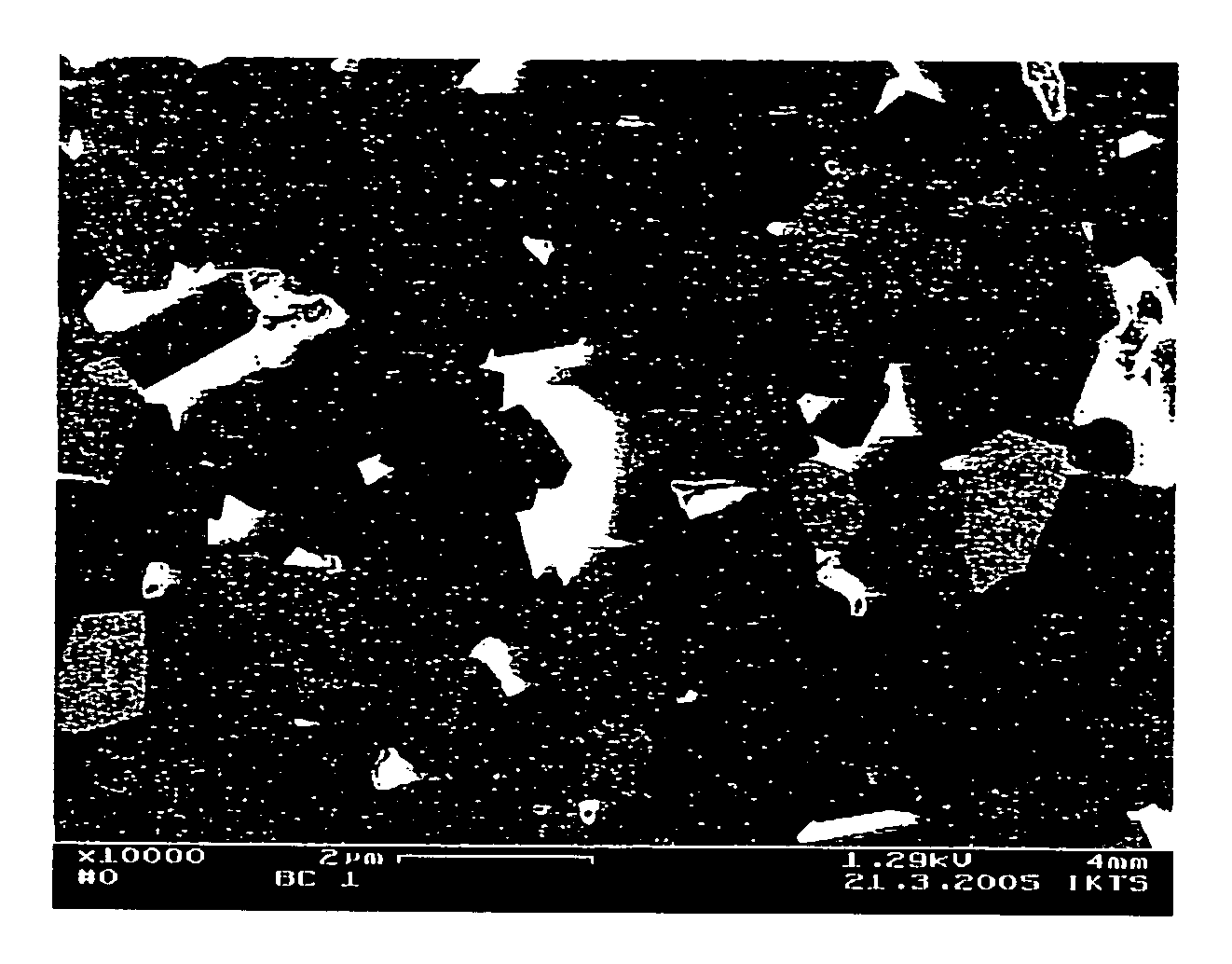
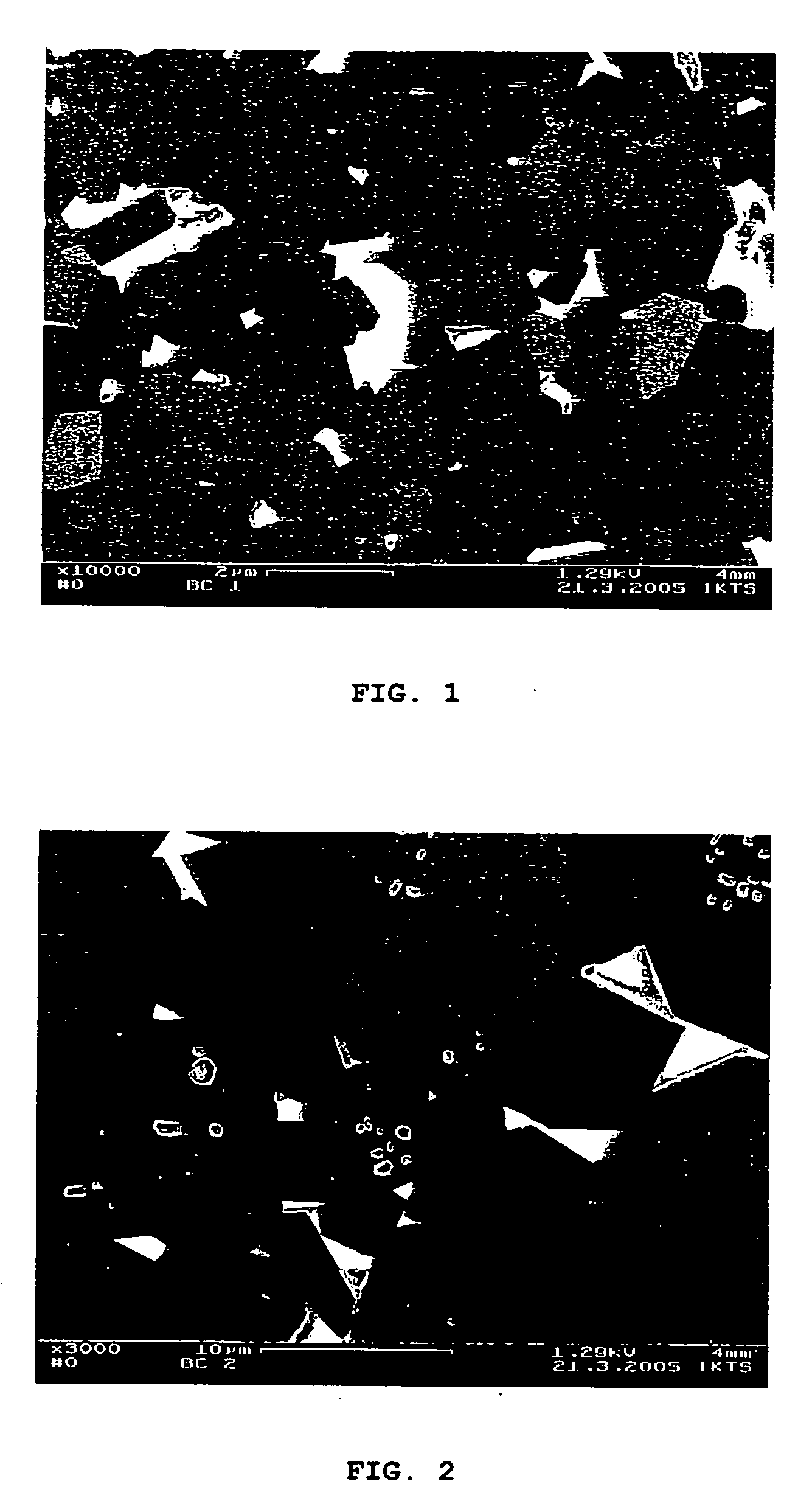
- A method involving the use of a bonding layer with metals like aluminum, copper, gold, or zirconium, or their compounds, applied as foils, pastes, or vapor deposition layers, to join boron carbide-containing ceramic members, achieving bonding strengths of 100 MPa or more and improved chemical resistance by heating within specific temperature ranges.


Lightweight boron carbide materials with improved mechanical properties and process for their manufacture
PatentInactiveUS20070010391A1
Innovation
- The development of substantially pore-free boron carbide sintered bodies with a rare earth aluminate as the main component of the oxide binder phase, achieved through low-temperature, low-pressure hot pressing, which maintains a density below 2.60 g/cm3 and enhances mechanical properties such as hardness and fracture toughness.
Manufacturing Standards for Ceramic Structural Components
The manufacturing of boron carbide structural components requires adherence to stringent standards that ensure consistent quality, performance, and reliability across production batches. Current manufacturing standards for ceramic structural components encompass material specifications, processing parameters, quality control protocols, and testing methodologies specifically tailored to the unique properties of boron carbide.
Material purity standards mandate that boron carbide powders used in structural applications must maintain a minimum purity level of 98.5%, with controlled particle size distribution typically ranging from 0.5 to 10 micrometers. Impurity content, particularly free carbon and boron oxide, must be limited to prevent degradation of mechanical properties and bonding effectiveness. Chemical composition verification through X-ray fluorescence spectroscopy and inductively coupled plasma analysis ensures compliance with these specifications.
Processing standards define critical parameters for powder preparation, forming, and sintering operations. Green density requirements typically specify 55-65% of theoretical density to ensure adequate particle packing while maintaining sufficient porosity for binder removal. Pressing pressures are standardized between 50-200 MPa depending on component geometry and desired final properties.
Sintering protocols establish temperature profiles ranging from 2100°C to 2250°C under controlled atmospheric conditions, with heating rates not exceeding 5°C per minute to prevent thermal shock and ensure uniform densification. Dwell times at maximum temperature are standardized based on component thickness and desired final density, typically ranging from 2 to 6 hours.
Quality control standards mandate comprehensive testing protocols including density measurements, porosity analysis, and mechanical property evaluation. Dimensional tolerances are specified according to component function, with typical requirements of ±0.1% for critical dimensions. Surface finish standards define acceptable roughness parameters and defect limitations.
Non-destructive testing protocols incorporate ultrasonic inspection, X-ray radiography, and visual examination to detect internal flaws, cracks, or bonding defects that could compromise structural integrity. These standards ensure that manufactured components meet performance requirements while maintaining cost-effectiveness and production efficiency.
Material purity standards mandate that boron carbide powders used in structural applications must maintain a minimum purity level of 98.5%, with controlled particle size distribution typically ranging from 0.5 to 10 micrometers. Impurity content, particularly free carbon and boron oxide, must be limited to prevent degradation of mechanical properties and bonding effectiveness. Chemical composition verification through X-ray fluorescence spectroscopy and inductively coupled plasma analysis ensures compliance with these specifications.
Processing standards define critical parameters for powder preparation, forming, and sintering operations. Green density requirements typically specify 55-65% of theoretical density to ensure adequate particle packing while maintaining sufficient porosity for binder removal. Pressing pressures are standardized between 50-200 MPa depending on component geometry and desired final properties.
Sintering protocols establish temperature profiles ranging from 2100°C to 2250°C under controlled atmospheric conditions, with heating rates not exceeding 5°C per minute to prevent thermal shock and ensure uniform densification. Dwell times at maximum temperature are standardized based on component thickness and desired final density, typically ranging from 2 to 6 hours.
Quality control standards mandate comprehensive testing protocols including density measurements, porosity analysis, and mechanical property evaluation. Dimensional tolerances are specified according to component function, with typical requirements of ±0.1% for critical dimensions. Surface finish standards define acceptable roughness parameters and defect limitations.
Non-destructive testing protocols incorporate ultrasonic inspection, X-ray radiography, and visual examination to detect internal flaws, cracks, or bonding defects that could compromise structural integrity. These standards ensure that manufactured components meet performance requirements while maintaining cost-effectiveness and production efficiency.
Environmental Impact of Boron Carbide Processing
The environmental implications of boron carbide processing present significant challenges that directly impact the optimization of bonding mechanisms for structural components. Traditional manufacturing processes involve high-temperature synthesis methods, typically requiring temperatures exceeding 2000°C, which result in substantial energy consumption and associated carbon emissions. The carbothermal reduction process, commonly used for boron carbide production, generates considerable amounts of carbon monoxide and carbon dioxide as byproducts.
Raw material extraction poses additional environmental concerns, particularly regarding boron mining operations. These activities can lead to soil contamination and groundwater pollution due to the chemical processing required to extract boron compounds from natural deposits. The mining process often involves the use of acids and other chemicals that require careful waste management to prevent environmental degradation.
Processing waste streams represent another critical environmental factor. The production of high-purity boron carbide generates various waste materials, including unreacted carbon residues, boron oxide byproducts, and contaminated process water. These waste streams require specialized treatment and disposal methods, adding complexity and cost to the overall manufacturing process. The presence of fine particulate matter during grinding and milling operations also raises concerns about air quality and worker safety.
Water consumption during processing represents a significant environmental burden, particularly in regions where water resources are scarce. The cooling and cleaning processes required for boron carbide manufacturing consume substantial quantities of water, which must be treated before discharge to meet environmental regulations.
Recent developments in green processing technologies are beginning to address these environmental challenges. Alternative synthesis methods, such as microwave-assisted processing and plasma-enhanced techniques, offer potential reductions in energy consumption and processing temperatures. These innovations not only reduce environmental impact but also influence the microstructural characteristics of boron carbide, potentially improving bonding performance in structural applications.
The implementation of circular economy principles in boron carbide processing is gaining attention, with research focusing on recycling strategies for end-of-life components and waste material recovery. These approaches aim to minimize raw material consumption while reducing overall environmental footprint throughout the product lifecycle.
Raw material extraction poses additional environmental concerns, particularly regarding boron mining operations. These activities can lead to soil contamination and groundwater pollution due to the chemical processing required to extract boron compounds from natural deposits. The mining process often involves the use of acids and other chemicals that require careful waste management to prevent environmental degradation.
Processing waste streams represent another critical environmental factor. The production of high-purity boron carbide generates various waste materials, including unreacted carbon residues, boron oxide byproducts, and contaminated process water. These waste streams require specialized treatment and disposal methods, adding complexity and cost to the overall manufacturing process. The presence of fine particulate matter during grinding and milling operations also raises concerns about air quality and worker safety.
Water consumption during processing represents a significant environmental burden, particularly in regions where water resources are scarce. The cooling and cleaning processes required for boron carbide manufacturing consume substantial quantities of water, which must be treated before discharge to meet environmental regulations.
Recent developments in green processing technologies are beginning to address these environmental challenges. Alternative synthesis methods, such as microwave-assisted processing and plasma-enhanced techniques, offer potential reductions in energy consumption and processing temperatures. These innovations not only reduce environmental impact but also influence the microstructural characteristics of boron carbide, potentially improving bonding performance in structural applications.
The implementation of circular economy principles in boron carbide processing is gaining attention, with research focusing on recycling strategies for end-of-life components and waste material recovery. These approaches aim to minimize raw material consumption while reducing overall environmental footprint throughout the product lifecycle.
Unlock deeper insights with PatSnap Eureka Quick Research — get a full tech report to explore trends and direct your research. Try now!
Generate Your Research Report Instantly with AI Agent
Supercharge your innovation with PatSnap Eureka AI Agent Platform!