
Optimize Lithium Battery Recycling for Cost Efficiency
FEB 25, 20269 MIN READ
Generate Your Research Report Instantly with AI Agent
Patsnap Eureka helps you evaluate technical feasibility & market potential.
Lithium Battery Recycling Background and Objectives
Lithium-ion batteries have become the dominant energy storage technology powering electric vehicles, consumer electronics, and renewable energy systems since their commercialization in the early 1990s. The exponential growth in battery production has created an urgent need for sustainable end-of-life management solutions. Current projections indicate that global lithium battery waste will exceed 11 million metric tons annually by 2030, presenting both environmental challenges and economic opportunities. The linear "take-make-dispose" model is no longer viable, necessitating a transition toward circular economy principles where valuable materials are recovered and reintegrated into manufacturing supply chains.
The evolution of battery recycling has progressed through distinct phases, from initial landfill disposal to rudimentary material recovery, and now toward advanced hydrometallurgical and direct recycling processes. Early recycling efforts focused primarily on recovering cobalt due to its high market value, while other critical materials like lithium, nickel, and manganese received less attention. However, recent supply chain disruptions and price volatility have highlighted the strategic importance of recovering all battery components efficiently. The technology landscape has shifted from simple pyrometallurgical smelting to sophisticated chemical processes capable of achieving over 95% recovery rates for key materials.
The primary objective of optimizing lithium battery recycling for cost efficiency centers on reducing operational expenses while maximizing material recovery value. This involves minimizing energy consumption during processing, reducing chemical reagent costs, streamlining logistics and collection networks, and improving automation to lower labor requirements. Achieving cost parity with virgin material extraction remains the critical threshold for widespread industry adoption. Secondary objectives include reducing environmental impact through lower carbon emissions, decreasing water usage, and eliminating hazardous waste generation.
Technical goals encompass developing scalable processes that can handle diverse battery chemistries and form factors, improving sorting and disassembly automation, enhancing material purity to meet battery-grade specifications, and shortening processing cycle times. Economic viability requires achieving processing costs below $1.50 per kilogram while recovering materials valued above $2.00 per kilogram, creating a sustainable business model that incentivizes collection and proper recycling rather than disposal.
The evolution of battery recycling has progressed through distinct phases, from initial landfill disposal to rudimentary material recovery, and now toward advanced hydrometallurgical and direct recycling processes. Early recycling efforts focused primarily on recovering cobalt due to its high market value, while other critical materials like lithium, nickel, and manganese received less attention. However, recent supply chain disruptions and price volatility have highlighted the strategic importance of recovering all battery components efficiently. The technology landscape has shifted from simple pyrometallurgical smelting to sophisticated chemical processes capable of achieving over 95% recovery rates for key materials.
The primary objective of optimizing lithium battery recycling for cost efficiency centers on reducing operational expenses while maximizing material recovery value. This involves minimizing energy consumption during processing, reducing chemical reagent costs, streamlining logistics and collection networks, and improving automation to lower labor requirements. Achieving cost parity with virgin material extraction remains the critical threshold for widespread industry adoption. Secondary objectives include reducing environmental impact through lower carbon emissions, decreasing water usage, and eliminating hazardous waste generation.
Technical goals encompass developing scalable processes that can handle diverse battery chemistries and form factors, improving sorting and disassembly automation, enhancing material purity to meet battery-grade specifications, and shortening processing cycle times. Economic viability requires achieving processing costs below $1.50 per kilogram while recovering materials valued above $2.00 per kilogram, creating a sustainable business model that incentivizes collection and proper recycling rather than disposal.
Market Demand for Battery Recycling Solutions
The global transition toward electric mobility and renewable energy storage has catalyzed unprecedented growth in lithium-ion battery production, simultaneously creating an urgent need for economically viable recycling solutions. As battery deployment accelerates across automotive, consumer electronics, and grid storage applications, the volume of end-of-life batteries is projected to surge dramatically in the coming decade. This mounting wave of retired batteries presents both environmental imperatives and economic opportunities, driving substantial market demand for cost-effective recycling technologies.
Current market dynamics reveal a significant gap between recycling capacity and projected battery waste volumes. The automotive sector alone faces a critical challenge as first-generation electric vehicles approach end-of-life, with battery packs containing valuable materials including lithium, cobalt, nickel, and manganese. Traditional disposal methods prove economically unsustainable and environmentally problematic, while existing recycling processes often operate at marginal profitability due to high operational costs and inefficient material recovery rates.
Industry stakeholders across the value chain are actively seeking optimized recycling solutions that can achieve positive unit economics while meeting increasingly stringent environmental regulations. Battery manufacturers face extended producer responsibility mandates in multiple jurisdictions, compelling them to establish closed-loop material flows. Automotive original equipment manufacturers require reliable recycling partnerships to support sustainability commitments and secure secondary material supplies amid volatile commodity markets.
The economic incentive structure is evolving favorably for advanced recycling technologies. Rising prices for battery-grade materials, coupled with supply chain vulnerabilities exposed by geopolitical tensions, have elevated the strategic importance of domestic recycling capacity. Governments worldwide are implementing policy frameworks that incentivize local recycling infrastructure through subsidies, tax benefits, and regulatory requirements, further stimulating market demand.
Emerging business models demonstrate growing commercial interest in this space. Battery-as-a-service platforms, second-life applications, and integrated recycling operations are attracting significant investment capital. However, profitability remains contingent upon achieving operational efficiencies that reduce processing costs while maximizing material recovery yields. The market increasingly demands solutions that can process diverse battery chemistries, scale efficiently, and deliver consistent material quality suitable for reintegration into manufacturing supply chains.
Current market dynamics reveal a significant gap between recycling capacity and projected battery waste volumes. The automotive sector alone faces a critical challenge as first-generation electric vehicles approach end-of-life, with battery packs containing valuable materials including lithium, cobalt, nickel, and manganese. Traditional disposal methods prove economically unsustainable and environmentally problematic, while existing recycling processes often operate at marginal profitability due to high operational costs and inefficient material recovery rates.
Industry stakeholders across the value chain are actively seeking optimized recycling solutions that can achieve positive unit economics while meeting increasingly stringent environmental regulations. Battery manufacturers face extended producer responsibility mandates in multiple jurisdictions, compelling them to establish closed-loop material flows. Automotive original equipment manufacturers require reliable recycling partnerships to support sustainability commitments and secure secondary material supplies amid volatile commodity markets.
The economic incentive structure is evolving favorably for advanced recycling technologies. Rising prices for battery-grade materials, coupled with supply chain vulnerabilities exposed by geopolitical tensions, have elevated the strategic importance of domestic recycling capacity. Governments worldwide are implementing policy frameworks that incentivize local recycling infrastructure through subsidies, tax benefits, and regulatory requirements, further stimulating market demand.
Emerging business models demonstrate growing commercial interest in this space. Battery-as-a-service platforms, second-life applications, and integrated recycling operations are attracting significant investment capital. However, profitability remains contingent upon achieving operational efficiencies that reduce processing costs while maximizing material recovery yields. The market increasingly demands solutions that can process diverse battery chemistries, scale efficiently, and deliver consistent material quality suitable for reintegration into manufacturing supply chains.
Current Recycling Technologies and Cost Challenges
Lithium battery recycling currently employs three primary technological approaches, each presenting distinct cost-efficiency profiles. Pyrometallurgical processing involves high-temperature smelting to recover valuable metals, operating at temperatures exceeding 1000°C. While this method demonstrates robust processing capabilities for various battery chemistries and requires minimal pre-sorting, it consumes substantial energy and fails to recover lithium economically. The process typically achieves recovery rates of 95% for cobalt and nickel but less than 5% for lithium, limiting its cost-effectiveness in an era where lithium prices significantly impact recycling economics.
Hydrometallurgical methods utilize chemical leaching processes to extract metals through acid or alkaline solutions. This approach enables selective recovery of lithium, cobalt, nickel, and manganese with recovery rates exceeding 90% for most materials. However, the technology faces considerable challenges including extensive chemical consumption, wastewater treatment requirements, and lengthy processing times ranging from several hours to days. The operational costs remain elevated due to reagent expenses and environmental compliance measures, with processing costs typically ranging from $1.50 to $2.50 per kilogram of battery material.
Direct recycling represents an emerging approach that preserves cathode material structure, potentially offering superior cost advantages. This method bypasses complete material breakdown, instead rejuvenating degraded cathode materials through targeted treatments. While theoretically more economical and environmentally friendly, direct recycling currently struggles with technological maturity and scalability limitations. The process demands precise control over material conditions and remains highly sensitive to battery chemistry variations.
The fundamental cost challenge stems from the economic imbalance between recycling expenses and recovered material values. Current recycling operations face break-even difficulties when lithium prices fall below $15,000 per ton. Collection and transportation logistics add 20-30% to total processing costs, while battery disassembly and sorting contribute another 15-25%. The heterogeneity of battery designs across manufacturers complicates standardized processing, necessitating flexible yet capital-intensive facilities. Additionally, safety protocols for handling damaged or degraded batteries impose substantial operational overhead, further constraining profitability margins in an increasingly competitive landscape.
Hydrometallurgical methods utilize chemical leaching processes to extract metals through acid or alkaline solutions. This approach enables selective recovery of lithium, cobalt, nickel, and manganese with recovery rates exceeding 90% for most materials. However, the technology faces considerable challenges including extensive chemical consumption, wastewater treatment requirements, and lengthy processing times ranging from several hours to days. The operational costs remain elevated due to reagent expenses and environmental compliance measures, with processing costs typically ranging from $1.50 to $2.50 per kilogram of battery material.
Direct recycling represents an emerging approach that preserves cathode material structure, potentially offering superior cost advantages. This method bypasses complete material breakdown, instead rejuvenating degraded cathode materials through targeted treatments. While theoretically more economical and environmentally friendly, direct recycling currently struggles with technological maturity and scalability limitations. The process demands precise control over material conditions and remains highly sensitive to battery chemistry variations.
The fundamental cost challenge stems from the economic imbalance between recycling expenses and recovered material values. Current recycling operations face break-even difficulties when lithium prices fall below $15,000 per ton. Collection and transportation logistics add 20-30% to total processing costs, while battery disassembly and sorting contribute another 15-25%. The heterogeneity of battery designs across manufacturers complicates standardized processing, necessitating flexible yet capital-intensive facilities. Additionally, safety protocols for handling damaged or degraded batteries impose substantial operational overhead, further constraining profitability margins in an increasingly competitive landscape.
Mainstream Cost-Efficient Recycling Processes
01 Hydrometallurgical processes for lithium recovery
Hydrometallurgical methods involve using aqueous solutions and chemical reactions to extract lithium and other valuable metals from spent batteries. These processes typically include leaching, precipitation, and solvent extraction steps to selectively recover lithium compounds. This approach can achieve high recovery rates while reducing energy consumption compared to pyrometallurgical methods, thereby improving overall cost efficiency in battery recycling operations.- Hydrometallurgical processes for lithium recovery: Hydrometallurgical methods involve using aqueous solutions and chemical reactions to extract lithium and other valuable metals from spent batteries. These processes typically include leaching, precipitation, and solvent extraction steps to selectively recover lithium compounds. This approach can achieve high recovery rates while reducing energy consumption compared to pyrometallurgical methods, thereby improving overall cost efficiency in battery recycling operations.
- Mechanical separation and pretreatment systems: Mechanical processes focus on the physical disassembly and separation of battery components before chemical processing. These systems employ crushing, screening, and sorting technologies to separate electrode materials, casings, and electrolytes. Efficient mechanical pretreatment reduces the complexity of subsequent processing steps and minimizes material loss, contributing to improved economic viability of recycling operations.
- Direct regeneration and cathode material restoration: Direct regeneration techniques aim to restore spent cathode materials to battery-grade quality without complete decomposition. This approach preserves the original crystal structure of cathode materials through targeted treatment processes, significantly reducing processing steps and energy requirements. By maintaining material integrity, this method offers substantial cost advantages over complete material breakdown and resynthesis.
- Integrated automated recycling systems: Automated recycling systems integrate multiple processing stages into streamlined operations with minimal manual intervention. These systems incorporate robotics, sensor technologies, and process control mechanisms to optimize material flow and recovery efficiency. Automation reduces labor costs, improves safety, and enhances throughput consistency, making large-scale battery recycling more economically feasible.
- Pyrometallurgical smelting and metal recovery: Pyrometallurgical approaches use high-temperature processes to recover valuable metals from battery waste through smelting and thermal treatment. These methods can handle mixed battery chemistries and contaminated materials, producing metal alloys that can be further refined. While energy-intensive, pyrometallurgical processes offer simplified logistics and can be cost-effective for certain battery types and scales of operation.
02 Automated disassembly and sorting systems
Implementing automated systems for battery disassembly and material sorting can significantly reduce labor costs and improve processing efficiency. These systems use mechanical and robotic technologies to safely separate battery components, classify different material types, and prepare them for subsequent recycling steps. Automation minimizes manual handling risks and increases throughput, contributing to better economic viability of recycling operations.Expand Specific Solutions03 Direct regeneration and cathode material restoration
Direct regeneration techniques focus on restoring cathode materials to battery-grade quality without complete decomposition into elemental components. This approach preserves the original crystal structure and reduces the number of processing steps required, leading to lower energy consumption and chemical usage. By maintaining material integrity, these methods offer a more cost-effective alternative to traditional recycling that requires complete material breakdown and resynthesis.Expand Specific Solutions04 Integrated recycling facilities with modular design
Modular and integrated recycling facilities combine multiple processing stages within a single operation, reducing transportation costs and material handling expenses. These facilities can be scaled according to regional battery waste volumes and adapted to process different battery chemistries. The integrated approach streamlines logistics, minimizes intermediate storage requirements, and optimizes resource utilization, thereby enhancing the overall cost efficiency of the recycling process.Expand Specific Solutions05 Selective extraction and high-purity recovery methods
Advanced selective extraction techniques enable the recovery of high-purity lithium and other valuable metals with minimal contamination. These methods employ specific reagents, optimized reaction conditions, and purification steps to achieve products that meet industry standards for reuse in new battery manufacturing. Higher purity recovered materials command better market prices and reduce the need for additional refining, improving the economic returns of recycling operations.Expand Specific Solutions
Major Players in Battery Recycling Industry
The lithium battery recycling industry is experiencing rapid growth driven by increasing electric vehicle adoption and stringent environmental regulations, positioning it in an early expansion phase with significant market potential. The sector demonstrates evolving technical maturity, with established players like Li-Cycle Corp., Primobius GmbH, and cylib GmbH advancing hydrometallurgical and direct recycling processes that achieve over 95% material recovery rates. Chinese leaders including Guangdong Bangpu and Hunan Bangpu dominate Asian markets, while Western innovators such as 24M Technologies and Blue Whale Materials focus on cost-effective, sustainable solutions. Research institutions like MIT, Central South University, and Worcester Polytechnic Institute drive technological breakthroughs in process optimization. Material suppliers including Albemarle Corp. and Ningbo Ronbay integrate recycling into circular supply chains. Despite technological progress, the industry faces challenges in achieving full cost competitiveness with virgin material extraction, requiring continued innovation in automation, energy efficiency, and scalable processing methods to optimize economic viability.
Primobius GmbH
Technical Solution: Primobius, a joint venture between SMS Group and Neometals, has developed an integrated mechanical and hydrometallurgical recycling solution optimized for cost efficiency. Their process begins with automated battery discharge and dismantling systems, followed by mechanical shredding in inert atmosphere to produce black mass. The hydrometallurgical refining stage uses selective precipitation and solvent extraction to recover lithium carbonate, nickel sulfate, cobalt sulfate, and manganese compounds at battery-grade purity levels exceeding 99.5%. The modular plant design allows for scalable deployment with capacities ranging from 10,000 to 50,000 tons per year, optimizing capital expenditure. Their technology emphasizes minimal chemical consumption and waste generation, with closed-loop water recycling systems that reduce operational costs by approximately 30% compared to conventional methods.
Strengths: Modular scalable design, high purity output (>99.5%), 30% lower operational costs through resource optimization, minimal waste generation. Weaknesses: Requires pre-sorting and discharge infrastructure, sensitive to black mass composition variability, moderate capital investment for modular units.
Guangdong Bangpu Recycling Technology Co., Ltd.
Technical Solution: Guangdong Bangpu has developed an integrated pyrometallurgical-hydrometallurgical hybrid recycling process optimized for high-volume, cost-efficient operations in the Chinese market. The process begins with thermal treatment in controlled atmosphere furnaces to remove organic binders and electrolytes, followed by smelting to produce metal alloys. The subsequent hydrometallurgical stage uses acid leaching and multi-stage solvent extraction to separate and purify individual metals. Bangpu's technology achieves recovery rates of over 98% for cobalt and nickel, and 85% for lithium, while processing costs are reduced through economies of scale with facilities handling over 30,000 tons annually. The company has optimized reagent recycling systems that recover and reuse over 90% of processing chemicals, significantly reducing operational expenses. Integration with downstream battery material manufacturers ensures stable demand and pricing for recovered materials.
Strengths: High throughput capacity (>30,000 tons/year), excellent recovery rates (98% Co/Ni, 85% Li), 90% chemical recycling reduces costs, integrated supply chain. Weaknesses: Pyrometallurgical stage has higher energy consumption and emissions, requires significant air pollution control infrastructure, lithium recovery rate lower than pure hydrometallurgical methods.
Key Patents in Economic Recycling Technologies
Method for recycling Li-ion batteries
PatentPendingUS20240347800A1
Innovation
- The method involves comminuting lithium-containing electrochemical energy storage devices, separating a fraction containing active materials like carbon and valuable metals, and then melting it in the presence of slag-forming agents. By adding a fluorinating agent and an oxygen-containing gas, lithium is converted into a gas phase, allowing for early and efficient recovery, while valuable metals are enriched in the molten metal phase, minimizing hydrometallurgical extraction.


Method for lithium battery recycling
PatentWO2025198659A1
Innovation
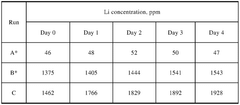
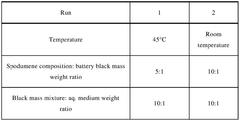
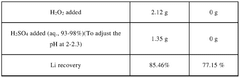
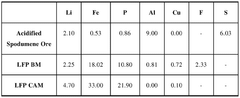
- A method involving the selective leaching of Li from spent LFP batteries using a spodumene composition, adjusting the pH to 2.5-3.0, and adding hydrogen peroxide as an oxidizer, with the LFP and spodumene mixed in a specific weight ratio, to form a black mass leaching mixture that is agitated and filtered, reducing the need for excessive chemicals and improving lithium recovery.
Environmental Regulations and Policy Framework
The regulatory landscape surrounding lithium battery recycling has evolved significantly in response to growing environmental concerns and resource scarcity. Governments worldwide have implemented stringent frameworks to manage end-of-life batteries, establishing mandatory collection targets and extended producer responsibility schemes. The European Union's Battery Directive and its recent updates mandate minimum collection rates of 65% for portable batteries and set ambitious recycling efficiency targets of 70% for lithium-based chemistries by 2030. These regulations directly impact cost structures by requiring investments in collection infrastructure and processing capabilities.
In the United States, regulatory approaches vary considerably across states, with California leading through its rechargeable battery recycling legislation that mandates producer-funded take-back programs. Federal initiatives under the Infrastructure Investment and Jobs Act allocate substantial funding for domestic battery recycling development, creating opportunities for cost optimization through subsidies and tax incentives. China's producer responsibility extension system requires battery manufacturers to establish recycling networks, fundamentally reshaping the economic model of battery lifecycle management.
Emerging policy trends emphasize circular economy principles, pushing for higher recovery rates of critical materials such as lithium, cobalt, and nickel. Carbon pricing mechanisms and environmental taxes on virgin material extraction are gradually making recycled materials more economically competitive. Several jurisdictions now offer preferential treatment for products containing recycled content, creating market-based incentives that can offset recycling costs.
Compliance requirements impose significant operational expenses, including tracking systems, reporting obligations, and certification processes. However, these same regulations create barriers to entry that benefit established players with compliant infrastructure. The harmonization of international standards, particularly through ISO technical committees, is reducing compliance complexity for global operators and enabling economies of scale in recycling operations.
Policy frameworks increasingly incorporate performance-based standards rather than prescriptive requirements, allowing technological innovation in recycling processes. This regulatory flexibility enables companies to pursue cost-efficient solutions while meeting environmental objectives, creating a dynamic environment where regulatory compliance and economic optimization can align strategically.
In the United States, regulatory approaches vary considerably across states, with California leading through its rechargeable battery recycling legislation that mandates producer-funded take-back programs. Federal initiatives under the Infrastructure Investment and Jobs Act allocate substantial funding for domestic battery recycling development, creating opportunities for cost optimization through subsidies and tax incentives. China's producer responsibility extension system requires battery manufacturers to establish recycling networks, fundamentally reshaping the economic model of battery lifecycle management.
Emerging policy trends emphasize circular economy principles, pushing for higher recovery rates of critical materials such as lithium, cobalt, and nickel. Carbon pricing mechanisms and environmental taxes on virgin material extraction are gradually making recycled materials more economically competitive. Several jurisdictions now offer preferential treatment for products containing recycled content, creating market-based incentives that can offset recycling costs.
Compliance requirements impose significant operational expenses, including tracking systems, reporting obligations, and certification processes. However, these same regulations create barriers to entry that benefit established players with compliant infrastructure. The harmonization of international standards, particularly through ISO technical committees, is reducing compliance complexity for global operators and enabling economies of scale in recycling operations.
Policy frameworks increasingly incorporate performance-based standards rather than prescriptive requirements, allowing technological innovation in recycling processes. This regulatory flexibility enables companies to pursue cost-efficient solutions while meeting environmental objectives, creating a dynamic environment where regulatory compliance and economic optimization can align strategically.
Circular Economy and Sustainability Strategy
The integration of circular economy principles into lithium battery recycling represents a fundamental shift from traditional linear production models toward sustainable resource management systems. This strategic approach addresses the dual imperatives of environmental stewardship and economic viability by transforming end-of-life batteries from waste streams into valuable material sources. The circular economy framework emphasizes designing out waste, keeping materials in productive use, and regenerating natural systems, which aligns perfectly with the urgent need to optimize recycling processes for cost efficiency.
Implementing a circular economy strategy in battery recycling requires establishing closed-loop material flows where recovered lithium, cobalt, nickel, and other critical metals re-enter manufacturing supply chains. This approach reduces dependency on virgin material extraction, which carries significant environmental costs including habitat destruction, water consumption, and carbon emissions. By maximizing material recovery rates and minimizing processing waste, recycling operations can achieve both ecological benefits and improved economic performance through reduced raw material procurement costs.
The sustainability dimension extends beyond material recovery to encompass energy efficiency in recycling processes, reduction of hazardous waste generation, and minimization of carbon footprint throughout the value chain. Advanced recycling technologies that operate at lower temperatures or utilize hydrometallurgical processes instead of energy-intensive pyrometallurgical methods exemplify this sustainability-driven innovation. These approaches not only reduce operational costs but also align with increasingly stringent environmental regulations and corporate sustainability commitments.
Strategic partnerships across the battery value chain are essential for circular economy implementation. Collaboration between battery manufacturers, automotive companies, recycling facilities, and material suppliers enables design-for-recycling initiatives, efficient collection systems, and guaranteed offtake agreements for recycled materials. Such ecosystem approaches create economic incentives that make recycling financially attractive while ensuring material quality standards meet manufacturing requirements.
Policy frameworks and extended producer responsibility schemes further reinforce circular economy adoption by internalizing environmental costs and creating regulatory drivers for recycling investment. These mechanisms, combined with consumer awareness and corporate sustainability goals, establish the foundation for economically viable and environmentally responsible battery recycling systems that support long-term industry growth.
Implementing a circular economy strategy in battery recycling requires establishing closed-loop material flows where recovered lithium, cobalt, nickel, and other critical metals re-enter manufacturing supply chains. This approach reduces dependency on virgin material extraction, which carries significant environmental costs including habitat destruction, water consumption, and carbon emissions. By maximizing material recovery rates and minimizing processing waste, recycling operations can achieve both ecological benefits and improved economic performance through reduced raw material procurement costs.
The sustainability dimension extends beyond material recovery to encompass energy efficiency in recycling processes, reduction of hazardous waste generation, and minimization of carbon footprint throughout the value chain. Advanced recycling technologies that operate at lower temperatures or utilize hydrometallurgical processes instead of energy-intensive pyrometallurgical methods exemplify this sustainability-driven innovation. These approaches not only reduce operational costs but also align with increasingly stringent environmental regulations and corporate sustainability commitments.
Strategic partnerships across the battery value chain are essential for circular economy implementation. Collaboration between battery manufacturers, automotive companies, recycling facilities, and material suppliers enables design-for-recycling initiatives, efficient collection systems, and guaranteed offtake agreements for recycled materials. Such ecosystem approaches create economic incentives that make recycling financially attractive while ensuring material quality standards meet manufacturing requirements.
Policy frameworks and extended producer responsibility schemes further reinforce circular economy adoption by internalizing environmental costs and creating regulatory drivers for recycling investment. These mechanisms, combined with consumer awareness and corporate sustainability goals, establish the foundation for economically viable and environmentally responsible battery recycling systems that support long-term industry growth.
Unlock deeper insights with Patsnap Eureka Quick Research — get a full tech report to explore trends and direct your research. Try now!
Generate Your Research Report Instantly with AI Agent
Supercharge your innovation with Patsnap Eureka AI Agent Platform!