

Optimize Low-Cost Reactors for Rural Biochar Production Systems
JUN 22, 20269 MIN READ
Generate Your Research Report Instantly with AI Agent
Patsnap Eureka helps you evaluate technical feasibility & market potential.
Rural Biochar Production Background and Objectives
Biochar production has emerged as a critical technology for addressing multiple challenges in rural agricultural communities, including soil degradation, waste management, and carbon sequestration. The conversion of agricultural residues and organic waste into biochar through pyrolysis processes offers significant environmental and economic benefits for smallholder farmers and rural cooperatives. However, the widespread adoption of biochar production systems in rural areas has been hindered by the high capital costs and technical complexity of conventional reactor technologies.
Rural communities generate substantial quantities of biomass waste, including crop residues, animal manure, and forestry byproducts, which are often burned in open fields or left to decompose, contributing to greenhouse gas emissions and air pollution. The transformation of these waste streams into valuable biochar presents an opportunity to create circular economy systems that enhance soil fertility while generating additional income streams for rural populations.
Current biochar production technologies predominantly rely on sophisticated reactor systems designed for industrial-scale operations, making them economically unfeasible for small-scale rural applications. The capital investment requirements, maintenance complexity, and operational expertise needed for these systems create significant barriers to adoption in resource-constrained rural environments. This technological gap has created an urgent need for simplified, cost-effective reactor designs specifically tailored to rural production contexts.
The primary objective of optimizing low-cost reactors for rural biochar production systems is to develop technically viable, economically accessible pyrolysis technologies that can be manufactured, operated, and maintained within rural communities using locally available materials and skills. These optimized systems must achieve consistent biochar quality while minimizing operational complexity and capital investment requirements.
Secondary objectives include maximizing energy efficiency through improved heat recovery and gas management systems, ensuring environmental compliance through controlled emissions, and enabling scalable production capacity that can accommodate varying biomass feedstock availability. The optimization process aims to balance production efficiency with affordability, creating sustainable biochar production pathways that can be replicated across diverse rural settings while maintaining economic viability for small-scale operators.
Rural communities generate substantial quantities of biomass waste, including crop residues, animal manure, and forestry byproducts, which are often burned in open fields or left to decompose, contributing to greenhouse gas emissions and air pollution. The transformation of these waste streams into valuable biochar presents an opportunity to create circular economy systems that enhance soil fertility while generating additional income streams for rural populations.
Current biochar production technologies predominantly rely on sophisticated reactor systems designed for industrial-scale operations, making them economically unfeasible for small-scale rural applications. The capital investment requirements, maintenance complexity, and operational expertise needed for these systems create significant barriers to adoption in resource-constrained rural environments. This technological gap has created an urgent need for simplified, cost-effective reactor designs specifically tailored to rural production contexts.
The primary objective of optimizing low-cost reactors for rural biochar production systems is to develop technically viable, economically accessible pyrolysis technologies that can be manufactured, operated, and maintained within rural communities using locally available materials and skills. These optimized systems must achieve consistent biochar quality while minimizing operational complexity and capital investment requirements.
Secondary objectives include maximizing energy efficiency through improved heat recovery and gas management systems, ensuring environmental compliance through controlled emissions, and enabling scalable production capacity that can accommodate varying biomass feedstock availability. The optimization process aims to balance production efficiency with affordability, creating sustainable biochar production pathways that can be replicated across diverse rural settings while maintaining economic viability for small-scale operators.
Market Demand for Low-Cost Rural Biochar Systems
The global biochar market is experiencing unprecedented growth driven by increasing awareness of climate change mitigation and sustainable agricultural practices. Rural communities represent a significant and largely untapped market segment for low-cost biochar production systems, particularly in developing regions where agricultural waste management and soil improvement are critical challenges.
Agricultural waste disposal presents a substantial problem for rural farmers worldwide, with crop residues often burned in fields, contributing to air pollution and greenhouse gas emissions. Low-cost biochar reactors offer an economically viable solution by converting this waste into valuable biochar while generating energy for local use. This dual benefit creates strong market pull from farming communities seeking cost-effective waste management alternatives.
Soil degradation affects billions of hectares globally, with rural agricultural areas bearing the most severe impacts. Biochar's proven ability to improve soil fertility, water retention, and crop yields creates substantial demand among smallholder farmers. The decentralized nature of rural communities makes on-site biochar production particularly attractive, eliminating transportation costs and ensuring fresh supply availability.
Carbon credit markets are increasingly recognizing biochar production as a legitimate carbon sequestration method, creating additional revenue streams for rural producers. This emerging market mechanism transforms biochar from a soil amendment into a climate commodity, significantly enhancing the economic viability of rural production systems.
The market demand varies significantly across geographic regions, with developing countries in Africa, Asia, and Latin America showing the highest potential due to abundant agricultural residues and urgent soil improvement needs. These regions often lack centralized waste management infrastructure, making distributed biochar production systems particularly valuable.
Economic constraints in rural markets necessitate reactor systems priced significantly below industrial alternatives while maintaining acceptable production efficiency. Market research indicates that systems costing less than traditional alternatives while providing multiple value streams attract the strongest adoption rates among rural communities.
Government policies promoting sustainable agriculture and carbon reduction are creating favorable market conditions. Subsidies, tax incentives, and technical support programs are emerging globally to encourage biochar adoption, particularly targeting rural and smallholder farming communities.
The integration potential with existing rural energy systems, such as cookstoves and heating applications, expands market appeal beyond pure biochar production. Multi-functional systems that address energy needs while producing biochar demonstrate higher market acceptance and economic sustainability in rural contexts.
Agricultural waste disposal presents a substantial problem for rural farmers worldwide, with crop residues often burned in fields, contributing to air pollution and greenhouse gas emissions. Low-cost biochar reactors offer an economically viable solution by converting this waste into valuable biochar while generating energy for local use. This dual benefit creates strong market pull from farming communities seeking cost-effective waste management alternatives.
Soil degradation affects billions of hectares globally, with rural agricultural areas bearing the most severe impacts. Biochar's proven ability to improve soil fertility, water retention, and crop yields creates substantial demand among smallholder farmers. The decentralized nature of rural communities makes on-site biochar production particularly attractive, eliminating transportation costs and ensuring fresh supply availability.
Carbon credit markets are increasingly recognizing biochar production as a legitimate carbon sequestration method, creating additional revenue streams for rural producers. This emerging market mechanism transforms biochar from a soil amendment into a climate commodity, significantly enhancing the economic viability of rural production systems.
The market demand varies significantly across geographic regions, with developing countries in Africa, Asia, and Latin America showing the highest potential due to abundant agricultural residues and urgent soil improvement needs. These regions often lack centralized waste management infrastructure, making distributed biochar production systems particularly valuable.
Economic constraints in rural markets necessitate reactor systems priced significantly below industrial alternatives while maintaining acceptable production efficiency. Market research indicates that systems costing less than traditional alternatives while providing multiple value streams attract the strongest adoption rates among rural communities.
Government policies promoting sustainable agriculture and carbon reduction are creating favorable market conditions. Subsidies, tax incentives, and technical support programs are emerging globally to encourage biochar adoption, particularly targeting rural and smallholder farming communities.
The integration potential with existing rural energy systems, such as cookstoves and heating applications, expands market appeal beyond pure biochar production. Multi-functional systems that address energy needs while producing biochar demonstrate higher market acceptance and economic sustainability in rural contexts.
Current Reactor Technology Status and Rural Challenges
Current biochar production technologies encompass several reactor designs, each with distinct operational characteristics and cost implications. Pyrolysis reactors dominate the landscape, ranging from simple batch kilns to sophisticated continuous-feed systems. Fixed-bed reactors represent the most basic approach, utilizing direct heating methods with limited process control. These systems typically achieve temperatures between 300-700°C but suffer from uneven heat distribution and inconsistent biochar quality.
More advanced slow pyrolysis reactors incorporate improved heat management through indirect heating mechanisms, utilizing external combustion chambers or heat exchangers. Fast pyrolysis systems, while offering higher throughput, require precise temperature control and rapid cooling systems, significantly increasing capital costs. Gasification-based reactors present an alternative approach, producing biochar as a co-product alongside syngas, though they demand more complex gas handling infrastructure.
Rural implementation faces substantial technological barriers that limit widespread adoption. Most existing reactor designs require consistent electricity supply for automated controls, monitoring systems, and material handling equipment. This dependency creates significant challenges in remote areas with unreliable power infrastructure. Additionally, current systems often demand skilled operators familiar with process parameters, temperature monitoring, and safety protocols, expertise rarely available in rural communities.
Economic constraints further compound rural deployment challenges. Commercial reactor systems typically require capital investments ranging from $50,000 to $500,000, making them financially inaccessible for small-scale rural operations. Operating costs include electricity consumption, maintenance requirements, and replacement parts, often necessitating specialized technical support from urban centers.
Feedstock handling presents another critical challenge in rural contexts. Existing reactor designs frequently require uniform feedstock sizing, moisture content below 15%, and consistent feeding rates. Rural biomass sources, including agricultural residues and forestry waste, often exhibit high variability in composition and moisture content, requiring additional preprocessing equipment and increasing overall system complexity.
Scale mismatch represents a fundamental barrier between current technology offerings and rural needs. Most commercial reactors target industrial-scale production volumes of several tons per day, while rural applications typically require smaller, distributed systems processing hundreds of kilograms daily. This scale disparity results in poor economic efficiency when downsizing existing technologies.
Safety and regulatory compliance add additional layers of complexity. Current reactor systems require sophisticated emission control systems, automated shutdown mechanisms, and continuous monitoring equipment to meet environmental standards. Rural installations often lack the infrastructure and expertise necessary to maintain these complex safety systems, creating potential operational and regulatory risks.
More advanced slow pyrolysis reactors incorporate improved heat management through indirect heating mechanisms, utilizing external combustion chambers or heat exchangers. Fast pyrolysis systems, while offering higher throughput, require precise temperature control and rapid cooling systems, significantly increasing capital costs. Gasification-based reactors present an alternative approach, producing biochar as a co-product alongside syngas, though they demand more complex gas handling infrastructure.
Rural implementation faces substantial technological barriers that limit widespread adoption. Most existing reactor designs require consistent electricity supply for automated controls, monitoring systems, and material handling equipment. This dependency creates significant challenges in remote areas with unreliable power infrastructure. Additionally, current systems often demand skilled operators familiar with process parameters, temperature monitoring, and safety protocols, expertise rarely available in rural communities.
Economic constraints further compound rural deployment challenges. Commercial reactor systems typically require capital investments ranging from $50,000 to $500,000, making them financially inaccessible for small-scale rural operations. Operating costs include electricity consumption, maintenance requirements, and replacement parts, often necessitating specialized technical support from urban centers.
Feedstock handling presents another critical challenge in rural contexts. Existing reactor designs frequently require uniform feedstock sizing, moisture content below 15%, and consistent feeding rates. Rural biomass sources, including agricultural residues and forestry waste, often exhibit high variability in composition and moisture content, requiring additional preprocessing equipment and increasing overall system complexity.
Scale mismatch represents a fundamental barrier between current technology offerings and rural needs. Most commercial reactors target industrial-scale production volumes of several tons per day, while rural applications typically require smaller, distributed systems processing hundreds of kilograms daily. This scale disparity results in poor economic efficiency when downsizing existing technologies.
Safety and regulatory compliance add additional layers of complexity. Current reactor systems require sophisticated emission control systems, automated shutdown mechanisms, and continuous monitoring equipment to meet environmental standards. Rural installations often lack the infrastructure and expertise necessary to maintain these complex safety systems, creating potential operational and regulatory risks.
Existing Low-Cost Reactor Solutions for Rural Applications
01 Modular reactor design for cost reduction
Implementation of modular reactor designs that allow for standardized components and mass production techniques to significantly reduce manufacturing costs. These designs enable easier assembly, maintenance, and scalability while maintaining operational efficiency and safety standards.- Modular reactor design for cost reduction: Implementation of modular reactor designs that allow for standardized components and mass production techniques to significantly reduce manufacturing costs. These designs enable easier assembly, maintenance, and scalability while maintaining operational efficiency and safety standards.
- Advanced materials and manufacturing processes: Utilization of cost-effective materials and innovative manufacturing processes to reduce reactor construction costs. This includes the use of alternative materials that provide adequate performance at lower costs and manufacturing techniques that streamline production while maintaining quality standards.
- Simplified reactor control systems: Development of simplified and automated control systems that reduce operational complexity and maintenance requirements. These systems incorporate cost-effective monitoring and control technologies that maintain reactor performance while minimizing operational expenses and training requirements.
- Compact reactor configurations: Design of compact reactor configurations that minimize space requirements and associated infrastructure costs. These configurations optimize reactor geometry and internal components to achieve maximum efficiency in smaller footprints, reducing construction and site preparation expenses.
- Standardized reactor components and systems: Implementation of standardized components and systems across reactor designs to leverage economies of scale and reduce manufacturing costs. This approach enables mass production of key components and simplifies maintenance, spare parts inventory, and operator training requirements.
02 Advanced materials and manufacturing processes
Utilization of cost-effective materials and innovative manufacturing processes to reduce reactor construction costs. This includes the use of alternative materials that provide adequate performance at lower costs and manufacturing techniques that streamline production while maintaining quality standards.Expand Specific Solutions03 Simplified reactor control systems
Development of simplified and automated control systems that reduce operational complexity and maintenance requirements. These systems incorporate cost-effective monitoring and control technologies that maintain reactor performance while minimizing operational expenses and training requirements.Expand Specific Solutions04 Compact reactor configurations
Design of compact reactor configurations that minimize space requirements and associated infrastructure costs. These configurations optimize reactor geometry and internal components to achieve maximum efficiency in smaller footprints, reducing construction and site preparation expenses.Expand Specific Solutions05 Standardized reactor components and systems
Implementation of standardized components and systems across reactor designs to enable economies of scale and reduce manufacturing costs. This approach facilitates interchangeable parts, simplified maintenance procedures, and bulk procurement advantages while ensuring compatibility and reliability.Expand Specific Solutions
Key Players in Biochar Reactor and Rural Energy Industry
The rural biochar production systems market is in an emerging growth stage, driven by increasing demand for sustainable agricultural solutions and carbon sequestration technologies. The market demonstrates significant potential with expanding applications in soil enhancement and waste management, though it remains relatively fragmented with diverse players across different sectors. Technology maturity varies considerably across the competitive landscape, with established industrial companies like Cummins, Toyota Motor Corp., and The Black & Decker Corp. bringing advanced engineering capabilities to reactor optimization, while specialized biotech firms such as Carbon Gold Ltd., Kiverdi Inc., and Capra Biosciences focus on biochar-specific applications. Academic institutions including MIT, Colorado State University, and Zhejiang University contribute fundamental research in reactor design and process optimization. Companies like Applikon Biotechnology BV provide sophisticated bioreactor platforms that can be adapted for biochar production systems, indicating strong technological convergence potential for cost-effective rural deployment solutions.
Carbon Gold Ltd.
Technical Solution: Carbon Gold specializes in developing biochar production systems specifically designed for agricultural applications. Their technology focuses on low-temperature pyrolysis reactors that can process various organic waste materials including agricultural residues, wood chips, and organic waste streams. The company has developed modular reactor designs that are scalable for rural operations, featuring automated feeding systems and temperature control mechanisms optimized for consistent biochar quality. Their systems typically operate at temperatures between 400-600°C with controlled oxygen-limited environments to maximize carbon sequestration while producing high-quality biochar suitable for soil amendment applications.
Strengths: Specialized focus on biochar production with proven commercial systems and strong agricultural market presence. Weaknesses: Limited scalability options and higher initial investment costs compared to simpler reactor designs.
Colorado State University
Technical Solution: Colorado State University has developed comprehensive biochar production systems tailored for small-scale rural operations. Their technology focuses on simple, robust reactor designs that can handle diverse feedstock materials common in rural areas. The university has created low-cost pyrolysis systems using locally available materials and simplified operation procedures that require minimal technical expertise. Their research emphasizes energy self-sufficiency through integrated heat recovery and gas combustion systems, making the reactors economically viable for small-scale operations while producing consistent biochar quality for agricultural and environmental applications.
Strengths: Practical focus on rural applications with emphasis on simplicity and local material utilization. Weaknesses: Limited commercial deployment experience and potential challenges in technology standardization across different rural contexts.
Core Innovations in Cost-Effective Biochar Reactor Design
Method, design and development of pyrolysis reactor for biochar production from agricultural residues
PatentActiveIN201811009557A
Innovation
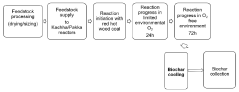
- Development of low-cost, simple, and self-sustaining pyrolysis reactors made from locally available materials like bricks, sand, and clay, which convert agricultural residues into biochar with high yield, using controlled oxygen environments and red-hot charcoal ignition, allowing for easy construction and operation by unskilled farmers.
Pyrolysis plant for batchwise production of biochar by pyrolysis of biomass and method
PatentWO2025190493A1
Innovation
- A pyrolysis plant designed for batch production using carrier inserts that facilitate continuous transfer between drying, pyrolysis, and cooling stages, utilizing gas circulation and heat exchangers to optimize heat utilization and minimize thermal losses, with a focus on low-cost, easy operation.


Environmental Regulations for Rural Biochar Operations
Rural biochar production systems operate within a complex regulatory framework that varies significantly across different jurisdictions. At the federal level, biochar operations must comply with Clean Air Act provisions, particularly regarding particulate matter emissions and air quality standards. The Environmental Protection Agency classifies biochar production under specific industrial categories, requiring operators to obtain appropriate permits for air emissions, especially when processing volumes exceed designated thresholds.
State-level regulations often impose additional requirements for rural biochar facilities. Many states have established specific guidelines for biomass processing operations, including setback requirements from residential areas, water bodies, and sensitive ecosystems. These regulations typically mandate minimum distances ranging from 100 to 500 feet depending on production capacity and local zoning classifications. Fire safety codes also play a crucial role, with many jurisdictions requiring comprehensive fire prevention plans and emergency response protocols.
Water quality protection represents another critical regulatory dimension. Rural biochar operations must comply with National Pollutant Discharge Elimination System permits if any process water is discharged. Groundwater protection regulations are particularly stringent in agricultural areas, requiring operators to implement containment measures for any liquid byproducts and establish monitoring protocols for nearby water sources.
Waste management regulations significantly impact reactor design and operational procedures. The Resource Conservation and Recovery Act governs the handling of feedstock materials and ash disposal, while some states classify certain biochar production residues as special waste requiring specific disposal methods. Operators must maintain detailed records of feedstock sources, processing volumes, and waste generation rates.
Local zoning ordinances often present the most restrictive requirements for rural biochar operations. Agricultural zoning typically permits biochar production as an accessory use, but conditional use permits may be required for commercial-scale operations. Noise ordinances frequently limit operating hours and require sound mitigation measures, particularly for mechanical components like feeders and cooling systems.
Emerging carbon credit regulations are creating new compliance opportunities and requirements. Several states have established protocols for biochar carbon sequestration verification, requiring specific documentation of feedstock sources, production methods, and final product characteristics. These programs often mandate third-party verification and ongoing monitoring to ensure carbon permanence claims.
Recent regulatory trends indicate increasing standardization of biochar quality specifications and production standards. The International Biochar Initiative's certification programs are gaining recognition among regulatory bodies, potentially streamlining permitting processes for compliant operations while establishing clear performance benchmarks for rural production systems.
State-level regulations often impose additional requirements for rural biochar facilities. Many states have established specific guidelines for biomass processing operations, including setback requirements from residential areas, water bodies, and sensitive ecosystems. These regulations typically mandate minimum distances ranging from 100 to 500 feet depending on production capacity and local zoning classifications. Fire safety codes also play a crucial role, with many jurisdictions requiring comprehensive fire prevention plans and emergency response protocols.
Water quality protection represents another critical regulatory dimension. Rural biochar operations must comply with National Pollutant Discharge Elimination System permits if any process water is discharged. Groundwater protection regulations are particularly stringent in agricultural areas, requiring operators to implement containment measures for any liquid byproducts and establish monitoring protocols for nearby water sources.
Waste management regulations significantly impact reactor design and operational procedures. The Resource Conservation and Recovery Act governs the handling of feedstock materials and ash disposal, while some states classify certain biochar production residues as special waste requiring specific disposal methods. Operators must maintain detailed records of feedstock sources, processing volumes, and waste generation rates.
Local zoning ordinances often present the most restrictive requirements for rural biochar operations. Agricultural zoning typically permits biochar production as an accessory use, but conditional use permits may be required for commercial-scale operations. Noise ordinances frequently limit operating hours and require sound mitigation measures, particularly for mechanical components like feeders and cooling systems.
Emerging carbon credit regulations are creating new compliance opportunities and requirements. Several states have established protocols for biochar carbon sequestration verification, requiring specific documentation of feedstock sources, production methods, and final product characteristics. These programs often mandate third-party verification and ongoing monitoring to ensure carbon permanence claims.
Recent regulatory trends indicate increasing standardization of biochar quality specifications and production standards. The International Biochar Initiative's certification programs are gaining recognition among regulatory bodies, potentially streamlining permitting processes for compliant operations while establishing clear performance benchmarks for rural production systems.
Economic Viability Assessment for Rural Biochar Systems
The economic viability of rural biochar production systems hinges on achieving favorable cost-benefit ratios through optimized reactor designs and operational strategies. Initial capital expenditure for low-cost reactors typically ranges from $2,000 to $15,000 per unit, depending on production capacity and automation level. These systems demonstrate break-even points within 18-36 months when processing agricultural residues at scales of 500-2000 kg per day, generating revenue streams from both biochar sales and carbon credit programs.
Revenue generation potential varies significantly based on regional market conditions and product quality specifications. Premium biochar commands prices between $300-800 per ton in developed markets, while standard-grade products fetch $150-400 per ton. Rural systems benefit from reduced transportation costs and direct farmer-to-farmer sales networks, improving profit margins by 15-25% compared to centralized production models. Carbon credit monetization adds $50-150 per ton of biochar produced, depending on certification standards and regional carbon pricing mechanisms.
Operational cost structures favor rural deployment due to abundant feedstock availability and lower labor costs. Raw material expenses typically represent 20-30% of total production costs, significantly lower than urban facilities that must transport biomass over long distances. Energy self-sufficiency through syngas utilization reduces operational expenses by 40-60%, while simplified maintenance requirements minimize technical support costs in remote locations.
Financial risk assessment reveals moderate investment risks with strong potential returns. Sensitivity analysis indicates that systems remain profitable even with 30% fluctuations in biochar prices or feedstock costs. Government subsidies and rural development grants further enhance economic attractiveness, with many regions offering 25-50% capital cost support for sustainable agriculture initiatives.
Long-term economic sustainability depends on establishing reliable market channels and maintaining consistent product quality. Cooperative ownership models and regional biochar networks demonstrate superior financial performance, achieving 12-18% internal rates of return while providing additional socioeconomic benefits to rural communities through job creation and agricultural productivity improvements.
Revenue generation potential varies significantly based on regional market conditions and product quality specifications. Premium biochar commands prices between $300-800 per ton in developed markets, while standard-grade products fetch $150-400 per ton. Rural systems benefit from reduced transportation costs and direct farmer-to-farmer sales networks, improving profit margins by 15-25% compared to centralized production models. Carbon credit monetization adds $50-150 per ton of biochar produced, depending on certification standards and regional carbon pricing mechanisms.
Operational cost structures favor rural deployment due to abundant feedstock availability and lower labor costs. Raw material expenses typically represent 20-30% of total production costs, significantly lower than urban facilities that must transport biomass over long distances. Energy self-sufficiency through syngas utilization reduces operational expenses by 40-60%, while simplified maintenance requirements minimize technical support costs in remote locations.
Financial risk assessment reveals moderate investment risks with strong potential returns. Sensitivity analysis indicates that systems remain profitable even with 30% fluctuations in biochar prices or feedstock costs. Government subsidies and rural development grants further enhance economic attractiveness, with many regions offering 25-50% capital cost support for sustainable agriculture initiatives.
Long-term economic sustainability depends on establishing reliable market channels and maintaining consistent product quality. Cooperative ownership models and regional biochar networks demonstrate superior financial performance, achieving 12-18% internal rates of return while providing additional socioeconomic benefits to rural communities through job creation and agricultural productivity improvements.
Unlock deeper insights with Patsnap Eureka Quick Research — get a full tech report to explore trends and direct your research. Try now!
Generate Your Research Report Instantly with AI Agent
Supercharge your innovation with Patsnap Eureka AI Agent Platform!