
Optimize Membrane Thickness for Redox Flow Cell Efficiency
MAY 20, 20268 MIN READ
Generate Your Research Report Instantly with AI Agent
Patsnap Eureka helps you evaluate technical feasibility & market potential.
Redox Flow Cell Membrane Technology Background and Objectives
Redox flow batteries have emerged as a promising solution for large-scale energy storage applications, particularly in grid-scale renewable energy integration and load balancing systems. These electrochemical devices store energy in liquid electrolytes containing dissolved redox-active species, offering unique advantages including decoupled power and energy capacity, long cycle life, and enhanced safety characteristics compared to conventional battery technologies.
The membrane component serves as a critical separator between the positive and negative electrolyte chambers, enabling selective ion transport while preventing crossover of active species. This selective permeability is essential for maintaining charge balance during operation while minimizing capacity fade caused by electrolyte mixing. The membrane's thickness directly influences multiple performance parameters, creating a complex optimization challenge that significantly impacts overall system efficiency.
Current redox flow cell technologies face substantial efficiency limitations, with round-trip efficiencies typically ranging from 65% to 85%. Membrane-related losses contribute significantly to these efficiency constraints through various mechanisms including ohmic resistance, species crossover, and parasitic reactions. The thickness parameter represents a fundamental design variable that governs the trade-off between ionic conductivity and selectivity performance.
Thinner membranes generally exhibit lower area-specific resistance, reducing ohmic losses and improving voltage efficiency during charge-discharge cycles. However, reduced thickness often correlates with increased permeability to active species, leading to higher crossover rates and accelerated capacity decay. This fundamental trade-off necessitates precise thickness optimization to achieve maximum energy efficiency while maintaining acceptable capacity retention over extended operational periods.
The optimization challenge extends beyond simple thickness selection to encompass membrane material properties, operating conditions, and system-specific requirements. Different redox chemistries, including vanadium, iron-chromium, and organic systems, present varying demands on membrane performance characteristics. Temperature variations, flow rates, and current density profiles further complicate the optimization landscape.
Advanced membrane technologies are being developed to address these challenges, including composite structures, selective coatings, and novel polymer chemistries. These innovations aim to decouple the traditional thickness-performance relationships by enhancing selectivity without proportionally increasing resistance. The objective involves achieving optimal membrane thickness configurations that maximize overall system efficiency while ensuring long-term durability and cost-effectiveness for commercial deployment.
The membrane component serves as a critical separator between the positive and negative electrolyte chambers, enabling selective ion transport while preventing crossover of active species. This selective permeability is essential for maintaining charge balance during operation while minimizing capacity fade caused by electrolyte mixing. The membrane's thickness directly influences multiple performance parameters, creating a complex optimization challenge that significantly impacts overall system efficiency.
Current redox flow cell technologies face substantial efficiency limitations, with round-trip efficiencies typically ranging from 65% to 85%. Membrane-related losses contribute significantly to these efficiency constraints through various mechanisms including ohmic resistance, species crossover, and parasitic reactions. The thickness parameter represents a fundamental design variable that governs the trade-off between ionic conductivity and selectivity performance.
Thinner membranes generally exhibit lower area-specific resistance, reducing ohmic losses and improving voltage efficiency during charge-discharge cycles. However, reduced thickness often correlates with increased permeability to active species, leading to higher crossover rates and accelerated capacity decay. This fundamental trade-off necessitates precise thickness optimization to achieve maximum energy efficiency while maintaining acceptable capacity retention over extended operational periods.
The optimization challenge extends beyond simple thickness selection to encompass membrane material properties, operating conditions, and system-specific requirements. Different redox chemistries, including vanadium, iron-chromium, and organic systems, present varying demands on membrane performance characteristics. Temperature variations, flow rates, and current density profiles further complicate the optimization landscape.
Advanced membrane technologies are being developed to address these challenges, including composite structures, selective coatings, and novel polymer chemistries. These innovations aim to decouple the traditional thickness-performance relationships by enhancing selectivity without proportionally increasing resistance. The objective involves achieving optimal membrane thickness configurations that maximize overall system efficiency while ensuring long-term durability and cost-effectiveness for commercial deployment.
Market Demand for High-Efficiency Energy Storage Systems
The global energy storage market is experiencing unprecedented growth driven by the urgent need for grid stabilization, renewable energy integration, and sustainable power solutions. Redox flow batteries have emerged as a critical technology for large-scale energy storage applications, particularly in utility-scale installations where long-duration storage capabilities are essential. The optimization of membrane thickness in redox flow cells directly addresses market demands for enhanced efficiency, reduced operational costs, and improved system reliability.
Grid modernization initiatives worldwide are creating substantial demand for energy storage systems that can provide reliable power quality management and load balancing. Redox flow batteries offer unique advantages including scalable capacity, long cycle life, and deep discharge capabilities that make them particularly attractive for utility operators. The membrane component represents a significant cost factor and performance determinant, making thickness optimization a key market differentiator.
Industrial and commercial sectors are increasingly adopting energy storage solutions to manage peak demand charges, ensure power reliability, and integrate renewable energy sources. Manufacturing facilities, data centers, and large commercial complexes require storage systems with high round-trip efficiency to maximize economic benefits. Optimized membrane thickness directly impacts energy conversion efficiency, making this technical advancement highly valuable for cost-conscious industrial customers.
The renewable energy sector's rapid expansion is driving demand for storage technologies that can effectively manage intermittent power generation from solar and wind sources. Redox flow batteries with optimized membranes can provide superior performance in frequent charge-discharge cycles typical of renewable integration applications. This creates significant market opportunities for manufacturers who can deliver enhanced membrane technologies.
Emerging markets in developing countries present substantial growth opportunities for efficient energy storage systems. These regions often require reliable, cost-effective solutions for grid infrastructure development and rural electrification projects. Membrane thickness optimization can reduce system costs while improving performance, making redox flow batteries more competitive in price-sensitive markets where energy access remains a critical challenge.
Grid modernization initiatives worldwide are creating substantial demand for energy storage systems that can provide reliable power quality management and load balancing. Redox flow batteries offer unique advantages including scalable capacity, long cycle life, and deep discharge capabilities that make them particularly attractive for utility operators. The membrane component represents a significant cost factor and performance determinant, making thickness optimization a key market differentiator.
Industrial and commercial sectors are increasingly adopting energy storage solutions to manage peak demand charges, ensure power reliability, and integrate renewable energy sources. Manufacturing facilities, data centers, and large commercial complexes require storage systems with high round-trip efficiency to maximize economic benefits. Optimized membrane thickness directly impacts energy conversion efficiency, making this technical advancement highly valuable for cost-conscious industrial customers.
The renewable energy sector's rapid expansion is driving demand for storage technologies that can effectively manage intermittent power generation from solar and wind sources. Redox flow batteries with optimized membranes can provide superior performance in frequent charge-discharge cycles typical of renewable integration applications. This creates significant market opportunities for manufacturers who can deliver enhanced membrane technologies.
Emerging markets in developing countries present substantial growth opportunities for efficient energy storage systems. These regions often require reliable, cost-effective solutions for grid infrastructure development and rural electrification projects. Membrane thickness optimization can reduce system costs while improving performance, making redox flow batteries more competitive in price-sensitive markets where energy access remains a critical challenge.
Current Membrane Thickness Challenges in Flow Batteries
Membrane thickness optimization in redox flow batteries represents one of the most critical engineering challenges affecting overall system performance and commercial viability. Current flow battery technologies face a fundamental trade-off between ionic conductivity and crossover prevention, where membrane thickness directly influences both parameters in opposing directions. This optimization challenge has become increasingly complex as the industry pushes toward higher energy densities and longer operational lifespans.
The primary challenge stems from the conflicting requirements of maintaining high ionic conductivity while minimizing active species crossover. Thinner membranes typically exhibit lower area-specific resistance, enabling higher current densities and improved energy efficiency. However, these same thin membranes often demonstrate increased permeability to active species, leading to capacity fade and reduced coulombic efficiency over extended cycling periods. This fundamental contradiction has constrained system designers to compromise between power performance and long-term stability.
Manufacturing consistency presents another significant obstacle in membrane thickness control. Current production methods struggle to maintain uniform thickness across large membrane areas, resulting in localized variations that create preferential pathways for crossover and uneven current distribution. These manufacturing tolerances become particularly problematic as target thicknesses decrease below 50 micrometers, where even minor variations can substantially impact performance characteristics.
Temperature-dependent membrane behavior further complicates thickness optimization strategies. Membrane swelling and contraction during thermal cycling can alter effective thickness by 10-20%, disrupting carefully optimized performance parameters. This dynamic behavior is particularly challenging in large-scale installations where temperature gradients across the stack can create non-uniform membrane conditions, leading to performance degradation and potential mechanical stress.
Chemical degradation mechanisms also influence optimal thickness selection, as thinner membranes typically exhibit reduced chemical stability under aggressive operating conditions. The accelerated degradation rates observed in ultra-thin membranes often negate their initial performance advantages, creating long-term reliability concerns that limit their practical application in commercial systems.
Current research efforts focus on developing advanced membrane materials and architectures that can decouple the traditional thickness-performance relationships, though significant technical barriers remain in translating laboratory achievements to scalable manufacturing processes.
The primary challenge stems from the conflicting requirements of maintaining high ionic conductivity while minimizing active species crossover. Thinner membranes typically exhibit lower area-specific resistance, enabling higher current densities and improved energy efficiency. However, these same thin membranes often demonstrate increased permeability to active species, leading to capacity fade and reduced coulombic efficiency over extended cycling periods. This fundamental contradiction has constrained system designers to compromise between power performance and long-term stability.
Manufacturing consistency presents another significant obstacle in membrane thickness control. Current production methods struggle to maintain uniform thickness across large membrane areas, resulting in localized variations that create preferential pathways for crossover and uneven current distribution. These manufacturing tolerances become particularly problematic as target thicknesses decrease below 50 micrometers, where even minor variations can substantially impact performance characteristics.
Temperature-dependent membrane behavior further complicates thickness optimization strategies. Membrane swelling and contraction during thermal cycling can alter effective thickness by 10-20%, disrupting carefully optimized performance parameters. This dynamic behavior is particularly challenging in large-scale installations where temperature gradients across the stack can create non-uniform membrane conditions, leading to performance degradation and potential mechanical stress.
Chemical degradation mechanisms also influence optimal thickness selection, as thinner membranes typically exhibit reduced chemical stability under aggressive operating conditions. The accelerated degradation rates observed in ultra-thin membranes often negate their initial performance advantages, creating long-term reliability concerns that limit their practical application in commercial systems.
Current research efforts focus on developing advanced membrane materials and architectures that can decouple the traditional thickness-performance relationships, though significant technical barriers remain in translating laboratory achievements to scalable manufacturing processes.
Current Membrane Optimization Solutions and Approaches
01 Membrane thickness optimization for enhanced ion selectivity
The thickness of redox flow cell membranes can be optimized to improve ion selectivity and reduce crossover of active species. Thinner membranes generally provide lower resistance but may compromise selectivity, while thicker membranes offer better separation but increase resistance. The optimal thickness balances these competing factors to maximize cell performance and efficiency.- Optimal membrane thickness for enhanced ion conductivity: The membrane thickness in redox flow cells is optimized to achieve maximum ion conductivity while maintaining structural integrity. Thinner membranes generally provide better ionic transport properties, reducing internal resistance and improving overall cell efficiency. However, the thickness must be carefully balanced to prevent mechanical failure and ensure adequate separation between electrolytes.
- Membrane thickness control for crossover prevention: Controlling membrane thickness is crucial for preventing active species crossover between positive and negative electrolyte compartments. Thicker membranes provide better barrier properties against unwanted ion migration, which can cause capacity fade and reduced coulombic efficiency. The thickness optimization helps maintain electrolyte purity and extends battery cycle life.
- Manufacturing methods for precise thickness control: Various manufacturing techniques are employed to achieve precise control over membrane thickness during production. These methods include casting, extrusion, and coating processes that ensure uniform thickness distribution across the membrane surface. Quality control measures are implemented to maintain consistent thickness specifications for reliable cell performance.
- Thickness-dependent mechanical properties and durability: The mechanical strength and durability of redox flow cell membranes are directly related to their thickness. Thicker membranes generally exhibit higher tensile strength and better resistance to swelling and dimensional changes during operation. The thickness design must account for long-term stability under cycling conditions and chemical exposure to electrolytes.
- Composite membrane structures with variable thickness: Advanced membrane designs incorporate composite structures with varying thickness profiles to optimize different performance aspects simultaneously. These multi-layer configurations can combine thin selective layers for high conductivity with thicker support layers for mechanical strength. The overall thickness architecture is tailored to specific redox flow cell applications and operating conditions.
02 Membrane thickness control for mechanical stability
Controlling membrane thickness is crucial for maintaining mechanical stability and durability of redox flow cells during operation. Adequate thickness ensures the membrane can withstand pressure differentials and flow conditions without tearing or degrading. The thickness must be sufficient to provide structural integrity while minimizing resistance to ion transport.Expand Specific Solutions03 Thin membrane design for reduced resistance
Thin membrane designs are employed to minimize electrical resistance and improve energy efficiency in redox flow cells. Reduced thickness decreases the distance ions must travel, lowering ohmic losses and improving overall cell performance. However, the thickness must be carefully controlled to maintain adequate selectivity and prevent electrolyte mixing.Expand Specific Solutions04 Multilayer membrane thickness engineering
Multilayer membrane structures with engineered thickness profiles can provide enhanced performance by combining different functional layers. Each layer can be optimized for specific properties such as selectivity, conductivity, or mechanical strength. The total thickness and individual layer thicknesses are designed to achieve optimal overall membrane performance.Expand Specific Solutions05 Membrane thickness measurement and characterization
Accurate measurement and characterization of membrane thickness is essential for quality control and performance prediction in redox flow cells. Various techniques are used to determine thickness uniformity and ensure consistency across the membrane area. Proper thickness characterization helps optimize manufacturing processes and predict cell performance.Expand Specific Solutions
Core Patents in Membrane Thickness Engineering
Optimization of the cerium-hydrogen redox flow cell
PatentActiveUS10424804B2
Innovation
- The implementation of a Ce—H2 redox flow cell with a 3-dimensional porous positive electrode, nanostructured thin-film platinum catalyst layer, and optimized electrolyte composition of 0.6 M Cerium and 5 M MSA, operated at elevated temperatures, and utilizing a pre-boiled membrane to minimize crossover and maximize energy efficiency.
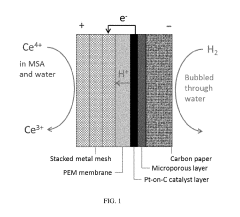
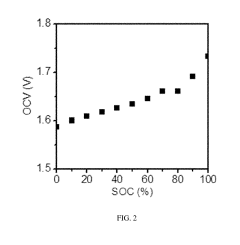
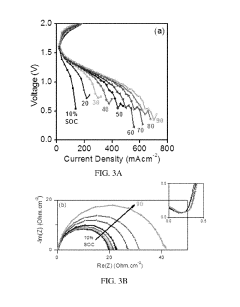
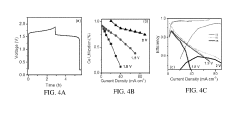
Cell element for a redox-flow battery, and membrane layer
PatentWO2022128738A1
Innovation
- A cell element design featuring a cell frame with a frame opening that houses an electrode and a membrane layer with both ion-conducting and non-ion-conducting areas, allowing for easy handling and positioning of the membrane without touching sensitive ion-conducting surfaces, reducing material waste and costs.


Environmental Impact Assessment of Flow Battery Systems
Flow battery systems, particularly redox flow batteries with optimized membrane thickness, present significant environmental advantages compared to conventional energy storage technologies. The manufacturing phase of these systems demonstrates a substantially lower carbon footprint than lithium-ion batteries, primarily due to the use of abundant materials such as vanadium, iron, and chromium compounds. The membrane optimization process itself contributes to environmental benefits by reducing material waste and improving overall system efficiency, thereby extending operational lifespan and reducing replacement frequency.
The lifecycle environmental impact of flow battery systems is notably favorable when membrane thickness is properly optimized. Thinner membranes reduce material consumption during manufacturing while maintaining adequate ion selectivity and chemical stability. This optimization directly correlates with reduced raw material extraction requirements, particularly for specialized polymer materials used in membrane fabrication. Additionally, optimized membrane thickness enhances energy efficiency, reducing the overall environmental burden associated with energy losses during charge-discharge cycles.
End-of-life considerations for flow battery systems reveal superior recyclability compared to alternative storage technologies. The electrolyte solutions can be reprocessed and reused with minimal environmental impact, while optimized membranes maintain their structural integrity longer, reducing waste generation. The separation of active materials from structural components facilitates efficient recycling processes, with recovery rates exceeding 95% for key materials.
Water usage and contamination risks associated with flow battery systems are significantly lower than those of mining-intensive battery technologies. Membrane thickness optimization plays a crucial role in preventing cross-contamination between electrolyte chambers, thereby maintaining system integrity and preventing environmental leakage. Properly designed membranes eliminate the risk of toxic material release during normal operation and minimize environmental exposure during maintenance procedures.
The carbon footprint analysis of optimized flow battery systems demonstrates net positive environmental impact over their operational lifetime. Enhanced membrane performance directly translates to improved round-trip efficiency, reducing grid-level energy waste and supporting renewable energy integration. This optimization contributes to overall grid decarbonization efforts by enabling more effective storage and utilization of intermittent renewable energy sources, ultimately supporting global climate change mitigation strategies.
The lifecycle environmental impact of flow battery systems is notably favorable when membrane thickness is properly optimized. Thinner membranes reduce material consumption during manufacturing while maintaining adequate ion selectivity and chemical stability. This optimization directly correlates with reduced raw material extraction requirements, particularly for specialized polymer materials used in membrane fabrication. Additionally, optimized membrane thickness enhances energy efficiency, reducing the overall environmental burden associated with energy losses during charge-discharge cycles.
End-of-life considerations for flow battery systems reveal superior recyclability compared to alternative storage technologies. The electrolyte solutions can be reprocessed and reused with minimal environmental impact, while optimized membranes maintain their structural integrity longer, reducing waste generation. The separation of active materials from structural components facilitates efficient recycling processes, with recovery rates exceeding 95% for key materials.
Water usage and contamination risks associated with flow battery systems are significantly lower than those of mining-intensive battery technologies. Membrane thickness optimization plays a crucial role in preventing cross-contamination between electrolyte chambers, thereby maintaining system integrity and preventing environmental leakage. Properly designed membranes eliminate the risk of toxic material release during normal operation and minimize environmental exposure during maintenance procedures.
The carbon footprint analysis of optimized flow battery systems demonstrates net positive environmental impact over their operational lifetime. Enhanced membrane performance directly translates to improved round-trip efficiency, reducing grid-level energy waste and supporting renewable energy integration. This optimization contributes to overall grid decarbonization efforts by enabling more effective storage and utilization of intermittent renewable energy sources, ultimately supporting global climate change mitigation strategies.
Cost-Performance Trade-offs in Membrane Manufacturing
The manufacturing of redox flow cell membranes presents a complex optimization challenge where cost considerations must be carefully balanced against performance requirements. Membrane thickness directly impacts both manufacturing expenses and operational efficiency, creating a multifaceted decision matrix for producers and end-users alike.
Manufacturing costs exhibit a non-linear relationship with membrane thickness variations. Thinner membranes, typically ranging from 10-50 micrometers, require more sophisticated production techniques and tighter quality control measures, driving up per-unit manufacturing costs by 15-25% compared to standard thickness variants. The precision coating processes, specialized handling equipment, and higher rejection rates during quality inspection contribute significantly to these elevated costs.
Conversely, thicker membranes exceeding 100 micrometers present different cost dynamics. While manufacturing complexity decreases, material consumption increases proportionally, and the extended processing times for polymer curing and treatment add to production overhead. These factors collectively result in a cost premium of 10-20% over optimal thickness ranges.
Performance metrics reveal inverse relationships with cost structures. Ultra-thin membranes demonstrate superior ionic conductivity and reduced area-specific resistance, translating to 8-12% higher energy efficiency in operational systems. However, their reduced mechanical durability necessitates more frequent replacement cycles, potentially increasing total cost of ownership by 20-30% over a five-year operational period.
The economic sweet spot emerges in the 60-80 micrometer thickness range, where manufacturing scalability intersects with acceptable performance parameters. This range offers the most favorable cost-performance ratio, with production costs remaining within 5% of baseline levels while maintaining 85-90% of optimal efficiency metrics.
Market dynamics further complicate these trade-offs. High-volume applications in grid-scale energy storage favor cost-optimized solutions, accepting modest performance compromises for significant cost reductions. Conversely, specialized applications in aerospace or critical infrastructure prioritize performance maximization despite premium pricing, creating distinct market segments with divergent optimization criteria.
Raw material costs represent 40-60% of total membrane manufacturing expenses, making material selection crucial for cost-performance optimization. Advanced polymer formulations can reduce required thickness while maintaining durability, though they command 25-40% higher material costs, requiring careful economic analysis to justify implementation.
Manufacturing costs exhibit a non-linear relationship with membrane thickness variations. Thinner membranes, typically ranging from 10-50 micrometers, require more sophisticated production techniques and tighter quality control measures, driving up per-unit manufacturing costs by 15-25% compared to standard thickness variants. The precision coating processes, specialized handling equipment, and higher rejection rates during quality inspection contribute significantly to these elevated costs.
Conversely, thicker membranes exceeding 100 micrometers present different cost dynamics. While manufacturing complexity decreases, material consumption increases proportionally, and the extended processing times for polymer curing and treatment add to production overhead. These factors collectively result in a cost premium of 10-20% over optimal thickness ranges.
Performance metrics reveal inverse relationships with cost structures. Ultra-thin membranes demonstrate superior ionic conductivity and reduced area-specific resistance, translating to 8-12% higher energy efficiency in operational systems. However, their reduced mechanical durability necessitates more frequent replacement cycles, potentially increasing total cost of ownership by 20-30% over a five-year operational period.
The economic sweet spot emerges in the 60-80 micrometer thickness range, where manufacturing scalability intersects with acceptable performance parameters. This range offers the most favorable cost-performance ratio, with production costs remaining within 5% of baseline levels while maintaining 85-90% of optimal efficiency metrics.
Market dynamics further complicate these trade-offs. High-volume applications in grid-scale energy storage favor cost-optimized solutions, accepting modest performance compromises for significant cost reductions. Conversely, specialized applications in aerospace or critical infrastructure prioritize performance maximization despite premium pricing, creating distinct market segments with divergent optimization criteria.
Raw material costs represent 40-60% of total membrane manufacturing expenses, making material selection crucial for cost-performance optimization. Advanced polymer formulations can reduce required thickness while maintaining durability, though they command 25-40% higher material costs, requiring careful economic analysis to justify implementation.
Unlock deeper insights with Patsnap Eureka Quick Research — get a full tech report to explore trends and direct your research. Try now!
Generate Your Research Report Instantly with AI Agent
Supercharge your innovation with Patsnap Eureka AI Agent Platform!