
Optimize Polyurethane Integration in 3D Printing Systems
FEB 26, 20269 MIN READ
Generate Your Research Report Instantly with AI Agent
Patsnap Eureka helps you evaluate technical feasibility & market potential.
Polyurethane 3D Printing Technology Background and Objectives
Polyurethane (PU) has emerged as a critical material in additive manufacturing due to its exceptional versatility and unique combination of properties. This thermoplastic elastomer exhibits remarkable flexibility, durability, and chemical resistance, making it highly sought after for applications ranging from automotive components to medical devices. The integration of polyurethane into 3D printing systems represents a significant technological advancement that addresses the growing demand for functional prototypes and end-use parts with rubber-like characteristics.
The historical development of polyurethane 3D printing can be traced back to the early 2000s when researchers began exploring elastomeric materials for additive manufacturing. Initial attempts focused on adapting existing thermoplastic processing techniques to accommodate PU's unique rheological properties. The evolution progressed through several phases, beginning with powder-based systems, advancing to filament-based approaches, and eventually incorporating liquid photopolymer formulations.
Current technological trends indicate a shift toward multi-material printing capabilities and improved processing parameters that enhance PU integration efficiency. The development trajectory shows increasing sophistication in material formulations, with manufacturers creating specialized PU variants optimized for specific printing technologies including Fused Deposition Modeling (FDM), Selective Laser Sintering (SLS), and Digital Light Processing (DLP).
The primary technical objectives driving polyurethane integration optimization center on achieving consistent material flow, minimizing processing defects, and enhancing interlayer adhesion. Key performance targets include maintaining dimensional accuracy within ±0.1mm tolerances, achieving shore hardness values ranging from 70A to 95A, and ensuring mechanical properties comparable to injection-molded counterparts.
Advanced processing objectives encompass temperature control optimization, typically maintaining extrusion temperatures between 210-250°C for thermoplastic PU variants, and developing support structures compatible with flexible materials. The integration aims to achieve printing speeds of 20-40mm/s while maintaining surface quality and eliminating common issues such as stringing, warping, and poor overhang performance.
Future technological goals include developing hybrid printing systems capable of seamlessly transitioning between rigid and flexible materials within single print jobs, implementing real-time monitoring systems for quality control, and establishing standardized material specifications that ensure cross-platform compatibility across different 3D printing manufacturers and technologies.
The historical development of polyurethane 3D printing can be traced back to the early 2000s when researchers began exploring elastomeric materials for additive manufacturing. Initial attempts focused on adapting existing thermoplastic processing techniques to accommodate PU's unique rheological properties. The evolution progressed through several phases, beginning with powder-based systems, advancing to filament-based approaches, and eventually incorporating liquid photopolymer formulations.
Current technological trends indicate a shift toward multi-material printing capabilities and improved processing parameters that enhance PU integration efficiency. The development trajectory shows increasing sophistication in material formulations, with manufacturers creating specialized PU variants optimized for specific printing technologies including Fused Deposition Modeling (FDM), Selective Laser Sintering (SLS), and Digital Light Processing (DLP).
The primary technical objectives driving polyurethane integration optimization center on achieving consistent material flow, minimizing processing defects, and enhancing interlayer adhesion. Key performance targets include maintaining dimensional accuracy within ±0.1mm tolerances, achieving shore hardness values ranging from 70A to 95A, and ensuring mechanical properties comparable to injection-molded counterparts.
Advanced processing objectives encompass temperature control optimization, typically maintaining extrusion temperatures between 210-250°C for thermoplastic PU variants, and developing support structures compatible with flexible materials. The integration aims to achieve printing speeds of 20-40mm/s while maintaining surface quality and eliminating common issues such as stringing, warping, and poor overhang performance.
Future technological goals include developing hybrid printing systems capable of seamlessly transitioning between rigid and flexible materials within single print jobs, implementing real-time monitoring systems for quality control, and establishing standardized material specifications that ensure cross-platform compatibility across different 3D printing manufacturers and technologies.
Market Demand Analysis for PU-Based Additive Manufacturing
The global additive manufacturing market has experienced substantial growth, with polyurethane-based 3D printing emerging as a critical segment driven by diverse industrial applications. The automotive sector represents the largest demand driver, where manufacturers increasingly require flexible, durable components for prototyping and end-use parts. Polyurethane's unique properties, including excellent elasticity, chemical resistance, and mechanical strength, make it particularly valuable for producing gaskets, seals, bushings, and interior components that traditional rigid materials cannot adequately address.
Healthcare and medical device manufacturing constitute another significant demand segment for PU-based additive manufacturing. The biocompatibility of certain polyurethane formulations enables production of custom prosthetics, orthotic devices, and surgical instruments. The ability to create patient-specific solutions through 3D printing has revolutionized personalized medicine approaches, driving sustained demand growth in this sector.
Consumer goods and footwear industries have embraced polyurethane 3D printing for creating customized products with enhanced comfort and performance characteristics. Athletic footwear manufacturers utilize PU printing for midsoles and cushioning systems, while consumer electronics companies employ it for flexible housings and protective components. The trend toward mass customization has significantly expanded market opportunities in these sectors.
Industrial applications, including tooling, fixtures, and manufacturing aids, represent a rapidly growing market segment. Polyurethane's durability and chemical resistance make it suitable for creating production tools that withstand harsh manufacturing environments while offering cost advantages over traditional tooling methods.
The aerospace and defense sectors, though smaller in volume, demand high-performance polyurethane components for specialized applications including vibration dampening, sealing systems, and lightweight structural elements. These applications often require stringent certification processes but offer higher value propositions.
Geographically, North America and Europe currently dominate PU-based additive manufacturing demand, driven by advanced manufacturing capabilities and early technology adoption. However, Asia-Pacific markets, particularly China and India, show accelerating growth rates as manufacturing capabilities expand and cost considerations drive adoption of more efficient production methods.
Market growth faces challenges including material cost considerations, processing speed limitations, and quality consistency requirements. However, ongoing technological improvements in printer capabilities, material formulations, and post-processing techniques continue to expand viable application areas and drive sustained market expansion across multiple industrial sectors.
Healthcare and medical device manufacturing constitute another significant demand segment for PU-based additive manufacturing. The biocompatibility of certain polyurethane formulations enables production of custom prosthetics, orthotic devices, and surgical instruments. The ability to create patient-specific solutions through 3D printing has revolutionized personalized medicine approaches, driving sustained demand growth in this sector.
Consumer goods and footwear industries have embraced polyurethane 3D printing for creating customized products with enhanced comfort and performance characteristics. Athletic footwear manufacturers utilize PU printing for midsoles and cushioning systems, while consumer electronics companies employ it for flexible housings and protective components. The trend toward mass customization has significantly expanded market opportunities in these sectors.
Industrial applications, including tooling, fixtures, and manufacturing aids, represent a rapidly growing market segment. Polyurethane's durability and chemical resistance make it suitable for creating production tools that withstand harsh manufacturing environments while offering cost advantages over traditional tooling methods.
The aerospace and defense sectors, though smaller in volume, demand high-performance polyurethane components for specialized applications including vibration dampening, sealing systems, and lightweight structural elements. These applications often require stringent certification processes but offer higher value propositions.
Geographically, North America and Europe currently dominate PU-based additive manufacturing demand, driven by advanced manufacturing capabilities and early technology adoption. However, Asia-Pacific markets, particularly China and India, show accelerating growth rates as manufacturing capabilities expand and cost considerations drive adoption of more efficient production methods.
Market growth faces challenges including material cost considerations, processing speed limitations, and quality consistency requirements. However, ongoing technological improvements in printer capabilities, material formulations, and post-processing techniques continue to expand viable application areas and drive sustained market expansion across multiple industrial sectors.
Current Challenges in Polyurethane 3D Printing Integration
Polyurethane integration in 3D printing systems faces significant material processing challenges that limit widespread adoption. The thermoplastic nature of polyurethane creates complex thermal management requirements, as the material exhibits narrow processing windows between melting and degradation temperatures. This sensitivity demands precise temperature control throughout the entire printing process, from filament heating to layer deposition and cooling phases.
Adhesion problems represent another critical obstacle in polyurethane 3D printing integration. The material's inherent flexibility and chemical properties often result in poor bed adhesion, leading to warping, lifting, and print failures. Layer-to-layer bonding also presents difficulties, as polyurethane's elastomeric characteristics can prevent proper fusion between successive layers, compromising structural integrity and surface quality of printed parts.
Print speed limitations significantly impact production efficiency when working with polyurethane materials. The material's viscosity characteristics and thermal sensitivity require slower extrusion rates and extended cooling times compared to conventional thermoplastics. These constraints result in prolonged printing cycles, making polyurethane integration less attractive for high-volume manufacturing applications where throughput is critical.
Hardware compatibility issues pose substantial technical barriers across different 3D printing platforms. Standard extruder designs often struggle with polyurethane's flexible nature, causing feeding inconsistencies and nozzle clogging. The material's tendency to compress rather than advance through drive mechanisms creates irregular flow rates, leading to dimensional inaccuracies and surface defects in finished products.
Post-processing complexities further complicate polyurethane integration workflows. Support material removal becomes challenging due to the flexible substrate, often requiring specialized techniques and extended processing times. Surface finishing operations must account for the material's elastic properties, limiting conventional machining and polishing approaches typically used with rigid thermoplastics.
Quality control and repeatability remain persistent challenges in polyurethane 3D printing systems. Environmental factors such as humidity and ambient temperature significantly affect material behavior and print outcomes. Achieving consistent mechanical properties across different production runs requires sophisticated monitoring systems and process control mechanisms that many existing 3D printing platforms lack.
Adhesion problems represent another critical obstacle in polyurethane 3D printing integration. The material's inherent flexibility and chemical properties often result in poor bed adhesion, leading to warping, lifting, and print failures. Layer-to-layer bonding also presents difficulties, as polyurethane's elastomeric characteristics can prevent proper fusion between successive layers, compromising structural integrity and surface quality of printed parts.
Print speed limitations significantly impact production efficiency when working with polyurethane materials. The material's viscosity characteristics and thermal sensitivity require slower extrusion rates and extended cooling times compared to conventional thermoplastics. These constraints result in prolonged printing cycles, making polyurethane integration less attractive for high-volume manufacturing applications where throughput is critical.
Hardware compatibility issues pose substantial technical barriers across different 3D printing platforms. Standard extruder designs often struggle with polyurethane's flexible nature, causing feeding inconsistencies and nozzle clogging. The material's tendency to compress rather than advance through drive mechanisms creates irregular flow rates, leading to dimensional inaccuracies and surface defects in finished products.
Post-processing complexities further complicate polyurethane integration workflows. Support material removal becomes challenging due to the flexible substrate, often requiring specialized techniques and extended processing times. Surface finishing operations must account for the material's elastic properties, limiting conventional machining and polishing approaches typically used with rigid thermoplastics.
Quality control and repeatability remain persistent challenges in polyurethane 3D printing systems. Environmental factors such as humidity and ambient temperature significantly affect material behavior and print outcomes. Achieving consistent mechanical properties across different production runs requires sophisticated monitoring systems and process control mechanisms that many existing 3D printing platforms lack.
Existing PU Integration Solutions in 3D Systems
01 Polyurethane synthesis methods and raw material compositions
Various methods for synthesizing polyurethane involve the reaction of polyols with isocyanates under controlled conditions. The selection of specific polyols, chain extenders, and catalysts significantly influences the final properties of the polyurethane. Different formulations can be optimized to achieve desired mechanical strength, flexibility, and chemical resistance. The synthesis process may include prepolymer formation followed by chain extension or one-shot methods where all components are mixed simultaneously.- Polyurethane synthesis methods and raw material compositions: Various methods for synthesizing polyurethane involve the reaction of polyols with isocyanates under controlled conditions. The selection of specific polyols, chain extenders, and catalysts significantly influences the final properties of the polyurethane. Different formulations can be optimized to achieve desired mechanical strength, flexibility, and chemical resistance. The synthesis process may include prepolymer formation followed by chain extension or one-shot methods where all components are mixed simultaneously.
- Polyurethane foam formulations and production techniques: Polyurethane foams can be produced through various techniques involving blowing agents, surfactants, and catalysts to control cell structure and density. The formulations can be adjusted to create flexible, semi-rigid, or rigid foams depending on the application requirements. Processing parameters such as temperature, mixing speed, and curing time are critical for achieving uniform cell distribution and optimal physical properties. These foams find applications in insulation, cushioning, and packaging materials.
- Waterborne and environmentally friendly polyurethane systems: Development of waterborne polyurethane dispersions offers environmentally friendly alternatives to solvent-based systems. These aqueous systems utilize water as the primary dispersion medium, reducing volatile organic compound emissions. The formulations require specific emulsifiers and stabilizers to maintain colloidal stability. Applications include coatings, adhesives, and textile treatments where environmental regulations demand reduced solvent usage.
- Polyurethane elastomers and their mechanical properties: Polyurethane elastomers exhibit excellent mechanical properties including high tensile strength, abrasion resistance, and flexibility. The hard and soft segment ratio can be tailored to achieve specific hardness levels and elastic recovery characteristics. Cross-linking density and molecular weight distribution significantly affect the final performance. These materials are widely used in automotive parts, industrial rollers, and sealing applications where durability is essential.
- Polyurethane coatings and surface treatment applications: Polyurethane coatings provide excellent protection against weathering, chemicals, and mechanical wear. The formulations can be designed as single-component or two-component systems with varying cure mechanisms. Surface preparation and application methods significantly influence adhesion and final coating performance. These coatings are extensively used in automotive finishes, wood protection, and industrial equipment where long-term durability and aesthetic appearance are required.
02 Polyurethane foam formulations and production processes
Polyurethane foams can be produced through various formulations that control cell structure, density, and mechanical properties. The foaming process involves the use of blowing agents, surfactants, and catalysts to create either flexible or rigid foam structures. Process parameters such as temperature, mixing speed, and curing time are critical for achieving uniform cell distribution and desired foam characteristics. Applications range from insulation materials to cushioning products.Expand Specific Solutions03 Waterborne and environmentally friendly polyurethane systems
Development of waterborne polyurethane dispersions provides environmentally friendly alternatives to solvent-based systems. These formulations utilize water as the primary dispersion medium, reducing volatile organic compound emissions. The technology involves creating stable dispersions through ionic or non-ionic stabilization mechanisms. Such systems find applications in coatings, adhesives, and textile treatments while meeting increasingly stringent environmental regulations.Expand Specific Solutions04 Polyurethane composites and reinforced materials
Polyurethane can be combined with various fillers, fibers, and reinforcing agents to create composite materials with enhanced properties. The incorporation of inorganic fillers, natural fibers, or synthetic reinforcements improves mechanical strength, thermal stability, and dimensional stability. Processing techniques include mixing, molding, and curing methods tailored to the specific composite system. These materials are utilized in automotive, construction, and sporting goods applications.Expand Specific Solutions05 Polyurethane applications in coatings and adhesives
Polyurethane-based coatings and adhesives offer excellent adhesion, abrasion resistance, and chemical resistance properties. Formulations can be tailored for specific substrates including metals, plastics, wood, and textiles. The curing mechanisms may involve moisture cure, heat cure, or UV cure systems depending on application requirements. These products are widely used in industrial coatings, automotive finishes, and construction adhesives due to their durability and performance characteristics.Expand Specific Solutions
Leading Companies in PU 3D Printing Technology
The polyurethane integration in 3D printing systems represents a rapidly evolving market in the growth stage, driven by increasing demand for flexible, durable printed materials across automotive, medical, and industrial applications. The market demonstrates significant expansion potential as additive manufacturing transitions from prototyping to production-scale applications. Technology maturity varies considerably across market participants, with established chemical giants like BASF Corp., Covestro Deutschland AG, and Henkel AG & Co. KGaA leveraging decades of polyurethane expertise to develop specialized 3D printing formulations. Meanwhile, dedicated additive manufacturing companies such as Stratasys Inc., Evolve Additive Solutions, and Chromatic 3D Materials focus on optimizing printing processes and material compatibility. Research institutions like MIT and University of Maine contribute fundamental innovations, while emerging players like Evoco Ltd. explore bio-based alternatives, creating a diverse competitive landscape spanning material science, equipment manufacturing, and sustainable chemistry solutions.
BASF Corp.
Technical Solution: BASF has developed specialized thermoplastic polyurethane (TPU) materials specifically designed for 3D printing applications, including Ultrasint TPU01 powder for selective laser sintering and filament-based TPU materials for fused deposition modeling. Their approach focuses on optimizing material flow characteristics, layer adhesion properties, and post-processing requirements to achieve consistent print quality and mechanical performance in polyurethane-based 3D printed parts.
Strengths: Extensive material science expertise and established supply chain infrastructure. Weaknesses: Limited focus on novel printing technologies beyond conventional FDM and SLS methods.
Covestro Deutschland AG
Technical Solution: Covestro has developed advanced polyurethane formulations for additive manufacturing, including their Addigy series of TPU materials optimized for various 3D printing processes. Their technology emphasizes precise control of molecular weight distribution and crosslinking density to achieve superior mechanical properties and processing stability. The company focuses on developing polyurethane systems with enhanced thermal stability and reduced warping during the printing process.
Strengths: Strong chemical engineering capabilities and comprehensive polyurethane portfolio. Weaknesses: Higher material costs compared to conventional thermoplastics and limited availability of specialized grades.
Key Patents in Polyurethane Additive Manufacturing
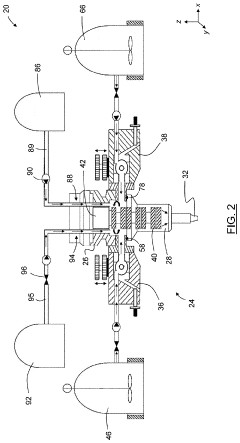
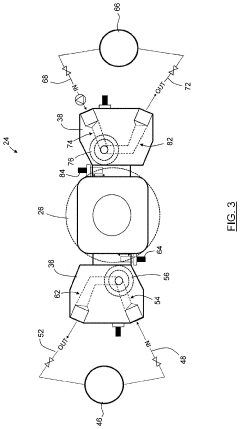
Three-dimensional printing device for printing polyurethane articles
PatentActiveUS20230101431A1
Innovation
- A 3D printing device comprising three tanks, pumps, and a rotary mixing chamber, with separate tanks for polyol, diisocyanates, and a cleaning solvent, connected to precision drive gears that feed the contents into a mixing chamber with a rotary screw for extrusion through a nozzle, allowing for the formation of thermoplastic or thermoset polyurethane articles.


Method for the 3D printing of two-component polyurethane compositions
PatentWO2020127484A1
Innovation
- A 3D printing process using a polyurethane composition comprising a polyol, a compound with thiol groups, and a polyisocyanate, with a metal catalyst that forms thiocomplexes, allowing for adjustable mechanical, chemical, and thermal properties, and a controlled pot life to prevent viscosity increase during mixing, enabling fast and efficient printing without heating.


Material Safety Standards for Industrial PU Processing
Industrial polyurethane processing in 3D printing environments requires comprehensive safety protocols to protect workers from chemical exposure and ensure operational compliance. Current regulatory frameworks primarily reference OSHA standards for isocyanate exposure limits, typically maintaining time-weighted averages below 0.005 ppm for most industrial applications. The European Union's REACH regulation additionally mandates specific handling procedures for diisocyanates used in polyurethane formulations, requiring specialized training certifications for operators working with these materials.
Respiratory protection standards represent the most critical safety consideration in industrial PU processing facilities. NIOSH-approved supplied-air respirators or self-contained breathing apparatus are mandatory when working with liquid polyurethane systems, particularly during material preparation and equipment maintenance phases. The selection of appropriate respiratory equipment must account for the specific isocyanate chemistry being processed, as different PU formulations present varying vapor pressure characteristics and toxicity profiles.
Personal protective equipment specifications extend beyond respiratory protection to include chemical-resistant clothing, nitrile or butyl rubber gloves, and eye protection rated for chemical splash resistance. The selection criteria for protective equipment must consider the processing temperature ranges typical in 3D printing applications, as elevated temperatures can increase chemical permeation rates through standard protective materials. Regular equipment inspection protocols ensure continued effectiveness of safety barriers throughout extended production cycles.
Ventilation system requirements mandate minimum air exchange rates of 10-15 air changes per hour in enclosed processing areas, with local exhaust ventilation positioned at material transfer points and printer enclosures. Engineering controls must maintain negative pressure differentials to prevent chemical migration to adjacent work areas, while ensuring adequate makeup air to prevent system imbalances that could compromise containment effectiveness.
Emergency response procedures specifically address polyurethane chemical exposures, including immediate decontamination protocols and medical surveillance requirements. Facilities must maintain eyewash stations within 10 seconds of any PU processing location, with emergency shower facilities accessible within 100 feet of work areas. Medical monitoring programs typically include baseline and periodic pulmonary function testing for workers with regular isocyanate exposure, ensuring early detection of potential respiratory sensitization or impairment.
Respiratory protection standards represent the most critical safety consideration in industrial PU processing facilities. NIOSH-approved supplied-air respirators or self-contained breathing apparatus are mandatory when working with liquid polyurethane systems, particularly during material preparation and equipment maintenance phases. The selection of appropriate respiratory equipment must account for the specific isocyanate chemistry being processed, as different PU formulations present varying vapor pressure characteristics and toxicity profiles.
Personal protective equipment specifications extend beyond respiratory protection to include chemical-resistant clothing, nitrile or butyl rubber gloves, and eye protection rated for chemical splash resistance. The selection criteria for protective equipment must consider the processing temperature ranges typical in 3D printing applications, as elevated temperatures can increase chemical permeation rates through standard protective materials. Regular equipment inspection protocols ensure continued effectiveness of safety barriers throughout extended production cycles.
Ventilation system requirements mandate minimum air exchange rates of 10-15 air changes per hour in enclosed processing areas, with local exhaust ventilation positioned at material transfer points and printer enclosures. Engineering controls must maintain negative pressure differentials to prevent chemical migration to adjacent work areas, while ensuring adequate makeup air to prevent system imbalances that could compromise containment effectiveness.
Emergency response procedures specifically address polyurethane chemical exposures, including immediate decontamination protocols and medical surveillance requirements. Facilities must maintain eyewash stations within 10 seconds of any PU processing location, with emergency shower facilities accessible within 100 feet of work areas. Medical monitoring programs typically include baseline and periodic pulmonary function testing for workers with regular isocyanate exposure, ensuring early detection of potential respiratory sensitization or impairment.
Sustainability Impact of Polyurethane 3D Printing
The integration of polyurethane materials in 3D printing systems presents significant sustainability implications that extend across the entire product lifecycle. Traditional polyurethane production relies heavily on petroleum-based feedstocks, contributing to carbon emissions and resource depletion. However, the additive manufacturing approach offers unique opportunities to minimize material waste through precise layer-by-layer deposition, potentially reducing overall environmental impact compared to conventional subtractive manufacturing methods.
Bio-based polyurethane formulations are emerging as a critical sustainability driver in 3D printing applications. These materials, derived from renewable sources such as plant oils, castor beans, and recycled content, can significantly reduce the carbon footprint of printed components. Recent developments in bio-polyol chemistry have enabled the creation of polyurethane systems with comparable mechanical properties to their petroleum-based counterparts while offering improved end-of-life disposal options.
The circular economy potential of polyurethane 3D printing represents a transformative sustainability opportunity. Advanced chemical recycling techniques allow for the breakdown of printed polyurethane components into their constituent monomers, enabling material recovery and reuse in new printing applications. This closed-loop approach addresses the traditional challenge of polyurethane waste management while creating economic value from previously discarded materials.
Energy consumption optimization in polyurethane 3D printing processes contributes substantially to sustainability outcomes. Lower processing temperatures required for certain polyurethane formulations reduce energy demands compared to high-temperature thermoplastics. Additionally, the ability to print complex geometries in single operations eliminates multiple manufacturing steps, reducing overall energy consumption and transportation requirements for component assembly.
Life cycle assessment studies indicate that polyurethane 3D printing can achieve up to 40% reduction in material waste compared to traditional manufacturing methods. The on-demand production capability eliminates inventory waste and enables localized manufacturing, reducing transportation-related emissions. Furthermore, the design freedom offered by 3D printing allows for topology optimization and lightweight structures that enhance product efficiency throughout their operational lifetime, multiplying the sustainability benefits beyond the manufacturing phase.
Bio-based polyurethane formulations are emerging as a critical sustainability driver in 3D printing applications. These materials, derived from renewable sources such as plant oils, castor beans, and recycled content, can significantly reduce the carbon footprint of printed components. Recent developments in bio-polyol chemistry have enabled the creation of polyurethane systems with comparable mechanical properties to their petroleum-based counterparts while offering improved end-of-life disposal options.
The circular economy potential of polyurethane 3D printing represents a transformative sustainability opportunity. Advanced chemical recycling techniques allow for the breakdown of printed polyurethane components into their constituent monomers, enabling material recovery and reuse in new printing applications. This closed-loop approach addresses the traditional challenge of polyurethane waste management while creating economic value from previously discarded materials.
Energy consumption optimization in polyurethane 3D printing processes contributes substantially to sustainability outcomes. Lower processing temperatures required for certain polyurethane formulations reduce energy demands compared to high-temperature thermoplastics. Additionally, the ability to print complex geometries in single operations eliminates multiple manufacturing steps, reducing overall energy consumption and transportation requirements for component assembly.
Life cycle assessment studies indicate that polyurethane 3D printing can achieve up to 40% reduction in material waste compared to traditional manufacturing methods. The on-demand production capability eliminates inventory waste and enables localized manufacturing, reducing transportation-related emissions. Furthermore, the design freedom offered by 3D printing allows for topology optimization and lightweight structures that enhance product efficiency throughout their operational lifetime, multiplying the sustainability benefits beyond the manufacturing phase.
Unlock deeper insights with Patsnap Eureka Quick Research — get a full tech report to explore trends and direct your research. Try now!
Generate Your Research Report Instantly with AI Agent
Supercharge your innovation with Patsnap Eureka AI Agent Platform!