
Optimize Solar Insolation Analysis for Rooftop Solar Feasibility
JUN 29, 20269 MIN READ
Generate Your Research Report Instantly with AI Agent
Patsnap Eureka helps you evaluate technical feasibility & market potential.
Solar Insolation Analysis Background and Objectives
Solar insolation analysis has emerged as a critical component in the renewable energy sector, particularly as global initiatives toward carbon neutrality and sustainable energy solutions intensify. The field originated from meteorological studies in the early 20th century but has evolved significantly with the advent of satellite technology, geographic information systems, and advanced computational modeling. Traditional solar resource assessment methods relied heavily on ground-based pyranometer measurements and interpolation techniques, which provided limited spatial coverage and temporal resolution.
The evolution of solar insolation analysis has been driven by the exponential growth of distributed solar photovoltaic installations, particularly in residential and commercial rooftop applications. Early assessment methods were primarily designed for utility-scale solar farms, where large, relatively uniform areas could be analyzed using simplified models. However, the complexity of urban environments, with their diverse building orientations, varying roof geometries, and dynamic shading patterns, has necessitated more sophisticated analytical approaches.
Contemporary solar insolation analysis encompasses multiple technological domains, including remote sensing, machine learning, three-dimensional modeling, and high-resolution meteorological data processing. The integration of LiDAR technology, satellite imagery, and digital surface models has revolutionized the precision with which solar potential can be assessed at individual building levels. These advancements have enabled the transition from broad regional assessments to granular, site-specific evaluations that account for micro-climatic conditions and local obstructions.
The primary objective of optimizing solar insolation analysis for rooftop solar feasibility is to enhance the accuracy, efficiency, and accessibility of solar resource assessment tools. This optimization aims to reduce the uncertainty in solar energy predictions, thereby improving investment confidence and facilitating more informed decision-making for property owners, developers, and financial institutions. Enhanced analytical capabilities seek to minimize the gap between predicted and actual solar energy generation, which has historically been a significant barrier to widespread solar adoption.
Furthermore, the optimization efforts target the development of scalable methodologies that can be applied across diverse geographic regions, climatic conditions, and urban morphologies. The objective extends beyond mere technical accuracy to encompass economic viability assessment, incorporating factors such as local electricity rates, incentive structures, and financing options into comprehensive feasibility analyses.
The evolution of solar insolation analysis has been driven by the exponential growth of distributed solar photovoltaic installations, particularly in residential and commercial rooftop applications. Early assessment methods were primarily designed for utility-scale solar farms, where large, relatively uniform areas could be analyzed using simplified models. However, the complexity of urban environments, with their diverse building orientations, varying roof geometries, and dynamic shading patterns, has necessitated more sophisticated analytical approaches.
Contemporary solar insolation analysis encompasses multiple technological domains, including remote sensing, machine learning, three-dimensional modeling, and high-resolution meteorological data processing. The integration of LiDAR technology, satellite imagery, and digital surface models has revolutionized the precision with which solar potential can be assessed at individual building levels. These advancements have enabled the transition from broad regional assessments to granular, site-specific evaluations that account for micro-climatic conditions and local obstructions.
The primary objective of optimizing solar insolation analysis for rooftop solar feasibility is to enhance the accuracy, efficiency, and accessibility of solar resource assessment tools. This optimization aims to reduce the uncertainty in solar energy predictions, thereby improving investment confidence and facilitating more informed decision-making for property owners, developers, and financial institutions. Enhanced analytical capabilities seek to minimize the gap between predicted and actual solar energy generation, which has historically been a significant barrier to widespread solar adoption.
Furthermore, the optimization efforts target the development of scalable methodologies that can be applied across diverse geographic regions, climatic conditions, and urban morphologies. The objective extends beyond mere technical accuracy to encompass economic viability assessment, incorporating factors such as local electricity rates, incentive structures, and financing options into comprehensive feasibility analyses.
Market Demand for Rooftop Solar Feasibility Assessment
The global rooftop solar market has experienced unprecedented growth driven by declining photovoltaic costs, supportive government policies, and increasing environmental consciousness among consumers and businesses. This expansion has created substantial demand for accurate and efficient solar feasibility assessment tools that can evaluate the viability of rooftop installations across diverse geographic and architectural conditions.
Residential sector demand represents the largest segment, with homeowners increasingly seeking reliable assessments to determine potential energy savings and return on investment before committing to solar installations. The complexity of residential rooftops, including varying orientations, shading conditions, and structural limitations, necessitates sophisticated insolation analysis tools that can provide precise energy generation forecasts.
Commercial and industrial segments demonstrate equally strong demand for comprehensive feasibility assessments, particularly as businesses pursue sustainability goals and energy cost reduction strategies. Large-scale commercial rooftops present unique challenges requiring detailed analysis of multiple roof sections, equipment placement optimization, and integration with existing building systems.
The emergence of solar-as-a-service business models has intensified demand for rapid, scalable assessment solutions. Solar developers and financing companies require tools capable of processing thousands of potential installations efficiently while maintaining accuracy standards necessary for investment decisions and performance guarantees.
Geographic expansion into emerging markets has created additional demand for assessment tools capable of handling diverse climatic conditions, building standards, and regulatory environments. These markets often lack comprehensive solar resource databases, increasing the importance of advanced insolation analysis capabilities that can operate with limited local data.
Utility companies and grid operators increasingly require detailed rooftop solar potential assessments for distribution planning and grid integration studies. This institutional demand emphasizes the need for tools that can analyze solar deployment scenarios at neighborhood and city scales while maintaining individual building-level accuracy.
The integration of artificial intelligence and machine learning technologies has opened new market opportunities for enhanced assessment accuracy and automation. Customers increasingly expect solutions that can automatically identify optimal panel configurations, predict shading impacts throughout the year, and account for local weather patterns in energy production estimates.
Residential sector demand represents the largest segment, with homeowners increasingly seeking reliable assessments to determine potential energy savings and return on investment before committing to solar installations. The complexity of residential rooftops, including varying orientations, shading conditions, and structural limitations, necessitates sophisticated insolation analysis tools that can provide precise energy generation forecasts.
Commercial and industrial segments demonstrate equally strong demand for comprehensive feasibility assessments, particularly as businesses pursue sustainability goals and energy cost reduction strategies. Large-scale commercial rooftops present unique challenges requiring detailed analysis of multiple roof sections, equipment placement optimization, and integration with existing building systems.
The emergence of solar-as-a-service business models has intensified demand for rapid, scalable assessment solutions. Solar developers and financing companies require tools capable of processing thousands of potential installations efficiently while maintaining accuracy standards necessary for investment decisions and performance guarantees.
Geographic expansion into emerging markets has created additional demand for assessment tools capable of handling diverse climatic conditions, building standards, and regulatory environments. These markets often lack comprehensive solar resource databases, increasing the importance of advanced insolation analysis capabilities that can operate with limited local data.
Utility companies and grid operators increasingly require detailed rooftop solar potential assessments for distribution planning and grid integration studies. This institutional demand emphasizes the need for tools that can analyze solar deployment scenarios at neighborhood and city scales while maintaining individual building-level accuracy.
The integration of artificial intelligence and machine learning technologies has opened new market opportunities for enhanced assessment accuracy and automation. Customers increasingly expect solutions that can automatically identify optimal panel configurations, predict shading impacts throughout the year, and account for local weather patterns in energy production estimates.
Current Solar Insolation Analysis Challenges and Limitations
Current solar insolation analysis for rooftop solar feasibility faces significant technical and methodological limitations that impede accurate assessment and optimal system design. Traditional approaches rely heavily on simplified solar radiation models that fail to capture the complex interplay of atmospheric conditions, local weather patterns, and site-specific variables affecting solar energy potential.
One of the primary challenges lies in the spatial and temporal resolution of available solar irradiance data. Most conventional datasets provide measurements at meteorological stations that may be located kilometers away from target rooftops, leading to substantial inaccuracies in local solar resource estimation. This geographic disconnect becomes particularly problematic in urban environments where microclimatic variations, building shadows, and atmospheric pollution create highly localized solar conditions.
Shading analysis represents another critical limitation in current methodologies. Existing tools often employ oversimplified geometric models that inadequately account for dynamic shading patterns caused by nearby buildings, vegetation, and infrastructure elements. These models typically fail to consider seasonal variations in sun angles, the impact of diffuse radiation, and the complex three-dimensional interactions between multiple shading objects throughout the day and across different seasons.
Data integration challenges further complicate accurate solar insolation analysis. Current systems struggle to effectively combine multiple data sources including satellite imagery, LiDAR data, weather station measurements, and real-time atmospheric conditions. The lack of standardized data formats and processing protocols results in inconsistent analysis outcomes and reduces the reliability of feasibility assessments.
Computational limitations also constrain the sophistication of current analysis methods. High-resolution modeling of solar irradiance requires substantial processing power and advanced algorithms that many existing platforms cannot support. This computational bottleneck forces analysts to rely on simplified models that sacrifice accuracy for processing speed, particularly when conducting large-scale assessments across multiple properties.
The temporal granularity of solar analysis presents additional constraints. Most current approaches provide annual or monthly solar estimates that fail to capture important short-term variations in solar availability. This limitation prevents accurate assessment of system performance during critical periods and hampers the optimization of energy storage and grid integration strategies.
Finally, the integration of emerging technologies such as bifacial solar panels, advanced tracking systems, and building-integrated photovoltaics remains poorly addressed in conventional analysis frameworks. These technologies require sophisticated modeling approaches that account for their unique operational characteristics and performance parameters, capabilities that current analysis tools largely lack.
One of the primary challenges lies in the spatial and temporal resolution of available solar irradiance data. Most conventional datasets provide measurements at meteorological stations that may be located kilometers away from target rooftops, leading to substantial inaccuracies in local solar resource estimation. This geographic disconnect becomes particularly problematic in urban environments where microclimatic variations, building shadows, and atmospheric pollution create highly localized solar conditions.
Shading analysis represents another critical limitation in current methodologies. Existing tools often employ oversimplified geometric models that inadequately account for dynamic shading patterns caused by nearby buildings, vegetation, and infrastructure elements. These models typically fail to consider seasonal variations in sun angles, the impact of diffuse radiation, and the complex three-dimensional interactions between multiple shading objects throughout the day and across different seasons.
Data integration challenges further complicate accurate solar insolation analysis. Current systems struggle to effectively combine multiple data sources including satellite imagery, LiDAR data, weather station measurements, and real-time atmospheric conditions. The lack of standardized data formats and processing protocols results in inconsistent analysis outcomes and reduces the reliability of feasibility assessments.
Computational limitations also constrain the sophistication of current analysis methods. High-resolution modeling of solar irradiance requires substantial processing power and advanced algorithms that many existing platforms cannot support. This computational bottleneck forces analysts to rely on simplified models that sacrifice accuracy for processing speed, particularly when conducting large-scale assessments across multiple properties.
The temporal granularity of solar analysis presents additional constraints. Most current approaches provide annual or monthly solar estimates that fail to capture important short-term variations in solar availability. This limitation prevents accurate assessment of system performance during critical periods and hampers the optimization of energy storage and grid integration strategies.
Finally, the integration of emerging technologies such as bifacial solar panels, advanced tracking systems, and building-integrated photovoltaics remains poorly addressed in conventional analysis frameworks. These technologies require sophisticated modeling approaches that account for their unique operational characteristics and performance parameters, capabilities that current analysis tools largely lack.
Existing Solar Insolation Measurement and Modeling Solutions
01 Solar tracking and positioning systems for optimization
Advanced solar tracking mechanisms and positioning systems are employed to optimize solar panel orientation and maximize energy capture throughout the day. These systems utilize sensors, motors, and control algorithms to automatically adjust panel angles based on sun position, weather conditions, and seasonal variations. The tracking systems can be single-axis or dual-axis configurations, incorporating feedback mechanisms to ensure optimal positioning for maximum solar insolation capture.- Solar tracking and positioning systems for optimization: Advanced solar tracking mechanisms and positioning systems are employed to optimize solar panel orientation and maximize energy capture throughout the day. These systems utilize sensors, motors, and control algorithms to automatically adjust panel angles based on sun position, weather conditions, and seasonal variations. The tracking systems can be single-axis or dual-axis configurations that significantly improve energy collection efficiency compared to fixed installations.
- Solar irradiance measurement and monitoring technologies: Sophisticated measurement systems and sensors are utilized to accurately assess solar irradiance levels and environmental conditions. These technologies include pyranometers, photodiodes, and weather monitoring equipment that provide real-time data on solar radiation intensity, atmospheric conditions, and shading effects. The collected data enables precise analysis of solar potential and helps optimize system performance through continuous monitoring and adjustment.
- Computational modeling and simulation for solar analysis: Advanced computational methods and simulation software are employed to model solar insolation patterns and predict energy generation potential. These systems utilize mathematical algorithms, weather databases, and geographical information to create detailed solar maps and forecasting models. The computational approaches enable optimization of solar installations through predictive analysis and performance modeling under various environmental scenarios.
- Data acquisition and processing systems for solar optimization: Comprehensive data collection and processing frameworks are implemented to gather, analyze, and interpret solar energy data from multiple sources. These systems integrate various sensors, communication networks, and data processing algorithms to create actionable insights for solar system optimization. The platforms enable real-time decision making and long-term performance analysis through advanced data analytics and machine learning techniques.
- Intelligent control systems for solar energy management: Smart control systems and automation technologies are developed to optimize solar energy collection and distribution based on real-time analysis of insolation data. These systems incorporate artificial intelligence, predictive algorithms, and adaptive control mechanisms to automatically adjust system parameters for maximum efficiency. The intelligent systems can respond to changing environmental conditions and energy demands while maintaining optimal performance throughout varying operational scenarios.
02 Solar irradiance measurement and monitoring technologies
Sophisticated measurement systems and monitoring technologies are utilized to accurately assess solar irradiance levels and environmental conditions. These systems incorporate various sensors, data acquisition units, and analytical tools to collect real-time solar radiation data, atmospheric conditions, and performance metrics. The monitoring systems enable precise evaluation of solar resource availability and help optimize system performance through continuous data analysis and feedback.Expand Specific Solutions03 Computational modeling and simulation for solar analysis
Advanced computational methods and simulation techniques are employed to model solar insolation patterns and predict optimal system configurations. These approaches utilize mathematical algorithms, weather data analysis, and predictive modeling to simulate solar radiation patterns across different time periods and geographical locations. The computational tools help in site assessment, system design optimization, and performance forecasting for solar installations.Expand Specific Solutions04 Optical enhancement and light concentration systems
Specialized optical systems and light concentration technologies are implemented to enhance solar energy capture efficiency. These systems utilize mirrors, lenses, reflectors, and other optical components to concentrate and redirect solar radiation onto photovoltaic surfaces. The optical enhancement methods include concentrating solar power systems, light-guiding structures, and reflective surfaces that maximize the effective solar insolation received by energy conversion devices.Expand Specific Solutions05 Smart control systems and optimization algorithms
Intelligent control systems and optimization algorithms are integrated to automatically adjust solar system parameters for maximum efficiency. These systems incorporate machine learning, artificial intelligence, and adaptive control strategies to optimize performance based on real-time conditions and historical data. The smart control mechanisms can adjust multiple parameters simultaneously, including panel orientation, cooling systems, and power management to achieve optimal solar insolation utilization.Expand Specific Solutions
Key Players in Solar Analysis and Assessment Industry
The solar insolation analysis market for rooftop solar feasibility is experiencing rapid growth driven by increasing renewable energy adoption and technological advancement. The industry is transitioning from early development to maturity, with significant market expansion projected as governments worldwide implement supportive policies and cost reductions make solar installations more accessible. Technology maturity varies significantly across market participants, with established players like Hitachi Ltd. and 3M Innovative Properties Co. leveraging advanced materials and system integration capabilities, while specialized firms such as GAF Energy LLC and Mounting Systems GmbH focus on innovative installation solutions. Research institutions including Beijing Institute of Technology, Tianjin University, and Universidad Politécnica de Madrid are advancing core analytical methodologies and optimization algorithms. Chinese companies like Sungrow New Energy and Jiangsu Electric Power Co. demonstrate strong regional market presence, while European entities such as Fraunhofer-Gesellschaft and Noveltis SAS contribute sophisticated modeling and satellite-based analysis technologies, creating a competitive landscape characterized by diverse technological approaches and varying levels of commercial readiness.
TotalEnergies OneTech SAS
Technical Solution: TotalEnergies OneTech has developed advanced solar insolation analysis systems that integrate satellite imagery with ground-based meteorological data to optimize rooftop solar feasibility assessments. Their technology combines machine learning algorithms with high-resolution irradiance mapping to provide accurate solar potential calculations for residential and commercial buildings. The system incorporates real-time weather pattern analysis, seasonal variation modeling, and shading impact assessment to deliver comprehensive feasibility reports. Their platform utilizes multi-spectral satellite data processing and advanced atmospheric correction algorithms to enhance prediction accuracy for solar energy yield estimation.
Strengths: Comprehensive data integration capabilities and strong meteorological expertise. Weaknesses: Limited market presence in residential solar assessment compared to utility-scale projects.
Sunpower, Inc. (Ohio)
Technical Solution: Sunpower has developed proprietary solar insolation analysis software that leverages LiDAR technology and aerial imagery to create detailed 3D models of rooftop structures for accurate solar feasibility assessment. Their system incorporates advanced shading analysis algorithms that account for nearby buildings, trees, and other obstructions throughout different seasons. The platform integrates local weather data, historical irradiance patterns, and roof geometry analysis to optimize solar panel placement and configuration. Their technology includes automated roof area calculation, tilt angle optimization, and energy production forecasting with high precision modeling capabilities for residential and commercial applications.
Strengths: Strong expertise in solar panel technology and established market presence in residential solar. Weaknesses: Technology focus primarily on hardware rather than advanced analytics software solutions.
Core Innovations in Solar Resource Analysis Optimization
Assessment of solar energy potential on existing buildings in a region
PatentInactiveUS7305983B1
Innovation
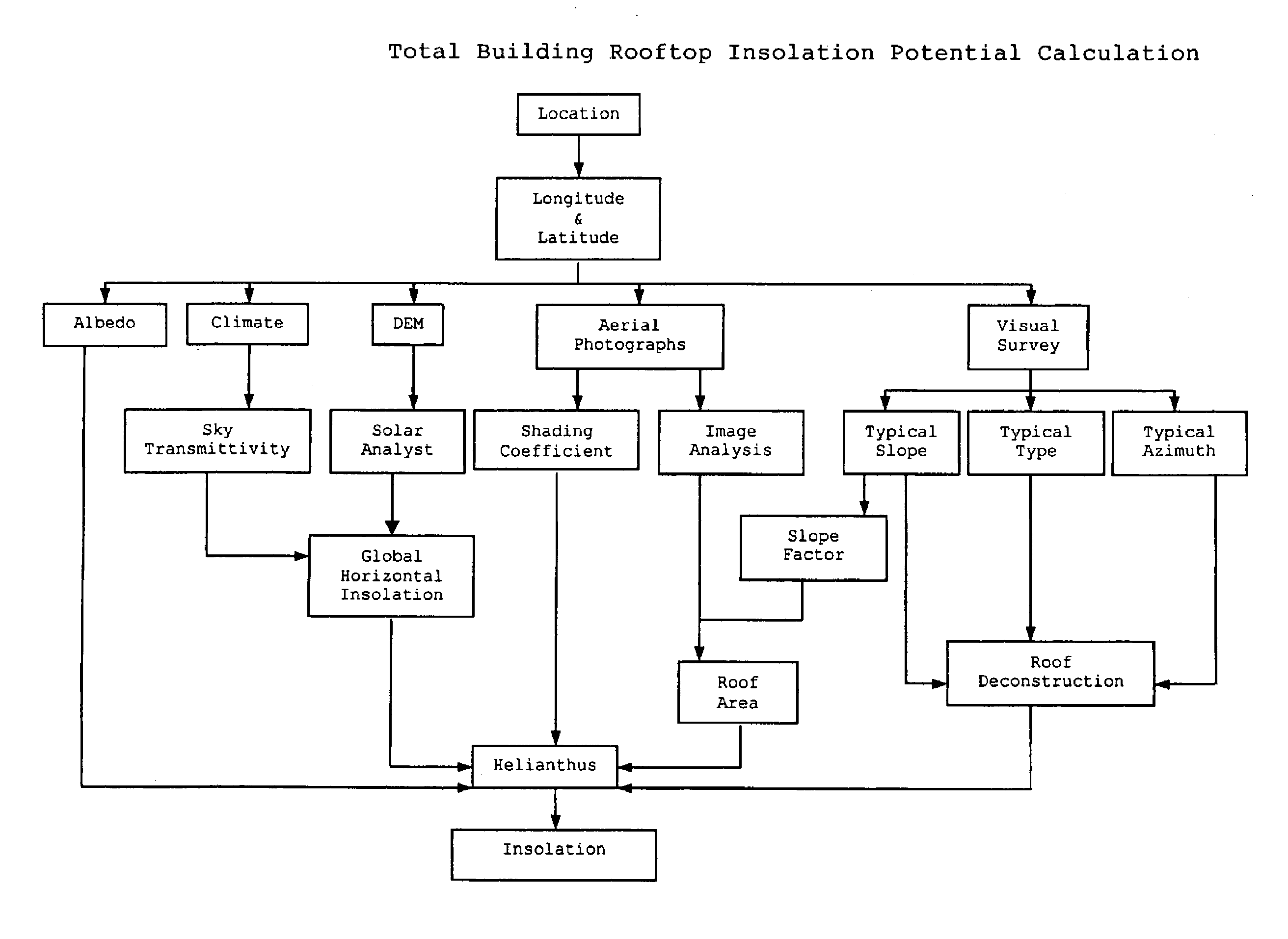
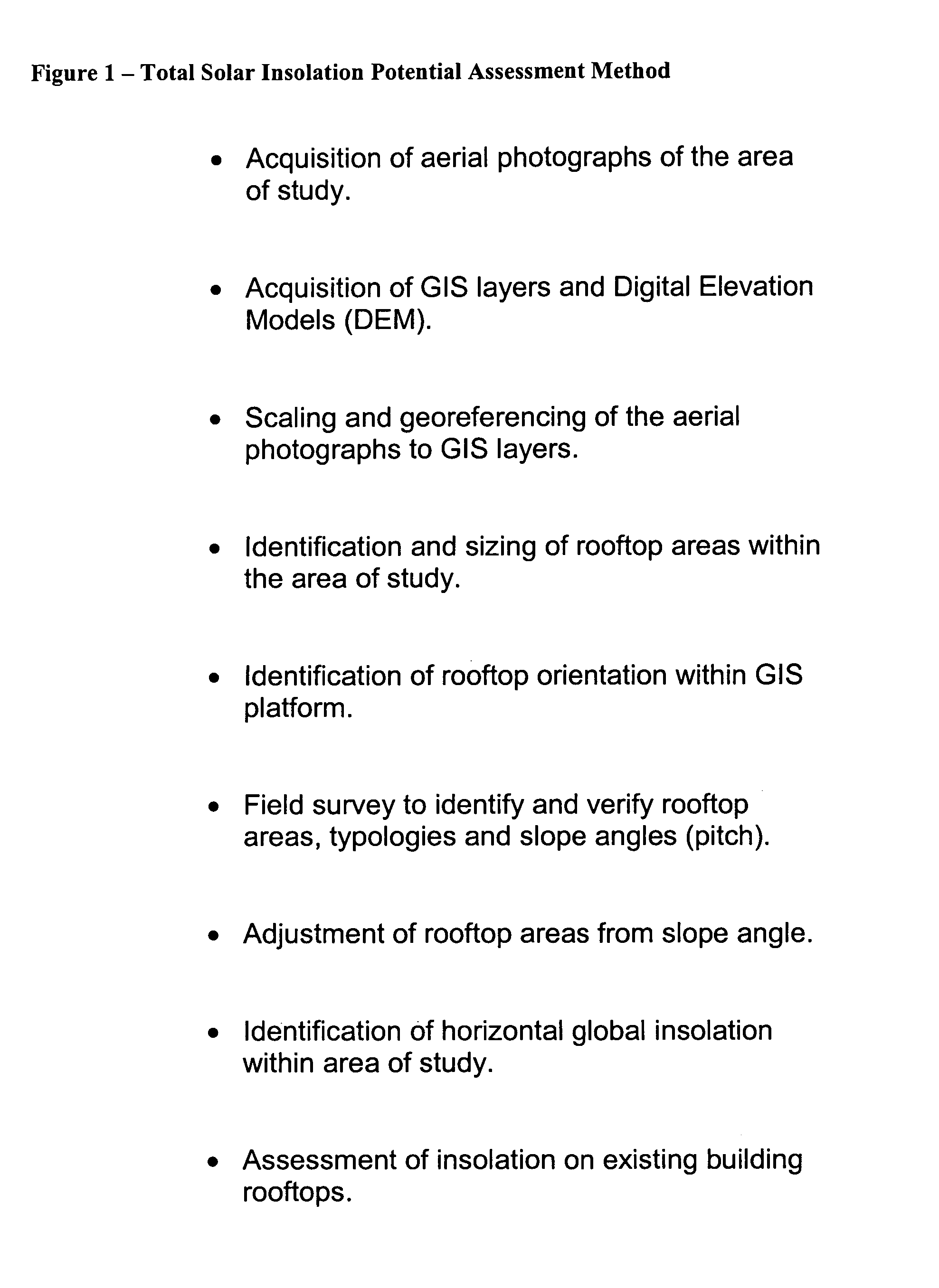
- A method involving computing Global Horizontal Insolation, Sky Transmissivity, Albedo, Shading Coefficient, and rooftop characteristics using Digital Elevation Models, aerial photographs, and GIS analysis to estimate Total Building Rooftop Insolation Potential.

Solar insolation blocking structure of roof
PatentActiveJP2016069833A
Innovation
- A solar radiation shielding structure comprising a plurality of solar cell panels installed with plate-shaped shielding members above the gaps between panels, which are positioned differently in height and orientation to block solar radiation and maintain airflow.


Policy Framework for Distributed Solar Energy Systems
The regulatory landscape for distributed solar energy systems has evolved significantly to support the optimization of solar insolation analysis for rooftop installations. Government agencies worldwide have established comprehensive frameworks that mandate standardized assessment methodologies for solar feasibility studies. These policies require developers to utilize validated solar radiation databases and employ certified modeling software to ensure accurate insolation calculations for residential and commercial rooftop applications.
Net metering policies represent a cornerstone of distributed solar frameworks, directly influencing the economic viability calculations derived from insolation analysis. Federal and state regulations establish standardized compensation rates for excess energy production, creating predictable revenue models that enhance the accuracy of feasibility assessments. These policies typically require detailed solar production estimates based on site-specific insolation data, driving demand for sophisticated analysis tools.
Building codes and zoning regulations increasingly incorporate solar-ready requirements that streamline the integration of insolation analysis into construction planning. Many jurisdictions now mandate solar feasibility assessments during the permitting process, requiring developers to demonstrate optimal panel placement based on comprehensive insolation modeling. These regulations often specify minimum solar access requirements and establish protocols for shadow analysis in urban environments.
Interconnection standards have been harmonized across regions to facilitate distributed solar deployment while maintaining grid stability. These technical standards require precise energy production forecasting based on validated insolation data, ensuring that distributed systems can be safely integrated into existing electrical infrastructure. Utilities must now accept standardized solar production estimates derived from approved insolation analysis methodologies.
Financial incentive programs, including tax credits and rebate structures, are increasingly tied to performance-based metrics derived from insolation analysis. Policy frameworks require accurate solar resource assessments to qualify for incentives, creating market demand for advanced analysis tools. These programs often incorporate tiered incentive structures based on expected energy production, making precise insolation modeling critical for project economics.
Environmental regulations and renewable energy portfolio standards establish mandatory targets for distributed solar adoption, creating sustained policy support for improved feasibility analysis tools. These frameworks typically require utilities to demonstrate progress toward renewable energy goals, incentivizing investment in technologies that optimize solar deployment through enhanced insolation assessment capabilities.
Net metering policies represent a cornerstone of distributed solar frameworks, directly influencing the economic viability calculations derived from insolation analysis. Federal and state regulations establish standardized compensation rates for excess energy production, creating predictable revenue models that enhance the accuracy of feasibility assessments. These policies typically require detailed solar production estimates based on site-specific insolation data, driving demand for sophisticated analysis tools.
Building codes and zoning regulations increasingly incorporate solar-ready requirements that streamline the integration of insolation analysis into construction planning. Many jurisdictions now mandate solar feasibility assessments during the permitting process, requiring developers to demonstrate optimal panel placement based on comprehensive insolation modeling. These regulations often specify minimum solar access requirements and establish protocols for shadow analysis in urban environments.
Interconnection standards have been harmonized across regions to facilitate distributed solar deployment while maintaining grid stability. These technical standards require precise energy production forecasting based on validated insolation data, ensuring that distributed systems can be safely integrated into existing electrical infrastructure. Utilities must now accept standardized solar production estimates derived from approved insolation analysis methodologies.
Financial incentive programs, including tax credits and rebate structures, are increasingly tied to performance-based metrics derived from insolation analysis. Policy frameworks require accurate solar resource assessments to qualify for incentives, creating market demand for advanced analysis tools. These programs often incorporate tiered incentive structures based on expected energy production, making precise insolation modeling critical for project economics.
Environmental regulations and renewable energy portfolio standards establish mandatory targets for distributed solar adoption, creating sustained policy support for improved feasibility analysis tools. These frameworks typically require utilities to demonstrate progress toward renewable energy goals, incentivizing investment in technologies that optimize solar deployment through enhanced insolation assessment capabilities.
Environmental Impact Assessment for Rooftop Solar Deployment
The deployment of rooftop solar systems presents a complex environmental profile that requires comprehensive assessment across multiple impact categories. While solar photovoltaic technology offers significant environmental benefits through clean energy generation, the complete lifecycle assessment reveals both positive and negative environmental implications that must be carefully evaluated.
Manufacturing processes for solar panels involve energy-intensive procedures and the use of various chemicals, including silicon purification, cell fabrication, and module assembly. These processes generate carbon emissions, consume substantial water resources, and produce industrial waste streams. However, lifecycle analyses consistently demonstrate that rooftop solar systems offset their manufacturing carbon footprint within 1-4 years of operation, depending on local solar irradiance conditions and grid electricity carbon intensity.
The installation phase typically involves minimal environmental disruption compared to ground-mounted systems, as rooftop installations utilize existing structures without requiring additional land use. However, considerations include proper handling of installation materials, waste management during mounting system installation, and potential impacts on building structural integrity that may require reinforcement materials.
Operational environmental benefits are substantial, with rooftop solar systems generating clean electricity without air pollutants, water consumption, or noise emissions. A typical residential rooftop system prevents approximately 3-4 tons of CO2 emissions annually, contributing significantly to greenhouse gas reduction goals. The distributed nature of rooftop solar also reduces transmission losses and grid infrastructure requirements.
End-of-life considerations are increasingly important as first-generation solar installations approach retirement. Solar panel recycling technologies are advancing, with recovery rates for silicon, silver, and aluminum reaching 85-95%. Proper recycling programs prevent potentially hazardous materials from entering landfills while recovering valuable materials for new manufacturing processes.
Regional environmental impacts vary significantly based on local climate conditions, grid carbon intensity, and manufacturing supply chains. Areas with high solar irradiance and carbon-intensive grid electricity demonstrate the most favorable environmental profiles for rooftop solar deployment, maximizing the environmental benefits per installed capacity.
Manufacturing processes for solar panels involve energy-intensive procedures and the use of various chemicals, including silicon purification, cell fabrication, and module assembly. These processes generate carbon emissions, consume substantial water resources, and produce industrial waste streams. However, lifecycle analyses consistently demonstrate that rooftop solar systems offset their manufacturing carbon footprint within 1-4 years of operation, depending on local solar irradiance conditions and grid electricity carbon intensity.
The installation phase typically involves minimal environmental disruption compared to ground-mounted systems, as rooftop installations utilize existing structures without requiring additional land use. However, considerations include proper handling of installation materials, waste management during mounting system installation, and potential impacts on building structural integrity that may require reinforcement materials.
Operational environmental benefits are substantial, with rooftop solar systems generating clean electricity without air pollutants, water consumption, or noise emissions. A typical residential rooftop system prevents approximately 3-4 tons of CO2 emissions annually, contributing significantly to greenhouse gas reduction goals. The distributed nature of rooftop solar also reduces transmission losses and grid infrastructure requirements.
End-of-life considerations are increasingly important as first-generation solar installations approach retirement. Solar panel recycling technologies are advancing, with recovery rates for silicon, silver, and aluminum reaching 85-95%. Proper recycling programs prevent potentially hazardous materials from entering landfills while recovering valuable materials for new manufacturing processes.
Regional environmental impacts vary significantly based on local climate conditions, grid carbon intensity, and manufacturing supply chains. Areas with high solar irradiance and carbon-intensive grid electricity demonstrate the most favorable environmental profiles for rooftop solar deployment, maximizing the environmental benefits per installed capacity.
Unlock deeper insights with Patsnap Eureka Quick Research — get a full tech report to explore trends and direct your research. Try now!
Generate Your Research Report Instantly with AI Agent
Supercharge your innovation with Patsnap Eureka AI Agent Platform!