Optimizing Gear Tooth Cutting Techniques for Precision Engineering
MAR 12, 20269 MIN READ
Generate Your Research Report Instantly with AI Agent
Patsnap Eureka helps you evaluate technical feasibility & market potential.
Gear Cutting Technology Background and Precision Goals
Gear cutting technology has evolved significantly since the industrial revolution, transforming from rudimentary manual processes to sophisticated computer-controlled manufacturing systems. The earliest gear cutting methods relied on simple filing and hand-shaping techniques, which gradually gave way to mechanical cutting processes in the 19th century. The introduction of gear hobbing machines in the early 1900s marked a pivotal moment, enabling mass production of gears with improved consistency and reduced manufacturing time.
The development trajectory of gear cutting has been characterized by continuous improvements in cutting tool materials, machine precision, and process control. The transition from carbon steel cutting tools to high-speed steel, and subsequently to carbide and ceramic materials, has dramatically enhanced cutting speeds and tool life. Modern gear cutting incorporates advanced technologies such as CNC machining, coordinate measuring machines, and real-time process monitoring systems.
Contemporary precision engineering demands have pushed gear cutting technology toward unprecedented accuracy levels. Industries such as aerospace, automotive transmissions, robotics, and renewable energy systems require gears with tolerances measured in micrometers. The increasing complexity of modern mechanical systems necessitates gears that operate with minimal noise, vibration, and power loss while maintaining exceptional durability under extreme operating conditions.
Current precision goals in gear cutting focus on achieving surface roughness values below 0.4 micrometers Ra, maintaining pitch accuracy within ±3 micrometers, and ensuring profile deviations of less than 5 micrometers across the entire tooth surface. These stringent requirements demand advanced cutting strategies that minimize thermal distortion, reduce cutting forces, and eliminate geometric errors inherent in traditional manufacturing processes.
The integration of digital manufacturing concepts has introduced new paradigms in gear cutting precision. Adaptive machining systems now utilize real-time feedback to compensate for tool wear, thermal expansion, and machine deflection during the cutting process. These technological advances enable manufacturers to achieve consistent quality while reducing production costs and cycle times, establishing new benchmarks for precision gear manufacturing in critical applications.
The development trajectory of gear cutting has been characterized by continuous improvements in cutting tool materials, machine precision, and process control. The transition from carbon steel cutting tools to high-speed steel, and subsequently to carbide and ceramic materials, has dramatically enhanced cutting speeds and tool life. Modern gear cutting incorporates advanced technologies such as CNC machining, coordinate measuring machines, and real-time process monitoring systems.
Contemporary precision engineering demands have pushed gear cutting technology toward unprecedented accuracy levels. Industries such as aerospace, automotive transmissions, robotics, and renewable energy systems require gears with tolerances measured in micrometers. The increasing complexity of modern mechanical systems necessitates gears that operate with minimal noise, vibration, and power loss while maintaining exceptional durability under extreme operating conditions.
Current precision goals in gear cutting focus on achieving surface roughness values below 0.4 micrometers Ra, maintaining pitch accuracy within ±3 micrometers, and ensuring profile deviations of less than 5 micrometers across the entire tooth surface. These stringent requirements demand advanced cutting strategies that minimize thermal distortion, reduce cutting forces, and eliminate geometric errors inherent in traditional manufacturing processes.
The integration of digital manufacturing concepts has introduced new paradigms in gear cutting precision. Adaptive machining systems now utilize real-time feedback to compensate for tool wear, thermal expansion, and machine deflection during the cutting process. These technological advances enable manufacturers to achieve consistent quality while reducing production costs and cycle times, establishing new benchmarks for precision gear manufacturing in critical applications.
Market Demand for High-Precision Gear Manufacturing
The global precision gear manufacturing market has experienced substantial growth driven by increasing demands across multiple industrial sectors. Aerospace and defense applications require gears with exceptional accuracy and reliability, where even microscopic deviations can result in catastrophic system failures. The automotive industry, particularly with the rise of electric vehicles and advanced transmission systems, demands gears that operate with minimal noise, vibration, and energy loss while maintaining extended service life.
Industrial automation and robotics represent another significant demand driver, where precision gears enable accurate positioning and smooth motion control in manufacturing equipment. The renewable energy sector, especially wind power generation, requires large-scale precision gears capable of handling substantial torque loads while maintaining efficiency over decades of operation. Medical device manufacturing also contributes to market demand, requiring miniaturized precision gears for surgical instruments and diagnostic equipment.
The semiconductor and electronics industries have created specialized demand for ultra-precise gear systems used in wafer handling equipment and precision positioning systems. These applications often require tolerances measured in micrometers, pushing the boundaries of conventional gear manufacturing capabilities. Marine and offshore applications demand corrosion-resistant precision gears that can operate reliably in harsh environmental conditions.
Market dynamics indicate a shift toward higher precision requirements across all sectors, driven by performance optimization and energy efficiency mandates. Manufacturers are increasingly seeking gear solutions that combine traditional mechanical precision with modern materials and surface treatments. The integration of Industry 4.0 technologies has created demand for smart gear systems with embedded sensors and monitoring capabilities.
Regional market patterns show concentrated demand in developed manufacturing economies, with emerging markets gradually increasing their precision requirements as local industries mature. The trend toward miniaturization in consumer electronics and medical devices continues to drive demand for micro-precision gears, while heavy industry applications push toward larger, more robust precision gear solutions.
Quality standards and regulatory requirements across industries have become increasingly stringent, necessitating advanced gear tooth cutting techniques that can consistently achieve specified tolerances while maintaining cost-effectiveness and production scalability.
Industrial automation and robotics represent another significant demand driver, where precision gears enable accurate positioning and smooth motion control in manufacturing equipment. The renewable energy sector, especially wind power generation, requires large-scale precision gears capable of handling substantial torque loads while maintaining efficiency over decades of operation. Medical device manufacturing also contributes to market demand, requiring miniaturized precision gears for surgical instruments and diagnostic equipment.
The semiconductor and electronics industries have created specialized demand for ultra-precise gear systems used in wafer handling equipment and precision positioning systems. These applications often require tolerances measured in micrometers, pushing the boundaries of conventional gear manufacturing capabilities. Marine and offshore applications demand corrosion-resistant precision gears that can operate reliably in harsh environmental conditions.
Market dynamics indicate a shift toward higher precision requirements across all sectors, driven by performance optimization and energy efficiency mandates. Manufacturers are increasingly seeking gear solutions that combine traditional mechanical precision with modern materials and surface treatments. The integration of Industry 4.0 technologies has created demand for smart gear systems with embedded sensors and monitoring capabilities.
Regional market patterns show concentrated demand in developed manufacturing economies, with emerging markets gradually increasing their precision requirements as local industries mature. The trend toward miniaturization in consumer electronics and medical devices continues to drive demand for micro-precision gears, while heavy industry applications push toward larger, more robust precision gear solutions.
Quality standards and regulatory requirements across industries have become increasingly stringent, necessitating advanced gear tooth cutting techniques that can consistently achieve specified tolerances while maintaining cost-effectiveness and production scalability.
Current State and Challenges in Gear Tooth Cutting
Gear tooth cutting technology has reached a sophisticated level of development, with multiple manufacturing approaches available to meet diverse precision engineering requirements. Traditional methods such as hobbing, shaping, and broaching continue to dominate high-volume production scenarios, while advanced techniques including gear grinding, skiving, and hard turning have emerged to address increasingly stringent accuracy demands. The integration of CNC technology has significantly enhanced process control and repeatability across all cutting methods.
Contemporary gear manufacturing facilities typically employ multi-stage production processes, combining rough cutting operations with precision finishing techniques. Hobbing remains the most widely adopted method for spur and helical gear production, offering excellent productivity rates and acceptable accuracy for many applications. However, the method faces limitations when processing hardened materials or achieving surface finishes below Ra 0.8 micrometers.
The industry currently grapples with several critical technical challenges that constrain further advancement. Tool wear represents a persistent issue, particularly when machining high-strength alloys and case-hardened steels commonly used in aerospace and automotive applications. Cutting tool materials, despite advances in coating technologies and substrate compositions, still experience rapid degradation under extreme cutting conditions, leading to dimensional variations and surface quality deterioration.
Thermal management during cutting operations poses another significant challenge. Heat generation during high-speed machining can cause workpiece distortion, affecting gear tooth geometry and introducing residual stresses that compromise fatigue performance. Current cooling strategies, including flood coolant and minimum quantity lubrication systems, provide limited effectiveness in managing thermal loads during intensive cutting operations.
Surface integrity concerns have become increasingly prominent as gear applications demand higher performance standards. Achieving optimal surface roughness while maintaining subsurface material properties requires careful balance of cutting parameters, tool geometry, and process conditions. White layer formation and microstructural alterations in the near-surface region can significantly impact gear durability and noise characteristics.
Dimensional accuracy requirements continue to escalate, with many precision applications now demanding gear quality grades of 4-6 according to ISO standards. Achieving such tolerances consistently requires exceptional machine tool stability, advanced measurement systems, and sophisticated process control algorithms. Manufacturing variations, even within acceptable statistical limits, can accumulate to produce unacceptable final product quality.
The geographical distribution of advanced gear cutting capabilities remains concentrated in established manufacturing regions, with Germany, Japan, and Switzerland leading in precision equipment development. However, emerging markets are rapidly developing capabilities, creating competitive pressure while simultaneously driving innovation in automation and process optimization technologies.
Contemporary gear manufacturing facilities typically employ multi-stage production processes, combining rough cutting operations with precision finishing techniques. Hobbing remains the most widely adopted method for spur and helical gear production, offering excellent productivity rates and acceptable accuracy for many applications. However, the method faces limitations when processing hardened materials or achieving surface finishes below Ra 0.8 micrometers.
The industry currently grapples with several critical technical challenges that constrain further advancement. Tool wear represents a persistent issue, particularly when machining high-strength alloys and case-hardened steels commonly used in aerospace and automotive applications. Cutting tool materials, despite advances in coating technologies and substrate compositions, still experience rapid degradation under extreme cutting conditions, leading to dimensional variations and surface quality deterioration.
Thermal management during cutting operations poses another significant challenge. Heat generation during high-speed machining can cause workpiece distortion, affecting gear tooth geometry and introducing residual stresses that compromise fatigue performance. Current cooling strategies, including flood coolant and minimum quantity lubrication systems, provide limited effectiveness in managing thermal loads during intensive cutting operations.
Surface integrity concerns have become increasingly prominent as gear applications demand higher performance standards. Achieving optimal surface roughness while maintaining subsurface material properties requires careful balance of cutting parameters, tool geometry, and process conditions. White layer formation and microstructural alterations in the near-surface region can significantly impact gear durability and noise characteristics.
Dimensional accuracy requirements continue to escalate, with many precision applications now demanding gear quality grades of 4-6 according to ISO standards. Achieving such tolerances consistently requires exceptional machine tool stability, advanced measurement systems, and sophisticated process control algorithms. Manufacturing variations, even within acceptable statistical limits, can accumulate to produce unacceptable final product quality.
The geographical distribution of advanced gear cutting capabilities remains concentrated in established manufacturing regions, with Germany, Japan, and Switzerland leading in precision equipment development. However, emerging markets are rapidly developing capabilities, creating competitive pressure while simultaneously driving innovation in automation and process optimization technologies.
Existing Gear Tooth Cutting Methods and Solutions
01 Advanced CNC and computer-controlled gear cutting systems
Modern gear tooth cutting precision is achieved through computer numerical control (CNC) systems that enable automated and highly accurate machining processes. These systems utilize sophisticated software algorithms to control cutting tool paths, feed rates, and positioning with micron-level accuracy. The integration of digital control systems allows for real-time monitoring and adjustment of cutting parameters, ensuring consistent tooth profile accuracy across production runs. Advanced servo motors and precision ball screws work in conjunction with the control systems to minimize positioning errors and vibration during the cutting process.- Advanced CNC and computer-controlled gear cutting systems: Modern gear tooth cutting precision is achieved through computer numerical control (CNC) systems that enable automated and highly accurate machining processes. These systems utilize sophisticated software algorithms to control cutting tool paths, feed rates, and positioning with micron-level accuracy. The integration of digital control systems allows for real-time monitoring and adjustment of cutting parameters, ensuring consistent tooth profile accuracy across production runs. Advanced servo motors and precision ball screws work in conjunction with the control systems to minimize positioning errors and improve repeatability.
- Precision tool geometry and cutting edge design: The accuracy of gear tooth cutting heavily depends on the geometric design and manufacturing quality of the cutting tools themselves. Specialized hob cutters, gear shapers, and broaching tools are designed with precise tooth profiles that directly transfer to the workpiece. Tool materials such as high-speed steel, carbide, and coated cutting edges are selected to maintain sharpness and dimensional stability during extended cutting operations. The relief angles, rake angles, and cutting edge radii are optimized to reduce cutting forces and minimize deflection, which directly impacts the final tooth surface finish and profile accuracy.
- Workpiece positioning and fixturing systems: Achieving precision in gear tooth cutting requires robust workpiece holding and positioning mechanisms that eliminate movement during the cutting process. Specialized fixtures and mandrels are designed to securely clamp the gear blank while maintaining concentricity and perpendicularity to the cutting tool axis. Indexing systems with high-resolution encoders ensure accurate angular positioning between successive tooth cuts. Thermal compensation mechanisms account for dimensional changes due to heat generation during cutting, and vibration damping systems minimize chatter that could affect surface quality.
- Measurement and inspection techniques for tooth accuracy: Precision gear tooth cutting is verified through advanced metrology systems that measure critical parameters such as tooth profile, lead angle, pitch accuracy, and surface finish. Coordinate measuring machines equipped with specialized gear measurement software can evaluate involute profile deviations and helix angle errors. In-process measurement systems enable real-time feedback to the cutting machine, allowing for adaptive control and correction of any deviations. Optical and laser-based measurement systems provide non-contact inspection capabilities for delicate or complex gear geometries.
- Cutting parameter optimization and process control: The precision of gear tooth cutting is significantly influenced by the selection and control of cutting parameters including cutting speed, feed rate, depth of cut, and coolant application. Optimization algorithms determine the ideal combination of parameters based on material properties, tool characteristics, and desired surface finish. Adaptive control systems monitor cutting forces, tool wear, and temperature to automatically adjust parameters during the cutting process. Multi-pass cutting strategies with roughing and finishing operations allow for material removal efficiency while maintaining final dimensional accuracy.
02 Specialized cutting tool geometry and materials
Precision in gear tooth cutting is significantly influenced by the design and material composition of cutting tools. High-performance cutting tools feature optimized rake angles, clearance angles, and edge geometries specifically engineered for different gear types and materials. The use of advanced tool materials such as carbide, ceramic, and coated cutting edges extends tool life while maintaining dimensional accuracy. Tool geometry innovations include variable pitch designs and specialized hob profiles that reduce cutting forces and improve surface finish quality.Expand Specific Solutions03 Precision measurement and inspection systems
Ensuring gear tooth cutting precision requires sophisticated measurement and inspection technologies integrated into the manufacturing process. Coordinate measuring machines and optical inspection systems verify tooth profile accuracy, pitch deviation, and surface finish quality. In-process monitoring systems detect dimensional variations during cutting operations, enabling immediate corrective actions. Advanced metrology techniques include laser scanning, tactile probing, and non-contact measurement methods that provide comprehensive quality data for each manufactured gear.Expand Specific Solutions04 Thermal management and vibration control
Maintaining precision during gear tooth cutting requires effective control of thermal expansion and mechanical vibrations. Temperature control systems regulate cutting zone temperatures to prevent thermal distortion of both the workpiece and cutting tools. Vibration damping mechanisms in machine tool structures minimize chatter and resonance effects that can compromise tooth surface quality. Coolant delivery systems are optimized to provide consistent temperature control while efficiently removing chips from the cutting zone. Machine foundation design and isolation systems further reduce external vibration transmission.Expand Specific Solutions05 Multi-axis machining and gear hobbing techniques
Advanced multi-axis machining capabilities enable complex gear geometries to be cut with high precision. Simultaneous control of multiple axes allows for continuous generating processes that produce accurate involute tooth profiles. Gear hobbing techniques utilize specialized hob cutters that generate teeth through a continuous indexing motion, achieving superior accuracy compared to traditional methods. Process optimization includes careful selection of cutting speeds, feed rates, and depth of cut parameters tailored to specific gear specifications and material properties.Expand Specific Solutions
Key Players in Precision Gear Manufacturing Industry
The gear tooth cutting optimization market represents a mature yet evolving industry driven by automotive, aerospace, and industrial machinery demands. The competitive landscape spans established German precision manufacturers like Gleason Pfauter, Klingelnberg AG, and Reishauer AG, alongside Japanese industrial giants including JTEKT Corp., Nachi-Fujikoshi Corp., and Mitsubishi Heavy Industries Machine Tool. Technology maturity varies significantly across segments, with traditional cutting methods well-established while advanced techniques like Profilator's scudding® process and digital integration through smart manufacturing ecosystems represent emerging frontiers. The market demonstrates strong consolidation trends, evidenced by strategic acquisitions and partnerships among key players. Research institutions like Xi'an Jiaotong University and Central South University contribute to technological advancement, while companies like Haas Schleifmaschinen and PRÄWEMA Antriebstechnik drive specialized grinding and machining innovations, indicating a competitive environment balancing proven technologies with next-generation precision engineering solutions.
Reishauer AG
Technical Solution: Reishauer specializes in advanced gear grinding technology with their patented continuous generating grinding process. Their machines utilize CBN (Cubic Boron Nitride) grinding wheels and sophisticated CNC control systems to achieve precision gear tooth cutting with tolerances down to IT 3-4 quality grades. The company's technology incorporates real-time process monitoring, adaptive grinding cycles, and integrated measurement systems that enable in-process quality control. Their grinding methodology optimizes cutting parameters through advanced algorithms that consider material properties, wheel wear, and thermal effects to maintain consistent surface finish and dimensional accuracy across production runs.
Strengths: Industry-leading precision in gear grinding, excellent surface finish quality, robust process control systems. Weaknesses: High initial investment costs, specialized for grinding operations only, requires skilled operators for optimal performance.
Gleason Pfauter Maschinenfabrik GmbH
Technical Solution: Gleason Pfauter develops comprehensive gear cutting solutions including hobbing, shaping, and skiving technologies. Their advanced hobbing machines feature high-speed spindles capable of up to 6000 RPM with precision indexing systems for optimal tooth geometry. The company's skiving technology represents a breakthrough in gear cutting efficiency, combining the productivity of hobbing with the flexibility of shaping. Their machines incorporate intelligent tool management systems, predictive maintenance capabilities, and adaptive cutting strategies that automatically adjust feed rates and cutting speeds based on real-time monitoring of cutting forces and tool wear patterns.
Strengths: Comprehensive gear cutting technology portfolio, high productivity rates, excellent automation capabilities. Weaknesses: Complex setup procedures, high maintenance requirements, significant floor space requirements for larger machines.
Core Innovations in Advanced Gear Cutting Techniques
Method for Precision Machining a Workpiece Provided With Gearing
PatentActiveUS20210187642A1
Innovation
- A method where the gear-cutting tool with teeth of varying thickness is used, positioned such that the thickness maximum is outside the workpiece's tooth gaps initially, allowing the teeth to penetrate and remove material uniformly as they move axially, reducing contact area and load variability, and enabling multiple passes for precise geometry reproduction.
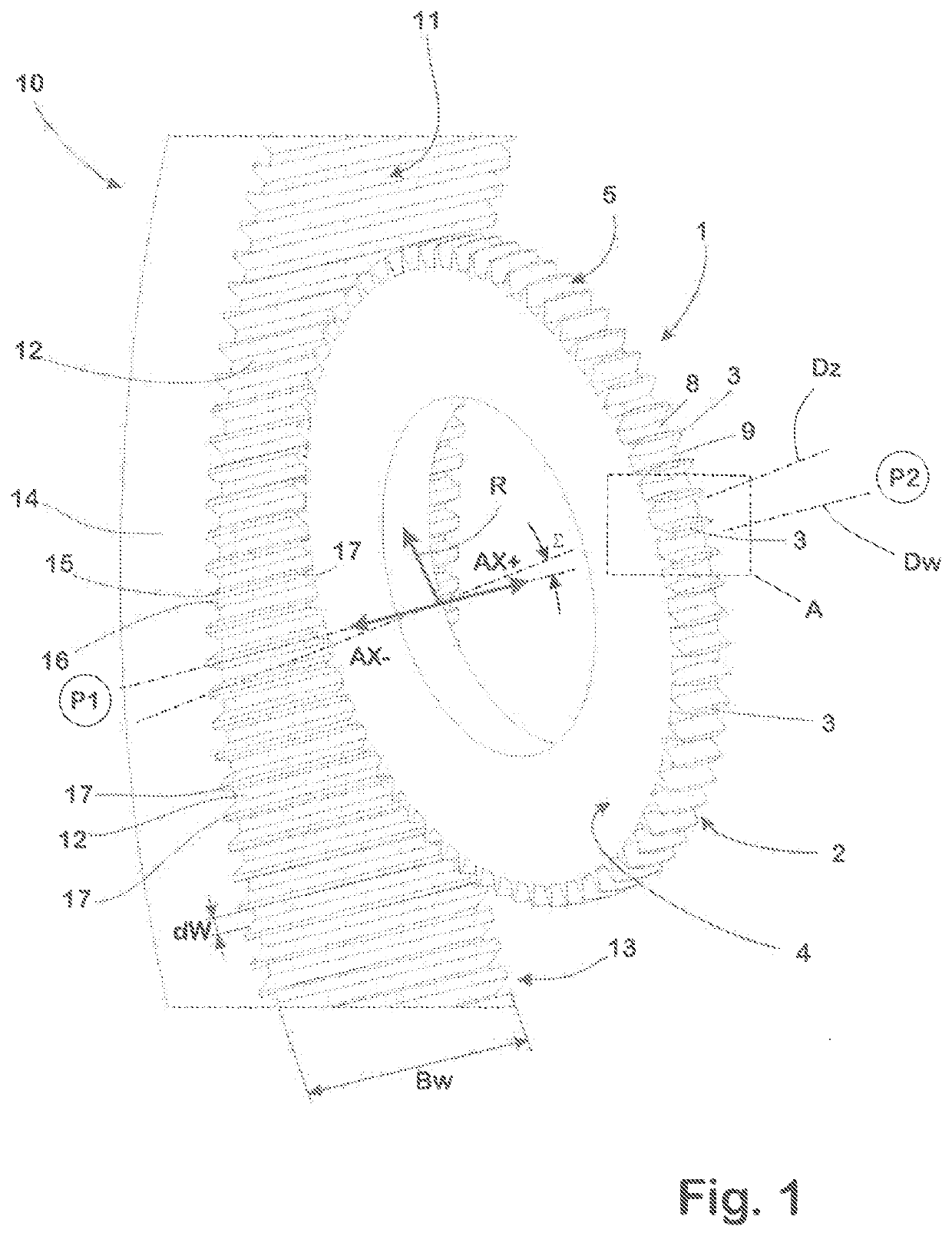
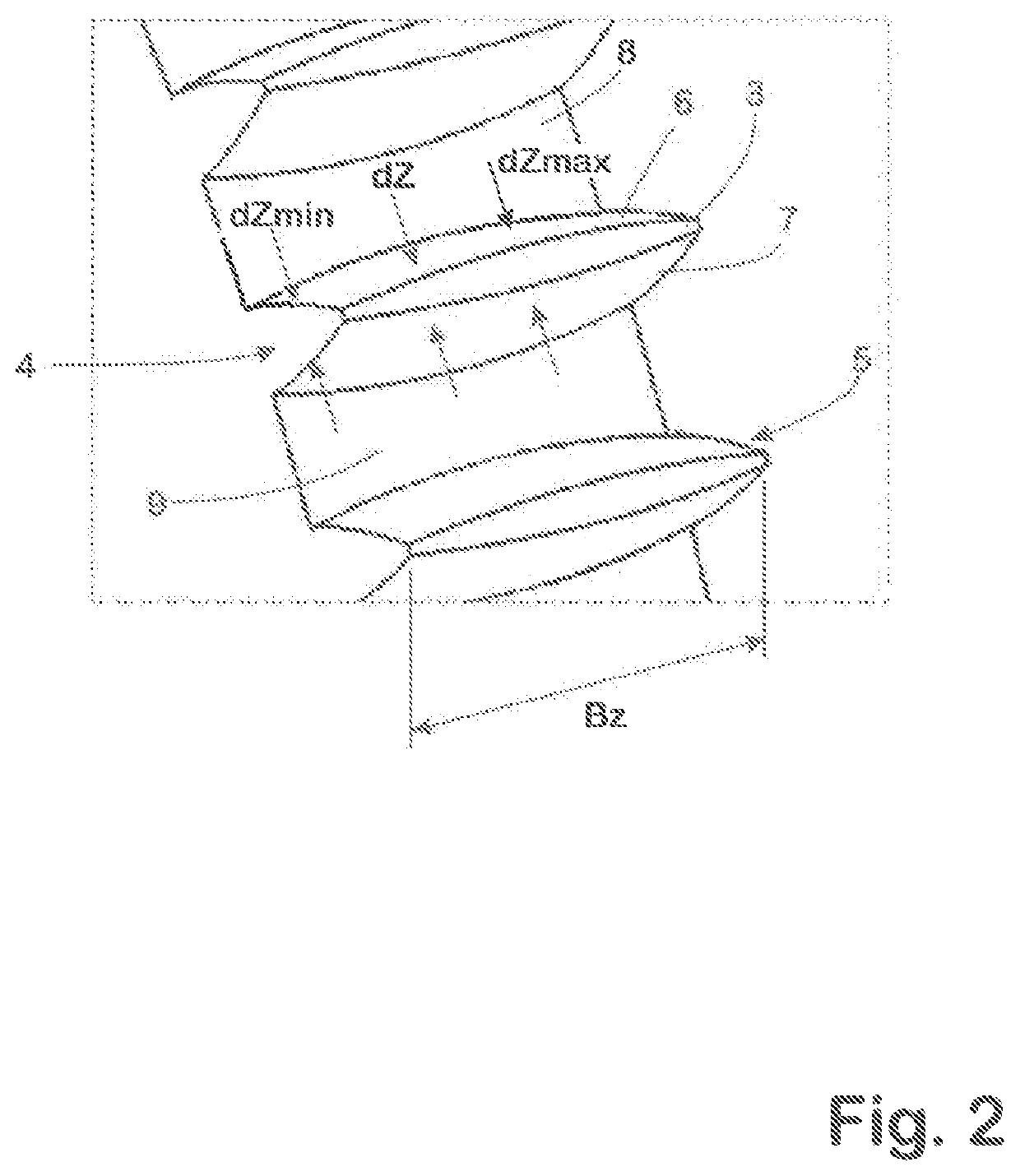
Method for cutting a gear, gear-cutting tool and gear-cutting machine
PatentActiveUS20230390842A1
Innovation
- A method using an elastically resilient cutting tool with a compressive preload during the cutting pass to reduce oversize by at least 2 μm, allowing for direct finishing after roughening and omitting the traditional finishing pass, achieving a reflective surface with reduced roughness values.


Quality Standards and Certification for Precision Gears
The precision gear manufacturing industry operates under stringent quality frameworks that ensure dimensional accuracy, surface integrity, and operational reliability. International standards such as ISO 1328 and AGMA 2015 establish fundamental requirements for gear accuracy classes, defining tolerances for pitch deviation, profile deviation, and lead deviation that directly impact cutting technique optimization.
Quality certification processes for precision gears encompass multiple verification stages throughout the manufacturing workflow. Initial material certification validates steel composition and heat treatment properties, while in-process monitoring ensures cutting parameters maintain specified tolerances. Advanced coordinate measuring machines and gear analyzers perform comprehensive dimensional inspections, measuring tooth geometry against established accuracy grades ranging from IT5 to IT12 depending on application requirements.
Certification bodies like DIN CERTCO and AGMA provide third-party validation services that authenticate manufacturing processes and final product quality. These certifications require documented evidence of process control, statistical quality monitoring, and traceability systems that link cutting parameters to final gear performance characteristics. Manufacturers must demonstrate consistent adherence to specified surface roughness values, typically Ra 0.8 to Ra 3.2 micrometers for precision applications.
Modern quality assurance protocols integrate real-time monitoring systems that track cutting tool wear, spindle vibration, and thermal variations during gear tooth machining operations. Statistical process control methods analyze measurement data to identify trends and prevent quality deviations before they impact production output. Digital quality management systems maintain comprehensive records linking individual gears to specific cutting conditions, enabling rapid root cause analysis when quality issues arise.
Emerging certification requirements increasingly emphasize sustainability metrics and energy efficiency in manufacturing processes. New standards are being developed to evaluate the environmental impact of cutting fluid usage, tool life optimization, and waste reduction strategies. These evolving requirements drive continuous improvement in cutting technique development, pushing manufacturers toward more efficient and environmentally responsible production methods while maintaining the highest precision standards.
Quality certification processes for precision gears encompass multiple verification stages throughout the manufacturing workflow. Initial material certification validates steel composition and heat treatment properties, while in-process monitoring ensures cutting parameters maintain specified tolerances. Advanced coordinate measuring machines and gear analyzers perform comprehensive dimensional inspections, measuring tooth geometry against established accuracy grades ranging from IT5 to IT12 depending on application requirements.
Certification bodies like DIN CERTCO and AGMA provide third-party validation services that authenticate manufacturing processes and final product quality. These certifications require documented evidence of process control, statistical quality monitoring, and traceability systems that link cutting parameters to final gear performance characteristics. Manufacturers must demonstrate consistent adherence to specified surface roughness values, typically Ra 0.8 to Ra 3.2 micrometers for precision applications.
Modern quality assurance protocols integrate real-time monitoring systems that track cutting tool wear, spindle vibration, and thermal variations during gear tooth machining operations. Statistical process control methods analyze measurement data to identify trends and prevent quality deviations before they impact production output. Digital quality management systems maintain comprehensive records linking individual gears to specific cutting conditions, enabling rapid root cause analysis when quality issues arise.
Emerging certification requirements increasingly emphasize sustainability metrics and energy efficiency in manufacturing processes. New standards are being developed to evaluate the environmental impact of cutting fluid usage, tool life optimization, and waste reduction strategies. These evolving requirements drive continuous improvement in cutting technique development, pushing manufacturers toward more efficient and environmentally responsible production methods while maintaining the highest precision standards.
Environmental Impact of Modern Gear Manufacturing
Modern gear manufacturing processes present significant environmental challenges that require immediate attention from precision engineering industries. Traditional gear tooth cutting techniques, particularly those involving conventional machining methods, generate substantial waste streams including metal chips, cutting fluids, and energy consumption. The environmental footprint extends beyond direct manufacturing impacts to encompass raw material extraction, transportation, and end-of-life disposal considerations.
Energy consumption represents one of the most critical environmental concerns in gear manufacturing. Conventional cutting processes typically require high-power machinery operating for extended periods, resulting in substantial carbon emissions. Studies indicate that gear cutting operations can consume 15-25% more energy compared to optimized precision techniques. The thermal management requirements for maintaining cutting tool performance further amplify energy demands, particularly in high-volume production environments.
Cutting fluid management poses another significant environmental challenge. Traditional gear cutting operations rely heavily on petroleum-based coolants and lubricants, which require careful handling, recycling, and disposal. These fluids often contain additives that can be harmful to both human health and environmental systems. The disposal of contaminated cutting fluids represents a major waste stream, with many facilities generating thousands of liters of hazardous waste annually.
Material waste generation during gear tooth cutting operations contributes substantially to environmental impact. Conventional subtractive manufacturing processes can result in material utilization rates as low as 60-70%, meaning significant portions of raw materials become waste. This inefficiency not only increases environmental burden but also drives up material costs and resource consumption.
Emerging precision engineering approaches offer promising solutions for reducing environmental impact. Advanced cutting techniques such as dry machining, minimum quantity lubrication systems, and optimized tool geometries can significantly reduce fluid consumption and waste generation. Additionally, precision manufacturing methods enable higher material utilization rates and reduced energy consumption per unit produced.
The implementation of circular economy principles in gear manufacturing is gaining traction, with companies exploring material recovery systems, cutting fluid recycling technologies, and energy-efficient production methods. These approaches demonstrate that environmental sustainability and precision engineering excellence can be achieved simultaneously through strategic technology adoption and process optimization.
Energy consumption represents one of the most critical environmental concerns in gear manufacturing. Conventional cutting processes typically require high-power machinery operating for extended periods, resulting in substantial carbon emissions. Studies indicate that gear cutting operations can consume 15-25% more energy compared to optimized precision techniques. The thermal management requirements for maintaining cutting tool performance further amplify energy demands, particularly in high-volume production environments.
Cutting fluid management poses another significant environmental challenge. Traditional gear cutting operations rely heavily on petroleum-based coolants and lubricants, which require careful handling, recycling, and disposal. These fluids often contain additives that can be harmful to both human health and environmental systems. The disposal of contaminated cutting fluids represents a major waste stream, with many facilities generating thousands of liters of hazardous waste annually.
Material waste generation during gear tooth cutting operations contributes substantially to environmental impact. Conventional subtractive manufacturing processes can result in material utilization rates as low as 60-70%, meaning significant portions of raw materials become waste. This inefficiency not only increases environmental burden but also drives up material costs and resource consumption.
Emerging precision engineering approaches offer promising solutions for reducing environmental impact. Advanced cutting techniques such as dry machining, minimum quantity lubrication systems, and optimized tool geometries can significantly reduce fluid consumption and waste generation. Additionally, precision manufacturing methods enable higher material utilization rates and reduced energy consumption per unit produced.
The implementation of circular economy principles in gear manufacturing is gaining traction, with companies exploring material recovery systems, cutting fluid recycling technologies, and energy-efficient production methods. These approaches demonstrate that environmental sustainability and precision engineering excellence can be achieved simultaneously through strategic technology adoption and process optimization.
Unlock deeper insights with Patsnap Eureka Quick Research — get a full tech report to explore trends and direct your research. Try now!
Generate Your Research Report Instantly with AI Agent
Supercharge your innovation with Patsnap Eureka AI Agent Platform!