

Optimizing Scintillator Emission With Additives
MAR 10, 20269 MIN READ
Generate Your Research Report Instantly with AI Agent
PatSnap Eureka helps you evaluate technical feasibility & market potential.
Scintillator Technology Background and Enhancement Goals
Scintillator technology emerged in the early 20th century with the discovery of materials capable of converting ionizing radiation into visible light. The fundamental principle relies on the excitation of electrons within crystalline or organic matrices, followed by photon emission during de-excitation processes. Early developments focused on inorganic crystals such as zinc sulfide and sodium iodide, which demonstrated promising detection capabilities for nuclear physics applications.
The evolution of scintillator materials has been driven by the increasing demands of medical imaging, high-energy physics experiments, and security screening systems. Traditional scintillators faced limitations in light output efficiency, energy resolution, and temporal response characteristics. These constraints prompted extensive research into material optimization strategies, particularly through the incorporation of dopants and additives to enhance fundamental scintillation properties.
Modern scintillator development encompasses diverse material systems including halide perovskites, garnet-based ceramics, and organic polymer composites. Each system presents unique advantages and challenges in terms of light yield, decay time, and radiation hardness. The integration of rare earth elements, transition metals, and organic chromophores as emission centers has become a cornerstone of contemporary enhancement approaches.
The primary enhancement goals center on maximizing photon yield per unit of absorbed energy while minimizing non-radiative decay pathways. Achieving optimal energy transfer efficiency from host matrix to emission centers requires precise control of dopant concentration, crystal structure, and defect density. Secondary objectives include tailoring emission wavelengths to match photodetector sensitivity curves and reducing afterglow phenomena that compromise temporal resolution.
Current research priorities emphasize the development of fast-response scintillators for time-of-flight applications and high-resolution materials for advanced medical imaging modalities. The pursuit of cost-effective manufacturing processes while maintaining superior performance characteristics represents a critical balance in commercial viability. Environmental stability and radiation tolerance continue to drive material selection criteria for demanding operational environments.
Emerging enhancement strategies explore nanostructured architectures, core-shell configurations, and hybrid organic-inorganic systems. These approaches offer unprecedented control over energy transfer mechanisms and emission characteristics, potentially revolutionizing scintillator performance across multiple application domains.
The evolution of scintillator materials has been driven by the increasing demands of medical imaging, high-energy physics experiments, and security screening systems. Traditional scintillators faced limitations in light output efficiency, energy resolution, and temporal response characteristics. These constraints prompted extensive research into material optimization strategies, particularly through the incorporation of dopants and additives to enhance fundamental scintillation properties.
Modern scintillator development encompasses diverse material systems including halide perovskites, garnet-based ceramics, and organic polymer composites. Each system presents unique advantages and challenges in terms of light yield, decay time, and radiation hardness. The integration of rare earth elements, transition metals, and organic chromophores as emission centers has become a cornerstone of contemporary enhancement approaches.
The primary enhancement goals center on maximizing photon yield per unit of absorbed energy while minimizing non-radiative decay pathways. Achieving optimal energy transfer efficiency from host matrix to emission centers requires precise control of dopant concentration, crystal structure, and defect density. Secondary objectives include tailoring emission wavelengths to match photodetector sensitivity curves and reducing afterglow phenomena that compromise temporal resolution.
Current research priorities emphasize the development of fast-response scintillators for time-of-flight applications and high-resolution materials for advanced medical imaging modalities. The pursuit of cost-effective manufacturing processes while maintaining superior performance characteristics represents a critical balance in commercial viability. Environmental stability and radiation tolerance continue to drive material selection criteria for demanding operational environments.
Emerging enhancement strategies explore nanostructured architectures, core-shell configurations, and hybrid organic-inorganic systems. These approaches offer unprecedented control over energy transfer mechanisms and emission characteristics, potentially revolutionizing scintillator performance across multiple application domains.
Market Demand for High-Performance Scintillator Materials
The global scintillator materials market is experiencing robust growth driven by expanding applications across multiple high-technology sectors. Medical imaging represents the largest demand segment, with computed tomography scanners, positron emission tomography systems, and digital radiography equipment requiring increasingly sophisticated scintillator materials. The transition from analog to digital imaging systems has created substantial demand for cesium iodide, gadolinium oxysulfide, and newer ceramic scintillators with enhanced light output and reduced afterglow characteristics.
Nuclear security and homeland defense applications constitute another significant market driver. Border security systems, cargo inspection equipment, and radiation detection instruments require scintillators with rapid response times and high detection efficiency. The growing emphasis on nuclear non-proliferation and threat detection has intensified demand for materials capable of distinguishing between different radiation types with superior energy resolution.
High-energy physics research facilities worldwide are driving demand for specialized scintillator materials with exceptional radiation hardness and fast decay times. Large-scale detector systems at particle accelerators and space-based experiments require materials that maintain performance under extreme radiation environments while providing precise timing information for particle detection and identification.
Industrial applications including oil well logging, non-destructive testing, and process monitoring are expanding the market for ruggedized scintillator materials. These applications demand materials with stable performance across wide temperature ranges and resistance to mechanical stress while maintaining consistent light output over extended operational periods.
The emerging market for advanced security screening systems at airports and critical infrastructure facilities is creating demand for dual-energy and multi-energy detection capabilities. These systems require scintillator materials with tailored spectral responses and minimal cross-talk between detection channels to enable accurate material discrimination and threat identification.
Market growth is further supported by the increasing adoption of hybrid imaging modalities that combine multiple detection technologies. These systems require scintillator materials with optimized properties for specific imaging protocols, driving demand for customized formulations and additive-enhanced materials that can deliver superior performance characteristics compared to conventional options.
Nuclear security and homeland defense applications constitute another significant market driver. Border security systems, cargo inspection equipment, and radiation detection instruments require scintillators with rapid response times and high detection efficiency. The growing emphasis on nuclear non-proliferation and threat detection has intensified demand for materials capable of distinguishing between different radiation types with superior energy resolution.
High-energy physics research facilities worldwide are driving demand for specialized scintillator materials with exceptional radiation hardness and fast decay times. Large-scale detector systems at particle accelerators and space-based experiments require materials that maintain performance under extreme radiation environments while providing precise timing information for particle detection and identification.
Industrial applications including oil well logging, non-destructive testing, and process monitoring are expanding the market for ruggedized scintillator materials. These applications demand materials with stable performance across wide temperature ranges and resistance to mechanical stress while maintaining consistent light output over extended operational periods.
The emerging market for advanced security screening systems at airports and critical infrastructure facilities is creating demand for dual-energy and multi-energy detection capabilities. These systems require scintillator materials with tailored spectral responses and minimal cross-talk between detection channels to enable accurate material discrimination and threat identification.
Market growth is further supported by the increasing adoption of hybrid imaging modalities that combine multiple detection technologies. These systems require scintillator materials with optimized properties for specific imaging protocols, driving demand for customized formulations and additive-enhanced materials that can deliver superior performance characteristics compared to conventional options.
Current State and Challenges in Scintillator Additive Engineering
Scintillator additive engineering has emerged as a critical field for enhancing radiation detection performance across medical imaging, nuclear security, and high-energy physics applications. Current research focuses on incorporating various dopants, co-dopants, and nanostructured additives to optimize light yield, energy resolution, and temporal characteristics of scintillating materials.
The state-of-the-art in additive engineering encompasses several established approaches. Rare earth elements such as cerium, europium, and terbium serve as primary activators in oxide and halide scintillators, creating luminescence centers through controlled energy level modifications. Co-doping strategies using lithium, sodium, or calcium have demonstrated significant improvements in light output and reduced afterglow in materials like LYSO and CsI(Tl).
Recent advances include the integration of quantum dots and nanoparticles as additives to enhance energy transfer efficiency. Perovskite nanocrystals and semiconductor quantum dots have shown promise in improving spectral matching with photodetector sensitivity curves. Additionally, organic additives and wavelength shifters are being explored to optimize emission spectra for specific detection requirements.
Despite these advances, several fundamental challenges persist in scintillator additive engineering. Concentration quenching remains a primary limitation, where excessive dopant levels lead to non-radiative energy transfer and reduced light output. The optimal additive concentration often exists within narrow ranges, requiring precise control during synthesis processes.
Thermal stability of additive-enhanced scintillators presents another significant challenge. Many promising additives exhibit degraded performance at elevated temperatures, limiting their application in harsh environments. The formation of color centers and defect states during prolonged radiation exposure continues to affect long-term stability.
Manufacturing scalability poses practical constraints on additive implementation. Laboratory-scale synthesis methods often cannot be directly translated to industrial production, particularly for complex multi-component systems. Achieving uniform additive distribution in large-volume crystals remains technically demanding and cost-prohibitive for many applications.
Characterization and optimization of additive effects require sophisticated analytical techniques and extensive parameter space exploration. The complex interplay between host matrix properties, additive concentration, and processing conditions creates multidimensional optimization challenges that current methodologies struggle to address efficiently.
The state-of-the-art in additive engineering encompasses several established approaches. Rare earth elements such as cerium, europium, and terbium serve as primary activators in oxide and halide scintillators, creating luminescence centers through controlled energy level modifications. Co-doping strategies using lithium, sodium, or calcium have demonstrated significant improvements in light output and reduced afterglow in materials like LYSO and CsI(Tl).
Recent advances include the integration of quantum dots and nanoparticles as additives to enhance energy transfer efficiency. Perovskite nanocrystals and semiconductor quantum dots have shown promise in improving spectral matching with photodetector sensitivity curves. Additionally, organic additives and wavelength shifters are being explored to optimize emission spectra for specific detection requirements.
Despite these advances, several fundamental challenges persist in scintillator additive engineering. Concentration quenching remains a primary limitation, where excessive dopant levels lead to non-radiative energy transfer and reduced light output. The optimal additive concentration often exists within narrow ranges, requiring precise control during synthesis processes.
Thermal stability of additive-enhanced scintillators presents another significant challenge. Many promising additives exhibit degraded performance at elevated temperatures, limiting their application in harsh environments. The formation of color centers and defect states during prolonged radiation exposure continues to affect long-term stability.
Manufacturing scalability poses practical constraints on additive implementation. Laboratory-scale synthesis methods often cannot be directly translated to industrial production, particularly for complex multi-component systems. Achieving uniform additive distribution in large-volume crystals remains technically demanding and cost-prohibitive for many applications.
Characterization and optimization of additive effects require sophisticated analytical techniques and extensive parameter space exploration. The complex interplay between host matrix properties, additive concentration, and processing conditions creates multidimensional optimization challenges that current methodologies struggle to address efficiently.
Existing Additive Solutions for Scintillator Optimization
01 Scintillator materials with rare earth dopants for enhanced emission
Scintillator materials can be doped with rare earth elements to enhance their light emission properties. These dopants act as luminescent centers that improve the efficiency and wavelength characteristics of the emitted light when the scintillator is exposed to radiation. The selection and concentration of rare earth dopants significantly influence the emission spectrum and decay time of the scintillator, making them suitable for various detection applications.- Scintillator materials with rare earth elements for enhanced emission: Scintillator materials incorporating rare earth elements such as cerium, europium, or terbium can significantly enhance light emission properties. These dopants act as luminescence centers that improve the conversion efficiency of high-energy radiation into visible light. The rare earth elements provide specific emission wavelengths and faster decay times, making them suitable for various detection applications including medical imaging and radiation detection.
- Halide-based scintillator compositions for improved light output: Halide-based scintillator materials, particularly those containing iodides, bromides, or chlorides combined with alkali or alkaline earth metals, demonstrate superior light output characteristics. These compositions offer high density and effective atomic numbers that enhance radiation absorption efficiency. The crystalline structure of halide scintillators provides excellent transparency and light transmission properties, resulting in improved detection sensitivity and energy resolution.
- Nanostructured and composite scintillator designs: Advanced scintillator designs utilizing nanostructured materials or composite architectures enhance emission performance through improved light extraction and reduced self-absorption. These designs may incorporate nanoparticles, nanocrystals, or layered structures that optimize the interface between scintillating materials and photodetectors. The nanostructured approach allows for better control of emission spectra and improved spatial resolution in imaging applications.
- Wavelength-shifting and light collection optimization techniques: Techniques for optimizing scintillator emission include the integration of wavelength-shifting materials and specialized light collection geometries. These methods convert emitted photons to wavelengths better matched to photodetector sensitivity, improving overall detection efficiency. Optical coatings, reflective layers, and photonic structures can be employed to maximize light collection and minimize losses, thereby enhancing the signal-to-noise ratio in detection systems.
- Fast decay time scintillators for high-speed detection: Scintillator materials engineered for fast decay times enable high-speed radiation detection and counting applications. These materials feature optimized host matrices and activator concentrations that minimize afterglow and enable rapid signal processing. Fast scintillators are particularly valuable in applications requiring high temporal resolution, such as time-of-flight measurements, high-energy physics experiments, and fast imaging systems where quick response times are critical.
02 Halide-based scintillator compositions for improved light output
Halide-based scintillator materials, particularly those containing cesium, sodium, or other alkali metals combined with halogen elements, demonstrate superior light output characteristics. These compositions provide high light yield and fast decay times, which are critical for high-resolution imaging applications. The crystal structure and purity of halide scintillators directly impact their emission efficiency and energy resolution.Expand Specific Solutions03 Scintillator detector configurations for optimized emission collection
The physical configuration and geometry of scintillator detectors play a crucial role in maximizing emission collection efficiency. Various detector designs incorporate reflective layers, light guides, and optimized crystal shapes to enhance the capture and transmission of emitted photons to photodetectors. These configurations minimize light loss and improve the overall detection sensitivity of the scintillation system.Expand Specific Solutions04 Wavelength-shifting techniques for scintillator emission optimization
Wavelength-shifting materials and techniques can be employed to convert the emission wavelength of scintillators to match the sensitivity range of photodetectors. This approach involves incorporating secondary fluorescent compounds or coatings that absorb the primary scintillation light and re-emit it at a more suitable wavelength. Such techniques improve the quantum efficiency of detection systems and enable better matching between scintillators and readout electronics.Expand Specific Solutions05 Nanostructured and composite scintillators for enhanced emission properties
Nanostructured scintillator materials and composite formulations offer improved emission characteristics compared to conventional bulk materials. These advanced structures can incorporate multiple phases, nanoparticles, or layered architectures that enhance light extraction, reduce self-absorption, and provide tailored emission spectra. The nanoscale engineering of scintillators enables optimization of both the emission intensity and temporal response for specific applications.Expand Specific Solutions
Key Players in Scintillator Materials and Additive Industry
The scintillator emission optimization field represents a mature yet evolving technology sector with significant growth potential driven by expanding applications in medical imaging, security screening, and radiation detection. The market demonstrates substantial scale with diverse participants ranging from established multinational corporations to specialized research institutions. Technology maturity varies considerably across the competitive landscape, with companies like Hamamatsu Photonics KK, Canon Inc., and Koninklijke Philips NV representing highly advanced commercial capabilities in photonics and medical imaging systems. Meanwhile, research institutions including MIT, University of California, and Shanghai Institute of Ceramics drive fundamental innovation in scintillator materials science. Specialized manufacturers such as Radiation Monitoring Devices Inc. and Hellma Materials GmbH focus on niche applications, while chemical companies like Afton Chemical Corp. and Toray Industries contribute advanced materials expertise. This multi-tiered ecosystem indicates a technologically mature market with ongoing innovation opportunities, particularly in additive formulations and performance optimization.
Shanghai Institute of Ceramics, Chinese Academy of Sciences
Technical Solution: SICCAS has developed innovative scintillator materials with novel additive systems focusing on rare earth-doped ceramics and single crystals. Their research includes systematic optimization of activator concentrations and co-dopant effects in various host matrices including lutetium-based compounds and halide systems. The institute focuses on understanding fundamental mechanisms of energy transfer and developing new additive combinations to enhance scintillation properties. Their work includes development of transparent ceramics with controlled microstructure and optimized dopant distribution for improved light transmission and emission efficiency in radiation detection applications.
Strengths: Strong fundamental research capabilities, access to advanced characterization facilities, collaboration with industry partners. Weaknesses: Limited commercial manufacturing capabilities, longer technology transfer timelines from research to market.
Koninklijke Philips NV
Technical Solution: Philips has developed advanced scintillator materials with optimized additive compositions for medical imaging applications. Their technology focuses on incorporating rare earth dopants and co-activators to enhance light output and reduce afterglow in cesium iodide and gadolinium oxysulfide scintillators. The company utilizes precise control of dopant concentrations and processing conditions to achieve optimal emission characteristics for X-ray detection systems. Their scintillator optimization includes the use of thallium and europium activators combined with specific co-dopants to improve quantum efficiency and spectral matching with photodetectors.
Strengths: Strong market presence in medical imaging, extensive R&D capabilities, proven commercial applications. Weaknesses: Focus primarily on medical applications may limit diversification into other scintillator markets.
Core Innovations in Scintillator Emission Enhancement Patents
Scintillator compositions, and related processes and articles of manufacture
PatentInactiveUS7576329B2
Innovation
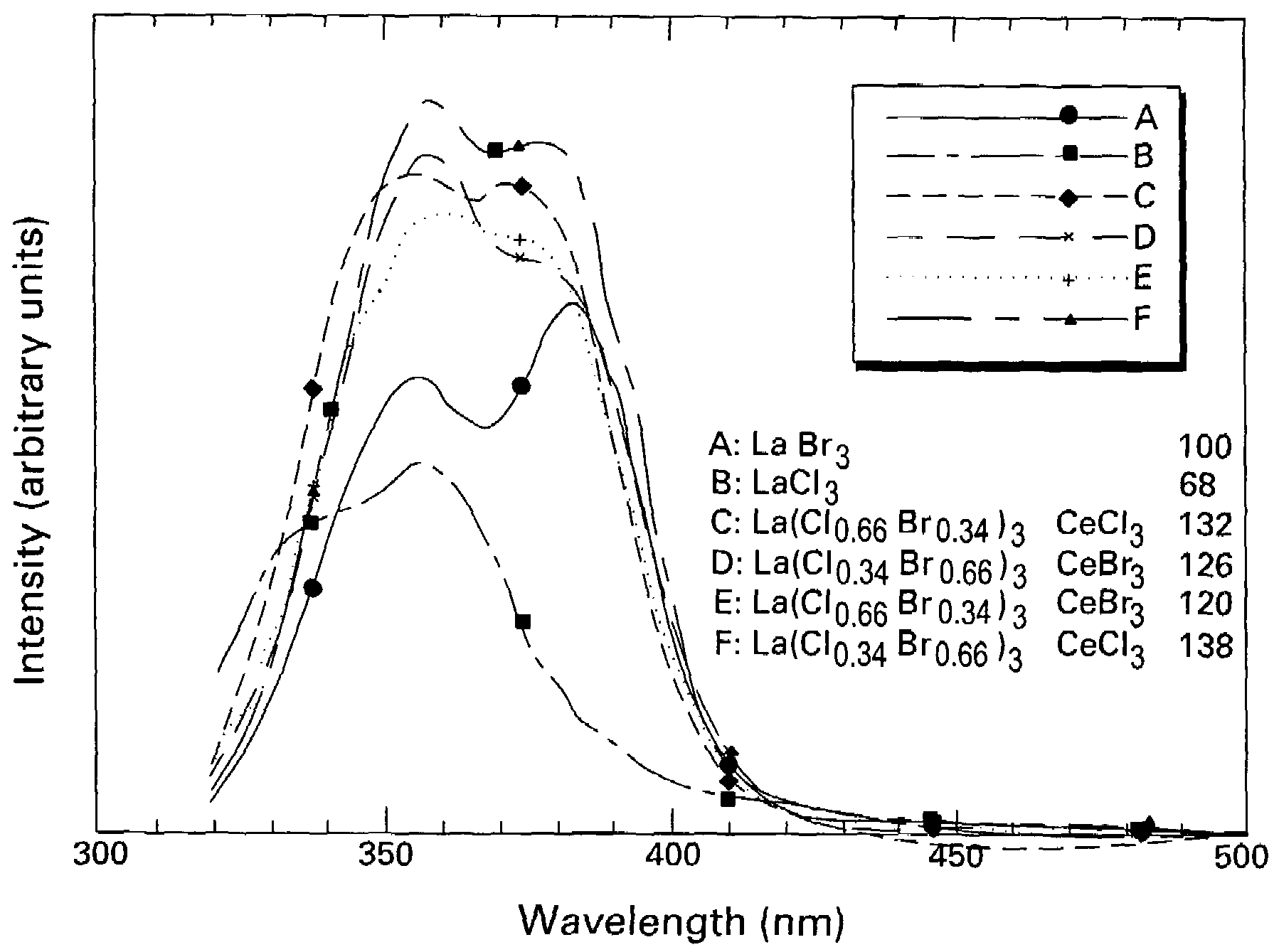
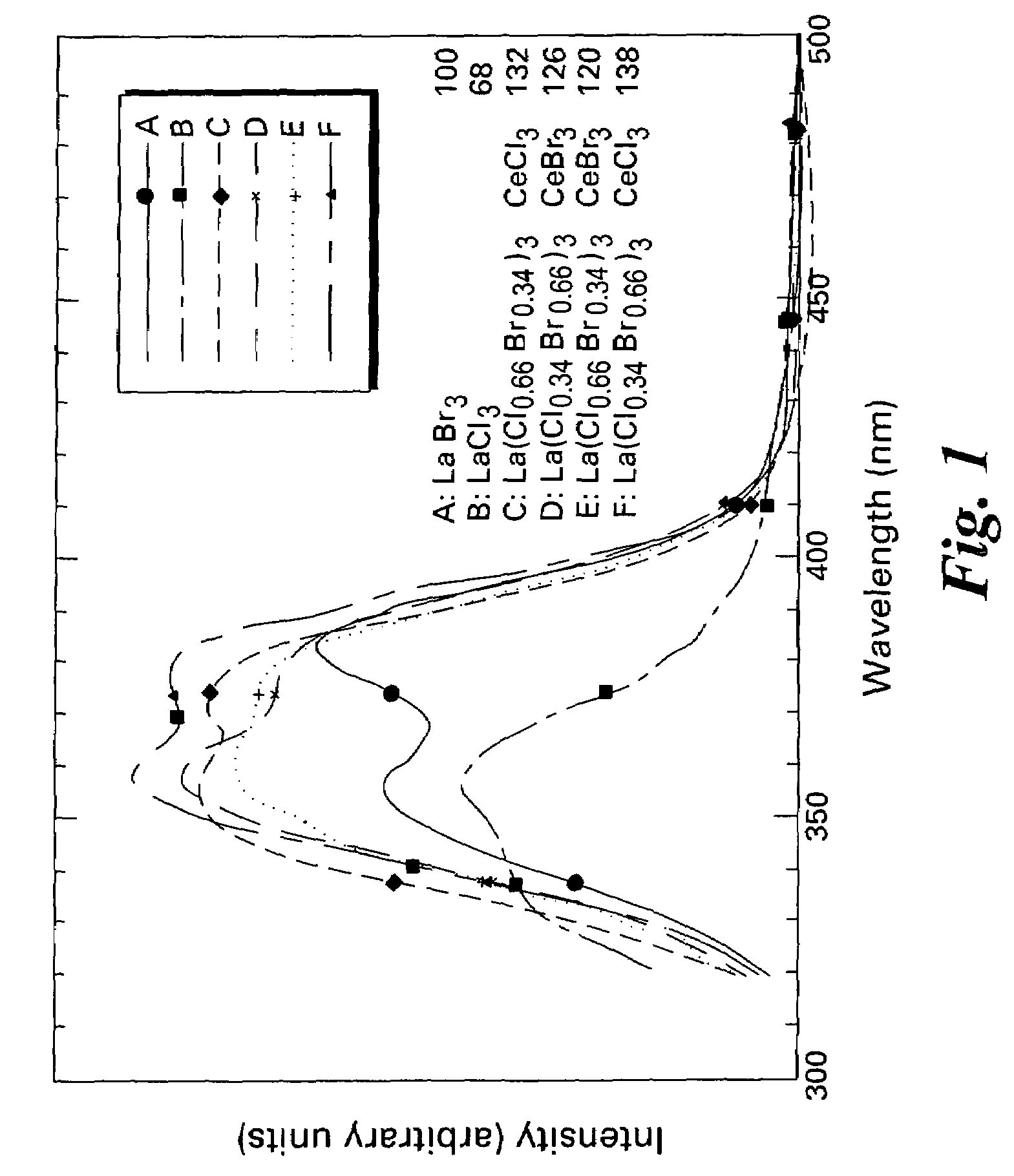
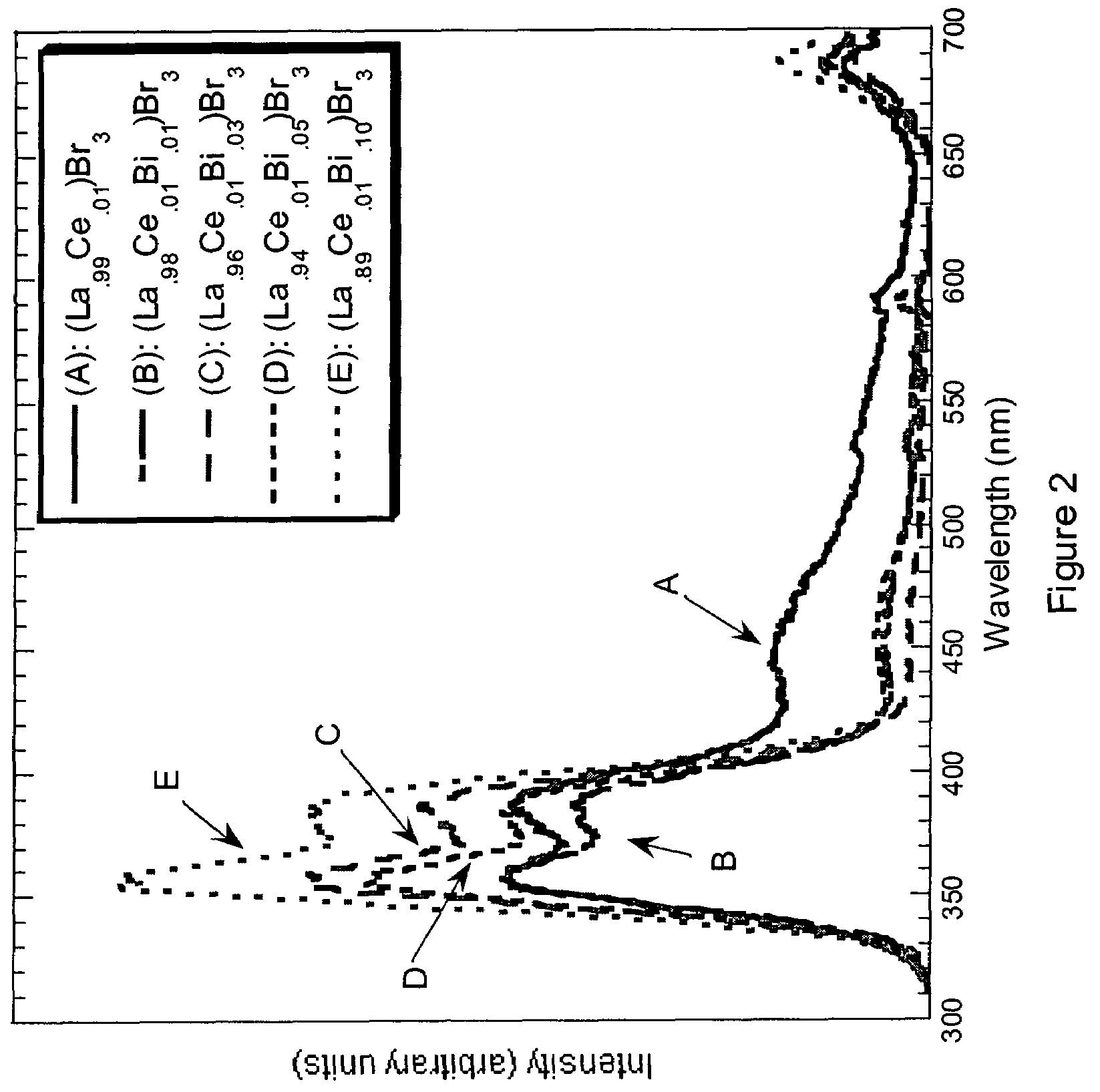
- Development of halide-lanthanide matrix materials, specifically solid solutions of lanthanide chlorides and bromides, with cerium or praseodymium activators, and optionally bismuth, which enhance light output, decay time, and stopping power, allowing for improved radiation detection capabilities.
Novel thallium doped sodium, cesium or lithium iodide scintillators
PatentWO2016081470A1
Innovation
- Development of thallium-doped sodium, cesium, or lithium iodide scintillators with specific dopants like lanthanides and alkaline earth metals to enhance light output and energy resolution, achieving a composition that optimizes scintillation properties for improved detection efficiency.


Environmental Impact of Scintillator Manufacturing Processes
The manufacturing of scintillator materials with optimized emission properties through additive incorporation presents significant environmental challenges that require comprehensive assessment and mitigation strategies. Traditional scintillator production processes often involve high-temperature synthesis, chemical vapor deposition, and extensive purification steps that generate substantial carbon emissions and consume considerable energy resources.
The integration of rare earth elements and organic additives into scintillator matrices introduces additional environmental complexities. Mining and processing of rare earth materials such as cerium, europium, and terbium create substantial ecological disruption, including soil contamination and water pollution. These materials often require extensive chemical processing involving acids and solvents that generate hazardous waste streams requiring specialized treatment and disposal protocols.
Solvent-based synthesis methods commonly employed in additive-enhanced scintillator production pose significant environmental risks. Organic solvents used in solution processing and purification stages contribute to volatile organic compound emissions and require careful handling to prevent groundwater contamination. The disposal of contaminated solvents and chemical byproducts necessitates expensive waste treatment facilities and long-term environmental monitoring.
Energy consumption represents another critical environmental factor in scintillator manufacturing. High-temperature annealing processes required for optimal crystal formation and additive distribution can consume substantial electrical energy, contributing to indirect carbon emissions. The precision control systems needed for maintaining optimal processing conditions further increase energy requirements throughout the manufacturing cycle.
Emerging green manufacturing approaches are being developed to address these environmental concerns. Water-based synthesis methods, recyclable solvent systems, and energy-efficient processing techniques show promise for reducing environmental impact. Implementation of closed-loop manufacturing systems can minimize waste generation while recovering valuable materials for reuse.
Regulatory compliance requirements continue to evolve, with stricter environmental standards driving innovation in cleaner production technologies. Life cycle assessment methodologies are increasingly being applied to evaluate the complete environmental footprint of scintillator manufacturing processes, from raw material extraction through end-of-life disposal, enabling more sustainable production strategies.
The integration of rare earth elements and organic additives into scintillator matrices introduces additional environmental complexities. Mining and processing of rare earth materials such as cerium, europium, and terbium create substantial ecological disruption, including soil contamination and water pollution. These materials often require extensive chemical processing involving acids and solvents that generate hazardous waste streams requiring specialized treatment and disposal protocols.
Solvent-based synthesis methods commonly employed in additive-enhanced scintillator production pose significant environmental risks. Organic solvents used in solution processing and purification stages contribute to volatile organic compound emissions and require careful handling to prevent groundwater contamination. The disposal of contaminated solvents and chemical byproducts necessitates expensive waste treatment facilities and long-term environmental monitoring.
Energy consumption represents another critical environmental factor in scintillator manufacturing. High-temperature annealing processes required for optimal crystal formation and additive distribution can consume substantial electrical energy, contributing to indirect carbon emissions. The precision control systems needed for maintaining optimal processing conditions further increase energy requirements throughout the manufacturing cycle.
Emerging green manufacturing approaches are being developed to address these environmental concerns. Water-based synthesis methods, recyclable solvent systems, and energy-efficient processing techniques show promise for reducing environmental impact. Implementation of closed-loop manufacturing systems can minimize waste generation while recovering valuable materials for reuse.
Regulatory compliance requirements continue to evolve, with stricter environmental standards driving innovation in cleaner production technologies. Life cycle assessment methodologies are increasingly being applied to evaluate the complete environmental footprint of scintillator manufacturing processes, from raw material extraction through end-of-life disposal, enabling more sustainable production strategies.
Quality Standards for Medical Imaging Scintillators
Medical imaging scintillators must adhere to stringent quality standards to ensure reliable diagnostic performance and patient safety. These standards encompass multiple dimensions including optical properties, physical characteristics, and manufacturing consistency. The International Electrotechnical Commission (IEC) and American National Standards Institute (ANSI) have established comprehensive guidelines that define acceptable performance parameters for scintillator materials used in various medical imaging modalities.
Light output uniformity represents a critical quality metric, requiring scintillator materials to maintain consistent photon emission across their entire surface area. Variations exceeding 5% can result in image artifacts and compromised diagnostic accuracy. Energy resolution standards mandate that scintillators achieve specific performance thresholds, typically requiring full-width-half-maximum values below 10% for gamma-ray detection applications. These specifications ensure adequate discrimination between different energy levels in medical imaging procedures.
Temporal response characteristics must meet strict timing requirements, particularly for applications involving coincidence detection such as positron emission tomography. Decay time constants should remain within specified ranges to prevent signal overlap and maintain temporal resolution. Additionally, afterglow levels must be minimized to prevent image ghosting effects that could obscure subsequent imaging sequences.
Physical stability standards address long-term performance reliability under clinical operating conditions. Scintillators must demonstrate resistance to radiation damage, maintaining their optical properties throughout their operational lifetime. Temperature stability requirements ensure consistent performance across typical clinical environment temperature ranges, typically spanning 15-35°C. Humidity resistance standards prevent degradation in varying atmospheric conditions commonly encountered in medical facilities.
Manufacturing quality control protocols mandate batch-to-batch consistency in scintillator production. Statistical process control measures ensure that optical and physical properties remain within specified tolerance ranges across production runs. Traceability requirements enable tracking of material sources and processing parameters, facilitating quality assurance and regulatory compliance. These comprehensive quality standards collectively ensure that scintillator materials deliver reliable, consistent performance in critical medical imaging applications.
Light output uniformity represents a critical quality metric, requiring scintillator materials to maintain consistent photon emission across their entire surface area. Variations exceeding 5% can result in image artifacts and compromised diagnostic accuracy. Energy resolution standards mandate that scintillators achieve specific performance thresholds, typically requiring full-width-half-maximum values below 10% for gamma-ray detection applications. These specifications ensure adequate discrimination between different energy levels in medical imaging procedures.
Temporal response characteristics must meet strict timing requirements, particularly for applications involving coincidence detection such as positron emission tomography. Decay time constants should remain within specified ranges to prevent signal overlap and maintain temporal resolution. Additionally, afterglow levels must be minimized to prevent image ghosting effects that could obscure subsequent imaging sequences.
Physical stability standards address long-term performance reliability under clinical operating conditions. Scintillators must demonstrate resistance to radiation damage, maintaining their optical properties throughout their operational lifetime. Temperature stability requirements ensure consistent performance across typical clinical environment temperature ranges, typically spanning 15-35°C. Humidity resistance standards prevent degradation in varying atmospheric conditions commonly encountered in medical facilities.
Manufacturing quality control protocols mandate batch-to-batch consistency in scintillator production. Statistical process control measures ensure that optical and physical properties remain within specified tolerance ranges across production runs. Traceability requirements enable tracking of material sources and processing parameters, facilitating quality assurance and regulatory compliance. These comprehensive quality standards collectively ensure that scintillator materials deliver reliable, consistent performance in critical medical imaging applications.
Unlock deeper insights with PatSnap Eureka Quick Research — get a full tech report to explore trends and direct your research. Try now!
Generate Your Research Report Instantly with AI Agent
Supercharge your innovation with PatSnap Eureka AI Agent Platform!