

Patents Landscape in Cold Spray Coating Developments
DEC 21, 20259 MIN READ
Generate Your Research Report Instantly with AI Agent
PatSnap Eureka helps you evaluate technical feasibility & market potential.
Cold Spray Technology Background and Objectives
Cold spray technology emerged in the mid-1980s at the Institute of Theoretical and Applied Mechanics of the Russian Academy of Sciences in Novosibirsk. Initially developed as a method for wind tunnel visualization, researchers discovered its potential for creating metallic coatings when they observed that accelerated metal particles could adhere to substrates without melting. This accidental discovery laid the foundation for what would become a revolutionary coating technology.
The fundamental principle of cold spray involves accelerating solid powder particles to supersonic velocities (300-1200 m/s) using a pressurized gas stream through a de Laval nozzle. Upon impact with the substrate, these particles undergo severe plastic deformation, creating mechanical interlocking and metallurgical bonding. Unlike traditional thermal spray methods, cold spray operates below the melting point of the feedstock material, thereby avoiding oxidation, phase transformations, and thermal stresses.
The evolution of cold spray technology has been marked by significant advancements in equipment design, process parameters optimization, and material compatibility expansion. Early systems were limited to soft metals like copper and aluminum, but contemporary systems can process a wide range of materials including hard metals, composites, and even ceramics when used with appropriate ductile binders.
Patent activity in cold spray technology has shown exponential growth since the early 2000s, with major innovation clusters in the United States, Germany, Japan, China, and Russia. Initial patents focused primarily on equipment design and basic process parameters, while recent intellectual property developments have shifted toward specialized applications, material combinations, and hybrid processes that combine cold spray with complementary technologies.
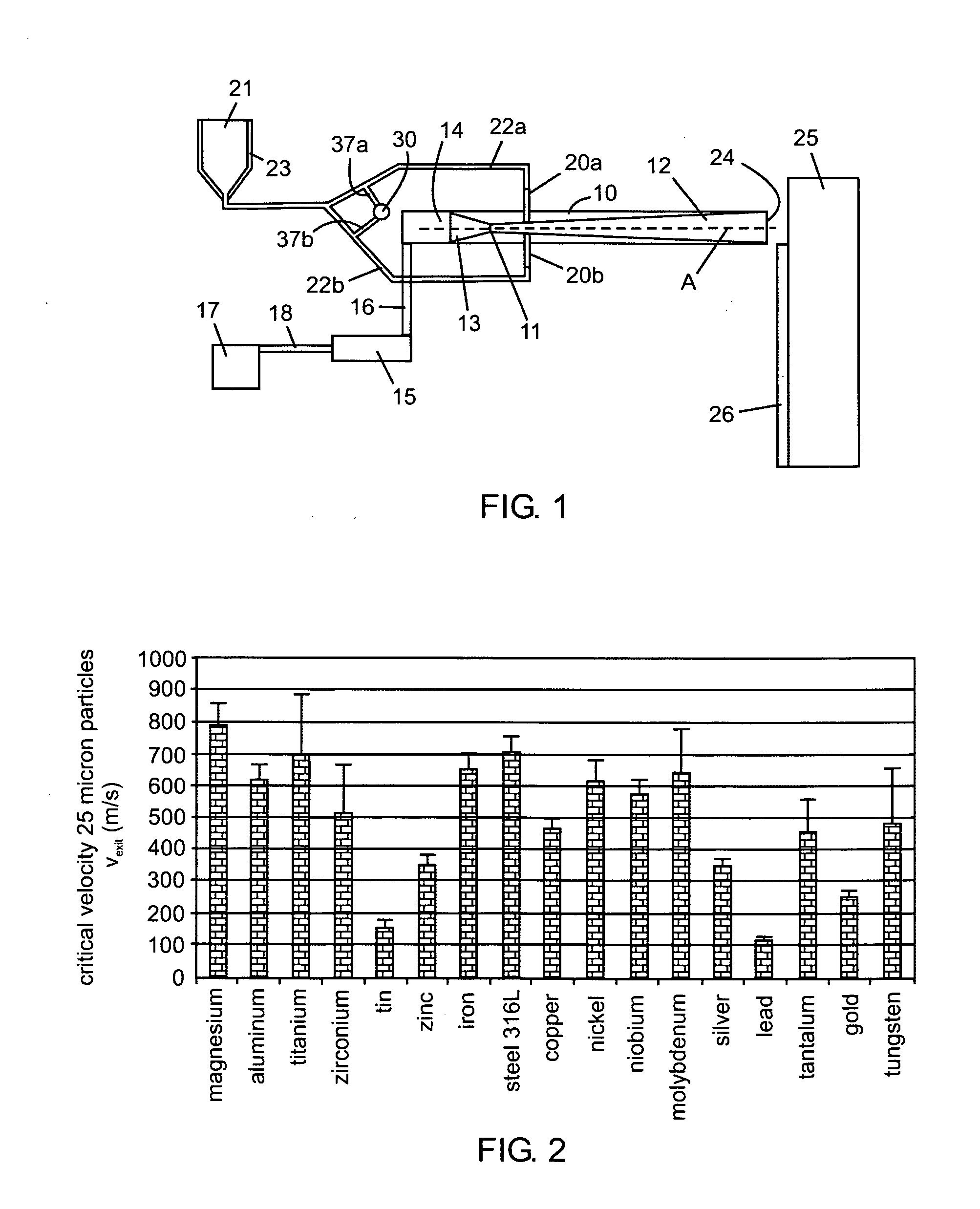
The primary objectives of cold spray coating development include enhancing deposition efficiency, improving coating-substrate adhesion strength, extending the range of sprayable materials, and developing cost-effective systems for industrial implementation. Particular emphasis has been placed on addressing the "critical velocity" challenge—determining and achieving the minimum particle velocity required for successful deposition of various materials.
Current research trends indicate growing interest in nanostructured cold spray coatings, functionally graded materials, and additive manufacturing applications. The technology is increasingly being explored for repair and restoration of high-value components in aerospace, defense, and power generation industries, where traditional welding or thermal spray methods may introduce unacceptable thermal distortion or microstructural changes.
The patent landscape reveals an industry transition from fundamental process development to application-specific solutions, with increasing focus on sustainability aspects such as reduced gas consumption, improved material utilization, and development of environmentally friendly powder feedstocks.
The fundamental principle of cold spray involves accelerating solid powder particles to supersonic velocities (300-1200 m/s) using a pressurized gas stream through a de Laval nozzle. Upon impact with the substrate, these particles undergo severe plastic deformation, creating mechanical interlocking and metallurgical bonding. Unlike traditional thermal spray methods, cold spray operates below the melting point of the feedstock material, thereby avoiding oxidation, phase transformations, and thermal stresses.
The evolution of cold spray technology has been marked by significant advancements in equipment design, process parameters optimization, and material compatibility expansion. Early systems were limited to soft metals like copper and aluminum, but contemporary systems can process a wide range of materials including hard metals, composites, and even ceramics when used with appropriate ductile binders.
Patent activity in cold spray technology has shown exponential growth since the early 2000s, with major innovation clusters in the United States, Germany, Japan, China, and Russia. Initial patents focused primarily on equipment design and basic process parameters, while recent intellectual property developments have shifted toward specialized applications, material combinations, and hybrid processes that combine cold spray with complementary technologies.
The primary objectives of cold spray coating development include enhancing deposition efficiency, improving coating-substrate adhesion strength, extending the range of sprayable materials, and developing cost-effective systems for industrial implementation. Particular emphasis has been placed on addressing the "critical velocity" challenge—determining and achieving the minimum particle velocity required for successful deposition of various materials.
Current research trends indicate growing interest in nanostructured cold spray coatings, functionally graded materials, and additive manufacturing applications. The technology is increasingly being explored for repair and restoration of high-value components in aerospace, defense, and power generation industries, where traditional welding or thermal spray methods may introduce unacceptable thermal distortion or microstructural changes.
The patent landscape reveals an industry transition from fundamental process development to application-specific solutions, with increasing focus on sustainability aspects such as reduced gas consumption, improved material utilization, and development of environmentally friendly powder feedstocks.
Market Analysis for Cold Spray Coating Applications
The global cold spray coating market is experiencing robust growth, driven by increasing demand across multiple industrial sectors. Current market valuation stands at approximately 1.2 billion USD with a compound annual growth rate projected between 6-8% over the next five years. This growth trajectory is primarily fueled by the aerospace and defense sectors, which together account for nearly 40% of the total market share.
The automotive industry represents the second-largest application segment, contributing roughly 25% of market demand. This sector's interest in cold spray technology stems from the need for lightweight materials and corrosion-resistant components that can withstand harsh operating conditions while extending product lifecycles.
Power generation and electronics industries are emerging as significant growth areas, collectively representing about 20% of the market. The ability of cold spray coatings to provide thermal management solutions and electrical conductivity properties makes them particularly valuable in these applications.
Geographically, North America dominates the market with approximately 35% share, followed by Europe at 30% and Asia-Pacific at 25%. However, the Asia-Pacific region is expected to witness the fastest growth rate due to rapid industrialization in countries like China and India, coupled with increasing manufacturing activities.
From a materials perspective, aluminum-based cold spray coatings lead the market with approximately 40% share, followed by copper-based (25%) and nickel-based (20%) coatings. Titanium and specialty alloy coatings, though currently representing smaller segments, are projected to grow significantly due to their superior performance characteristics.
The market is characterized by a growing preference for environmentally friendly coating solutions, with cold spray technology gaining favor due to its minimal environmental impact compared to traditional thermal spray methods. This eco-friendly aspect is expected to drive further adoption across industries with strict environmental regulations.
Customer demand patterns indicate increasing requirements for customized coating solutions that address specific performance needs rather than generic applications. This trend is pushing manufacturers to develop specialized formulations and application techniques, creating new market niches and opportunities for premium pricing strategies.
Economic factors influencing market growth include increasing infrastructure development in emerging economies, rising defense budgets globally, and growing investments in renewable energy technologies, all of which require advanced material solutions that cold spray coatings can provide.
The automotive industry represents the second-largest application segment, contributing roughly 25% of market demand. This sector's interest in cold spray technology stems from the need for lightweight materials and corrosion-resistant components that can withstand harsh operating conditions while extending product lifecycles.
Power generation and electronics industries are emerging as significant growth areas, collectively representing about 20% of the market. The ability of cold spray coatings to provide thermal management solutions and electrical conductivity properties makes them particularly valuable in these applications.
Geographically, North America dominates the market with approximately 35% share, followed by Europe at 30% and Asia-Pacific at 25%. However, the Asia-Pacific region is expected to witness the fastest growth rate due to rapid industrialization in countries like China and India, coupled with increasing manufacturing activities.
From a materials perspective, aluminum-based cold spray coatings lead the market with approximately 40% share, followed by copper-based (25%) and nickel-based (20%) coatings. Titanium and specialty alloy coatings, though currently representing smaller segments, are projected to grow significantly due to their superior performance characteristics.
The market is characterized by a growing preference for environmentally friendly coating solutions, with cold spray technology gaining favor due to its minimal environmental impact compared to traditional thermal spray methods. This eco-friendly aspect is expected to drive further adoption across industries with strict environmental regulations.
Customer demand patterns indicate increasing requirements for customized coating solutions that address specific performance needs rather than generic applications. This trend is pushing manufacturers to develop specialized formulations and application techniques, creating new market niches and opportunities for premium pricing strategies.
Economic factors influencing market growth include increasing infrastructure development in emerging economies, rising defense budgets globally, and growing investments in renewable energy technologies, all of which require advanced material solutions that cold spray coatings can provide.
Global Cold Spray Technology Status and Challenges
Cold spray technology has evolved significantly over the past three decades, transitioning from laboratory experimentation to commercial applications. Originally developed in Russia during the mid-1980s, this solid-state deposition process has gained substantial traction globally due to its unique ability to create coatings without significant thermal input. The technology landscape shows concentrated development centers in North America, Europe, and Asia-Pacific regions, with each contributing distinct innovations to the field.
The current global market for cold spray technology is experiencing robust growth, estimated at approximately $1.2 billion in 2022 with projections to reach $2.5 billion by 2028. This growth is primarily driven by increasing demands in aerospace, defense, and automotive sectors where traditional thermal spray technologies face limitations in depositing oxygen-sensitive materials.
Despite its commercial adoption, cold spray technology faces several significant technical challenges. The foremost challenge remains the limited deposition efficiency for certain materials, particularly ceramics and high-strength alloys. Current systems typically achieve 40-70% deposition efficiency depending on material combinations, substantially lower than theoretical maximums. This inefficiency translates directly to increased operational costs and material waste.
Another critical challenge is the high capital equipment cost, with industrial-grade systems ranging from $500,000 to over $2 million, creating significant barriers to entry for smaller enterprises. The technology also suffers from limitations in coating thickness uniformity when addressing complex geometries, with variations exceeding 15% in some applications.
From a geographical perspective, the United States leads in patent filings (approximately 35% of global patents), followed by China (22%), Germany (15%), and Japan (12%). This distribution reflects not only R&D investment patterns but also strategic industrial priorities in these nations. Recent patent analysis reveals increasing focus on nozzle design optimization, powder feedstock development, and process parameter control systems.
The academic research landscape shows parallel growth, with annual publications increasing from fewer than 50 in 2000 to over 500 in 2022. Key research institutions include Helmholtz-Zentrum Geesthacht (Germany), University of Cambridge (UK), McGill University (Canada), and Xi'an Jiaotong University (China), each specializing in different aspects of cold spray technology development.
Standardization remains another significant challenge, with inconsistent testing methodologies and quality metrics across different regions hampering broader industrial adoption. The International Organization for Standardization (ISO) and ASTM International have initiated efforts to address this gap, though comprehensive standards remain under development.
The current global market for cold spray technology is experiencing robust growth, estimated at approximately $1.2 billion in 2022 with projections to reach $2.5 billion by 2028. This growth is primarily driven by increasing demands in aerospace, defense, and automotive sectors where traditional thermal spray technologies face limitations in depositing oxygen-sensitive materials.
Despite its commercial adoption, cold spray technology faces several significant technical challenges. The foremost challenge remains the limited deposition efficiency for certain materials, particularly ceramics and high-strength alloys. Current systems typically achieve 40-70% deposition efficiency depending on material combinations, substantially lower than theoretical maximums. This inefficiency translates directly to increased operational costs and material waste.
Another critical challenge is the high capital equipment cost, with industrial-grade systems ranging from $500,000 to over $2 million, creating significant barriers to entry for smaller enterprises. The technology also suffers from limitations in coating thickness uniformity when addressing complex geometries, with variations exceeding 15% in some applications.
From a geographical perspective, the United States leads in patent filings (approximately 35% of global patents), followed by China (22%), Germany (15%), and Japan (12%). This distribution reflects not only R&D investment patterns but also strategic industrial priorities in these nations. Recent patent analysis reveals increasing focus on nozzle design optimization, powder feedstock development, and process parameter control systems.
The academic research landscape shows parallel growth, with annual publications increasing from fewer than 50 in 2000 to over 500 in 2022. Key research institutions include Helmholtz-Zentrum Geesthacht (Germany), University of Cambridge (UK), McGill University (Canada), and Xi'an Jiaotong University (China), each specializing in different aspects of cold spray technology development.
Standardization remains another significant challenge, with inconsistent testing methodologies and quality metrics across different regions hampering broader industrial adoption. The International Organization for Standardization (ISO) and ASTM International have initiated efforts to address this gap, though comprehensive standards remain under development.
Current Cold Spray Coating Solutions and Methods
01 Cold spray coating materials and compositions
Various materials and compositions can be used in cold spray coating processes to achieve specific properties. These include metal powders, alloys, composites, and specialized formulations designed for particular applications. The selection of coating materials affects adhesion strength, corrosion resistance, wear properties, and overall coating performance. Different powder compositions can be tailored to meet specific industrial requirements and enhance the functional properties of the coated surfaces.- Cold spray coating materials and compositions: Various materials and compositions can be used in cold spray coating processes to achieve specific surface properties. These include metal powders, alloys, composites, and specialized formulations designed for particular applications. The selection of coating materials significantly impacts the performance characteristics such as corrosion resistance, wear resistance, and thermal conductivity of the coated surface.
- Cold spray equipment and application methods: Cold spray coating technology utilizes specialized equipment and application techniques to accelerate particles to supersonic velocities without melting them. This equipment includes high-pressure gas systems, specialized nozzles, powder feeders, and control systems. Various application methods have been developed to optimize coating deposition, thickness control, and adhesion for different substrate geometries and materials.
- Surface preparation and post-treatment processes: Effective cold spray coating requires proper surface preparation of the substrate and may involve post-treatment processes. Surface preparation techniques include cleaning, degreasing, grit blasting, and chemical treatments to enhance coating adhesion. Post-treatment processes such as heat treatment, machining, or polishing can improve coating properties, reduce porosity, and enhance the final surface finish.
- Cold spray applications in repair and restoration: Cold spray technology is increasingly used for repair and restoration of damaged components across various industries. This approach allows for dimensional restoration of worn parts, repair of corrosion damage, and rebuilding of critical components without the thermal distortion associated with traditional welding or thermal spray processes. The technique is particularly valuable for repairing high-value components in aerospace, automotive, and industrial applications.
- Advanced cold spray innovations and monitoring systems: Recent innovations in cold spray technology include advanced process monitoring systems, robotic application methods, and hybrid coating approaches. These developments focus on improving coating quality, process efficiency, and expanding the range of applicable materials. Monitoring systems provide real-time feedback on particle velocity, temperature, and deposition efficiency, allowing for precise control and quality assurance during the coating process.
02 Cold spray equipment and application methods
Cold spray coating involves specialized equipment and application techniques to accelerate particles to supersonic velocities without melting them. The equipment typically includes gas heaters, pressure control systems, powder feeders, and specially designed nozzles. Various application methods have been developed to optimize coating deposition, including robotic systems for precise control, portable devices for field applications, and customized spray patterns for complex geometries. These technologies enable efficient coating application across diverse industrial settings.Expand Specific Solutions03 Surface preparation and post-processing techniques
Effective cold spray coating requires proper surface preparation and may involve post-processing treatments. Surface preparation techniques include cleaning, grit blasting, and chemical treatments to enhance adhesion. Post-processing methods such as heat treatment, machining, and polishing can improve coating properties, reduce porosity, and enhance bonding between the coating and substrate. These preparation and finishing steps are critical for achieving optimal coating performance and durability in various applications.Expand Specific Solutions04 Applications in corrosion protection and repair
Cold spray coating is widely used for corrosion protection and repair of damaged components. The technique allows for the restoration of worn or corroded parts without significant heat input, preserving the substrate's properties. Applications include repairing aerospace components, marine equipment, industrial machinery, and infrastructure elements. The cold spray process enables the deposition of thick, dense coatings that provide excellent corrosion resistance and can extend the service life of valuable components while reducing replacement costs.Expand Specific Solutions05 Advanced cold spray technologies and innovations
Recent innovations in cold spray technology have expanded its capabilities and applications. These advancements include low-pressure cold spray systems, hybrid processes combining cold spray with other techniques, improved powder feeding mechanisms, and enhanced process monitoring and control systems. Novel approaches include the development of nanostructured coatings, functionally graded materials, and specialized applications in emerging industries. These innovations are driving the adoption of cold spray coating in new sectors and enabling more sophisticated coating solutions.Expand Specific Solutions
Leading Companies and Research Institutions in Cold Spray
The cold spray coating technology market is currently in a growth phase, characterized by increasing adoption across aerospace, automotive, and industrial sectors. The market size is estimated to be expanding at a CAGR of 7-9%, driven by demand for corrosion-resistant and high-performance coatings. Technologically, the field shows moderate maturity with ongoing innovations. Key players exhibit varying levels of technical sophistication: RTX (formerly United Technologies) and General Electric lead in aerospace applications; Applied Materials and DENSO focus on semiconductor and automotive implementations; while academic institutions like University of Michigan and Northwestern Polytechnical University contribute fundamental research. Military entities such as the US Army are advancing specialized applications, while companies like ArcelorMittal and Baoshan Iron & Steel are developing industrial-scale implementations for metallurgical applications.
RTX Corp.
Technical Solution: RTX Corporation (formerly United Technologies) has developed advanced cold spray coating technologies for aerospace applications. Their patented process utilizes a high-pressure carrier gas system that accelerates metal powders to supersonic velocities (500-1000 m/s) through a de Laval nozzle[1]. This creates solid-state bonding without melting the particles, preserving the original material properties. RTX's innovations include precise particle size distribution control (typically 5-45 μm) and specialized nozzle geometries that optimize gas dynamics for different substrate materials. Their technology enables deposition of oxidation-resistant coatings on turbine components, with demonstrated coating adhesion strengths exceeding 80 MPa[3]. RTX has also pioneered portable cold spray systems for in-field repairs of aerospace components, reducing maintenance downtime by up to 60% compared to traditional repair methods[5].
Strengths: Superior coating adhesion without thermal degradation; ability to deposit thick coatings (>5mm) with minimal residual stress; excellent for repair of high-value components. Weaknesses: Higher equipment costs compared to thermal spray methods; limited to ductile materials; requires significant gas consumption which increases operational costs.
General Electric Company
Technical Solution: General Electric has developed proprietary cold spray coating technology called "SPAD" (Solid-state Particle Acceleration Deposition) specifically designed for power generation and aviation components. Their system utilizes nitrogen or helium as carrier gases at pressures up to 50 bar and temperatures reaching 1000°C to achieve optimal particle velocities[2]. GE's innovation includes multi-material layered coatings that combine copper, nickel, and aluminum alloys to create functionally graded materials with tailored properties. Their patented process enables the restoration of turbine blade tips with dimensional accuracy within 0.1mm, extending component life by up to 300%[4]. GE has also developed specialized powder feeders that maintain consistent particle flow rates (±2%) even at high pressures, ensuring coating uniformity across complex geometries. Recent advancements include integrating real-time monitoring systems that adjust spray parameters based on substrate temperature and deposition efficiency[7].
Strengths: Exceptional dimensional control for precision repairs; ability to create multi-material coatings with gradient properties; extensive material portfolio including superalloys. Weaknesses: Process requires significant energy for gas heating; limited deposition efficiency with certain material combinations; challenging to coat internal surfaces and complex geometries.
Key Patent Analysis in Cold Spray Technology
Cold gas dynamic spray apparatus, system and method
PatentInactiveUS20100151124A1
Innovation
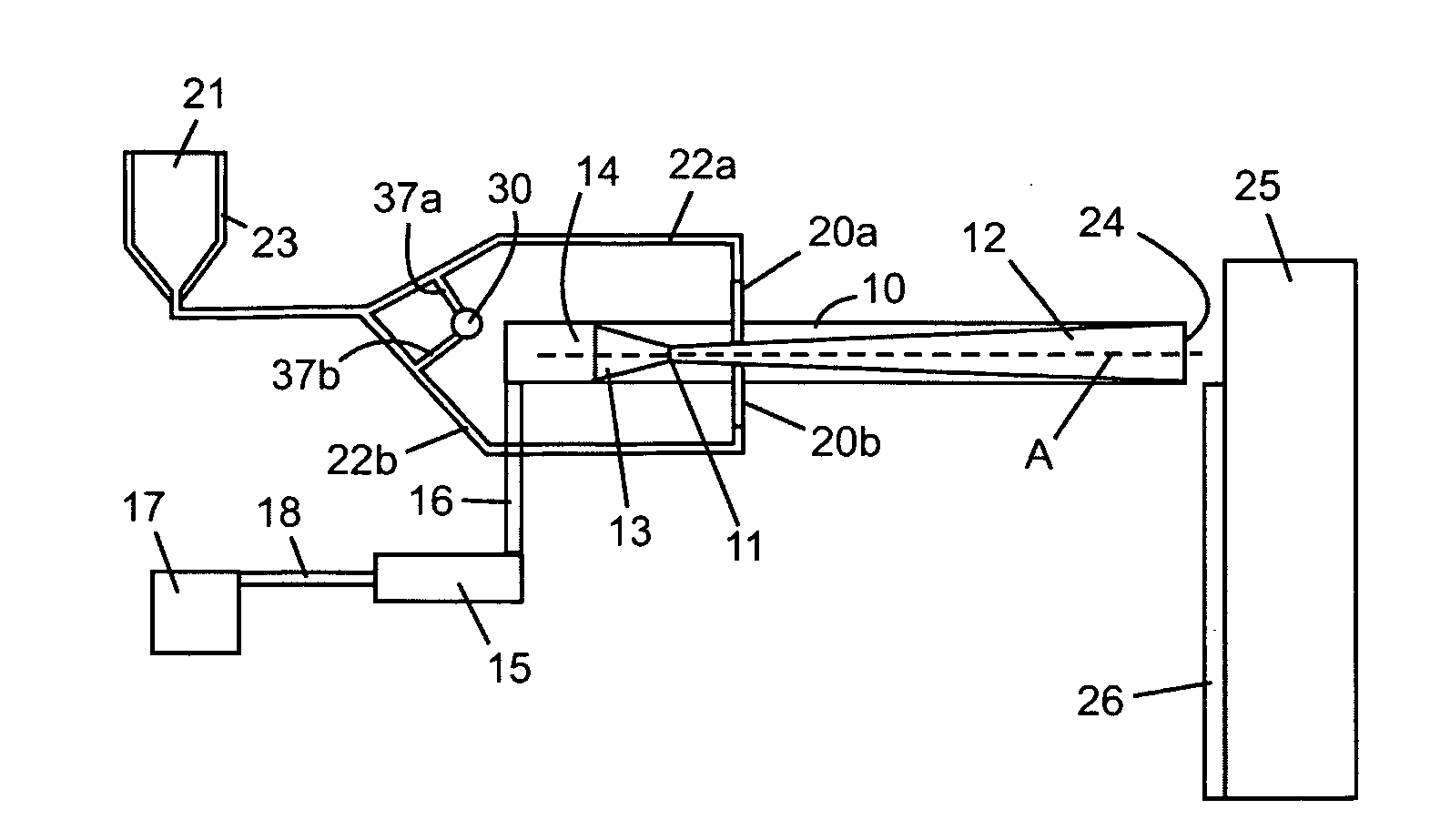
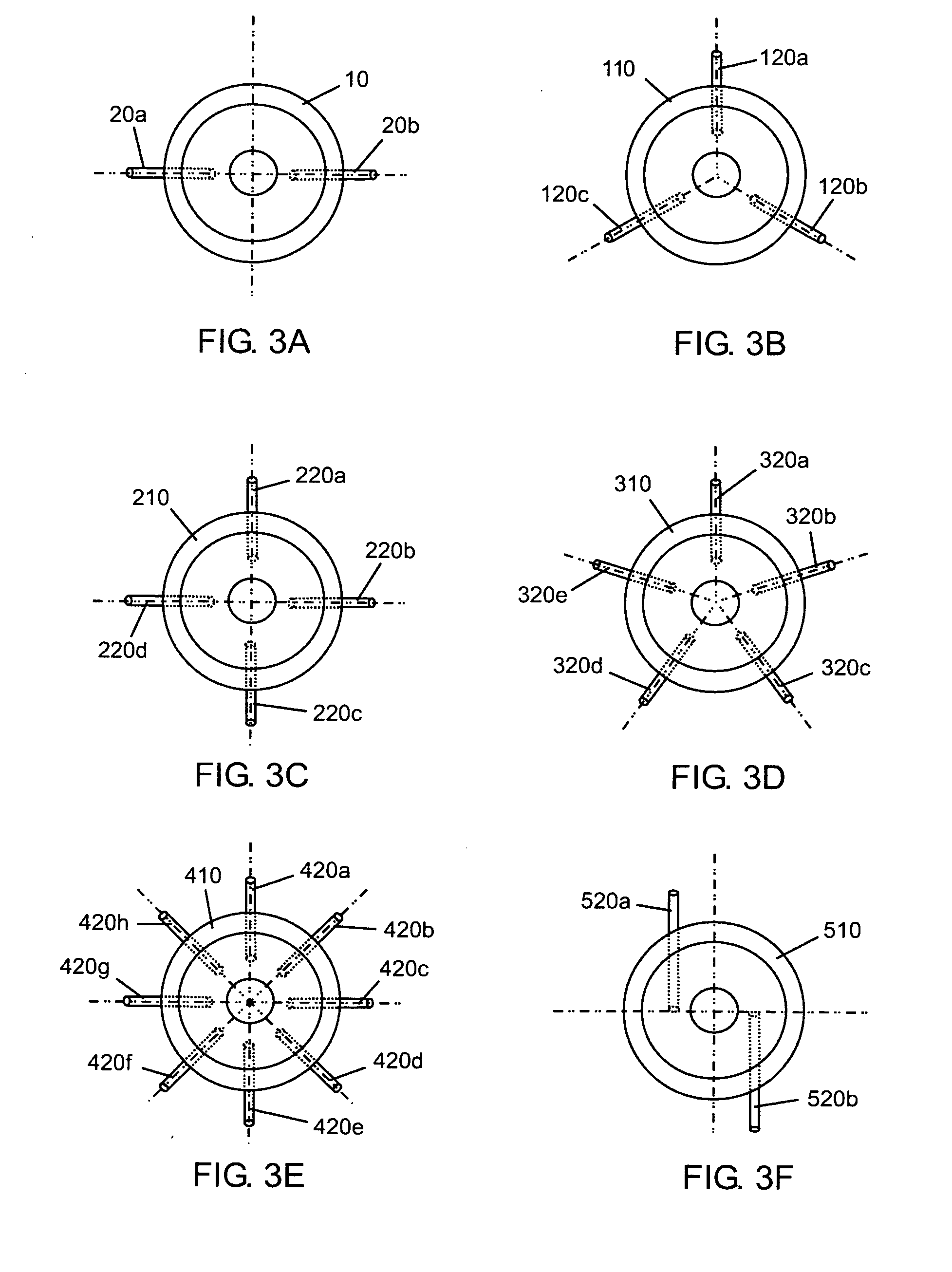
- A cold gas dynamic spraying system with a de Laval type nozzle featuring multiple radial particle inlets between the throat and the nozzle exit, allowing pressurized particle feeding and controlled gas flow to achieve higher particle velocities and reduce clogging, while using a pressure regulator to maintain stable injection pressure and clear residual particles.

Method of coating with cryo-milled nano-grained particles
PatentActiveUS20100172789A1
Innovation
- A method involving the formation of a nickel-based face-centered-cubic gamma matrix with dispersion strengthening materials, followed by cryo-milling to create a nano-grained structure, and then cold spraying this mixture onto a substrate without heat introduction, utilizing a high-velocity gas to adhere the coating and preserve the nano-grained structure.

Patent Strategy and IP Protection in Cold Spray Field
The cold spray coating technology sector has witnessed significant growth in patent filings over the past decade, reflecting its increasing industrial importance. Effective patent strategy in this field requires a multi-layered approach focusing on both defensive and offensive intellectual property management. Companies leading in cold spray innovation typically maintain robust patent portfolios covering fundamental process parameters, equipment designs, and specific material applications.
Key patent protection strategies observed in the cold spray field include the creation of patent thickets around core technologies, with particular emphasis on spray parameters, nozzle designs, and powder characteristics. Market leaders such as Plasma Giken, Impact Innovations, and Centerline have established strong IP positions by filing comprehensive patent families that protect not only their primary innovations but also adjacent application areas.
Geographic patent filing patterns reveal strategic market prioritization, with most companies securing protection in North America, Europe, Japan, and increasingly China. The patent landscape shows clustering around specific application domains, particularly aerospace, automotive, and medical implant coatings, where the value proposition of cold spray technology is most compelling.
Freedom-to-operate considerations are becoming increasingly complex as the patent landscape densifies. New entrants must navigate carefully through existing patent claims, often necessitating licensing agreements or strategic partnerships with established players. Cross-licensing arrangements between major industry participants have emerged as a common practice to facilitate continued innovation while minimizing litigation risks.
Patent quality metrics indicate varying approaches to IP protection, with some entities pursuing numerous incremental patents while others focus on fewer but more fundamental innovations. The most valuable patents typically address critical technical challenges such as adhesion improvement, porosity reduction, or coating performance enhancement for specific substrate-powder combinations.
Emerging trends in cold spray IP strategy include increased focus on digital process control patents, integration with complementary technologies like additive manufacturing, and protection of sustainable processing methods. Forward-looking companies are also securing patents on in-situ monitoring systems and AI-driven parameter optimization, anticipating the next generation of cold spray technologies.
For new market entrants, strategic patent mapping and white space identification represent critical first steps before committing to R&D investments. Successful IP strategies in this field typically balance proprietary technology development with open innovation approaches, allowing for ecosystem growth while maintaining competitive differentiation through carefully protected core innovations.
Key patent protection strategies observed in the cold spray field include the creation of patent thickets around core technologies, with particular emphasis on spray parameters, nozzle designs, and powder characteristics. Market leaders such as Plasma Giken, Impact Innovations, and Centerline have established strong IP positions by filing comprehensive patent families that protect not only their primary innovations but also adjacent application areas.
Geographic patent filing patterns reveal strategic market prioritization, with most companies securing protection in North America, Europe, Japan, and increasingly China. The patent landscape shows clustering around specific application domains, particularly aerospace, automotive, and medical implant coatings, where the value proposition of cold spray technology is most compelling.
Freedom-to-operate considerations are becoming increasingly complex as the patent landscape densifies. New entrants must navigate carefully through existing patent claims, often necessitating licensing agreements or strategic partnerships with established players. Cross-licensing arrangements between major industry participants have emerged as a common practice to facilitate continued innovation while minimizing litigation risks.
Patent quality metrics indicate varying approaches to IP protection, with some entities pursuing numerous incremental patents while others focus on fewer but more fundamental innovations. The most valuable patents typically address critical technical challenges such as adhesion improvement, porosity reduction, or coating performance enhancement for specific substrate-powder combinations.
Emerging trends in cold spray IP strategy include increased focus on digital process control patents, integration with complementary technologies like additive manufacturing, and protection of sustainable processing methods. Forward-looking companies are also securing patents on in-situ monitoring systems and AI-driven parameter optimization, anticipating the next generation of cold spray technologies.
For new market entrants, strategic patent mapping and white space identification represent critical first steps before committing to R&D investments. Successful IP strategies in this field typically balance proprietary technology development with open innovation approaches, allowing for ecosystem growth while maintaining competitive differentiation through carefully protected core innovations.
Environmental Impact and Sustainability of Cold Spray Methods
Cold spray coating technology has demonstrated significant environmental advantages over traditional thermal spray methods, primarily due to its solid-state nature that eliminates the need for high-temperature melting processes. This fundamental characteristic results in substantially lower energy consumption compared to plasma spraying, HVOF, or arc spraying techniques, with studies indicating energy reductions of 30-60% depending on application parameters and materials used.
The absence of combustion processes in cold spray significantly reduces greenhouse gas emissions associated with coating operations. Research data shows that cold spray systems produce approximately 40-70% fewer carbon dioxide emissions per square meter of coated surface compared to conventional thermal spray technologies. This reduction becomes particularly significant in large-scale industrial applications where coating operations represent a substantial portion of manufacturing emissions.
Material efficiency represents another key sustainability advantage of cold spray methods. The technology typically achieves deposition efficiencies of 70-95%, substantially higher than the 40-60% common in many thermal spray processes. This improved efficiency translates directly to reduced material waste and lower environmental impact from raw material extraction and processing.
The elimination of toxic gases and reduced volatile organic compound (VOC) emissions further enhances the environmental profile of cold spray technology. Unlike traditional coating methods that may require solvents or produce hazardous byproducts, cold spray processes generally utilize inert carrier gases like nitrogen or helium, which can be recaptured and recycled in closed-loop systems.
Patent analysis reveals growing interest in environmentally-focused cold spray innovations, with approximately 15% of recent patent applications specifically addressing sustainability improvements. These innovations include water-based carrier systems, biodegradable masking materials, and energy-efficient gas recycling technologies that further reduce environmental footprint.
Life cycle assessment (LCA) studies comparing cold spray to conventional coating technologies demonstrate 25-45% reductions in overall environmental impact across multiple categories including global warming potential, acidification, and resource depletion. These advantages become particularly pronounced in applications requiring thick coatings or when considering the extended service life of cold-sprayed components.
The sustainability benefits extend to workplace safety, with reduced operator exposure to hazardous substances and lower noise levels compared to thermal alternatives. Recent patent developments have focused on further enhancing these aspects through automated application systems and improved filtration technologies that minimize environmental releases.
The absence of combustion processes in cold spray significantly reduces greenhouse gas emissions associated with coating operations. Research data shows that cold spray systems produce approximately 40-70% fewer carbon dioxide emissions per square meter of coated surface compared to conventional thermal spray technologies. This reduction becomes particularly significant in large-scale industrial applications where coating operations represent a substantial portion of manufacturing emissions.
Material efficiency represents another key sustainability advantage of cold spray methods. The technology typically achieves deposition efficiencies of 70-95%, substantially higher than the 40-60% common in many thermal spray processes. This improved efficiency translates directly to reduced material waste and lower environmental impact from raw material extraction and processing.
The elimination of toxic gases and reduced volatile organic compound (VOC) emissions further enhances the environmental profile of cold spray technology. Unlike traditional coating methods that may require solvents or produce hazardous byproducts, cold spray processes generally utilize inert carrier gases like nitrogen or helium, which can be recaptured and recycled in closed-loop systems.
Patent analysis reveals growing interest in environmentally-focused cold spray innovations, with approximately 15% of recent patent applications specifically addressing sustainability improvements. These innovations include water-based carrier systems, biodegradable masking materials, and energy-efficient gas recycling technologies that further reduce environmental footprint.
Life cycle assessment (LCA) studies comparing cold spray to conventional coating technologies demonstrate 25-45% reductions in overall environmental impact across multiple categories including global warming potential, acidification, and resource depletion. These advantages become particularly pronounced in applications requiring thick coatings or when considering the extended service life of cold-sprayed components.
The sustainability benefits extend to workplace safety, with reduced operator exposure to hazardous substances and lower noise levels compared to thermal alternatives. Recent patent developments have focused on further enhancing these aspects through automated application systems and improved filtration technologies that minimize environmental releases.
Unlock deeper insights with PatSnap Eureka Quick Research — get a full tech report to explore trends and direct your research. Try now!
Generate Your Research Report Instantly with AI Agent
Supercharge your innovation with PatSnap Eureka AI Agent Platform!